Independent Skipper Capstone: Would You Leave the Dock?
Training scenario: Cedar Harbour, Pine Bay, Fox Channel and every depth, tide and current figure in this capstone are fictional. They are designed to be internally consistent for learning and must never be used for real navigation.
About this Guide
Written by Kelly Hiebert, a recreational sailor since 2002 and a middle-school teacher. Kelly created Sailboat Zone to provide beginners with clear, structured sailing education.
Last reviewed: September 2026
Jurisdiction: This capstone is a fictional educational scenario designed to apply general recreational sailing decision-making principles using Canadian marine-weather, hydrographic, collision-avoidance and boating-safety guidance as its reference framework. All locations, chart information, depths, tides, currents, distances and conditions in the scenario are invented and must not be used for navigation. For a real voyage, use current official information and requirements applicable to the actual vessel, route and location.
Safety note: Completing this written capstone does not certify or qualify anyone to operate a sailboat or take responsibility for a crew. Real-world readiness requires supervised hands-on instruction, repeated practice, familiarity with the specific vessel and local waters, and sound judgment in conditions comfortably within the sailor’s abilities. Base every actual go/no-go decision on current official information and preserve enough margin to change or abandon the plan safely.
This Is the Last Lesson
You have spent this course learning the pieces of sailing one at a time. You learned how the boat, sails, wind, steering and lines work. You learned to trim sails, tack, jibe, reef, heave-to, handle stronger wind and manage the boat around docks and moorings. You learned to maintain a lookout, communicate with and manage a crew, respond to emergencies, understand marine weather, use aids to navigation, read charts, interpret tides and currents, evaluate route hazards, anchor, plan a trip and make decisions while conditions are changing.
Now those subjects stop being separate lessons.
Your final task is to use them together.
Those skills matter. But none of them, by itself, makes someone the skipper.
The skipper is the person who has to put the pieces together while there is still time to choose. Weather does not wait politely while you finish a calculation. A tired crew member does not become more capable because the destination is close. A safe depth at 09:00 may not be safe at 15:00. A route that works in ten knots of wind may become a poor route when the wind increases and opposes the current.
This final assessment therefore does not ask you to define another term. It gives you a sailing day. Your job is to decide whether to depart, modify the plan, delay or stay at the dock – and to explain why.
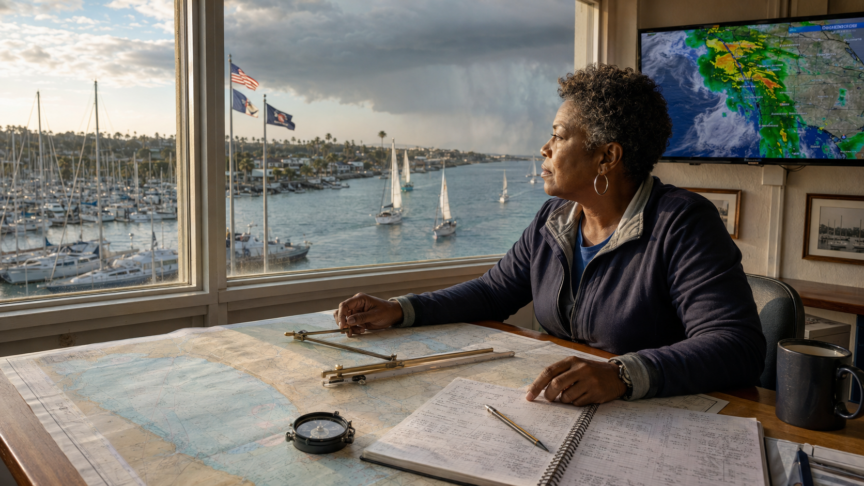
An independent skipper reviews the route, forecast, tide and current information before deciding whether conditions justify leaving the dock.
How to Take the Capstone
Read the scenario in order. The information arrives the way it often does on a real sailing morning: first as an appealing plan, then as a forecast, a chart, a current table, a look at the boat and an honest look at the crew.
When you reach Decision One, stop. Write down your choice, schedule, route, alternate and limits before reading the model answer. Later, Decision Two will test whether you can reassess after departure. You are allowed to be conservative. In fact, a conservative decision that uses the evidence well may be stronger than an ambitious decision supported mainly by optimism.
What This Capstone Tests
This challenge is not testing whether you remember isolated facts.
It is testing whether you can:
build an accurate picture from incomplete information;
identify the hazards that actually matter;
recognize interactions between weather, water, route, boat and crew;
distinguish an observation from an interpretation;
anticipate what may happen next;
prioritize competing problems;
preserve useful alternatives;
establish trigger points before they are needed;
brief and manage the crew;
act before margin disappears; and
reassess when reality differs from the plan.
There may be more than one defensible decision.
What matters is whether your reasoning uses the available evidence, protects reasonable margin and changes when the situation changes.
The standard: A passing answer is not the one that gets to Pine Bay. It is the one that protects the crew, preserves options and can be defended with the information available at the time.
The Trip You Have Been Planning
It is Friday evening in early September. Tomorrow will be your first day as skipper without an instructor aboard. The trip has been discussed for two weeks: Cedar Harbour to Pine Bay, lunch at anchor, then home before dinner.
The boat is North Star, a 30-foot cruising sloop. Pine Bay lies 11.8 nautical miles from the marina. On the chart, the route looks short enough for a comfortable day sail and long enough to feel like a genuine achievement.
Your partner Maya is coming. She has sailed three times, can steer a compass course and can handle a dock line after a clear briefing. Short, steep waves make her seasick. Your friend Liam has sailed twice. He is calm, willing and fit, but he does not yet anticipate what needs to happen aboard. You are the only person who can reef, navigate, operate the radio or bring the boat alongside without coaching.
You have sailed North Star six times. You are comfortable in six to twelve knots. You once sailed in fifteen knots with an instructor and reefed the mainsail under supervision. You have never taken this boat through Fox Channel or anchored at Pine Bay on your own.
Friday’s forecast is encouraging: light westerly wind in the morning, ten to fifteen knots in the afternoon, good visibility and no precipitation. You calculate 11.8 nautical miles divided by a planning speed of 4.5 knots and get about two hours and forty minutes each way. Depart at 08:30, arrive around 11:15, eat lunch, leave at 13:00 and dock before 16:00.
Everyone agrees. The food is packed. The plan feels real.
SATURDAY – 06:10
The Forecast Has Changed
Before driving to the marina, you check the latest official marine forecast rather than relying on yesterday’s phone screenshot. The change is not dramatic enough to cancel the day automatically, but it is significant enough to change the decision.
Time
Wind
Additional conditions
06:00-09:00
West 8-12 knots
Occasional gusts near 15; seas 0.3-0.5 m; good visibility
09:00-12:00
West 12-16 knots
Gusts 20 near exposed points; seas building to 0.7 m
12:00-18:00
West 15-20 knots
Gusts 25; seas near 1.0 m in exposed water; good visibility
There is no thunderstorm risk and no warning in effect. The sky should remain clear. That is reassuring, but sunshine is not a safety category. The useful fact is that the wind is now expected to strengthen earlier, and the afternoon gusts reach beyond the conditions in which you have sailed independently.
You remember the central lesson from Sailing Weather for Beginners: the question is not whether the boat can survive the forecast. It is whether the forecast is sensible for this boat, this crew and this trip – with enough margin for the forecast to be wrong.
The return-time forecast matters more than the pleasant morning at the dock. If the original schedule slips, the most exposed part of the day may occur precisely when the crew is tired and the wind is strongest.
SATURDAY – 06:35
The Tide and the Current Tell Different Stories
The tide table for Cedar Harbour shows high water at 06:48 at 4.4 metres, low water at 13:52 at 0.8 metres and the next high water at 20:05 at 4.2 meters. The figures use the same vertical datum as the training chart.
Fox Channel’s marked fairway has a least charted depth of 1.9 metres. North Star draws 1.6 metres. The hourly prediction gives about 2.6 meters of tide height when you expect to pass outbound and about 1.2 meters on the early return. In the simplified scenario, that means roughly 4.5 meters of water outbound and 3.1 meters on the return, before allowing for prediction uncertainty, waves and the way the depth sounder is referenced.
Depth is not the reason to reject the fairway. It has workable margin. But the tide calculation does not tell you how the water will move horizontally. For that, you check the current prediction separately, just as you learned in How to Read Tide Tables and How to Understand Tidal Currents.
Fox Channel prediction
Planning significance
08:55 – Slack before ebb
Current near its minimum
10:15 – Ebb setting west about 1.5 knots
Favourable outbound, but opposing the westerly wind
11:55 – Maximum ebb west 2.4 knots
Shorter, steeper waves possible if wind continues to build
15:25 – Slack before flood
Current weakens, then begins setting east
A favourable current can increase speed over ground, but it is not automatically favourable in every other sense. In Fox Channel, the west-setting ebb opposes the west wind. The water may become rougher even while the GPS shows good progress toward Pine Bay.
SATURDAY – 07:00
The Shortest Route Is Not the Safe Route
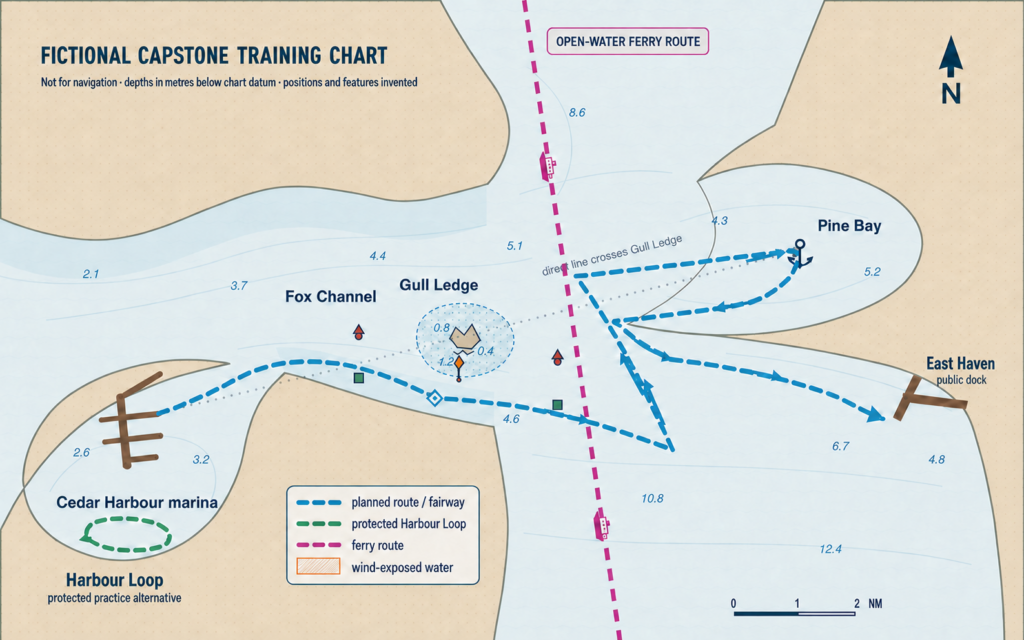
At the chart table, you trace the trip again. A straight line from Cedar Harbour to Pine Bay crosses Gull Ledge, a rocky area with charted soundings as shallow as 0.4 meters and a rock that uncovers near low water. The safe route goes south of the danger mark, follows the marked fairway through Fox Channel and then turns northwest toward Pine Bay.
The extra distance is not optional. A waypoint belongs in safe water, not on top of the hazard. The chartplotter route is useful only after you have checked the underlying chart, scale, depth units, datum and route geometry. The lessons in How to Read a Nautical Chart and Basic Coastal Navigation were preparing you for exactly this moment.
There are three other route facts:
First, the west half of Fox Channel is exposed to the forecast wind. Its narrowest usable water lies close enough to rock and shoal that a beginner will have limited room to solve a sail-handling problem.
Second, Pine Bay is protected from northerly wind but open to the west. It is a pleasant lunch anchorage in the original forecast and a poor place to count on for shelter in the updated one.
Third, a ferry route crosses beyond Fox Channel. You need to cross only when clear, maintain a proper lookout and act early if risk of collision develops. Being a sailing vessel never removes the duty to avoid collision. That is the practical point behind the course’s sailing right-of-way rules.
A fictional capstone chart for practising route planning, hazard avoidance, ferry-lane crossing decisions and the choice between an offshore passage and a protected harbour exercise.
SATURDAY – 07:25
The Boat Is Ready. Is the Crew?
At the marina, North Star passes the pre-departure inspection. The engine starts easily, cooling water flows from the exhaust, fuel is above three-quarters, the bilge is normal and the steering moves freely. The standing and running rigging look sound. Both mainsail reefs are rigged. The furling jib works. The anchor and rode are ready.
The fixed VHF is connected to GPS and shows the correct position. The DSC identity is programmed. A charged handheld VHF and waterproofed phones provide backup. The paper chart, chartplotter, compass and depth sounder agree at the berth.
Nothing about the boat creates an automatic no-go. That can be misleading. A boat may be mechanically capable of a trip that is still a poor choice for the people aboard.
Maya slept badly and admits that she is already anxious about the stronger forecast. Liam says he is happy to do anything but cannot explain how to put in a reef or what he would do if someone fell overboard. You can brief both crew members, but briefing does not instantly create experience.
You ask yourself a better question than Can the boat handle twenty knots? You ask: Can I manage this route, reefing, navigation, traffic, a possible seasick crew member and the return to the marina if several of those demands arrive together?
The answer is less comfortable.
SATURDAY – 07:50
Daylight Helps, but It Does Not Rescue the Plan
Sunset is at 20:32, with useful twilight later. Daylight is not the limiting factor. Even a delayed return should occur well before dark.
But extra daylight does not repair the other margins. The original two-hour-forty-minute estimate assumed the boat could travel the route at 4.5 knots in a straight line. The outbound leg is now partly upwind. Tacking adds distance. Sail changes, traffic, current, anchoring and the approach to the marina add time. A more honest plan places arrival at Pine Bay around noon or later and the return in the strongest forecast period.
That is how delays cascade. A twenty-minute reef, a missed ferry crossing and a slower crew do not merely make lunch late. They move the hard parts of the voyage into worse conditions.
Alternatives That Actually Reduce the Risk
You identify three alternatives before making the decision.
The Harbour Loop is a 5.2-nautical-mile sail inside Cedar Sound. It stays within 1.5 nautical miles of shelter, avoids Fox Channel, does not cross the ferry route and can be shortened at several points. A conservative return by noon keeps the trip largely ahead of the strongest forecast.
East Haven is a public dock 2.1 nautical miles from Pine Bay on the protected side of the sound. It is a genuine refuge if the engine, crew or weather changes before you return.
A dockside training day would allow you to practise reefing, crew commands, VHF procedures and departure preparation without committing to open water. Staying at the dock is not the absence of a plan. It is one of the available plans.
Delaying the original trip is not an attractive alternative. The current might become easier later, but the wind and sea forecast become harder. Waiting only helps when the conditions you care about are expected to improve.
Communications Before Commitment
Before departure, you prepare a float plan for a responsible person ashore. It includes the boat description, the three people aboard, the modified route, East Haven as the alternate, the departure time, the planned docking time and instructions to begin follow-up if you have not checked in by the stated overdue time.
The VHF will remain on and monitored on Channel 16. Everyone is shown the radio, the distress button cover and the written emergency card, but they are also told not to press the distress button except in grave and imminent danger. Maya will keep the boat pointed and slow if you need both hands. Liam will maintain the lookout and handle lines only after a specific instruction. Everyone wears a properly fitted PFD from departure to return.
You review the basic person-overboard sequence and make the roles simple: shout, point continuously, throw flotation, mark the position, control the boat and call for help early if the recovery is not immediately under control. The purpose of the person-overboard, marine VHF and emergency procedures lessons is not to make the crew recite pages of information. It is to make the first actions available when stress narrows everyone’s attention.
Decision One: The Dock Lines Are Still On
It is 08:05. You have enough information to decide. Do not read ahead yet. Your task is not to find the answer the author wants. Your task is to make a decision that you could defend to your crew before the dock lines come off.
Choose one: ☐ DEPART on the original Pine Bay plan ☐ MODIFY the plan ☐ DELAY departure ☐ STAY AT THE DOCK
If ____________________, I will __________________________________ If ____________________, I will __________________________________
Before continuing: Say your decision aloud as though Maya and Liam were standing in the cockpit waiting for you. A skipper owes the crew a clear plan, not a private feeling.
Model Answer: Modify the Plan
Recommended decision: Sail the protected Harbour Loop, depart early with the first reef already set, remain on the sheltered side of Fox Channel and be secured at the marina by noon. Do not attempt Pine Bay today.
Why Modify Is the Strongest Answer
No single factor forces the boat to remain tied up. The forecast has no thunderstorm or warning. The fairway has adequate depth. The boat is sound. Visibility is good. There is ample daylight.
The risk appears when those facts are combined with the details that reduce margin: the wind is trending stronger and arriving earlier; the ebb will oppose the west wind in Fox Channel; Pine Bay is exposed to the forecast direction; the upwind leg will take longer than the original arithmetic suggests; the skipper has never made this passage alone; one crew member is anxious and vulnerable to seasickness; the other crew member cannot yet perform key tasks without direction.
The Harbour Loop changes that complete picture. It removes the tidal gate, open-water exposure, ferry crossing and anchoring commitment. It shortens the time on the water. It keeps multiple return routes open. It turns the morning into a manageable independent sail instead of using the crew’s entire margin to preserve a destination.
Putting the first reef in at the dock applies the course principle from How to Reef a Sailboat: reef before you need to. In the early breeze the boat may be slower, but it will remain balanced as the wind increases. The objective is not maximum speed. It is control.
Why the Other Answers Are Weaker – or Still Acceptable
Depart on the Original Pine Bay Plan
This is the weakest choice. It depends on several favourable assumptions at once: that the forecast will not strengthen early, the upwind leg will not take longer, the wind-against-current sea state will remain comfortable, Maya will not become sick, the anchorage will remain usable and the return manoeuvres will go smoothly in gusts. A plan that works only if every uncertain factor breaks in your favour is not a plan with margin.
Delay the Original Trip
Delay is useful when it moves the trip into better conditions. Here it does the opposite. A later departure may avoid part of the ebb, but it moves the passage into stronger wind, larger seas and the period when the beginner crew is least suited to the route. Delay without improvement is merely postponing the same problem.
Stay at the Dock
This is a fully defensible passing answer. A first independent sail with two novice crew members does not have to occur on a marginal forecast. If your personal limit says the combination of early gusts, an anxious crew and limited reefing experience leaves insufficient margin, staying is excellent seamanship. The model selects the Harbour Loop only because it removes the main hazards and preserves an early, simple return.
The Modified Plan
Plan element
Decision
Objective
A 5.2 NM protected Harbour Loop; no Fox Channel, Pine Bay, ferry crossing or anchoring.
Departure
08:30 only if actual wind, visibility, engine, instruments and crew condition remain acceptable.
Sail plan
First reef set at the dock; conservative headsail; engine available; no sail change in confined water.
Return limit
Turn toward the marina no later than 10:45; be inside the marina by 11:45 and secured by noon.
Alternate
East Haven public dock if returning directly to Cedar Harbour becomes unsuitable.
Weather trigger
Return immediately if sustained wind reaches about 16 knots in the protected area, gusts repeatedly exceed 20, visibility deteriorates or whitecaps spread inside Cedar Sound.
Crew trigger
Return if Maya becomes nauseated or frightened, Liam cannot perform his assigned role, or the skipper becomes overloaded.
Navigation trigger
Slow down and re-establish the situation if chartplotter, compass, depth or visual information disagree.
Communications
VHF monitored; handheld and waterproof phones ready; float plan ashore; check-in on return; overdue time 13:00.
Notice that the triggers are observable. Turn back if it gets bad is too vague. A specific wind, sea-state, crew or navigation condition tells the skipper when the plan has changed before the boat reaches an emergency.
SATURDAY – 08:32
The Dock Lines Come Off
The crew is briefed before the boat moves. Fenders and lines are prepared for the return rather than buried. The engine is in neutral and cooling water is visible. You identify wind and current in the fairway, confirm the escape route, assign one person to the bow line and keep everyone else clear.
The departure is slow and controlled. In open, safe water you turn into the wind, hoist the already-reefed main and unfurl a modest amount of jib. The boat accelerates without excessive heel. Maya takes the helm on a simple compass course. Liam watches traffic and calls out anything that could create a collision risk.
For the first hour, the plan works. The reefed boat is comfortable. Telltales stream. You make small steering corrections, avoid over-trimming and compare the compass heading with the GPS track. The current is already pulling the boat west more strongly than expected, but because you remain in open, known safe water, the correction is easy.
This is what good preparation feels like: not dramatic, not heroic, simply unhurried.
SATURDAY – 10:15
Decision Two: The Water Disagrees With the Schedule
Near Seal Rock, the wind reaches fourteen to sixteen knots with repeated gusts around twenty-two – roughly an hour earlier than expected. Whitecaps are appearing even inside Cedar Sound. Beyond the point, Fox Channel is visibly rough. The boat remains controllable under the first reef, but Maya has stopped talking and says she feels cold and mildly nauseated. Liam is doing his job, yet every tack still requires close supervision.
You are ahead of the modified schedule. The next leg of the Harbour Loop would carry you farther from Cedar Harbour for about forty minutes before turning home. East Haven is twenty minutes away. Cedar Harbour is about thirty-five minutes away on a broad reach.
Choose again: ☐ Continue the Harbour Loop because the boat is under control ☐ Go to East Haven ☐ Return to Cedar Harbour now ☐ Reconsider Pine Bay because you are ahead of schedule
Write one sentence explaining which new fact matters most: __________________________________________________________________________________________
Model Decision Two: Return Now
The boat is not in immediate danger. That is exactly why this is the right moment to return.
The wind is stronger and earlier than forecast. Whitecaps inside the protected area suggest the exposed water is already less comfortable. Maya’s condition is deteriorating. The skipper’s workload is rising because Liam still needs close direction. Continuing would spend more of the margin that the modified plan was designed to preserve.
East Haven remains available, but it is not needed while Cedar Harbour is safely reachable. Pine Bay is no longer part of the day’s plan. Being ahead of schedule is not permission to upgrade the mission after the risk picture has worsened.
You bear away gradually onto a broad reach, keep the boom under control and steer to avoid an accidental jibe. The boat is faster now, but speed is managed rather than celebrated. If you needed time to reorganize, heaving-to would remain an option in suitable open water. You do not need it today.
The Return Is Part of the Assessment
Twenty minutes before the marina, the engine is started and its cooling water checked. Sails are lowered in open water while there is room. Fenders and dock lines are placed on the correct side. Maya is given one simple job: step ashore only when the boat is alongside and secure the bow line without jumping or trying to stop the boat with the rope. Liam is told exactly which line he will control and when.
At the marina entrance you pause outside, observe the wind on flags and the movement of water past the pilings, then confirm the berth is clear. The approach uses the lesson from How to Dock a Sailboat: prepare early, control momentum, keep enough speed for steerage and use neutral to avoid carrying unnecessary power into the berth.
At 11:18, North Star is secured. The float-plan holder receives the return message. The VHF and electronics are turned off. Lines and fenders are reset. The crew is tired, but nobody is frightened and nothing aboard has been damaged.
You did not reach Pine Bay.
You succeeded as the skipper.
The Debrief: What Made This Skipper-Like?
The best decision was not a display of fearlessness. It was a chain of ordinary, disciplined choices.
You checked the forecast again. You examined the trend and the whole sailing window. You kept tide height separate from current. You rejected a dangerous shortcut. You planned with a realistic speed and allowed for tacking, traffic and crew work. You judged the crew honestly. You put in the reef before it was urgent. You named an alternate, filed a float plan and created explicit triggers. Most importantly, you changed the plan twice while you still had good options.
None of those actions was dramatic. Together, they prevented the day from becoming dramatic.
Notice the pattern. The successful skipper did not solve one enormous problem.
The skipper repeatedly observed, interpreted, anticipated, prioritized, kept options open, decided, acted and reassessed.
That is the central skill this course has been building toward.
Boat handling gives you control of the sailboat.
Skipper thinking helps you decide what that sailboat should do next.
That is the central lesson of the course: seamanship is not only the ability to solve problems. It is the habit of arranging the day so that fewer problems arrive at once.
Your Capstone Self-Assessment
This is a course assessment, not a licence or certification. Give yourself 0, 1 or 2 points for each criterion: 0 means missing or unsafe; 1 means identified but incomplete; 2 means integrated into a clear decision or action.
Criterion
Evidence of competent judgment
Score
1. Whole weather window
Used the latest marine forecast, gusts, trend, sea state and return-time conditions – not only the departure wind.
___ / 2
2. Tide and depth
Kept tide height separate from water depth; checked charted depth, predicted height, draft and margin.
___ / 2
3. Current
Used a current prediction for Fox Channel; considered direction, timing, boat speed and wind against current.
___ / 2
4. Route and hazards
Rejected the Gull Ledge shortcut, used safe water, and set decision points before exposed water.
___ / 2
5. Realistic timing
Allowed for tacking, reduced speed, anchoring, crew work, traffic and docking.
___ / 2
6. Boat and crew
Judged conditions against this crew’s ability and comfort, not only what the boat can survive.
___ / 2
7. Alternatives
Named a genuinely easier plan, refuge or return option and knew when it would be used.
___ / 2
8. Communications
Prepared VHF/backup communications, crew roles, a float plan and an overdue time.
___ / 2
9. Explicit limits
Set measurable triggers for reefing, turning back, seeking shelter or calling for help.
___ / 2
10. Reassessment
Responded early when actual wind, current or crew condition differed from the plan.
___ / 2
Total
Interpretation
16-20
Strong capstone judgment. Practise the same process on a simple real trip with appropriate local guidance and conservative limits.
12-15
Developing judgment. Review the weak criteria, revise your plan, and repeat the scenario before treating the process as routine.
0-11
Important gaps remain. Return to the relevant lessons and complete the capstone again.
A Defensible Answer Can Be Different From the Model
Real go/no-go decisions rarely have one magic threshold. Two competent skippers can choose differently because they have different boats, crews, local knowledge and limits.
In this scenario, modify is the recommended answer and stay at the dock is also fully defensible. A learner who chose to stay and supported that decision with the forecast trend, crew limits and lack of independent reefing experience has demonstrated strong judgment.
A learner who chose the full Pine Bay trip would need an unusually convincing risk-control plan, and the given crew and forecast make that choice difficult to defend. A learner who chose delay would need to explain what improves during the delay; in the stated forecast, the most important conditions get worse.
The label matters less than the reasoning, but the reasoning must change the plan. Listing ten hazards and then proceeding exactly as originally intended is not risk management.
The Independent Skipper Standard
You are ready to begin practising as the skipper of simple day sails when you can consistently do five things:
Build a complete picture. Weather, water, route, boat and crew must tell one coherent story.
Leave margin. Do not plan at the edge of your time, depth, skill or weather limits.
Communicate the plan. The crew and a responsible person ashore should know what is supposed to happen and what will trigger a change.
Reassess. Compare the forecast and plan with what the boat, water, instruments and crew are telling you now.
Act early. Reef, turn back, seek shelter or call for help while you still have choices.
Important: This written course does not certify anyone to skipper a vessel. Readiness requires hands-on practice, familiarity with the boat and local waters, and appropriate instruction.
You Have Completed the Beginner Sailing Course
At the beginning, a sailboat may have looked like unfamiliar parts and ropes. Then the pieces acquired names, the wind gained direction, the sails began to explain what they needed, and the boat’s movement became something you could predict and control.
After that came manoeuvres, changing conditions, rules, emergencies, navigation, docking, anchoring and trip planning. Each lesson added a capability. This capstone asks you to add something different: judgment.
Judgment connects every skill to the responsibility of carrying people onto the water and bringing them home. It is recognizing what you know, what you do not know, what is changing and how much margin remains.
The course ends here, but skipper development does not. Start with familiar water and boat, good visibility, a capable crew and conditions comfortably within your limits. Make a plan. Brief it. Sail it. Reassess. Debrief. Repeat.
One day, the process that felt slow at the chart table will become natural. You will look at weather, tide, current, route, crew and alternatives and see one voyage instead of separate categories. That is when learning to sail begins becoming seamanship.
Course Review and Real-World Planning Sources
Before attempting a real trip, revisit How to Plan a Sailing Trip and the course lessons linked throughout this capstone. Use current, authoritative local information rather than the fictional data above.