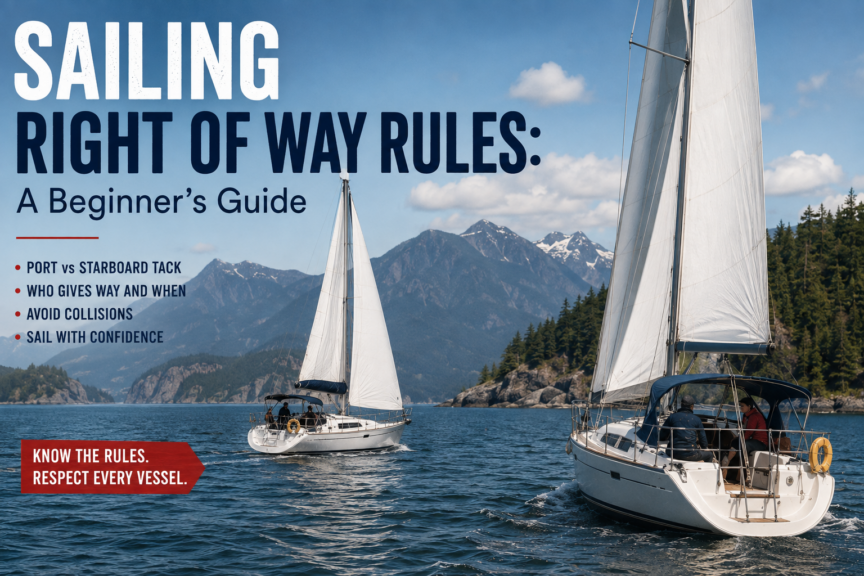
You are sailing along on a beautiful afternoon. The wind is steady, the sails are trimmed, and for once everything seems wonderfully uncomplicated.
Then you look ahead.
Another sailboat is approaching.
It is not directly in front of you, but it is close enough that you begin wondering whether your courses might cross.
Do you turn?
Does the other boat turn?
You notice its sails are on the opposite side from yours. Does that matter? What if it is a powerboat instead? What if you are in a narrow channel? And what happens if you technically have the right of way but the other skipper does absolutely nothing?
This is where the sailing right of way rules become important.
Fortunately, you do not need to memorize dozens of complicated situations before you can begin making sensible decisions. Most encounters a recreational sailor experiences can be understood using a handful of basic principles.
In this guide, we will work through them in a logical order:
port versus starboard tack → windward versus leeward → overtaking → power versus sail → crossing situations → narrow channels → avoiding collision regardless of who should give way.
Once you understand that sequence, boat traffic becomes considerably less mysterious.
About this Guide
Written by Kelly Hiebert, a recreational sailor since 2002 and a middle-school teacher. Kelly created Sailboat Zone to provide beginners with clear, structured sailing education.
Last reviewed: September 2026
Jurisdiction: This guide explains general principles from the International Regulations for Preventing Collisions at Sea (COLREGs). Canadian regulations include national modifications, while the United States also has Inland Navigation Rules. Additional local rules may apply in particular harbours, rivers, lakes and waterways.
Primary sources:
- Government of Canada — Collision Regulations
- International Maritime Organization — COLREG Convention
- U.S. Coast Guard — Navigation Rules (International and Inland)
Safety note: This article provides general educational information for beginner sailors. It is not a substitute for official regulations, local notices, qualified instruction or sound seamanship. Always follow the laws and requirements that apply where you sail.
Quick Summary: Sailing Right of Way Rules
For beginners, these are the major rules to remember:
- Two sailboats on different tacks: the boat on port tack keeps clear of the boat on starboard tack.
- Two sailboats on the same tack: the windward boat keeps clear of the leeward boat.
- Overtaking: the overtaking vessel keeps clear, regardless of whether it is sail or power.
- Power versus sail: in ordinary open-water circumstances, a power-driven vessel generally keeps clear of a sailing vessel.
- Powerboat crossing situations: the vessel that has the other vessel on its starboard side normally gives way.
- Narrow channels: a small sailboat must not impede a vessel that can safely navigate only within the channel.
- Above everything else: nobody is entitled to continue into a collision simply because they believe they are the stand-on vessel.
There are exceptions and additional responsibilities, which we will explore throughout this article.
First: “Right of Way” Is Not Quite the Correct Term
Sailors commonly talk about which boat has the right of way.
It is useful conversational shorthand, and beginners will hear it constantly.
However, the Collision Regulations are better understood through two different terms:
Give-way vessel
The give-way vessel is required to take action to keep out of the way.
Stand-on vessel
The stand-on vessel generally maintains its course and speed initially, making its behavior predictable while the give-way vessel manoeuvres.
That distinction matters.
Being the stand-on vessel does not give you permission to stubbornly continue toward another boat.
The purpose of the rules is not to decide who “wins.”
The purpose is to prevent collisions.
Think of the rules as a system that makes boat movements predictable.
If both skippers understand which vessel should maintain course and which should maneuver, each skipper can anticipate what the other will probably do.
That predictability is what makes the system work.
For Canadian boaters, the complete legal requirements are contained in the Government of Canada’s Collision Regulations, which incorporate the International Regulations for Preventing Collisions at Sea with Canadian modifications.
BEGINNER TIP: Instead of asking, “Do I have the right of way?” train yourself to ask, “Am I the stand-on vessel or the give-way vessel, and is there a risk of collision?”
Before Applying Any Rule: Is There Actually a Risk of Collision?
Not every vessel you see requires action.
Two boats can appear relatively close while following courses that will safely take them past one another.
Your first job is therefore to maintain a proper lookout and determine whether a collision risk is developing.
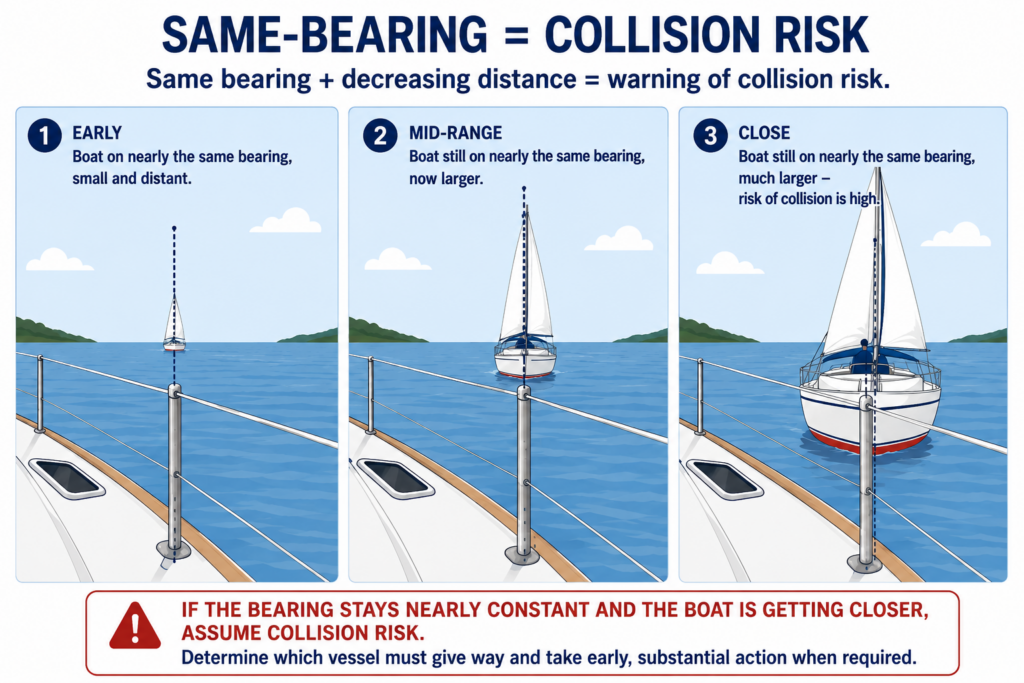
One useful beginner technique is to watch the relative bearing of the other vessel.
Choose a fixed reference aboard your boat — perhaps a shroud, stanchion, window frame, or part of the pulpit — and notice where the other vessel appears relative to it.
Check again a short time later.
If the other vessel remains at approximately the same bearing while getting noticeably closer, treat that as a warning that your courses may intersect.
Do not wait until the boats are close together to start thinking about it.
Good seamanship begins early.
Rule 1: Port Tack Gives Way to Starboard Tack
This is probably the most famous sailing right-of-way rule.
Imagine two sailboats approaching one another under sail.
One is on port tack.
The other is on starboard tack.
The boat on port tack must keep out of the way.
The boat on starboard tack is the stand-on vessel.
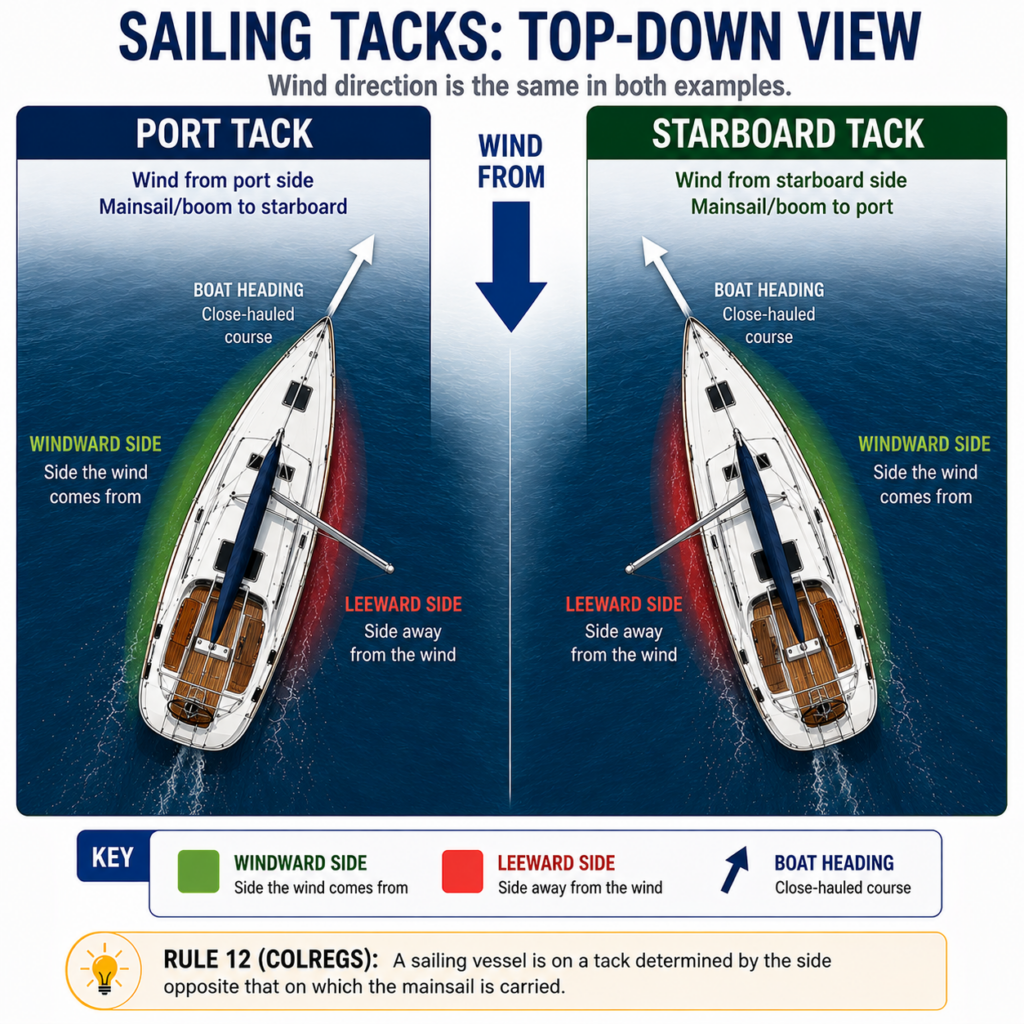
This comes directly from Rule 12 of the Collision Regulations.
But first you need to identify which tack you are actually on.
How Do You Know Whether You Are on Port or Starboard Tack?
A simple beginner method is to determine which side the wind is coming over.
Starboard tack
If the wind is coming over the starboard side of your boat, you are on starboard tack.
Your boom will normally be carried toward the port side.
Port tack
If the wind is coming over the port side, you are on port tack.
Your boom will normally be carried toward starboard.
The Collision Regulations formally determine the windward side from the side opposite the side on which the mainsail is carried.
A useful shortcut is therefore:
Boom to port → starboard tack.
Boom to starboard → port tack.
A Port-versus-Starboard Example
Suppose you are close-hauled on port tack.
Another sailboat is approaching on starboard tack.
Your courses appear likely to intersect.
You are the give-way vessel.
Do not wait until you are fifty feet apart and then make a frantic turn.
Make an early, obvious maneuver that leaves plenty of room.
Depending on the circumstances, that might mean:
- tacking,
- bearing away sufficiently to pass safely behind the other boat,
- slowing the boat, or
- another clear maneuver appropriate to the situation.
The important ideas are early, substantial and predictable action.
If you are the starboard-tack vessel, meanwhile, do not immediately start weaving around unnecessarily.
Predictability matters.
Initially maintaining course and speed allows the port-tack skipper to determine how to keep clear.
What If You Cannot Tell Which Tack the Other Boat Is On?
There is an important beginner-friendly rule for exactly this situation.
If you are on port tack, see another sailing vessel to windward, and cannot determine with certainty whether it is on port or starboard tack, you are required to keep out of its way.
In plain language:
If you are on port tack and genuinely cannot figure it out, don’t gamble on being right.
Give the other vessel room.
That principle will appear repeatedly throughout this article:
When uncertain, choose the safer option.
Rule 2: Same Tack — Windward Boat Gives Way to Leeward Boat
Now suppose both sailboats have the wind coming from the same side.
Both are on starboard tack.
Or both are on port tack.
The port-versus-starboard rule can no longer decide the situation because both boats are on the same tack.
Instead, you determine which boat is windward and which is leeward.
The windward vessel must keep out of the way of the leeward vessel.
Windward and Leeward Refresher
Windward means toward the direction the wind is coming from.
Leeward means away from the wind.
Imagine two boats sailing approximately parallel courses.
The boat closer to the direction from which the wind is arriving is the windward boat.
The other boat is the leeward boat.
When both are on the same tack and there is risk of collision:
Windward gives way to leeward.
Why Does the Windward Boat Give Way?
This becomes easier to remember when you think about maneuvering space.
A leeward boat has the windward vessel occupying some of the water into which it might otherwise turn.
Giving the leeward vessel priority helps create predictable separation.
For a beginner, however, you do not need to overcomplicate the reasoning.
Remember:
Different tack? Port keeps clear of starboard.
Same tack? Windward keeps clear of leeward.
Those two questions resolve many sailboat-versus-sailboat encounters.
If identifying the windward side of the boats still feels confusing, review our guide to How to Read the Wind, because everything in this rule begins with knowing where the wind is coming from.
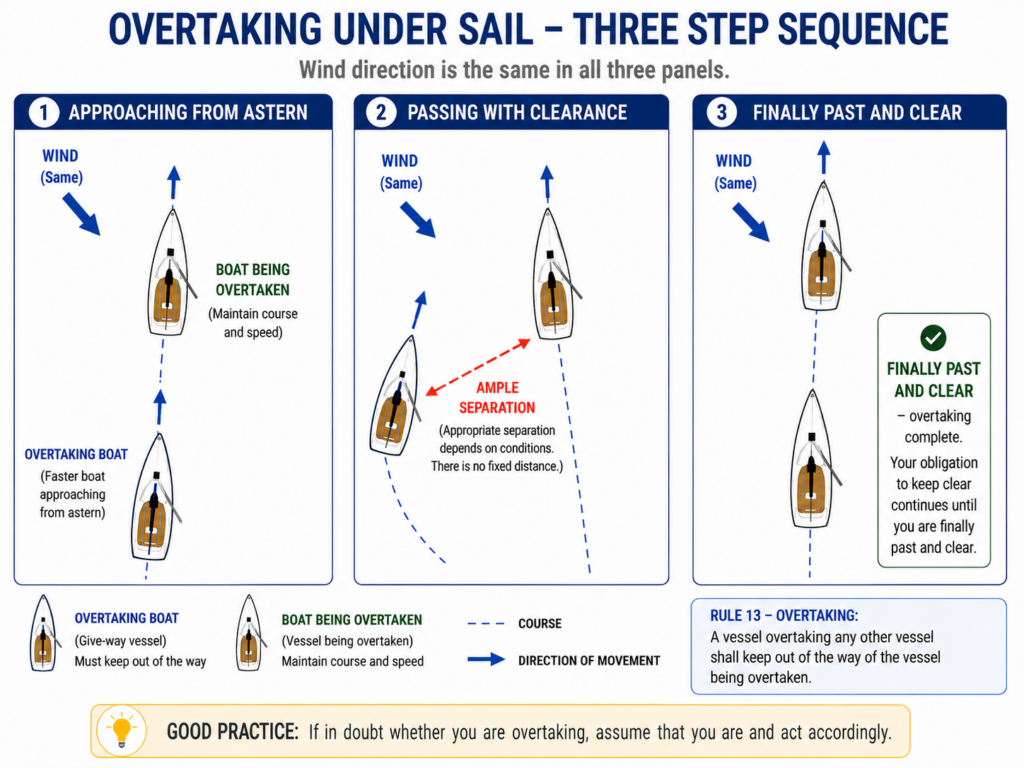
Rule 3: The Overtaking Vessel Keeps Clear
Here is a rule that overrides many of the assumptions beginners make:
If you are overtaking another vessel, you keep out of its way.
It does not matter that you are sailing and the other boat is motoring.
It does not matter that you are on starboard tack.
It does not matter that your boat is faster.
The overtaking vessel is responsible for keeping clear until it is finally past and clear.
What Counts as Overtaking?
Under the Collision Regulations, a vessel is considered to be overtaking when approaching another vessel from more than 22.5 degrees abaft its beam.
There is an easier way for a beginner to visualize this.
Imagine looking at another boat at night.
If you were approaching from an angle where you would see its sternlight but not either sidelight, you would generally be in its overtaking sector.
If you are unsure whether you are overtaking, the rules tell you to assume that you are overtaking and act accordingly.
Again, uncertainty does not earn you more privilege.
It earns you more responsibility.
Passing Another Sailboat
Imagine you are sailing considerably faster than another cruising boat ahead.
You gradually catch it.
Perhaps you are on starboard tack while the other boat is on port tack.
It can be tempting to think:
I’m on starboard tack. They should keep clear.
Not in this situation.
You are overtaking.
You keep clear.
Pass with plenty of separation and remain clear until you have completely passed the other vessel.
Do not cut sharply across its bow immediately after getting ahead.
Remember that your stern, rig and sails are still part of the vessel.
Give everyone space.
Rule 4: Power Versus Sail
This is another famous rule:
Power gives way to sail.
That statement is useful — but incomplete.
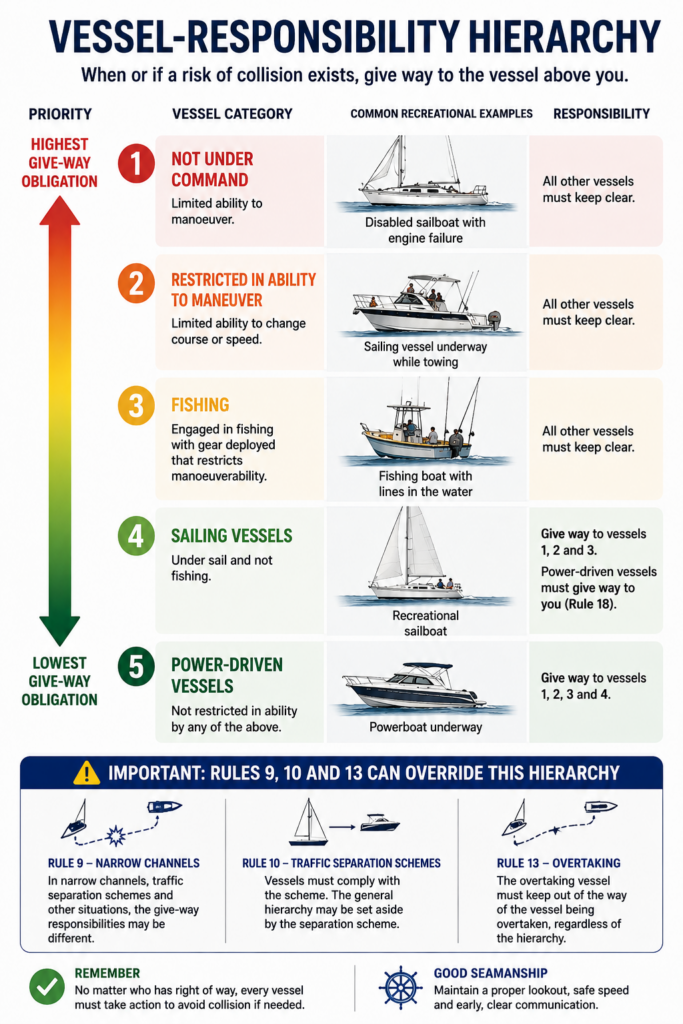
Under Rule 18, in ordinary circumstances a power-driven vessel underway must keep out of the way of a sailing vessel.
Imagine you are sailing across open water.
A recreational powerboat approaches on a course that creates a risk of collision.
Assuming none of the special circumstances discussed later apply, the power-driven vessel should keep out of your way.
You are generally the stand-on vessel.
But there are some extremely important qualifications.
A Sailboat Using Its Engine Is a Power-Driven Vessel
This catches beginners surprisingly often.
Imagine your mainsail is still hoisted, but the wind has disappeared.
You start the engine and motor toward the marina.
Are you still considered a sailing vessel because your sails are up?
Not for purposes of these steering and sailing rules.
A vessel proceeding under sail and also being propelled by machinery is treated as a power-driven vessel.
That means the sail-versus-power priority you may have had while genuinely sailing no longer applies simply because there is still a sail in the air.
This distinction is worth remembering because sailors frequently motor-sail.
“Power Gives Way to Sail” Has Important Exceptions
Do not turn that phrase into an absolute rule.
A sailing vessel must keep out of the way of certain vessels, including vessels that are:
- not under command,
- restricted in their ability to maneuver, or
- engaged in fishing as defined by the Collision Regulations.
There are also special considerations involving vessels constrained by draft and situations governed by narrow-channel and traffic-separation rules.
The practical beginner lesson is simple:
A sailboat is not automatically the most privileged vessel on the water.
What Does “Engaged in Fishing” Mean?
This deserves clarification.
Seeing someone holding a fishing rod from a recreational boat does not automatically transform that vessel into a privileged fishing vessel under the Collision Regulations.
The rules use “vessel engaged in fishing” in a specific navigational sense involving fishing equipment that restricts maneuverability.
So do not assume every recreational fishing boat automatically outranks a sailboat.
At the same time, common sense still matters.
Give other boaters reasonable room.
Rule 5: Crossing Situations
Beginners often use the word crossing for almost any situation in which two boat paths intersect.
The formal rules are more specific.
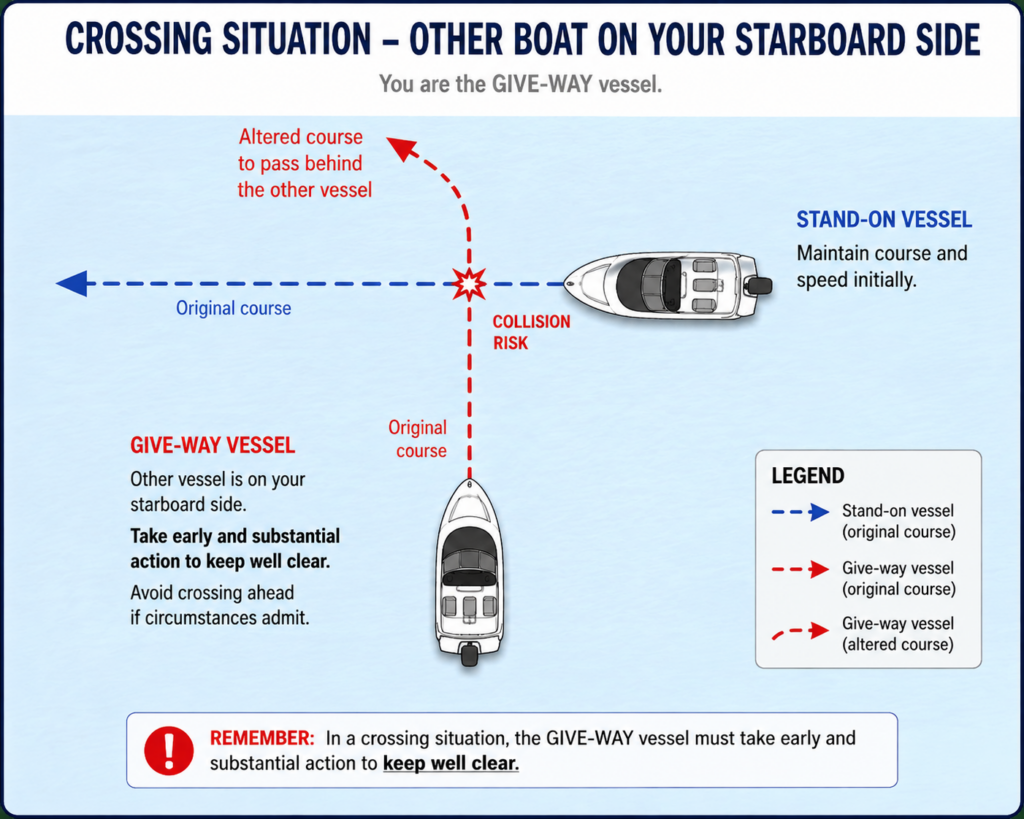
When two power-driven vessels are crossing so as to involve risk of collision, the vessel that has the other vessel on its starboard side must keep out of the way.
Where circumstances permit, it should avoid crossing ahead of the other vessel.
An easy beginner memory aid is:
Boat on your right? You give way.
Crossing Under Sail Is Different
If two vessels are both sailing, you do not simply apply the powerboat crossing rule.
You return to Rule 12.
Ask:
Are we on different tacks?
If yes:
Port gives way to starboard.
Are we on the same tack?
If yes:
Windward gives way to leeward.
This is why understanding the hierarchy of questions is more useful than memorizing random diagrams.
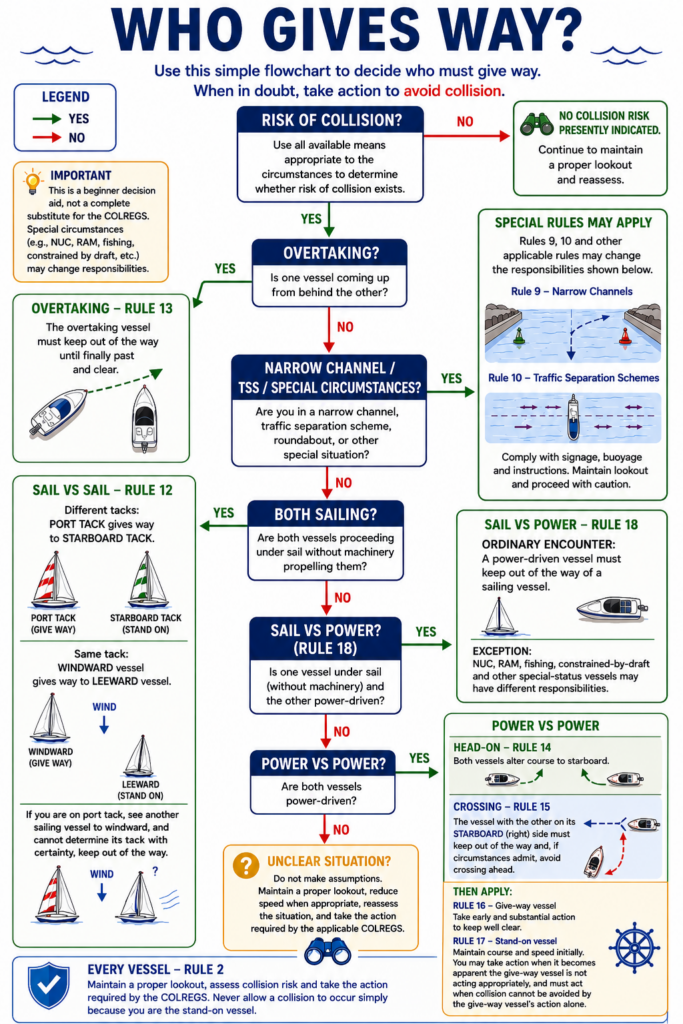
A Simple Sailboat Encounter Decision Process
When another vessel approaches, work through these questions:
Question 1: Is there a risk of collision?
If no, continue monitoring.
If yes or uncertain, continue through the decision process.
Question 2: Am I overtaking?
If yes, you keep clear.
Question 3: Are we both sailing vessels?
If yes, determine tack.
Different tacks:
Port gives way to starboard.
Same tack:
Windward gives way to leeward.
Question 4: Is one vessel power-driven and the other genuinely sailing?
In ordinary circumstances:
Power keeps clear of sail.
But check whether special vessel-status, narrow-channel or other rules apply.
Question 5: Are we two power-driven vessels crossing?
The vessel with the other on its starboard side gives way.
Question 6: Are we in a narrow channel, traffic separation scheme or other special situation?
The special rules may change your responsibilities.
What Should the Give-Way Vessel Actually Do?
Knowing that you are required to give way is only half the lesson.
You also need to make your intentions obvious.
A common beginner mistake is making a succession of tiny course changes.
Five degrees.
Then another five.
Then perhaps slowing slightly.
From the other boat, those changes may be almost impossible to detect.
Collision-avoidance action should generally be positive, made in ample time and large enough to be readily apparent.
Think:
Early. Obvious. Safe.
Do not make the other skipper guess what you are doing.
What Should the Stand-On Vessel Do?
Suppose you determine that you are the stand-on vessel.
Your first instinct might be:
Great. I don’t have to do anything.
That is not quite right.
Initially, maintaining your course and speed helps make the situation predictable.
The give-way vessel can then maneuver around you.
Imagine driving down a road when someone is trying to merge.
If you randomly accelerate, brake and change direction, you make their job much more difficult.
The same principle applies on the water.
Predictability is valuable.
However, being stand-on does not mean doing nothing forever.
We will return to that shortly.
Rule 6: Narrow Channels Change the Situation
Imagine sailing through a broad bay.
A large commercial vessel appears several miles away.
There may be enormous amounts of water available for both vessels to maneuver.
Now imagine the same encounter inside a dredged shipping channel.
The situation is completely different.
A large ship may have deep draft and very limited safe water available.
You may technically be sailing.
But that does not mean you should force a ship to leave the channel to avoid you.
Rule 9 addresses narrow channels and fairways.
Keep to the Starboard Side of a Narrow Channel
A vessel proceeding along a narrow channel or fairway should keep as near to the outer limit on its starboard side as is safe and practicable.
This helps create predictable traffic flow.
Think of it loosely like keeping to the appropriate side of a road — although waterways obviously do not have painted lanes.
Small Sailboats Must Not Impede Certain Vessels
This rule is particularly important for recreational sailors.
A sailing vessel — and a vessel less than 20 meters long — must not impede the passage of a vessel that can safely navigate only within the narrow channel or fairway.
Imagine your 30-foot sailboat crossing a shipping channel.
A freighter is approaching.
Outside the dredged channel, the water may be too shallow for that ship.
Your sailboat, meanwhile, may need only a few feet of water.
Insisting that:
“I’m sailing, so power gives way to sail!”
would completely misunderstand the rules.
Stay clear.
Do Not Cross a Narrow Channel If You Will Impede Traffic
Sailors often need to cross channels.
That is not automatically prohibited.
But you must not cross in a way that impedes a vessel that can safely navigate only within that channel.
Plan your crossing.
Look both directions.
Understand the speed of approaching vessels.
And remember that large commercial ships may be moving much faster than they appear.
Large Ships Cannot Simply “Go Around You”
From the cockpit of a small sailboat, open water can look enormous.
From the bridge of a ship constrained by depth, that same water may effectively be a narrow corridor.
Large vessels also have significant momentum.
They may require considerable distance to slow or stop.
The fact that you can see the ship does not guarantee its crew can easily see your small sailboat, either.
Never use the Collision Regulations as an excuse to create an unnecessarily close encounter with commercial traffic.
Rule 7: Avoid the Collision — Even When You Are the Stand-On Vessel
This may be the most important lesson in the entire article.
Imagine you are on starboard tack.
Another sailboat approaches on port tack.
The situation is obvious.
You are the stand-on vessel.
The other boat should maneuver.
But it doesn’t.
The boats get closer.
Still nothing.
At some point, saying:
“I was on starboard!”
stops being useful.
You must avoid the collision.
The Stand-On Vessel Has Responsibilities Too
Rule 17 explains the responsibilities of the stand-on vessel.
Initially, the stand-on vessel should maintain course and speed.
However, it may take action when it becomes apparent that the give-way vessel is not taking appropriate action.
And when the vessels become so close that collision cannot be avoided by the give-way vessel’s action alone, the stand-on vessel must take whatever action will best help avoid collision.
The give-way vessel is not excused from its responsibility simply because the stand-on vessel eventually acts.
But avoiding the collision takes priority.
Never Try to “Prove” Your Right of Way
There is a dangerous temptation on the water.
You know the rule.
You know the other skipper is supposed to give way.
So you hold your course longer than feels comfortable because you want the other person to acknowledge your position.
Don’t.
The objective is not to teach the other skipper a lesson.
Perhaps they have misunderstood the situation.
Perhaps they haven’t seen you.
Perhaps they are distracted.
Perhaps something aboard their boat has failed.
Perhaps you have misunderstood the situation yourself.
You cannot determine any of that with certainty from your cockpit.
Your responsibility is to operate your boat safely.
Never deliberately create a close-quarters situation merely to demonstrate that you were technically correct.
The Rules Do Not Replace Good Seamanship
Collision avoidance begins before deciding who gives way.
A responsible skipper should also:
- maintain a proper lookout,
- operate at a safe speed,
- assess whether risk of collision exists,
- account for visibility and weather,
- understand the maneuverability of the boat,
- consider traffic density,
- make collision-avoidance manoeuvres early enough to be obvious, and
- continue monitoring the situation until the vessels are safely clear.
The rules are a framework for safe decisions.
They are not a substitute for judgment.
American sailors can also review the U.S. Coast Guard Navigation Rules, which provide the International and U.S. Inland navigation requirements.
A Realistic Beginner Scenario
Let’s put several rules together.
You are sailing on a beam reach across a bay.
Ahead, you notice another sailboat.
Your courses seem to be converging.
Step 1: Assess collision risk
You watch the boat against one of your shrouds.
Its bearing barely changes while the boat gets larger.
Assume a collision risk exists.
Step 2: Determine whether anyone is overtaking
Neither vessel is approaching from behind.
No.
Step 3: Determine tack
The wind is coming across your starboard side.
You are on starboard tack.
The other vessel’s boom is carried toward starboard, indicating that its wind is coming over its port side.
It is on port tack.
Step 4: Apply the rule
Port gives way to starboard.
You are the stand-on vessel.
Step 5: Be predictable
Maintain course and speed while watching carefully.
Step 6: Watch for action
The port-tack boat makes a clear course alteration and passes safely astern.
Problem solved.
No shouting.
No dramatic turns.
No close call.
That is exactly what the rules are designed to accomplish.
Another Scenario: Same Tack
This time both boats are on starboard tack.
The other boat is farther away from the direction the wind is coming from.
That makes it the leeward vessel.
You are the windward vessel.
Windward keeps clear of leeward.
You make an early course adjustment and establish generous separation.
Again, nothing dramatic happens.
Good seamanship often looks boring.
That is a compliment.
Another Scenario: Sailboat and Powerboat
You are sailing across open water.
Your engine is off.
A recreational powerboat approaches on a potentially conflicting course.
No special circumstances apply.
The power-driven vessel is generally required to keep out of the way of your sailing vessel.
You initially maintain course and speed.
The powerboat changes course early and passes comfortably astern.
That is the simple version of power gives way to sail.
Now Change One Detail
Take exactly the same two boats.
But this time you are approaching a narrow shipping channel.
A commercial ship that can safely navigate only within that channel is approaching.
Suddenly, simply repeating “power gives way to sail” is inadequate.
The narrow-channel rule matters.
You must not impede that vessel’s passage.
This is why experienced sailors learn the system of rules, rather than memorizing one-line slogans.
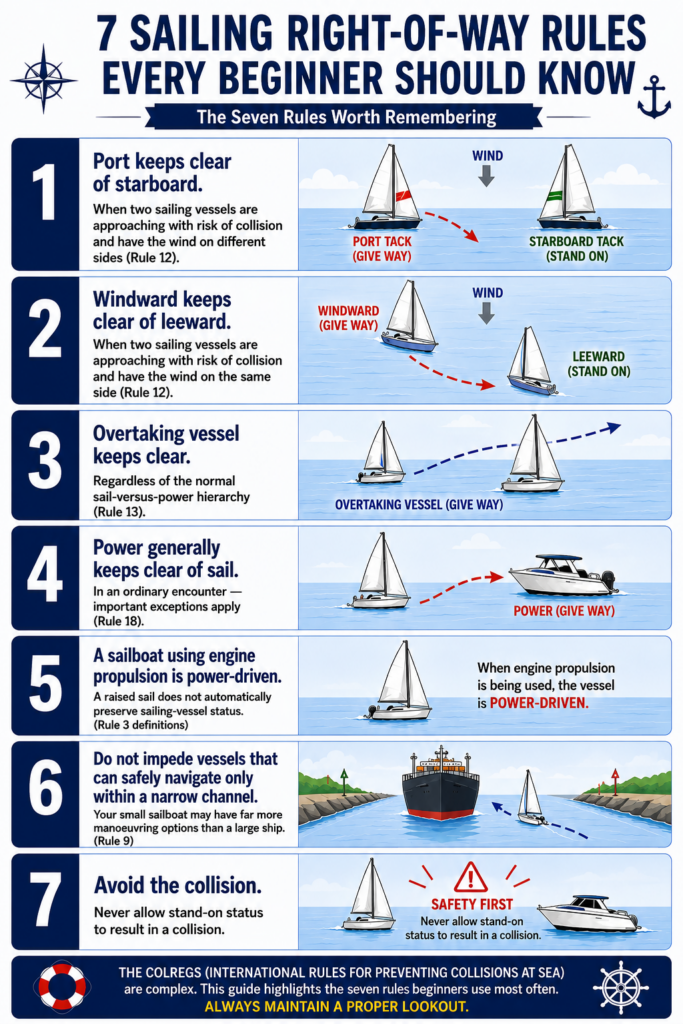
The Seven Rules Worth Remembering
If you remember nothing else from this article, remember these:
1. Port keeps clear of starboard.
When two sailing vessels are on different tacks.
2. Windward keeps clear of leeward.
When two sailing vessels are on the same tack.
3. Overtaking vessel keeps clear.
Regardless of the normal sail-versus-power hierarchy.
4. Power generally keeps clear of sail.
But there are important exceptions.
5. A sailboat using engine propulsion is power-driven.
A raised sail does not automatically preserve sailing-vessel status.
6. Do not impede vessels confined to narrow channels.
Your small sailboat may have far more maneuvering options than a large ship.
7. Avoid the collision.
Being stand-on never gives you permission to collide.
Common Right-of-Way Mistakes Beginners Make
Mistake 1: “Sailboats always have right of way over powerboats.”
False.
It is a useful starting principle but not a universal rule.
Mistake 2: “Starboard tack always has right of way.”
Not if you are overtaking.
Context matters.
Mistake 3: Confusing port tack with the side the boom is on
Remember:
Boom to port usually means starboard tack.
Boom to starboard usually means port tack.
Mistake 4: Assuming stand-on means “never change course”
Initially, maintaining course and speed creates predictability.
But if the give-way vessel fails to act and danger develops, the stand-on vessel also has collision-avoidance responsibilities.
Mistake 5: Making tiny course adjustments
Small changes can be difficult for another skipper to detect.
Make your intentions obvious.
Mistake 6: Passing too close
The rules determine responsibility.
They do not require you to use the smallest possible amount of separation.
Give other vessels room.
Mistake 7: Forgetting that motoring changes your status
If your engine is propelling the boat, you are operating as a power-driven vessel for these rules.
Mistake 8: Assuming every fishing boat has special priority
“Engaged in fishing” has a specific meaning under the Collision Regulations.
Mistake 9: Challenging large ships in channels
Never assume a ship can simply maneuver around your sailboat.
Mistake 10: Focusing on being correct instead of being safe
This is perhaps the biggest mistake of all.
The safest skipper is not the person who can shout the rule number loudest.
It is the skipper who recognizes the developing situation early and prevents it from becoming dangerous.
A Simple Right-of-Way Routine for Beginners
Whenever another vessel appears to be approaching your course, use this mental routine:
LOOK → ASSESS → IDENTIFY → DECIDE → ACT → MONITOR
LOOK
Maintain a proper lookout.
ASSESS
Could there be a risk of collision?
IDENTIFY
What type of vessel is it?
Are you overtaking?
If both vessels are sailing, what tack are they on?
Which vessel is windward?
Are you in a narrow channel or another special navigation area?
DECIDE
Determine which vessel should keep clear.
ACT
If you are give-way, take early and obvious action.
If you are stand-on, remain predictable while monitoring the situation closely.
MONITOR
Do not assume the situation is solved simply because somebody turned.
Continue watching until both vessels are safely past and clear.
How Right-of-Way Knowledge Fits Into Learning to Sail
At first, right-of-way rules can seem like another collection of facts to memorize.
They become much easier once your other sailing skills develop.
When you can confidently identify:
- wind direction,
- port and starboard,
- windward and leeward,
- points of sail,
- tacking,
- jibing,
- boat speed and momentum,
you already possess most of the information needed to interpret a basic sailboat encounter.
That is why collision avoidance is not really a separate sailing skill.
It combines many of the skills you have already learned.
Final Thoughts
Learning sailing right-of-way rules changes the way you look at boat traffic.
Instead of seeing another vessel and wondering:
What am I supposed to do?
you begin automatically asking useful questions.
Are we getting closer?
Is the bearing changing?
Am I overtaking?
Are we both sailing?
Which tack am I on?
Which tack are they on?
Who is windward?
Is one vessel power-driven?
Are we inside a narrow channel?
And most importantly:
What can I do to make sure these boats never collide?
That final question should always win.
The Collision Regulations give sailors a common system for deciding who should maintain course and who should maneuver.
But the rules work only when sailors combine them with observation, judgment and common sense.
Learn the rules.
Know your responsibilities.
Make your actions obvious.
Give other boats room.
And never allow being technically correct to become more important than keeping your boat and everyone aboard safe.
Beginner Sailing Right-of-Way Quiz
Test yourself before looking at the answers.
Question 1
Two sailboats are approaching one another with risk of collision. Boat A is on port tack and Boat B is on starboard tack.
Which boat must keep clear?
A. Boat A
B. Boat B
C. The faster boat
D. The smaller boat
Question 2
Two sailboats are on the same tack and their courses create a risk of collision. Which vessel keeps clear?
A. Leeward vessel
B. Windward vessel
C. Faster vessel
D. Larger vessel
Question 3
You are sailing on starboard tack and overtaking a sailboat on port tack.
Who keeps clear?
A. The port-tack boat
B. The starboard-tack boat because it is overtaking
C. Neither vessel
D. Whichever vessel is windward
Question 4
In ordinary open-water circumstances, a recreational power-driven vessel and a sailing vessel are approaching with risk of collision.
Which generally keeps clear?
A. Sailing vessel
B. Power-driven vessel
C. Larger vessel
D. Faster vessel
Question 5
Your mainsail is raised, but your engine is running and propelling the boat.
For purposes of the steering and sailing rules, are you operating as a sailing vessel or power-driven vessel?
A. Sailing vessel
B. Power-driven vessel
C. Whichever you choose
D. Both equally
Question 6
Two sailing vessels are on starboard tack.
Boat A is windward of Boat B.
Who keeps clear?
A. Boat A
B. Boat B
C. Both must tack
D. The slower vessel
Question 7
You cannot determine whether you are overtaking another vessel.
What should you do?
A. Assume you are crossing
B. Assume you are overtaking
C. Maintain maximum speed
D. Sound a distress signal
Question 8
You are sailing across a narrow shipping channel and a large ship is approaching that can safely navigate only inside that channel.
What should you do?
A. Continue because sail always has priority over power
B. Cross immediately before the ship
C. Avoid impeding the ship’s passage
D. Stop in the middle of the channel
Question 9
You are the stand-on vessel, but the give-way vessel is not taking appropriate action and the boats are becoming dangerously close.
Should you maneuver if necessary to prevent collision?
A. No
B. Yes
C. Only if you are on port tack
D. Only if the other vessel signals first
Question 10
What is the primary purpose of the Collision Regulations?
A. Determine which skipper is legally superior
B. Give sailboats priority
C. Prevent collisions
D. Allow racing boats to maintain speed
Question 11
Two power-driven vessels are crossing. You see the other vessel on your starboard side and there is risk of collision.
Which vessel normally gives way?
A. Your vessel
B. The other vessel
C. The faster vessel
D. The larger vessel
Question 12
When taking action as the give-way vessel, which approach is generally best?
A. Several tiny course changes
B. Wait until the vessels are very close
C. Early, substantial and obvious action
D. Maintain course regardless of circumstances
Quiz Answer Key
1. A — Boat A
The port-tack sailing vessel keeps out of the way of the starboard-tack sailing vessel.
2. B — Windward vessel
When both sailing vessels have the wind on the same side, the windward vessel keeps clear of the leeward vessel.
3. B — The starboard-tack boat
Because it is overtaking. The overtaking rule takes precedence over the normal port-versus-starboard sailing rule.
4. B — Power-driven vessel
In ordinary circumstances, a power-driven vessel keeps out of the way of a sailing vessel, although important exceptions apply.
5. B — Power-driven vessel
If machinery is propelling the sailboat, it is treated as a power-driven vessel for these steering and sailing rules.
6. A — Boat A
Boat A is windward and therefore must keep clear of the leeward boat.
7. B — Assume you are overtaking
If in doubt about whether you are overtaking, assume that you are and act accordingly.
8. C — Avoid impeding the ship
A sailing vessel must not impede a vessel that can safely navigate only within the narrow channel or fairway.
9. B — Yes
Being the stand-on vessel does not allow you to continue into a collision.
10. C — Prevent collisions
The rules create predictable responsibilities so vessels can safely avoid one another.
11. A — Your vessel
In a crossing situation between two power-driven vessels, the vessel with the other on its starboard side normally keeps out of the way.
12. C — Early, substantial and obvious action
A clear maneuver made in good time is easier for the other skipper to recognize and understand.