

Returning to the marina after a good day of sailing should feel satisfying.
For many new sailors, however, the sight of the dock produces exactly the opposite feeling.
The sails are coming down. The fairway seems narrower than you remembered. Other boats suddenly look very expensive. Someone is standing on the dock watching. The wind seems to have changed direction at precisely the wrong moment.
And now you have to put the boat into a space that suddenly looks much too small.
The good news is that docking a sailboat is not about making one perfect maneuver. It is mostly about preparation, controlling speed, understanding what the wind and current are doing, and being willing to abandon an approach that isn’t working.
A well-planned docking can actually be remarkably calm.
In this guide, we’ll work through how to dock a sailboat step by step, beginning before you enter the marina and finishing only after the boat is properly secured.
About this Guide
Written by Kelly Hiebert, a recreational sailor since 2002 and a middle-school teacher. Kelly created Sailboat Zone to provide beginners with clear, structured sailing education.
Last reviewed: September 2026
Jurisdiction: This guide explains general recreational sailboat-docking and close-quarters manoeuvring principles using Canadian boating-safety guidance as its primary reference. Marina rules, speed limits, traffic procedures, berth arrangements and local conditions vary. Follow applicable laws, posted limits and directions from marina or harbour authorities, and learn the handling characteristics and operating procedures of your specific boat.
Primary sources:
- Transport Canada — Safe Boating Guide 2026
- Justice Laws Website — Collision Regulations
- Canadian Coast Guard — Canadian Aids to Navigation System 2023
Safety note: Docking technique varies with the boat, berth, wind, current and available room. Practise close-quarters handling in controlled conditions and approach at the minimum speed that preserves reliable control. Keep lines clear of the propeller, never wrap a line around a hand, never place any part of the body between the boat and dock, and never require anyone to jump ashore. Abort the approach early and try again or request assistance whenever control or safety margins are uncertain.
Quick Summary: How to Dock a Sailboat
A basic docking sequence looks like this:
- Locate your berth before entering the marina.
- Assess the wind and current.
- Start the engine and confirm that it is operating normally.
- Lower or furl the sails in a safe location.
- Rig fenders on the correct side.
- Prepare dock lines before the final approach.
- Brief the crew.
- Enter the marina slowly.
- Approach at the minimum speed that still gives you reliable steering.
- Use neutral frequently and allow the boat to coast.
- Use short applications of forward or reverse only when needed.
- Get the most useful first dock line secured.
- Secure the remaining lines and springs.
- Adjust the fenders and lines for the berth and tide.
The central idea is simple:
Slow enough to remain safe, but fast enough to remain in control.
What Docking a Sailboat Actually Involves
Docking often feels more difficult than leaving the dock because you are trying to remove the boat’s remaining momentum while simultaneously placing it in a very specific location.
When you leave a dock, the open water usually gets larger as you move away.
When you return, your available space gets smaller.
That makes speed control one of the most important docking skills you can learn.
A sailboat does not stop instantly when you put the transmission in neutral. It has mass and therefore momentum. A heavy cruising sailboat traveling slowly may continue moving surprisingly far after the propeller stops pushing it.
That’s why slower is usually better.
But there is an important qualification.
Slow does not mean uncontrolled.
Your rudder needs water moving across it to steer effectively. If you slow the boat too much, particularly before making an important turn, you may lose steerage.
The goal is therefore not to approach at the slowest speed imaginable.
You want the minimum controllable speed.
That means moving slowly enough that you have time to think and stop, while maintaining enough water flow across the rudder to steer the boat.
And that is why a good docking maneuver actually begins long before the boat reaches the dock.
The Three Forces Affecting Your Docking Approach
If you’ve read our How to Leave the Dock in a Sailboat guide, you’ll recognize three forces that become especially important around a marina:
- Wind
- Current
- Momentum
Understanding these forces makes docking much less mysterious.
Wind
Wind acts on everything above the waterline—the hull, cabin, mast, rigging, sails and even crew.
A sailboat has considerable windage.
Depending on the boat’s design, the bow may blow downwind quickly when the boat slows. On other boats, the stern may be more affected.
Current
Current acts primarily on the underwater portion of the boat.
The keel, rudder and hull below the waterline give moving water plenty to push against.
This is why current can sometimes overpower what the wind appears to be doing.
Momentum
Momentum is simply the boat’s tendency to keep moving.
A heavier boat moving at two knots may take considerably more effort and distance to stop than you expect.
Good docking means anticipating all three forces rather than reacting to them after they have already moved the boat.
Assess Conditions Before Entering the Marina
Don’t enter a marina and then begin figuring out your docking plan.
Before you enter, look at:
- Wind direction and strength
- Gusts
- Current
- Tide
- Marina traffic
- Fairway width
- Turning room
- Your assigned berth
- Nearby hazards
- An escape route if the approach doesn’t work
Flags, pennants, water movement around pilings and the orientation of other boats can all provide useful clues.
Pay particular attention to conditions inside the marina. Buildings, breakwaters and rows of boats can alter the wind considerably.
Most importantly, ask yourself:
Are these conditions within my present ability?
There is nothing wrong with waiting outside, asking the marina for assistance or choosing a safer berth if conditions are beyond your current skill level.
For Canadian sailors, Transport Canada’s recreational boating safety resources provide useful guidance on preparation, safe operation, required equipment and responsible boat handling.
Know Exactly Where You’re Going
Before entering the marina, identify your berth.
Know whether you will be docking:
- Port side to
- Starboard side to
- In a finger slip
- Alongside a dock
- Between pilings
- In a double slip
- At a fuel dock
- At a guest dock
If you’re visiting an unfamiliar marina, study its layout beforehand when possible.
Determine which fairway you need and where you must turn.
If you cannot find your berth, don’t continue wandering deeper into a tight marina while trying to read numbers.
Move to a safe area, maintain control, and ask for directions.
Prepare the Boat Before Approaching the Dock
Preparation may be the single biggest difference between an easy docking and a chaotic one.
Do everything possible before the final approach.
Start the engine early
Don’t wait until you’re entering the marina.
Start the engine in open water and confirm that:
- It starts normally
- Cooling water is flowing if applicable
- Forward gear works
- Reverse works
- Throttle response is normal
An engine problem is much easier to deal with outside the marina.
Lower or furl the sails
Choose a safe location with enough room to maneuver.
Secure the sails, sheets and halyards so nothing is dragging overboard or cluttering the cockpit.
Clear the cockpit
Loose lines, bags and equipment become hazards when crew members need to move quickly.
Rig your fenders
Put them on the side that will be alongside the dock.
Prepare dock lines
Attach them to the boat before the final approach.
Brief the crew
Everyone should know what is about to happen.
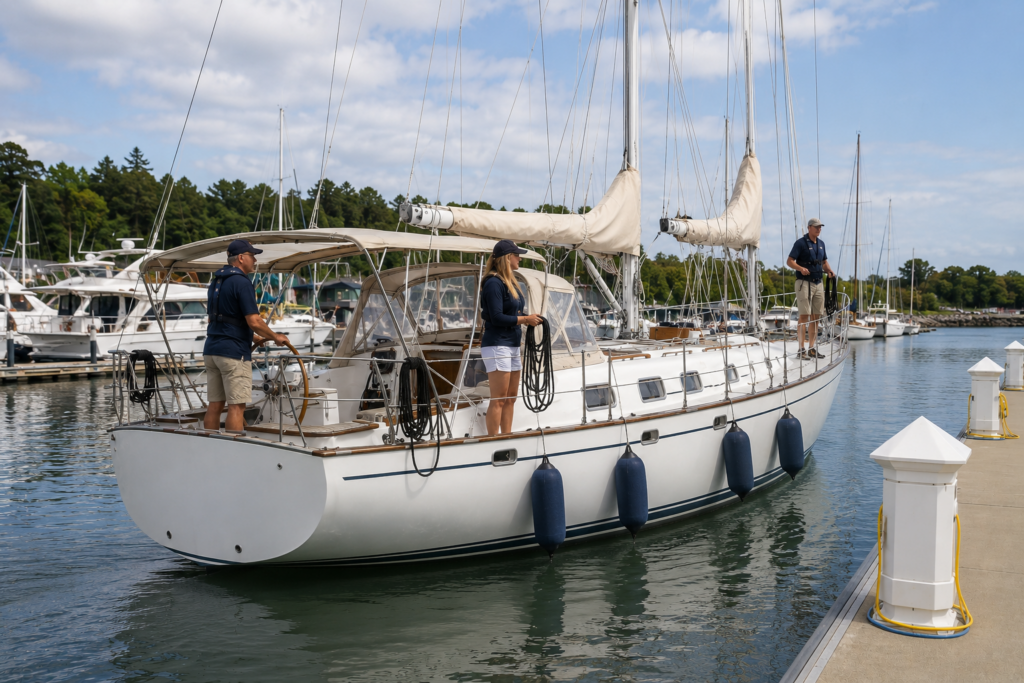
Preparing Your Dock Lines
A properly secured sailboat generally uses four basic types of dock line.
Bow line
The bow line runs from the forward portion of the boat to the dock and helps control movement of the bow.
Stern line
The stern line helps control the stern.
Forward spring
A spring line runs diagonally and helps restrict fore-and-aft movement.
Aft spring
The opposite spring works in the other direction.
If these terms are unfamiliar, review our Parts of a Sailboat: Complete Beginner’s Guide and How to Leave the Dock in a Sailboat before practicing close-quarters maneuvering.
Before approaching, your lines should already be:
- Attached securely aboard
- Led outside lifelines and stanchions as appropriate
- Ready to deploy
- Clear of the propeller
- Long enough to reach the intended cleat or piling
One especially important rule:
Keep dock lines out of the water whenever the engine is running.
A line around the propeller can instantly turn a routine docking into an emergency.
Position Your Fenders Correctly
Fenders only work if they are protecting the part of the boat likely to contact the dock.
Generally, you’ll want several fenders along the docking side, with extra protection near the boat’s widest point.
Their height depends on the dock.
For a low floating dock, they may need to hang relatively low.
For a higher fixed dock, they may need to sit higher.
A fender hanging above the dock provides no protection. Neither does one hanging completely underneath it.
After docking, reposition the fenders as necessary.
Brief the Crew
Before entering the final approach, tell everyone what the plan is.
Crew should know:
- Which line they are responsible for
- Which line goes ashore first
- Where they should stand
- What cleat or piling they’re aiming for
- What commands you’ll use
- What happens if you abort the approach
Avoid giving several people conflicting instructions at the last moment.
And establish one rule before every docking:
Nobody jumps ashore.
If the boat is too far from the dock for someone to step ashore safely, the boat isn’t close enough yet.
Never put a hand, foot or leg between the hull and the dock.
Human beings make terrible fenders.
Understanding Prop Walk
Many single-engine sailboats have a tendency for the stern to move sideways when reverse gear is engaged.
This is called prop walk.
For example, a particular boat may consistently pull its stern to port when reverse is applied.
Another may behave differently.
Prop walk depends on factors including propeller rotation, propeller design, hull shape and drivetrain arrangement.
Rather than discovering your boat’s behavior while approaching an expensive neighboring yacht, experiment in open water.
At very low speed:
- Stop the boat.
- Put the helm approximately amidships.
- Apply a short burst of reverse.
- Observe which direction the stern moves.
Once you understand your boat’s tendencies, prop walk becomes something you can anticipate—and sometimes use.
Prop Wash and Rudder Authority
Your rudder works because water flows across it.
At very low speed, there may be little water flow and therefore little steering force.
Applying forward power can increase water flow over the rudder, giving you greater steering authority.
But continuous power creates another problem:
speed.
That’s why one of the most useful docking techniques is:
In gear → neutral → coast → correction → neutral.
You don’t necessarily need to remain in forward gear continuously.
A brief application of power creates momentum and water flow.
Neutral then gives you time to see what the boat is actually doing.
Plan the Final Approach
Before turning toward the berth, you should be able to explain your plan in one or two sentences.
For example:
“We’ll approach slowly along the fairway, turn to starboard into the slip, shift to neutral as we straighten and use a brief burst of reverse to stop.”
You should know:
- Wind direction
- Current direction
- Approach angle
- Where you want the boat to finish
- When you expect to reduce speed
- Which line goes ashore first
- Where you’ll go if you abort
If you can’t describe the plan, you’re probably not ready to execute it.
Docking Into the Wind
When practical, approaching generally into the wind can make speed control easier because the wind helps slow the boat.
Maintain enough forward movement for steerage.
As you approach your stopping point, shift into neutral and allow the boat’s momentum to carry it forward.
If necessary, use a brief application of reverse to remove the remaining momentum.
Remember that wind strength matters.
A gentle headwind may help.
A strong headwind may stop the boat surprisingly quickly.
Docking With Wind Blowing Off the Dock
Wind blowing away from the dock tries to carry your boat with it.
The temptation is to approach much faster so you can “beat the wind.”
Resist that temptation.
Instead, plan an appropriate angle and anticipate the sideways drift.
Your first useful line becomes especially important. In some circumstances, a well-positioned spring line can give you control of the boat even while the wind is trying to move you away.
Docking With Wind Blowing Onto the Dock
Wind blowing toward the dock sounds helpful.
Sometimes it is.
But it can also push the entire boat sideways faster than expected.
A shallow approach angle is often useful.
Rather than driving directly at the dock, position the boat nearby at low speed and allow the wind to help close the remaining distance.
Your fenders should already be properly positioned.
Most importantly, minimize momentum.
You want the wind to gently place the boat alongside—not slam it against the dock.
Crosswind Docking
Crosswinds can make docking considerably more challenging.
As the boat slows, the bow may begin drifting downwind.
This means you sometimes need to compensate before the boat appears perfectly aligned.
Your boat may temporarily look slightly misaligned with the slip because you’re anticipating where the wind will move it next.
Maintain steerage as long as necessary, but avoid compensating with excessive speed.
If the crosswind exceeds your ability to control the boat safely, don’t force the maneuver.
Accounting for Current
Current deserves just as much attention as wind.
Watch pilings, buoys and fixed docks to determine how the water is moving.
Whenever practical, approaching against the current gives you greater control because you can maintain water flow past the rudder while moving relatively slowly over the bottom.
Remember:
Your speed through the water and your speed relative to the dock aren’t necessarily the same.
When docking, what matters is how your boat is moving relative to the dock.
How to Dock a Sailboat Step by Step
Now let’s put everything together.
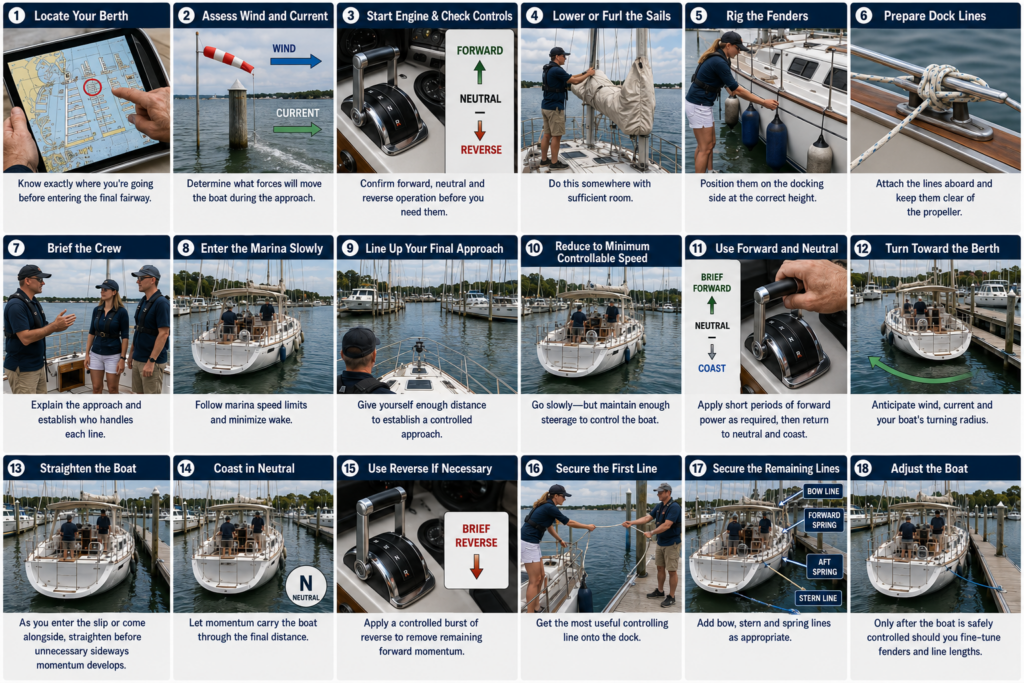
Step 1: Locate Your Berth
Know exactly where you’re going before entering the final fairway.
Step 2: Assess Wind and Current
Determine what forces will move the boat during the approach.
Step 3: Start the Engine
Confirm forward, neutral and reverse operation before you need them.
Step 4: Lower or Furl the Sails
Do this somewhere with sufficient room.
Step 5: Rig the Fenders
Position them on the docking side at the correct height.
Step 6: Prepare Dock Lines
Attach the lines aboard and keep them clear of the propeller.
Step 7: Brief the Crew
Explain the approach and establish who handles each line.
Step 8: Enter the Marina Slowly
Follow marina speed limits and minimize wake.
Transport Canada advises operators to choose a safe speed based on factors including wind, current, manoeuvrability, traffic and nearby hazards.
Step 9: Line Up Your Final Approach
Give yourself enough distance to establish a controlled approach.
Step 10: Reduce to Minimum Controllable Speed
Go slowly—but maintain enough steerage to control the boat.
Step 11: Use Forward and Neutral
Apply short periods of forward power as required, then return to neutral and coast.
Step 12: Turn Toward the Berth
Anticipate wind, current and your boat’s turning radius.
Step 13: Straighten the Boat
As you enter the slip or come alongside, straighten before unnecessary sideways momentum develops.
Step 14: Coast in Neutral
Let momentum carry the boat through the final distance.
Step 15: Use Reverse If Necessary
Apply a controlled burst of reverse to remove remaining forward momentum.
Step 16: Secure the First Line
Get the most useful controlling line onto the dock.
Step 17: Secure the Remaining Lines
Add bow, stern and spring lines as appropriate.
Step 18: Adjust the Boat
Only after the boat is safely controlled should you fine-tune fenders and line lengths.
The Importance of Neutral
One of the most common beginner docking habits is constantly shifting:
Forward → reverse → forward → reverse.
This can make the boat harder to understand.
Instead, learn to appreciate neutral.
Try thinking:
Forward → neutral → coast → small correction → neutral.
Neutral gives you information.
You can see:
- How much momentum remains
- How the wind is moving the bow
- How current is affecting the hull
- Whether the boat is turning
- Whether another correction is actually necessary
Sometimes the best control input is no input at all.
Using Reverse to Stop the Boat
Reverse is useful for removing forward momentum, but it shouldn’t become a panic button.
As you approach your stopping point:
- Shift into neutral.
- Allow the engine RPM to settle.
- Shift into reverse.
- Apply only enough power to stop the boat.
- Return to neutral.
Remember that steering in reverse may initially be weak.
Prop walk may also move the stern sideways.
Practise stopping the boat in open water until you understand how much reverse your boat needs.
Getting the First Line Ashore
There isn’t one universal answer to:
Which dock line goes ashore first?
It depends on the situation.
Sometimes the bow line is most useful.
Sometimes the stern line.
Very often, a spring line provides excellent control.
The important thing is that everyone knows before the approach which line is the priority.
And when the line reaches the dock, secure it appropriately rather than simply relying on someone to hold a heavily loaded line indefinitely.
The crew member should communicate clearly:
“Line secure.”
Using Spring Lines During Docking
Spring lines are among the most useful tools in close-quarters boat handling.
They can:
- Stop forward movement
- Prevent the boat moving aft
- Help hold the boat alongside
- Assist in positioning the boat
- Give a short-handed skipper control from one strategic line
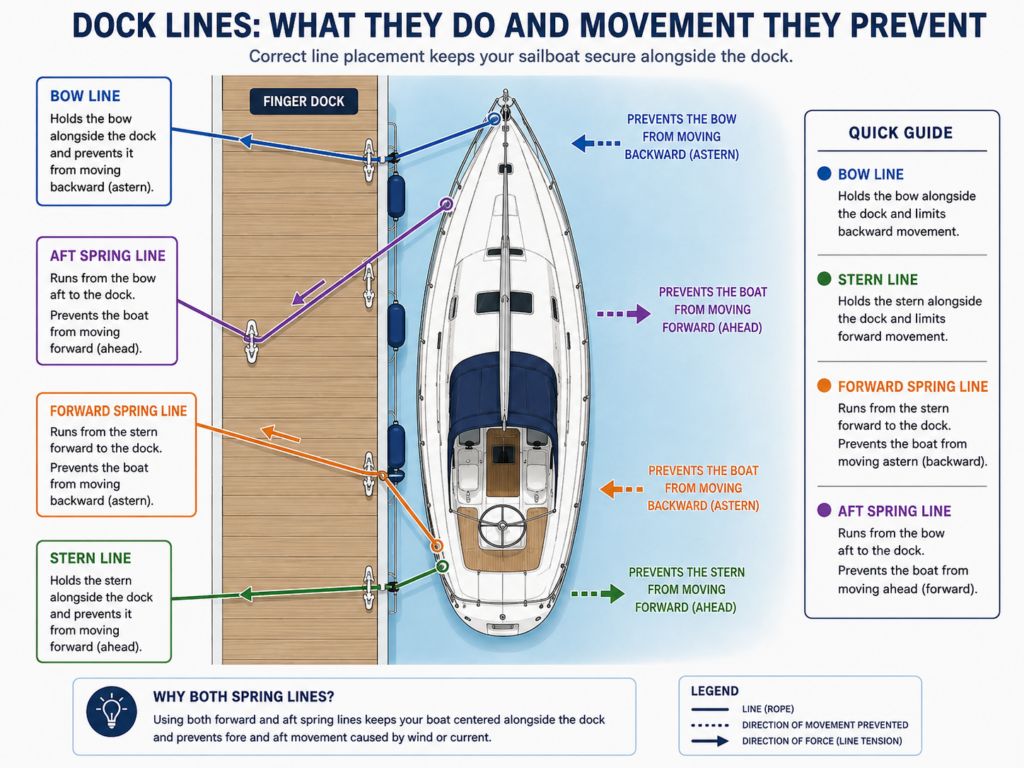
With appropriate technique, gentle engine power against a properly rigged spring can help bring or hold part of the boat alongside.
However, line loads can become substantial.
Keep hands clear of cleats and never wrap a line around your hand.
Docking in a Finger Slip
Finger slips are common in marinas.
The basic sequence is:
- Travel slowly along the fairway.
- Identify your slip early.
- Allow sufficient turning room.
- Begin the turn at minimum controllable speed.
- Account for wind and current.
- Straighten the boat as you enter.
- Shift into neutral.
- Coast into position.
- Use reverse if required.
- Secure the first controlling line.
Avoid focusing entirely on the dock.
Watch neighboring boats, pilings and your stern as well.
Docking Alongside a Dock
For an alongside landing, approach at a modest angle rather than steering directly at the dock.
As you get closer:
- Reduce speed
- Shift into neutral
- Turn toward parallel
- Allow remaining momentum to carry you forward
- Let wind or current assist when useful
- Secure the first controlling line
- Add springs, bow and stern lines
The objective isn’t to “hit the dock gently.”
Ideally, you arrive alongside with almost no relative motion at all.
Backing Into a Slip
Some sailors prefer stern-first docking because it can make boarding easier and simplify departure.
But reversing a single-engine sailboat introduces additional challenges.
Steering authority may initially be limited, and prop walk may move the stern sideways.
If you want to learn stern-first docking, practice prolonged reversing and slow-speed steering in open water first.
For a beginner, there’s no reason to make docking unnecessarily complicated until basic close-quarters control feels comfortable.
Docking Under Sail
Most beginners should normally dock under engine power when an engine is available and functioning.
Nevertheless, understanding how to approach a dock under sail is valuable seamanship.
An engine can fail.
When docking under sail, you lose one major tool:
reverse thrust.
Therefore, controlling momentum becomes even more important.
Whenever practical, choose a conservative approach that allows you to depower the sails and slow naturally.
The techniques in How to Stop a Sailboat become particularly relevant here.
Docking under sail is something to practice with an experienced sailor or instructor before you actually need the skill.
What to Do When the Approach Goes Wrong
This may be the most important lesson in this entire article:
Abort early.
If the approach isn’t developing the way you planned, don’t keep trying to rescue it.
Warning signs include:
- Too much speed
- Incorrect approach angle
- Strong unexpected drift
- Missing the turn
- Crew not ready
- A line falling into the water
- Another boat entering your path
- Losing steerage
If you still have sufficient room:
- Abandon the docking attempt.
- Apply controlled power.
- Steer back toward clear water.
- Reassess the situation.
- Reset the crew and lines.
- Try again.
A go-around is good seamanship.
It is not a failed docking.
When NOT to Abort
There is an important exception.
Once the boat is extremely close to the dock, neighboring vessels or people, suddenly applying large amounts of power may create a greater danger.
Before powering away, consider:
- Are lines in the water?
- Is anyone near the propeller?
- Are people on neighboring boats?
- Is there enough room to turn?
- Could prop walk swing the stern into another boat?
There comes a point where accepting gentle contact with properly positioned fenders may be safer than making an aggressive last-second maneuver.
10 Common Sailboat Docking Mistakes
1. Approaching too fast
Excessive momentum removes your options.
2. Preparing dock lines too late
Everything should be ready before the final approach.
3. Forgetting the fenders
Fenders can’t protect the hull while they’re sitting in a locker.
4. Not checking the wind
A small amount of wind can have a large effect at low speed.
5. Ignoring current
Current may move the underwater hull more strongly than expected.
6. Crew jumping ashore
Never require athletic ability to rescue a docking maneuver.
7. Using excessive throttle
More power can quickly turn a small mistake into a large one.
8. Trying to save a bad approach
Abort while you still have room.
9. Using hands or feet as fenders
Never place body parts between the boat and dock.
10. Failing to brief the crew
Good docking is teamwork.
After the Boat Reaches the Dock
Touching the dock doesn’t mean you’re finished.
Once alongside:
- Secure bow and stern lines
- Install or adjust spring lines
- Centre the boat appropriately
- Adjust fenders
- Consider tidal movement
- Check clearance from neighboring boats
- Shut down the engine
- Secure sails
- Coil excess lines
- Turn off unnecessary electrical equipment
- Perform a final walk-around
Only then is the docking maneuver complete.
How Tight Should Dock Lines Be?
Dock lines don’t necessarily need to be stretched tight like guitar strings.
The boat normally needs some controlled movement.
The correct setup depends partly on whether you’re tied to a floating dock or fixed dock.
A floating dock rises and falls with the boat as the tide changes.
A fixed dock does not.
At a fixed dock in tidal waters, improperly adjusted lines can become dangerously tight—or allow the boat to hang or move excessively—as the water level changes.
Your lines should prevent the boat from striking the dock or neighboring boats while allowing appropriate movement.
Also inspect potential chafe points where lines rub against hardware.
Docking Short-Handed or Single-Handed
Docking alone requires more preparation—not more speed.
Prepare everything earlier.
Keep the plan simple.
Rig lines so they can be reached from aboard whenever practical.
Rather than attempting to control four lines simultaneously, identify the one line that gives you the greatest immediate control.
A strategically positioned spring line can be particularly useful.
Most importantly, don’t leave the helm prematurely.
Get the boat under control first.
Practising Docking Safely
Docking improves enormously with deliberate practice.
Don’t wait until the end of a long sailing day to practice.
Choose:
- Calm conditions
- Light wind
- Minimal marina traffic
- Plenty of open space
Before practicing against a dock, practice approaching a floating marker.
Try stopping the boat beside it without touching it.
Practise:
- Slow-speed turns
- Going into neutral
- Coasting
- Short bursts of power
- Stopping with reverse
- Steering in reverse
- Observing prop walk
- Holding position
The goal is to learn what your boat does.
Two sailboats can behave very differently at low speed.
The RYA’s boat-handling material similarly emphasizes understanding wind, tide/current, momentum, prop walk, lines, fenders, springs and short applications of power when maneuvering in close quarters.
Beginners who want supervised hands-on instruction can also explore Sail Canada training programs, which include practical boat-handling skills and safe procedures for leaving and returning to the dock.
Beginner Sailboat Docking Checklist
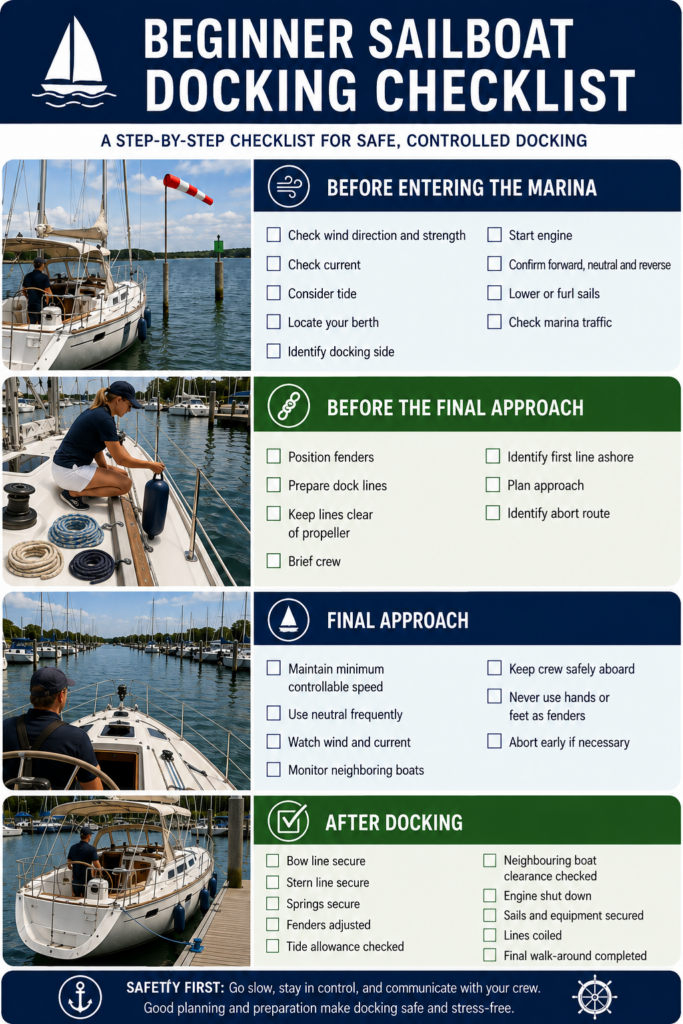
Before Entering the Marina
☐ Check wind direction and strength
☐ Check current
☐ Consider tide
☐ Locate your berth
☐ Identify docking side
☐ Start engine
☐ Confirm forward and reverse
☐ Lower or furl sails
☐ Check marina traffic
Before the Final Approach
☐ Position fenders
☐ Prepare dock lines
☐ Keep lines clear of propeller
☐ Brief crew
☐ Identify first line ashore
☐ Plan approach
☐ Identify abort route
Final Approach
☐ Maintain minimum controllable speed
☐ Use neutral frequently
☐ Watch wind and current
☐ Monitor neighboring boats
☐ Keep crew safely aboard
☐ Never use hands or feet as fenders
☐ Abort early if necessary
After Docking
☐ Bow line secure
☐ Stern line secure
☐ Springs secure
☐ Fenders adjusted
☐ Tide allowance checked
☐ Neighbouring boat clearance checked
☐ Engine shut down
☐ Sails and equipment secured
☐ Lines coiled
☐ Final walk-around completed
Transport Canada’s current recreational boating guidance also stresses planning ahead, monitoring weather and water conditions, carrying required safety equipment and operating at a safe speed.
Frequently Asked Questions About Docking a Sailboat
How fast should you approach a dock in a sailboat?
Approach at the minimum speed that still gives you reliable control. There isn’t one correct speed for every boat because displacement, rudder design, wind and current all affect handling.
The important principle is to minimize momentum without losing steerage.
Should you dock a sailboat into the wind?
When circumstances allow, approaching generally into the wind can make speed control easier because the wind helps slow the boat. However, marina layout, current and berth orientation may make another approach necessary.
When should you shift into reverse?
Ideally, most forward momentum should already have disappeared before substantial reverse thrust is required. Use reverse deliberately to remove the remaining momentum rather than waiting until the last second.
What is the best angle for approaching a dock?
There isn’t one universal angle. Wind, current, dock configuration and boat handling characteristics determine the best approach. Alongside approaches are generally made at a modest angle before turning parallel.
Which dock line should be attached first?
Whichever line gives you the most useful control in that particular situation. Depending on conditions, that may be the bow line, stern line or a spring.
What do you do if the wind is blowing you away from the dock?
Anticipate the drift and approach appropriately rather than simply increasing speed. Getting a useful controlling line ashore—often a spring—can help secure the boat.
How do you dock a sailboat in a crosswind?
Anticipate how the wind will move the bow and stern as the boat slows. Maintain sufficient steerage and compensate before the boat has already drifted out of position.
Can you dock a sailboat under sail?
Yes. Sailboats were docking long before auxiliary engines became commonplace. However, docking under sail requires careful momentum management because you cannot use reverse thrust to stop. Beginners should practice the skill under controlled conditions.
What is prop walk?
Prop walk is the tendency of the stern to move sideways when the propeller turns, particularly when reverse gear is engaged. The direction and strength vary between boats.
What should you do if you miss the dock?
If you still have room to maneuver safely, abort the approach, return to clear water, reset and try again.
There is no prize for docking successfully on the first attempt.
The Most Important Docking Lesson
When beginners imagine expert sailors docking, they sometimes picture dramatic throttle movements and perfect last-second turns.
Good docking usually looks much less exciting.
The boat approaches slowly.
The crew already knows the plan.
Fenders are out.
Lines are ready.
The skipper uses neutral frequently.
Wind and current have been anticipated.
The boat arrives with very little remaining momentum.
And if the approach isn’t right?
They leave and try again.
That’s the real goal.
Not a perfect docking.
A controlled docking.
As you gain experience, you’ll become better at judging momentum, predicting how your boat responds to reverse, recognizing prop walk and using wind and current to your advantage.
For now, remember one simple sequence:
Prepare early. Approach slowly. Stay in control. Abort early when necessary.
That is the foundation of good sailboat docking.
Sailboat Docking Quiz
1. Why is minimum controllable speed preferable during docking?
A. It saves fuel
B. It reduces momentum while maintaining steering control
C. It prevents prop walk
D. It eliminates current
2. What three major forces should you consider during docking?
A. Lift, drag and gravity
B. Wind, current and momentum
C. Wind, waves and tide tables
D. Propeller, rudder and keel
3. When should dock lines and fenders normally be prepared?
A. After touching the dock
B. During the final turn
C. Before beginning the final approach
D. After the engine is shut down
4. Why shouldn’t you approach as slowly as physically possible?
A. The engine may stall
B. You may lose sufficient water flow over the rudder for reliable steering
C. The wind will stop
D. Dock lines become harder to use
5. What is prop walk?
A. The boat moving forward after shifting into neutral
B. The sideways movement of the stern caused by propeller action
C. Walking a boat along a dock with lines
D. Propeller vibration
6. Why is neutral so useful while docking?
A. It stops the boat instantly
B. It removes wind pressure
C. It allows the boat to coast while giving the skipper time to assess its movement
D. It increases rudder authority
7. Your approach is clearly going badly and you still have plenty of room. What should you normally do?
A. Increase throttle and continue
B. Have a crew member jump ashore
C. Abort and try again
D. Turn the engine off
8. Why should dock lines be kept out of the water while the engine is running?
A. Wet lines shrink
B. They could become tangled around the propeller
C. They become difficult to throw
D. They may attract marine growth
9. Which dock line should always go ashore first?
A. Bow line
B. Stern line
C. Forward spring
D. There is no universal answer
10. What should a crew member do if the boat is too far from the dock to step ashore safely?
A. Jump
B. Stretch across the gap
C. Remain aboard
D. Put one foot on the dock
11. What is one advantage of approaching against a current when practical?
A. Current disappears
B. You can maintain water flow past the rudder while moving relatively slowly over the bottom
C. Prop walk stops
D. The boat becomes lighter
12. When docking with wind blowing onto the dock, what is a major risk?
A. The boat cannot reach the dock
B. The wind may push the boat sideways against the dock too quickly
C. The rudder stops working
D. The engine automatically speeds up
13. What should you do before entering an unfamiliar marina?
A. Wait until you’re inside to find the berth
B. Determine the berth location and plan the approach
C. Increase speed
D. Remove the fenders
14. Why are spring lines particularly useful?
A. They replace fenders
B. They control fore-and-aft movement and can help position the boat
C. They prevent wind
D. They are easier to coil
15. What is one of the best ways for a beginner to improve docking skills?
A. Practise only when returning from long trips
B. Approach docks as quickly as possible
C. Practise slow-speed handling in open water and calm conditions
D. Avoid using neutral
Sailboat Docking Quiz — Answer Key
- B — Minimum controllable speed reduces momentum while retaining sufficient steerage.
- B — Wind, current and momentum are the three primary forces to consider.
- C — Fenders and dock lines should be ready well before the final approach.
- B — At extremely low speed, insufficient water may be flowing across the rudder to provide reliable steering.
- B — Prop walk is the sideways tendency of the stern produced by propeller action, particularly in reverse.
- C — Neutral allows the boat to coast while the skipper observes what wind, current and momentum are doing.
- C — Abort the approach while you still have room, reset and try again.
- B — A dock line in the water can become wrapped around the propeller.
- D — The best first line depends on the berth, wind, current and docking plan.
- C — Crew should remain safely aboard rather than jumping.
- B — Working against current can provide useful water flow over the rudder while keeping speed relative to the dock low.
- B — An on-dock wind may push the hull sideways faster than expected.
- B — Know where you’re going and have a plan before entering confined water.
- B — Spring lines restrict fore-and-aft movement and can be extremely useful for controlling and positioning the boat.
- C — Slow-speed practice in open water allows you to learn how your particular boat responds without the pressure and hazards of a real docking situation.
Comments
Pingback: Parts of a Sailboat: Complete Beginner’s Guide -