

Learning to sail begins with individual skills.
You learn how to find the wind. You learn the points of sail. You learn how to steer, trim sails, tack, jibe, reef, anchor, dock and navigate.
At first, most questions have fairly direct answers.
Which way should I move the tiller?
When do I release the jib sheet?
How much rode should I let out?
Which vessel should keep clear?
Eventually, however, sailing begins asking harder questions.
The wind is building, but the boat is still under control. Should you reef now or wait?
The direct route is shorter, but it passes close to a shoal and across a ferry route. Is it still the best route?
Your docking approach is not terrible, but it is becoming worse. Do you keep correcting or go around?
A crew member is cold and tired. The boat can certainly continue. Should the trip continue?
You are legally the stand-on vessel, but another boat is not behaving as expected. How long do you wait?
There may not be one memorized rule that answers these questions.
This is where skipper decision making begins.
A capable skipper does more than operate the boat.
A skipper builds a picture of what is happening, notices when that picture changes, decides what matters most, considers the available options, acts while useful options still remain, and then checks whether the decision actually worked.
That process connects almost everything you have learned in the SailboatZone course.
The individual lessons taught you the skills.
This lesson is about deciding when, why and whether to use them.

The Difference Between Operating the Boat and Skippering It
Imagine the wind increases.
The boat heels farther.
The helm becomes heavier.
A beginner may respond by pulling harder on the wheel or tiller.
That is operating the control that appears to be causing the problem.
A developing skipper asks a different question:
Why did the helm become heavier?
That distinction appears in Weather Helm, Lee Helm and Sailboat Balance, where increasing helm pressure is treated as information about the larger relationship between wind, heel, sail area, trim and boat balance rather than simply as a reason to apply more rudder.
The same distinction appears throughout sailing.
If the anchor is dragging, pulling harder on the rode does not necessarily solve the problem.
If the boat is approaching the dock too quickly, increasingly aggressive steering may not solve the problem.
If your GPS says you are where you expected to be but the depth sounder disagrees, continuing because the screen looks reassuring does not solve the problem.
If the crew is becoming overwhelmed, giving them instructions faster does not solve the problem.
A skipper has to look beyond the immediate symptom.
That leads to the first major principle of skipper decision making:
Do not merely ask, “What control should I use?” Ask, “What is actually happening?”
This is the shift from operating equipment to managing a situation.
The Skipper Decision Loop
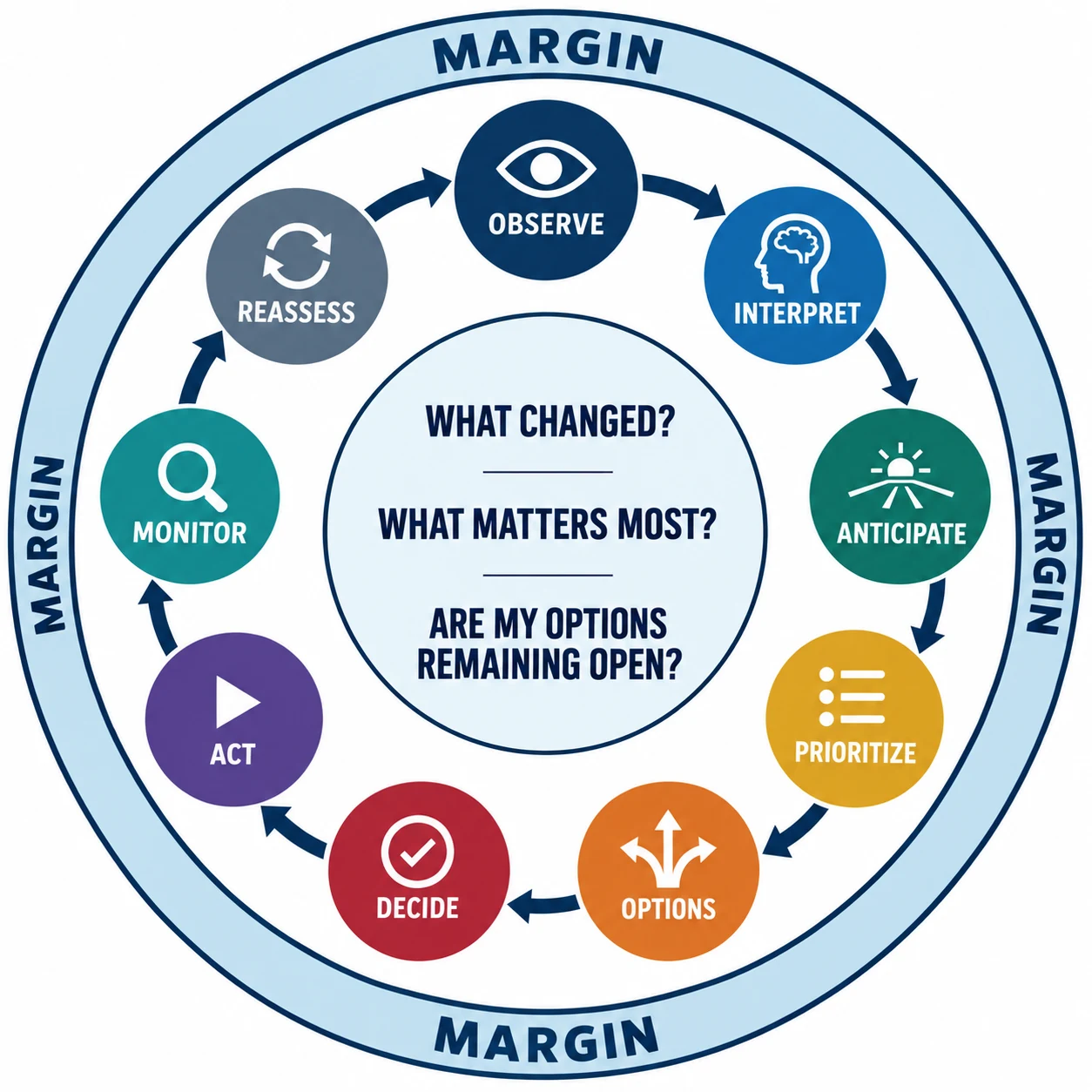
Skipper decision making can be organized into a simple repeating process:
OBSERVE → INTERPRET → ANTICIPATE → PRIORITIZE → OPTIONS → DECIDE → ACT → MONITOR → REASSESS
Then the process begins again.
It is a loop because a sailboat operates in a changing environment.
The decision you made ten minutes ago may have been entirely reasonable.
Ten minutes later:
- the wind may be stronger;
- the tide may have fallen;
- the current may have changed;
- another vessel may have altered course;
- your crew may be tiring;
- visibility may have deteriorated;
- your boat may be behaving differently;
- an alternate harbour may now be behind you;
- daylight may be disappearing.
The most useful question in the entire process may therefore be:
What changed?
1. Observe: Build the Whole Picture
You cannot make a good decision using information you never noticed.
That is why skipper decision making begins with lookout and situational awareness.
The routine developed in How to Keep a Proper Lookout While Sailing teaches sailors to scan beyond the bow and include traffic, hazards, position, depth, weather, the boat and the crew in the same mental picture.
Canada’s Collision Regulations similarly require vessels to maintain a proper lookout using sight, hearing and all available means appropriate to the circumstances so that the situation and risk of collision can be properly assessed.
But observation is broader than collision avoidance.
A skipper may be collecting information from:
The environment
- wind direction;
- wind strength;
- gusts;
- waves;
- visibility;
- clouds;
- current;
- tide;
- daylight.
The boat
- heading;
- speed;
- heel;
- helm pressure;
- sail shape;
- telltales;
- depth;
- unusual noise;
- vibration;
- steering response;
- equipment condition.
The route
- hazards;
- traffic;
- shallow water;
- harbour entrances;
- escape routes;
- available shelter;
- alternate destinations.
The crew
- experience;
- fatigue;
- cold;
- seasickness;
- confusion;
- fear;
- workload;
- communication.
A skipper does not stare at all of these continuously.
The skill is scanning often enough to keep the mental picture current.
Skipper Thinking
Ask:
What am I not looking at because something else has my attention?
That question matters because sailing creates task fixation.
A tangled line seems urgent.
A badly trimmed sail attracts attention.
The chartplotter demands a closer look.
A crew member asks a question.
Meanwhile, the boat keeps moving.
The situation does not pause while you deal with the task.
2. Interpret: What Does the Information Mean?
Observation tells you what you can see.
Interpretation asks what it means.
Suppose the helm becomes progressively heavier.
That fact alone does not tell you what to do.
You need context.
Did the wind increase?
Did the boat heel more?
Did the mainsail become overpowered?
Did the sail trim change?
Did something happen to the steering system?
The same principle appears in navigation.
A buoy is useful information, but Aids to Navigation for Beginners emphasizes that a prudent navigator does not depend on one buoy alone. Position, chart information, GPS, depth, visual references and nearby aids should support the same general story.
Likewise, Basic Coastal Navigation treats navigation as repeated confirmation rather than discovering your position once and assuming the problem is solved.
This produces another important principle:
Important decisions should rarely depend on one clue when independent confirmation is available.
If the chartplotter says you are in deep water but the sounder shows rapidly decreasing depth, investigate.
If the forecast predicted moderate conditions but the sky, sea and wind tell a different story, believe the conditions you are actually experiencing.
If the anchor alarm says everything is fine but two shore transits are moving steadily, investigate.
If the crew says they are fine but someone is shivering, quiet and responding slowly, keep observing.
Interpretation means asking:
What story do these clues tell together?
3. Anticipate: What Happens Next If I Do Nothing?
One of the biggest differences between reactive sailing and good skippering is time.
A reactive sailor waits until something becomes a problem.
A skipper tries to recognize the developing problem while the response can still be small.
Consider reefing.
The lesson in How to Reef a Sailboat begins with a familiar pattern: wind increases, heel increases, helm load increases and the crew begins working harder. The important decision is not what to do once the boat is badly overpowered. It is recognizing the progression early enough to reduce sail before the situation becomes difficult.
The same logic appears in docking.
How to Dock a Sailboat emphasizes aborting early when speed, angle, drift, crew readiness or steerage indicate that the approach is deteriorating. A go-around preserves the ability to reset while open water is still available.
Different skill.
Same judgement principle.
Ask:
If nothing changes, where does this situation lead?
Examples:
The depth is still safe.
But it is decreasing steadily.
The wind is manageable.
But it has risen from 10 to 15 knots and is forecast to continue building.
The crew member is only mildly cold.
But they are becoming colder.
The approaching ship is still far away.
But its bearing is nearly constant and the range is decreasing.
There is still plenty of daylight.
But progress is slower than planned and the return leg will be upwind.
A snapshot tells you what is happening.
A trend helps you decide what may happen next.
4. Prioritize: What Matters Most Right Now?
Several things can be wrong at once.
They are not necessarily equally important.
Imagine this situation:
You are sailing toward a harbour entrance.
The jib trim is poor.
A crew member has dropped a fender.
A ferry is approaching.
The depth is beginning to decrease.
The wind is pushing the boat toward the edge of the channel.
All five things deserve attention.
Only some deserve attention now.
This is prioritization.
A useful skipper question is:
What could become difficult to recover from if I ignore it for the next minute?
The loose fender might wait.
Perfect jib trim can probably wait.
The ferry, depth and position may not.
This is why emergency and person-overboard procedures emphasize simple first actions. Stress narrows attention. The first job is not to solve everything simultaneously; it is to stabilize the situation and protect the most important priorities.
Prioritization is contextual, so there is no universal numbered list that works in every situation.
But some recurring questions help:
- Is anyone in immediate danger?
- Is the vessel under control?
- Am I entering danger?
- Is collision risk developing?
- Is depth becoming critical?
- Is there enough room to manoeuvre?
- What problem becomes irreversible first?
- What can safely wait?
This principle also changes how you think about small equipment problems.
A jammed line can feel urgent because it is physically in front of you.
But if fixing it requires two people to stare downward while the boat is crossing a busy channel, the repair may be less urgent than maintaining the wider picture.
Urgency is not determined by which problem is making the most noise.
5. Create Options Before Choosing One
Beginners sometimes frame sailing decisions as two choices:
Continue.
Or fail.
That is rarely the full set of options.
Suppose conditions are getting stronger.
Your choices may include:
- reef;
- reduce headsail;
- change course;
- move toward sheltered water;
- heave-to;
- return;
- divert;
- shorten the trip;
- delay a manoeuvre;
- ask someone for assistance;
- use the engine where appropriate;
- alter the crew plan.
This is one reason How to Heave To in a Sailboat is more than a manoeuvring lesson. Heaving-to can create a comparatively stable, low-workload period in which the crew can organize the cockpit, deal with a problem, check position or simply gain time before deciding what happens next.
Sometimes the best immediate decision is not to solve the larger problem.
It is to change the situation so you have more capacity to solve it.
That might mean:
Slow down.
Move into open water.
Reef.
Heave-to.
Wait outside a harbour.
Abort the approach.
Anchor somewhere safe.
Reduce the number of tasks the crew is attempting.
This leads to an important skipper principle:
When workload is outrunning your ability to think, create time and space.
6. Compare Options by the Margin They Preserve
Being able to do something does not automatically make it the prudent choice.
A sailboat may be physically capable of continuing in stronger wind.
A harbour may still be technically enterable.
A shallow route may still have enough water.
A skipper may still be able to reach the destination before dark.
But a better question is:
How much margin remains if something else goes wrong?
Margin takes many forms.
Time margin
Do you have enough time to deal with slower progress, a navigation problem or an equipment issue?
Distance margin
How much sea room exists between you and the hazard?
Depth margin
How much water is beneath the keel after accounting for tide, waves, loaded draft and uncertainty?
Weather margin
Are present conditions comfortably within your limits, or already near them?
Crew margin
Is the crew relaxed enough to handle another problem?
Control margin
Is the boat balanced and manageable, or does every gust demand correction?
Route margin
Is there another harbour, route or safe area available?
Daylight margin
Will the difficult part of the trip happen with useful daylight remaining?
The weather lesson Sailing Weather for Beginners: Should You Leave the Dock? makes this point particularly well: conditions should be evaluated across the whole sailing window and in combination, because several individually manageable concerns can accumulate into a poor overall decision.
Environment and Climate Change Canada publishes marine forecasts specifically to provide mariners with wind, weather, visibility, wave and warning information that can support those decisions.
The skipper’s question is not:
Can we probably get away with this?
It is:
What happens to our margin if the situation becomes slightly worse than expected?
7. Preserve Reversibility
Some decisions are easy to change.
Others quietly close the door behind you.
Reefing early is relatively easy to reverse. If conditions moderate, you can shake the reef out later.
Waiting outside a difficult harbour entrance leaves the option to enter later.
Aborting a docking approach while open water remains lets you try again.
Other decisions reduce your future options.
Passing the last sheltered harbour before a long exposed leg.
Entering confined water.
Continuing downwind when the return will be difficult upwind.
Allowing daylight to disappear before a complicated harbour entrance.
Continuing toward a shoal while depth is decreasing.
Entering a narrow pass before confirming the current.
The direct route may therefore not be the best route.
How to Plan a Sailing Trip identifies critical points such as narrow channels, shallow passages, strong-current areas, ferry routes and exposed headlands—places where the consequences of continuing deserve additional thought before you become committed.
This gives us another powerful decision rule:
The harder a decision will be to reverse, the more margin you should want before committing to it.
Skipper Thinking
Before entering a more committed situation, ask:
If I change my mind five minutes from now, what options will still be available?
That question changes route planning.
It changes docking.
It changes anchoring.
It changes weather decisions.
And it changes when a skipper chooses to turn around.
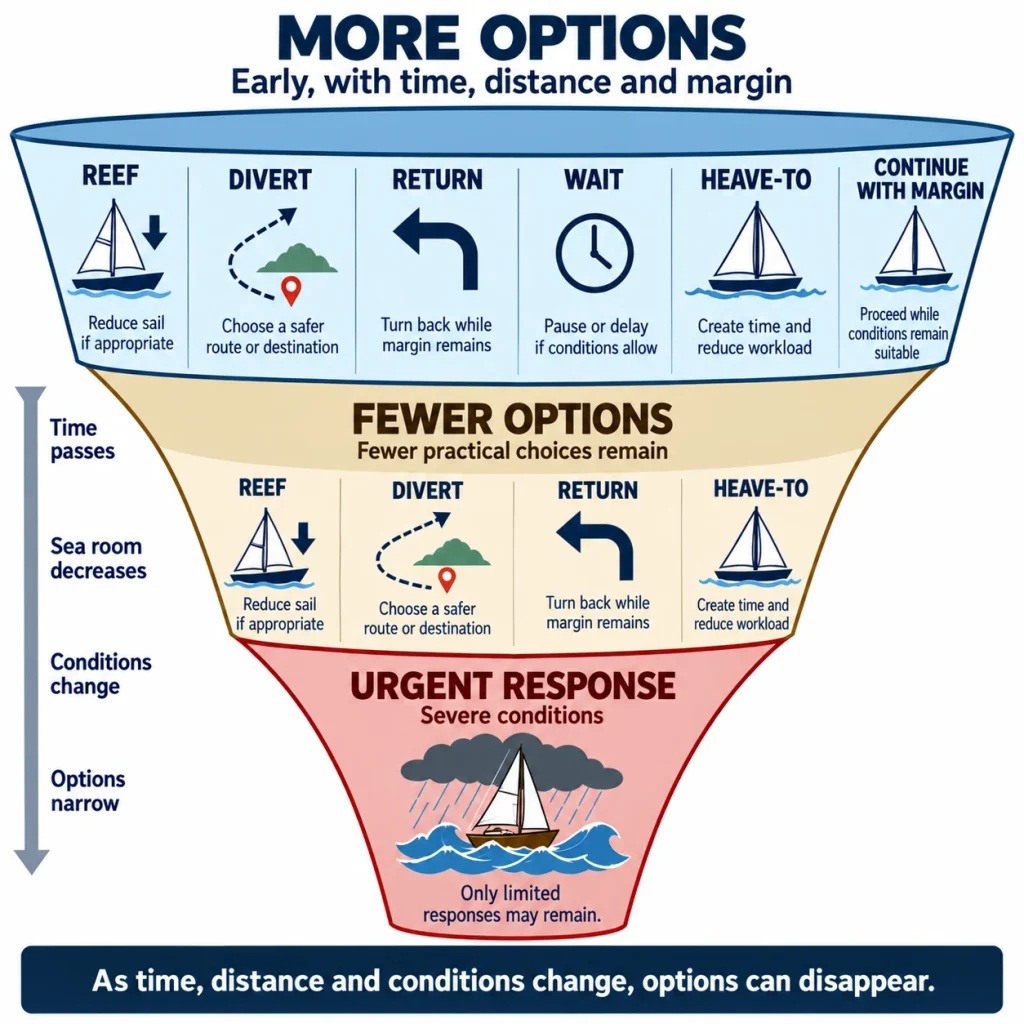
8. Act Early While Small Actions Still Work
Many apparently unrelated lessons in sailing teach one common principle.
Reef early.
Alter course early.
Prepare dock lines early.
Slow before the harbour entrance.
Check the tide before entering shallow water.
Abort the docking approach before the boat is trapped.
Call for help before the emergency becomes unmanageable.
Find another anchorage before darkness makes the search difficult.
These are not separate pieces of sailing folklore.
They express the same idea:
Early decisions preserve options. Late decisions consume them.
Consider strong-wind sailing.
How to Sail in Strong Winds asks the developing skipper not merely whether the boat can tolerate the conditions, but whether this boat, with this crew, in these conditions, should continue, and whether safe alternatives are increasing or disappearing.
That is skipper thinking.
As conditions deteriorate, the question is not simply:
Can we continue?
Ask instead:
What will be harder to do thirty minutes from now than it is now?
Reefing?
Turning around?
Finding shelter?
Crossing the channel?
Docking?
Helping the cold crew member?
Calling for assistance?
An early decision may require only a small change.
A late decision may require a major recovery.
9. Do Not Fight the Symptom
There is a recurring trap in sailing:
Something becomes harder, so the sailor works harder.
The helm becomes heavier.
More rudder.
The boat keeps heeling.
More steering.
The docking approach is poor.
More throttle.
The route is no longer working.
More determination.
The crew is falling behind.
More instructions.
Sometimes the increasing workload is itself a clue that the plan needs to change.
The reefing lesson demonstrates this clearly. When increasing wind makes the boat heel farther and the helm harder to manage, working harder at the controls may be less effective than reducing the sail power causing the problem.
Anchoring offers another example.
In How to Anchor a Sailboat, the anchor, rode, seabed, scope and boat are treated as a system. If the anchor will not hold, the correct response might involve changing scope, resetting or choosing another location—not merely hoping the existing setup starts working.
The general principle is broader:
If the same problem keeps demanding greater effort, ask whether you are correcting the symptom instead of the cause.
The Boat Is Giving You Information
One of the most useful transitions from beginner to skipper is learning to read the boat itself.
The boat communicates through behaviour.
Increasing heel.
Changing helm pressure.
Slower acceleration.
More leeway.
Repeated rounding up.
Loss of steerage.
Different vibration.
Unexpected noise.
Poor sail shape.
Telltales behaving differently.
The developing skipper treats these as evidence.
Suppose a gust arrives.
The boat heels hard.
The helm loads up.
Speed does not increase significantly.
The skipper could simply steer harder.
Or the skipper could interpret the combination:
The additional sail power is not producing useful performance.
The boat may be overpowered.
Now the decision changes.
Ease?
Flatten the sails?
Bear away temporarily?
Reef?
Change the plan?
The exact response depends on the situation.
But the reasoning begins by listening to what the boat is telling you.
Do not merely command the boat. Observe its response.
The Crew Is Part of the Situation
Skipper decision making is sometimes discussed as though the skipper is making decisions about wind, water and machinery.
The crew belongs in the same picture.
A trip that is appropriate for three experienced sailors may not be appropriate for a skipper and two people sailing for the first time.
Conditions that feel exciting at the beginning of the afternoon may feel very different after several cold, wet hours.
A crew member may become:
- fatigued;
- seasick;
- cold;
- frightened;
- confused;
- physically unable to perform a task;
- overloaded with instructions.
That changes the sailing problem.
The boat has not changed.
The crew capability has.
Transport Canada’s current pleasure-craft guidance includes checking the vessel, weather and local hazards before departure, filing a trip plan and briefing guests about safety equipment and safe operation.
Transport Canada’s pre-departure guidance for pleasure craft reinforces the same idea by emphasizing weather checks, local hazards, trip planning, vessel readiness and briefing everyone aboard before departure.
The broader skipper principle is:
The crew is part of the operating condition of the vessel.
Do not ask only:
Can the boat handle it?
Ask:
Can this crew continue to operate this boat well if the situation gets harder?
The Plan Is Allowed to Change
Planning matters.
But a plan is not a promise.
Suppose you planned to sail to Pine Bay.
You prepared the route.
You told your family where you were going.
Lunch is packed.
The crew is excited.
You have been looking forward to the trip all week.
Then the wind builds sooner than forecast.
Progress becomes slower.
The crew tires.
A better-protected harbour is available nearby.
There is a subtle danger here.
The original destination begins to feel like something you are supposed to accomplish.
It isn’t.
The purpose of planning is not to force reality to follow the plan.
The purpose is to help you recognize when reality is no longer matching it.
The Independent Skipper Capstone deliberately asks the learner to choose among departing, modifying, delaying or staying at the dock and to identify the facts and abort triggers supporting the decision.
That is exactly the mindset to bring underway.
A good plan contains the conditions under which the plan will change.
Examples:
If the wind reaches the point where the boat becomes consistently overpowered, we reef.
If visibility deteriorates before the ferry crossing, we hold outside.
If we have not reached the decision point by 1500, we return.
If the crew becomes too cold to participate effectively, we shorten the trip.
If the anchorage does not provide adequate holding or swinging room, we leave.
The exact trigger depends on the boat, crew and situation.
The principle does not.
Decide some of your limits before pressure makes the decision harder.
Aborting Is a Sailing Skill
Beginners often think successful seamanship means completing the manoeuvre.
Experienced judgement sometimes means stopping it.
The departure is becoming confused?
Secure the boat again.
The docking approach is unstable?
Go around.
The anchorage is not working?
Retrieve the anchor and move.
The harbour entrance no longer looks sensible?
Remain outside.
The weather deteriorated?
Return or divert.
How to Leave the Dock explicitly recommends aborting when the situation is no longer under control and resetting before trying again.
That lesson is much larger than docking.
A skipper should be comfortable saying:
This is no longer developing the way I expected. We are going to reset.
Aborting early is not indecision.
Sometimes it is the clearest decision available.
Legal Does Not Automatically Mean Prudent
Rules matter.
But knowing a rule does not remove the need for judgement.
Consider collision avoidance.
You correctly determine that your sailboat is the stand-on vessel.
The other vessel should keep clear.
But it is not altering course.
Do you maintain your course indefinitely because you are “right”?
No.
Canada’s Collision Regulations require vessels to maintain a proper lookout, assess collision risk using all available means and avoid relying on scanty information when deciding whether danger exists. The Canadian Collision Regulations require every vessel to avoid collision, and Rule 7 specifically warns against making assumptions from scanty information.
Sailing Right-of-Way Rules therefore teaches an essential point: nobody gains the right to continue into a collision merely because they believe they are the stand-on vessel.
This distinction appears elsewhere too.
A route may be legally navigable yet imprudent in the conditions.
A harbour may technically have enough water while leaving very little depth margin.
A forecast may contain no warning while still being unsuitable for your crew.
A boat may be capable of surviving conditions that are inappropriate for your experience.
So ask four different questions:
Is it allowed?
Is it possible?
Can we do it?
Is it prudent?
Those questions do not always produce the same answer.
Monitor: Making the Decision Is Not the End
Suppose you reef because the boat is overpowered.
Now what?
Check.
Did the heel decrease?
Did helm pressure become more manageable?
Is the boat easier to steer?
Did speed remain reasonable?
Did crew workload improve?
Suppose you alter course to avoid another vessel.
Is the bearing opening?
Is separation increasing?
Did the alteration create another traffic problem?
Suppose you choose another route.
Is the depth trend improving?
Is the new route actually providing more margin?
Suppose you reset the anchor.
Is it holding now?
This is the part of decision making that beginners often omit.
They decide.
They act.
Then mentally move on.
A skipper asks:
Did that work?
That is why the loop contains:
ACT → MONITOR → REASSESS
Never confuse making a decision with solving the problem.
When Your Decision Turns Out to Be Wrong
Sometimes you will make a reasonable decision and later discover that it was not the best one.
That happens.
You may choose a route and find the current stronger than expected.
You may delay reefing and realize you should have done it earlier.
You may choose an anchorage and discover poor holding.
You may attempt a docking approach that begins well and deteriorates.
The dangerous response is defending the old decision because it was yours.
The useful response is:
New information. New decision.
Good skippering does not require pretending that your first judgement was perfect.
It requires remaining willing to update it.
The conditions do not care what you decided twenty minutes ago.
Skipper Thinking: The Questions to Keep
You do not need a complicated decision matrix in the cockpit.
These questions cover most of the process:
What changed?
What does that change mean?
What happens next if I do nothing?
What matters most right now?
What are my options?
Which option gives me more margin?
Am I solving the actual problem or just fighting a symptom?
Am I continuing because it still makes sense—or because it was the original plan?
Are my options remaining open or disappearing?
What would make this decision difficult to reverse?
Can I create more time or space before deciding?
What will tell me whether my action worked?
Scenario: The Return to Cedar Harbour
You are skipper of a 28-foot cruising sailboat returning from Pine Bay to Cedar Harbour.
It is 1530.
Sunset is at 1905.
The original forecast called for northwest wind 10–15 knots.
The wind is now 17–20 knots with stronger gusts.
You reefed the mainsail twenty minutes ago.
The boat is sailing well and remains under control.
Your route home crosses the fictional Cedar Harbour ferry route before entering Fox Channel.
One crew member is experienced.
The other is sailing for the first time and has become cold and quiet.
The current through Fox Channel will strengthen against you during the next hour.
Visibility is still good.
East Haven is a sheltered alternate harbour approximately forty minutes away on a less demanding route.
Cedar Harbour remains reachable.
Nothing here automatically tells you the answer.
That is deliberate.
Observe
What facts matter?
- stronger-than-forecast wind;
- gusts;
- successful reef;
- boat presently under control;
- approaching ferry route;
- strengthening adverse current;
- daylight remaining;
- alternate harbour;
- inexperienced crew member becoming cold and quiet.
Interpret
Which facts change the picture?
The stronger wind alone may not require abandoning the trip.
But it combines with an adverse current, a ferry crossing and a crew member whose condition may be deteriorating.
Anticipate
What happens if you simply continue?
You may reach Cedar Harbour.
But the crossing and channel transit will happen later.
The adverse current will be stronger.
The inexperienced crew member may be less capable.
If another problem develops, the available capacity aboard will be lower.
Prioritize
The crew member deserves attention.
So do traffic and route timing.
Perfect sail trim probably does not.
Generate Options
You could:
- continue toward Cedar Harbour;
- divert to East Haven;
- heave-to temporarily while assessing the crew;
- shorten sail further if control begins deteriorating;
- alter the timing of the ferry crossing;
- use engine assistance where appropriate;
- communicate the revised plan to the crew.
Compare Margin
Continuing may remain entirely reasonable if the crew member quickly warms up, the boat remains comfortably controlled and traffic conditions are favourable.
Diverting may become more attractive if the crew member deteriorates, progress slows or the wind continues building.
The important point is not that one answer is secretly correct.
It is that you recognize the decision before Cedar Harbour becomes the only practical destination.
Decide
Choose an option.
Then state why.
A skipper should be able to explain:
These are the facts that matter most.
This is the option we are choosing.
This is what would cause us to change it.
Monitor
After acting:
- Is the crew member improving?
- Is wind still building?
- Is boat control comfortable?
- Is actual progress matching the revised plan?
- What is traffic doing?
- Are alternatives still available?
That is skipper decision making.
Not predicting the future perfectly.
Managing the situation as the future arrives.
The Hidden Lesson Across the Sailing Curriculum
Think back across the skills you have learned.
Reef before the boat becomes badly overpowered.
Abort a poor docking approach.
Slow down when uncertain of position.
Cross-check a buoy rather than trusting one clue.
Leave adequate anchoring margin.
Watch depth trends.
Plan around current instead of merely fighting it.
Heave-to when you need time.
Alter early when collision risk develops.
Stay at the dock when the trip no longer makes sense.
At first, these look like separate lessons.
They are not.
They are variations on the same deeper process:
Notice what is happening.
Understand what it means.
Think ahead.
Protect your margin.
Act while good options remain.
Watch what happens next.
That is the judgement layer underneath sailing technique.
Knowledge Check
1. Why can a technically manageable situation still be a poor choice?
Because skipper judgement includes the crew, forecast trend, route, alternatives, consequences and remaining margin—not merely whether the boat can physically continue.
2. Why are trends often more useful than single observations?
A single observation tells you the current condition. A trend helps you anticipate where the situation may be heading.
3. What does it mean to preserve reversibility?
It means favouring decisions that leave useful alternatives available and recognizing when a choice will make changing the plan increasingly difficult.
4. Why might heaving-to be part of decision making?
Because it may reduce boat speed and workload enough to give the skipper and crew time to organize, assess the situation and decide what to do next.
5. Why should a skipper monitor after acting?
Because an action may not solve the problem, may work differently than expected, or may create a new problem.
Key Takeaways
Skipper decision making is not a separate sailing trick.
It is the process that connects all your sailing skills.
Remember:
- Build the whole picture before making the decision.
- Look for agreement among several sources of information.
- Pay attention to trends, not just current conditions.
- Ask what happens if you do nothing.
- Decide what matters most right now.
- Create several options before selecting one.
- Preserve time, distance, depth, control and crew capacity.
- Be especially cautious when a decision will be difficult to reverse.
- Act early while small actions can still work.
- When workload keeps increasing, question the plan—not only your execution.
- Treat the boat and crew as sources of information.
- Let the plan change when the evidence changes.
- Be willing to abort and reset.
- Distinguish what is legal or possible from what is prudent.
- Monitor the result of every important action.
- Change your decision when new information justifies it.
Above all:
Good skippers do not eliminate uncertainty.
They make sound decisions while uncertainty still exists.
Final Quiz
1. The wind has increased and the helm is becoming progressively heavier. What is the best first thinking step?
A. Apply more rudder
B. Assume the steering system is broken
C. Ask what changed in the boat, sail plan and conditions
D. Immediately return to the dock
2. Your chartplotter position looks correct, but depth is decreasing faster than expected. What is the best response?
A. Trust the GPS
B. Trust the depth sounder only
C. Cross-check the chart, position, depth, visual references and other available information
D. Continue until the discrepancy becomes obvious
3. Why is early action valuable?
A. It guarantees the correct outcome
B. It often preserves more safe options
C. It prevents conditions from changing
D. It eliminates uncertainty
4. Your docking approach is becoming increasingly unstable, but you could probably still force the boat into the slip. What principle applies?
A. Finish every manoeuvre once it begins
B. More throttle normally solves poor approaches
C. Abort while sufficient room still exists and reset
D. Ask the crew to jump ashore
5. What is meant by decision margin?
A. The distance shown beside a route on a chart
B. Reserve capacity in areas such as time, distance, depth, control, weather, crew and alternatives
C. The difference between boat speed and wind speed
D. The amount of unused engine power
6. Which question best tests reversibility?
A. Is the boat sailing quickly?
B. How much fuel remains?
C. If I change my mind shortly, what options will still be available?
D. Is everyone enjoying the sail?
7. The boat is under control in strengthening wind, but the crew is cold and tired. What should the skipper conclude?
A. The boat’s capability is the only relevant consideration
B. Crew condition is part of the overall operating situation
C. The trip must end immediately
D. Crew fatigue does not matter until someone refuses to continue
8. Why can repeatedly working harder indicate a decision problem?
A. Sailing should always be effortless
B. Increasing effort may indicate that you are fighting a symptom instead of correcting its cause
C. Strong sailors should never become tired
D. Hard helm always indicates rudder failure
9. You alter course to avoid another vessel. What should happen next?
A. Return attention immediately to sail trim
B. Assume the collision problem is solved
C. Monitor whether bearing and separation are actually improving
D. Return to the original course immediately
10. Your original destination is still reachable, but several conditions have changed and a safer alternate is nearby. Which statement best reflects skipper thinking?
A. Continue because changing destination means the plan failed
B. Continue because the destination is technically reachable
C. Reassess the original plan using the changed conditions and available margin
D. Always choose the nearest harbour
11. Which statement best describes a prudent skipper’s relationship with uncertainty?
A. Do not act until uncertainty disappears
B. Ignore uncertainty unless something goes wrong
C. Recognize uncertainty and preserve additional margin when appropriate
D. Treat the most optimistic outcome as the most likely
12. A decision seemed reasonable when made, but new information now suggests it is no longer working. What should the skipper do?
A. Continue long enough to prove whether the original decision was correct
B. Change the plan if the new information warrants it
C. Ask the crew to decide instead
D. Ignore the new information unless conditions become dangerous
Answer Key
1. C — Ask what changed.
Heavy helm is information. Wind, heel, sail trim, sail area, boat speed and steering condition may all deserve consideration before simply applying more rudder.
2. C — Cross-check the available information.
Important navigation decisions should not depend unnecessarily on one source. A disagreement between instruments or observations is itself information that deserves investigation.
3. B — Early action often preserves more safe options.
It does not guarantee success, but reefing, diverting, slowing, altering or aborting are generally easier while time and sea room remain.
4. C — Abort and reset.
A developing bad approach is easier to solve in open water than beside the dock.
5. B — Reserve capacity.
Margin can exist in time, water depth, distance from hazards, weather, crew capability, boat control, daylight and available alternatives.
6. C — Ask what options remain afterward.
The more difficult a decision is to reverse, the more carefully the skipper should consider it before committing.
7. B — Crew condition matters.
Boat capability and crew capability are not the same thing.
8. B — You may be fighting the symptom.
Increasing effort should sometimes trigger a diagnostic question: is the configuration, route, sail plan or underlying decision wrong?
9. C — Monitor the result.
Action is not the end of the decision process. Confirm that the situation is actually improving.
10. C — Reassess.
The original plan is allowed to change. Reachability alone does not establish prudence.
11. C — Recognize uncertainty and preserve margin.
Waiting for certainty may itself consume the time or distance that would have made several good options possible.
12. B — Change the plan when warranted.
A skipper should not defend an outdated decision simply because it was previously reasonable.
Scoring Guide
11–12 correct — Strong skipper-thinking foundation
You are recognizing the central pattern: observe, interpret, anticipate, preserve margin, decide, monitor and reassess. Continue practising these decisions in real sailing situations and scenario exercises. You are ready to apply this framework in the Independent Skipper Capstone.
9–10 correct — Good understanding
You understand most of the framework. Review the questions involving margin, reversibility and monitoring. These are often what separate procedural sailing from judgement.
7–8 correct — Developing judgement
You understand many of the individual ideas but may still be treating decisions as isolated problems. Review the sections on trends, options, early action and changing the plan.
Fewer than 7 correct — Rebuild the decision process
Return to the major underlying lessons on lookout, weather, route planning, navigation, reefing, boat balance and docking. Then revisit this lesson and focus on how those individual skills connect.
The goal is not to memorize another set of rules.
It is to reach the point where, as conditions change, you naturally begin asking:
What changed?
What matters now?
What are my options?
How much margin do I have?
What happens next?
That is when you are beginning to think like the skipper.