The pleasant 10- or 12-knot breeze you started with builds to 15 knots, then 18, perhaps 20. The boat heels farther. The helm feels heavier. The main sheet becomes harder to handle. The crew starts bracing themselves against the cockpit. Every gust seems to demand another correction.
A beginner’s natural reaction is often to work harder.
Pull harder on the tiller. Fight the weather helm. Ease the main sheet in every gust. Sheet it back in afterwards. Try to keep everyone on the high side of the boat.
But there is a much better solution.
Reduce the amount of sail you are carrying.
That is what reefing does.
Reefing allows you to reduce sail area while continuing to sail normally. Instead of fighting an overpowered boat, you adjust the boat to suit the conditions.
And something surprising often happens after you reef:
The boat may actually sail better.
It becomes flatter, easier to steer, more comfortable, and more predictable. In some conditions, a properly reefed sailboat can even be faster than the same boat struggling under too much sail.
Learning how to reef a sailboat is therefore much more than learning how to pull another line. It is an important step from simply operating a sailboat toward becoming a capable sailor.
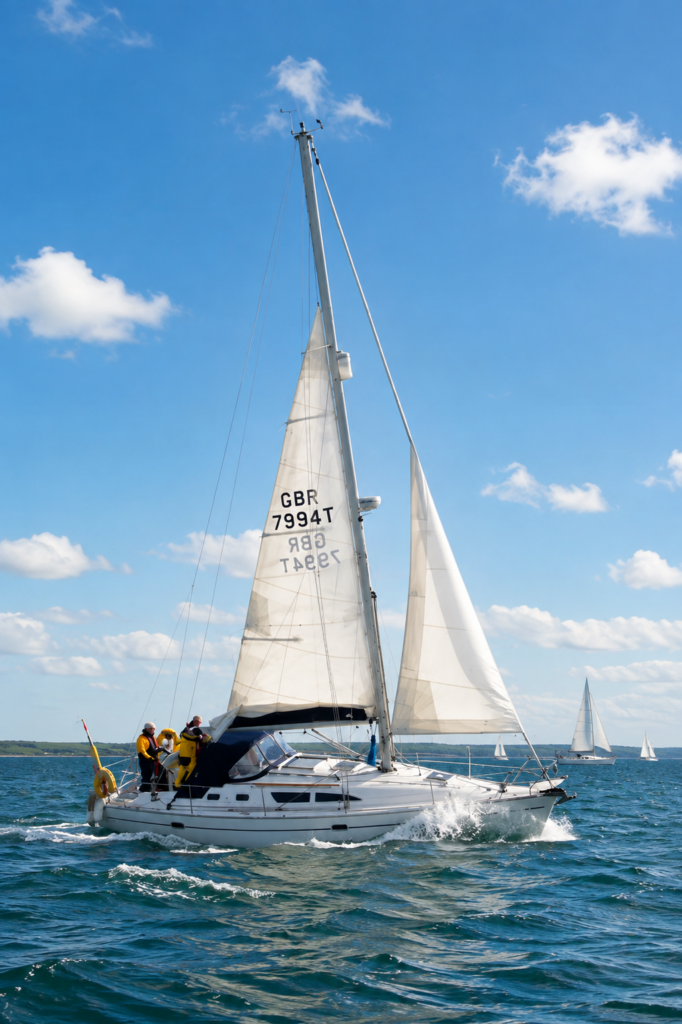
A cruising sailboat carries a reefed mainsail and reduced head sail to maintain better balance and control as the wind increases.
Quick Summary: How to Reef a Sailboat
The exact procedure depends on your boat’s reefing system, so always learn the arrangement and manufacturer’s instructions for the boat you sail.
For a typical cruising sailboat with slab or jiffy reefing, the basic process is:
Decide to reef before the boat becomes badly overpowered.
Prepare the reefing lines and crew.
Reduce the load on the mainsail by heading up, easing the main sheet, or using another appropriate technique for your boat.
Ease the mainsail halyard enough to lower the sail to the reef point.
Secure the reef tack near the gooseneck.
Tension the reefing line to bring the new reef clew down and aft.
Re-tension the mainsail halyard.
Check that the reef tack and clew are properly secured.
Trim the mainsail and resume sailing.
Check the sail shape and all reefing lines.
The important principle is simple:
Reef early, reef methodically, and reef before conditions make the job difficult.
What Does Reefing a Sailboat Mean?
To reef a sail means to reduce its effective area.
On most cruising sailboats, reefing the mainsail involves lowering it partway and securing new attachment points so that the lower portion of the sail is no longer being used.
Imagine shortening the mainsail vertically.
Instead of the sail extending from the top of the mast all the way down to the boom, part of its lower section is gathered near the boom. A new tack and clew become the working lower corners of the sail.
The result is a smaller mainsail.
Many cruising mainsails have two or three reef positions. These are commonly called the first reef, second reef, and sometimes third reef.
Each progressively reduces the amount of mainsail exposed to the wind.
Reefing systems vary considerably between boats. Common arrangements include:
slab reefing
jiffy reefing
single-line reefing
separate tack and clew reefing lines
in-mast furling
in-boom furling
This article concentrates primarily on conventional slab reefing, because understanding that system makes the principles of mainsail reefing particularly easy to see.
The sequence on your own boat may differ.
Before attempting to reef underway, identify every component of your boat’s reefing system at the dock and consult the boat or equipment manufacturer’s instructions where available.
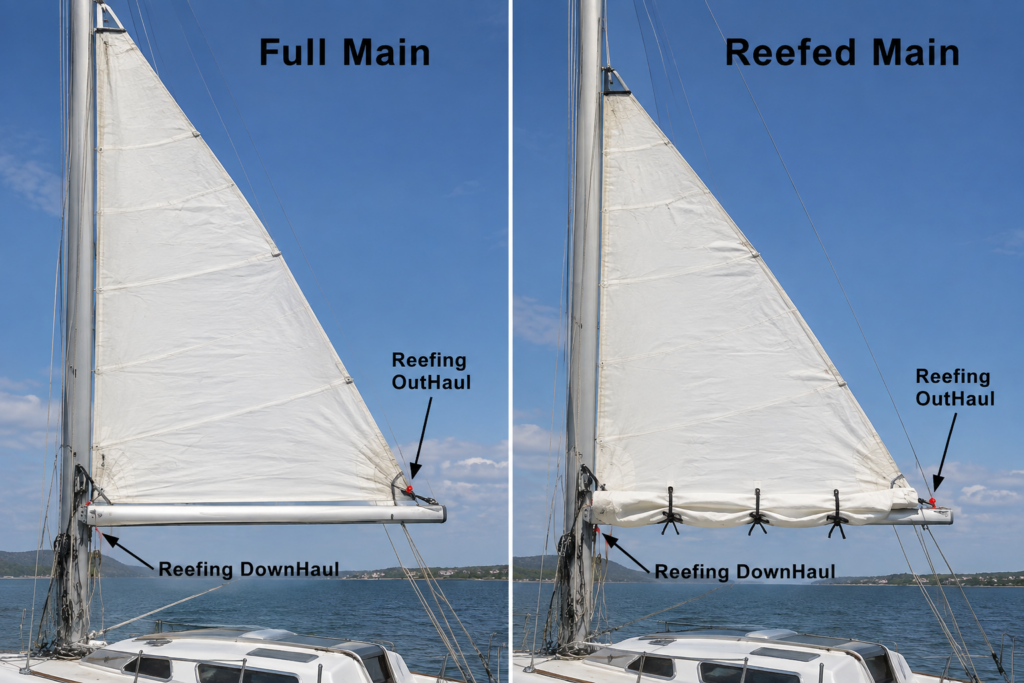
A full mainsail compared with a reefed mainsail. Reefing reduces sail area while the reefing downhaul and outhaul secure and tension the new lower corners of the sail.
Why Do Sailboats Need to Reef?
A sailboat needs enough sail area to capture useful energy from the wind.
But more sail area is not always better.
As wind speed increases, the forces generated by the sails increase dramatically. Eventually the sail plan produces more power than the boat can comfortably use.
The symptoms become obvious.
The boat may:
heel excessively
develop strong weather helm
become difficult to steer
round up repeatedly
require frequent main sheet easing
feel unsettled in gusts
become uncomfortable for the crew
This is called being overpowered.
Reefing reduces that excess power.
This fits naturally with something you have already learned about how to trim a sail: good sailing is not about extracting the maximum possible force from the sails at every moment.
It is about producing the appropriate amount of force.
Reefing is not admitting defeat
Beginners sometimes think reefing means the weather has become dangerous or that the skipper has somehow failed to control the boat.
Experienced sailors generally view it very differently.
Reefing is simply another form of sail trim.
You adjust your sheets when the wind angle changes.
You adjust your course when necessary.
And when wind strength changes enough, you adjust the size of your sail plan.
The RYA includes reefing among the practical sail-handling skills taught in its Competent Crew program, which is aimed specifically at sailors progressing from passengers toward useful, active crew members.
That is exactly how a beginner should think about reefing: normal seamanship rather than an emergency response.
Sailors who want structured practical training can also explore the RYA Competent Crew course, which includes reefing among the fundamental sail-handling skills taught aboard cruising yachts.
How Do You Know When It’s Time to Reef?
There isn’t one universal wind speed at which every sailboat should reef.
That’s important.
A lightweight 22-foot sailboat and a heavy 40-foot cruising yacht can respond very differently to the same wind. Sail design, boat displacement, sea state, point of sail, crew experience, gusts, and sail condition all affect the decision.
Your boat’s manual or sail maker may provide recommended reefing guidance.
But beginners should also learn to recognize what the boat is telling them.
Signs that you may be carrying too much sail
Consider reefing when you notice several of these symptoms:
Excessive heel
Some heel is normal. But if the boat is consistently heeled far enough that moving around becomes difficult or uncomfortable, reducing sail can help.
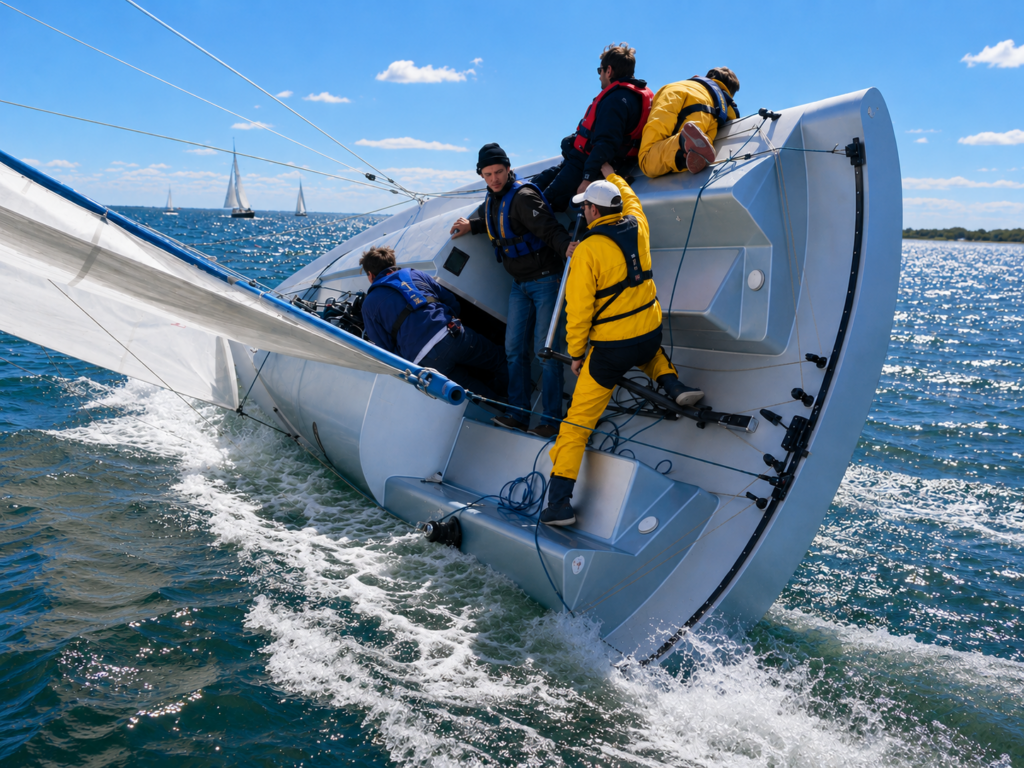
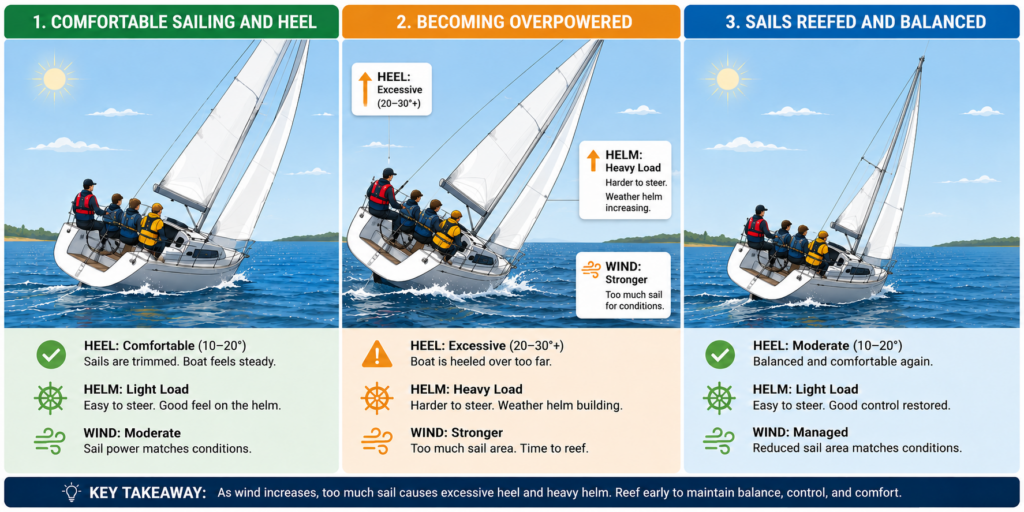
An overpowered sailboat heels sharply in stronger wind. Excessive heel and increasing difficulty controlling the boat are important signs that it may be time to reduce sail.
Heavy weather helm
If you need increasing tiller or wheel pressure to keep the boat from rounding toward the wind, the sail plan may be overpowering the boat.
Repeated main sheet easing
Easing the main sheet during an occasional gust is normal. Constantly dumping the main sheet just to keep the boat upright suggests it may be time for a more permanent reduction in power.
The boat repeatedly rounds up
If gusts are overpowering the rudder and forcing the bow toward the wind, reefing can restore control.
The crew is uncomfortable
Crew comfort matters. A boat does not need to be on the edge of control before reducing sail.
The wind is continuing to build
Don’t base the decision solely on what the wind is doing now.
Think about what it is likely to do next.
Reef Before You Need To
There is an old sailing principle worth remembering:
It is easier to put in a reef too early than too late.
The exact wording varies from sailor to sailor, but the lesson is sound.
Imagine two situations.
In the first, the wind is 14 knots and gradually building. The boat is still manageable. You have plenty of sea room. The crew can move around comfortably.
You decide to reef.
The operation is calm and controlled.
Now imagine waiting.
The wind reaches 22 knots with stronger gusts. The boat is heeled hard. Spray is coming over the bow. The mainsail is heavily loaded. Lines are under considerably more tension and the crew is already uncomfortable.
Now you decide to reef.
You are performing exactly the same operation—but under much more difficult conditions.
The safest reef is often the reef you put in before you are certain you need it.
If conditions later moderate, you can always shake it out.
As wind increases, excessive sail area can cause greater heel and heavier weather helm. Reefing reduces sail area and helps restore balance, comfort, and steering control.
Why Reefing Can Make a Sailboat Faster
This surprises many beginners.
You reduce the sail area.
Surely the boat must slow down.
Sometimes it does.
But an overpowered sailboat isn’t necessarily converting all that extra sail force into forward speed.
Excessive heel can make the hull and rudder work less efficiently. Weather helm creates drag. The sails may need to be repeatedly eased. The helmsman may be constantly correcting course.
The boat has plenty of power—but isn’t using it efficiently.
Put in a reef and several things can improve at once.
The boat sails flatter.
The rudder becomes easier to control.
Weather helm may decrease.
The sail shape becomes manageable.
The boat tracks more consistently.
The crew can concentrate on sailing rather than simply holding on.
You may discover that the boat maintains nearly the same speed—or occasionally sails faster.
This is an important lesson:
The goal isn’t maximum sail area. The goal is the right sail area for the conditions.
Know Your Reefing System Before Leaving the Dock
Do not wait for a windy afternoon to figure out how your reefing system works.
Inspect it at the dock.
Find the reef points in the mainsail.
Identify the reef tack near the luff.
Identify the reef clew near the leech.
Follow every reefing line.
Find its turning blocks.
Find the clutch, cleat, or winch used to tension it.
Check which reef each line controls.
If your boat uses reefing hooks at the gooseneck, learn how the tack cringle fits onto them.
If your boat uses single-line reefing, trace the line from beginning to end.
Then practice.
Raise the mainsail at the dock only when conditions and your location make doing so safe, or have an experienced instructor demonstrate the system.
A five-minute inspection alongside the dock can prevent enormous confusion later.
If the halyard, boom fittings, cleats, and sail attachment points are still unfamiliar, review our guide to How to Rig a Sailboat before learning to reef underway.
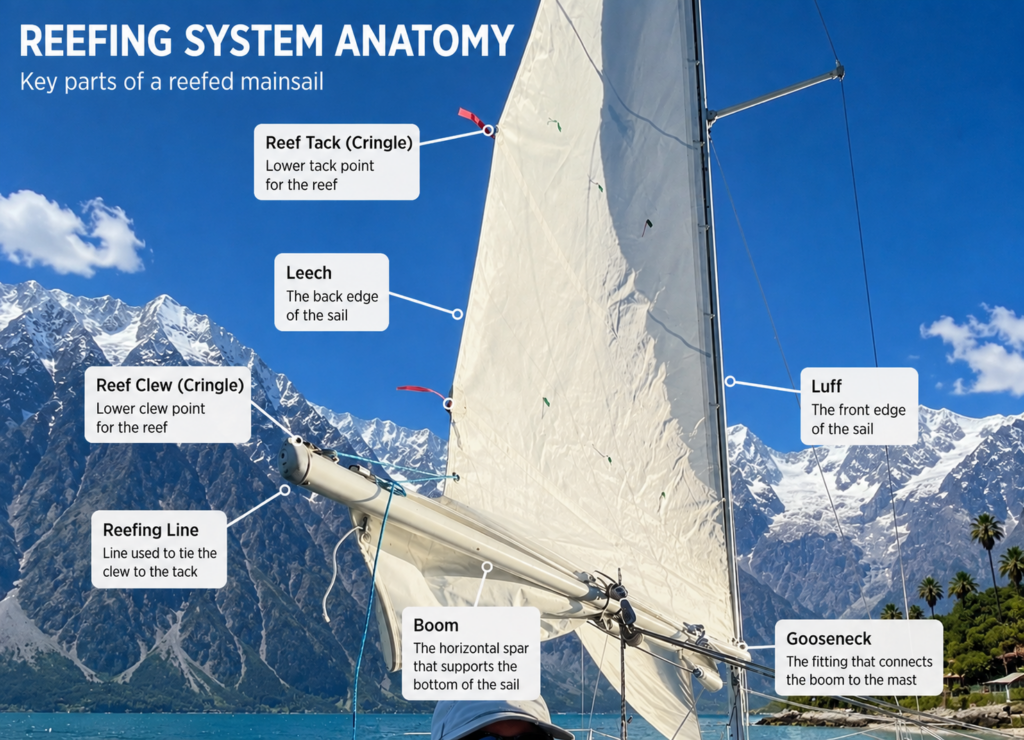
The main parts of a sailboat reefing system, including the reef tack, reef clew, reefing line, boom, gooseneck, luff and leech.
How to Reef a Mainsail: Step by Step
Let’s walk through a conventional reefing procedure.
Remember: boats differ.
The correct order on your boat depends on how its reefing system is rigged. Treat this as an explanation of the underlying process, not a substitute for the instructions for your particular vessel.
Step 1: Decide to Reef
The first step happens before anyone touches a line.
Recognize that the boat is becoming overpowered—or that conditions are likely to become stronger—and make the decision.
Don’t wait until the boat becomes difficult to manage.
Tell the crew what you intend to do.
For example:
“Let’s put the first reef in.”
A calm crew briefing makes the maneuver predictable.
Reefing decisions become much easier once you learn How to Read the Wind, particularly when you can recognize gusts and building conditions before the boat becomes overpowered.
Step 2: Prepare the Boat and Crew
Before reefing, check your surroundings.
Do you have enough sea room?
Where is traffic?
Are there nearby hazards?
Who will steer?
Who will handle the halyard?
Who will control the reefing line?
Everyone working on deck should wear an appropriate PFD or lifejacket, and crew should keep clear of the boom and loaded lines.
Prepare the necessary lines before changing course.
A reef should be a deliberate sequence—not a scramble.
Step 3: Reduce the Load on the Mainsail
Before lowering the mainsail, you need to reduce the force acting on it.
One common approach is to head toward the wind enough that the mainsail begins to depower while maintaining control of the boat.
Ease the main sheet as appropriate.
The objective is to remove enough pressure from the sail that it can be lowered without fighting enormous aerodynamic loads.
Exactly how you accomplish this depends on the boat, conditions, reefing arrangement, and crew.
This is also where an earlier seamanship skill becomes particularly useful.
Heaving-to before reefing
On many cruising sailboats, heaving-to can create a much calmer platform for reefing because the boat slows down and the loads on the sails become easier to manage.
Instead of the crew trying to reef while the boat charges through the water, heaving-to may give everyone more time and stability.
However, boats behave differently when hove-to, so this technique should be practiced in moderate conditions before relying on it when the wind increases.
The mainsail needs to be depowered enough to work with safely.
Ease the main sheet as required for your course and reefing procedure.
If the sail remains heavily loaded, friction can make lowering it difficult.
Be especially aware of the boom.
As main sheet tension changes and the sail depowers, the boom can move.
Keep heads, hands, and bodies clear.
Step 5: Lower the Mainsail to the Reef Point
Now ease the mainsail halyard.
Don’t simply release it.
Lower the sail in a controlled manner until the reef tack reaches the appropriate position near the boom and gooseneck.
You only need to lower enough sail to establish the new tack.
One common beginner mistake is lowering far too much mainsail and ending up with a pile of loose sail around the boom.
Work deliberately.
Ease.
Watch.
Stop at the correct position.
Step 6: Secure the Reef Tack
The new tack must now be secured near the forward end of the boom.
Depending on the boat, this may involve:
placing a reef cringle over a reefing hook
tensioning a tack line
operating part of a single-line reefing system
Once secured, the reef tack becomes the new lower forward corner of the working mainsail.
Make sure it is properly seated before applying heavy tension elsewhere.
Step 7: Tension the Reef Clew
Next, tension the reefing line controlling the aft end of the reef.
This pulls the reef clew toward the boom and usually aft toward the end of the boom.
That aft component matters.
You aren’t merely pulling the sail downward.
You are also establishing tension along the new foot of the mainsail.
Continue tensioning until the reef clew is firmly positioned according to your boat’s system.
Use the winch if required—but remember that winches generate tremendous mechanical advantage.
If something refuses to move, stop and inspect the system rather than simply applying more force.
A reefing line may be caught.
The sail may be snagged.
A cringle may be incorrectly positioned.
The halyard may not have been eased enough.
Resistance is information.
Don’t automatically answer it with a bigger winch handle.
Step 8: Re-Tension the Mainsail Halyard
Once the reef tack is secured, tension the mainsail halyard again.
This restores proper luff tension to the shortened sail.
The reefed mainsail should not simply hang loosely from its reef points.
It should once again become a properly tensioned aerodynamic sail—just a smaller one.
Look along the luff.
Remove excessive horizontal wrinkles without blindly overtensioning the halyard.
Step 9: Secure the Loose Sail
Once the reef is established, you may have a fold of unused mainsail hanging beneath the new foot.
Some sails have intermediate reef points or reef ties that allow this loose material to be gathered.
These ties are generally intended to tidy loose sailcloth, not to carry the primary sailing loads.
Do not substitute them for properly securing the reef tack and clew.
And do not tie the sail so tightly around the boom that loads are transferred through areas of the sail not designed to carry them.
Follow your sail maker’s recommendations for your particular mainsail.
Step 10: Trim the Reefed Mainsail
Now return the boat to your intended course and trim the mainsail.
Sheet in gradually.
Watch the sail.
Watch the telltales.
Feel the helm.
The boat should begin sailing normally again—but with considerably less sail area.
This is the moment when many beginners understand why reefing is so useful.
The boat that felt aggressive a few minutes earlier may suddenly feel composed.
Step 11: Check the Entire Reef
Don’t finish the maneuver simply because the boat is moving again.
Inspect the system.
Check:
reef tack secure
reef clew secure
halyard properly tensioned
reefing line properly cleated
sailcloth not trapped or chafing
loose reefing lines secured
main sheet running freely
sail shape reasonable
crew and cockpit organized
Then look at the boat itself.
How much is it heeling?
How does the helm feel?
Is the boat easier to steer?
Has the repeated rounding-up stopped?
A successful reef should improve the whole boat, not merely make the mainsail smaller.
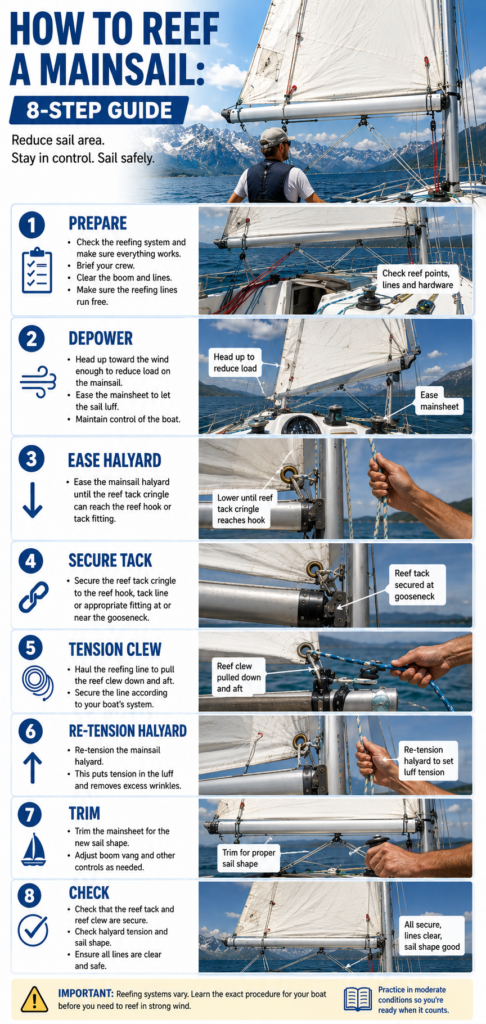
How to reef a mainsail in eight steps: prepare, depower, ease the halyard, secure the reef tack, tension the reef clew, re-tension the halyard, trim the sail, and check the finished reef.
What Is Single-Line Reefing?
Many modern cruising sailboats use single-line reefing.
Instead of separately securing the reef tack and then tensioning another line at the reef clew, one reefing line is routed through a system designed to control both ends.
The advantage is convenience.
In some boats, reefing can be performed largely or entirely from the cockpit.
But “single line” doesn’t mean “one step.”
You still need to:
depower the mainsail
ease the halyard
tension the reefing system
re-tension the halyard
check the tack and clew
inspect sail shape
Single-line systems can also develop considerable friction because the reefing line passes through several blocks and turning points.
Know the routing on your own boat.
If the system suddenly becomes unusually difficult to tension, investigate rather than forcing it.
How to Reef a Roller-Furling Jib
The mainsail isn’t the only sail that may need to be reduced.
Many cruising sailboats use a roller-furling jib or genoa.
These systems allow the head sail to be rolled around the forestay.
To reduce head sail area, the jib can often be partially furled.
The general concept is simple:
Reduce the load on the head sail.
Ease the working jib sheet under control.
Pull the furling line to roll part of the sail around the forestay.
Stop at the desired sail area.
Secure the furling line.
Re-trim the jib sheet.
Inspect the resulting sail shape.
But there is an important limitation.
A roller-furling genoa is generally designed to perform best when fully unfurled. As increasingly large portions are rolled away, sail shape can deteriorate.
Partially furling a head sail can therefore be useful for reducing sail area, but it is not necessarily equivalent to setting a smaller purpose-designed heavy-weather sail.
The appropriate reduction depends on the sail and furling system, so follow the sail maker’s and equipment manufacturer’s guidance.
And remember that reefing is not the same thing as preparing for extreme storm conditions. Offshore safety guidance may call for dedicated heavy-weather sails rather than relying solely on a deeply furled genoa. RYA cruising guidance, for example, distinguishes reefed mainsails from dedicated storm-sail arrangements for heavier conditions.
As sailors progress toward offshore and heavy-weather sailing, reefing becomes part of a much larger sail-reduction strategy. The RYA cruising training checklist illustrates this distinction by separately addressing mainsail reefing and dedicated storm sails for demanding conditions.
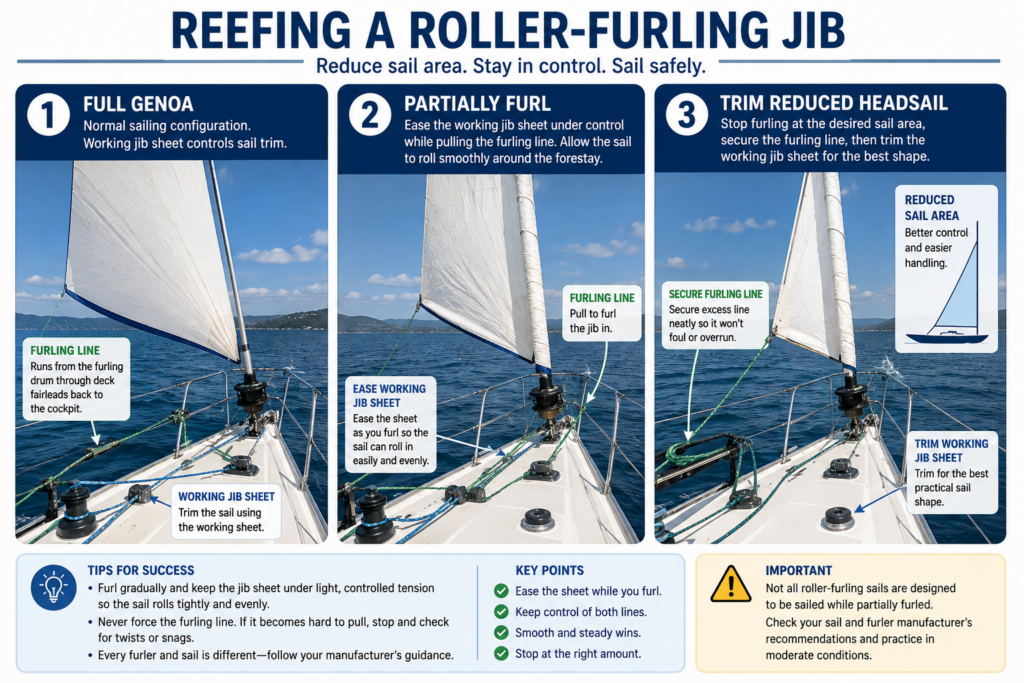
Reefing a roller-furling jib involves easing the working jib sheet while pulling the furling line, then securing the furling line and trimming the reduced headsail.
Should You Reef the Mainsail or Jib First?
There isn’t a universal answer.
Sailboats are designed differently.
Some boats become better balanced when the mainsail is reefed first.
Others may benefit from reducing a large genoa.
Eventually both sails may need to be reduced.
The important concept is balance.
Your mainsail and head sail work together. Changing the size or power of one can affect helm balance and handling.
After any sail reduction, ask:
How does the boat feel?
Is weather helm increasing or decreasing?
Is the boat sailing efficiently?
Is the heel comfortable?
Can the helmsman maintain course without fighting the rudder?
The correct reefing strategy for a particular boat is something worth discussing with the boat’s owner, sail maker, or experienced instructor.
How to Shake Out a Reef
Eventually the wind may decrease.
Now you can reverse the process and return to full sail.
Removing a reef is often called shaking out the reef.
Again, the exact procedure depends on your reefing system.
Generally, you will:
Prepare the crew and reefing lines.
Reduce the load on the mainsail.
Ease the mainsail halyard slightly if necessary.
Release the reef clew line.
Release the reef tack.
Hoist the mainsail fully.
Re-tension the halyard.
Trim the mainsail.
Secure the reefing lines.
Inspect the sail.
Don’t forget the last step.
Reefing lines that were tight with the reef installed may become very loose once the mainsail is fully raised.
Make sure they cannot snag, trail overboard, or interfere with other equipment.
Common Beginner Reefing Mistakes
Reefing becomes straightforward with practice, but several mistakes appear repeatedly.
Waiting too long
This is probably the most important.
If you are already struggling to control the boat, reefing becomes harder.
Act earlier.
Fighting the sail while it is loaded
If the mainsail is still generating substantial power, lowering and controlling it can become unnecessarily difficult.
Depower first.
Releasing the halyard too quickly
A controlled lowering is much easier than dumping several metres of mainsail onto the boom.
Ease deliberately.
Forgetting to secure the reef tack
The reef clew line is not a substitute for a properly secured tack.
Both ends matter.
Using excessive winch force
If something is jammed, investigate.
Don’t automatically grind harder.
Treating reef ties as structural reefing points
Their primary purpose on many mainsails is to gather loose sailcloth.
The major sailing loads should be carried by the reef tack and clew arrangements designed for them.
Forgetting to re-tension the halyard
A reefed sail still requires proper luff tension.
Ignoring sail trim after reefing
Smaller does not mean automatically correct.
Trim the sail.
Reefing by wind speed alone
Wind speed can inform your decision, but the behavior of the boat matters enormously.
Learn to recognize excessive heel, helm load and poor control.
Never practising
The worst time to reef for the first time is when you urgently need a reef.
Practise in moderate conditions.
Reefing and Heavy Weather
Learning to reef does not mean you’re ready for heavy-weather sailing.
That’s an important distinction.
Reefing is a normal sail-management technique that may be used in quite ordinary conditions.
As conditions become substantially stronger, however, additional considerations arise:
sea state
crew safety
harnesses and tethers where appropriate
storm sails
navigation
visibility
breaking waves
equipment loads
safe course selection
emergency planning
Don’t intentionally seek severe conditions simply to practice reefing.
Learn the mechanics in manageable weather first.
Then gradually expand your experience.
A Beginner Reefing Practice Exercise
The best way to learn reefing is to practice before you need it.
Choose a day with moderate wind, adequate sea room, and preferably an experienced sailor aboard.
Then practice the complete sequence.
Start sailing normally.
Announce:
“Prepare to reef.”
Check your surroundings.
Assign crew roles.
Depower the mainsail.
Ease the halyard.
Secure the reef tack.
Tension the reef clew.
Re-tension the halyard.
Resume your course.
Trim.
Inspect.
Sail for several minutes with the reef installed.
Pay attention to how the boat feels.
Then practice shaking the reef out.
Repeat the exercise.
The objective isn’t speed.
The objective is to make the sequence predictable.
Eventually you want reefing to feel no more mysterious than tacking.
You recognize the need.
You prepare.
You perform the sequence.
You check the result.
Then you continue sailing.
Frequently Asked Questions About Reefing a Sailboat
What does reefing a sailboat mean?
Reefing means reducing the effective area of a sail so the boat generates less power. On a conventional mainsail, this normally involves lowering the sail partway and securing a new tack and clew.
When should I reef a sailboat?
Reef before the boat becomes seriously overpowered. Excessive heel, increasing weather helm, repeated rounding up, constant main sheet easing, uncomfortable crew, and a forecast or observation of increasing wind can all indicate that it is time to reduce sail.
At what wind speed should I reef?
There is no single wind speed appropriate for every sailboat. Boat design, sail plan, sea state, crew, point of sail and manufacturer recommendations all matter. Learn your particular boat rather than relying solely on a universal number.
Does reefing make a sailboat slower?
Not necessarily. Reefing an overpowered sailboat can reduce heel, weather helm and rudder drag while improving control. In some conditions the boat may maintain similar speed or even perform better.
What is slab reefing?
Slab reefing reduces mainsail area by lowering part of the sail and establishing a new tack and clew at designated reef points.
What is jiffy reefing?
Jiffy reefing is a commonly used term for a quick slab-reefing arrangement in which reefing lines and hardware make reducing the mainsail relatively fast and straightforward.
What is single-line reefing?
Single-line reefing uses one line routed through the reefing system to help control both the forward and aft reef points. The precise arrangement varies between boats.
Can you reef while sailing?
Yes. Reefing underway is a normal sailing operation. The crew typically reduces the load on the mainsail before lowering and securing the reef.
Can you reef while hove-to?
On many cruising sailboats, heaving-to can provide a slower and more stable platform for reefing. However, boats behave differently when hove-to, so practice the technique in manageable conditions first.
Can you reef a roller-furling jib?
Many roller-furling headsails can be partially furled to reduce sail area. Sail shape may deteriorate as more sail is rolled away, however, and the sail and furling-system manufacturer’s recommendations should be followed.
What does “shake out a reef” mean?
Shaking out a reef means removing the reef and returning the mainsail to a larger or full-sail configuration when conditions permit.
Reefing Is About Control, Not Fear
There is an important change happening in your sailing education when you learn to reef.
At first, sailing lessons are mostly about making the boat do things.
Steer here.
Trim the sail.
Tack.
Jibe.
Sail upwind.
Sail downwind.
Reach.
Then the lessons begin changing.
You learn how to stop a sailboat, which teaches you to remove its driving force.
You learn how to heave-to, which teaches you to deliberately balance opposing forces and place the boat into a controlled, low-energy state.
And now you learn to reef.
Reefing teaches a slightly different lesson:
You don’t have to stop sailing when the wind becomes stronger. You adapt the boat.
That’s a major step toward seamanship.
The beginner sees the boat heel farther and thinks:
I need to fight harder.
The developing sailor thinks:
The boat has more power than it needs.
And then does something about it.
A reefed sailboat should not feel like a boat that has surrendered to the weather.
It should feel like a boat that has been adjusted for it.
That distinction matters.
Because one of the most useful lessons you can learn in sailing is this:
When the boat becomes difficult to control, the answer is rarely to fight it harder.
Reduce the forces.
Restore balance.
Then keep sailing.
Beginner Reefing Quiz
Use this short quiz to check your understanding before moving on. Try to answer each question without looking back at the article.
1. What is the main purpose of reefing a sailboat?
A. To stop the boat completely B. To reduce sail area and control excess power C. To make the boat heel more D. To make tacking easier
2. Which of the following is a common sign that it may be time to reef?
A. The boat has very little heel B. The helm feels lighter than normal C. The boat develops excessive heel and heavy weather helm D. The sails are completely luffing
3. Why is it usually better to reef early?
A. Reefing only works in light wind B. The boat and sail loads are generally easier to manage before conditions become strong C. You cannot reef once the boat is moving D. Reefing early guarantees the boat will sail faster
4. Before lowering the mainsail to reef, what should you generally do?
A. Increase the load on the mainsail B. Tighten every line as hard as possible C. Reduce the load on the mainsail D. Turn directly downwind
5. What becomes the new lower forward corner of the mainsail after a reef is installed?
A. The reef tack B. The reef clew C. The head D. The leech
6. What is the purpose of tensioning the reef clew?
A. To raise the mainsail higher B. To pull the new clew down and aft and establish the new foot of the sail C. To furl the jib D. To loosen the sail completely
7. If a reefing line suddenly becomes very difficult to move, what should you do?
A. Use a larger winch handle and pull harder B. Have two people grind the winch C. Stop and check for a snag, jam, or incorrect setup D. Release the main sheet completely and ignore it
8. Can reefing sometimes make a sailboat sail better?
A. No. Less sail always means worse performance B. Yes. Reducing excessive heel and weather helm can improve efficiency and control C. Only when sailing directly downwind D. Only on racing boats
9. What does “shaking out a reef” mean?
A. Shaking water off the sail B. Tightening the reefing line C. Removing a reef and returning to more sail area D. Changing from the mainsail to the jib
10. Which statement best summarizes the main lesson of reefing?
A. Stronger wind means you should work harder to hold the boat on course B. The largest possible sail plan is always the fastest C. When the boat has too much power, reduce the power instead of fighting it D. Reefing should only be used during emergencies
Reefing Quiz Answer Key
1. B — Reduce sail area and control excess power. Reefing reduces the amount of sail exposed to the wind, helping an overpowered sailboat become more balanced and manageable.
2. C — Excessive heel and heavy weather helm. These are two important signs that the boat may be carrying more sail than conditions comfortably allow.
3. B — The boat and sail loads are easier to manage before conditions become strong. Reefing early usually means lower loads, a more comfortable crew, and a more controlled procedure.
4. C — Reduce the load on the mainsail. Depowering the mainsail makes it much easier to lower and reef safely.
5. A — The reef tack. Once the reef is installed, the reef tack becomes the new lower forward corner of the working mainsail.
6. B — Pull the new clew down and aft. Tensioning the reefing line positions the reef clew and helps establish proper tension along the new foot of the sail.
7. C — Stop and check for a snag, jam, or incorrect setup. If something suddenly requires excessive force, don’t simply pull harder. Find out what is causing the resistance.
8. B — Yes, reefing can improve sailing performance and control. Reducing excessive heel, weather helm, and rudder drag can make an overpowered boat easier—and sometimes faster—to sail.
9. C — Remove a reef and return to more sail area. When the wind decreases, “shaking out a reef” means reversing the reefing process and increasing sail area again.
10. C — When the boat has too much power, reduce the power instead of fighting it. This is the central lesson of reefing: match the amount of sail you carry to the conditions.
How Did You Do?
9–10 correct — Excellent! You have a strong understanding of the basic principles of reefing.
7–8 correct — Good work. You understand the fundamentals. Review the step-by-step reefing procedure before practising aboard a sailboat.
5–6 correct — Almost there. Review when to reef and how the tack, clew, halyard, and reefing line work together.
0–4 correct — Give the lesson another read. Concentrate on recognizing an overpowered sailboat and understanding the reefing sequence before moving on.
Beginner Tip: You don’t need to wait for strong wind to practice reefing. Learning the sequence in moderate conditions gives you time to understand your boat’s reefing system without the added pressure of a heavily loaded sail.