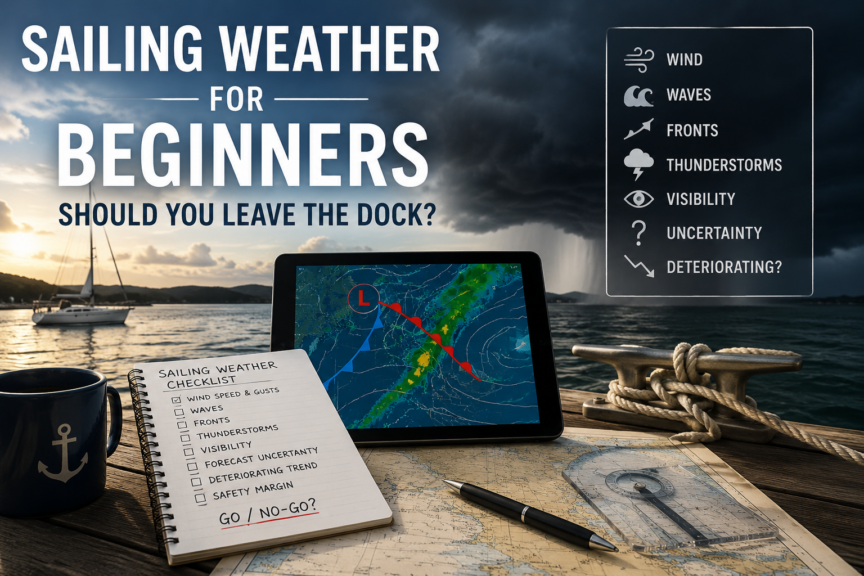
There is a moment before every sail when you make one of the most important decisions of the day.
It happens before the sails go up. Before the engine goes into gear. Before the dock lines come off.
You decide whether you should leave at all.
For experienced sailors, checking the weather becomes part of the routine. They look at the wind, gusts, waves, clouds, visibility, tide, current and what is expected later in the day. Often, they are not consciously working through a checklist. Years of experience have taught them which details deserve attention.
For a beginner, a marine forecast can look like a wall of numbers and unfamiliar words.
Wind northwest 10 to 15 knots increasing to 20 late this afternoon. Gusts 25. Seas 1 meter building to 2. Chance of thunderstorms.
Is that good sailing weather?
Should you reef?
Will the water be rough?
Is 20 knots too much?
What does “building” mean?
And perhaps most importantly:
Should you leave the dock in the first place?
That is the question this guide will help you answer.
Weather decisions in sailing are rarely based on one number. There is no universal wind speed at which sailing suddenly changes from “safe” to “dangerous.” A forecast has to be considered alongside your boat, your experience, your crew, your sailing area, the waves, the current and how easily you can get back to shelter.
The goal isn’t to teach you to become a meteorologist.
It is to teach you to look at a marine forecast and think like a cautious skipper.
By the end of this guide, you should be able to identify the important parts of a marine forecast, recognize conditions that deserve caution and make a much more informed go/no-go decision before leaving the dock.
About this Guide
Written by Kelly Hiebert, a recreational sailor since 2002 and a middle-school teacher. Kelly created Sailboat Zone to provide beginners with clear, structured sailing education.
Last reviewed: September 2026
Jurisdiction: This guide explains general marine-weather interpretation and go/no-go planning for recreational sailors, using Canadian marine-weather services as its primary reference. Forecast formats, warning criteria and local conditions vary by region. Always check the current official marine forecast and warnings for your specific area and entire sailing window before departure.
Primary sources:
- Environment and Climate Change Canada — Guide to Marine Weather Forecasts
- Canadian Coast Guard — Marine Weather Forecasts and Conditions
- Environment and Climate Change Canada — Canadian Marine Warning Program
Safety note: Marine forecasts are decision aids, not guarantees of the conditions at your exact location. Check current official forecasts and warnings before departure, continue monitoring them while underway and compare them with actual conditions. Postpone or alter the trip when the weather, uncertainty or available safety margin exceeds the abilities of the boat or crew.
Why Weather Matters So Much to Sailors
Weather matters in almost every outdoor activity, but sailing has an unusual relationship with it.
The wind is your engine.
The same wind that quietly pushes your sailboat across the water can also heel the boat, load the rigging, build waves and make maneuvering considerably more difficult.
A small increase in wind can completely change the character of a sailing trip.
A morning with 7 knots of breeze and nearly flat water might be an ideal learning environment. If that wind increases to 18 knots with gusts into the mid-20s during the afternoon, the trip home could feel very different.
Weather affects almost everything you do aboard a sailboat:
- Sail selection and reefing
- Boat speed
- Heel angle
- Steering
- Waves
- Crew comfort
- Docking
- Anchoring
- Visibility
- Navigation
- Emergency options
This is why experienced sailors don’t simply ask:
“Can the boat handle these conditions?”
Most cruising sailboats can handle considerably more weather than a beginner comfortably can.
A much better question is:
“Are these sensible conditions for this boat, this crew and this trip?”
That distinction matters.
If you’re learning, you want enough wind to sail well but enough margin to make mistakes, think through manoeuvres and solve small problems without everything happening at once.
A day can be technically sailable and still be a poor day for a beginner to leave the dock.
Start With a Marine Forecast — Not Just a Regular Weather App
One of the easiest beginner mistakes is checking the ordinary weather forecast and assuming you’ve checked the sailing weather.
You open your phone and see:
22°C. Partly cloudy. 20% chance of rain.
That might be useful if you’re deciding whether to bring a jacket.
It doesn’t tell you nearly enough to decide whether you should take a sailboat onto the water.
A proper marine forecast is designed around conditions that matter to people operating boats.
Depending on the forecasting service and location, it may include:
- Wind direction
- Sustained wind speed
- Gusts
- Waves or seas
- Swell
- Visibility
- Fog
- Precipitation
- Thunderstorms
- Significant weather changes
- Marine watches and warnings
For Canadian sailors, Environment and Climate Change Canada provides official marine forecasts and warnings for Canadian waters.
A recreational weather app can still be useful as an additional source. Some provide excellent hourly wind forecasts, radar and visual forecast models.
But don’t let a colorful wind map replace the official marine forecast.
There is another important limitation to understand.
Marine forecast areas can be large.
Your marina might sit inside a protected bay while the official forecast covers a much larger body of exposed water. Mountains, islands, valleys, headlands and shorelines can all modify the wind locally.
That means the forecast is not necessarily telling you exactly what will happen beside your boat.
It is giving you the broader weather picture from which you make your decision. Write it down. If you’re like me, I forget a name as soon as I meet a person. It’s the same with weather forecasts. A waterproof sailing logbook makes it easy to note the forecast, observed wind and your reasons for changing or postponing a trip. You will likely reference this later in your trip. And in the thick of it, you won’t be returning to your radio for updated weather forecasts, you’ll be too busy dealing with the weather you’re actually in.
Marine Forecast Terminology Beginners Need to Know
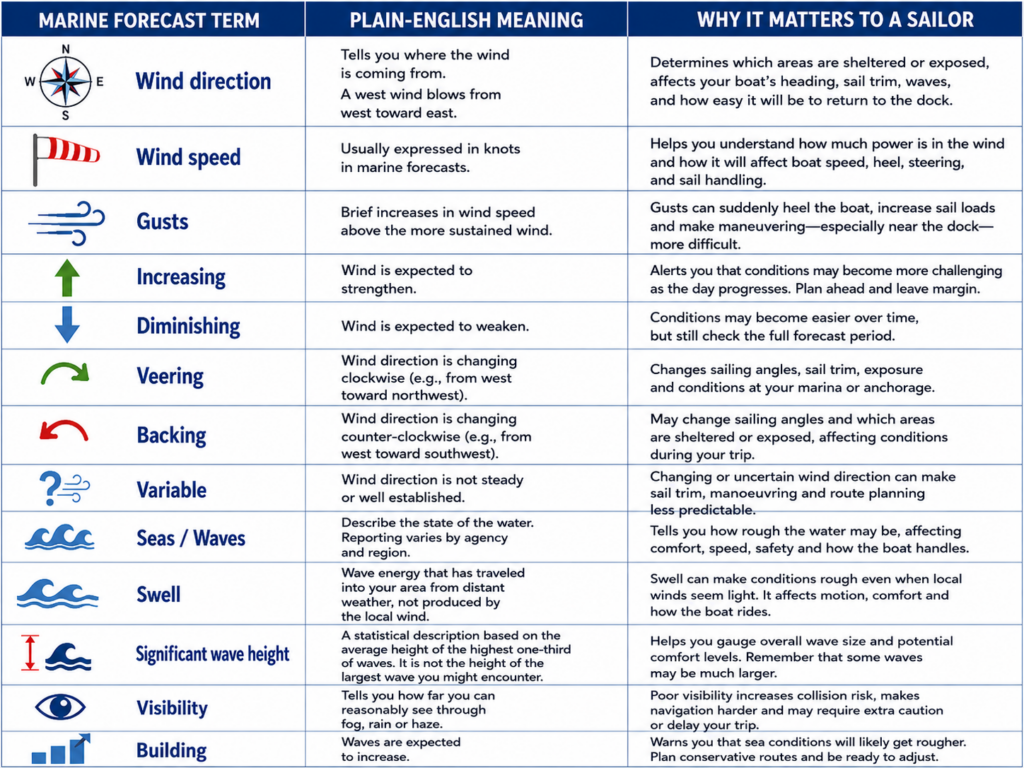
Marine forecasts become much easier to understand once you learn a small vocabulary.
You don’t need to memorize an entire meteorology textbook.
You do need to understand what the forecast is telling you.
Wind direction tells you where the wind is coming from. A west wind blows from west toward east.
Wind speed is usually expressed in knots in marine forecasts.
Gusts are brief increases in wind speed above the more sustained wind.
Increasing means the wind is expected to strengthen.
Diminishing means it is expected to weaken.
Veering generally means the wind direction is changing clockwise.
Backing generally means the wind direction is changing counter-clockwise.
Variable indicates that the wind direction is not steady or well established.
Seas or waves describe the state of the water, although exactly how these are reported varies by forecasting agency and region.
Swell is wave energy that may have traveled into your area from distant weather rather than being produced by the local wind.
Significant wave height is a statistical description of the sea state, traditionally based on the average height of the highest one-third of waves. It is not the height of the largest wave you might encounter.
Visibility tells you how far you can reasonably see through conditions such as fog, rain or haze.
Building means waves are expected to increase.
Subsiding means they are expected to decrease.
Thunderstorms deserve special attention because they can produce winds considerably stronger and more variable than the general forecast.
You’ll also encounter watches, advisories and warnings. Their names and exact criteria differ between countries and regions, so learn the terminology used by your local marine forecasting authority.
The important habit is not memorizing every possible forecast term.
It is refusing to ignore a term you don’t understand.
If the official marine forecast contains unfamiliar language, find out what it means before leaving.
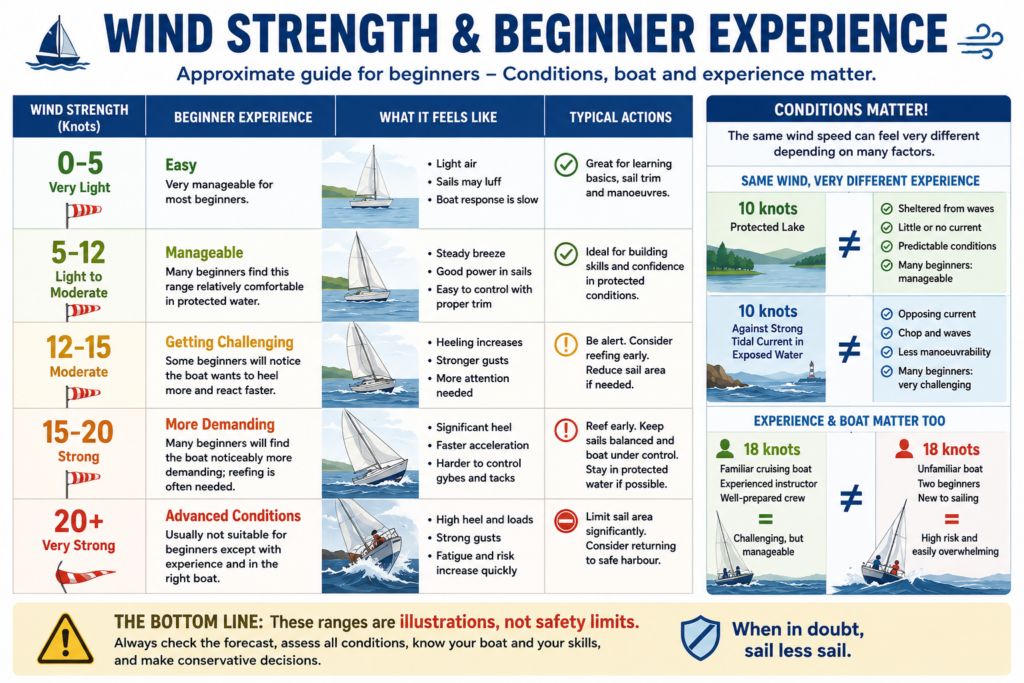
Understanding Wind Speed
Wind speed is usually the first number sailors look at.
Marine wind speeds are commonly given in knots.
One knot is one nautical mile per hour, approximately 1.85 kilometers per hour or 1.15 statute miles per hour.
But knowing the conversion isn’t nearly as important as learning what different wind strengths feel like aboard your boat.
Very light wind may make sailing difficult because the sails struggle to remain filled.
As the wind increases, the boat generally becomes more responsive. For many beginners, this moderate range is where sailing begins to feel wonderful. The sails fill consistently, the boat responds to the helm and manoeuvres happen predictably.
Increase the wind further and things begin happening faster.
The boat heels more.
Sheet loads increase.
Mistakes in sail trim become more noticeable.
Tacks and gybes require better coordination.
Docking becomes more demanding.
Eventually, reducing sail becomes necessary.
This leads to the question almost every beginner asks:
How much wind is too much for sailing?
Unfortunately, there isn’t one correct number.
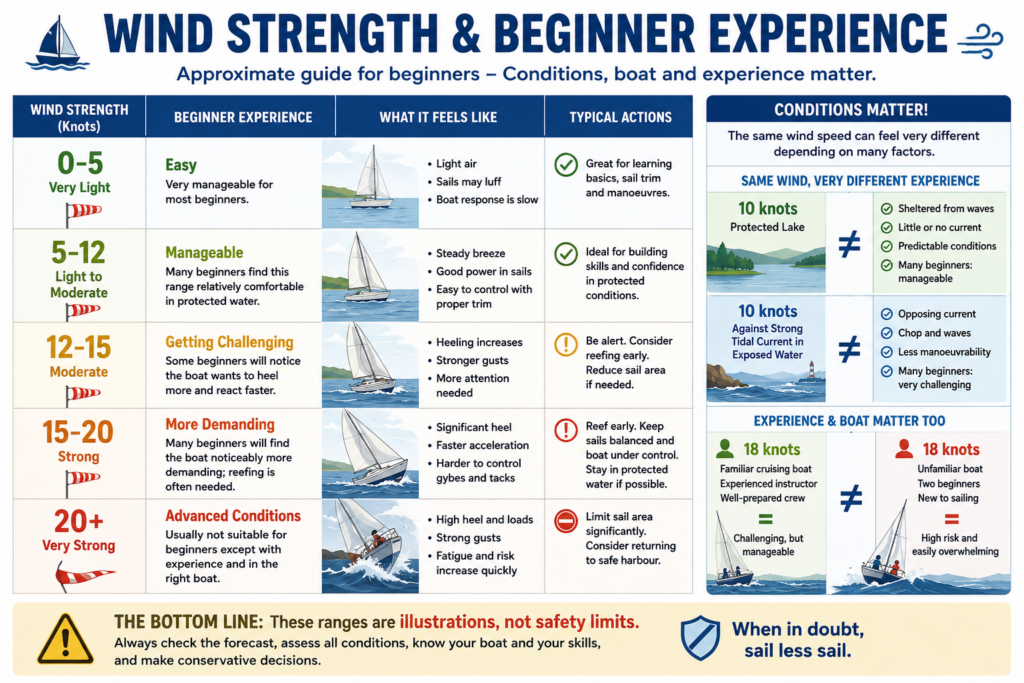
For learning purposes, many beginners may find something around 5–12 knots in protected water relatively manageable, assuming the boat and other conditions are suitable.
Once winds move into roughly the 15–20 knot range, many beginners will find the boat noticeably more demanding and may need to reef.
But those are illustrations, not safety limits.
Ten knots on a protected lake is not the same experience as 10 knots opposing a strong tidal current in exposed coastal water.
Similarly, 18 knots aboard a familiar cruising boat with an experienced instructor is very different from 18 knots aboard an unfamiliar boat with two people who started sailing last weekend.
Wind speed is information.
It is not permission.
Gusts: The Number Beginners Often Overlook
Suppose you see this forecast:
Wind 12 knots, gusting 22.
A beginner may see “12 knots” and think:
Perfect.
But your sails and your boat will certainly notice those 22-knot gusts.
A gust is a temporary increase in wind speed. When one reaches the boat, several things may happen almost simultaneously.
The boat may heel sharply.
The helm may become heavier.
Sail loads increase.
Loose objects can move.
An inexperienced crew member may become frightened.
And if you’re maneuvering near a dock when the gust arrives, the consequences can be much more significant.
This is why you should always look at both the sustained wind and the gust forecast.
A forecast of:
12 knots, gusting 15
is quite different from:
12 knots, gusting 25.
The average wind might be identical.
The sailing experience won’t be.
A large spread between the sustained wind and forecast gusts should make you pay attention.
Gusty conditions also influence reefing decisions. Waiting until the boat is repeatedly overpowered before reducing sail makes reefing harder than doing it early.
If stronger gusts are expected, prepare for the gusts rather than pretending only the lower number matters.
Wind Direction Matters as Much as Wind Speed
Imagine your marina is tucked behind a shoreline.
The forecast calls for 15 knots.
At the dock, however, the flags are barely moving.
It would be easy to conclude that the forecast is wrong.
Then you motor outside the protected harbour and suddenly find the full 15 knots.
Nothing mysterious happened.
The marina was sheltered.
Wind direction determines which areas are protected and which are exposed.
An offshore wind blows away from shore. Water immediately beside the shoreline may look relatively calm because the wind hasn’t had much distance to build waves.
That can be deceptive.
Sail farther offshore and conditions may become much stronger.
An onshore wind blows toward shore. Depending on the coastline, it can create larger waves and make a shoreline or harbour entrance more difficult.
A shoreline onto which the wind is blowing is often called a lee shore. This deserves particular respect because the wind is pushing the boat toward land rather than away from it.
Wind direction also affects your return trip.
A pleasant downwind sail away from the marina may mean an upwind return.
Ask yourself:
If the wind increases while I’m out here, what will the trip home look like?
That is skipper thinking.
Understanding Wave Height
Beginners sometimes think wind speed tells the whole story.
Then they encounter 15 knots with short, steep waves and wonder why the boat feels so uncomfortable.
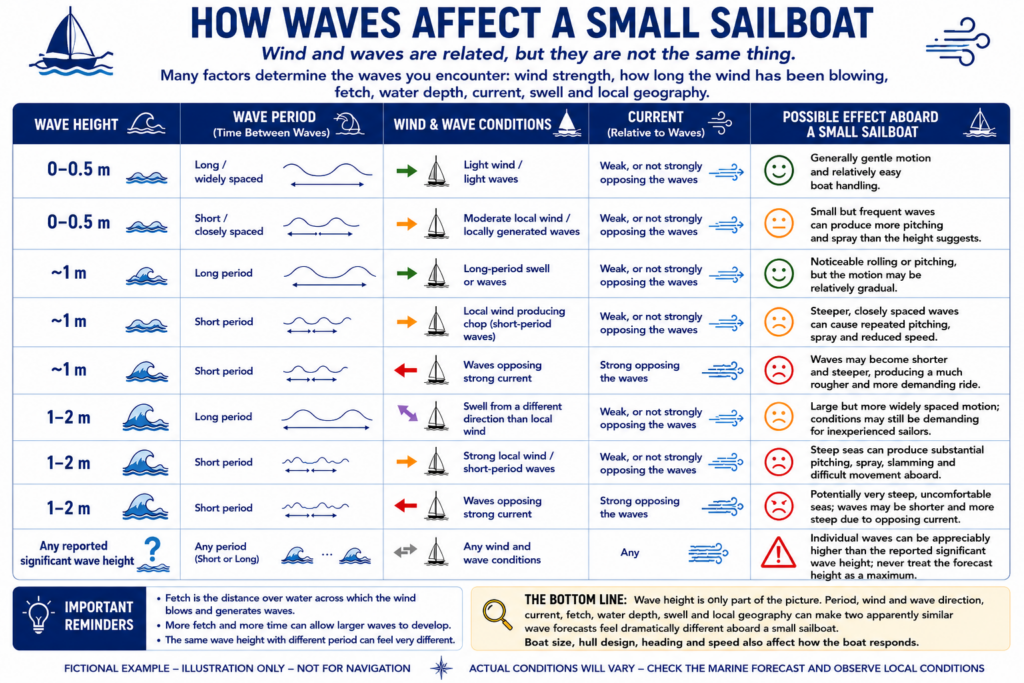
The answer is that wind and waves are related, but they are not the same thing.
Several factors determine the waves you encounter.
These include:
- Wind strength
- How long the wind has been blowing
- Fetch
- Water depth
- Current
- Swell
- Local geography
Fetch is the distance over water that the wind has been blowing.
If a 15-knot wind has only a short stretch of protected water over which to work, waves may remain relatively small.
Give that same wind many kilometers of open water and enough time, and the resulting waves can be much larger.
Wave period also matters.
Imagine two sets of one-meter waves.
One consists of long, gently spaced swells.
The other consists of short, steep waves arriving rapidly.
The reported wave height may be similar, but the experience aboard a small sailboat can be dramatically different.
Short, steep waves can slow the boat, throw spray across the deck and make movement uncomfortable.
One term worth understanding is significant wave height.
It does not mean that every wave will be that height, nor does it represent the largest possible wave. Individual waves can be appreciably higher.
So don’t interpret a forecast of one-meter significant waves as a promise that you will never encounter anything larger.
Look at the sea-state trend, not just the wave height
A sea-state forecast is more useful when you read it as a sequence rather than a single number.
Suppose the forecast calls for one-metre seas when you leave, but says seas will build to two metres during the afternoon. The important information is not simply that both numbers appear in the forecast. The important information is that conditions are deteriorating while you are expected to be on the water.
Also consider what is producing the sea state. Local wind waves may be building while an existing swell arrives from another direction. That can produce a confused or uncomfortable sea even when neither component looks extreme by itself.
Ask:
- Are the waves building or subsiding?
- Is the period becoming shorter or longer?
- Is swell arriving from a different direction than the local wind waves?
- Will the current change during the trip?
- Will wind oppose that current later?
- Will the roughest conditions occur on the return leg or near a difficult harbour entrance?
The skipper-thinking question is therefore not simply:
“What are the waves?”
It is:
“What are the waves likely to become before I am safely back?”
Wind Against Current Can Change Everything
One of the most useful coastal-weather lessons is also one of the easiest to overlook.
Wind opposing current can make waves shorter and steeper.
Imagine a strong tidal current moving east while the wind blows strongly from the east.
The water is moving toward the wind.
The resulting sea state can become much rougher than the wind speed alone might suggest.
This is why checking weather without checking tide and current can leave an important part of the picture missing.
A forecast of 15 knots might be perfectly manageable in one part of your trip and considerably less pleasant when the tidal current reverses.
This effect can be especially important around:
- Narrow channels
- Harbour entrances
- Headlands
- Tidal passes
- Shallow areas
The lesson is simple:
Don’t evaluate wind, waves and current independently. Look at how they interact. These interactions become especially important when evaluating an exposed route, harbour entrance or tidal pass, which is why they should also be considered during Route Hazards and Route Evaluation.
Fronts and Rapid Weather Changes
You don’t need to become an expert in weather systems to understand why fronts matter.
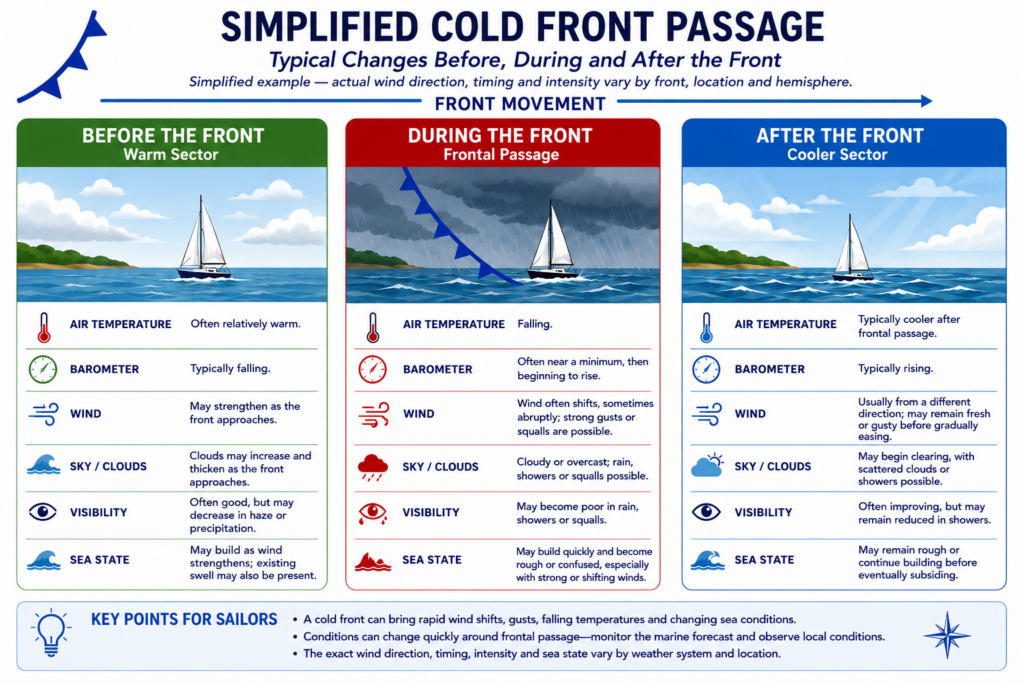
A front is a boundary between different air masses.
For sailors, the practical importance is that fronts can bring changes in:
- Wind strength
- Wind direction
- Temperature
- Cloud
- Rain
- Visibility
- Atmospheric pressure
- Thunderstorm potential
A cold front, for example, can be associated with a noticeable wind shift and stronger, gustier conditions around its passage.
The most important question for a beginner isn’t:
“Can I explain the atmospheric physics of this front?”
It is:
“When is it expected to reach me?”
Suppose you’re planning a four-hour sail and a front is forecast to pass through late in the afternoon.
That timing matters enormously.
If its expected arrival begins moving earlier as the forecast is updated, your comfortable weather window may be disappearing.
Thunderstorms Are a Different Category of Risk
Thunderstorms deserve more respect than a simple rain icon on your phone might suggest.
A thunderstorm can produce:
- Lightning
- Heavy rain
- Hail
- Rapidly changing wind
- Strong gusts
- Squalls
- Sudden wind shifts
- Reduced visibility
- Localized steep waves
Most importantly, the wind associated with a thunderstorm can be dramatically different from the general wind forecast.
You might have a forecast calling for moderate winds while a thunderstorm produces a short period of much stronger conditions.
That is why a forecast saying “chance of thunderstorms” deserves attention.
A 30% probability of thunderstorms does not mean:
“There is a 70% chance everything will be fine.”
Weather probabilities don’t work as a personal safety guarantee.
For a beginner, thunderstorm avoidance is generally a much better strategy than trying to learn how to manage a thunderstorm while underway.
If thunderstorms are likely during your planned sailing window, postponing the sail may be the sensible decision.
If conditions begin developing unexpectedly while you’re already sailing, consider heading toward safe shelter early rather than waiting to see how bad things become.
Visibility, Fog and Heavy Rain
Wind gets most of the attention in sailing weather.
Visibility deserves more.
Fog can turn familiar water into an unfamiliar place surprisingly quickly.
A shoreline you normally use as a reference may disappear.
Navigation marks become difficult to identify.
Other boats become harder to see.
Distances become difficult to judge.
Heavy rain, haze and smoke can create similar problems.
Electronic navigation helps enormously, but GPS does not make poor visibility irrelevant.
A chartplotter may show where you are.
It doesn’t guarantee that you will see a small fishing boat, kayak, floating debris or another vessel crossing your path.
Poor visibility becomes especially significant when combined with:
- Heavy vessel traffic
- Narrow channels
- Strong currents
- Unfamiliar water
- Nightfall
- Limited navigation experience
For a beginner still learning basic coastal navigation, good visibility provides valuable safety margin.
Forecast Uncertainty: Weather Forecasts Are Not Promises
Suppose tomorrow’s forecast says:
Wind 12 knots.
That does not mean someone has made an appointment for exactly 12 knots of wind to arrive at your mast.
Weather forecasts are predictions.
Good predictions, often.
Perfect predictions, never.
Wind may arrive earlier or later than expected.
A front may move faster.
Gusts may be stronger.
Thunderstorms may develop in one part of the forecast area but not another.
Local terrain may accelerate the wind.
Forecast uncertainty generally increases the farther into the future you’re looking.
This leads to one of the most important concepts in beginner seamanship:
margin.
Imagine that 15 knots is currently about the strongest wind in which you feel comfortable handling your boat.
If tomorrow’s forecast calls for 14–15 knots, you don’t have much margin.
If the forecast is slightly wrong on the stronger side, conditions may quickly move beyond your comfort level.
Now imagine the forecast is 8–10 knots.
You have considerably more room for the forecast to be imperfect before reaching your personal limit.
Good seamanship doesn’t require predicting the weather perfectly.
It requires leaving yourself room for the forecast to be wrong.
Recognizing a Deteriorating Forecast
Checking the forecast once is useful.
Checking how the forecast is changing can be even more useful.
Imagine that yesterday’s forecast for Saturday said:
Wind 8–10 knots.
This morning it says:
10–15 knots.
By lunchtime it says:
15 knots increasing to 20, gusting 25.
Something important is happening.
The forecast is trending toward stronger conditions.
Pay attention when successive forecasts show:
- Increasing wind
- Stronger gusts
- Building waves
- Earlier arrival of bad weather
- Thunderstorms appearing
- Visibility deteriorating
- Fronts arriving sooner
- New watches or warnings
- Increasing disagreement or uncertainty
A forecast changing from 10 knots to 12 knots isn’t automatically alarming.
The important skill is recognizing a pattern of deterioration.
Don’t become so committed to tomorrow’s sailing plan that you spend your time searching for the one forecast source that still gives you the answer you want.
Weather doesn’t care about your reservation, your vacation schedule or how long you drove to the marina.
Look at the Whole Sailing Window — Not Just Departure Time
This may be the most important practical lesson in this article.
Suppose you plan to leave at 10:00 a.m. and return around 3:00 p.m.
At 10:00:
Wind 8 knots.
Beautiful.
At noon:
Wind 12 knots.
Still comfortable.
At 2:00:
Wind 17 knots, gusting 24.
Now the situation is different.
If you only checked the forecast for your departure time, you missed the part that mattered most.
Before leaving, look at the forecast for your entire sailing window.
Ask:
- What will conditions be when I depart?
- What is the strongest wind expected while I’m sailing?
- What are the strongest expected gusts?
- Are waves expected to build?
- Is a front approaching?
- Could thunderstorms develop?
- What will the current be doing?
- What will conditions be when I’m trying to dock?
The last question is especially important.
Returning to the marina may require you to enter a narrow fairway, turn the boat and approach a dock at low speed.
That’s not when you want to discover that the wind has doubled.
A useful question before every trip is:
“What are the worst conditions I’m reasonably likely to encounter before I’m safely tied back to the dock?”
Local Weather Can Be Very Different
Marine forecasts cover areas.
Sailboats occupy very specific pieces of water.
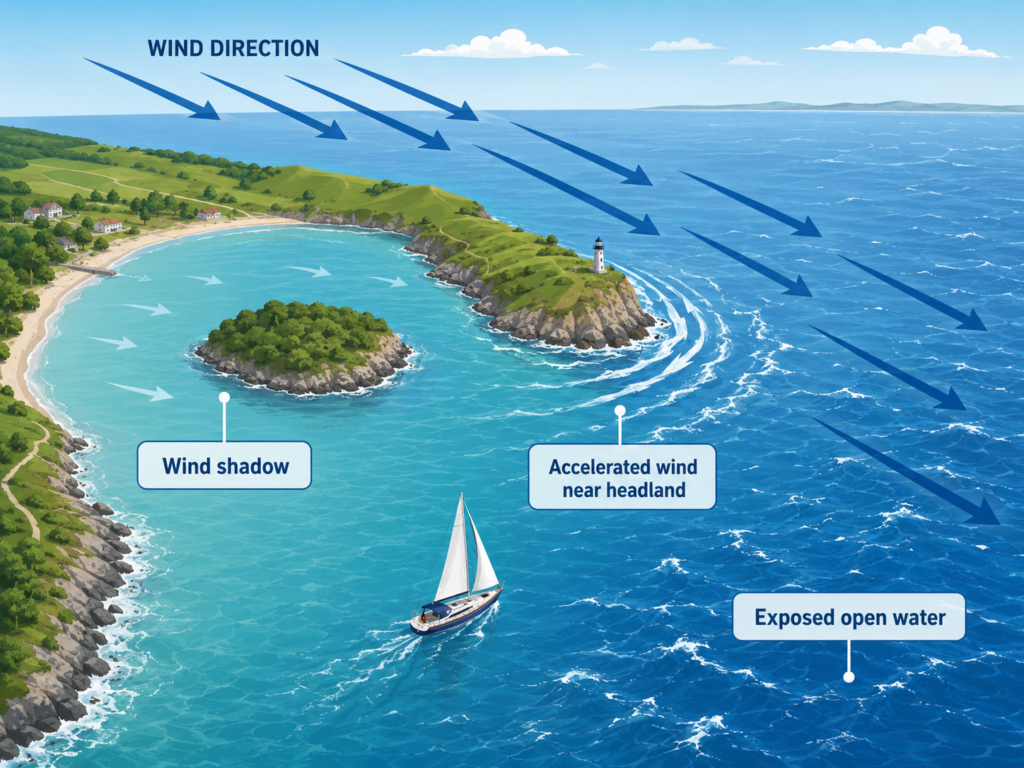
Local geography can create surprisingly different conditions within the same forecast region.
Mountains and valleys can funnel wind.
Headlands can accelerate airflow.
Islands can create wind shadows.
Protected bays can remain relatively calm while exposed water outside is considerably windier.
Heating of the land can also create local sea-breeze effects, sometimes causing wind to increase during the afternoon.
This is one reason local knowledge is so valuable.
When you begin sailing regularly from the same marina, talk to experienced sailors there.
Ask:
“What does this forecast usually mean here?”
You may learn that a particular wind direction creates rough conditions outside the harbour.
Or that the afternoon breeze regularly arrives earlier than the forecast suggests.
Or that one headland becomes particularly unpleasant when wind opposes the tide.
That knowledge develops gradually.
It is part of becoming a sailor.
The Beginner’s Go/No-Go Weather Decision
You have checked the forecast and take it with “a grain of salt”. A handheld weather meter such as the Kestrel 3000 can help you compare its measured wind with the forecast while learning, but use it as a supplement to an official marine forecast rather than a replacement.
With the general forecast known, and immediate conditions observed, now you have to make a decision.
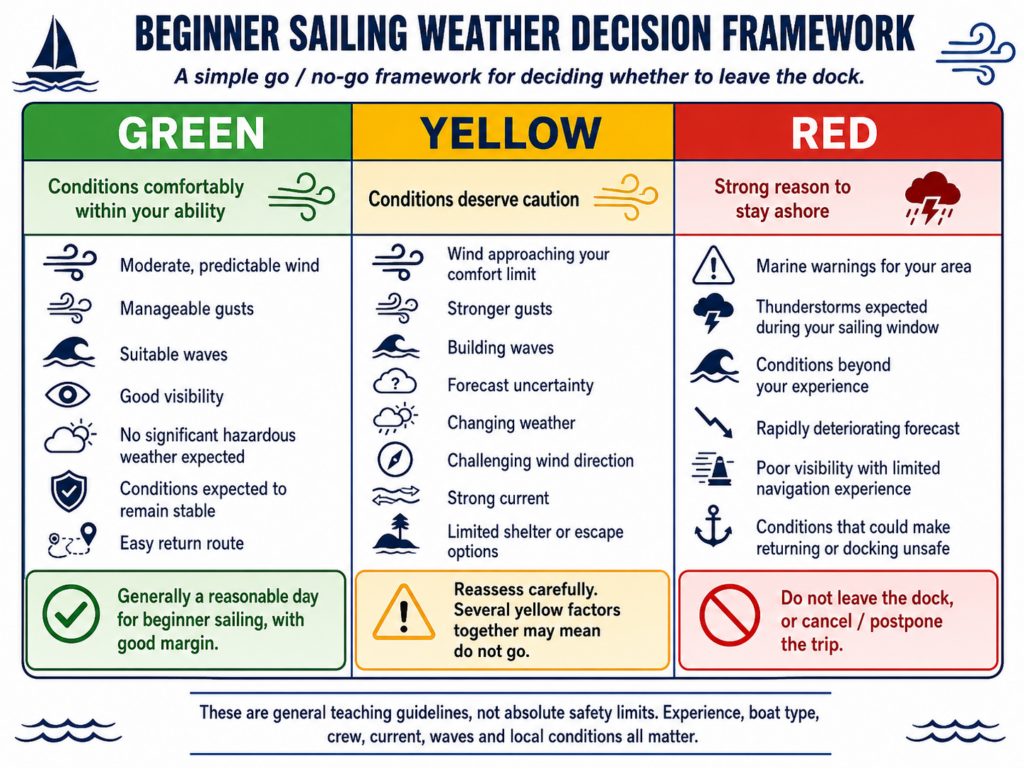
One useful way to organize your thinking is to imagine conditions as green, yellow and red.
These aren’t official marine-weather categories.
They’re simply a beginner decision-making tool.
Green: Conditions Comfortably Within Your Ability
Green conditions might include:
- Moderate, predictable wind
- Manageable gusts
- Comfortable waves
- Good visibility
- No hazardous weather expected
- Stable forecast
- Straightforward return route
The key word is comfortably.
You want margin.
Yellow: Conditions Deserve Caution
Yellow factors might include:
- Wind approaching your personal limit
- Strong gusts
- Building waves
- Changing weather
- Strong current
- Difficult wind direction
- Limited shelter
- Forecast uncertainty
One yellow factor may not cancel the trip.
But yellow factors accumulate.
Perhaps the wind is a little stronger than you’d prefer.
The current is also strong.
The waves are building.
And your most experienced crew member just canceled.
None of those factors exists in isolation anymore.
Together, they may make the decision obvious.
Red: Strong Reasons to Stay Ashore
For a beginner, red factors might include:
- Relevant marine warnings
- Thunderstorms expected during the trip
- Conditions clearly beyond your experience
- Rapidly deteriorating forecast
- Severe visibility restrictions
- Conditions that could make returning to the marina unsafe for your skill level
The point isn’t to create rigid rules.
It is to stop yourself from evaluating every risk separately.
Several moderate concerns can combine into one poor sailing decision.
Avoid the “One Number” Trap
Search online for “how much wind is too much for sailing?” and you’ll find plenty of numbers.
Be careful with them.
Consider five different days, each with 15 knots of wind.
Day one:
Protected water, experienced instructor aboard, flat sea.
Day two:
15 knots gusting 17.
Day three:
15 knots gusting 28.
Day four:
15 knots opposing a strong tidal current.
Day five:
15 knots blowing toward a lee shore with waves building.
The wind-speed number is identical.
The risk and difficulty are not.
Your boat matters too.
So does whether you’ve sailed it before.
So does whether you know how to reef it.
So does your crew.
So does water temperature.
So does distance from shelter.
So does daylight.
A single number cannot capture all of that.
Your Personal Weather Limits Should Be Conservative
As you gain experience, you’ll begin developing personal weather limits.
Those limits may change.
That’s normal.
A beginner who is comfortable in 10 knots today may feel completely relaxed in 15 knots after another season of sailing.
That doesn’t mean the earlier limit was wrong.
It means experience has increased capability.
Consider:
- Your experience
- Crew experience
- Familiarity with the boat
- Boat size and design
- Reefing ability
- Engine reliability
- Local knowledge
- Distance from shelter
- Traffic
- Water temperature
- Daylight
- Current
- Fatigue
There’s no prize for expanding your limits quickly.
The best way to become comfortable in stronger conditions is generally to gain experience progressively, ideally alongside sailors who already know how to manage those conditions.
When Staying at the Dock Is Good Seamanship
You drove an hour to the marina.
Your friends came with you.
Lunch is packed.
The boat is ready.
Everyone is excited.
Then you check the latest forecast.
It has deteriorated.
This is where decision-making gets harder.
There is a psychological pressure to go because you’ve already invested time and effort in the trip.
Resist it.
You are under no obligation to leave because you arrived at the marina.
You’re under no obligation to leave because other sailboats are going out.
Those sailors may have decades more experience than you.
They may have a different boat.
They may be sailing for 30 minutes.
They may be making a poor decision themselves.
You don’t know.
Choosing to remain at the dock because conditions exceed your limits isn’t a failed sailing trip.
It’s seamanship.
Sometimes the best sailing decision of the day is the one that keeps the sails in their bags.
A 5-Minute Pre-Departure Weather Routine
Before leaving, develop a routine.
It doesn’t need to take half an hour.
With practice, you can gather the essential information quickly.
1. Check the official marine forecast.
Read the entire forecast rather than looking only at the current wind.
2. Check marine warnings.
Don’t assume you’ll notice them elsewhere.
3. Check sustained wind.
What is expected now, and what is the maximum expected during your trip?
4. Check gusts.
How much stronger could they be than the sustained wind?
5. Check wind direction.
What does that direction mean for your sailing area and return route?
6. Check waves and swell.
Especially if you’re sailing exposed coastal water.
7. Check thunderstorms and precipitation.
Look at both probability and timing.
8. Check visibility.
Fog can matter as much as wind.
9. Look for major changes.
Is a front arriving? Are conditions increasing or diminishing?
10. Check tide and current.
Consider how they interact with wind and waves.
11. Look outside.
Does reality resemble the forecast?
12. Check your return-time forecast.
Don’t stop at departure time.
13. Consider your crew.
Are these appropriate conditions for everyone aboard?
14. Consider your alternatives.
Where can you go if conditions deteriorate?
15. Make the decision.
Go, modify the plan or stay at the dock.
Beginner Sailing Weather Checklist
Before taking off the dock lines, run through this quick check.
- Official marine forecast checked
- Marine warnings checked
- Sustained wind acceptable
- Gusts acceptable
- Wind direction understood
- Wave conditions acceptable
- Thunderstorm risk checked
- Visibility acceptable
- Fronts and weather changes understood
- Tide and current checked
- Return-time forecast checked
- Actual conditions match the forecast reasonably well
- Conditions are comfortably within my abilities
- Crew is comfortable with the plan
- I have an alternate plan if conditions deteriorate
If several of those boxes make you hesitate, pay attention to that hesitation.
You don’t need to convince yourself to go sailing.
Common Beginner Sailing Weather Mistakes
Several weather mistakes appear repeatedly among new sailors.
Checking only a normal weather app.
Temperature and chance of rain aren’t enough. Start with a marine forecast.
Looking only at sustained wind.
Always check gusts.
Checking only departure conditions.
Your return forecast may matter more.
Ignoring waves.
Moderate wind can still produce uncomfortable conditions.
Assuming sunshine means good sailing weather.
A bright, dry day can still be extremely windy.
Ignoring visibility.
Fog and heavy rain can transform a straightforward trip into a navigation problem.
Ignoring current.
Wind opposing current can dramatically change sea state.
Treating the forecast as exact.
Forecasts have uncertainty.
Using somebody else’s limits.
An experienced sailor’s comfortable conditions aren’t automatically yours.
Going because everyone is already at the marina.
Plans can be changed.
Failing to reassess conditions underway.
Weather decisions don’t stop when the dock lines come off.
Failing to prepare yourself, your own physical needs, for worsening conditions.
Approaching foul weather means wearing wet weather gear before you need to. It’s always easier to remove a jacket or a warm layer than it is to put it on when the weather worsens.
What to Do If the Weather Deteriorates While You’re Sailing
Even careful planning won’t prevent every weather surprise.
Sometimes conditions change faster than forecast.
The most important thing is recognizing deterioration early.
If the wind is steadily increasing, don’t wait until the boat is badly overpowered before reefing.
If dark clouds are developing and thunderstorms are becoming possible, don’t wait for lightning nearby before considering shelter.
If fog is forming, don’t continue blindly toward increasingly difficult water simply because that was the original plan.
As conditions deteriorate:
- Reduce sail early if appropriate.
- Decide if rain jacket and pants are worth wearing
- Consider heading toward protected water.
- Reassess the route home.
- Monitor updated forecasts.
- Keep the crew informed.
- Simplify manoeuvres.
- Increase your safety margin.
The earlier you act, the more options you usually have.
The Final Go/No-Go Question
You’ve checked the wind.
You’ve checked the gusts.
You’ve looked at waves, thunderstorms, visibility, fronts, tides and currents.
You’ve checked what the weather is expected to do later.
Now ask yourself one final question:
Are the worst conditions reasonably expected during this trip comfortably within my ability, my crew’s ability and my boat’s capabilities?
Notice the wording.
Not:
“Can I probably handle it?”
And not:
“Will the boat survive it?”
Those are very different standards.
A beginner sailing trip should give you room to learn.
You should have time to think.
Time to recognize mistakes.
Time to correct them.
And enough reserve capacity to deal with something unexpected.
If the weather removes all of that margin before you’ve even left the dock, wait for another day.
There will always be another forecast.
And there will always be another sailing day.
Sailing Weather for Beginners: Knowledge Check
1. A forecast says wind 10 knots, gusting 24 knots. Which number deserves consideration when deciding whether conditions are appropriate?
A. Only 10 knots
B. Only 24 knots
C. Both sustained wind and gusts
D. Neither if the sky is sunny
2. Why might 15 knots of wind create very different conditions in two sailing areas?
A. Wind speed is measured differently near land
B. Waves, current, exposure and geography may be different
C. Sailboats only respond to apparent wind
D. It cannot; 15 knots always produces similar conditions
3. You plan to sail from 10:00 a.m. until 3:00 p.m. Which forecast period should you check?
A. 10:00 a.m. only
B. 3:00 p.m. only
C. The entire period, including expected return conditions
D. The previous evening only
4. What can happen when strong wind opposes a tidal current?
A. Waves can become shorter and steeper
B. The wind stops affecting the boat
C. Waves always disappear
D. The current automatically weakens
5. What does significant wave height describe?
A. The largest possible wave
B. The height of every wave
C. A statistical description based on the higher portion of observed waves
D. The minimum wave height
6. Yesterday’s forecast predicted 8–10 knots. Successive updates now predict 15–20 knots with stronger gusts. What should you recognize?
A. Forecasts are meaningless
B. The forecast is trending toward deteriorating conditions
C. The original forecast is always more accurate
D. Gusts don’t matter
7. Why do thunderstorms deserve particular caution?
A. They only produce rain
B. They can produce strong gusts, lightning, rapid wind shifts and poor visibility
C. Sailboats attract every lightning strike in the area
D. They always last all day
8. Why shouldn’t a beginner simply adopt an experienced sailor’s maximum wind limit?
A. Experienced sailors measure wind differently
B. Appropriate limits depend on experience, boat, crew and conditions
C. Beginners need larger boats
D. Wind limits only apply to racing
9. You’re at the marina and several experienced sailors are leaving despite conditions being above your comfort level. What should you do?
A. Follow them because they prove conditions are safe
B. Leave before the weather becomes worse
C. Make your own decision based on your abilities, boat and crew
D. Assume your forecast is wrong
10. Why is forecast uncertainty important when conditions are already close to your personal limit?
A. There is little safety margin if actual conditions are stronger than forecast
B. Forecast uncertainty only matters offshore
C. Forecasts always overestimate wind
D. It isn’t important
11. The wind at your sheltered marina is light even though the marine forecast predicts stronger wind. What is a reasonable explanation?
A. Marine forecasts never apply near shore
B. The marina may be sheltered by local geography
C. Your wind indicator must be broken
D. Wind forecasts only apply at night
12. What is the best final question before leaving the dock?
A. Can the boat survive these conditions?
B. Are other boats going out?
C. Have I already spent too much time preparing to cancel?
D. Are the worst conditions reasonably expected during this trip comfortably within our abilities?
Sailing Weather for Beginners: Knowledge Check Answer Key
1. C — Both sustained wind and gusts
The sustained wind describes the general wind strength, while gusts show how much stronger the wind may become for short periods. A forecast of 10 knots gusting 24 knots can produce much more demanding conditions than a steady 10-knot wind.
2. B — Waves, current, exposure and geography may be different
The same wind speed can create very different sailing conditions depending on fetch, waves, tidal current, shoreline exposure and local terrain. Fifteen knots in protected water may feel very different from 15 knots in exposed coastal water.
3. C — The entire period, including expected return conditions
Always check the forecast for your whole sailing window. Conditions may be comfortable when you leave but considerably stronger or rougher by the time you return to the marina.
4. A — Waves can become shorter and steeper
When waves encounter a strong opposing current, their wavelength can shorten and their steepness can increase. This can create a rougher and more demanding sea state than the wind speed alone would suggest.
5. C — A statistical description based on the higher portion of observed waves
Significant wave height is commonly described as the average height of the highest one-third of waves. It is not the maximum wave height, and individual waves can be appreciably higher.
6. B — The forecast is trending toward deteriorating conditions
Successive forecasts showing stronger winds and gusts indicate a worsening trend. Comparing forecast updates can be just as important as reading a single forecast.
7. B — They can produce strong gusts, lightning, rapid wind shifts and poor visibility
Thunderstorms can create rapidly changing conditions that are much more severe than the general forecast suggests. Strong gusts, lightning, heavy rain and sudden wind shifts make them especially important for sailors to avoid or prepare for.
8. B — Appropriate limits depend on experience, boat, crew and conditions
There is no universal wind limit for every sailor. What is manageable depends on your skill level, the boat, crew experience, waves, current, shelter and other conditions.
9. C — Make your own decision based on your abilities, boat and crew
Other sailors may have more experience, a different boat or a different plan. Their decision to leave does not prove that the conditions are suitable for you.
10. A — There is little safety margin if actual conditions are stronger than forecast
Forecasts are predictions, not guarantees. If the forecast is already near your personal limit, even a modest increase in actual wind or waves could push conditions beyond what you are comfortable handling.
11. B — The marina may be sheltered by local geography
Hills, islands, buildings and shorelines can block or redirect wind. A marina may feel calm while stronger winds exist only a short distance away in more exposed water.
12. D — Are the worst conditions reasonably expected during this trip comfortably within our abilities?
This is the best question because it considers the whole sailing window, your crew, your boat and your experience. Good weather planning is about maintaining a comfortable safety margin, not simply asking whether the boat could survive the conditions.