
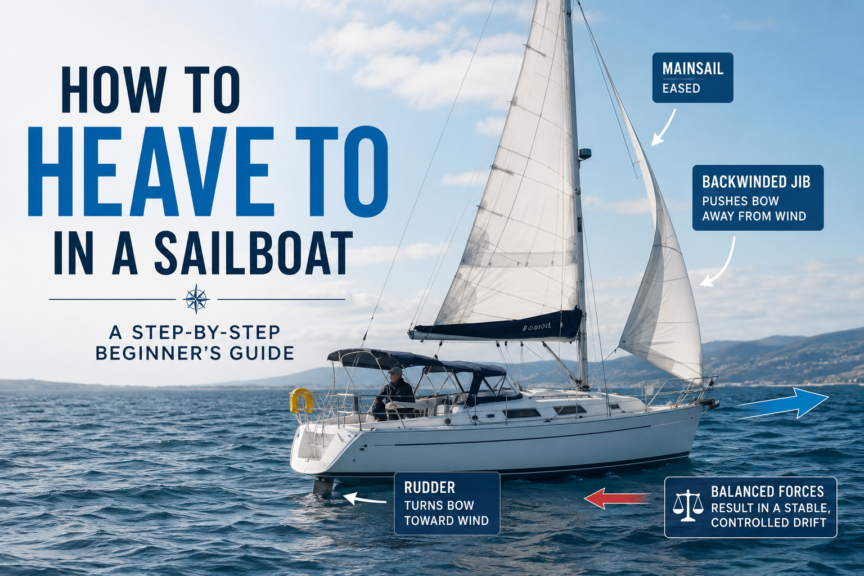
There comes a point in learning to sail when you discover that controlling a sailboat does not always mean making it go somewhere.
Sometimes, the best thing you can do is almost stop.
You may want a few quiet minutes to organize the cockpit. Someone aboard may need a break. You might need time to check your position, sort out a line, put on another layer of clothing, wait for another boat to pass, or simply reduce the workload while you decide what to do next.
This is where heaving-to becomes one of the most useful skills you can learn.
A sailboat that is properly hove-to is not completely stopped. Instead, the sails and rudder are deliberately arranged so that opposing forces largely balance one another. The boat usually makes very little forward progress and drifts slowly to leeward while remaining relatively stable and predictable.
For a beginner, this can feel almost magical.
One moment, you are actively steering and trimming the sails. A short maneuver later, the boat settles down and requires surprisingly little attention.
Learning how to heave to in a sailboat is therefore more than learning another maneuver. It is one of your first lessons in seamanship: using the characteristics of the boat and the wind to make sailing easier, safer, and more controlled.
In this guide, you’ll learn what heaving-to means, how the forces work, how to enter and leave the hove-to position, how to fine-tune it, and why different sailboats may require slightly different techniques.
BEGINNER TIP: Practise heaving-to for the first time in open water, moderate wind, flat or manageable seas, and well away from traffic, shorelines, shoals, docks, and other hazards.
Quick Summary: How to Heave To in a Sailboat
For a typical cruising sailboat with a mainsail and jib:
- Begin sailing close-hauled with good boat speed.
- Check that you have plenty of clear water around you.
- Prepare to tack.
- Turn the bow through the wind as you normally would.
- Do not release the jib sheet.
- Allow the jib to become backwinded on the new tack.
- Ease the mainsail as necessary.
- Steer as though you were trying to turn the boat back toward the wind.
- Hold the helm in that position.
- Give the boat time to slow down and settle.
- Fine-tune the mainsail, backed jib, and helm until the boat maintains a stable position.
- To resume sailing, release the backed jib, center the helm, steer onto your desired course, and trim the sails.
That is the basic sequence.
However, understanding why it works will make you much better at actually doing it.
What Does Heaving-To Mean?
Heaving-to is a sailing technique in which the sails and rudder are deliberately arranged to oppose one another, causing the boat to settle into a slow, relatively stable state.
When the boat has settled into this condition, we say the boat is hove-to.
The terminology can be confusing at first:
- Heave-to describes the maneuver.
- Heaving-to describes the process.
- Hove-to describes the boat once it has settled into the position.
For example:
“We’re going to heave-to.”
Then, after completing the maneuver:
“The boat is now hove-to.”
A hove-to sailboat will usually point somewhere roughly around a close-hauled orientation relative to the wind, though the exact angle varies considerably between boats and setups.
The important thing is not achieving a particular compass heading or wind angle.
The important thing is achieving balance.
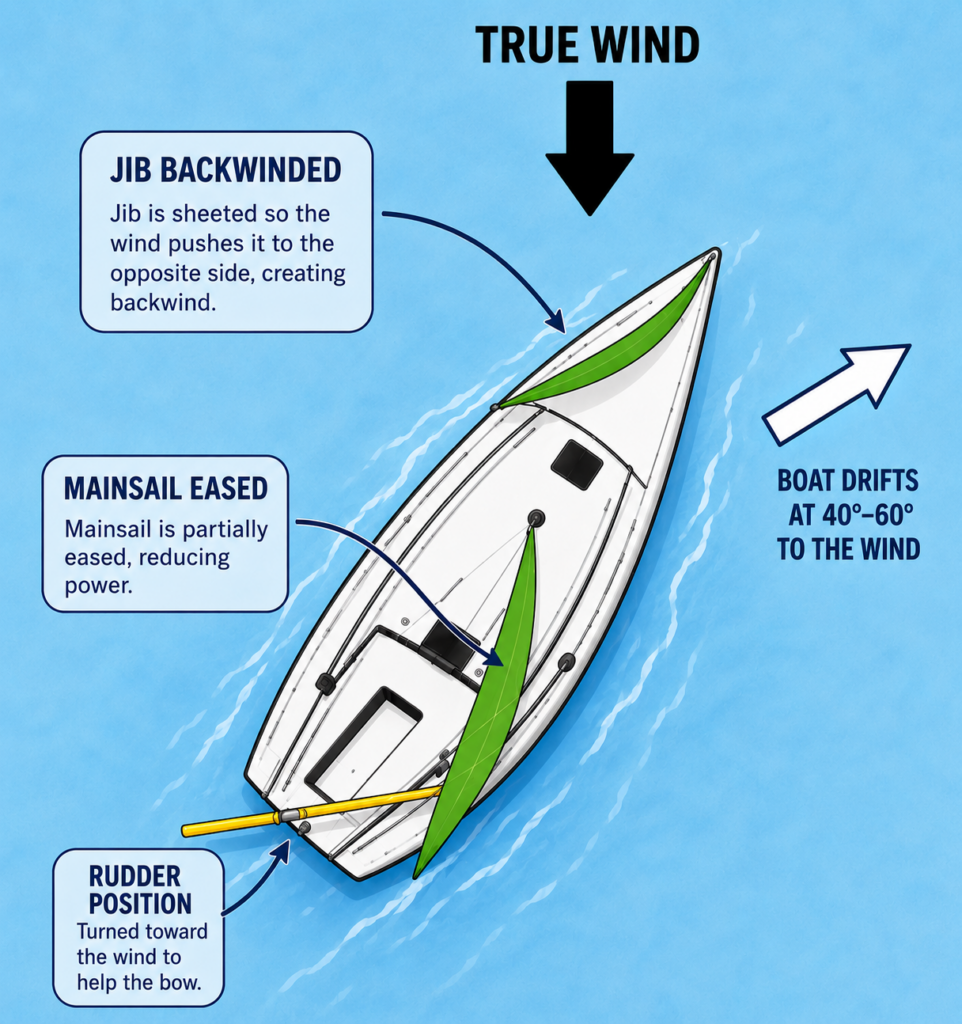
The backed jib tries to push the bow one way. The rudder tries to turn it the other way. The mainsail contributes another adjustable force.
When those forces are reasonably balanced, the boat settles down.
Heaving-To Is Not the Same as Stopping
If you’ve already learned How to Stop a Sailboat, there is an important distinction to understand.
When you stop a sailboat by heading toward the wind and allowing the sails to luff, you are deliberately removing the forces that drive the boat forward.
The boat slows.
Eventually, it may lose enough speed that the rudder becomes much less effective.
Heaving-to works differently.
Instead of simply removing propulsion, you deliberately create opposing forces.
The sails are still interacting with the wind. The rudder is still part of the system. However, instead of using those forces primarily to drive the boat efficiently forward, you arrange them so that they largely work against one another.
That distinction is fundamental.
Stopping is primarily about:
removing energy.
Heaving-to is primarily about:
balancing forces.
This is why a properly hove-to boat can remain surprisingly stable without constant steering.
Why Do Sailors Heave-To?
Heaving-to has a long association with offshore sailing and heavy weather, but that can make the maneuver sound more specialized than it really is.
You do not need to be crossing an ocean or dealing with a storm to find it useful.
For ordinary recreational sailors, heaving-to can simply provide a temporary pause button.
You might heave-to when you want to:
- take a short break;
- organize the cockpit;
- consult a chart or navigation display;
- put on foul-weather clothing;
- prepare food or drinks;
- deal with a minor equipment problem;
- brief inexperienced crew;
- wait for traffic to clear;
- reduce the workload aboard;
- wait before approaching a destination;
- reef or make other sail-handling tasks easier when appropriate;
- help someone who is feeling seasick;
- regain your composure after a difficult maneuver.
It can also be useful when you simply want time to think.
That may sound trivial while sitting comfortably at home. On a sailboat, however, creating a few minutes in which the boat requires less active management can be extremely valuable.
That is one reason heaving-to belongs in a beginner’s progression toward seamanship.
You’re learning to control the situation rather than merely react to it.
How Does Heaving-To Work?
To understand heaving-to, imagine three major forces acting on the boat.
The Backwinded Jib
Normally, the jib is trimmed on the leeward side of the boat.
During a tack, you release the old working jib sheet and trim the jib on the opposite side.
When heaving-to, you deliberately do not release the old jib sheet.
The boat turns through the wind, but the jib remains secured on what is now the windward side.
The wind therefore presses against the “wrong” side of the jib.
This is called backwinding the jib.
The backed jib tends to push the bow away from the wind.
The Rudder
Meanwhile, you position the rudder so that it tries to turn the boat back toward the wind.
This creates an opposing influence.
The jib wants the bow to fall away.
The rudder resists that tendency and tries to bring the bow back up.
The Mainsail
The mainsail provides the third major adjustment.
Depending on the boat, the mainsail may need to be eased considerably, trimmed somewhat, reefed, or otherwise adjusted until its contribution helps create a stable balance.
Together, these forces can create a kind of sailing stalemate.
The backed jib pushes.
The rudder resists.
The mainsail contributes enough drive and turning influence to help establish equilibrium.
The boat slows dramatically and generally begins making a controlled drift to leeward.
Before You Heave-To
Like a tack or jibe, a good heave-to begins before you move the helm.
First, look around.
You are about to deliberately reduce your boat’s speed and maneuverability, so you need enough room for the boat to drift.
Check:
- boats nearby;
- commercial traffic;
- shorelines;
- rocks and shoals;
- navigation marks;
- docks and mooring fields;
- current;
- your available sea room;
- the direction you expect to drift.
Remember that hove-to does not mean anchored.
Your boat will still move.
In many boats, most of that movement will be a slow drift generally toward leeward, potentially with some fore-and-aft motion as the boat settles.
Current will also carry the entire boat independently of what the sails are doing.
Therefore, always think about where your boat might be several minutes from now—not just where it is when you begin the maneuver.
BEGINNER TIP: Before practicing, identify a fixed object or way point and watch how your position changes while hove-to. This helps you understand your particular boat’s actual drift.
How to Heave To in a Sailboat: Step by Step
Let’s walk through the complete maneuver.
For this lesson, we’ll assume a conventional monohull sloop with a mainsail and jib.
Different boats may require adjustments, which we’ll discuss later.
Step 1: Establish a Close-Hauled Course
Begin by sailing close-hauled.
You should already be comfortable with this point of sail from How to Sail Upwind.
Trim the sails appropriately and establish normal boat speed.
You do not need to race into the maneuver, but entering with steerageway makes the tack predictable.
Look ahead and make sure you have sufficient space.
Step 2: Prepare to Tack
The beginning of the maneuver looks very much like an ordinary tack.
Check that the new course is clear.
Make sure the crew knows what you’re doing.
However, there is one critical difference:
The jib sheet that would normally be released during the tack stays secured.
If you have crew aboard, make this very clear before beginning.
Step 3: Turn the Bow Through the Wind
Turn the boat smoothly toward the wind.
The sails will begin to luff as the bow enters the no-sail zone.
Continue turning until the bow passes through the wind, just as it would during a normal tack.
Don’t rush the turn.
Don’t stop halfway through.
You want the boat to make a clean tack onto the opposite side.
Step 4: Do Not Release the Jib
This is the defining difference between an ordinary tack and the usual method of heaving-to.
During a normal tack, the old working jib sheet is released so the jib can cross the fore triangle.
When heaving-to:
leave it cleated.
As the bow crosses through the wind, the jib stays on its original side.
The wind now fills the opposite face of the sail.
Your jib is backwinded.
Step 5: Let the Backwinded Jib Push the Bow Away
Once the jib fills backwards, you should notice its effect on the boat.
The backed jib tends to push the bow away from the wind.
If you did nothing else, the boat might simply bear away and begin sailing again in an uncontrolled or unintended configuration.
We need another force to oppose the jib.
That’s where the rudder comes in.
Step 6: Turn the Helm as Though Heading Back Toward the Wind
After completing the tack, steer toward the wind.
With a tiller, this generally means moving the tiller toward the leeward side of the boat.
With a wheel, turn the wheel as though you wanted the bow to head back up toward the wind.
Then hold the helm there.
This can initially feel strange.
Normally, you move the helm to make the boat turn and then straighten it when you reach your new heading.
Here, you intentionally leave the rudder turned.
As the boat slows, the rudder and backed jib begin working against one another.
MEMORY AID: Back the jib. Helm toward the wind. Let the boat find its balance.
Step 7: Ease the Mainsail
The mainsail usually needs to be eased to reduce its driving force.
How much?
There is no universal setting.
Start by easing it enough that the boat no longer wants to power strongly forward.
Then watch what happens.
If the mainsail is producing too much drive, the boat may keep trying to sail forward or round aggressively toward the wind.
If it is eased too far for your particular boat, the balance may also become unstable.
The goal is not a particular boom angle.
The goal is balance.
This is an important transition in your sailing education.
Earlier lessons often teach you to put a control in approximately the right position.
Now you’re beginning to use the boat’s behavior to determine the correct setting.
Step 8: Wait
This step is frequently overlooked.
Give the boat time.
Immediately after the tack, the hull still has momentum. The rudder may still be relatively powerful because water is flowing past it. The sails are changing loads.
The boat may turn one way and then the other.
Don’t immediately start changing everything.
Hold the helm.
Keep the jib backed.
Watch the mainsail.
Then allow the boat to slow.
After several moments, its behavior should become much clearer.
A properly balanced boat may begin gently oscillating around a relatively consistent heading while drifting slowly to leeward.
That is what you’re looking for.
Step 9: Fine-Tune the Balance
If the boat doesn’t settle nicely, adjust one thing at a time.
This is crucial.
If you change the jib, mainsheet, and helm simultaneously, you won’t know which adjustment helped.
Start with small changes.
If the boat keeps bearing away
The backed jib may be overpowering the forces trying to bring the bow toward the wind.
You may need to:
- adjust the amount of backed jib;
- alter the helm angle;
- change the mainsail trim.
If the boat keeps rounding strongly into the wind
The mainsail and rudder may be overpowering the backed jib.
Try easing the mainsail more or reducing the amount of helm.
If the boat keeps sailing forward too quickly
Reduce the mainsail’s driving force.
You may also need to adjust the jib or helm.
If the boat alternates gently between heading up and falling away
That isn’t necessarily a problem.
A hove-to boat does not need to be frozen at one exact angle.
Small, slow oscillations can be perfectly normal.
The real questions are:
Is the boat stable?
Is it slow?
Is the behavior predictable?
If yes, you’ve probably achieved what you wanted.
What Should a Hove-To Sailboat Feel Like?
One of the best ways to recognize a successful heave-to is by how dramatically the atmosphere aboard changes.
Before the maneuver, you were actively sailing.
The boat had speed. Water was moving quickly along the hull. You were steering and trimming.
After settling hove-to, everything often feels quieter.
Boat speed drops significantly.
The helm workload decreases.
The boat may still heel somewhat, depending on conditions, but its motion can become more controlled.
The boat slowly drifts rather than charging ahead.
This is the real benefit.
You have deliberately changed the boat from something requiring continuous active sailing into something that can temporarily demand much less attention.
But you are not parked.
Maintain a lookout and continue monitoring your position.
How Fast Does a Sailboat Drift While Hove-To?
There is no single correct drift speed.
It depends on:
- boat design;
- wind strength;
- sea state;
- sail area;
- reefing;
- keel configuration;
- rudder design;
- jib size;
- current;
- how the sails are adjusted.
Your boat may also make some forward progress while drifting sideways.
This is why GPS can be useful during practice.
Heave-to for several minutes in open water and observe your speed over ground and track.
You may discover that your actual movement is different from what you expected.
BEGINNER EXERCISE: Record your heading, wind direction, GPS speed, and direction of travel while hove-to. Repeat the exercise in different moderate wind strengths. You’re creating a practical reference for how your boat behaves.
Heaving-To With a Roller Furling Jib
Many modern cruising sailboats use roller furling headsails.
The basic principle remains the same.
However, a large overlapping genoa can create considerable force when backwinded.
If the boat won’t settle comfortably, reducing the amount of headsail exposed may help.
Partially furling the headsail changes both its area and shape, so the exact result varies by boat and furling system.
A smaller jib may balance much more comfortably against the mainsail and rudder.
This illustrates an important principle:
More sail is not necessarily better when heaving-to.
You’re not trying to maximize speed.
You’re trying to create equilibrium.
Different Sailboats Heave-To Differently
If there is one warning worth remembering, it is this:
There is no single heave-to setup that works perfectly on every sailboat.
The textbook method is a starting point.
Boat design matters enormously.
A traditional cruising monohull with a long keel may settle differently from a modern lightweight fin-keel boat.
A boat with a large overlapping genoa may behave differently from one carrying a small non-overlapping jib.
A boat with a powerful mainsail may require more mainsheet adjustment.
Some boats heave-to beautifully almost immediately.
Others require experimentation.
A few modern designs may not settle into the classic hove-to attitude particularly well using the basic technique.
That doesn’t mean you’re necessarily doing it wrong.
Learn what your boat wants.
This is seamanship rather than choreography.
Heaving-To in Stronger Wind
Heaving-to has historically been used as a heavy-weather technique, particularly by offshore sailors.
However, heavy-weather heaving-to should not be treated as simply the beginner maneuver performed in much stronger wind.
As wind and sea state increase, the consequences become more serious.
Sail area may need to be substantially reduced. Sea room becomes increasingly important. Breaking waves, vessel design, keel configuration, storm sails, wave direction, and other factors can affect whether heaving-to is appropriate at all.
The important lesson for now is simpler:
Learn to heave-to before you need it.
Practise in moderate conditions.
Learn how your boat settles with a full jib.
Try it with a partially furled jib if appropriate.
Try it with a reefed mainsail.
Observe the differences.
If you eventually encounter stronger conditions, you will be adapting a maneuver you already understand rather than attempting it for the first time under pressure.
Can You Reef While Hove-To?
Depending on the boat and conditions, heaving-to can sometimes create a useful platform for reefing or other sail-handling tasks.
However, don’t automatically assume that hove-to is the correct configuration for reefing every boat.
The loads on the sails, boom, reefing lines, and halyards depend on your particular rig and setup.
Follow the procedures appropriate for your boat and reefing system.
The broader principle is still valuable:
Heaving-to can sometimes reduce the workload aboard long enough to perform another task more safely and deliberately.
How to Get Out of a Heave-To
Eventually, you’ll want to start sailing again.
Fortunately, leaving the hove-to position is usually straightforward.
Step 1: Look Around
Before changing anything, check your surroundings.
You’ve been moving slowly and may have drifted farther than you realized.
Confirm that your intended course is clear.
Step 2: Release the Backed Jib
Uncleat the backed jib sheet in a controlled manner.
Be aware that it may be loaded.
Keep hands and fingers clear of winches, blocks, and other pinch points, and keep your body out of the path of loaded lines.
Step 3: Centre the Helm
Release the fixed helm position and regain normal steering control.
Step 4: Steer Onto Your Desired Course
Allow the boat to begin moving again.
As speed increases, the rudder becomes more effective.
Choose your new heading.
Step 5: Trim the Jib and Mainsail
Bring the jib across and trim it normally.
Adjust the mainsail for your new point of sail.
The boat should accelerate and return to normal sailing.
If you need a refresher, review How to Trim a Sail before practising this sequence.
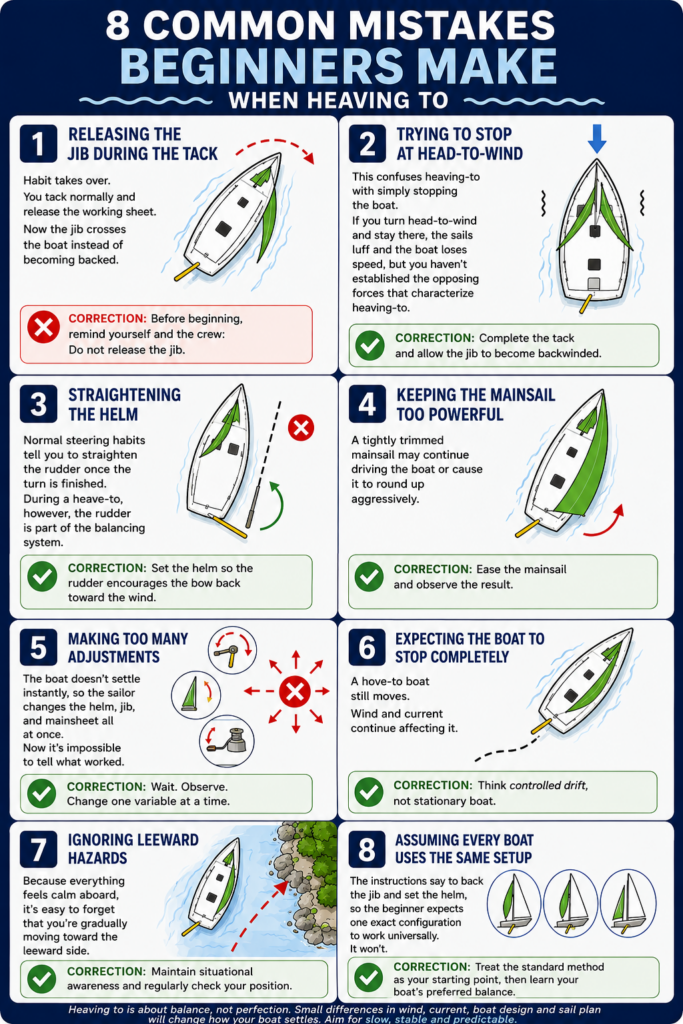
Common Heaving-To Mistakes
Heaving-to is simple once understood, but beginners tend to encounter a few predictable problems.
Mistake 1: Releasing the Jib During the Tack
Habit takes over.
You tack normally and release the working sheet.
Now the jib crosses the boat instead of becoming backed.
Correction: Before beginning, remind yourself and the crew: Do not release the jib.
Mistake 2: Trying to Stop at Head-to-Wind
This confuses heaving-to with simply stopping the boat.
If you turn head-to-wind and stay there, the sails luff and the boat loses speed, but you haven’t established the opposing forces that characterize heaving-to.
Correction: Complete the tack and allow the jib to become backwinded.
Mistake 3: Straightening the Helm
Normal steering habits tell you to straighten the rudder once the turn is finished.
During a heave-to, however, the rudder is part of the balancing system.
Correction: Set the helm so the rudder encourages the bow back toward the wind.
Mistake 4: Keeping the Mainsail Too Powerful
A tightly trimmed mainsail may continue driving the boat or cause it to round up aggressively.
Correction: Ease the mainsail and observe the result.
Mistake 5: Making Too Many Adjustments
The boat doesn’t settle instantly, so the sailor changes the helm, jib, and mainsheet all at once.
Now it’s impossible to tell what worked.
Correction: Wait. Observe. Change one variable at a time.
Mistake 6: Expecting the Boat to Stop Completely
A hove-to boat still moves.
Wind and current continue affecting it.
Correction: Think controlled drift, not stationary boat.
Mistake 7: Ignoring Leeward Hazards
Because everything feels calm aboard, it’s easy to forget that you’re gradually moving toward the leeward side.
Correction: Maintain situational awareness and regularly check your position.
Mistake 8: Assuming Every Boat Uses the Same Setup
The instructions say to back the jib and set the helm, so the beginner expects one exact configuration to work universally.
It won’t.
Correction: Treat the standard method as your starting point, then learn your boat’s preferred balance.
A Beginner Practice Exercise
Don’t wait until you need to heave-to.
Go out and practise deliberately.
Choose a day with moderate, reasonably steady wind and plenty of open water.
Then work through this exercise.
Round 1: Establish the Basic Heave-To
Sail close-hauled.
Tack without releasing the jib.
Backwind the jib.
Set the helm toward the wind.
Ease the mainsail.
Wait.
Don’t immediately adjust anything.
Observe what the boat does.
Round 2: Fine-Tune
Now make one small adjustment.
Ease or trim the mainsail slightly.
Wait again.
Did the boat become more stable or less stable?
Return to the previous setting if necessary.
Then experiment carefully with the helm position.
Again, observe the effect.
Round 3: Watch Your Movement
Once the boat is settled, note your GPS position.
Wait five minutes.
Check again.
Which direction did you move?
How far?
What was your approximate speed over ground?
Now you know much more than simply “how to heave-to.”
You know how your boat behaves while hove-to.
Round 4: Resume Sailing
Check your surroundings.
Release the backed jib.
Return the helm to normal steering.
Choose a course.
Trim the sails.
Accelerate.
Then repeat the entire exercise from the opposite tack.
Heaving-To Versus Other Ways of Slowing or Stopping
By this point in your sailing progression, you have several different ways to reduce the boat’s speed.
Understanding when to use each technique is more important than treating them as interchangeable manoeuvres.
| Technique | What You Do | Typical Result |
|---|---|---|
| Ease the sails | Reduce sail power | Boat slows but continues sailing |
| Luff the sails | Remove much of the sails’ driving force | Boat slows significantly |
| Head toward the wind | Move toward the no-sail zone | Sails luff and boat loses speed |
| Heave-to | Balance backed jib, mainsail, and rudder | Boat settles into controlled low-speed drift |
This gives you a much more complete boat-control toolkit.
You can accelerate.
You can slow down.
You can stop producing drive.
And now you can deliberately put the boat into a stable, low-speed configuration.
Heaving-To Is a Seamanship Skill
At first glance, heaving-to can look like an odd maneuver.
Why deliberately backwind a perfectly good jib?
Why hold the rudder over?
Why not just keep sailing?
Because good sailing isn’t always about maximizing speed or getting somewhere as quickly as possible.
Sometimes good sailing means reducing the number of things happening at once.
Imagine you’re approaching an unfamiliar harbour.
The wind has increased.
One crew member is uncomfortable.
There’s traffic near the entrance.
You need to check the chart and prepare lines and fenders.
A beginner may feel pressure to keep sailing toward the harbour while simultaneously solving every other problem.
An experienced sailor may recognize another option:
Create time.
Create space.
Reduce the boat’s workload.
Then solve the problems deliberately.
Heaving-to is one way of doing exactly that.
That is why this maneuver represents an important stage in your progression as a sailor.
You’re no longer learning only how to make the boat obey commands.
You’re learning how to manage the boat and the situation around it.
Frequently Asked Questions About Heaving-To
What does hove-to mean?
A sailboat is hove-to when its sails and rudder have been deliberately configured so that opposing forces largely balance one another, resulting in very low speed and a controlled drift.
Does a sailboat completely stop when hove-to?
No.
A hove-to sailboat normally continues drifting, generally toward leeward, and may retain some forward or other movement. Current also moves the boat independently of the wind.
Why is the jib backwinded?
The backed jib creates a force that tends to push the bow away from the wind. The rudder is positioned to oppose that tendency. The interaction between these forces helps stabilize the boat.
Which way should the tiller go when heaving-to?
On a conventional tiller-steered boat after the tack, the tiller is generally held toward the leeward side, positioning the rudder so that it encourages the bow back toward the wind.
Remember the desired effect rather than memorizing tiller direction:
The rudder should try to turn the bow toward the wind.
Should the mainsail be eased when heaving-to?
Usually, yes, but the amount depends on the boat.
Ease the mainsail enough to reduce excessive forward drive, then fine-tune it according to the boat’s behavior.
Can I heave-to with a roller furling jib?
Yes, many sailboats with roller furling headsails can heave-to.
Depending on the size of the headsail and the characteristics of the boat, partially furling the jib may produce a better balance.
Can every sailboat heave-to?
Most conventional sailing boats can be slowed and balanced using some variation of the technique, but not every design behaves the same way or achieves the classic hove-to position equally well.
Experiment in safe conditions to determine what works for your boat.
Is heaving-to only for storms?
No.
Although heaving-to has important heavy-weather applications, it is also an extremely useful everyday boat-control technique.
For beginners, that everyday use should be learned first.
How do you get out of a heave-to?
Check your surroundings, release the backed jib in a controlled manner, regain normal helm control, steer onto your desired course, trim the jib and mainsail, and allow the boat to accelerate.
How long can you remain hove-to?
There is no simple time limit determined by the maneuver itself.
The real limitations are your surroundings, drift, current, weather, traffic, sea room, crew needs, and the suitability of the conditions.
Never treat heaving-to as an excuse to stop maintaining a proper lookout.
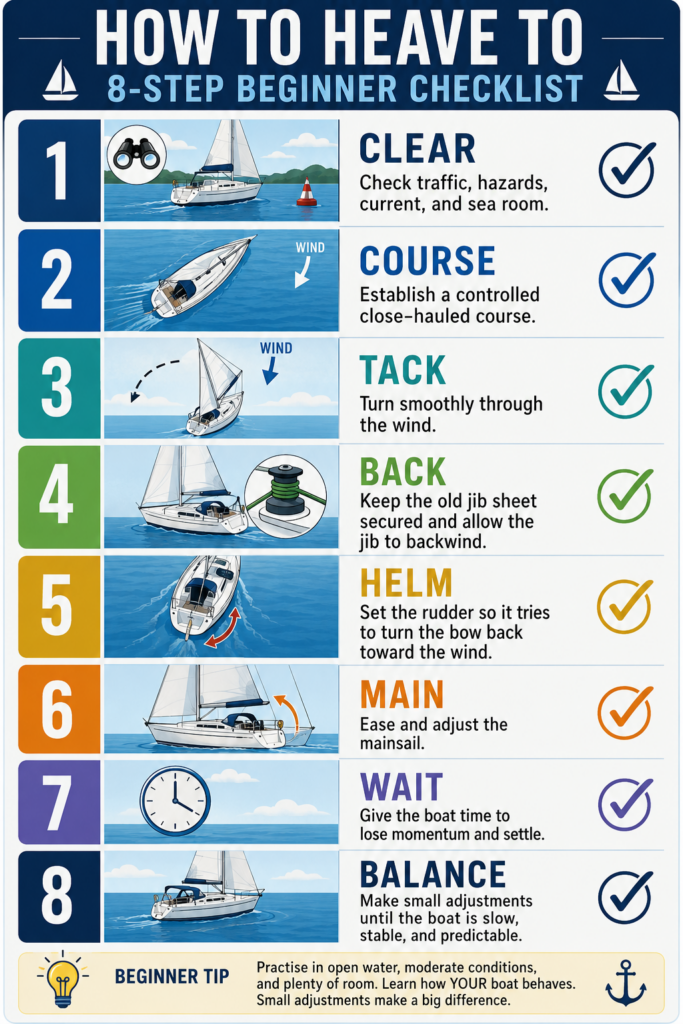
Beginner Heaving-To Checklist
Before practicing, remember this sequence:
CLEAR — COURSE — TACK — BACK — HELM — MAIN — WAIT — BALANCE
CLEAR
Check traffic, hazards, current, and sea room.
COURSE
Establish a controlled close-hauled course.
TACK
Turn smoothly through the wind.
BACK
Keep the old jib sheet secured and allow the jib to backwind.
HELM
Set the rudder so it tries to turn the bow back toward the wind.
MAIN
Ease and adjust the mainsail.
WAIT
Give the boat time to lose momentum and settle.
BALANCE
Make small adjustments until the boat is slow, stable, and predictable.
Key Takeaways
Learning how to heave to in a sailboat gives you something beginners often don’t realize they need:
time.
Instead of continuing to sail while dealing with every problem that arises, you can deliberately reduce the boat’s speed and workload.
The standard technique is straightforward:
Sail close-hauled.
Tack without releasing the jib.
Allow the jib to backwind.
Set the helm so the rudder encourages the bow toward the wind.
Ease the mainsail.
Wait.
Then adjust the balance.
But don’t become obsessed with reproducing one exact diagram or wind angle.
The real objective is to make the boat slow, stable, and predictable.
Every sailboat behaves somewhat differently. Your jib size, mainsail, keel, rudder, hull design, wind strength, waves, and sail settings all affect the result.
Therefore, the final part of learning to heave-to cannot happen by reading an article.
You need to practise.
Go into open water on a manageable day. Heave-to on one tack. Observe the boat. Adjust one control at a time. Watch your GPS track. Resume sailing. Then repeat from the other tack.
Learn what your boat wants.
Because heaving-to isn’t really about stopping.
It’s about something more important:
putting the boat into a condition where you have time to decide what happens next.
And that is one of the foundations of good seamanship.