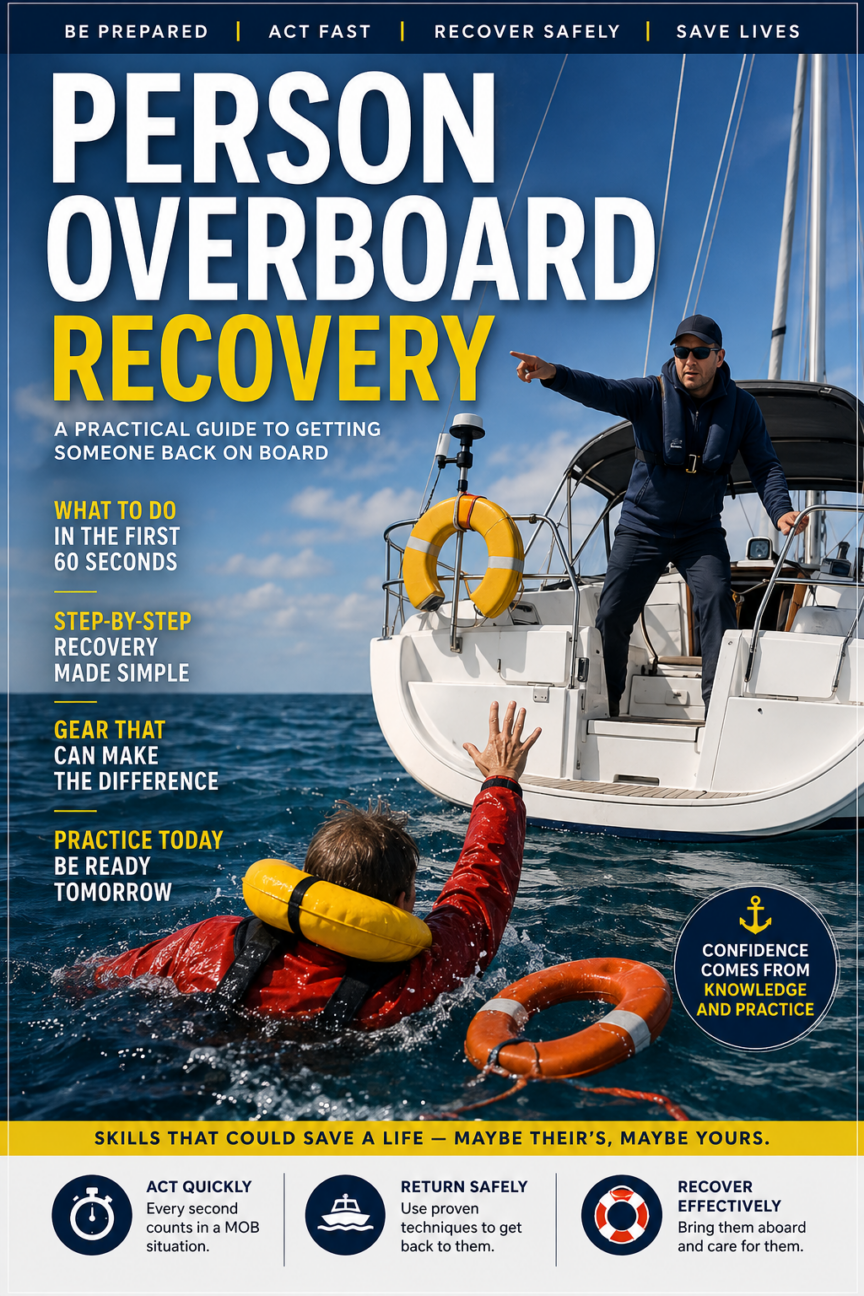
Few situations aboard a sailboat demand a faster response than a person falling overboard.
Fortunately, there is something reassuring every beginner should understand:
Person overboard recovery is a skill you can practice.
You do not need to improvise the entire maneuver during an emergency. You can learn a sequence, practice it in controlled conditions, and gradually make the response familiar.
That is the purpose of this guide.
If you have been following the SailboatZone beginner sailing series, you have already learned many of the individual skills needed for a successful recovery. You know how to steer the boat, trim the sails, tack, jibe, sail upwind and downwind, slow the boat, heave-to, reef, and manage the boat in stronger winds.
Now we are going to bring several of those skills together.
By the end of this lesson, you should understand:
- What to do immediately when someone falls overboard
- Why keeping the person in sight is so important
- How to alert everyone aboard
- How to use flotation and recovery equipment
- How to maneuver a sailboat back toward the person
- Why controlling your final approach matters more than rushing
- How to stop beside the person
- How to get someone back aboard
- What changes when you are sailing short-handed
- Why person-overboard drills should become a regular part of your sailing
BEGINNER TIP: You may hear the terms man overboard, MOB, crew overboard, COB, and person overboard, or POB. They all describe essentially the same emergency. In this article, we’ll use person overboard.
About this Guide
Written by Kelly Hiebert, a recreational sailor since 2002 and a middle-school teacher. Kelly created Sailboat Zone to provide beginners with clear, structured sailing education.
Last reviewed: September 2026
Jurisdiction: This guide explains general person-overboard prevention and recovery principles for recreational sailboats, using Canadian safety guidance as its primary reference. Required equipment, emergency communications and training standards vary by vessel, voyage and location. Follow current Canadian regulations, local conditions, your boat’s procedures and instructions from rescue authorities.
Primary sources:
- Transport Canada — Person Overboard
- Transport Canada — Safe Boating Guide 2026
- Canadian Safe Boating Council — Cold Water Awareness
Safety note: Person-overboard recovery is a time-critical emergency, and no single manoeuvre works for every boat or condition. This guide does not replace hands-on instruction, regular drills, first-aid training, cold-water preparation or a vessel-specific recovery plan. Practise with a floating training object in controlled conditions—never with a person in the water.
What Is Person Overboard Recovery?
Person overboard recovery is the process of locating, approaching, reaching, and bringing back aboard someone who has fallen from a boat.
It sounds straightforward when written as a sentence.
On the water, however, several things begin happening at once.
The boat continues moving.
The person in the water may quickly become difficult to see.
Wind and waves can separate the boat from the person.
The crew may panic.
The skipper suddenly has to control the boat while also organizing the recovery.
If the person is injured, cold, frightened, or unconscious, getting them back aboard may be difficult even after the boat reaches them.
This is why the first few seconds matter.
But those first few seconds should not become frantic.
A good recovery is urgent but controlled.
The goal is not simply to turn the boat around as fast as possible.
The goal is to:
Keep sight of the person → Mark their position → Keep them afloat → Maintain control of the boat → Return safely → Stop alongside → Recover them aboard.
That sequence is worth remembering.
The First Rule: Do Not Lose Sight of the Person
Imagine dropping a brightly colored hat into the water.
Turn away for a few seconds.
Now try to find it again.
It can be surprisingly difficult.
A human head and shoulders are not very large compared with the surface of the water. Waves, glare, spray, darkness, rain, and distance can make someone disappear from view remarkably quickly.
That is why one of the most important actions following a person-overboard incident is also one of the simplest:
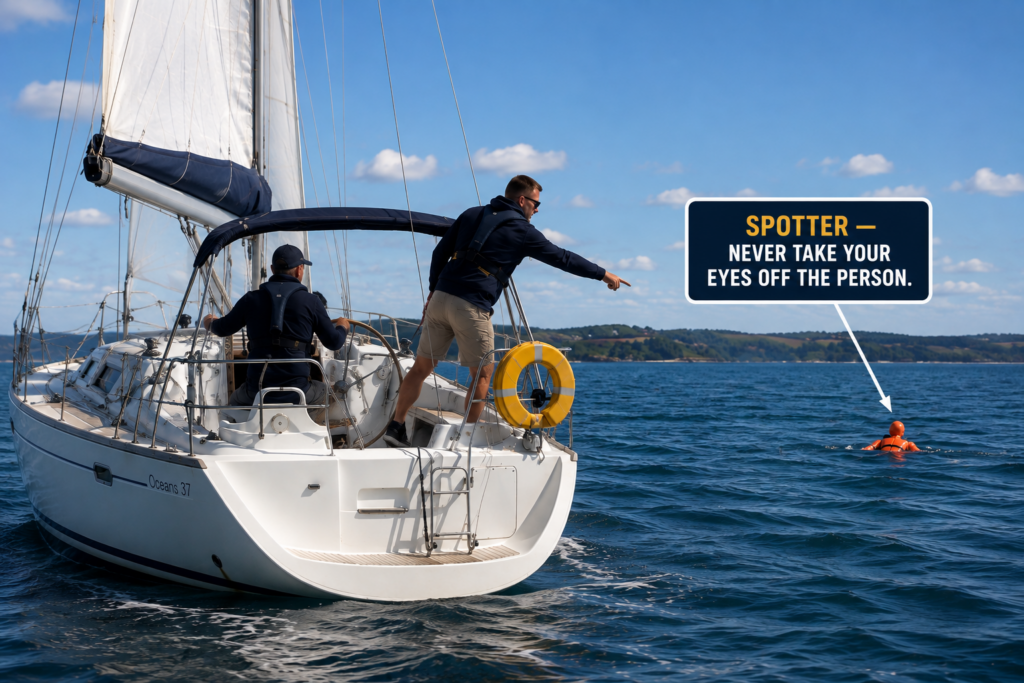
Point at the person.
If there are several people aboard, assign one crew member as the spotter.
That person’s primary job is not trimming sails.
It is not gathering equipment.
It is not helping steer.
Their job is:
Point at the person and keep pointing.
They should also call out useful information to the skipper:
“Person still in sight.”
“About 50 meters behind us.”
“Off the starboard quarter.”
This continuous visual reference makes the skipper’s job much easier.
Step 1: Shout “Person Overboard!”
The instant someone falls into the water, raise the alarm.
Shout clearly:
“PERSON OVERBOARD!”
This alerts everyone aboard and begins the recovery response.
If possible, include the side:
“PERSON OVERBOARD — STARBOARD SIDE!”
or
“PERSON OVERBOARD — PORT SIDE!”
This gives the crew immediate orientation.
Do not assume everyone saw what happened.
A person below deck, working at the bow, or concentrating on a line may have no idea someone has fallen overboard.
The call should be loud, clear, and immediate.
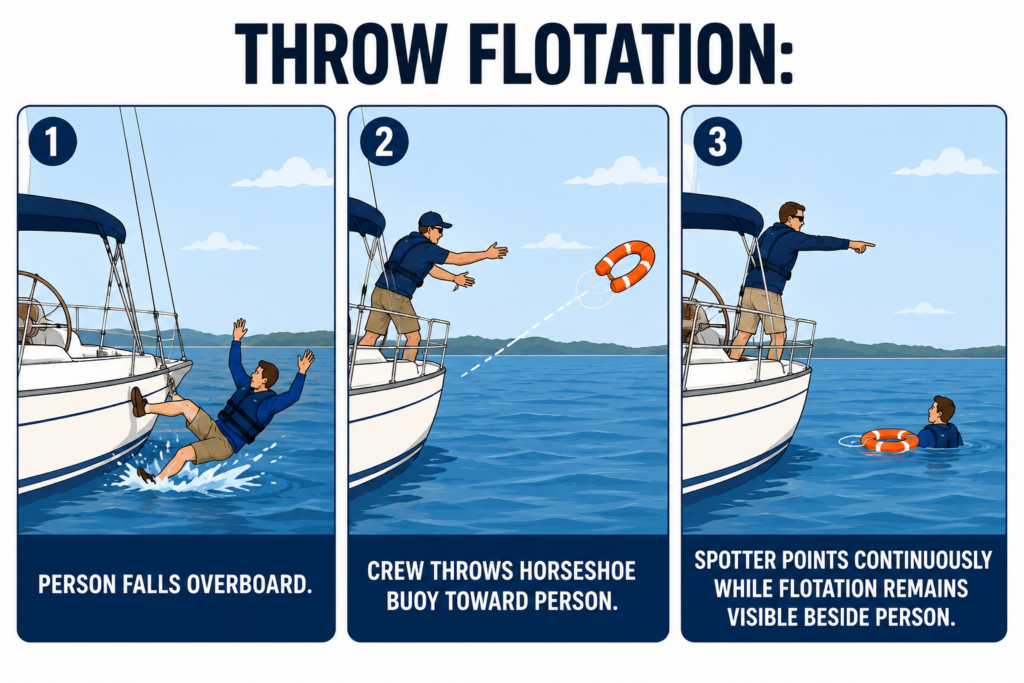
Step 2: Throw Flotation
Get flotation into the water as quickly as practical.
Depending on the boat, this might include:
- A horseshoe buoy
- Lifebuoy
- Throwable flotation cushion
- Lifesling
- Dan buoy
- Floating recovery line
- Other dedicated person-overboard equipment
Flotation serves more than one purpose.
First, it gives the person something buoyant to hold.
Second, brightly colored equipment makes the location easier to see.
Third, multiple floating objects can help mark the general area if visual contact is temporarily lost.
If your boat carries a dedicated throwable flotation device, make sure everyone aboard knows where it is before leaving the dock.
Emergency equipment buried underneath cockpit cushions or stored deep inside a locker is much less useful.
Step 3: Mark the Position
Modern electronics provide another valuable tool.
If your chart plotter or GPS has a dedicated MOB button or function, activate it as soon as practical.
This records the boat’s approximate position when the alarm is triggered.
However, there is an important limitation.
The MOB position does not replace the spotter.
The person may drift with wind and current after entering the water.
The GPS position therefore gives you an important reference point, but it may not remain the person’s exact position.
Visual contact is still extremely important.
This is another reason every skipper should learn where the MOB function is located before an emergency occurs.
Do not wait until someone is in the water to begin searching through menus.
Step 4: Control the Boat
The instinctive response may be:
Turn around immediately!
But before making a violent maneuver, remember something important.
You are still sailing a boat.
The boom can swing.
Sheets can load suddenly.
Crew members can lose their footing.
Another person could fall overboard.
A rushed maneuver can turn one emergency into two.
Maintain control.
If you are sailing quickly, begin reducing the boat’s energy while preparing to return.
Your exact maneuver will depend on:
- Wind direction
- Sea state
- Boat type
- Sail configuration
- Crew experience
- Whether the engine is available
- How far you have traveled since the person fell
- Whether you are sailing short-handed
There is no single turn that works perfectly for every sailboat in every situation.
That is an important point for beginners.
The objective is not to memorize an elaborate drawing.
The objective is to understand what you need the boat to do.
Get back to the person under control and arrive slowly enough to stop beside them.
Choosing a Recovery maneuver
Sailing instruction has traditionally taught several named person-overboard manoeuvres.
You may encounter terms such as:
- Quick stop
- Figure-eight recovery
- Reach-turn-reach
- Quick return
- Heave-to recovery
Different sailing schools, organizations, boats, and conditions may favor different techniques.
Rather than becoming overwhelmed by terminology, focus first on the principles shared by successful recoveries.
You need to:
- Prevent excessive separation from the person.
- Maintain visual contact.
- Establish a controllable return course.
- Approach at low speed.
- Stop close enough to make physical contact.
- Recover the person aboard.
A maneuver that brings you back quickly but leaves the boat moving at several knots past the casualty is not a successful recovery.
Control matters.
The Quick-Stop Principle
One commonly taught approach is based on keeping the boat relatively close to the person from the beginning.
Instead of sailing a long distance away before turning around, the skipper begins maneuvering promptly and keeps the recovery area compact.
The precise sail handling will vary by boat and conditions, which is why this should be practiced aboard the boat you actually sail.
The broad sequence is:
Person overboard → Raise alarm → Throw flotation → Assign spotter → Reduce separation → maneuver around → Establish controlled final approach → Slow and stop beside person.
For a beginner, understanding this overall geometry is more useful than memorizing exact helm angles.
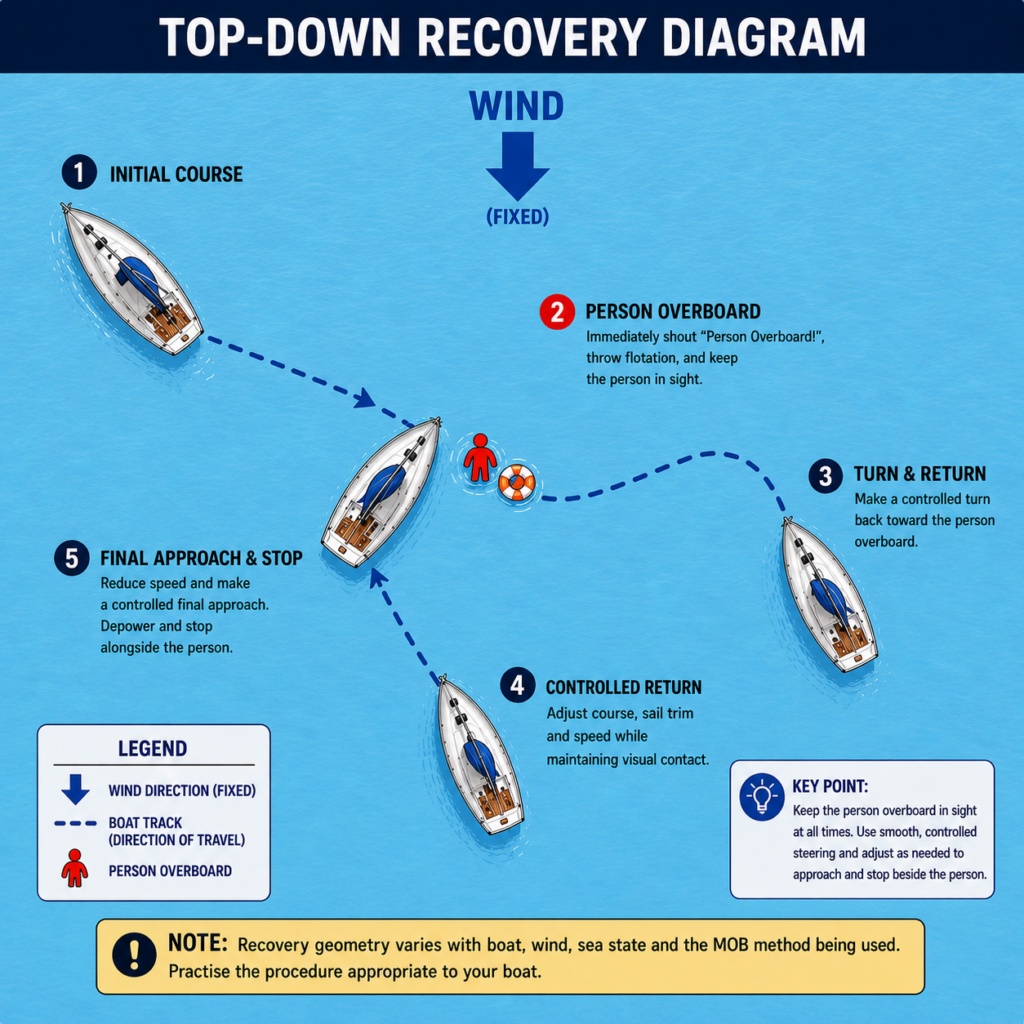
The Figure-Eight Recovery
Another widely taught technique is the figure-eight recovery.
The idea is to create enough room to establish a controlled approach without sailing unnecessarily far away.
After the person falls overboard, the boat sails onto an appropriate reaching course, turns, and then returns toward the person on a controlled approach.
Viewed from above, the track can resemble part of a figure eight.
The advantage is that the skipper has time to organize the boat and establish a predictable final approach.
The disadvantage is that sailing farther away makes maintaining visual contact even more important.
For beginners, the lesson is not that one recovery pattern is universally superior.
It is this:
You must practice the recovery method appropriate to your boat until you understand where the boat will actually go.
Drawings teach the concept.
Practice teaches the skill.
Why the Final Approach Is So Important
This is where many beginners focus on the wrong objective.
They think:
I have to reach the person.
A better objective is:
I have to reach the person and stop beside them.
A sailboat passing within three meters at four knots may be much less useful than a sailboat stopping calmly within arm’s reach.
The final approach therefore requires deliberate speed control.
Remember what you learned in How to Stop a Sailboat.
A sailboat does not have brakes.
You reduce its propulsion by managing heading and sail power.
As you approach the person, gradually remove the boat’s driving force.
Ease sails when appropriate.
Luff sails when appropriate.
Use your heading to help reduce speed.
Your aim is to arrive with very little remaining momentum.
Approach From the Safest Direction
Wind direction matters enormously during the final approach.
If you approach too quickly with fully powered sails, stopping may become difficult.
If you place the person directly downwind of a boat that is still moving quickly, the boat may drift or bear down on them.
Instead, organize the approach so you can progressively depower the sails and bring the boat under control.
The precise approach varies with boat type and recovery method, which is another reason practical training is essential.
The important beginner principle is:
Do not charge directly at the person.
Approach deliberately.
Slow down.
Keep them visible.
Prepare the crew for contact.
Keep the Person Away From the Propeller
If you start the engine during a recovery, the propeller becomes an additional hazard.
Before engaging the engine, make sure lines are not trailing in the water where they could foul the propeller.
If sails are still raised, maintain awareness of what they are doing as well.
As the boat reaches the person, the propeller should not be turning where it could endanger them.
The skipper should know exactly where the person is relative to the boat before using propulsion.
This becomes particularly important when visibility from the helm is limited.
A spotter can help enormously by continuously calling the person’s position.
Which Side Should You Recover the Person On?
This depends on the boat, conditions, recovery equipment, and crew.
On some boats, the lowest and easiest boarding point may be:
- A swim platform
- Boarding ladder
- Sugar-scoop stern
- Open transom
- Side gate
- Lifesling recovery point
The important thing is to decide your preferred recovery location before you need it.
Walk around your boat at the dock and ask:
If someone were unconscious in the water beside this boat, how would we actually get them aboard?
That question sometimes exposes a major weakness in an emergency plan.
It is easy to imagine sailing back to someone.
Lifting an exhausted adult from the water can be much harder.
Making Contact With the Person
Once the boat has stopped beside the person, establish physical contact as quickly as possible.
That might mean passing them:
- A line
- Lifesling
- Horseshoe buoy
- Recovery strop
- Boat hook used carefully to bring a floating line within reach
Avoid relying solely on someone grabbing the boat with their hands.
Cold, fatigue, injury, waves, wet clothing, and fear can drastically reduce grip strength.
Secure the person to the boat or recovery system before assuming the difficult part is over.
The recovery is not complete until the person is safely aboard.
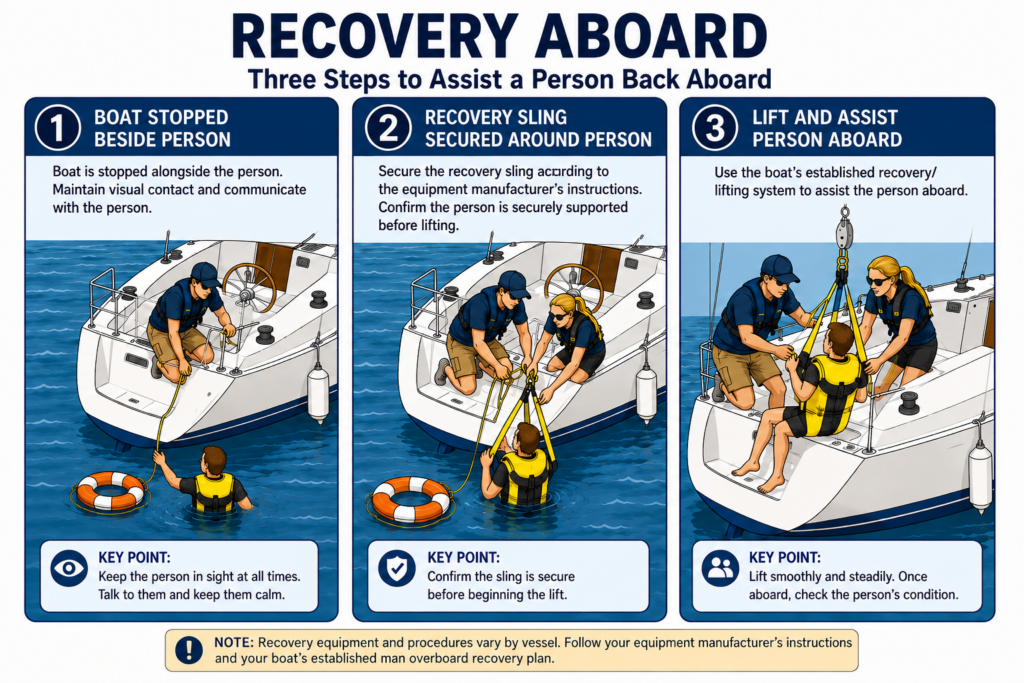
Getting the Person Back Aboard
This can be one of the hardest parts of a real person-overboard recovery.
An adult soaked in water is heavy.
An injured or unconscious person cannot necessarily climb a ladder.
A cold person may have very little strength.
Even an excellent swimmer may become exhausted after spending time in cold water.
A boarding ladder can work well for a conscious, capable person.
But your emergency plan should also consider someone who cannot climb.
Possible recovery systems include:
- Lifesling systems
- Dedicated recovery slings
- Halyards
- Block-and-tackle arrangements
- Boom-supported lifting systems
- Purpose-built recovery devices
Any lifting method involving rigging should be understood and practiced beforehand.
The middle of an emergency is not the time to discover that a halyard does not reach your intended recovery point or that your lifting arrangement cannot handle the load safely.
What If the Person Is Unconscious?
An unconscious person makes the recovery substantially more difficult.
They cannot swim toward the boat.
They cannot catch a line.
They cannot climb a ladder.
Someone aboard may need to establish physical contact with them using appropriate recovery equipment.
Entering the water yourself should not be an automatic response.
Doing so can create another casualty and leave fewer capable people aboard the boat.
Whenever possible, use equipment and boat-handling techniques that allow the crew to recover the person without creating another person-overboard situation.
Once the person is aboard, assess their condition and obtain emergency medical assistance as appropriate.
Cold Water Changes Everything
In cold water, time matters.
A person who suddenly enters cold water may experience an involuntary cold-shock response, including rapid breathing and difficulty controlling respiration.
Even someone wearing a lifejacket may become increasingly impaired as exposure continues.
That makes two things especially important:
Flotation and rapid recovery.
A properly worn personal flotation device can make an enormous difference because the person does not need to expend as much energy simply staying at the surface.
After recovery, continue monitoring the person and seek appropriate medical assistance when necessary. The Canadian Safe Boating Council provides additional cold-water safety guidance that is worth reviewing before sailing in Canada’s colder waters.
What If You Lose Sight of the Person?
This is one of the most serious developments during a recovery.
Immediately use all available information.
Return toward the last known position.
Check the MOB position recorded on your navigation equipment.
Look for:
- Flotation thrown into the water
- Bright clothing
- A lifejacket
- Waving arms
- Reflections
- Disturbances between waves
Assign every available person to a deliberate visual search while still maintaining safe control of the boat.
Call emergency services or the appropriate maritime rescue authority without unnecessary delay when assistance is needed.
A person in the water can become extremely difficult to locate.
This is why the simple act of assigning a dedicated spotter immediately after the fall is so important.
Using the Engine During a Person Overboard Recovery
Many cruising sailboats have auxiliary engines.
Should you use yours?
Often, an engine can be extremely useful because it provides maneuverability without relying entirely on sail power.
But starting it does not eliminate the need for good seamanship.
Before using the engine:
Check for lines in the water.
Make sure the crew understands what is happening.
Keep track of the person.
Be especially careful as you approach.
And remember the propeller.
If you practice recovery under sail, you develop a skill that remains available if the engine will not start.
If you practice recovery under power, you learn how your particular boat manoeuvres at very low speeds.
A well-prepared sailor should understand both.
Person Overboard While Sailing in Strong Winds
Strong wind makes everything more demanding.
The boat may be moving quickly.
Sails are heavily loaded.
The boom moves with greater force.
Waves may hide the person from view.
Turning manoeuvres require more attention.
And stopping the boat can become more difficult.
This is one reason learning how to sail in strong winds before moving into emergency recovery is such a useful progression.
You already know that strong-wind sailing is largely about reducing excess power and keeping the boat balanced.
Those same principles help during recovery.
If the boat is overpowered, control becomes harder.
A reefed, balanced boat can be considerably easier to maneuver than one carrying too much sail.
Person Overboard While Sailing Downwind
A person-overboard incident while sailing downwind deserves particular attention.
The boat may be traveling quickly.
The sails may be eased well out.
The boom may be far from the centerline.
Changing course can introduce the possibility of an accidental jibe.
Do not become so focused on the person in the water that you forget the boom.
The skipper must continue managing both the recovery and the boat.
If a jibe becomes part of the maneuver, it should be controlled.
This is another example of why the beginner sailing lessons build upon each other.
The emergency maneuver is not a completely new form of sailing.
It is the controlled application of skills you have already learned.
What If You Are Sailing Short-Handed?
A person-overboard situation becomes considerably more difficult when only two people are aboard.
If one falls overboard, the remaining sailor suddenly has to do everything.
You must:
- Maintain visual contact
- Control the boat
- Deploy flotation
- Mark the position
- Handle sails
- Possibly start the engine
- Return to the person
- Establish contact
- Recover them aboard
- Communicate for assistance if necessary
That is a lot for one person.
For couples and other short-handed crews, person-overboard practice is particularly important.
Each person should practice being the one left aboard.
Do not build an emergency plan that assumes the most experienced sailor will always be the one at the helm.
What happens if the skipper falls overboard?
Can the other person:
Start the engine?
Release the sails?
Use the radio?
Activate MOB?
Turn the boat around?
Stop the boat?
Deploy the recovery equipment?
That is the standard you should work toward.
Prevention Is Better Than Recovery
The best person-overboard recovery is the one you never have to perform.
Many falls can be prevented through simple habits.
Move deliberately around the boat.
Keep one hand available for the boat when conditions require it.
Wear suitable footwear.
Keep the cockpit organized.
Avoid stepping on loose lines.
Use handholds.
Be especially cautious when moving forward in rough conditions.
Wear appropriate personal flotation.
Use harnesses and tethers when conditions and circumstances warrant them.
Reduce sail early when the boat becomes difficult to manage.
Good seamanship often looks uneventful.
That is because the sailor has removed many of the opportunities for an emergency before anything goes wrong.
Practise Person Overboard Recovery
You should not wait for a real emergency to attempt this maneuver for the first time.
Practice changes everything.
Choose suitable conditions and use a floating training object rather than a person.
A fender attached to a bucket, floating training dummy, or other suitable object can be used to simulate someone in the water.
Never create unnecessary danger simply to make the drill feel realistic.
Begin in moderate conditions.
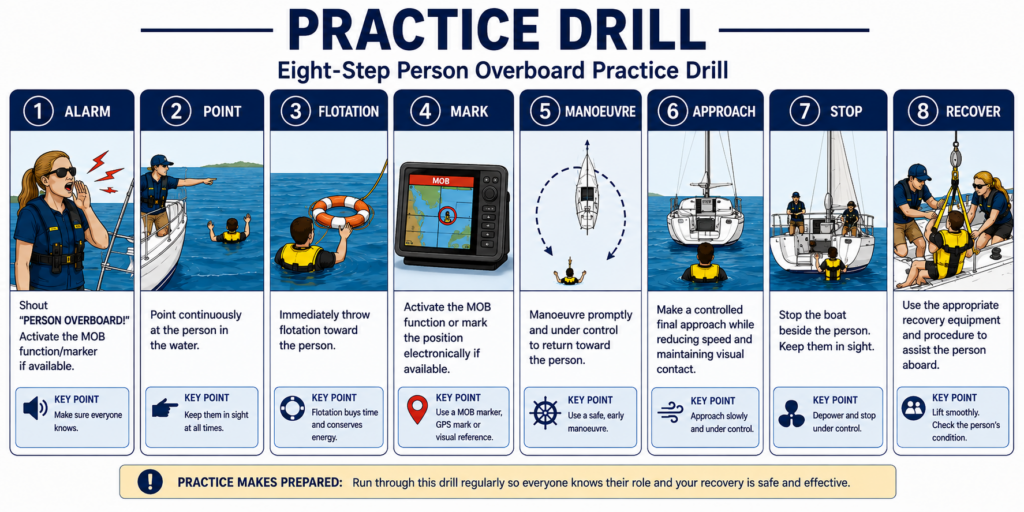
Practise the sequence:
Alarm → Point → Flotation → Mark → maneuver → Approach → Stop → Recover.
Then repeat it.
Approach from different points of sail.
Try it under sail.
Try it under power if your boat has an engine.
Practise with different crew members at the helm.
Most importantly, practice stopping accurately beside the object.
Connect the Drill to Skills You Already Know
Person-overboard practice is an excellent test of your overall sailing ability.
You need to understand wind direction.
You need to steer accurately.
You need to adjust sail power.
You may need to tack.
You need to understand your position relative to the wind.
And you need to know how to stop.
This is why person-overboard recovery belongs at this point in the beginner learning journey.
You are beginning to combine individual sailing skills into seamanship.
Common Person Overboard Recovery Mistakes
Mistake 1: Everyone Looks Away
Crew members immediately start grabbing lines and preparing equipment.
Nobody remains focused on the person.
Better approach: Assign one dedicated spotter immediately.
Mistake 2: Sailing Too Far Away
The skipper follows a memorized maneuver but allows unnecessary separation.
Better approach: Keep the recovery area as compact as practical while maintaining control.
Mistake 3: Returning Too Fast
The skipper successfully returns to the person but cannot stop.
The boat sails straight past.
Better approach: Think about stopping before reaching the person.
Mistake 4: Forgetting the Boom
The skipper concentrates entirely on the person in the water and makes an uncontrolled turn.
Better approach: Continue sailing the boat throughout the emergency.
Mistake 5: Forgetting About Lines Near the Propeller
The engine is started while lines are trailing in the water.
Better approach: Check the water around the boat before engaging propulsion.
Mistake 6: Assuming the Person Can Climb Aboard
The boat returns successfully, but the crew has no plan for lifting an exhausted or unconscious person.
Better approach: Develop and practice an actual recovery method.
Mistake 7: Never Practising
Everyone aboard knows what a person-overboard recovery is theoretically, but nobody has actually tried one.
Better approach: Make recovery drills part of normal sailing practice.
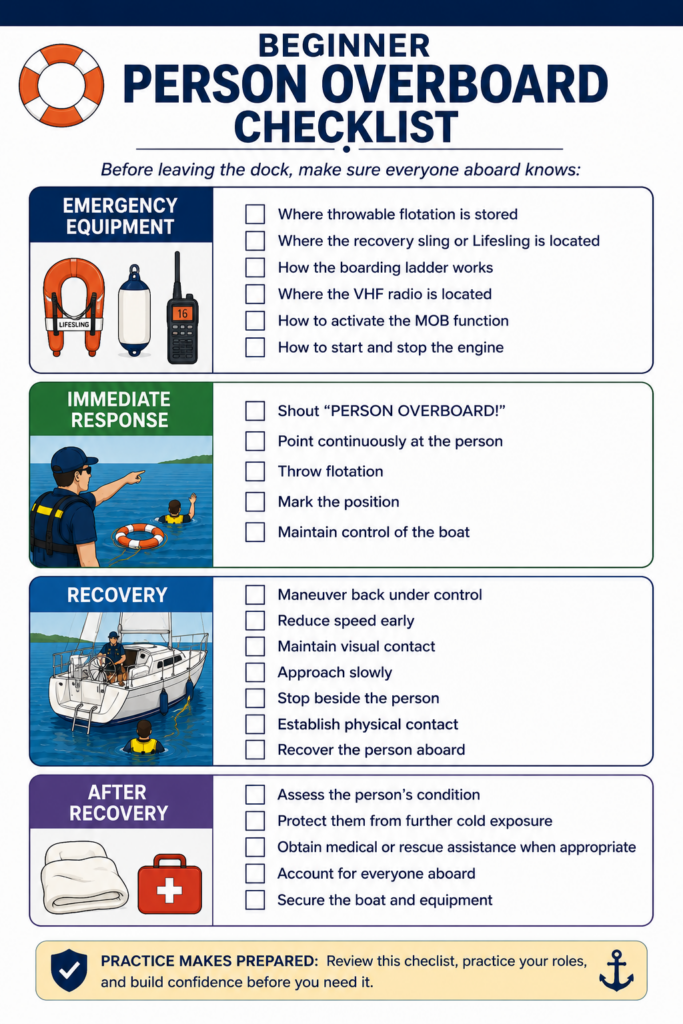
A Beginner Person Overboard Checklist
Before leaving the dock, make sure everyone aboard knows:
Emergency Equipment
☐ Where throwable flotation is stored
☐ Where the recovery sling or Lifesling is located
☐ How the boarding ladder works
☐ Where the VHF radio is located
☐ How to activate the MOB function
☐ How to start and stop the engine
Immediate Response
☐ Shout “PERSON OVERBOARD!”
☐ Point continuously at the person
☐ Throw flotation
☐ Mark the position
☐ Maintain control of the boat
Recovery
☐ maneuver back under control
☐ Reduce speed early
☐ Maintain visual contact
☐ Approach slowly
☐ Stop beside the person
☐ Establish physical contact
☐ Recover the person aboard
After Recovery
☐ Assess the person’s condition
☐ Protect them from further cold exposure
☐ Obtain medical or rescue assistance when appropriate
☐ Account for everyone aboard
☐ Secure the boat and equipment
Calling for Help
A person-overboard situation can become life-threatening quickly.
If the person cannot be immediately recovered, is lost from sight, is injured, is unconscious, or circumstances are beyond the crew’s ability to manage safely, call for professional assistance.
A VHF marine radio is an important piece of safety equipment because it allows communication with maritime rescue authorities and nearby vessels.
Every sailor should learn proper emergency radio procedures before they are needed.
For detailed distress-call guidance and broader onboard response planning, see our Sailboat Emergency Guide.
The Canadian Coast Guard provides official information about marine communications and emergency response procedures for boaters operating in Canadian waters.
The Most Important Lesson: Keep Sailing the Boat
A person-overboard emergency creates powerful tunnel vision.
Your attention naturally goes toward the person in the water.
But someone still has to sail the boat.
That means maintaining awareness of:
Wind.
Sails.
Boom.
Lines.
Traffic.
Shore.
Depth.
Waves.
Propeller.
Crew.
And the person in the water.
This is why a trained response is so valuable.
Instead of inventing your actions under stress, you begin following a familiar sequence.
Alarm.
Point.
Flotation.
Mark.
maneuver.
Approach.
Stop.
Recover.
That sequence gives the crew something simple to work from.
Person Overboard Recovery Is a Seamanship Skill
Earlier in your sailing journey, the questions were relatively simple.
How do I steer?
How do I trim the sails?
How do I tack?
How do I jibe?
Now the questions are becoming more sophisticated.
How do I keep the boat under control when something unexpected happens?
That is the beginning of seamanship.
A good sailor is not someone who never encounters a problem.
A good sailor develops the skills, judgement, preparation, and habits that make problems manageable.
Person-overboard recovery is one of those skills.
You do not need to become frightened by it.
You need to respect it.
Prepare your equipment.
Discuss the procedure with your crew.
Practise the maneuver.
Learn how your own boat behaves.
And repeat the drill often enough that the first few actions become familiar.
Because if the day ever comes when someone actually falls overboard, familiarity can give you something extremely valuable:
A plan.
Key Takeaways
Remember these principles:
Raise the alarm immediately.
Make sure everyone aboard knows someone has fallen overboard.
Never lose sight of the person.
Assign a dedicated spotter who points continuously.
Deploy flotation.
Give the person something buoyant and make the recovery area easier to see.
Mark the position.
Use the MOB function on your navigation equipment when available.
Keep control of the boat.
Do not create a second emergency through a rushed maneuver.
Return under control.
The objective is not simply to get back quickly.
Slow before you arrive.
A successful recovery requires stopping beside the person.
Have a way to get them aboard.
Do not assume an exhausted or unconscious person can climb a ladder.
Practise.
A person-overboard maneuver should not be something you attempt for the first time during a real emergency.
Test Your Knowledge: Person Overboard Recovery Quiz
Let’s finish with a quick knowledge check.
1. What should you shout immediately when someone falls from the boat?
A. Stop sailing
B. Person overboard
C. Prepare to tack
D. Start the engine
2. What should the designated spotter do?
A. Trim the mainsail
B. Start the engine
C. Continuously watch and point toward the person
D. Go below for emergency equipment
3. Why should flotation be thrown into the water?
A. Only to mark the boat’s position
B. To give the person flotation and help mark their location
C. To slow the boat
D. To determine wind direction
4. Does activating the MOB function eliminate the need for a spotter?
A. Yes
B. No
5. What is one of the biggest mistakes during the final approach?
A. Approaching too slowly
B. Watching the wind
C. Returning with too much speed
D. Wearing a PFD
6. When is the recovery complete?
A. When the boat turns around
B. When the person catches a line
C. When the boat reaches the person’s location
D. When the person is safely aboard
7. Why can an unconscious person be especially difficult to recover?
A. They drift upwind
B. They cannot catch a line or climb aboard
C. They make the boat heel
D. They cannot wear a PFD
8. What additional hazard should you consider when using the engine?
A. The mast
B. The traveller
C. The propeller
D. The telltales
9. Should a crew member automatically jump into the water to help?
A. Yes
B. No
10. What is the best way to become confident with person-overboard recovery?
A. Read about it once
B. Wait until an emergency happens
C. Practise regularly in controlled conditions
D. Always rely on the engine
Person Overboard Recovery Quiz — Answer Key
1. What should you shout immediately when someone falls from the boat?
Correct Answer: B — Person overboard
Call out “Person overboard!” loudly and immediately so everyone aboard knows an emergency has occurred and can begin the recovery response.
2. What should the designated spotter do?
Correct Answer: C — Continuously watch and point toward the person
The spotter should keep their eyes on the person and continue pointing toward them. A person in the water can become surprisingly difficult to see, particularly in waves or poor visibility.
3. Why should flotation be thrown into the water?
Correct Answer: B — To give the person flotation and help mark their location
Throwable flotation can help the person remain at the surface while also providing a larger, more visible reference for the crew aboard the boat.
4. Does activating the MOB function eliminate the need for a spotter?
Correct Answer: B — No
The MOB function records an approximate position, but the person may drift with wind and current. Maintaining visual contact remains extremely important.
5. What is one of the biggest mistakes during the final approach?
Correct Answer: C — Returning with too much speed
Simply reaching the person is not enough. The boat must arrive slowly enough to stop beside them and begin the recovery.
6. When is the recovery complete?
Correct Answer: D — When the person is safely aboard
Reaching the person or getting a line to them is only part of the recovery. The emergency continues until the person has been safely brought aboard and their condition can be assessed.
7. Why can an unconscious person be especially difficult to recover?
Correct Answer: B — They cannot catch a line or climb aboard
An unconscious or severely weakened person cannot assist with their own recovery. This is why every boat should have a practical method for recovering someone who cannot simply climb a boarding ladder.
8. What additional hazard should you consider when using the engine?
Correct Answer: C — The propeller
The skipper must always know where the person is relative to the boat before using the engine. Lines in the water can also become tangled around the propeller.
9. Should a crew member automatically jump into the water to help?
Correct Answer: B — No
Entering the water can turn one person-overboard emergency into two. Whenever possible, use the boat and appropriate recovery equipment to reach and recover the person without putting another crew member in the water.
10. What is the best way to become confident with person-overboard recovery?
Correct Answer: C — Practise regularly in controlled conditions
Reading about person-overboard recovery gives you the knowledge, but practice develops the skill. Use a suitable floating training object and practice the maneuver in safe conditions.
How Did You Score?
9–10 correct — Excellent!
You have a strong understanding of the basic person-overboard recovery procedure. The next step is turning that knowledge into practical skill through regular drills.
7–8 correct — Good work!
You understand most of the important principles. Review the questions you missed, particularly the immediate response and final approach.
5–6 correct — You’re getting there.
Review the recovery sequence and then try the quiz again. Concentrate on what happens during the first few seconds after someone falls overboard.
Below 5 — Keep learning.
Person-overboard recovery combines several sailing skills, so don’t be discouraged if it takes time to become familiar. Review the lesson and try again.
The Recovery Sequence to Remember
ALARM → POINT → FLOTATION → MARK → MANOEUVRE → APPROACH → STOP → RECOVER
The most important thing is not simply remembering the sequence on land. Practise it in safe, controlled conditions until the first few actions begin to feel familiar.
That preparation can make an enormous difference if you ever face a real person-overboard emergency.How Did You Do?
9–10 correct: Excellent. You understand the essential recovery sequence.
7–8 correct: Good work. Review the final approach and recovery sections before practising.
5–6 correct: You are building the right foundation. Read through the procedure once more and focus on the order of the immediate actions.
Below 5: No problem. This is exactly why we practice before an emergency. Review the article and then work through the checklist again.
The sequence to remember is:
ALARM → POINT → FLOTATION → MARK → MANOEUVRE → APPROACH → STOP → RECOVER
You do not need to perform every action perfectly the first time you practice.
Start slowly.
Understand what your boat is doing.
Then repeat the drill.
Each repetition makes the sequence a little more familiar.
And that is exactly what good seamanship training is supposed to accomplish.