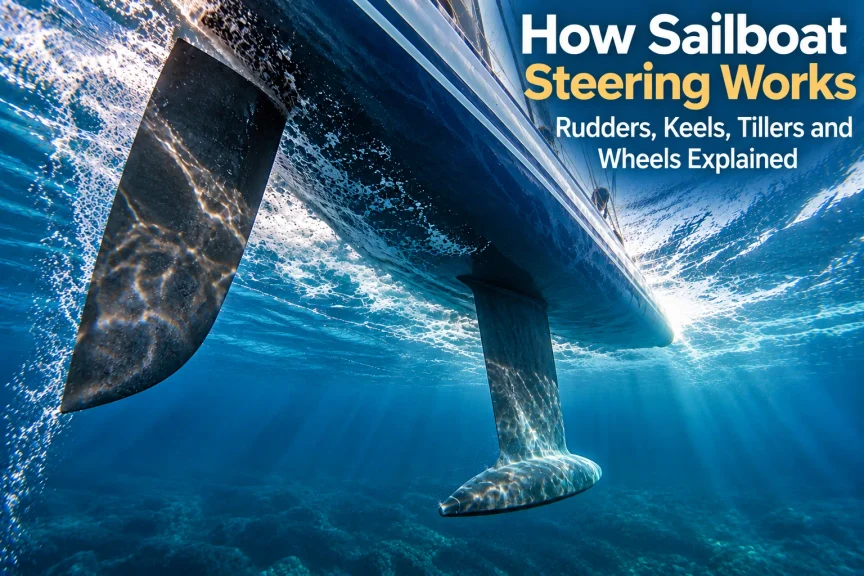
You turn the tiller or wheel, the bow changes direction, and the boat turns. At first, steering a sailboat can seem that simple. However, the control in your hands is only the beginning of the story.
Most of the work happens where you cannot see it: underwater. The rudder is meeting moving water, the keel and hull are resisting sideways motion, the boat is carrying momentum, and the sails are applying forces of their own. All of those effects combine to determine how quickly—and how cleanly—the boat changes direction.
If you have already worked through How to Steer a Sailboat, you know the practical basics of controlling a boat with a tiller or wheel. This lesson goes one level deeper. Instead of asking only, “Which way do I move the helm?” we are going to ask, “Why does the boat respond that way?”
That change in thinking matters. A beginner reacts to what the boat just did. A developing skipper starts predicting what the boat is about to do.
What Actually Makes a Sailboat Turn?
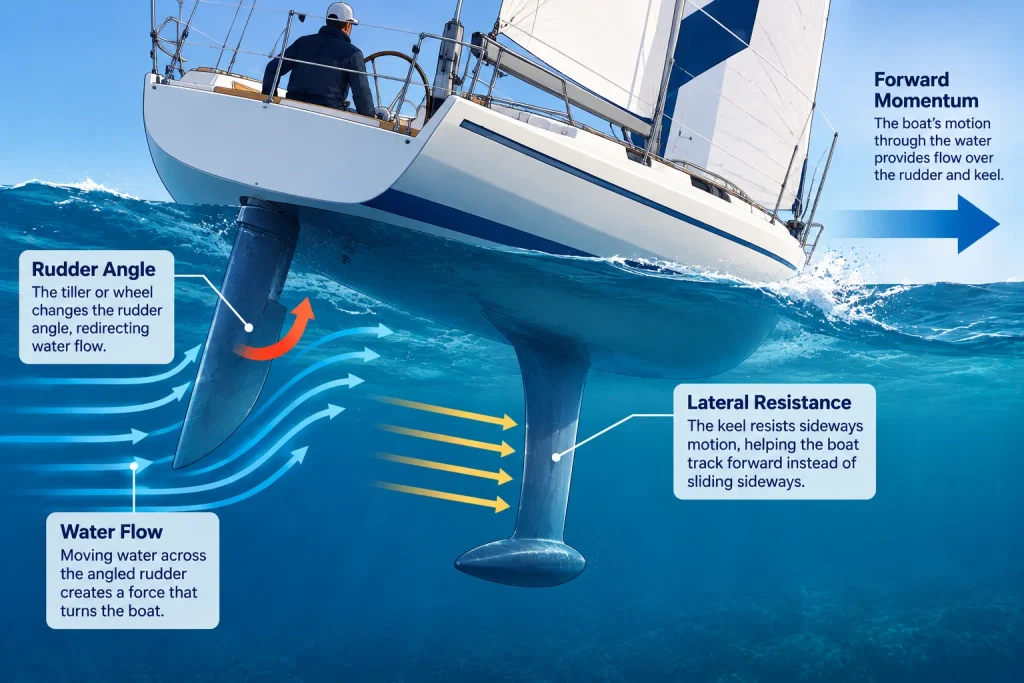
A tiller or wheel does not directly point the bow in a new direction. Instead, it changes the angle of the rudder. When the boat is moving through the water, water flows past that rudder. Turning the rudder changes the way that water flows and creates a sideways force at the stern.
Because that force acts behind much of the boat’s underwater resistance, it creates a turning effect, or yaw. The stern begins moving one way while the bow begins turning the other way. Meanwhile, the keel and underwater shape of the hull resist the boat simply sliding sideways. The result is a curved path through the water.
This is why it is misleading to imagine a sailboat as a shopping cart whose front wheels have simply been pointed somewhere else. A sailboat is moving through a fluid. Its direction changes because forces acting on different parts of the boat create a turn.
For a useful beginner mental model, think of four ingredients working together: water flow, rudder angle, underwater lateral resistance, and momentum. Change any one of them and the steering response can change too.
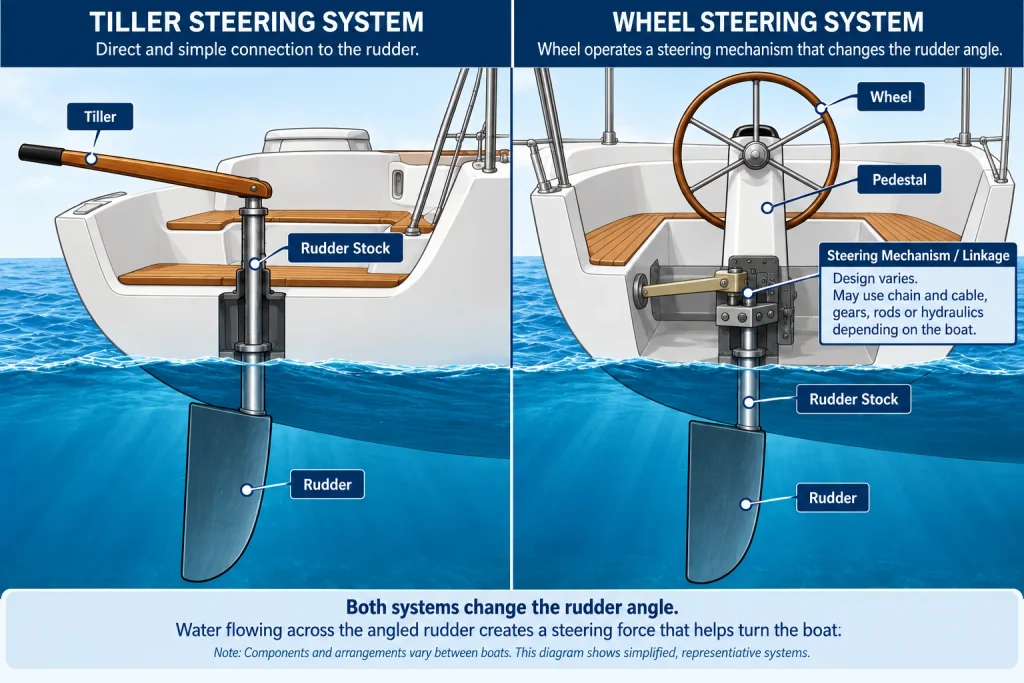
Whether the boat has a tiller or a wheel, the final job is the same: rotate the rudder to a useful angle. The difference is how your hand movement reaches it.
The Steering System: From Your Hands to the Rudder
On a typical tiller-steered boat, the tiller is attached directly to the rudder stock or to a fitting connected to it. Move the tiller to starboard and the rudder angles so that water flowing across it creates a hydrodynamic force and a yawing moment that begins turning the boat to port. The entire hull responds; as the turn develops, the bow moves into the turn while the stern sweeps through its own arc. This opposite relationship between tiller movement and bow direction is why tiller steering can feel backwards at first.
Fortunately, the relationship soon becomes intuitive. A small tiller movement changes rudder angle; the useful habit is to notice how the whole boat responds rather than thinking of the tiller as a device that simply points the bow.
Wheel steering adds mechanical parts between your hands and the rudder. Depending on the boat, the wheel may act through a chain, cables, a quadrant, rods, gears, hydraulics, or another linkage. You do not need to become a steering-system mechanic before you can sail. However, you should understand the basic chain of events: wheel movement becomes rudder movement.
A wheel usually feels more intuitive because turning the wheel to starboard normally begins a starboard turn. In contrast, a tiller moves to the opposite side. Underwater, though, the same basic event is occurring: the rudder changes angle and redirects water flow.
How a Rudder Produces a Turn
A conventional rudder needs water flowing across it to generate useful steering force. Normally that flow comes from the boat moving through the water. With the rudder centred, there is relatively little sideways steering force; turn it moderately and the altered flow creates force on the rudder and a turning moment on the boat. On many auxiliary-powered sailboats, propeller wash can also send water across the rudder at low boat speed. The central rule remains the same: little effective flow across the rudder means little conventional rudder authority.
Next, imagine turning the rudder farther and farther. It is tempting to assume that twice as much helm must create twice as much turning. It does not. At large angles, flow around the rudder can separate, drag rises sharply, and the rudder can become less efficient. Sailors often describe this as rudder stall.
Therefore, a large helm movement can sometimes slow the boat without producing the extra turn you expected. That lost speed then reduces water flow across the rudder, which can make the problem worse.
The practical lesson is simple: use enough rudder to create the turn, but do not automatically assume more is better. Smooth, deliberate steering usually preserves both speed and control.
What the Keel Has to Do With Steering
The rudder may start the conversation, but it does not turn the boat by itself. The keel and underwater hull are a major part of why the boat follows a controlled curved path instead of simply skidding sideways.
A keel provides lateral resistance. In ordinary sailing, that resistance helps limit leeway—the sideways movement caused by the wind pushing on the sails and hull. During a turn, the same underwater resistance interacts with the sideways force created by the rudder.
You will sometimes hear the explanation, “The rudder turns the boat and the keel keeps it from sliding sideways.” That is useful as a first approximation. However, the keel does not act like a stationary underwater anchor around which the boat pivots. The moving hull, keel and rudder all interact with the water, while speed, heel, momentum and sail forces influence the resulting turn.
Sailors also use the centre of lateral resistance as a model for where the combined underwater resistance can be thought of as acting. Treat it as a conceptual tool, not a bolt driven through one permanent point in the hull. As the boat heels, accelerates, slows and turns, the distribution and balance of underwater forces change.
If the underwater parts themselves are still unfamiliar, review Parts of a Sailboat: Complete Beginner’s Guide before going farther.
Why Sailboat Speed Changes Steering Response
Now we can explain one of the most important steering lessons: the same helm movement can produce very different results at different speeds.
At very low speed, little effective water flow may be crossing the rudder. As a result, you can move the tiller or wheel and receive only a weak response. This is especially noticeable while docking, stopping, or maneuvering in confined water. Under power, propeller wash can improve rudder flow on many boats, so low boat speed does not always mean identical steering response.
That is why the How to Dock a Sailboat lesson emphasizes minimum controllable speed rather than simply the slowest speed possible. You need enough water flow for useful steerage while keeping momentum low enough to remain safe.
At higher speed, the rudder generally has more authority and the boat may respond more quickly. However, the boat also carries more momentum. It will continue moving while the turn develops, and the loads on the steering system can become greater.
This creates a useful rule for beginners: steer early and smoothly. Waiting until the last moment and then using a large helm movement is usually harder on both the boat and the person steering it.
The same relationship becomes obvious when learning How to Stop a Sailboat: as speed disappears, steering authority disappears with it. Therefore, the skipper has to plan the final steering corrections before the boat becomes nearly stationary.
Tiller vs Wheel: What Changes and What Does Not?
For a tiller, move the tiller opposite the direction you initially want the bow to turn. To turn the bow to port, move the tiller to starboard. To turn the bow to starboard, move the tiller to port.
With a wheel, turn the wheel toward the direction you initially want the bow to turn. Turn the wheel to port for a port turn and to starboard for a starboard turn.
That is the beginner rule. Next comes the more useful skipper habit: stop thinking only about hand direction and start thinking about rudder angle and boat response.
Tillers often provide very direct feedback. You can usually see the tiller angle, and changes in rudder load are transmitted clearly to your hand. Wheels can provide greater leverage and may be more comfortable on larger boats, although the mechanical system can soften or alter some of the feedback.
Neither system changes the basic hydrodynamics. The boat does not care whether the rudder angle came from a wooden tiller, a stainless-steel wheel or a more complex linkage. It responds to the rudder, water flow and the forces acting on the hull.
The Boat Does Not Turn Around Its Centre
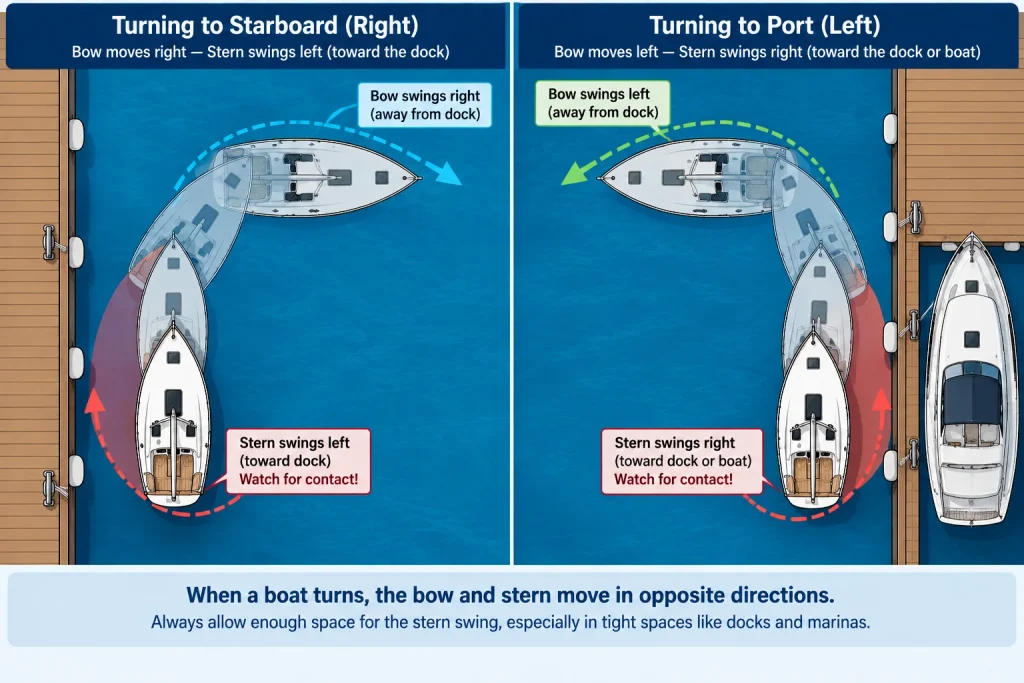
When the bow turns, the stern moves too. This seems obvious once you see it from above, but beginners often focus so intensely on where the bow is going that they forget what the back of the boat is doing.
During a turn, different parts of the boat sweep through different arcs. Sailors sometimes talk about a pivot point to make this easier to visualize. However, that point is not fixed in one permanent location. It changes with speed, direction of motion, hull shape, power application and other conditions.
For example, when turning away from a dock, the bow may move safely into open water while the stern swings closer to the dock, a piling, or the neighbouring boat. Therefore, clearance must be judged around the whole hull.
This becomes especially important in marinas, where the consequences of forgetting stern swing are immediate and expensive. In open water, a wide turn may simply look untidy. Beside a dock, the same mistake can put the stern exactly where you did not want it.
The Sails Affect Steering Too
So far, we have concentrated on what happens underwater. However, a sailboat is being acted on above the waterline at the same time. The sails can create turning tendencies that the helm must either work with or oppose.
If you have read How Sails Work, you already know that sails generate aerodynamic forces rather than simply catching wind like bags. Where those forces act relative to the boat’s underwater resistance influences helm balance.
A useful beginner model compares the sail plan’s centre of effort with the boat’s centre of lateral resistance. Again, neither should be imagined as a perfectly fixed dot. They are conceptual ways to understand the balance of forces.
When the boat has a modest tendency to turn toward the wind, the helm is experiencing weather helm. A small amount can provide useful feel. Too much, however, means the rudder may be held at a larger angle just to keep the boat on course. That creates drag and makes steering tiring.
Lee helm is the opposite tendency: the boat wants to turn away from the wind. Significant lee helm is undesirable because it can make the boat less naturally inclined to head toward the wind if control is released.
Excessive heel can also make steering harder. Therefore, when a boat suddenly requires a lot of helm in stronger wind, the best answer may not be to pull harder on the tiller or wheel. Better sail trim, flattening the sails, or reefing may restore balance and reduce rudder load.
When Steering Technique Isn’t the Problem
When the boat does not respond as expected, the reflex is often to add more helm. Instead, use a developing-skipper sequence: observe → diagnose → anticipate → make the appropriate correction. The question changes from “How much farther should I turn the helm?” to “What is causing this response?”
Weak steering response? First ask whether there is enough effective water flow across the rudder. A boat creeping through the water may have little conventional rudder authority. Large helm angle but a disappointing turn? Excessive rudder angle may be adding drag or encouraging flow separation rather than producing the extra turn you expected.
Heavy helm? Look at sail balance and heel. An overpowered or poorly balanced boat can develop strong weather helm, so reducing heel or changing sail trim may be more effective than fighting the wheel or tiller. Boat pointing correctly but moving sideways? Consider leeway and current before blaming the steering.
Under power, propeller wash can change rudder effectiveness on many boats, particularly when forward thrust sends water across the rudder. Reverse handling can be very different and may also involve prop walk. These effects are reminders that steering response depends on the water reaching the rudder, not simply on boat speed shown by an instrument.
Sudden stiffness, looseness, vibration, grinding or delayed response? Consider the machinery. A skipper should recognize when the problem may be mechanical rather than answering every steering difficulty with more helm.
Transport Canada includes a properly working steering system in its pre-departure checks for maintaining a safe pleasure craft. A fault discovered at the dock is inconvenient; the same fault discovered in traffic or heavy weather can become an emergency.
Heading Is Not the Same as Track
The bow can point in one direction while the boat actually moves in another. Heading describes where the bow points. Track describes the path the boat makes over the ground.
Leeway can push a sailing boat sideways. Current can move the entire boat across the bottom. Therefore, steering directly at a destination does not guarantee that you will arrive there.
For example, a boat crossing a strong current may need to point into the current so the combined motion produces the desired track. The helm can hold the intended heading perfectly while the boat still misses its destination. Diagnosis therefore includes asking whether the problem is steering—or the environment moving the boat.
What the Helm Can Tell You
The helm is not only a control. It is also an instrument.
A light, steady helm can suggest that the boat is reasonably balanced. Increasing pressure may warn that heel or weather helm is building. Easing or trimming a sail can change that feel; likewise, reefing an overpowered boat may reduce helm load. The response gives the skipper information about whether the correction addressed the cause.
Likewise, unusual vibration, stiffness, excessive play or delayed response deserves attention. Learn the normal feel of the boat you sail. Once you know that baseline, an abnormal change becomes useful information rather than a surprise.
Steering Failure Awareness
Steering systems can fail. A tiller can be damaged. A rudder stock or fitting can develop a problem. Wheel-steering cables, chains, quadrants, rods or hydraulic components can fail or disconnect. A rudder can also be damaged, fouled or jammed.
You do not need to become a marine technician to prepare for this. You do need to know how your own boat’s steering system works, where you can inspect its important components, and whether the boat has an emergency tiller or another emergency-steering arrangement.
Before leaving, know where that equipment is stored and how it is fitted. In a real failure, your first priorities are to keep people safe, reduce immediate danger, control sail power or propulsion as appropriate, avoid traffic and hazards, and establish the best steering alternative available.
Try This on the Water — Feel What the Rudder Is Doing
The fastest way to make these ideas useful is to feel them on a real boat. Choose safe open water with plenty of room and appropriate supervision. Do not run this exercise near docks, swimmers, traffic, shoals, other hazards or confined water.
First, establish a steady course at a comfortable speed and centre the helm. Look well ahead. Notice how much small movement is already happening even when you are trying to sail straight.
Next, apply a small rudder input and hold it briefly. Notice the delay before the bow clearly changes direction. Watch what the stern does as well. Then return the rudder toward centre before the boat reaches the new heading and observe how the turn settles.
Repeat the exercise with a moderate rudder input. Compare the rate of turn, loss of speed and amount of correction needed to stop the turn. Do not use extreme rudder angles simply to prove a point.
Now repeat at a somewhat lower safe speed. The boat should help you discover the lesson: less water flow usually means less immediate rudder authority. Finally, if conditions and supervision allow, make a modest sail-trim change and notice whether helm pressure changes.
The objective is not to perform perfect turns. It is to connect what your hands feel with what the hull, rudder, keel and sails are doing.
Skipper Thinking: The Late Turn
Imagine you are approaching a planned turn at relatively low speed. You wait until the bow reaches the turning point, then apply a large amount of helm. The boat responds slowly, so you add even more. A moment later, the boat begins turning much more aggressively than you expected.
Before reading on, think through five questions: Why was the initial response weak? Why could adding more rudder make the situation worse? What should have been anticipated before the turning point? How could speed, timing and rudder angle have been managed differently? And if this happened beside a dock, which part of the boat might become an immediate collision concern?
The developing-skipper answer combines several ideas. At low speed, the rudder had limited water flow. A very large rudder angle added drag and could further reduce efficiency. Instead, the turn should have been planned earlier, with enough steerage maintained and a moderate helm input applied before the boat reached the point where the turn was needed. Meanwhile, stern swing would need to be watched carefully near any obstacle.
That is the larger lesson of steering: anticipation beats rescue.
Key Takeaways
The tiller or wheel controls the rudder; it does not directly point the boat.
A rudder creates steering force because water is moving across it.
The keel, underwater hull and rudder work together to shape the boat’s turn.
Very low speed can mean weak rudder authority, while higher speed brings more response and more momentum.
Large rudder angles create drag and do not automatically produce a better turn.
The stern swings as the bow turns, which matters enormously in confined water.
Sail balance and heel affect helm pressure; sometimes the right steering correction is a sail-trim or reefing correction.
Good skippers use helm feel as information and anticipate the boat’s response before making large corrections.
Knowledge Check
1. Why can a nearly stationary sailboat have very little conventional rudder authority?
2. What role does the keel play while the rudder is trying to turn the boat?
3. Why can excessive rudder angle slow the boat without giving the turn you expected?
4. When the bow turns away from a dock, why must the skipper still watch the stern?
5. What might increasing weather helm tell you about sail balance or heel?
6. A boat is pointing at the destination but being carried sideways. What should the skipper diagnose before adding more helm?
7. What is the difference between heading and track?
8. Name two changes in helm feel that could justify checking the steering system.
Summary
Steering begins with helm input, but the response comes from a chain of forces: helm movement changes rudder angle; water flow creates force on the rudder; that force interacts with keel and hull resistance to produce yaw and a curved path. Speed and momentum change how quickly the response develops, while sails, heel, waves and current can alter what the skipper feels and where the boat actually goes.
Once you understand that system, several beginner mysteries disappear. Weak response at very low speed, drag from excessive rudder angle, stern swing, heavy weather helm and a mismatch between heading and track all become clues that can be diagnosed rather than surprises that demand more helm.
Most importantly, you move from steering by reaction to steering by prediction. Observe the clue, diagnose the likely cause, anticipate the boat’s response, and then make the appropriate correction.
That is the purpose of this lesson. Knowing which way to move the control makes you capable of steering; understanding what the boat is doing, why it is doing it and what it is likely to do next is part of learning to think like a skipper.
Quiz
1. What gives a conventional rudder most of its steering authority?
A. Wind pressure on the mast
B. Water flowing across the rudder
C. The weight of the keel
D. The compass heading
2. On a tiller-steered boat, to begin turning the bow to starboard, you normally move the tiller:
A. To starboard
B. To port
C. Straight forward
D. Upward
3. Why is a keel important to steering?
A. It acts as a second rudder
B. It powers the turn
C. It contributes lateral resistance that helps shape the boat’s motion
D. It prevents all leeway
4. What can happen when the rudder is held at an excessive angle?
A. Drag increases and rudder efficiency can decrease
B. The boat always turns twice as fast
C. The keel stops working
D. The sails automatically depower
5. Why should a skipper begin a low-speed turn early?
A. The compass reacts slowly
B. Rudder authority may be weak and the boat needs time to respond
C. The mast bends during turns
D. The keel must first move forward
6. What is stern swing?
A. The boom moving across the cockpit
B. The sideways movement of the stern as the boat turns
C. Propeller vibration
D. The rudder returning to centre
7. A suddenly heavy helm in strong wind may be a clue that:
A. More rudder is always required
B. The boat may be overpowered or poorly balanced
C. The compass is wrong
D. The keel has become lighter
8. Heading describes:
A. The path over the seabed
B. The direction the bow points
C. Current speed
D. Rudder angle
9. A boat is pointing on the intended heading but is being carried sideways by current. What is the best diagnosis?
A. The rudder needs a much larger angle
B. The heading may be correct while the track over ground is being changed by current
C. The keel has stopped providing lateral resistance
D. The wheel must be centred immediately
10. If the wheel suddenly feels unusually stiff or develops excessive play, the skipper should:
A. Ignore it if the boat still turns
B. Assume it is caused by the wind
C. Treat the change as useful warning information and investigate the steering system
D. Turn the wheel harder
Quiz Answer Key
1. B — A rudder needs water flow to create useful steering force.
2. B — Moving the tiller to port turns the rudder so the bow begins turning to starboard.
3. C — The keel and underwater hull provide lateral resistance; they do not simply act as another rudder.
4. A — Excessive angle can create heavy drag and separated flow, reducing efficiency.
5. B — Low-speed steering develops more slowly because rudder authority is reduced.
6. B — As the boat turns, the stern sweeps sideways through its own arc.
7. B — Excessive heel or poor sail balance can create strong weather helm.
8. B — Heading is the direction the bow points; track is the path actually made over the ground.
9. B — Heading is where the bow points; current can alter the boat’s track over the ground even while the heading is correct.
10. C — A change in normal steering feel can indicate a mechanical or rudder problem and deserves attention.
Scoring Guide
9–10 correct: Excellent. You understand both how steering works and how to anticipate the boat’s response.
7–8 correct: Strong foundation. You understand the major concepts. Review the questions you missed.
5–6 correct: Developing. Review rudder authority, lateral resistance, stern swing and sail balance.
0–4 correct: Review before continuing. Return to the sections on water flow, rudder angle, keel/hull resistance and boat speed before moving to the next lesson.