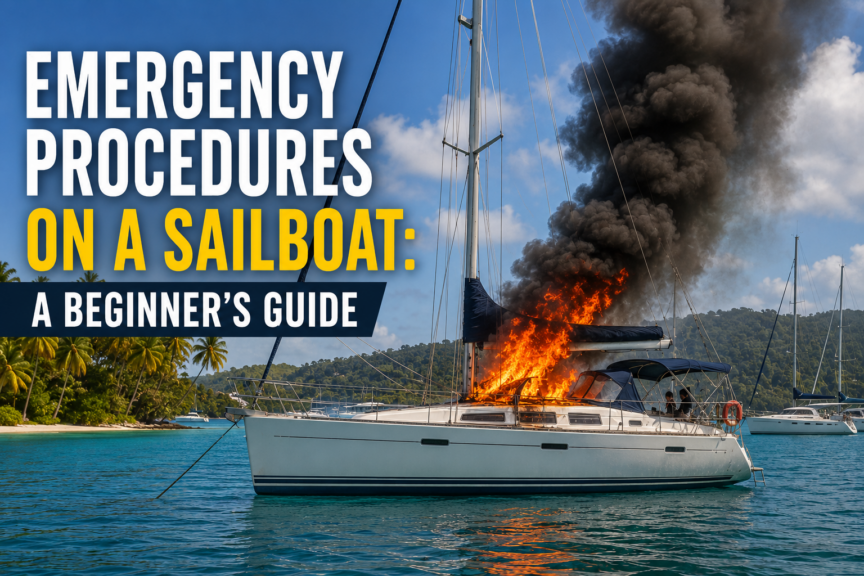
Sailing is usually a remarkably safe and enjoyable activity. Most days on the water involve nothing more dramatic than adjusting sails, watching the weather, and deciding where to stop for lunch.
Still, things can go wrong.
A crew member can get hurt. A steering cable can fail. An engine can refuse to start just when you need it. A sudden squall can arrive faster than expected. You might touch bottom, discover water where it should not be, or smell smoke coming from below deck.
For a beginner, even a relatively minor problem can feel like a major emergency.
The good news is that you do not need to be an offshore sailor or professional mariner to respond effectively. In many situations, the most important skills are surprisingly simple:
Stay calm. Control the boat. Protect the crew. Identify the problem. Then deal with it one step at a time.
This guide explains the emergency procedures on a sailboat that a recreational beginner should understand before heading onto the water.
We are not going to turn this into an offshore survival manual. Storm tactics, life-raft survival, ocean rescue procedures, drogues, sea anchors, and other advanced subjects deserve their own lessons.
Instead, we will concentrate on the emergencies you could realistically encounter while recreational sailing and what you should do when they happen.
About this Guide
Written by Kelly Hiebert, a recreational sailor since 2002 and a middle-school teacher. Kelly created Sailboat Zone to provide beginners with clear, structured sailing education.
Last reviewed: September 2026
Jurisdiction: This guide focuses on general emergency preparedness for recreational sailboats operating in Canadian waters. Required equipment, reporting duties, radio procedures and emergency services can vary by vessel, voyage and location. Follow current Canadian laws, local notices, equipment instructions and directions from emergency authorities.
Primary sources:
- Transport Canada — Safe Boating Guide 2026
- Canadian Coast Guard — Radio Aids to Marine Navigation 2026
- Transport Canada — Maintaining a Safe Pleasure Craft
Safety note: This guide provides general educational information for beginner sailors. It does not replace current regulations, first-aid or emergency training, vessel-specific procedures, equipment manuals or instructions from emergency authorities. Conditions differ, so use judgment, protect people first and call for qualified assistance early when needed.
Quick Summary: What to Do in a Sailing Emergency
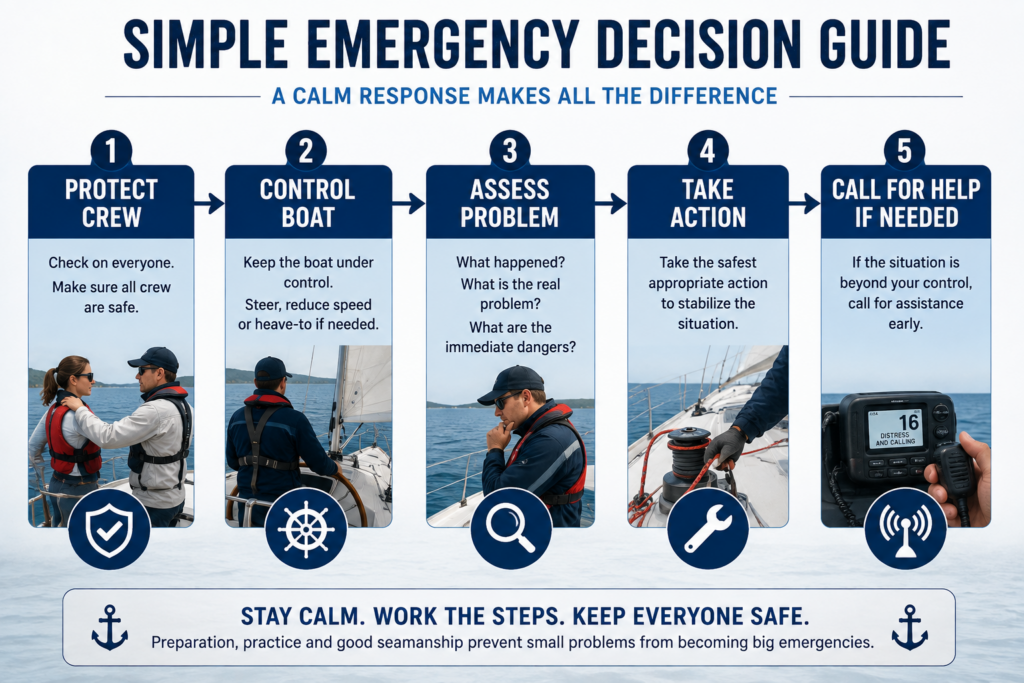
If something suddenly goes wrong aboard your sailboat, remember this basic sequence:
- Protect the crew.
- Keep control of the boat.
- Reduce immediate danger.
- Identify what happened.
- Decide whether you can safely solve the problem yourself.
- Call for assistance early if you may need it.
- Stay with the boat unless remaining aboard becomes more dangerous than leaving it.
You do not have to solve everything immediately.
Your first job is to prevent one problem from becoming several.
The First Rule: Control the Boat and Protect the Crew
Imagine that something suddenly breaks.
There is a loud bang from the rig.
Someone slips in the cockpit.
The engine stops.
Smoke appears below deck.
A beginner’s natural reaction is often to focus entirely on the problem.
But before rushing toward it, ask two questions:
Is everyone safe?
Is the boat under control?
These questions come first because a manageable problem can quickly become a serious emergency if nobody is steering the boat or watching the crew.
For example, suppose a jib sheet jams while sailing in strong wind.
The jammed sheet matters.
But if everyone immediately rushes forward to deal with it and nobody controls the helm, the boat may turn unexpectedly, the boom may swing across the cockpit, or someone may fall overboard.
Whenever possible, assign one person to remain responsible for the boat.
That person should monitor:
- the boat’s heading
- nearby traffic
- wind and waves
- rocks and shoreline
- water depth
- the position of the sails
- the safety of the crew
Everyone else can then address the problem.
If necessary, slow the boat down.
Ease the sails.
Head toward a safer area if one is available.
Start the engine if doing so is safe and useful.
In some circumstances, you may even choose to heave-to, allowing the boat to settle into a slow, controlled configuration while you deal with the situation.
The important principle is simple:
Stabilize the situation before trying to fix it.
Marine rescue organizations would much rather hear about a developing problem while you still have control than receive a desperate call much later. The Canadian Coast Guard emphasizes early alerting because giving search-and-rescue services advance notice can provide valuable time before a developing problem becomes a distress situation.
What to Do When Someone Is Injured
Injuries aboard a sailboat can range from a minor cut to something much more serious.
Common sailing injuries include:
- cuts and scrapes
- rope burns
- bruises
- sprains
- seasickness and dehydration
- head injuries
- burns
- fractures
- injuries caused by the boom or other moving equipment
Your first task is to prevent further injury.
If someone is injured while the boat is sailing quickly, consider slowing or stopping the boat before attempting treatment.
Ease the sails or change course if appropriate.
If conditions allow, heaving-to may provide a much calmer platform for helping an injured person.
Then assess the casualty.
Check whether the person is:
- conscious
- breathing normally
- bleeding seriously
- able to communicate
- able to move safely
For serious injuries, call for professional assistance rather than trying to diagnose the problem yourself.
A proper marine first-aid kit should always be aboard, stored somewhere accessible and known to the crew.
At least one person aboard should also have current first-aid training.
A useful beginner habit
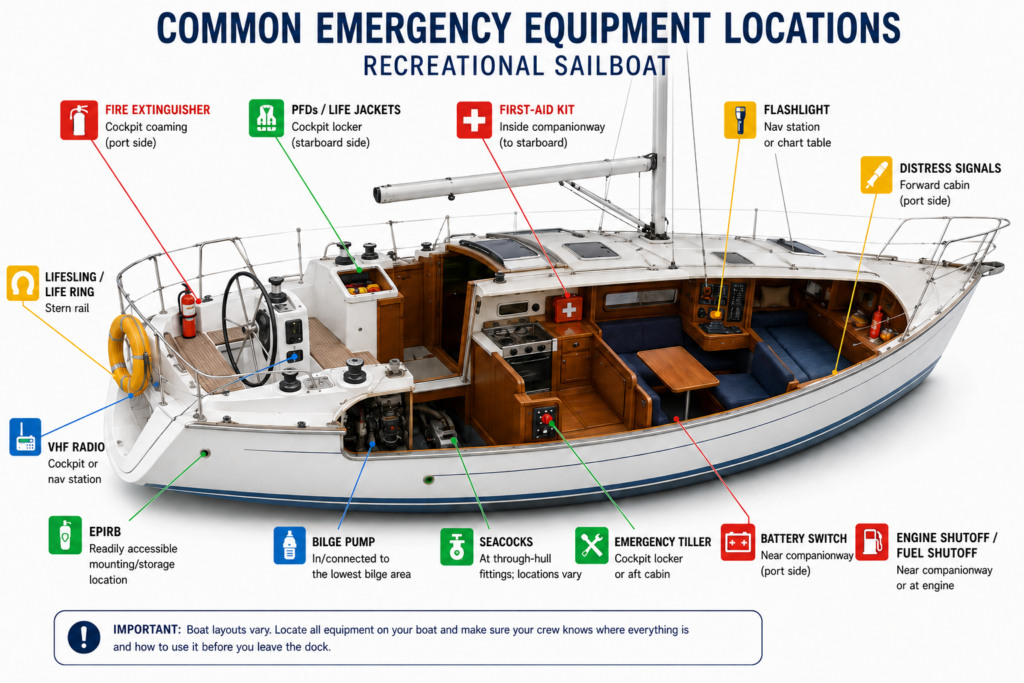
Before leaving the dock, tell everyone where the first-aid kit is located.
Do the same for:
- life jackets/PFDs
- fire extinguishers
- VHF radio
- emergency signalling equipment
- bilge pumps
- emergency tiller
- engine shutoff
- fuel shutoff
- battery switches
Emergency equipment is far less useful if nobody knows where it is.
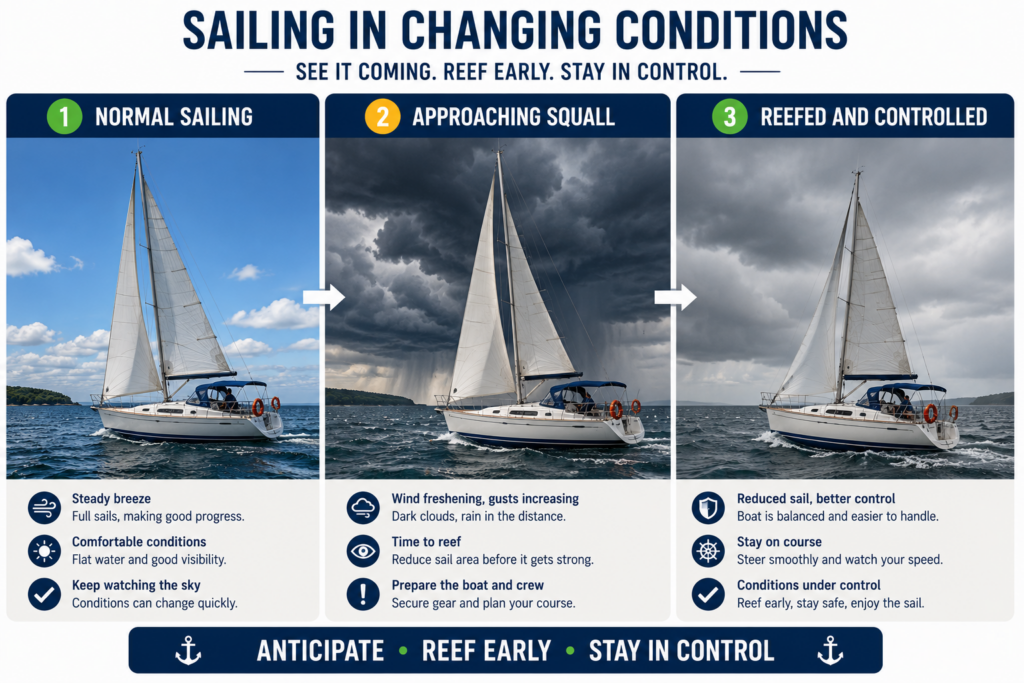
Sudden Severe Weather
Weather does not always change gradually.
A pleasant afternoon can become uncomfortable very quickly when a squall approaches or wind suddenly increases.
The safest response usually begins before conditions become severe.
Watch the sky.
Monitor forecasts.
Pay attention to changes in wind direction and strength.
If stronger weather appears to be approaching, prepare early.
You may want to:
- put on PFDs if they are not already being worn
- secure loose equipment
- close hatches
- reef the mainsail
- reduce or furl the headsail
- organize the cockpit
- prepare the engine if appropriate
- move inexperienced crew to safer positions
- decide where you will go if conditions deteriorate further
The key word is early.
Reefing in 15 knots of wind is generally much easier than trying to reef after the wind suddenly reaches 25 knots.
If the boat becomes overpowered, reducing sail can make an enormous difference.
Less sail area generally means:
- less heel
- lower loads
- easier steering
- more comfortable crew
- better control
Do not confuse carrying lots of sail with good seamanship.
Good sailors adjust the boat to suit the conditions.
Loss of Steering
You turn the wheel or tiller.
Nothing happens.
That is an alarming moment, but steering failure does not automatically mean the boat is lost.
First, tell the crew what has happened.
Then reduce speed if necessary.
Ease the sails and avoid allowing the boat to accelerate uncontrollably.
Next, determine what kind of steering system you have and whether an emergency steering method is available.
Many wheel-steered sailboats have an emergency tiller that can connect more directly to the rudder system.
Every skipper should know:
- whether an emergency tiller exists
- where it is stored
- how to access the rudder post
- how to install it
This is something worth practising at the dock.
Not during the emergency.
If the normal steering system fails but the rudder itself remains intact, an emergency tiller may restore enough control to reach safety.
If the rudder itself has been damaged or lost, the situation is considerably more serious.
Sail trim, drogues or other improvised methods can sometimes influence direction, but these techniques are boat-specific and can be difficult for inexperienced sailors.
If you cannot safely control the vessel, call for assistance early.
Beginner Tip
The first time you see your emergency tiller should not be after your steering system fails.
Find it before your next sail.
Engine Failure
A sailboat has one enormous advantage over many powerboats when the engine stops:
It is still a sailboat.
If the engine fails while you have enough room and suitable wind, sailing may provide the safest immediate solution.
Do not become so focused on restarting the engine that you forget to control the boat.
If necessary:
- Establish a safe heading.
- Hoist or trim the sails.
- Move away from immediate hazards.
- Then investigate the engine.
Common causes of apparent engine failure can include fuel problems, overheating, electrical problems, fouled propellers, or other mechanical faults.
Beginners should be cautious about attempting repairs underway, particularly around a hot engine or moving machinery.
If you are drifting toward danger and cannot sail away safely, the situation is more urgent.
Consider anchoring if water depth and conditions permit.
If you cannot control the vessel or prevent it from entering danger, request assistance.
The lesson here is important:
The engine is useful equipment aboard a sailboat, but your safety plan should not depend entirely upon it.
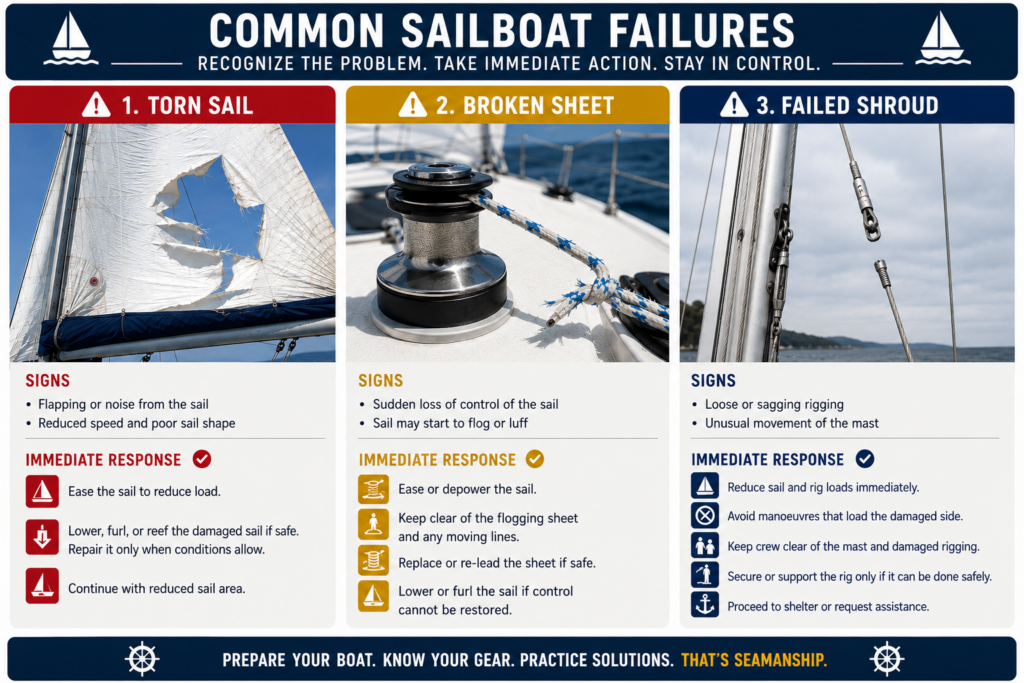
Rigging or Sail Failure
Sailing places substantial loads on equipment.
Sheets can break.
Halyards can fail.
Sails can tear.
Fittings can loosen.
Standing rigging can occasionally fail.
The response depends upon what has broken.
A torn sail may simply require reducing sail and returning home.
A broken sheet can often be replaced.
A failed halyard may mean lowering or abandoning use of that sail.
Standing rigging failure is more serious because the mast itself may no longer be adequately supported.
If a shroud or stay fails:
Reduce loads on the rig immediately.
Ease or lower sails if doing so can be done safely.
Keep crew away from damaged rigging.
Avoid standing beneath a compromised mast.
If the engine is available, it may be safer to proceed under power after the sails are secured.
Be extremely cautious around broken stainless-steel wire, loaded ropes, and damaged rigging.
A line or cable under tension can release enormous energy if it fails.
Never put yourself in the path of loaded equipment simply to save a sail.
Equipment can be replaced. Crew cannot.
Running Aground
At some point, many sailors touch bottom.
Not every grounding is an emergency.
A slow grounding on soft mud may be little more than embarrassing.
Running hard onto rock at speed is very different.
If you run aground, your first reaction should generally not be to apply maximum engine power.
Stop and assess the situation.
Ask:
- Is anyone injured?
- Is the boat stable?
- Are we taking on water?
- What is the bottom made of?
- Is the tide rising or falling?
- How did we get here?
- Which direction is deeper water?
Check the bilge for water.
Inspect accessible areas around the keel if possible.
If you grounded gently and there appears to be no damage, you may be able to reverse your course and carefully move back toward deeper water.
But avoid aggressive manoeuvres that could worsen hull, keel, rudder, or propeller damage.
The tide matters
A grounding on a rising tide can sometimes solve itself.
A grounding on a falling tide can become increasingly difficult as the water level drops.
Know your local tides before sailing in shallow or tidal waters.
If the boat is damaged, stuck in a dangerous position, or exposed to waves, call for assistance.
Before trying to get free
The first objective is not necessarily to refloat the boat immediately. It is to determine whether attempting to move it could make the situation worse.
Before using substantial engine power, sails, crew weight or another boat to pull the vessel free, consider:
- whether the hull or keel may have been damaged;
- whether water is entering the boat;
- whether the rudder or propeller may be obstructed;
- whether the boat is being driven farther onto the hazard by wind or waves;
- whether the tide is rising or falling;
- whether the boat could become unstable as the water level changes;
- where the deeper water actually lies; and
- what will happen immediately after the boat comes free.
A hard grounding deserves particular caution. Impact with rock can damage a keel, hull structure, rudder or other underwater components even when the damage is not immediately visible.
If the boat is stable and there is no immediate danger, taking a few minutes to understand the situation may be far safer than turning a simple grounding into flooding, propulsion damage or an injury.
If the boat is pounding on a hard bottom, taking on water, becoming unstable or being driven toward greater danger, seek assistance early.
Skipper Thinking: Before attempting to refloat the boat, ask:
“If this works, where will the boat go next?”
Getting off the bottom is only useful if you remain in control afterward.
Taking on Water
Water inside the boat deserves immediate attention.
But do not panic simply because you find water in the bilge.
Many sailboats collect small amounts of water from rain, spray, shaft seals, condensation, or other minor sources.
The emergency is uncontrolled water entering the boat.
If the water level is rising:
1. Find the source
Look for obvious possibilities such as:
- damaged through-hull fittings
- failed hoses
- leaking seacocks
- collision damage
- grounding damage
- propeller-shaft leaks
- damaged plumbing
2. Slow the inflow
If possible, close the appropriate seacock.
A wooden plug or purpose-made soft plug may help control a damaged through-hull.
Other temporary materials may slow a leak until help arrives.
3. Remove water
Use the electric bilge pump if available.
Use a manual bilge pump as necessary.
Buckets can also move a surprising amount of water.
4. Call for help early
If water is entering faster than you can remove it, you have a serious emergency.
Do not wait until batteries are underwater or the boat is close to sinking before calling for assistance.
Give rescuers time to reach you.
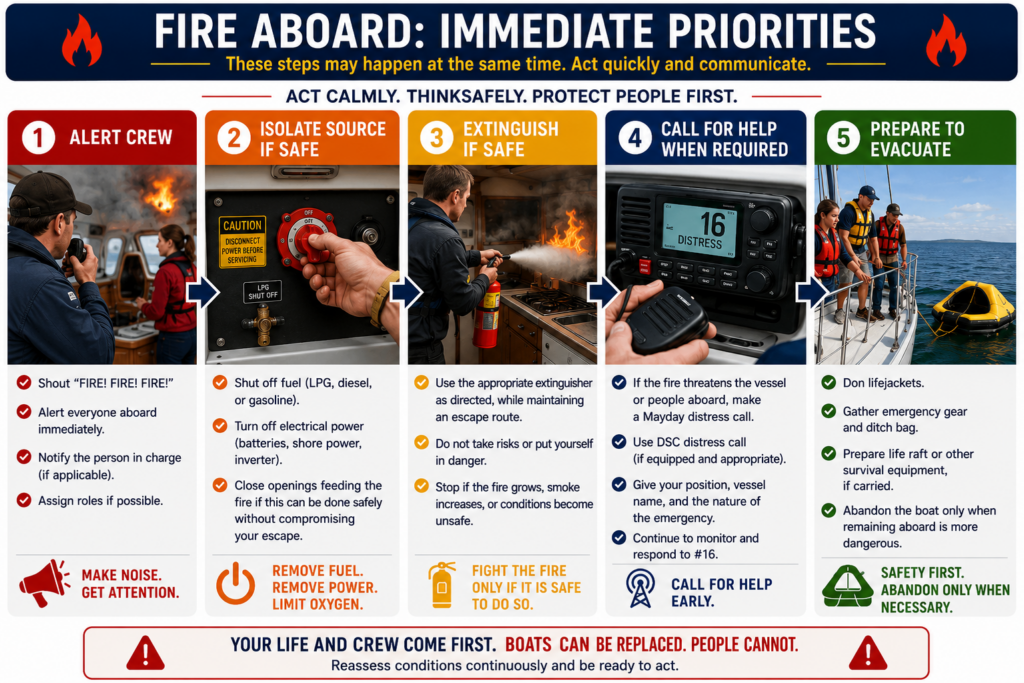
Fire Aboard
Fire is one of the most serious emergencies aboard any boat.
Boats contain several things that can make fires particularly dangerous:
- fuel
- batteries
- electrical wiring
- cooking equipment
- upholstery
- confined spaces
If you discover a fire, alert everyone aboard immediately.
Keep people away from smoke and flames.
If appropriate and safe, shut down the engine, fuel supply, electrical source, or other system feeding the fire.
Use the correct fire extinguisher if the fire is small enough to attack safely.
Keep yourself between the fire and a safe escape route whenever possible.
Do not allow the fire to trap you below deck.
Engine-compartment fires
Opening an engine compartment unnecessarily can provide additional oxygen to a fire.
If your boat has a dedicated engine-compartment fire suppression system or extinguisher access port, know how it works before an emergency occurs.
Your priority is the crew
Trying to save the boat is never worth trapping yourself inside a burning cabin.
If you cannot control the fire safely, make a distress call and prepare the crew for the possibility of leaving the vessel.
Collision
Even careful sailors can become involved in collisions.
You might strike:
- another vessel
- a dock
- floating debris
- a navigation marker
- a submerged object
Immediately check the crew for injuries.
Then determine whether either vessel is in danger.
Check for:
- hull damage
- water entering the boat
- rigging damage
- steering problems
- fuel leaks
- electrical damage
If two vessels remain physically entangled after a collision, do not automatically pull them apart.
One boat may actually be plugging a hole in the other.
Separating them without understanding the damage could dramatically increase flooding.
If there are injuries, significant damage, pollution, or danger to either vessel, contact the appropriate authorities.
Once immediate safety has been addressed, record relevant information about what happened.
Loss of Electrical Power
Electrical failure aboard a sailboat can range from an inconvenience to a significant safety problem.
You may lose:
- navigation lights
- electronic navigation
- instruments
- electric bilge pumps
- cabin lighting
- engine starting
- fixed VHF radio
This is one reason good seamanship does not rely on a single electrical system.
Carry backups appropriate to your sailing area.
These may include:
- waterproof flashlight
- spare batteries
- handheld VHF radio
- phone in a waterproof case
- portable power bank
- paper chart where appropriate
- manual bilge pump
- alternative navigation tools
If electrical power disappears suddenly, check the battery switch and main breakers before assuming everything has failed.
Do not repeatedly reset a breaker that immediately trips again.
A breaker may be protecting the boat from an electrical fault.
If you smell burning insulation or suspect an electrical fire, isolate the affected circuit if it is safe to do so.
When Should You Call for Help?
Beginners sometimes wait too long to ask for assistance because they are embarrassed.
Do not.
Marine rescue organizations would much rather hear about a developing problem while you still have control than receive a desperate call much later.
Consider asking for help when:
- someone is seriously injured
- you cannot control the boat
- the boat is taking on significant water
- there is an uncontrolled fire
- you are disabled near hazards
- you are lost and entering danger
- the vessel has suffered serious damage
- weather conditions are overwhelming the boat or crew
- you believe life or the vessel may be at risk
Calling for help does not mean you have failed.
Recognizing that a situation is moving beyond your ability to manage it is part of responsible seamanship.
Using the VHF Radio in an Emergency
For many recreational sailors, the marine VHF radio is the primary way to request assistance on the water.
In many areas, VHF Channel 16 is used for distress, safety, and calling.
Know how your particular radio works before leaving the dock.
Modern fixed VHF radios may also include Digital Selective Calling (DSC) capabilities and a distress button.
If your radio has DSC, proper setup—including connecting the radio to position information and registering the appropriate maritime identity—is important if you want the system to provide its intended emergency functions.
A waterproof handheld VHF can also be an excellent backup.
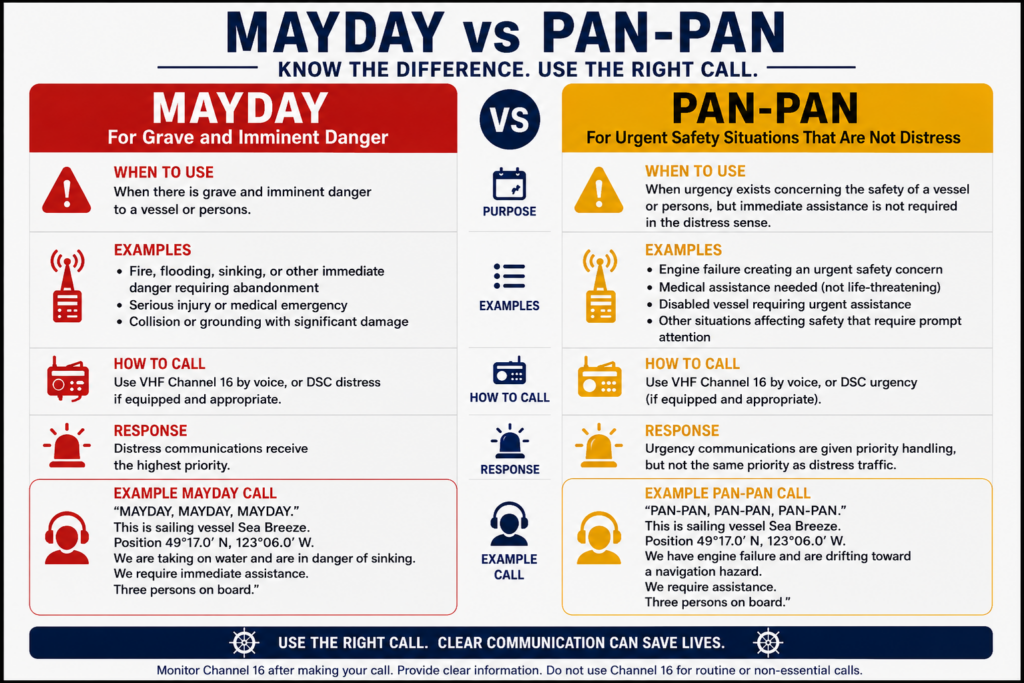
Mayday vs. Pan-Pan
Two emergency calls beginners should understand are Mayday and Pan-Pan.
They do not mean the same thing.
MAYDAY
A Mayday is used when there is grave and imminent danger and immediate assistance is required.
Examples might include:
- uncontrolled fire
- serious flooding
- a person overboard who cannot be recovered
- a life-threatening medical emergency
- a vessel in immediate danger of sinking
A typical voice distress call begins:
“Mayday, Mayday, Mayday.”
You then provide essential information such as:
- vessel name
- position
- nature of the emergency
- assistance required
- number of people aboard
- relevant vessel description or other useful information
- MMSI, if available
Speak slowly and clearly.
The goal is not to sound professional.
The goal is to communicate useful information.
PAN-PAN
Pan-Pan indicates an urgent situation that is serious but does not presently involve grave and imminent danger requiring immediate rescue.
For example, a disabled vessel in a safe position may require urgent assistance without yet being in immediate life-threatening danger.
The call begins:
“Pan-Pan, Pan-Pan, Pan-Pan.”
The distinction can be simplified this way:
Mayday = immediate grave danger.
Pan-Pan = urgent problem, but not currently grave and imminent danger.
If circumstances worsen, an urgency situation can become a distress situation.
For the complete Canadian procedures for Mayday, Pan-Pan, DSC alerts and distress communications, see the Canadian Coast Guard’s Radio Aids to Marine Navigation guidance
Person Overboard
A person falling overboard deserves its own complete lesson because recovery requires a coordinated sequence of actions.
The immediate priorities are to:
- alert everyone
- keep the person in sight
- throw flotation
- mark the position if possible
- manoeuvre back under control
- recover the person safely
Do not underestimate how difficult it can be to see someone in the water, particularly in waves.
Prevention remains enormously important.
Encourage crew to:
- wear appropriate PFDs
- use handholds
- move carefully
- stay out of dangerous positions
- avoid standing in loaded lines
- remain particularly cautious when conditions deteriorate
Abandoning the Boat: Usually the Last Resort
Movies make abandoning a vessel look like the obvious response to a serious emergency.
In reality, leaving a sailboat can expose the crew to additional dangers.
A sailboat—even a badly damaged one—may provide:
- flotation
- shelter
- visibility to rescuers
- emergency equipment
- communication equipment
- food and water
A person or small life raft can be much harder to locate than a sailboat.
For that reason, abandoning the vessel is generally a last resort when remaining aboard presents the greater danger.
Examples might include an uncontrollable fire or a vessel that is actually sinking.
If abandoning becomes necessary, and circumstances permit, take essential emergency equipment such as:
- VHF radio
- emergency signalling equipment
- EPIRB or other locator beacon if carried
- water
- first-aid supplies
- survival equipment appropriate to the voyage
But never delay escape from an immediately life-threatening situation simply to collect equipment.
The boat is replaceable.
People are not.
Build an Emergency Plan Before Leaving the Dock
The best emergency procedure begins before the emergency.
You do not need a complicated binder full of procedures for an afternoon sail.
You do need a basic plan.
Before heading out, it is also worth reviewing Transport Canada’s Safe Boating Guide, which covers required safety equipment, emergency communications and other preparation every recreational boater should understand.
Before leaving the dock, make sure someone aboard knows:
Where the safety equipment is
Show the crew the location of:
- PFDs
- fire extinguishers
- first-aid kit
- VHF radio
- emergency signalling equipment
- bilge pumps
- emergency tiller
How to stop the boat
A crew member should have at least a basic idea of how to:
- ease the sails
- steer
- start and stop the engine
- shift into neutral
How to call for help
Show someone else how to use the VHF.
Do not assume you will be the person making the emergency call.
You might be the person who becomes injured.
How to recover you
If you are the skipper, your crew should understand what to do if you fall overboard.
This is one of the strongest arguments for teaching everyone aboard at least the basics of boat handling.
Where you are going
Someone ashore should know your general plan when appropriate.
Tell them:
- where you are departing from
- your intended sailing area
- who is aboard
- approximately when you expect to return
- what they should do if you do not return
For more ambitious trips, consider using a formal sail plan or float plan.
Avoid Creating a Second Emergency
This principle deserves special attention.
When something goes wrong, people often rush.
Rushing creates new problems.
A jammed sail does not justify climbing onto a dangerous deck without a PFD.
A fouled propeller does not justify entering the water beside a moving boat without carefully assessing the risks.
A dropped object does not justify reaching into loaded rigging.
A minor leak does not justify ignoring navigation while everyone goes below.
Before acting, ask:
“Could what I’m about to do make this situation worse?”
That single question can prevent many accidents.
Emergencies Can Escalate Because of People, Too
A mechanical problem does not occur in isolation.
Imagine a headsail sheet jams while the boat is approaching a harbour.
By itself, the jam may be manageable.
But then:
- one crew member begins shouting;
- another leaves the helm to help;
- nobody maintains a lookout;
- the skipper becomes fixated on freeing the line;
- the boat continues toward shallow water;
- someone puts a hand near heavily loaded equipment;
- and nobody calls for help because everyone is trying to solve the original problem.
The jam did not become much worse.
The situation did.
This is human-factor escalation.
Stress can narrow attention. People may rush, repeat an action that is not working, stop communicating clearly or become so focused on one problem that they lose awareness of the boat around them.
Fatigue, cold, seasickness, fear and inexperience can make this worse.
When an emergency begins to feel chaotic:
- Keep someone controlling the boat.
- Protect people before equipment.
- Reduce speed, sail or other loads when possible.
- Give crew members clear individual jobs.
- Say the problem aloud so everyone is solving the same problem.
- Keep watching what is happening around the boat.
- Ask whether your current action is improving the situation.
- Call for assistance before the situation exceeds your ability to manage it.
A skipper does not need to personally perform every task.
The skipper needs to make sure the most important task is being done.
That distinction becomes increasingly important as situations become complicated.
The same principles apply before an emergency occurs. Clear roles, short instructions and continuous monitoring are central to How to Assess, Brief, and Manage a Crew, while Skipper Decision Making explores how recognizing deteriorating margin early can keep an ordinary problem from becoming an urgent one.
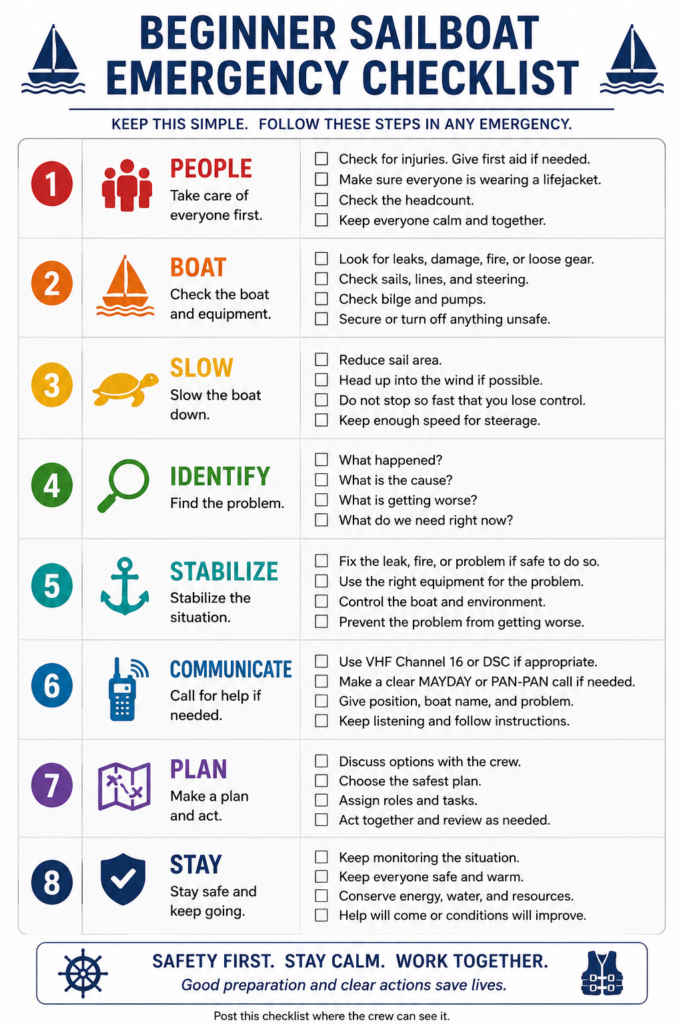
The Beginner Emergency Checklist
You do not need to memorize dozens of procedures.
Remember this sequence:
1. PEOPLE
Is everyone aboard?
Is anyone injured?
Is everyone wearing appropriate flotation?
2. BOAT
Who is steering?
Where is the boat going?
Are there immediate hazards?
Assign someone to maintain lookout and situational awareness when crew are available.
3. SLOW DOWN
Reduce sail or speed if necessary.
Create time to think.
4. IDENTIFY
What actually happened?
Do not start solving the wrong problem.
5. STABILIZE
Stop flooding.
Reduce sail.
Secure damaged equipment.
Control a small fire if safe.
Anchor if appropriate.
6. COMMUNICATE
Tell the crew what is happening.
Call for assistance early if necessary.
Assign clear roles rather than having everyone attack the same problem.
7. PLAN
Can you safely return to harbour?
Do you need assistance?
Are conditions getting better or worse?
Ask what could make the situation worse and what options are disappearing.
8. STAY WITH THE BOAT
Unless remaining aboard becomes more dangerous than leaving it.
Preparation Makes Emergencies Less Frightening
One of the biggest differences between an experienced sailor and a beginner is not that the experienced sailor never encounters problems.
Things still break.
Weather still changes.
Engines still stop.
People still make mistakes.
The difference is that an experienced sailor is more likely to recognize the problem and already have an idea of what to do next.
You can begin developing that ability long before you consider yourself experienced.
Find your emergency tiller.
Inspect your fire extinguishers.
Learn how your VHF works.
Know where your seacocks are.
Practise reefing.
Practise heaving-to.
Practise stopping the boat.
Practise person-overboard recovery.
Every one of these skills gives you another option when something unexpected happens.
And options create confidence.
Final Thoughts
Emergencies aboard sailboats are rarely improved by panic.
When something goes wrong, return to the fundamentals:
Protect the crew.
Control the boat.
Slow the situation down.
Identify the problem.
Take the safest practical action.
Ask for help before the situation becomes unmanageable.
You do not need to know how to repair every engine problem, jury-rig a mast, or survive an ocean storm to become a responsible recreational sailor.
You simply need to prepare for the problems you are reasonably likely to encounter.
That preparation is part of becoming a skipper.
The earlier lessons in this course taught you how to make a sailboat move.
Then you learned how to steer it, trim it, tack, jibe, sail upwind and downwind, reef, heave-to, sail in stronger winds, and recover someone who falls overboard.
Emergency procedures bring many of those skills together.
Because good seamanship is not just knowing how to sail when everything goes according to plan.
It is knowing how to remain in control when it doesn’t.
Beginner Emergency Procedures Quiz
Test yourself before moving to the next lesson.
1. What should generally be your first priorities when an emergency occurs?
A. Call the marina immediately
B. Protect the crew and control the boat
C. Start repairing the problem
D. Lower every sail
2. Why can slowing the boat be helpful during an emergency?
A. It always fixes the problem
B. It gives the crew more time and can reduce loads
C. It prevents the VHF from working
D. It makes steering impossible
3. When should you learn how to install an emergency tiller?
A. After steering fails
B. Only before an ocean crossing
C. Before you need it
D. Emergency tillers are unnecessary
4. If your engine fails but you have adequate wind and room, what useful option may you have?
A. Sail the boat
B. Abandon the vessel
C. Immediately transmit Mayday
D. Drop every sail
5. What should you do if standing rigging fails?
A. Increase sail to reach harbour quickly
B. Reduce loads on the rig and keep crew clear
C. Send someone up the mast
D. Tighten every line aboard
6. After running aground, what should you check for early?
A. Whether lunch is ready
B. Whether another boat saw you
C. Injuries and water entering the boat
D. Whether the sails match
7. If water is entering the boat, what is a sensible response?
A. Find the source, slow the inflow, pump water and call for help if necessary
B. Immediately jump overboard
C. Ignore it until the bilge is full
D. Increase boat speed
8. Why can opening an engine compartment during a fire be dangerous?
A. It may allow additional oxygen to reach the fire
B. It turns off the VHF
C. It damages the sails
D. It prevents the engine from cooling
9. What does a Mayday indicate?
A. A routine radio check
B. An urgent but minor inconvenience
C. Grave and imminent danger requiring immediate assistance
D. A request for weather information
10. What does Pan-Pan indicate?
A. An urgency situation that does not presently involve grave and imminent danger
B. The boat has definitely sunk
C. A person is ordering food
D. The radio is malfunctioning
11. Why should you consider calling for assistance before a situation becomes desperate?
A. Rescue organizations charge less
B. It gives assistance more time to reach you
C. It guarantees the boat will not be damaged
D. You are required to call after every equipment failure
12. Why should another crew member know how to use the VHF radio?
A. The skipper may be the person who becomes injured or incapacitated
B. It makes the boat sail faster
C. It is required before every sail
D. VHF radios require two operators
13. What is one danger of rushing to solve an emergency?
A. The sails may become cleaner
B. You may create a second emergency
C. The boat will automatically stop
D. The wind will increase
14. When should you abandon a sailboat?
A. Whenever the engine stops
B. Whenever you run aground
C. Generally only when remaining aboard presents the greater danger
D. As soon as bad weather approaches
15. Which sequence best summarizes the beginner emergency checklist?
A. Repair → Sail → Radio → Panic
B. People → Boat → Slow → Identify → Stabilize → Communicate → Plan → Stay
C. Engine → Sails → Anchor → Dock
D. Mayday → Abandon → Swim → Wait
Emergency Procedures Quiz — Answer Key
1. B — Protect the crew and control the boat.
Before concentrating on equipment or repairs, make sure people are safe and the vessel remains under control.
2. B — It gives the crew more time and can reduce loads.
Reducing speed can turn a rapidly developing situation into something much easier to assess.
3. C — Before you need it.
Find your emergency tiller and learn how to install it while safely at the dock.
4. A — Sail the boat.
One of the advantages of a sailboat is that engine failure does not necessarily remove your means of propulsion.
5. B — Reduce loads on the rig and keep crew clear.
Damaged rigging can carry enormous loads and may fail suddenly.
6. C — Injuries and water entering the boat.
After ensuring everyone is safe, determine whether the grounding caused hull or underwater damage.
7. A — Find the source, slow the inflow, pump water and call for help if necessary.
Flooding becomes particularly dangerous when water enters faster than the crew can remove it.
8. A — It may allow additional oxygen to reach the fire.
Know how your boat’s engine-compartment fire suppression arrangements work before an emergency occurs.
9. C — Grave and imminent danger requiring immediate assistance.
Mayday is the internationally recognized voice distress signal.
10. A — An urgency situation that does not presently involve grave and imminent danger.
Pan-Pan communicates an urgent safety problem without declaring immediate distress.
11. B — It gives assistance more time to reach you.
Waiting until a manageable situation becomes desperate reduces your options.
12. A — The skipper may be the person who becomes injured or incapacitated.
Basic emergency knowledge should never belong to only one person aboard.
13. B — You may create a second emergency.
Before taking action, consider whether your proposed solution could put another crew member at risk.
14. C — Generally only when remaining aboard presents the greater danger.
Even a disabled sailboat usually provides better flotation, shelter and visibility than people in the water.
15. B — People → Boat → Slow → Identify → Stabilize → Communicate → Plan → Stay.
This simple sequence gives beginners a framework they can remember when something unexpected happens.