
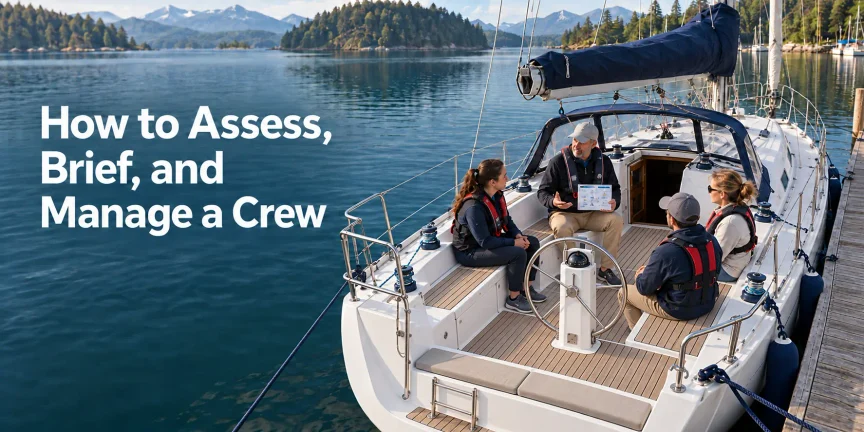
You are returning to the marina with an experienced sailor, an enthusiastic beginner and a nervous first-time passenger aboard.
As the boat enters the fairway, you realize that nobody knows who is handling the bow line. Two people reach for the same line, a fender appears on the wrong side, and the nervous passenger moves into your working space.
You are now steering, watching traffic, explaining unfamiliar words and correcting mistakes at the same time.
The problem began earlier, when the crew was not assessed, briefed or assigned clear roles.
Good crew management increases the skipper’s attention and the boat’s safety margin. Poor management consumes attention when it is needed most.
It means creating a system in which people understand the plan, know their jobs and report problems early.
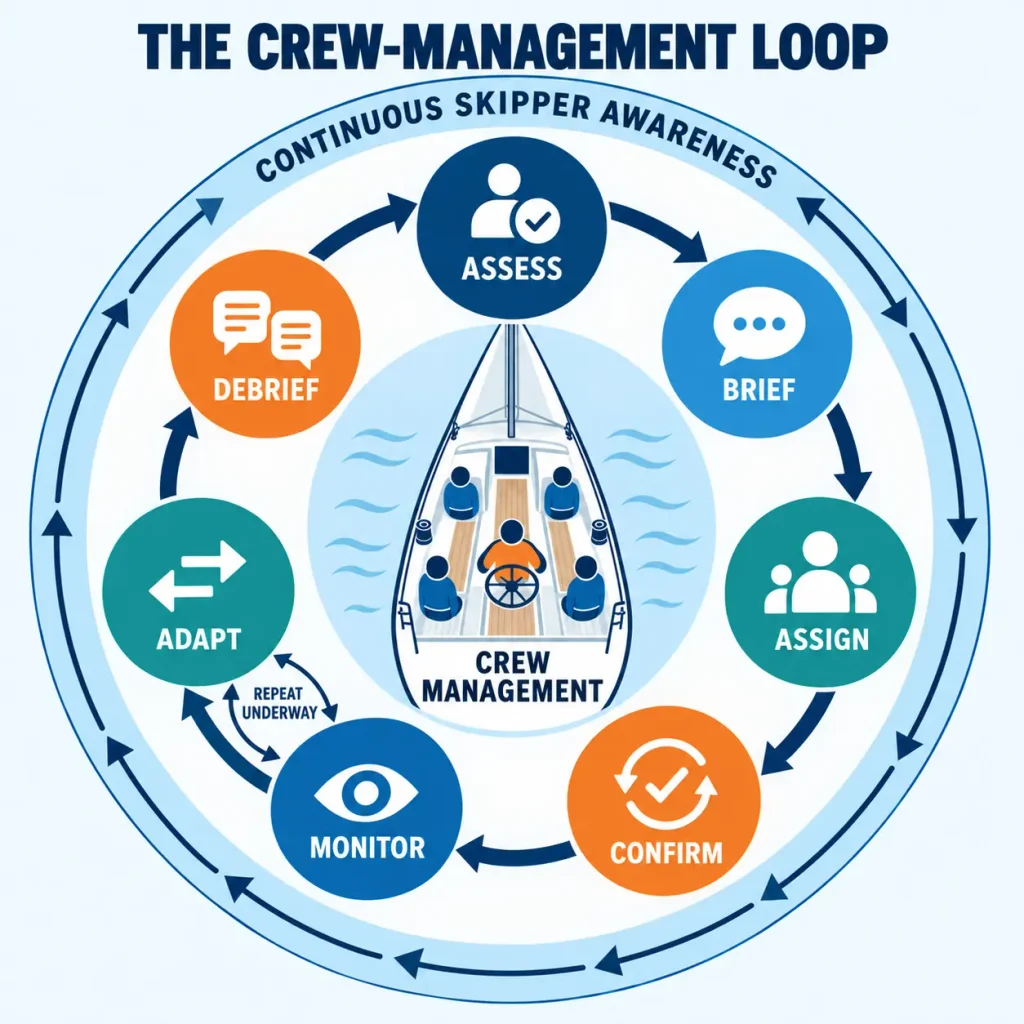
Use this process:
ASSESS → BRIEF → ASSIGN → CONFIRM → MONITOR → ADAPT → DEBRIEF
What Managing a Crew Actually Means
Having people aboard does not automatically give you a crew. Even willing helpers can create more work if they do not understand the boat, the task or the plan.
Managing a crew means:
- understanding what each person can reasonably do;
- assigning necessary jobs deliberately;
- explaining the plan and hazards;
- confirming understanding;
- monitoring the manoeuvre and the people performing it;
- adapting when conditions or capabilities change; and
- learning together afterward.
These principles apply with experienced friends, family, first-time guests or one other person. For a solo sailor, they become workload management: prepare earlier and avoid creating several urgent jobs at once. Crew management is not about making everyone busy; sometimes the safest assignment is to remain seated and clear of working lines.
Assess the Crew You Actually Have
Do not assign jobs according to confidence, enthusiasm or proximity. First consider each person’s experience, familiarity, physical capability, understanding and current condition.
An experienced sailor may be unfamiliar with your boat’s systems or docking arrangement. A confident beginner may still need close supervision. A quiet crew member may understand a task but be uncomfortable performing it in the present conditions.
Ask simple questions before departure:
- Have you sailed before?
- Have you used this boat or this type of equipment?
- Are you comfortable handling lines or steering?
- Do you know port, starboard, bow and stern?
- Is there anything that may affect your balance, mobility or comfort today?
- Is there a job you would rather not do?
Capability is not fixed. Someone who was comfortable at departure may later become cold, tired, seasick, anxious or overloaded. Assessment therefore continues throughout the sail.
Watch behaviour rather than trying to diagnose a person. Missed instructions, unsafe movement, declining coordination or repeated questions may mean an assignment needs to change. Do not automatically give every loaded line to the strongest person; mechanical advantage, technique and preparation often matter more than brute force.
Assign the Person to the Task
For each important job, ask:
Who is the best available person for this task under these conditions?
Give one person one clearly defined primary job. Use the person’s name, identify the equipment and describe the desired result.
“Someone get a line” is vague.
“Jordan, prepare the port bow line and keep it aboard until I ask for it” is much clearer.
Position people before the manoeuvre starts so they will not have to cross the cockpit at the critical moment. If someone does not need a job, say where that person should remain.
Avoid assigning an unfamiliar critical task at the last second. Explain and practise while the boat is stable. Familiarity with Sailboat Lines Explained will make instructions faster, but still use language the person understands.
Give a Useful Pre-Departure Briefing
A useful briefing is short enough to hold attention but complete enough to prevent predictable confusion. Cover safety, assignments, the forward plan and immediate emergency actions.
Begin with personal safety:
- when PFDs or lifejackets are to be worn;
- how to move while maintaining secure handholds;
- where to sit during departure and docking;
- how to stay clear of the boom;
- how to stay clear of loaded lines, winches and pinch points;
- why nobody should stand inside a loop of line; and
- why hands and feet must never be used as fenders.
Point out the safety equipment relevant to the trip: PFDs, throwable flotation, VHF radio, distress equipment, fire extinguisher, first-aid kit and bilge pump. Where appropriate, show another capable person the engine controls and emergency tiller.
Transport Canada recommends briefing guests about safe operation and showing them where the safety equipment is kept and how to use it. That does not mean delivering a half-hour lecture. It means making sure people know the few things they may need before those things become urgent.
A compact briefing can follow four plain-language prompts:
SAFETY — ASSIGNMENTS — FORWARD PLAN — EMERGENCIES
Explain what you will do first, what could change the plan, how to respond if someone falls overboard, how to summon help and what to do if you become unable to operate the boat.
The preparation described in How to Leave the Dock becomes much more effective when everyone understands the line plan before the final dock line comes off.
Build Minimum Emergency Redundancy
You do not need to turn every passenger into a second skipper. However, if you are the only person who knows how to slow the boat, use the radio or identify your position, a single injury can turn a manageable problem into a much more serious one.
At least one other capable person should ideally know how to:
- reduce or stop engine propulsion;
- steer a basic course;
- ease a sail if the boat is overpowered;
- locate and operate the VHF radio;
- describe the boat’s approximate position;
- deploy flotation; and
- begin a person-overboard response.
Minimum emergency capability does not equal complete competence; it lets another person act while obtaining help.
Ask yourself: If I suddenly became incapacitated five miles from the marina, what would the other people aboard actually know how to do?
Brief Each Manoeuvre Before It Begins
Before docking, tacking, jibing, reefing or changing sails, explain:
- what is about to happen;
- who will do each job;
- when each action should occur;
- what hazards to avoid; and
- what happens if the manoeuvre is abandoned.
Use this short structure:
WHAT → WHO → WHEN → HAZARDS → ABORT
For a docking approach, that might sound like this:
“We are entering the berth starboard side to. Jamie has the bow line. Chris has the stern line. Keep both lines aboard until I ask. Do not jump and keep hands and feet clear. If I say ‘go around,’ keep every line aboard and return to your seats.”
The abort instruction gives the crew a plan when the original one no longer works. Review the go-around principles in How to Dock a Sailboat before expecting inexperienced crew to improvise.
Use Closed-Loop Communication
Closed-loop communication simply means that an instruction is directed to a person, acknowledged, completed and reported.
INSTRUCTION → ACKNOWLEDGEMENT → ACTION → CONFIRMATION
For example:
Skipper: “Sarah, prepare the port bow line.”
Sarah: “Port bow line.”
Sarah prepares it and reports: “Port bow line ready.”
On a noisy boat, this prevents the skipper from assuming an instruction was heard or completed. It is especially useful when wind, engine noise or workload makes communication difficult.
Use names. Speak in short sentences. Give one instruction at a time. Teach useful sailing vocabulary before it is urgently required, but translate it when necessary: “Ease—let the line out slowly” is better than repeating an unfamiliar word more loudly.
Agree on words such as “ease,” “hold,” “release,” “stop” and “abort.” Terminology varies, so crew consistency matters. Urgency should sound urgent, but constant shouting makes genuine emergencies harder to recognize.
Confirm Readiness Without Losing Awareness
Before committing to a manoeuvre, pause and check:
PLAN → POSITION → PREPARE → CONFIRM → EXECUTE
Are people in position? Are lines ready and clear? Are hands and feet safe? Does each person understand the job? Is the traffic clear? Is there enough room? Has the wind, current or boat position changed?
Crew readiness is only part of manoeuvre readiness. Continue the scan described in How to Keep a Proper Lookout While Sailing, because traffic, hazards and available space keep changing.
Rule 5 of Canada’s Collision Regulations requires every vessel to maintain a proper lookout by sight, hearing and all available means appropriate to the circumstances. Delegating a lookout can add valuable eyes and ears, but it does not permit the person directing the boat to ignore the developing situation.
Make lookout assignments specific. “Watch the ferry behind us and tell me if its bearing stays the same while it gets closer” is more useful than “Keep an eye out.” Crew members are sources of information, not merely labour.
Monitor Without Micromanaging
Delegation is not abandoning supervision, and micromanagement is not effective supervision. Give a person enough independence to perform the task, but not more responsibility than they can safely manage. Watch for misunderstanding, unsafe position, increasing loads and changing conditions.
Do not grab every task at the first small mistake. Beginners need room to learn. Use a graduated response:
COACH → CLARIFY → ASSIST → REASSIGN → TAKE OVER
Take over immediately when there is an imminent safety hazard. Otherwise, start with the least intervention that will restore understanding and control.
If a beginner begins loading the wrong winch, stop and clarify. If a heavily loaded line overrides or the person loses control, intervene. Teach the practices in How to Use a Sailboat Winch Safely before expecting a beginner to handle a loaded sheet during a busy manoeuvre.
Adapt Before Workload Becomes Chaos
The original crew plan is not permanent. Rising wind, deteriorating visibility, seasickness, fatigue, equipment trouble, traffic or an unfamiliar harbour may all require new assignments.
Changing jobs is not failure. It is management.
Watch for task saturation:
- instructions must be repeated;
- two people perform the same job while another is missed;
- crew ask what to do after the manoeuvre has begun;
- the skipper stops looking outside to fix minor problems;
- several jobs become urgent at once; or
- communication becomes louder and less precise.
Respond with:
SIMPLIFY → SLOW DOWN → STABILIZE → REASSIGN → REASSESS
That may mean delaying, remaining in open water, going around, reefing earlier or heaving-to. There is no universal response, but continuing unchanged after capacity is exceeded is rarely wise.
As conditions build, reassess crew workload alongside the sail and boat-handling decisions described in How to Sail in Strong Winds. If reefing is likely, brief early and use the boat-specific sequence explained in How to Reef a Sailboat rather than waiting until the crew and equipment are heavily loaded.
Manage Crew During High-Workload Manoeuvres
During docking, assign lines and fenders early. Decide whether anyone should step ashore, and make “do not jump” explicit. Tell crew whether to retain, pass or throw a line. Identify the go-around plan and ensure that one person directs the manoeuvre, even if helpful people on the dock offer contradictory advice.
During a tack or jibe, identify who controls each sheet, keep people clear of the boom and confirm readiness. The lesson on tacking and jibing explains the difference, but commands must still suit the boat and crew.
During reefing or a sail change, assign the helm, halyard and reefing or furling controls. Maintain the lookout and report jams rather than forcing equipment. The systems in How to Hoist, Lower, Furl and Change Sails are easier to manage when everyone is briefed first.
Manage the Crew During an Emergency
In an emergency, identify the immediate priority, assign one person to each critical job and use short, named instructions. Prevent unnecessary movement. Confirm critical actions and reassess continuously.
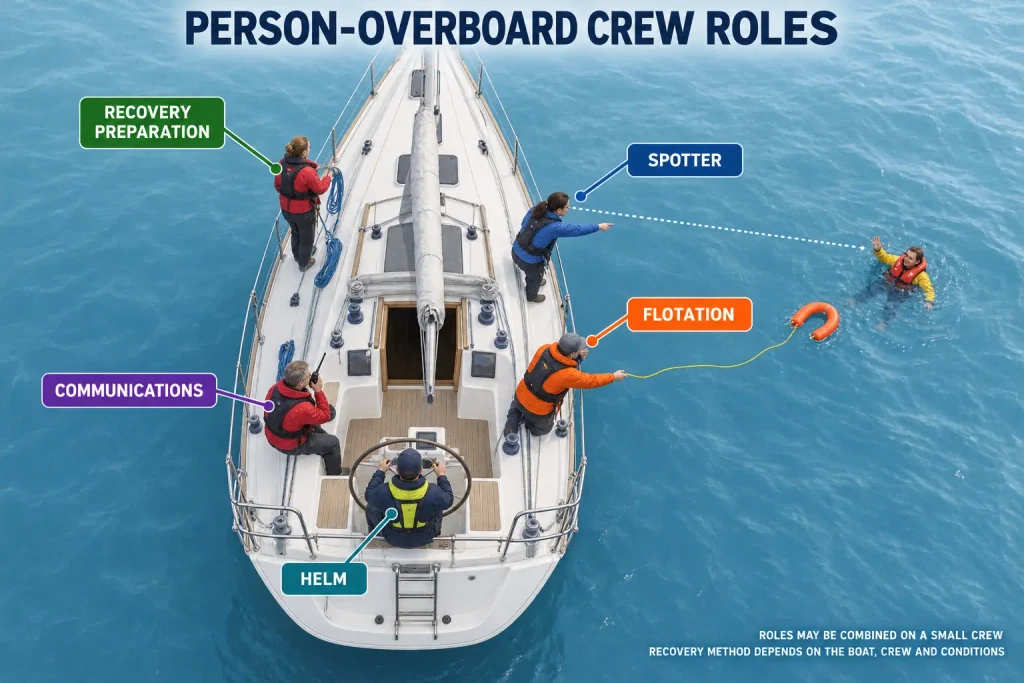
In a person-overboard response, possible roles include:
- skipper or helm;
- dedicated spotter;
- flotation deployment;
- communications; and
- recovery preparation.
One person may hold more than one role on a small crew, but the spotter should not be distracted. Transport Canada’s person-overboard procedure assigns a spotter to keep the person in sight while the master brings the vessel back.
The return and recovery method depends on the boat, crew and circumstances. Practise the complete response in Person Overboard Recovery rather than relying on reading alone.
Encourage Information and Safety Concerns
A crew member who says “I don’t understand,” “the line is jammed” or “I’m not comfortable going forward” is providing important information.
Good skippers encourage reports about traffic, hazards, depth, approaching gusts, sail shape, equipment problems and personal capability. They do not treat every question as disobedience.
That does not mean several people should command at once. Listen to useful information, decide and communicate one operational plan. Never discourage someone from reporting something that appears unsafe.
Skipper Thinking: Crew Capability Is Part of the Conditions
A sailing plan is not based only on wind, waves, tide, traffic and boat condition. The available crew is part of the situation.
Ten knots of wind on flat water with an experienced, familiar crew is not the same situation as ten knots with two first-time guests and a seasick passenger. Eighteen knots on a familiar boat with capable crew is not the same as eighteen knots on an unfamiliar charter boat in a busy harbour.
The weather may be identical, but the safety margin is not.
Consider this crew approaching a berth in a moderate crosswind:
- Alex: experienced sailor, unfamiliar with this boat;
- Jordan: has sailed twice and is comfortable with lines;
- Sam: first time aboard, nervous but observant; and
- You: familiar with the boat and steering.
A reasonable plan might put Alex on the most consequential line after a boat-specific briefing, Jordan on the second line and Sam in a secure position with a traffic-reporting task. Another arrangement could also be sound.
Now change one fact: Jordan becomes seasick. Or the wind rises sharply. Or Alex cannot hear you from the bow.
The correct response is not loyalty to the original assignments. Reassess who can still perform each job, reduce the number of simultaneous tasks and preserve an abort option.
This is Skipper Thinking: matching people, tasks, conditions and consequences in real time.
Common Crew-Management Mistakes
Giving instructions too late: Brief while there is time to ask questions.
Assuming understanding: Ask for acknowledgement and a readiness report.
Using unexplained jargon: Teach the term or translate it into plain language.
Giving one beginner several jobs: Assign one clear primary responsibility.
Keeping everyone busy: Leave unnecessary personnel safely out of the working area.
Failing to state the abort plan: Tell the crew what “stop” or “go around” requires.
Letting several people direct the manoeuvre: Invite information, then communicate one plan.
Doing everything personally: Delegate suitable tasks so you can preserve awareness.
Delegating without supervision: Monitor the person, equipment and conditions.
Waiting too long to reassign: Adapt when capability begins to decline, not after control is lost.
Teaching emergency actions during the emergency: Build minimum redundancy beforehand.
Using blame as a debrief: Study the system and improve the next plan.
Debrief After the Sail
A debrief can take two minutes. Ask:
- What worked well?
- What was confusing?
- Which instruction was unclear or late?
- Did any part feel rushed or unsafe?
- What should we practise next time?
- What should we change in the assignments or briefing?
Keep it constructive. The purpose is to improve the system, not assign blame. Repeated briefing, practice and debriefing can turn passengers into capable sailing partners.
Knowledge Check
- Why can a confident crew member still require close supervision?
- What five elements belong in a short manoeuvre briefing?
- What is the difference between delegation and abandoning supervision?
- Give one example of a specific lookout assignment.
- Name three observable signs of task saturation.
- Why should another capable person know a few emergency actions?
- When should the skipper take over a delegated task?
- Why is debriefing part of crew management rather than an optional extra?
Key Takeaways
- Assess people individually instead of making assumptions.
- Brief safety, roles, the forward plan and essential emergency actions.
- Match the person to the task and give one clear primary job.
- Use names, plain language and closed-loop communication.
- Brief manoeuvres before they begin and include an abort plan.
- Keep the wider lookout while the crew prepares and works.
- Monitor without smothering learning.
- Reassign early when conditions, workload or capability changes.
- Treat crew as additional sources of information, not merely labour.
- Build enough redundancy that the skipper is not the only person who can act.
- Debrief briefly so the crew system improves with experience.
A good skipper does not merely control the boat. A good skipper creates a crew that helps the entire boat remain under control.
Final Quiz
- Which is the best first step before assigning jobs?
A. Give the strongest person every loaded line
B. Assess each person’s experience, familiarity and present capability
C. Ask everyone to choose a job
D. Wait until the manoeuvre begins - True or false: An experienced sailor will automatically know the systems on an unfamiliar boat.
- Which instruction is clearest?
A. “Somebody get ready.”
B. “Deal with that line.”
C. “Maya, prepare the starboard bow line and keep it aboard until I ask.”
D. “You know what to do.” - What are the four broad subjects in the pre-departure briefing used in this lesson?
- Put the closed-loop communication steps in order: action, confirmation, instruction, acknowledgement.
- True or false: Everyone aboard should be given a job during every manoeuvre.
- Name two things that may reduce a crew member’s capability after departure.
- What does WHAT → WHO → WHEN → HAZARDS → ABORT help the skipper do?
- Which response best fits early task saturation?
A. Add more instructions
B. Continue so the crew learns under pressure
C. Simplify, slow down, stabilize, reassign and reassess
D. Have everyone work faster - Why should a person-overboard spotter avoid taking on unrelated tasks?
- A crew member says, “I don’t understand the instruction.” What is the best response?
A. Repeat the same words louder
B. Clarify the instruction and confirm understanding
C. Ignore the comment if the manoeuvre has begun
D. Treat it as a refusal - During a docking approach, a crosswind strengthens and a crew member becomes confused about the bow line. What should the skipper consider?
- True or false: Delegating a lookout removes the skipper’s need to maintain awareness.
- What is the purpose of a short post-sail debrief?
- Complete the crew-management cycle: ASSESS → BRIEF → ASSIGN → ______ → MONITOR → ______ → DEBRIEF.
Answer Key and Scoring Guide
- B. Assess the actual people aboard before choosing assignments.
- False. General experience does not guarantee familiarity with a particular boat, system or procedure.
- C. It names the person, equipment, side and expected limit of action.
- Safety, assignments, forward plan and emergencies. The details should be adapted to the boat and trip.
- Instruction → acknowledgement → action → confirmation.
- False. A person without a necessary job may be safest seated and clear of the working area.
- Acceptable answers include fatigue, cold, seasickness, anxiety, injury, distraction or overload.
- It structures a short pre-manoeuvre briefing, including the plan if the manoeuvre is abandoned.
- C. Reducing concurrent demands restores attention and options.
- Continuous visual contact is the spotter’s critical responsibility; distraction can cause the person in the water to be lost from sight.
- B. Uncertainty is valuable information. Clarify before relying on the action.
- A sound answer recognizes the need to reassess, clarify or reassign the line, and abort or go around if crew and boat are not ready. More than one exact decision may be defensible depending on available space and control.
- False. Crew can support the lookout, but delegation does not justify losing overall situational awareness.
- To identify what worked, what was confusing and what should be changed or practised before the next sail—not to assign blame.
- CONFIRM; ADAPT.
13–15 correct — Strong understanding: You understand the crew-management cycle and can reason through changing assignments. Continue practising briefings and role changes in controlled conditions.
10–12 correct — Good foundation: Review closed-loop communication, manoeuvre briefings and the signs of task saturation.
7–9 correct — Developing: Revisit assessment, role assignment, monitoring and emergency redundancy before coordinating inexperienced crew.
Below 7 — Review recommended: Work through the lesson again, then practise short briefings and simple assignments with an experienced sailor.
An online quiz does not qualify anyone to command a vessel. Competence comes from supervised practice, boat-specific knowledge, sound judgement and experience in conditions appropriate to your ability.