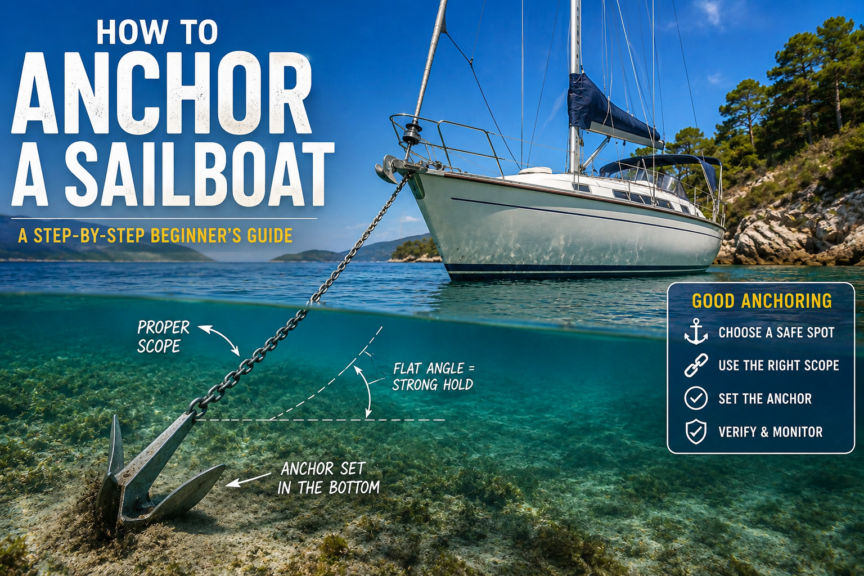
Anchoring a sailboat can seem surprisingly simple.
You find a quiet spot, lower the anchor, let out some rope or chain, and settle in.
But good anchoring involves considerably more than dropping a heavy object onto the seabed.
A properly anchored sailboat is held by an entire anchoring system: the anchor, chain or rope, the angle of pull, the seabed, the amount of rode deployed, and the way the anchor has been set.
Once you understand how those pieces work together, anchoring becomes much less mysterious.
In this guide, we will work through the entire process—from choosing an anchorage and calculating scope to setting the anchor, checking that it is holding, monitoring it overnight, and retrieving it safely.
By the end, you should understand not only how to anchor a sailboat, but why each step matters.
About this Guide
Written by Kelly Hiebert, a recreational sailor since 2002 and a middle-school teacher. Kelly created Sailboat Zone to provide beginners with clear, structured sailing education.
Last reviewed: September 2026
Jurisdiction: This guide explains general recreational sailboat-anchoring principles using Canadian safety and navigation guidance as its primary reference. Equipment requirements, anchoring restrictions, required lights and local procedures vary by vessel, location and conditions. In Canadian waters, use current official charts and publications, observe local restrictions and notices, and follow the requirements that apply to your vessel and anchoring location.
Primary sources:
- Transport Canada — Safe Boating Guide 2026
- Canadian Hydrographic Service — Canadian Sailing Directions
- Justice Laws Website — Collision Regulations
Safety note: No anchor, scope ratio or anchoring procedure is suitable for every boat and condition. Confirm the expected maximum depth and tidal change, calculate scope from the seabed to the rode’s attachment point, allow adequate swinging room, and follow the anchor and windlass manufacturers’ instructions. Set and verify the anchor, monitor weather and position, and relocate or get underway if the holding ground, available room or conditions become unsafe.
What Does Anchoring a Sailboat Actually Mean?
An anchor does not simply “hold the boat down.”
That is one of the most important ideas for a beginner to understand.
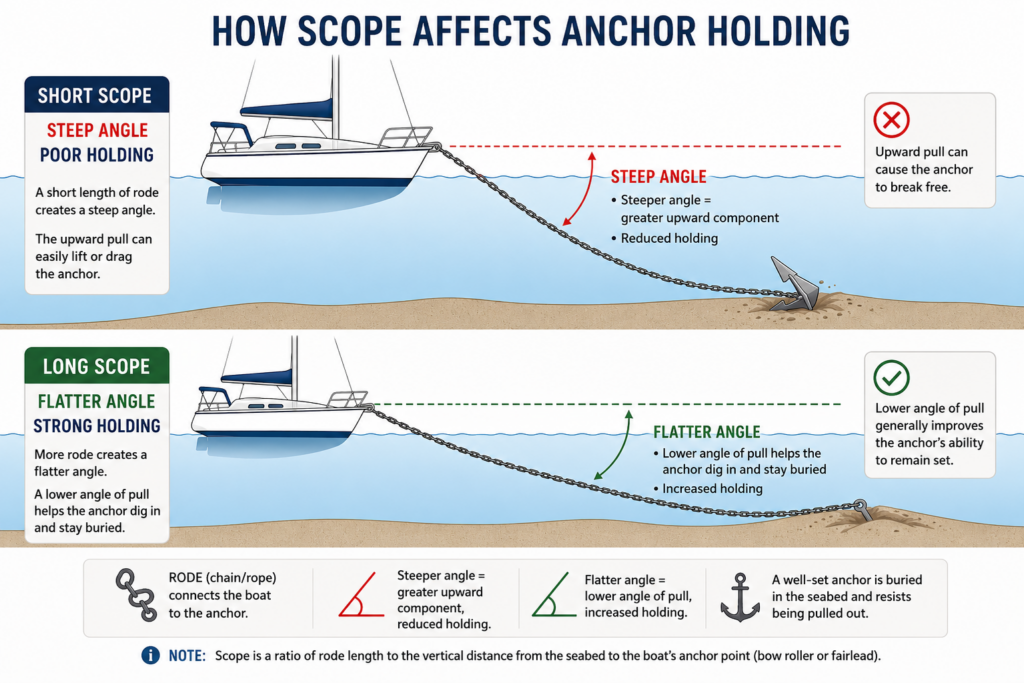
Most modern sailboat anchors are designed to dig into the seabed. As the boat pulls backwards, the anchor buries itself more deeply into sand, mud, clay, or another suitable bottom.
The anchor works best when the pull on it is nearly horizontal.
Imagine pulling a garden shovel sideways through packed soil. It tends to dig.
Now imagine pulling the handle almost straight upward. The shovel comes out.
An anchor behaves somewhat similarly.
The more horizontally the rode pulls against the anchor, the better many anchors are able to remain buried.
That is one reason scope is so important.
The rode—the chain, rope, or combination connecting the boat to the anchor—is therefore not merely a connection between the boat and anchor.
It is part of the anchoring system.
Parts of a Sailboat Anchoring System
Before learning the procedure, become familiar with the equipment. If terms such as bow, stern, windward and leeward are still unfamiliar, review our Basic Sailing Terminology guide before continuing.
Anchor
The anchor is the part that penetrates or grips the seabed.
Its effectiveness depends on its design, size, seabed conditions, scope and how well it has been set.
Chain
Chain is commonly used between the anchor and the boat, either as the entire rode or as the lower portion of a combination rode.
Chain provides abrasion resistance near the seabed and adds weight to the rode.
However, don’t fall into the trap of thinking chain eliminates the need for adequate scope. As loads increase, chain can straighten considerably.
Nylon Rope Rode
Smaller cruising sailboats commonly use nylon rope as part of their anchor rode.
Nylon is particularly useful because it stretches under load, helping absorb shock when waves or gusts pull against the boat.
Combination Chain-and-Rope Rode
A very common arrangement uses chain nearest the anchor and nylon rope farther back.
This combines the abrasion resistance and weight of chain with the elasticity and lighter weight of nylon.
Bow Roller
The bow roller guides the anchor and rode over the bow while reducing chafe and helping control deployment and retrieval.
Anchor Locker
The anchor locker stores the rode when it is not being used.
The rode should be arranged so it can deploy without tangling.
Windlass
A windlass is a powered or manual device used to retrieve—and on many boats deploy—the anchor rode.
It makes handling heavy ground tackle considerably easier, particularly on larger cruising boats.
A windlass should not normally be treated as the final attachment point carrying the boat’s anchoring loads.
Cleats
Strong deck cleats provide secure attachment points for rope rode or snubbers.
Shackles and Swivels
Shackles connect components of the anchoring system.
Some systems also incorporate swivels to reduce twisting.
These fittings need to be properly sized, secured and inspected regularly. The anchoring system is only as reliable as its weakest component.
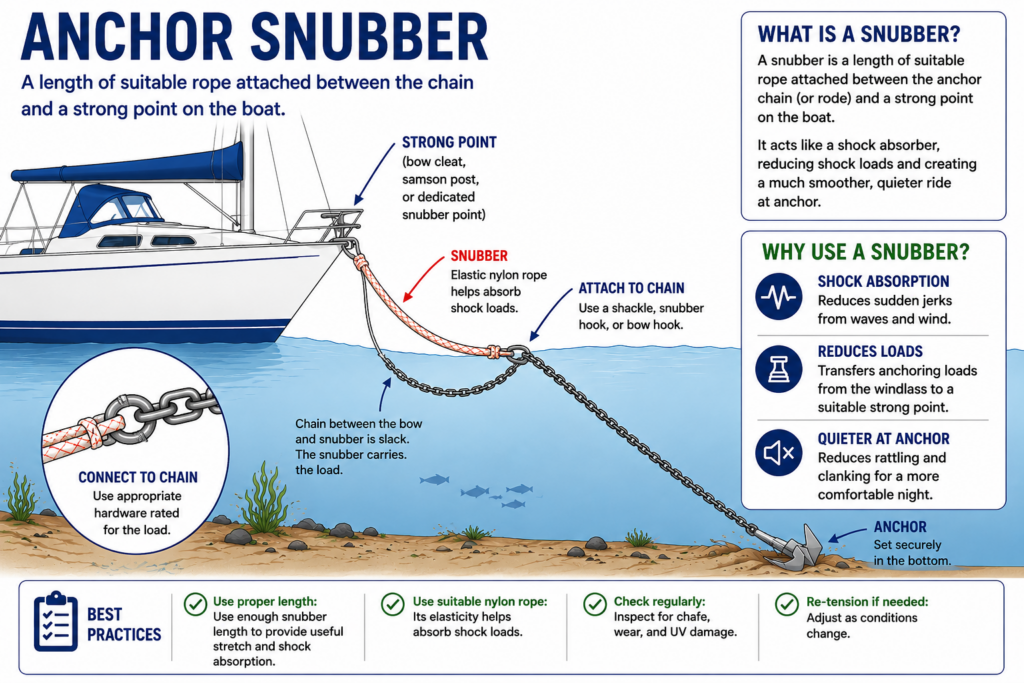
Snubber
An all-chain rode has relatively little elasticity once heavily loaded.
A snubber is a length of suitable rope attached between the chain and a strong point on the boat. It provides shock absorption, reduces loads on the windlass and can make an anchored boat considerably quieter.
Common Types of Sailboat Anchors
There is no single perfect anchor for every boat and every seabed.
That is why experienced cruising sailors sometimes carry more than one type.
Modern Scoop Anchors
Modern scoop-style anchors are designed to orient themselves correctly and bury deeply.
They are popular cruising anchors because many perform well in several common seabeds and can develop impressive holding power when properly sized and set.
Their disadvantages include weight, cost, bow-roller compatibility issues on some boats and reduced effectiveness in certain rocky or heavily weeded bottoms.
Plow or Plough Anchors
Plow-style anchors have been used successfully on cruising sailboats for decades.
They can perform well across several bottom types and often reset after moderate changes in direction.
Some older designs may not set as quickly or develop as much holding power as newer scoop designs in particular seabeds.
Danforth or Fluke Anchors
Danforth-style anchors use large, relatively flat flukes.
They can develop excellent holding power for their weight in suitable sand and mud.
Their broad flukes can make them less suitable for rock, thick weed or some very hard bottoms.
Claw Anchors
Claw-style anchors became popular because they are rugged, relatively simple and can work across a range of seabeds.
They are often easy to handle and may reset reasonably well when the direction of pull changes.
However, their holding power relative to weight may be lower than some newer anchor designs.
Older Traditional Designs
Traditional fisherman-style and similar anchors still have specialized uses, particularly around rock, weed and difficult bottoms.
However, they can be awkward to store and may offer less practical holding ability for their weight in typical recreational cruising conditions.
Which anchor is best?
There is no universal answer.
Anchor selection depends on:
- boat size and displacement;
- expected wind and sea conditions;
- seabed;
- cruising area;
- anchor weight;
- available storage;
- bow-roller arrangement; and
- manufacturer recommendations.
For a beginner, the important lesson is this:
Choose an appropriately sized anchor for your boat and understand the conditions in which that particular anchor works well.
Understanding the Seabed
An anchor’s holding power depends heavily on what it is trying to dig into.
Sand
Firm sand is often excellent anchoring ground.
Many modern anchors dig into it quickly and develop strong holding power.
Mud
Mud can provide good holding, but not all mud is equal.
Soft surface mud may hide firmer material beneath it, while very soft mud may require an anchor capable of penetrating deeply.
Clay
Clay can provide excellent holding once an anchor penetrates it, but hard clay can sometimes make initial setting difficult.
Gravel
Gravel can be unpredictable because an anchor may have difficulty penetrating between larger particles.
Rock
Rock generally provides unreliable holding for anchors designed to bury.
An anchor might catch temporarily on a rock without actually being securely set.
It can also become fouled.
Weed and Grass
Dense vegetation can prevent an anchor from reaching the seabed.
The anchor may appear to catch before breaking free with a clump of vegetation attached.
This is why checking the charted bottom composition before anchoring is valuable.
How to Choose a Safe Anchorage
A beautiful bay is not automatically a safe anchorage.
Before committing to a location, consider several factors.
Protection from wind
Look for land that provides protection from the present wind.
Then ask a second question:
What happens if the wind changes?
An anchorage protected from a northwest wind could become exposed if the wind shifts southeast overnight.
Knowing how to read the wind is especially important when choosing a protected anchorage and anticipating how your boat may swing.
Protection from waves and swell
Wind protection does not necessarily mean wave protection.
Ocean swell can wrap around headlands and enter apparently sheltered bays.
Water depth
The water must be deep enough to remain safely afloat throughout the tidal cycle, but not so deep that you cannot deploy adequate rode.
Tide
Determine both the present depth and expected tidal range.
Current
Strong current can affect your approach, the direction the boat lies and how it swings after anchoring.
Bottom type
Look for bottom conditions compatible with your anchor.
Hazards
Identify rocks, shoals, reefs, docks, shorelines and other hazards within your possible swinging area.
Other boats
Leave enough room for both your boat and neighboring boats to swing.
Weather
Check what conditions are expected several hours later—not merely what they are now.
Escape route
Before anchoring, ask:
If this anchorage becomes unsafe at 2:00 a.m., can I get out safely?
Knowing your exit route before darkness or deteriorating weather is good seamanship.
Read the Chart Before Anchoring
Your nautical chart provides much of the information needed to evaluate an anchorage.
Look for:
- charted depths;
- depth contours;
- bottom characteristics;
- rocks;
- shoals;
- wrecks and obstructions;
- cables and pipelines;
- restricted or prohibited anchoring areas; and
- nearby navigation hazards.
Remember that charted depth is referenced to a chart datum. The actual water depth at a particular time may therefore differ because of the tide.
Before anchoring, estimate the shallowest water you expect during your stay.
Submarine cables and pipelines deserve particular attention. Anchoring in prohibited areas can damage critical infrastructure and can also result in a badly fouled anchor.
Before choosing an anchoring position, use your nautical chart to check water depths, hazards, bottom features and designated anchorages; NOAA provides a useful overview of the information nautical charts contain.
Understanding Swinging Room
Once anchored, your boat does not remain in one exact position.
It normally swings around the anchor as wind and current change.
Imagine the anchor near the center of a circle.
Your boat can potentially move around that anchor through a large portion—or all—of that circle.
Wind shifts can move it.
Tidal currents can reverse.
A neighboring boat can swing too.
Therefore, when evaluating an anchorage, think about the entire area your boat may occupy, not just where the boat is when you lower the anchor.
As a rough planning concept, the distance from your anchor to your stern can approach:
deployed rode + boat length
That is a conservative way to visualize the space your boat could occupy, although actual geometry depends on rode shape, depth, wind and current.
Different boats may also swing differently.
A boat on all-chain rode may not behave exactly like a lighter boat using mostly rope. Sailboats, catamarans and powerboats can also respond differently to wind and current.
That is why merely matching the distance between neighboring boats is not always enough.
What Is Anchor Scope?
Scope is one of the most important concepts in anchoring.
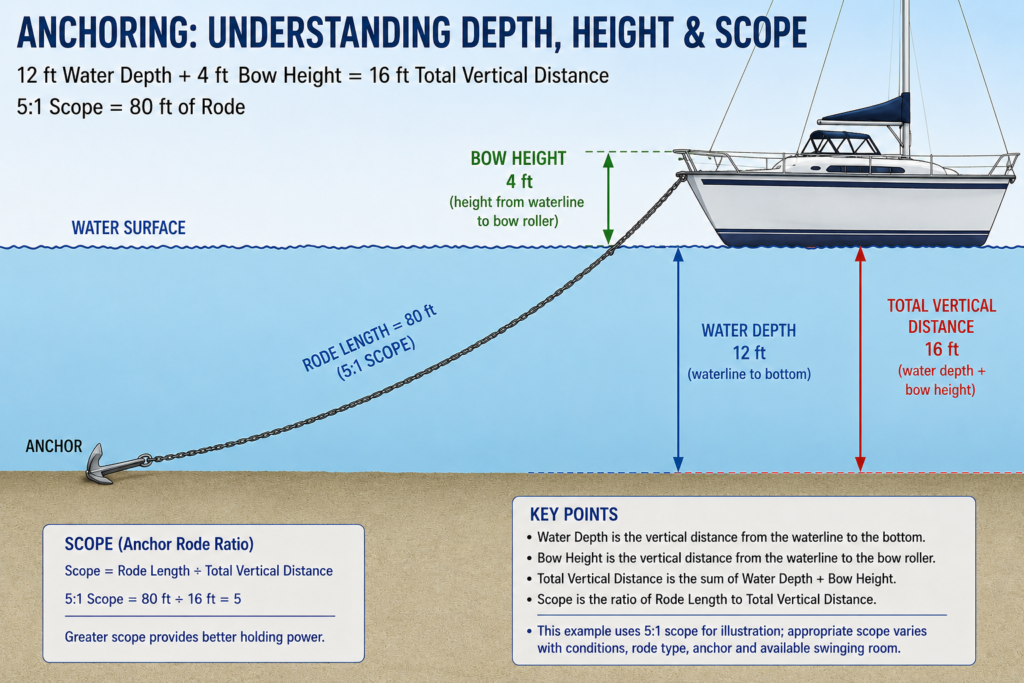
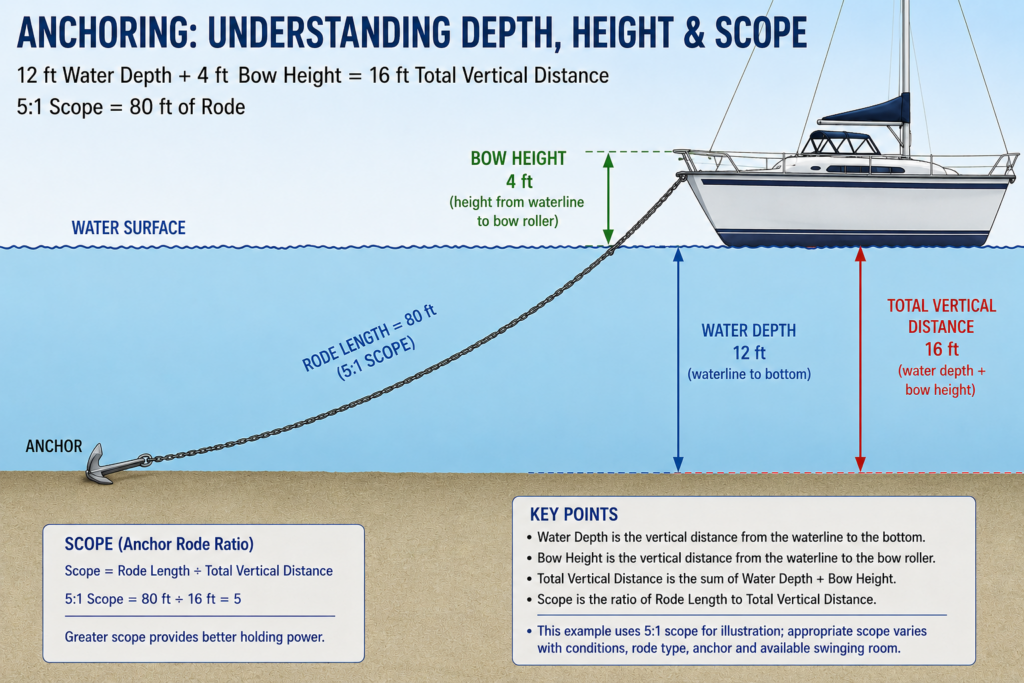
Scope is the ratio between the length of rode deployed and the vertical distance from the anchor to the point where the rode leaves the boat.
This last part matters enormously.
Beginners sometimes calculate scope using water depth alone.
That is incorrect.
Suppose:
- water depth = 12 feet;
- bow roller = 4 feet above the water.
The relevant vertical distance is approximately:
12 + 4 = 16 feet
If you want 5:1 scope:
16 × 5 = 80 feet of rode
Not 60 feet.
Another example
Suppose the water is 20 feet deep and your bow roller is 5 feet above the surface.
Vertical distance:
20 + 5 = 25 feet
At 5:1:
25 × 5 = 125 feet
At 7:1:
25 × 7 = 175 feet
This distinction becomes increasingly important as conditions deteriorate.
The BoatUS Foundation includes anchoring among the core navigation and boat-handling skills recreational boaters should understand, alongside docking, navigation aids and the rules of the road.
How Much Scope Should You Use?
There is no single ratio appropriate for every situation.
For many recreational anchoring situations, 5:1 to 7:1 is a useful planning range, with more scope commonly used when stronger conditions are expected.
Shorter scope may sometimes be used temporarily in benign conditions or crowded locations, while stronger winds, waves or uncertain holding may warrant considerably more.
The appropriate scope depends on your anchor, rode, seabed, weather, sea state and manufacturer’s guidance.
In general:
More scope produces a flatter pull on the anchor and usually improves holding.
The limitation is swinging room.
You cannot safely deploy 200 feet of rode if doing so allows you to swing onto rocks or another boat.
Sometimes the correct solution isn’t less scope.
It is finding another place to anchor.
The BoatUS Foundation also explains scope as the relationship between rode length and the height of the boat’s attachment point above the seabed, rather than water depth alone.
Preparing to Anchor
Good anchoring begins before the anchor goes overboard.
Use this sequence:
- Select the intended anchoring position.
- Determine present depth.
- Check the tidal range.
- Determine expected maximum and minimum depths.
- Check the bottom.
- Calculate required rode.
- Check swinging room.
- Prepare the anchor and rode.
- Confirm the bitter end is secured.
- Brief the crew.
- Establish clear communication between skipper and foredeck crew.
- Approach slowly and under control.
The bitter end is the inboard end of the rode.
It should be properly secured.
You do not want to watch your entire anchor rode disappear overboard because nobody checked the other end.
How to Anchor a Sailboat: Step by Step
Step 1: Approach into the dominant wind or current
Determine which force is primarily controlling the boat.
Usually you will approach slowly into that force.
Step 2: Slow the boat
Arrive at your intended anchor position under complete control.
You do not need speed.
Anchoring requires bringing the boat almost to a controlled stop at exactly the position where you want the anchor to land.
Step 3: Lower the anchor
When the boat is nearly stopped, lower the anchor rather than throwing it.
Lowering gives you greater control and reduces the chance of tangling the rode.
Step 4: Confirm the anchor reaches bottom
Pay out enough rode for the anchor to reach the seabed.
Step 5: Allow the boat to move backwards
Use wind, current or gentle reverse power to establish sternway.
Step 6: Pay out rode progressively
Continue feeding rode as the boat moves backwards.
Do not dump the entire rode into one pile on top of the anchor.
You want the rode extending progressively along the bottom.
Step 7: Reach your planned scope
Continue until the calculated amount of rode has been deployed.
Step 8: Secure the rode
Transfer the anchoring load to the appropriate strong point.
If using all-chain rode, deploy and properly load the snubber.
You are now ready to set the anchor.
How to Set an Anchor
Setting means deliberately loading the anchor so that it penetrates the seabed and develops holding power.
Do this gradually.
As the boat moves backwards, the rode begins to straighten.
Allow the anchor time to orient itself and begin digging.
If using an engine, gradually apply reverse power as appropriate for your boat and conditions.
Avoid immediately applying excessive reverse power.
A newly landed anchor may not yet be oriented correctly. Jerking it violently can cause it to skip rather than bury.
Instead:
Load → observe → increase load → verify.
A properly setting anchor often gives the rode a solid, increasingly firm feel.
An anchor dragging across rock or hard bottom may produce vibration, jumping or repeated skipping.
How Do You Know the Anchor Is Holding?
Never assume that because the boat stopped moving, the anchor is set.
Verify it.
Use shore transits
Choose two stationary objects ashore that line up with each other.
Watch their relationship.
If one steadily moves relative to the other, your boat may be moving.
Check GPS position
A chartplotter or GPS provides another useful reference.
Remember that an anchored boat normally swings, so changing GPS position alone does not prove dragging.
Watch depth
Unexpected depth changes can provide another clue.
Feel the rode
A firmly loaded rode feels different from an anchor bouncing or skipping across the bottom.
Give it time
One quick glance is not enough.
Watch the boat for several minutes.
A boat swinging normally usually moves along an arc centered around the anchor.
A dragging boat progressively moves away from the anchor position.
That distinction matters.
Using an Anchor Alarm
An anchor alarm uses GPS position to warn you when the boat moves outside a defined area.
Anchor alarms are available on many chartplotters and smartphone applications.
The alarm radius must allow for normal swinging.
Set it too tightly and every normal wind shift can trigger an alarm.
Set it too widely and the boat could drag a dangerous distance before you are warned.
Where possible, establish the alarm in relation to the anchor’s position, not merely wherever the boat happens to be after anchoring.
Smartphones can provide useful backup alarms, while a permanently powered chartplotter may provide a more integrated solution.
Either way:
An anchor alarm supplements seamanship. It does not replace it.
What to Do If Your Anchor Drags
Dragging is not a reason to panic.
It is a reason to act promptly.
If you believe the anchor is dragging:
- Start the engine.
- Regain positive control of the boat.
- Keep clear of neighboring vessels and hazards.
- Retrieve the anchor when safe.
- Reassess the situation.
- Reset with more scope if appropriate.
- Choose a better location if necessary.
Ask why the anchor dragged.
Was there too little scope?
Poor holding ground?
Did the wind increase?
Did the anchor never set properly?
Has the wind shifted?
Is the anchorage now too crowded?
Sometimes the best decision is not to reset.
It is to leave.
Dragging toward another boat, rocks or a lee shore can quickly become an emergency, so every skipper should have a simple emergency plan.
Anchoring Overnight
Overnight anchoring deserves additional preparation because conditions can change while you are asleep.
Before settling in:
- check the latest weather forecast;
- check tidal changes;
- consider predicted wind shifts;
- verify the anchor’s set;
- consider whether additional scope is appropriate;
- set an anchor alarm;
- display the legally required anchor/navigation lights for your vessel and location;
- establish a position-check routine; and
- know your escape route.
Ask yourself:
If the wind increases significantly at 3:00 a.m., what will I do?
That answer should exist before you go to bed.
Anchoring in Stronger Winds
As wind increases, loads on the anchoring system rise substantially.
Additional scope can improve the anchor’s holding angle.
Also consider reducing unnecessary windage where practical and ensuring the anchor is thoroughly set.
All-chain systems particularly benefit from an effective snubber because it provides elasticity and reduces shock loading.
Most importantly, maintain adequate swinging room.
A beginner should not feel obligated to remain in a marginal anchorage simply because more experienced boats are staying.
If stronger weather is expected, moving early to a more protected anchorage or marina may be the better seamanship decision.
If stronger conditions are developing, review the principles in our guide to sailing in strong winds before deciding whether to remain in the anchorage.
Anchoring in Current
Current can complicate anchoring because the boat may not lie directly downwind of the anchor.
Ask:
Which force is actually controlling the boat—wind or current?
In strong tidal locations, the answer may change every few hours.
When the current reverses, the boat can swing approximately 180 degrees.
That greatly increases the importance of swinging room.
Also watch that the rode remains clear of the keel, rudder and propeller as the boat moves.
Anchoring Under Sail Versus Under Power
A sailboat can certainly be anchored without an engine.
Traditionally, sailors routinely anchored under sail.
However, for a beginner with a functioning engine, engine-assisted anchoring is normally easier because it allows precise low-speed control and provides an immediate way to maneuver if something goes wrong.
Anchoring under sail involves approaching under reduced sail, controlling speed carefully, stopping at the intended position and allowing the boat to fall backwards as the rode is deployed.
It is an excellent seamanship skill to develop eventually. Sailors who want to develop these skills further can explore the RYA’s Yacht Sailing Techniques resources, which cover anchoring and mooring alongside boat handling, sail handling, navigation and other practical cruising skills.
For now, concentrate on making your anchoring routine controlled, predictable and repeatable.
How to Retrieve an Anchor
Retrieving an anchor is essentially the anchoring sequence in reverse—but there is one important principle:
The windlass is designed to retrieve rode and lift the anchor. It should not be used to drag the entire boat toward the anchor against heavy wind or current.
Start the engine before retrieval when appropriate.
Establish communication between the helm and foredeck.
Then:
- Move slowly toward the anchor.
- Take in slack rode as the boat advances.
- Keep the rode clear of the propeller.
- Continue until the rode approaches vertical.
- Break the anchor free.
- Raise the anchor carefully.
- Confirm the anchor is clear.
- Secure it properly before getting underway.
The helm should use the boat’s engine to move the boat.
The windlass retrieves the rode.
What If the Anchor Is Stuck?
Sometimes an anchor becomes deeply buried or fouled beneath rock, debris or another obstruction.
Do not simply overload the windlass.
Bring the rode nearly vertical and use controlled boat movement.
Sometimes motoring gently beyond the anchor changes the direction of pull enough to break it free.
Be cautious.
A fouled anchor can produce extremely high loads.
If recovery risks damaging the boat, injuring someone or putting the vessel onto a hazard, abandoning the anchor temporarily may be the safer choice.
Ground tackle is expensive.
A boat—or a person—is considerably more valuable.
Windlass Operation Safety
A windlass makes handling heavy ground tackle easier, but it does not remove the need for controlled anchoring procedures.
Before operating one:
- understand the controls and emergency/manual-release procedure for the unit installed on your boat;
- confirm that the electrical system is being operated according to the manufacturer’s instructions;
- make sure the crew member operating the windlass can communicate with the helm;
- keep the rode properly aligned with the windlass or gypsy;
- keep hands and feet away from moving chain and rope; and
- stop immediately if the rode jams, piles up or stops feeding normally.
Never use hands or feet to force moving rode into position.
During retrieval, the helm should normally move the boat toward the anchor so the windlass is primarily recovering rode rather than hauling the boat through the water.
If something jams, stop the windlass before investigating it.
Always follow the operating instructions for the specific windlass installed aboard, because controls, clutches, circuit protection and manual-recovery procedures vary between systems.
Anchor windlasses are powerful machines.
Treat them accordingly.
Keep:
- fingers away from chain and gypsy;
- feet away from the rode;
- loose clothing clear;
- long hair secured;
- hands away from moving machinery.
Never stand inside a bight or loop of rode.
Never assume you can pull your hand away quickly enough if a chain suddenly begins running.
Once underway, secure the anchor independently rather than relying solely on the windlass to hold it in place.
Anchor Rode Safety
Loaded anchor rode can cause serious injuries.
Never:
- stand on running chain;
- place your foot inside a coil;
- straddle loaded rode;
- wrap rode around your hand;
- put fingers between chain and hardware.
Wear appropriate footwear.
Gloves can provide useful protection when handling rope and equipment, but they do not make it safe to place your hands near moving chain or a windlass.
Common Beginner Anchoring Mistakes
Too little scope
Probably the classic beginner mistake.
The anchor may initially appear to hold but pull free when the wind increases.
Anchoring too close to another boat
Remember that both boats will swing.
Miscalculating depth
Do not confuse charted depth, current depth and the total vertical distance used to calculate scope.
Forgetting the tide
An anchorage that has 15 feet beneath you now may be very different at low tide.
Dropping all the chain in one pile
Deploy rode progressively while the boat moves backwards.
Failing to set the anchor
Lowering an anchor and setting an anchor are different steps.
Assuming it is holding
Verify.
Then verify again.
Misusing the windlass
Use the boat to move toward the anchor rather than using the windlass to pull the boat.
Failing to secure the rode
Transfer loads to appropriate strong points.
Forgetting the bitter end
Check it before deployment.
Ignoring forecast wind shifts
Today’s protected anchorage may become tonight’s lee shore.
Choosing poor protection
Good holding ground cannot compensate for every poorly chosen anchorage.
Anchoring Etiquette
Anchoring is also a social activity.
Other boats are sharing the same limited space.
As a general principle, respect boats that were already anchored when you arrived.
Avoid anchoring so close that your arrival forces another skipper to move.
Remember that different boats may swing differently.
Keep noise reasonable.
Avoid creating unnecessary wake.
Be particularly careful not to cross another vessel’s anchor rode.
If an anchorage becomes crowded beyond your comfort level, consider moving.
You are never required to squeeze into a marginal space simply because someone else managed to.
When NOT to Anchor
Good seamanship includes recognizing when anchoring is the wrong option.
Think carefully before anchoring where there is:
- poor holding ground;
- insufficient swinging room;
- excessive depth;
- a dangerous lee shore;
- significant exposed swell;
- strong current beyond your experience;
- a prohibited anchoring area;
- underwater cables or pipelines;
- severe weather beyond the capability of boat or crew.
Sometimes another harbour, mooring or marina is simply safer.
Choosing not to anchor is not a failure.
It is a seamanship decision.
A Complete Beginner Anchoring Routine
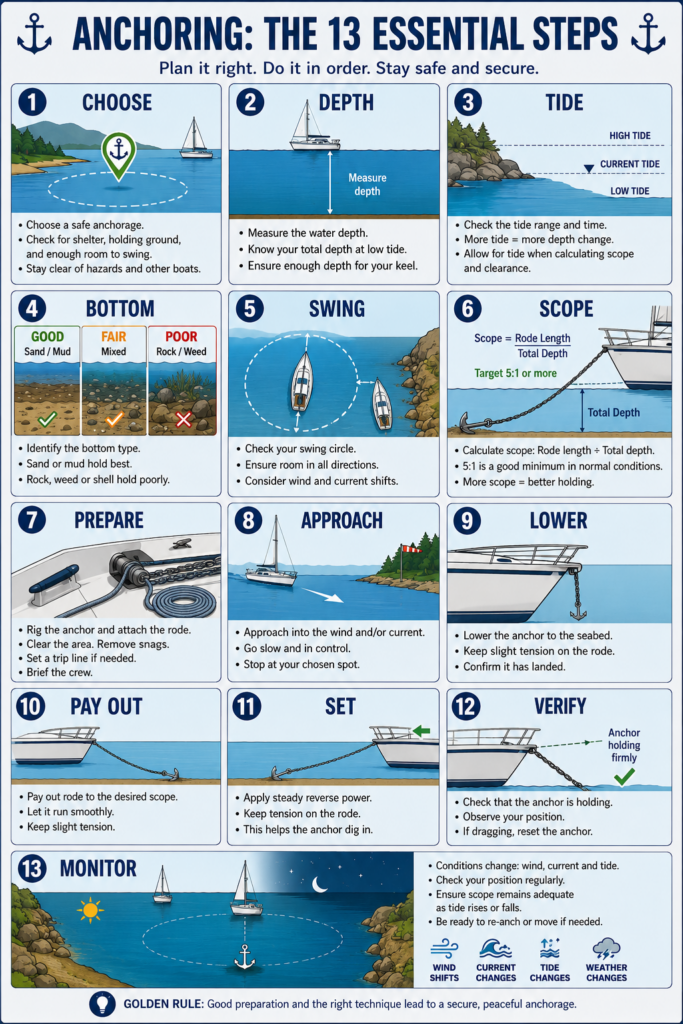
You can reduce this entire lesson to thirteen actions:
Choose → Check Depth → Check Tide → Check Bottom → Check Swing → Calculate Scope → Prepare → Approach → Lower → Pay Out → Set → Verify → Monitor
Let’s walk through that once more.
Choose a protected anchorage.
Check depth so you know how much water you have.
Check tide so you know how that depth will change.
Check bottom so you know whether your anchor is suitable.
Check swing so the boat has room to move.
Calculate scope using total vertical distance—not water depth alone.
Prepare the anchor, rode, crew and equipment.
Approach slowly into the dominant wind or current.
Lower the anchor under control.
Pay out rode progressively while moving backwards.
Set the anchor by gradually loading it.
Verify that it is holding.
Monitor the boat while anchored.
That routine is worth remembering.
Beginner Anchoring Checklist
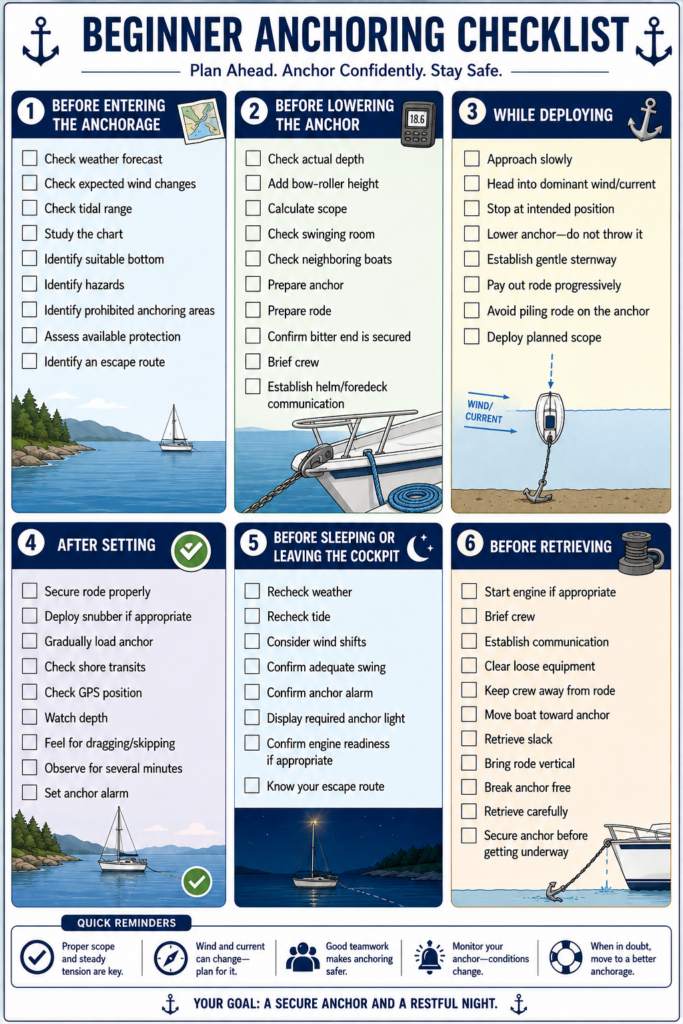
Before Entering the Anchorage
☐ Check weather forecast
☐ Check expected wind changes
☐ Check tidal range
☐ Study the chart
☐ Identify suitable bottom
☐ Identify hazards
☐ Identify prohibited anchoring areas
☐ Assess available protection
☐ Identify an escape route
Before Lowering the Anchor
☐ Check actual depth
☐ Add bow-roller height
☐ Calculate scope
☐ Check swinging room
☐ Check neighboring boats
☐ Prepare anchor
☐ Prepare rode
☐ Confirm bitter end is secured
☐ Brief crew
☐ Establish helm/foredeck communication
☐ If using a windlass, confirm controls, power and crew operating procedure
While Deploying
☐ Approach slowly
☐ Head into dominant wind/current
☐ Stop at intended position
☐ Lower anchor—do not throw it
☐ Establish gentle sternway
☐ Pay out rode progressively
☐ Avoid piling rode on the anchor
☐ Deploy planned scope
After Setting
☐ Secure rode properly
☐ Deploy snubber if appropriate
☐ Gradually load anchor
☐ Check shore transits
☐ Check GPS position
☐ Watch depth
☐ Feel for dragging/skipping
☐ Observe for several minutes
☐ Set anchor alarm
Before Sleeping or Leaving the Cockpit
☐ Recheck weather
☐ Recheck tide
☐ Consider wind shifts
☐ Confirm adequate swing
☐ Confirm anchor alarm
☐ Display required anchor light
☐ Confirm engine readiness if appropriate
☐ Know your escape route
Before Retrieving
☐ Start engine if appropriate
☐ Brief crew
☐ Establish communication
☐ Clear loose equipment
☐ Keep crew away from rode
☐ Move boat toward anchor
☐ Retrieve slack
☐ Bring rode vertical
☐ Break anchor free
☐ Retrieve carefully
☐ Secure anchor before getting underway
☐ Helm moves boat toward anchor — windlass retrieves rode
☐ Stop if chain or rope jams or piles up
☐ Secure anchor independently after retrieval
Frequently Asked Questions About Anchoring a Sailboat
How much anchor rode do I need?
You need enough rode to provide appropriate scope at the maximum depths and conditions in which you reasonably expect to anchor. Remember that scope calculations use the vertical distance from the seabed to the bow roller or rode attachment point—not water depth alone.
How much scope should I use?
For many normal recreational situations, approximately 5:1 to 7:1 is a useful starting range, but conditions, rode type, anchor manufacturer guidance, seabed and available swinging room matter. Stronger conditions may require more.
How do I know if my anchor is dragging?
Use several indicators: shore transits, GPS position, depth, the feel of the rode and your boat’s movement. Normal swinging follows an arc around the anchor. Dragging causes the boat’s overall position to migrate.
How deep can I anchor a sailboat?
There is no universal maximum. Practical depth is limited by the amount of rode available, required scope, anchor-handling equipment, conditions and your ability to retrieve the anchor safely.
Should I anchor into the wind or current?
Approach into whichever force predominantly controls the boat. In many anchorages this is the wind, but strong current can dominate.
How close can I anchor to another boat?
There is no single safe distance because rode lengths, boat lengths, depths and swinging behavior vary. Allow enough room for both boats to swing without colliding.
Can I anchor a sailboat overnight?
Yes. Overnight anchoring is a normal part of cruising, provided the anchorage, equipment, weather and crew preparation are appropriate.
What size anchor does my sailboat need?
Follow the anchor manufacturer’s sizing recommendations while considering your boat’s displacement, windage and intended cruising conditions. Cruising sailors may choose more conservative sizing than the minimum recommendation.
Why won’t my anchor set?
Possible reasons include inadequate scope, weed, rock, hard bottom, very soft mud, excessive reverse power before the anchor has oriented itself, a fouled anchor or an anchor unsuitable for that seabed.
Can I anchor without an engine?
Yes. Sailboats can be anchored under sail. However, beginners will generally find engine-assisted anchoring easier and more repeatable while developing their boat-handling skills.
Beginner Anchoring Quiz
1. What actually provides most of a modern anchor’s holding ability?
A. Its weight alone
B. Its ability to dig into the seabed
C. The bow roller
D. The windlass
2. Why is a relatively horizontal pull desirable?
A. It makes the rode easier to retrieve
B. It encourages the anchor to remain buried
C. It stops the boat swinging
D. It prevents tidal changes
3. Your boat is anchored in 12 feet of water and the bow roller is 4 feet above the water. What vertical distance should you use for calculating scope?
A. 8 feet
B. 12 feet
C. 16 feet
D. 20 feet
4. Using the previous example, approximately how much rode gives 5:1 scope?
A. 60 feet
B. 64 feet
C. 80 feet
D. 100 feet
5. Which bottom commonly provides good anchoring conditions?
A. Firm sand
B. Bare rock
C. Dense weed
D. Submarine cable
6. Why must swinging room be checked?
A. Sailboats remain perfectly stationary at anchor
B. Boats can move around their anchors as wind and current change
C. It reduces anchor weight
D. It eliminates the need for scope
7. What should you do with the anchor during deployment?
A. Throw it as far forward as possible
B. Lower it under control
C. Drop the entire rode at once
D. Motor forward rapidly
8. What does “setting the anchor” mean?
A. Storing it on the bow roller
B. Connecting it to the rode
C. Loading it so it digs in and develops holding power
D. Turning off the engine
9. Which can indicate a dragging anchor?
A. Progressive movement away from the anchor position
B. Normal swinging in an arc
C. Small wind-direction changes
D. A properly loaded snubber
10. What should you do first when you discover the anchor is dragging toward danger?
A. Go below and check the chart
B. Start the engine and regain control of the boat
C. Deploy less rode
D. Turn off the anchor alarm
11. Why should you check the tide before anchoring?
A. It determines sail color
B. Water depth and current may change while you are anchored
C. It prevents wind shifts
D. It tells you which anchor you own
12. What should normally pull the boat toward the anchor during retrieval?
A. The windlass
B. A crew member pulling the chain
C. Controlled movement of the boat
D. The anchor alarm
13. Why is a snubber useful with all-chain rode?
A. It adds elasticity and helps absorb shock loads
B. It replaces the anchor
C. It prevents tides
D. It eliminates swinging
14. What should you do if adequate scope would cause your boat to swing dangerously close to another boat or rocks?
A. Always use less scope
B. Move to a more suitable anchoring location
C. Drop two anchors immediately
D. Turn off the GPS
15. Which sequence best summarizes good beginner anchoring?
A. Drop → Leave → Sleep
B. Approach → Throw → Reverse
C. Choose → Check → Calculate → Prepare → Deploy → Set → Verify → Monitor
D. Stop → Drop → Start engine
Key Takeaways
Anchoring is not simply dropping a heavy object onto the bottom.
The anchor, rode, seabed, scope and boat all work together as a system.
Remember these principles:
The anchor must dig into suitable ground.
A flatter pull generally improves holding.
Scope is based on the vertical distance from the seabed to the rode’s attachment height—not water depth alone.
Leave enough room for the boat to swing.
Lower the anchor and pay out rode progressively.
Set the anchor deliberately.
Never assume it is holding—verify it.
Continue monitoring after you anchor.
Most importantly, never let the desire to stay in a particular anchorage override your judgment.
Sometimes the best anchoring decision is to retrieve the anchor and find somewhere safer.
That isn’t giving up.
That’s seamanship.
Separate Quiz Answer Key
1. B — Its ability to dig into the seabed
Most modern anchors develop their holding power by penetrating and gripping suitable bottom material.
2. B — It encourages the anchor to remain buried
A flatter, more horizontal pull generally helps a burying anchor remain embedded.
3. C — 16 feet
12 feet of water + 4 feet from the waterline to the bow roller = approximately 16 feet of vertical distance.
4. C — 80 feet
16 × 5 = 80 feet of rode for approximately 5:1 scope.
5. A — Firm sand
Firm sand commonly provides excellent holding for many modern anchor designs.
6. B — Boats can move around their anchors as wind and current change
The boat needs sufficient space to swing without contacting other vessels, shorelines or hazards.
7. B — Lower it under control
Lowering the anchor helps prevent tangles and allows controlled deployment.
8. C — Loading it so it digs in and develops holding power
Setting is the deliberate process of encouraging the anchor to penetrate and then verifying that it can resist load.
9. A — Progressive movement away from the anchor position
Normal swinging moves the boat around the anchor. Dragging causes the overall anchoring system to migrate across the seabed.
10. B — Start the engine and regain control of the boat
Preventing collision or grounding becomes the immediate priority.
11. B — Water depth and current may change while you are anchored
Tides affect both under-keel clearance and the vertical distance used in your scope calculation.
12. C — Controlled movement of the boat
The engine should move the boat toward the anchor when appropriate. Do not use the windlass to drag the boat against significant wind or current.
13. A — It adds elasticity and helps absorb shock loads
A snubber also helps transfer anchoring loads away from the windlass.
14. B — Move to a more suitable anchoring location
Reducing scope simply to squeeze into an unsafe anchorage can compromise holding. Moving may be the safer choice.
15. C — Choose → Check → Calculate → Prepare → Deploy → Set → Verify → Monitor
That sequence captures the central principle of reliable anchoring: plan first, deploy carefully, verify the anchor, and continue monitoring it.