
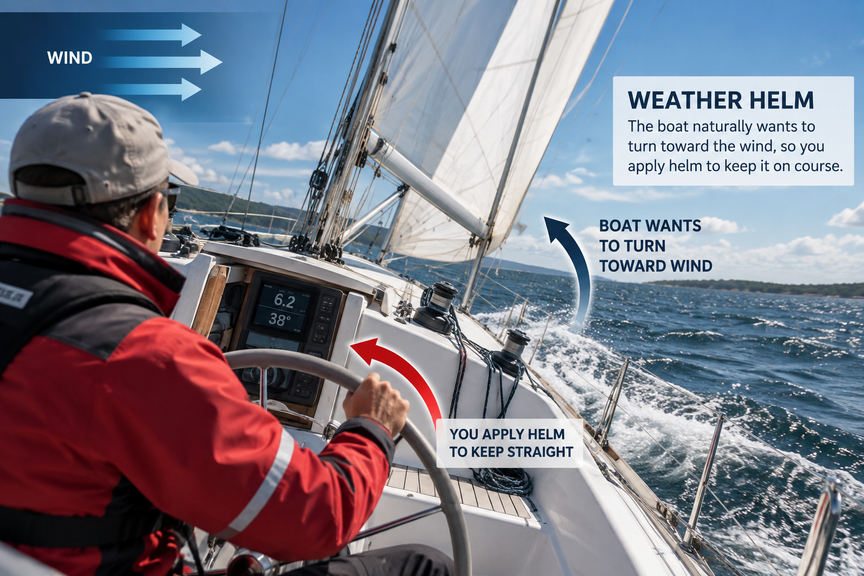
Introduction — Your Helm Is Telling You Something
You are sailing comfortably upwind. The boat is moving well, the sails look settled, and the helm feels light enough that holding a steady course takes little effort. Then the breeze begins to build. The boat heels a little farther. The wheel starts to load up, or the tiller begins to push more firmly against your hand. A gust arrives and the bow wants to turn toward the wind. You correct with the helm. Another gust arrives, and this time you need even more correction.
A beginner may think, “I need more rudder.” A developing skipper asks a more useful question: “Why has the helm load increased?” That change in thinking is the purpose of this lesson.
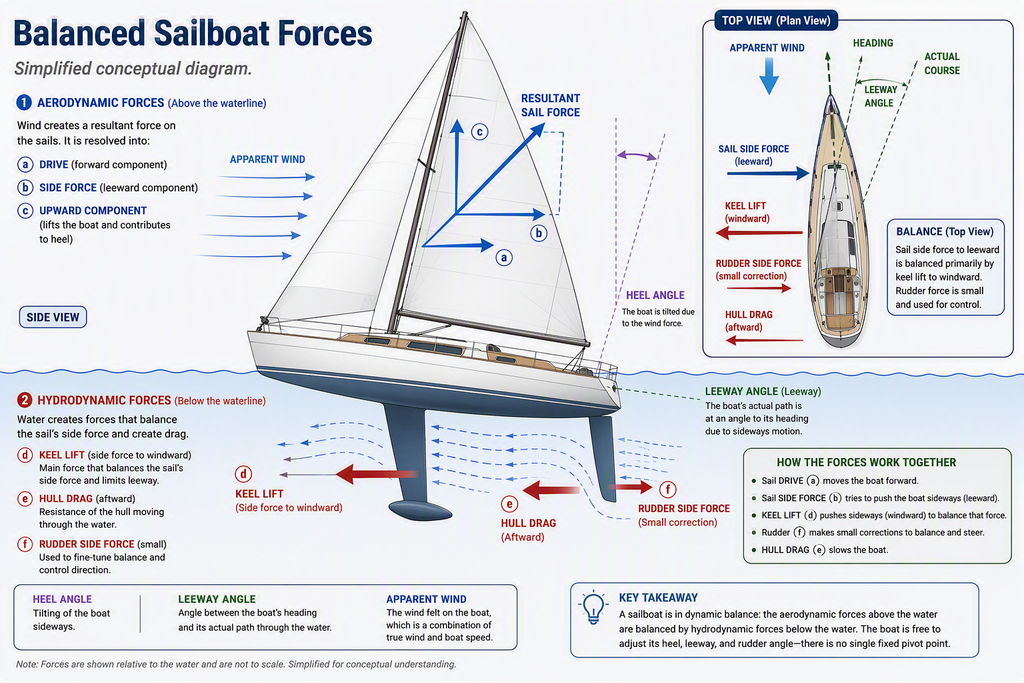
Helm pressure is information. The rudder, keel, hull and sails are all part of the same moving system. As explained in SailboatZone’s How Sailboat Steering Works lesson, the boat turns because aerodynamic forces above the water and hydrodynamic forces below it interact with the hull, keel and rudder. When the balance among those forces changes, the feel of the helm can change too.
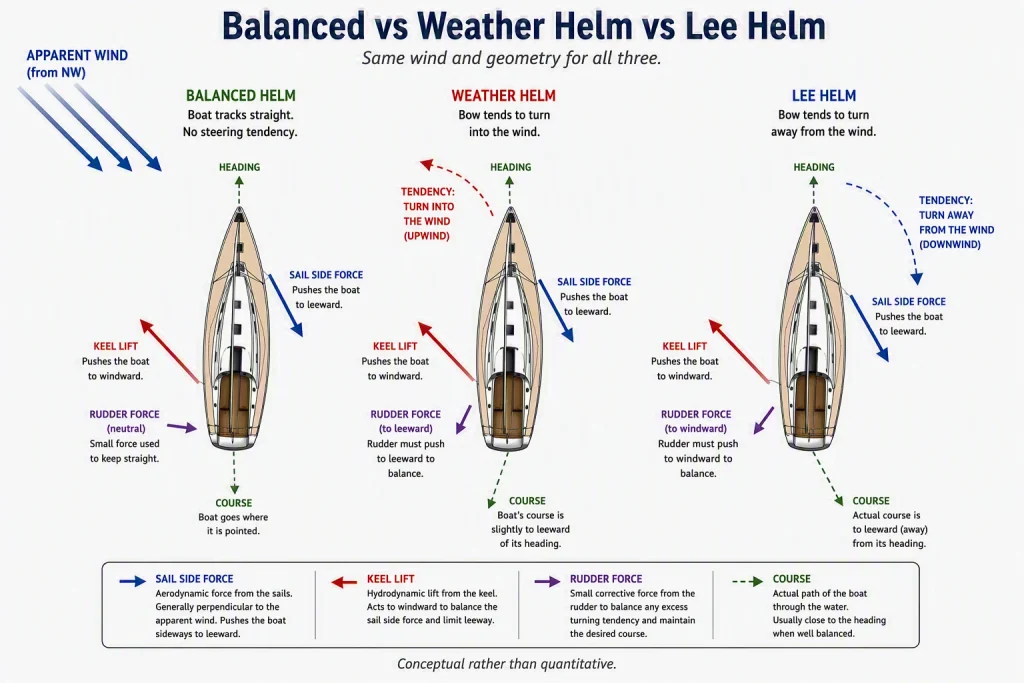
Three basic conditions help us describe what the helm is telling us. A well-balanced boat may have a light, manageable helm. A boat with weather helm tends to turn toward the wind unless the helmsperson corrects it. A boat with lee helm tends to turn away from the wind unless corrected. These are tendencies, not commands from the boat, and their strength matters.
Some weather helm can be a normal characteristic of a sailing boat. Excessive weather helm, however, can mean more steering effort, more rudder drag and poorer control. Persistent lee helm also deserves investigation. The goal is not to chase a magical “zero pressure” setting. It is to understand what the boat is doing and keep the helm manageable, predictable and efficient.
This lesson will connect sail trim, heel, sail area, the mainsail and headsail, and the forces acting below the water. We will keep the naval architecture simple and focus on the practical question that matters on the water: when the helm changes, what should you notice, what might be causing it, and what should you do next?
Quick Summary — Sailboat Balance in 60 Seconds
Weather helm is a tendency for the boat to turn toward the wind unless the helmsperson corrects it.
Lee helm is the opposite tendency: the boat wants to turn away from the wind unless corrected.
Helm pressure comes from the interaction of aerodynamic forces from the sails and hydrodynamic forces from the hull, keel or centreboard, and rudder.
Heel, sail trim, sail shape, sail area, boat speed and course can all change how the helm feels.
A large sustained rudder angle creates drag, so simply steering harder may treat the symptom without correcting the cause.
If increasing wind, increasing heel and increasing helm pressure appear together, treat them as clues. Depowering or reefing may restore a more manageable balance.
The practical goal is controlled heel, an efficient sail plan, predictable steering and a helm that does not require constant fighting.
BEGINNER TAKEAWAY: A heavy helm is not merely something to fight — it is something to investigate.
1. What Does Sailboat Balance Mean?
In sailing, “balance” does not simply mean keeping the deck level. A boat can be heeled and still be reasonably balanced. Nor is balance just another word for sail trim. For a beginner, a useful definition is this: sailboat balance is the relationship among the forces acting above and below the water, the boat’s resulting tendency to hold or change its heading, and the amount of helm correction needed to keep it on the intended course.
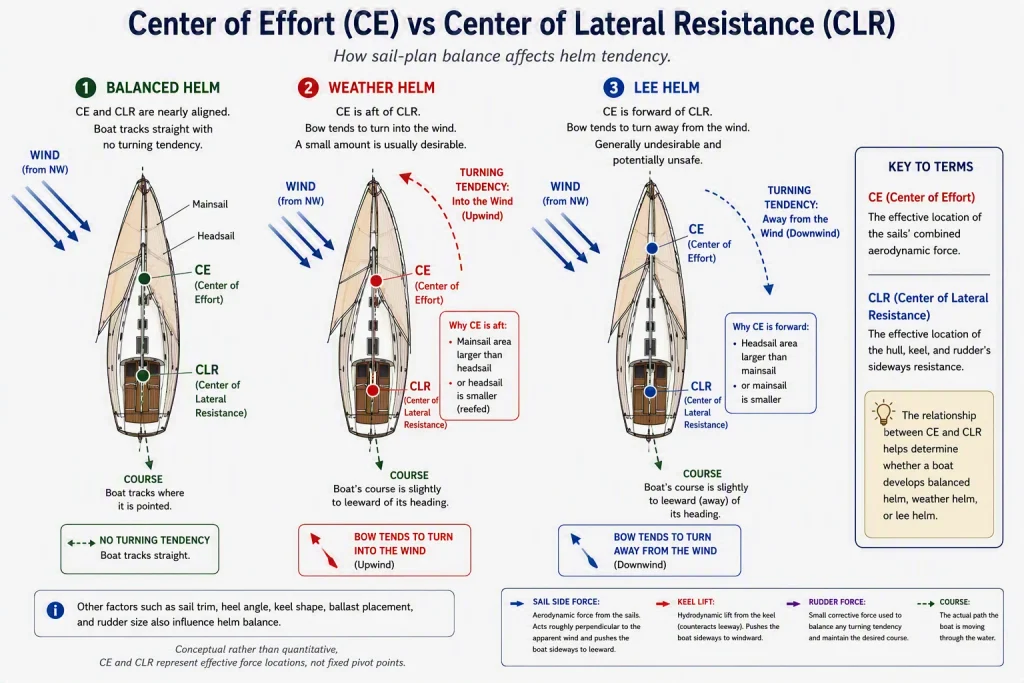
Above the water, the mainsail and headsail produce aerodynamic forces. Sailors often simplify their combined effect by imagining a centre of effort — a conceptual location through which the overall sail force can be represented. Below the water, the hull, keel or centreboard and rudder produce hydrodynamic forces that resist sideways motion and influence turning. These effects are sometimes simplified using a centre of lateral resistance.
If you want the aerodynamic foundation before continuing, review How Sails Work. The important point here is that the forces created by the sails do not act independently of the underwater parts of the boat.
These “centres” are teaching models, not fixed pins around which the boat rotates. Real force distributions change as the boat heels, accelerates, slows, changes course or encounters waves. Sail shape and trim change. Sail area changes when a sail is reefed or replaced. The immersed shape of the hull changes with heel and loading. The rudder itself contributes force whenever it is deflected. Treat the simplified centres as a way to understand the system, not as permanent points painted onto the boat.
World Sailing’s Learn to Sail Training Programme identifies balance as one of the core sailing essentials and connects boat balance with turning behavior. That is a useful beginner perspective: balance is not an abstract performance concept reserved for racers. It directly affects how predictable and controllable the boat feels.
A reasonably balanced cruising sailboat will generally be easier to steer, less tiring for the helmsperson, more predictable in gusts and potentially more efficient because the rudder is not being used continuously as a brake. It can also make life easier for an autopilot or self-steering system. Most importantly for a new sailor, a balanced boat gives clearer feedback. Small changes in wind, heel or trim are easier to notice before they become large control problems.
Show more lines
2. What Is Weather Helm?
Weather helm is the tendency of a sailing boat to turn toward the wind unless the helmsperson applies corrective helm to maintain the desired course. The key word is tendency. If you deliberately turn the boat toward the wind, that is simply steering. Weather helm describes what the boat wants to do when you are trying to hold a steady heading.
On a tiller-steered boat, weather helm is usually felt as increasing pressure through the tiller. The exact direction in which you move the tiller depends on the correction required because a tiller moves opposite the rudder’s trailing edge and opposite the direction the bow initially turns. On a wheel-steered boat, the sensation is different, but the practical clue is similar: you find yourself holding continuous corrective wheel input to stop the boat from heading up.
If tiller and wheel movements are not yet intuitive, review How to Steer a Sailboat: Steering Made Simple before trying to diagnose helm balance under sail.
A small, manageable amount of weather helm can provide useful feedback and may be a normal characteristic of a particular boat. Excessive weather helm is different. The helm becomes tiring, the rudder may need to remain noticeably deflected, the boat may repeatedly try to round up in gusts, and maintaining a straight course can become harder. Because a deflected rudder creates both steering force and drag, continually fighting the boat can also waste energy.
This is where beginners often misread the situation. They blame the rudder, assume that sailboats are simply supposed to feel heavy, or make larger and larger steering corrections. A better response is to look beyond the helm. Has the wind increased? Is the boat heeling farther? Has the mainsail become too powerful for the conditions? Has trim changed? Is the boat carrying more sail than it can use efficiently?
The Royal Yachting Association uses reducing weather helm as an example of a sailing problem that learners can solve by understanding its causes and how sail controls affect the boat. That is exactly the mindset to develop here: do not merely overpower the symptom with the helm. Ask what changed in the whole boat.
3. What Is Lee Helm?
Lee helm is the opposite of weather helm. Instead of tending to turn toward the wind, the boat tends to turn away from it unless the helmsperson applies corrective rudder. Again, the important idea is tendency. A boat bearing away because you deliberately steered it downwind is not displaying lee helm; lee helm exists when the boat requires continuing correction simply to hold the course you intended.
On the water, lee helm may feel as though the boat is persistently trying to fall away from the wind. The helmsperson must keep correcting toward the wind to maintain the chosen heading. The sensation can be subtle on one boat and obvious on another, and it may change with point of sail, heel, sail combination and wind strength.
Lee helm deserves attention because it tells you that the boat’s aerodynamic and hydrodynamic forces are not producing the balance you expected. It does not follow that every trace of lee helm is an emergency, nor should a beginner conclude that weather helm is always safe while lee helm is always dangerous. Severity, circumstances and the design of the particular boat matter. What matters most is recognizing a persistent or strong tendency and investigating why it exists.
Possible contributors include sail-plan distribution, mainsail and headsail trim, sail selection, rig setup, hull and appendage characteristics, point of sail, heel and loading. Some of those factors are easy for a sailor to change; others are inherent in the boat or require knowledgeable inspection. That is why a universal rule such as “every sailboat should have exactly this much weather helm” is misleading.
If a boat that normally feels predictable suddenly develops pronounced lee helm, treat the change as information. Check the sailing conditions and your sail setup first, but also remain alert to the possibility of an equipment or configuration problem. Persistent unexplained lee helm in ordinary conditions is a good reason to seek boat-specific advice from an experienced instructor, sailmaker, rigger, designer or manufacturer.
SKIPPER THINKING: Do not decide that a helm characteristic is acceptable simply because you can overpower it. First ask whether the behavior is normal for this boat and these conditions.
4. Why Sailboats Develop Helm Pressure
A sailing boat develops helm pressure because several forces are acting at the same time. Wind flowing over the sails creates aerodynamic force. The hull and keel or centreboard resist sideways motion through the water. The rudder creates additional hydrodynamic force when it is angled. The combined effect determines whether the boat tracks steadily, tends to head toward the wind or tends to bear away.
Sailors often describe the sail force using a simplified centre of effort. Think of it as a convenient conceptual location for the combined effect of the sails, not as a fixed point. Change the mainsail shape, reef the main, furl or change the headsail, alter the apparent wind or heel the boat and the overall force distribution changes. The effective location and direction of the sail forces can change with it.
The same caution applies below the water. A simplified centre of lateral resistance helps us think about the combined effect of the immersed hull, keel or centreboard and other underwater surfaces, but the real hydrodynamic force is distributed over those surfaces. Boat speed, heel, leeway, rudder angle, hull form and appendage configuration all influence what is happening.
For a fuller explanation of the aerodynamic side of this system, review How Sails Work. For the underwater steering side, return to How Sailboat Steering Works. The important connection in this lesson is that neither system operates alone.
Balance therefore changes continuously. Apparent wind changes as the boat accelerates or changes course. Gusts alter sail loading. Waves alter heel and yaw. Trim changes sail shape. Reefing changes sail area. A different headsail changes the sail plan. Even if the helmsperson holds the wheel or tiller in the same apparent position, the forces acting on the boat may be different a few seconds later.
5. How Heel Changes Sailboat Balance
Heel is not just a comfort issue. When a sailboat heels, the geometry of the whole system changes. The underwater shape presented to the water changes, the orientation of the rig and sail forces changes, and the relationship between those forces and the hull changes. Depending on the boat and conditions, that can change the boat’s tendency to turn and the amount of corrective rudder needed.
This is especially noticeable when a gust arrives. The stronger wind increases aerodynamic loading. The boat heels farther. Helm pressure may increase and the boat may begin to round toward the wind. The beginner’s instinct can be to steer harder. The better question is: “Why did heel and helm pressure increase together?”
Corrective rudder is necessary whenever you need to maintain or change course, but a large sustained rudder angle is not free. The rudder creates the side force needed to oppose the turning tendency, and it also creates drag. If the boat is badly overpowered, continually adding rudder can slow the boat while leaving the underlying excess sail force and heel largely unchanged.
World Sailing’s Learn to Sail Training Programme treats balance as one of sailing’s core essentials, connects balance and heel with turning, and teaches sailors that unnecessary rudder movement costs speed. For a beginner, that supports a simple rule: when the boat suddenly needs much more helm, look at the whole boat before assuming the answer is simply more steering.
6. How Sail Trim Affects the Helm
Sail trim changes much more than how fast the boat moves. Every adjustment that changes sail shape or angle can change aerodynamic force, heel and the balance felt at the helm. That means a trim problem can show up not only in the telltales or boat speed, but also in the amount of steering effort required.
The mainsheet is one obvious example. Its effect varies with rig and point of sail, but changing mainsheet tension alters the mainsail’s angle and often its shape and load. The traveller can change the boom’s lateral position while allowing a different relationship between mainsheet tension and sail angle. The vang influences leech tension, particularly as the boom moves outboard. The outhaul changes lower-sail depth, while halyard or Cunningham tension can influence draft position and luff tension. These controls can change how much power and heel the mainsail produces. A set of sail telltales gives you a visible way to connect changes in airflow and sail trim with the load you feel at the helm.
The headsail matters too. Sheet tension and lead position affect its angle, twist and shape. Headsail size changes the amount and distribution of sail area. Partially furling a roller-furling headsail reduces area but can also change sail shape. The exact result depends on the sail, rig and furling system, so avoid treating one adjustment as a universal cure.
If these controls are unfamiliar, revisit SailboatZone’s lessons on How to Trim a Sail and the five primary sail controls before using helm feel as a diagnostic tool. The goal here is not to reteach every control, but to connect those controls to balance.
When conditions allow, make diagnostic adjustments deliberately. Observe the helm and heel, change one variable, then feel and compare the result. If you change the traveller, mainsheet, headsail sheet and course all at once, you may improve the boat without learning which change mattered. In a developing emergency or crowded water, of course, safe control takes priority over experimentation.
PRACTICAL RULE: Where conditions permit, OBSERVE → ADJUST ONE THING → FEEL → COMPARE. If safety requires immediate action, control the boat first and diagnose later.
7. How the Mainsail and Headsail Affect Balance
A sloop’s mainsail and headsail form one sail plan. Although sailors trim them with different controls, their forces combine to influence heel, drive and helm balance. Changing one sail can therefore change how the entire boat feels.
An overpowered mainsail can contribute to excessive heel and weather helm. You may notice the boat loading up in gusts, the helm becoming heavier and the bow repeatedly trying to round toward the wind. Depowering the mainsail may reduce both heel and helm load. That does not prove that every case of weather helm is “too much main”; it simply makes the mainsail one of the first places to look when the symptoms appear together.
Headsail changes can also alter balance. Moving from a large genoa to a smaller jib, reefing or partially furling a headsail, or changing its trim alters the amount and distribution of aerodynamic force. Because boats differ, the balance response can differ too. A change that improves one boat’s helm may affect another differently.
Reefing the mainsail is especially important because it changes more than total sail area. It reduces sail area and usually lowers the centre of the remaining sail area, which reduces heeling moment. When a boat was previously overpowered, the result can be a more upright, controllable boat with a lighter helm. Sometimes the reefed boat maintains surprisingly good speed because less energy is being wasted in excessive heel and rudder drag.
For the actual procedure, use the dedicated How to Reef a Sailboat lesson. Here, the important lesson is why reefing can restore balance rather than viewing it only as a way to make the sails smaller.
8. When Weather Helm Becomes Excessive
There is no single helm-pressure number that tells every sailor when weather helm has become excessive. Boats, steering systems and conditions differ. Instead, look for a pattern of deteriorating control and increasing workload.
Warning signs include a helm that becomes progressively heavier, a need for substantial sustained rudder correction, repeated rounding up in gusts, excessive heel, larger steering corrections, growing fatigue at the helm and a boat that feels loaded or uncomfortable. Another clue is carrying more sail without gaining useful speed. If you repeatedly dump the mainsheet in gusts just to keep the boat manageable, the sail plan may no longer suit the conditions.
The heavy helm itself is a symptom. Possible contributors include excessive sail power, excessive heel, poor trim, sail-plan imbalance, rig or setup issues, loading and characteristics specific to the boat. That distinction matters because a symptom does not tell you which cause is responsible.
Imagine the wind has built gradually for half an hour. The boat is now heeling hard in every gust, the helmsperson is holding significant correction and the crew has started treating each round-up as normal. The boat is still moving quickly, so nobody changes anything. That is exactly the habit a developing skipper should avoid. Forward motion is not proof that the boat is well balanced or efficiently controlled.
SKIPPER PRINCIPLE: Do not normalize deteriorating control simply because the boat is still moving forward.
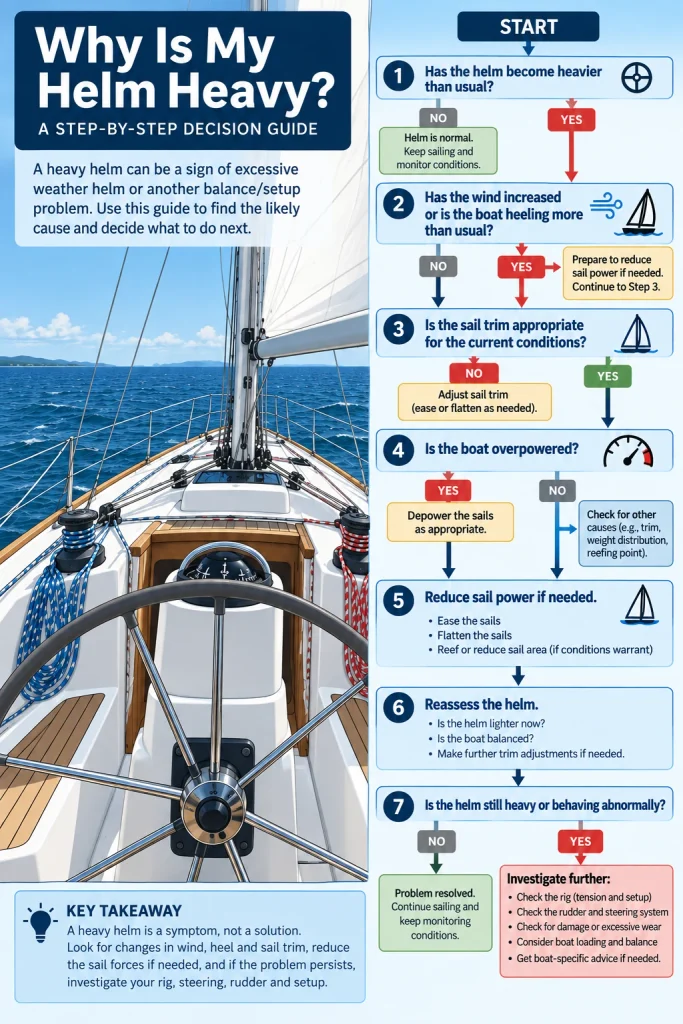
9. Diagnosing a Heavy Helm
A heavy helm is a prompt to investigate, not a diagnosis by itself. The most useful approach is a sequence that starts with what has changed and moves from simple, reversible sailing adjustments toward boat-specific inspection if the problem persists.
1. Has the wind increased?
Compare the present conditions with a few minutes earlier. A building breeze or stronger, more frequent gusts can increase sail loading before a beginner consciously recognizes that the conditions have changed.
2. Has heel increased?
Look at the boat, not only the helm. More heel occurring at the same time as more helm pressure is an important clue that the boat may be becoming overpowered.
3. Is the sail trim appropriate?
Check the mainsail and headsail. An overpowered or poorly trimmed sail plan can create unnecessary heel and imbalance.
4. Is the boat carrying too much sail?
If normal trim adjustments no longer keep the boat comfortable and controllable, consider whether the sail area itself needs to be reduced.
5. Is the pressure continuous or mainly in gusts?
A brief increase during an isolated gust tells a different story from a heavy helm that persists between gusts.
6. Does sensible mainsail depowering reduce the load?
If reducing mainsail power noticeably reduces heel and helm pressure, you have learned something useful about the source of the problem.
7. Does reducing sail improve control?
If reefing produces a more upright boat and lighter, more predictable helm, the previous sail plan was likely too powerful for the conditions.
8. Does the problem remain in moderate conditions?
Persistent abnormal helm after conditions, trim and sail area have been addressed deserves a closer look at sail and rig setup, steering, rudder, loading and boat-specific factors.
If the behavior remains unusual, do not start making major rig changes from generic internet advice. Consult the boat’s documentation and, where appropriate, an experienced instructor, sailmaker, rigger, designer or manufacturer. Steering-system or rudder concerns may also warrant inspection before further sailing.
DIAGNOSTIC MINDSET: OBSERVE → IDENTIFY → ADJUST → REASSESS. Not: FEEL PRESSURE → PULL HARDER.
10. How to Reduce Excessive Weather Helm
The right response to excessive weather helm depends on the boat, point of sail, traffic, sea room and conditions. Think in terms of a response hierarchy rather than one magic adjustment.
First, confirm that the course itself is sensible and that you are not asking the sails to work at an inappropriate angle. Then check trim. If the mainsail is producing too much power, use the controls available on your boat to depower it appropriately. Depending on the rig and point of sail, that may involve mainsheet, traveller, vang, outhaul and luff-tension controls. The aim is not to memorize a single sequence, but to reduce unnecessary power and heel while maintaining useful drive.
Easing the mainsheet can be a fast way to spill power in some situations, especially in a gust, but “ease the main” should not be taught as a universal cure for weather helm. A temporary depowering action may manage a gust without solving a sail-plan problem that persists for the next hour.
If the wind has genuinely built and the boat repeatedly becomes overpowered, reduce sail. Reef the mainsail and, where appropriate for the boat and conditions, reduce or change the headsail. A reef taken at the right time can make the boat easier to steer, more comfortable and more efficient. Do not wait until every gust requires a major steering correction before considering it.
Use How to Reef a Sailboat for the procedure itself, and connect this decision to the SailboatZone strong-wind lesson when conditions are becoming more demanding.
Altering course can also change sail loading, but only if navigation, hazards and traffic allow it. Sometimes the best skipper decision is not another trim adjustment at all: it may be to change the plan, seek more sheltered water or stop pressing on as conditions deteriorate.
ASK YOURSELF: Am I adjusting the boat to the conditions – or forcing the boat to carry a sail plan that no longer suits the conditions?
11. What to Do About Lee Helm
Start by confirming that the lee-helm tendency is real and persistent. Note the point of sail and conditions, then check mainsail trim, headsail trim and sail selection. Consider whether loading or unusual heel could be contributing. If the behavior appeared suddenly, remain alert for steering, rudder, sail or rig problems.
Do not jump directly to rig tuning. Mast rake, sail design, rig geometry and other setup changes are boat-specific and can have consequences beyond helm feel. A beginner should not make major rig adjustments simply because a generic article says that moving something forward or aft will “fix” lee helm.
If lee helm remains pronounced in moderate conditions after ordinary trim and sail-plan checks, get knowledgeable boat-specific help. An experienced instructor, sailmaker or rigger can observe the boat under sail and distinguish between normal design characteristics, sail-condition issues, rig setup and possible equipment problems.
BEGINNER PRINCIPLE: Diagnosis comes before adjustment.
12. Helm Balance in Gusts and Stronger Winds
Picture a boat sailing comfortably in a moderate breeze. A stronger gust arrives. Sail force increases, the boat heels farther, the helm loads up and the bow begins to round toward the wind. The helmsperson has several possible responses: use more helm, depower the sails, change trim, alter course, reef, or combine actions.
More helm can maintain the desired heading temporarily, and sometimes that is exactly what is required. But it increases rudder load and drag and does not remove the extra sail power that caused the heel. Depowering can reduce the load quickly. Changing course can alter sail loading, but it must make sense with respect to hazards, traffic and the intended route. Reefing is a more durable response when the wind has actually increased rather than producing one isolated gust.
The decision threshold matters. One brief gust does not automatically mean you should reef. But repeated gusts, sustained excessive heel and steadily increasing helm pressure form a pattern. The skipper is no longer reacting to a single event; the evidence suggests that the boat may be carrying too much power for the conditions.
This is where earlier lessons come together. Reading the wind helps you recognize whether the gust is isolated or part of a trend. Weather knowledge helps you anticipate what may happen next. Sail trim gives you short-term control. Reefing changes the sail plan. Strong-wind skills help you decide whether the overall sailing plan remains sensible.
A developing skipper does not ask only, “Can I still hold the course?” The better question is, “Is the boat still under comfortable, efficient and predictable control?”
13. Common Beginner Mistakes
Mistake 1 — Fighting the wheel or tiller
If helm load rises, beginners often simply pull or turn harder. Correct the course as necessary, but then investigate why the load changed.
Mistake 2 — Assuming a heavy helm means a steering problem
Steering gear can fail, but heavy helm under increasing wind and heel may be caused by sail power and balance. Check the whole system.
Mistake 3 — Carrying full sail too long
Beginners sometimes treat reefing as surrender. In reality, reducing sail before control deteriorates can make the boat faster, easier and safer to handle.
Mistake 4 — Changing everything at once
Several simultaneous adjustments can hide cause and effect. When conditions permit, change one variable and reassess.
Mistake 5 — Treating heel as proof of speed
A dramatic heel angle may feel fast while producing extra drag, leeway and steering load. Useful drive matters more than drama.
Mistake 6 — Trying to eliminate every trace of helm pressure
The objective is not an arbitrary zero-force helm. Seek manageable, predictable balance appropriate to the boat.
Mistake 7 — Applying universal trim rules
Rig types, hulls, sails and control systems differ. Use principles, then confirm how your boat responds.
Mistake 8 — Ignoring a change in helm feel
A change is information. Wind, trim, sail area, heel or equipment may have changed even if you have not consciously altered the controls.
14. Skipper Thinking — Treat the Helm as Information
You are sailing close-hauled in about a 12-knot breeze. The boat has a comfortable heel, the helm is light and the crew is relaxed. Over the next twenty minutes the wind builds. Gusts become stronger and more frequent. The boat heels farther, wheel or tiller load rises, and in the strongest gusts the bow begins to round toward the wind. You still have plenty of sea room and the crew is comfortable.
What should you do? Apply more helm? Change sail trim? Alter course? Reef? Combine several actions? The point of the exercise is that there is not enough wisdom in choosing a letter without first reading the evidence.
OBSERVE
What changed? Note the wind trend, gust frequency, heel, helm load, sail behavior, sea room, crew and the boat’s ability to hold course.
INTERPRET
What is the boat telling you? Increasing heel and helm load occurring with building wind suggest that sail loading has increased and the boat may be moving toward an overpowered state.
OPTIONS
What can you change? You can correct the heading, depower through trim, reduce sail, alter course where safe, or combine actions.
CONSEQUENCES
What will each option affect? More rudder may hold the course but adds drag. Depowering may reduce heel quickly. Reefing takes more action but can provide a lasting improvement if the wind has built.
DECIDE
Choose a response proportionate to the evidence rather than waiting for the boat to become difficult to control.
REASSESS
After the adjustment, check the result. Is heel reduced? Is the helm lighter? Is the boat tracking better? Are the crew and boat more comfortable?
The Royal Yachting Association uses reducing weather helm as an example of a problem that sailors can learn to solve by understanding causes and sail controls. That is the larger lesson here. The objective is not to identify one textbook control to pull. It is to recognize a changing situation, interpret the boat’s feedback, choose an appropriate response and then verify that the response worked.
SKIPPER THINKING: Conditions changed → boat behavior changed → the helm communicated the change → the skipper responded to the cause, not merely the symptom.
15. On-the-Water Practice — Learn to Feel Sailboat Balance
Helm balance is best understood through controlled experience. Practise only in suitable weather, open water and adequate sea room, away from nearby traffic and hazards. A beginner should have experienced supervision and should follow the normal safety procedures for the boat. The purpose is to notice small changes, not deliberately create a loss-of-control situation.
Exercise 1 — Establish a Baseline
Sail close-hauled or on a close reach in manageable conditions. Trim the sails normally and settle onto a steady course. Notice how much pressure you feel at the helm and how much correction is required. This is your baseline.
Exercise 2 — Observe a Gust
When a normal gust arrives, maintain situational awareness and notice what changes. Does heel increase? Does helm pressure increase? Does the bow want to head up? What do the sails and telltales show? Do not stare at the instruments; feel the boat.
Exercise 3 — Make a Controlled Trim Change
Where safe, make one small trim adjustment and observe the result. Does the helm become lighter or heavier? Does heel change? Restore the original setting and compare.
Exercise 4 — Depower
Use an appropriate mainsail depowering adjustment for your boat and point of sail. Observe whether heel and helm pressure change together. The exercise is about cause and effect, not finding a universal control setting.
Exercise 5 — Compare After Reefing
When the actual conditions appropriately justify a reef, establish control and reef using the boat’s normal procedure. Resume a comparable course and compare heel, helm pressure, comfort, steering workload and boat speed. Many beginners are surprised by how well a properly reefed boat can perform.
Keep a simple practice log: wind strength and trend, point of sail, sail configuration, approximate heel, helm feel, the adjustment you made and the result. Over time, this turns vague sensations into recognizable patterns and forms the basis of the Weather Helm Diagnostic Worksheet planned for this lesson.
16. Troubleshooting Guide
| Symptom | Possible Contributors | First Things to Check |
| Helm suddenly heavier in a gust | Increased sail force and heel | Wind, heel, mainsail trim |
| Helm progressively heavier | Building wind or overpowering | Sail area, trim, reefing |
| Boat repeatedly rounds up | Excess power, heel or balance | Mainsail power, sail area |
| Boat consistently bears away | Possible lee helm | Trim, sail plan, setup |
| Heavy helm in moderate conditions | Setup, trim or steering issue possible | Trim, sails, rig, rudder |
| Boat feels easier after reefing | Previous sail plan may have been overpowering the boat | Reassess sail area and conditions |
| Helm suddenly feels abnormal | Possible equipment or setup problem | Inspect steering, rudder and rig as appropriate |
Accuracy note: These are possible contributors, not diagnoses. Similar symptoms can have different causes on different boats.
17. Frequently Asked Questions
Is weather helm normal?
A mild, manageable tendency toward the wind can be a normal characteristic of a sailboat. Excessive or suddenly changing weather helm should be investigated rather than accepted automatically.
Is weather helm dangerous?
Ordinary, manageable weather helm is not the same as loss of control. Strong weather helm combined with excessive heel, repeated rounding up or large sustained rudder angles can indicate that the boat is overpowered or poorly balanced and deserves action.
What causes weather helm?
There is no single cause. Sail force, heel, trim, sail-plan distribution, hull and appendage characteristics, boat speed, loading and rig setup can all contribute.
Does too much mainsail cause weather helm?
An overpowered mainsail can contribute substantially by increasing sail force and heel, but it is not the only possible cause. Diagnose the whole boat.
Will reefing reduce weather helm?
When the boat is overpowered, reefing often reduces heel and load and may make the helm lighter and more predictable. The exact balance response depends on the boat and sail plan.
Why does my tiller get harder when the wind increases?
Stronger wind can increase sail force and heel, which may increase the turning tendency that the rudder must oppose. The result can be greater pressure at the tiller.
What is lee helm?
Lee helm is a tendency for the boat to turn away from the wind unless corrected.
Is lee helm always dangerous?
No simple absolute applies to every boat, but persistent or significant lee helm deserves investigation, especially if it is new or unexplained.
Can weight distribution affect helm balance?
Yes. Loading can change trim, heel and the immersed shape of the hull. Its effect varies with the boat and should not be used as a substitute for an appropriate sail plan.
Does weather helm slow the boat?
Excessive corrective rudder angle creates drag, and the excessive heel that often accompanies heavy weather helm can also reduce efficiency.
Should I adjust the rig to fix weather helm?
Not as a beginner’s first response. Check conditions, sail trim and sail area first. Major rig changes should follow boat-specific guidance or knowledgeable professional advice.
18. Key Takeaways
Helm pressure is feedback from the whole sailing system, not merely resistance in the steering mechanism.
Weather helm is a tendency to turn toward the wind; lee helm is a tendency to turn away from it.
Sailboat balance comes from interacting aerodynamic and hydrodynamic forces.
Heel can change steering behavior and helm load.
Sail trim affects power, heel and balance, so the mainsail and headsail should be considered as one sail plan.
Large sustained rudder corrections create drag.
Increasing wind, heel and helm pressure together can indicate that the boat is becoming overpowered.
Reefing can restore control and balance as well as reduce sail area.
There is no universal helm-angle or helm-pressure target that applies to every sailboat.
Persistent abnormal weather or lee helm deserves diagnosis rather than generic rig adjustments.
A developing skipper asks why the helm changed, chooses a proportionate response and then reassesses the result.
19. Knowledge Check — Read the Boat
Scenario 1
The wind increases and heel and helm load increase at the same time.
Question: What information should you gather before deciding what to change?
Scenario 2
The boat requires increasing corrective rudder through repeated gusts.
Question: Why might simply applying more helm be an incomplete solution?
Scenario 3
After reefing, the boat stands more upright and the helm becomes noticeably lighter without a major reduction in useful speed.
Question: What does this suggest about the previous sail configuration?
Scenario 4
Persistent lee helm occurs in otherwise moderate conditions.
Question: What should you investigate rather than simply accepting it?
Scenario 5
Another sailor tells you that every cruising sailboat should have exactly the same amount of weather helm.
Question: Why is that claim too simplistic?
20. End-of-Lesson Quiz
1. Define weather helm.
2. Define lee helm.
3. Does weather helm automatically mean the rudder is malfunctioning? Explain.
4. Name three factors that can change helm balance.
5. Why can excessive rudder angle reduce sailing efficiency?
6. How can heel influence steering behavior?
7. Why might reefing reduce helm load when a boat is overpowered?
8. What should a beginner do before making major rig changes to correct helm balance?
9. Why is helm pressure useful information for a developing skipper?
10. A gust increases heel and helm load. What should a developing skipper assess before simply applying more rudder?
21. Answer Key and Scoring Guide
1. Weather helm is the boat’s tendency to turn toward the wind unless corrective helm is applied.
2. Lee helm is the boat’s tendency to turn away from the wind unless corrective helm is applied.
3. No. Weather helm is a balance characteristic or symptom and can result from the interaction of sail force, heel, trim, sail plan and boat design. An abnormal steering feel can also justify checking the steering system, but weather helm alone does not prove a rudder fault.
4. Examples include wind strength, heel, sail trim, sail shape, sail area, point of sail, boat speed, loading, rig setup and hull or appendage characteristics. Any three are acceptable.
5. A deflected rudder creates the side force needed to steer or oppose a turning tendency, but it also creates drag. Large sustained correction can therefore waste energy.
6. Heel changes the geometry and force relationships of both the rig and the immersed hull. On many boats, increased heel can change the tendency to turn and increase required helm correction.
7. Reefing reduces sail area and generally reduces heeling moment. If the boat was overpowered, this can reduce heel and the turning tendency that the rudder was opposing, producing a lighter helm.
8. First diagnose ordinary factors such as conditions, sail trim, sail area, sail selection and loading. If the imbalance persists, use boat-specific documentation or knowledgeable professional help before making major rig changes.
9. A change in helm pressure can reveal a change in wind, heel, trim, sail loading, balance or possibly equipment condition. It gives the skipper another way to read what the boat is doing.
10. Assess what changed: wind strength and trend, gust frequency, heel, sail trim, sail area, course, sea room, crew and overall boat behavior. Correct the course as necessary, but address the underlying cause if the boat is becoming overpowered.
Scoring Guide
9–10 — Strong understanding
You are ready to begin applying the diagnostic framework on the water under suitable supervision.
7–8 — Good foundation
Review the relationship among heel, sail power and helm load.
5–6 — Developing
Revisit weather helm versus lee helm and the heavy-helm diagnostic sequence.
Below 5 — Review before continuing
Return to the steering, sail-trim and sail-control lessons, then work through this lesson again.
Final Skipper Thinking Question
The helm suddenly becomes much heavier than it was five minutes ago. What changed – and how will you find out?
There is no single supplied answer. The purpose is to practise the habit that this entire lesson is designed to build: observe the change, gather evidence, identify likely causes, choose a proportionate action and reassess the boat afterward.
Next Step
Do not finish this lesson by memorizing definitions alone. On your next suitable sail, pay deliberate attention to helm pressure. Establish what “normal” feels like on that boat, then notice how the helm changes with wind, heel, trim and sail area. That is how weather helm stops being an abstract term and becomes useful skipper information.