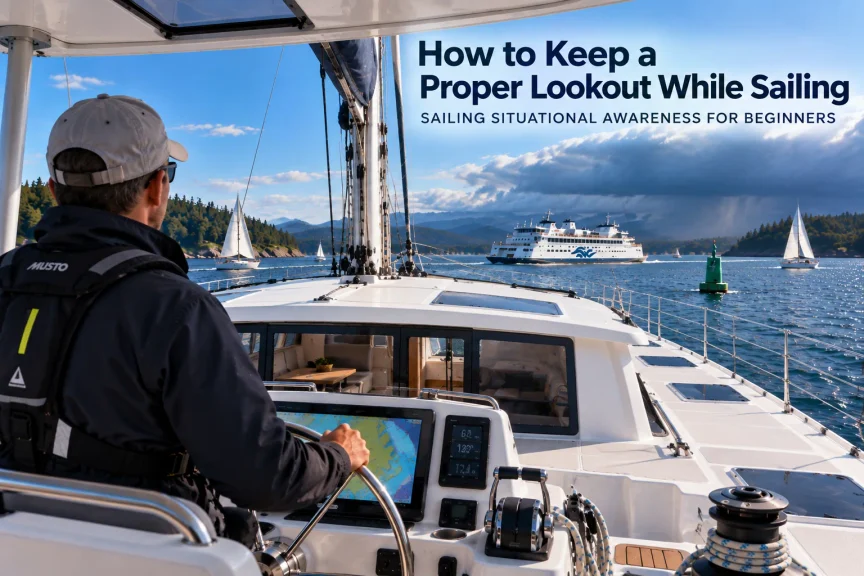
You are sailing on a comfortable reach. The boat feels good, but the jib telltales are not flowing quite the way you want.
You look up at the sail, ease the sheet slightly, watch the telltales, adjust again and wait to see whether the boat speeds up.
Then you finally look around.
A powerboat you noticed earlier is much closer than you remember.
It did not suddenly appear. While you were concentrating on the sail, the situation around your boat continued to change.
That is one of the most important lessons a developing skipper can learn:
Sailing the boat is only part of the job. You also have to keep track of the world around it.
Learning how to steer a sailboat and how to trim a sail gives you control of the boat. A proper lookout helps you decide where that boat can safely go, what is changing around you and what deserves your attention now.
This is not simply good practice. Canada’s Collision Regulations require every vessel to maintain a proper lookout at all times by sight, hearing and all available means appropriate to the circumstances so that the situation and risk of collision can be properly assessed. You can read the exact wording in Rule 5 of Canada’s Collision Regulations.
For a beginner sailor, however, “keep a proper lookout” can sound frustratingly vague.
Where should you look? How often? What should you be looking for? How do you know which vessel matters? What happens when you’re also steering, trimming sails, checking depth, answering a crew member and trying to solve a problem aboard?
That’s what this lesson is about.
By the end, you should have a simple mental routine you can use whenever you sail:
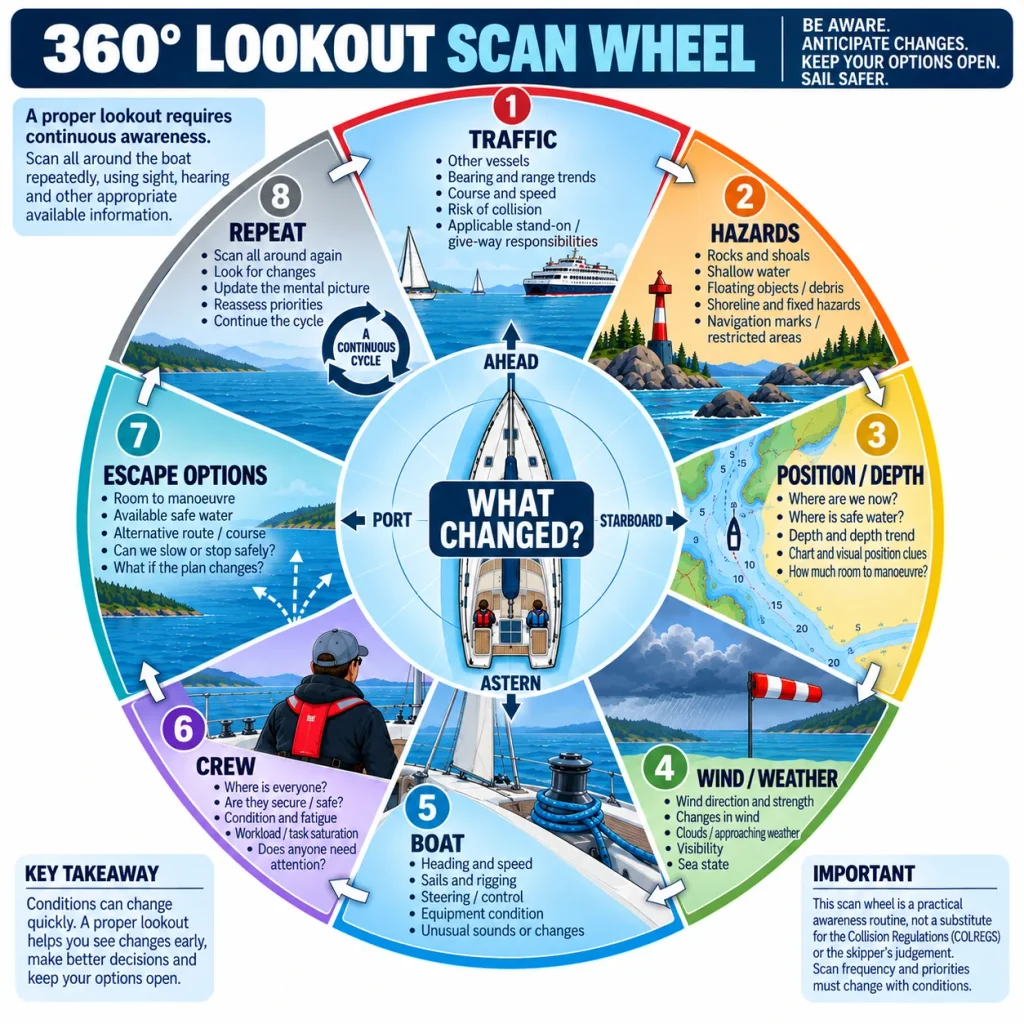
SCAN → COMPARE → PRIORITIZE → ACT → REASSESS
What Does Keeping a Proper Lookout Actually Mean?
Beginners sometimes interpret “keep a lookout” as:
Watch where you’re going.
That’s part of it.
It isn’t enough.
A sailboat operates in a constantly changing environment. Traffic moves. Wind shifts. Visibility changes. Crew members become tired or distracted. A shoreline gets closer. Water becomes shallower. A vessel that initially posed no problem can gradually become important.
A proper lookout is therefore not a single glance.
It is an ongoing process of gathering information, noticing changes and deciding what those changes mean.
Rule 5 is deliberately broad. It doesn’t say to stare ahead. It requires a proper lookout by sight and hearing, as well as by all available means appropriate to the prevailing circumstances and conditions.
For a recreational sailor, that means your awareness may include:
- other vessels ahead, beside and behind you;
- navigation marks and fixed hazards;
- shoreline and shallow water;
- floating logs, fishing gear and debris;
- your position, heading, speed and depth;
- wind direction and strength;
- approaching weather;
- changes in waves or sea state;
- sails, rigging and steering;
- what your crew is doing;
- safe water and possible escape options.
That sounds like a lot.
It is.
But experienced sailors do not necessarily see more because they stare harder. They become better at scanning, recognizing patterns and deciding what deserves attention.
There is an important distinction here:
Looking tells you what is there. Situational awareness helps you understand what is happening.
Build a Repeatable 360° Lookout Scan
One of the easiest ways to improve your lookout is to stop relying on memory to remind you to look around.
Build scanning into the way you sail.
There is no universal interval such as “look around every 30 seconds.” The appropriate frequency depends on the situation.
A quiet afternoon in open water is very different from approaching a busy harbour in poor visibility.
Instead, develop a repeatable 360° scanning habit.
A simple pattern might be:
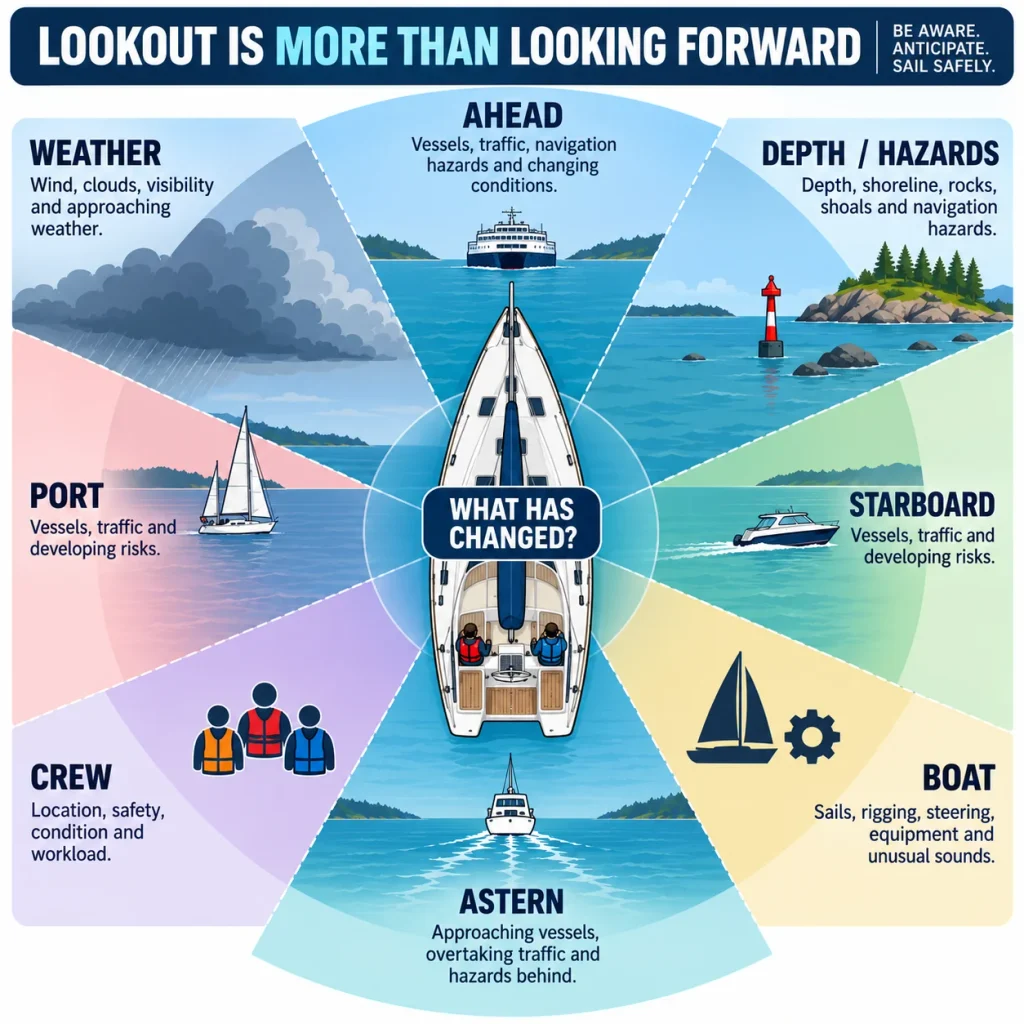
Ahead → starboard → astern → port → boat → crew → environment → ahead again.
You are not simply asking:
What can I see?
Ask better questions:
What is there?
What has changed since my last scan?
What is getting closer?
What might become a problem?
Suppose you saw a ferry several minutes ago.
Seeing it again is useful.
Noticing that it has moved significantly across your view is more useful.
Noticing that it remains in nearly the same direction from you while getting noticeably closer may be much more important.
The same principle applies to the environment.
The techniques in How to Read the Wind When Sailing become more valuable when you repeatedly ask whether the wind has strengthened, shifted or become gustier since your previous scan.
Your lookout should become more deliberate as the situation becomes more demanding.
Dense traffic, restricted visibility, confined water, nearby hazards and rapidly changing weather all reduce the amount of time you can afford to remain unaware of what is happening around you.
Don’t Just Spot Other Boats—Watch What They’re Doing
Imagine two boats.
One is fairly close but steadily moving away from you.
The other is farther away but travelling on a course that may cross yours.
Which deserves more attention?
Possibly the second.
Distance matters, but distance alone does not tell you whether collision risk exists.
That is why a good lookout doesn’t simply spot vessels.
It tracks them.
Look at another vessel.
Continue sailing.
Look again.
What changed?
Two concepts are particularly useful.
Bearing is the direction from your vessel toward the other vessel.
Range is the distance between the vessels.
You don’t need advanced navigation skills to begin noticing trends in both.
If the vessel moves noticeably across your field of view, its relative bearing is changing.
If it remains in approximately the same direction while getting closer, that deserves closer attention.
Constant Bearing and Decreasing Range: A Warning Sign Worth Knowing
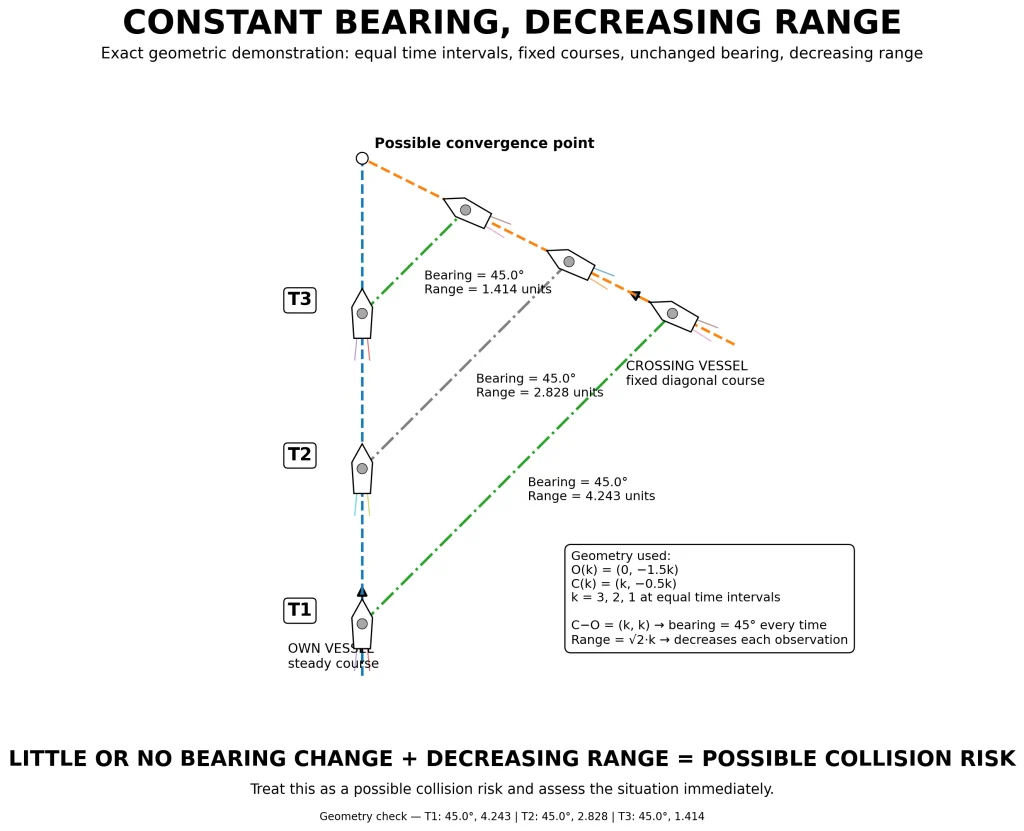
One of the most useful collision-risk concepts for a beginner sailor is often called constant bearing, decreasing range, or CBDR.
The name sounds technical.
The basic idea is straightforward.
If the bearing of an approaching vessel changes little or not at all while the distance between you continues to decrease, the two tracks may be converging.
A better beginner reminder than “same direction means collision” is:
Little or no change in bearing + decreasing distance = treat it as a possible collision risk and assess it immediately.
That wording matters.
A nearly constant bearing does not prove that a collision will occur.
And a changing bearing does not automatically prove that there is no risk.
Rule 7 of the Collision Regulations is very specific about this. It requires vessels to use all available means appropriate to the circumstances to determine whether risk of collision exists. It also states that if there is any doubt, risk should be deemed to exist.
Rule 7 also gives two especially important warnings:
- risk of collision should be considered to exist when the compass bearing of an approaching vessel does not appreciably change;
- risk can sometimes exist even when the bearing is changing, particularly with a very large vessel, a tow, or a vessel at close range.
That is why CBDR should be treated as a warning tool, not a magic formula.
You may sometimes use a fixed object aboard your own boat—a shroud, stanchion, window frame or part of the pulpit—as a rough visual reference while your own heading remains reasonably steady.
For example, another vessel might repeatedly appear beside the same stanchion while becoming noticeably larger.
That should get your attention.
But a stanchion is not a bearing instrument.
A sailboat may yaw, heel, alter course or move in waves. Your own changes in heading affect the apparent relationship.
So use visual references as a simple warning technique, not as a substitute for repeated observations, proper bearings when available, or a complete assessment under the Collision Regulations.
A Changing Bearing Does Not Automatically Mean You’re Safe
Now imagine a different vessel.
On your first scan, it appears off the starboard bow.
A short time later, it has moved noticeably across your view.
Later still, its relative position has changed again.
That movement is useful information.
Its bearing relative to you is changing.
But don’t jump to the conclusion:
“The bearing changed, so we’re safe.”
Rule 7 specifically warns against that assumption in some situations.
Continue observing.
Ask:
Is the range increasing or decreasing?
Has either vessel altered course?
Is the vessel very large?
Are you close to it?
Are you in restricted water?
Are other vessels becoming relevant?
A developing skipper keeps the mental picture open to new information.
This gives us a useful habit:
Observe → Compare → Update.
Not:
Look once → Decide → Forget.
Situational Awareness Is Bigger Than Collision Avoidance
Other vessels are important, but they are not the only things a skipper has to monitor.
A useful beginner mental model divides situational awareness into four areas:
Boat. Crew. Environment. Route and Traffic.
Boat
What is the boat telling you?
Has the heel increased?
Has steering become heavier?
Has speed changed unexpectedly?
Is something flogging?
Did you hear an unusual sound?
Are the sails still appropriate for the conditions?
The boat itself provides information.
Increasing helm load, for example, may be telling you something about heel, sail trim or balance rather than simply asking you to pull harder on the tiller or wheel.
Crew
Where is everyone?
Is somebody cold?
Is someone becoming seasick?
Is a crew member struggling with a task?
Has somebody moved forward without telling the helm?
Is everyone still capable of doing what the plan requires?
Crew condition is part of the safety picture.
It is not something to consider only after the boat and weather.
Environment
What is happening to the wind?
Are gusts increasing?
Is visibility deteriorating?
Are waves building?
Is rain approaching?
Has the sea state changed?
Our Sailing Weather for Beginners lesson helps you assess conditions before departure. Underway, situational awareness helps you notice when the conditions you are experiencing begin to differ from what you expected.
Route and Traffic
Where are you?
What is ahead?
What is behind?
How much sea room do you have?
Is the water becoming shallower?
Where is the shoreline?
Where are the navigation marks?
Where could you go if the current plan stopped making sense?
This last question is important.
A developing skipper does not merely know the current plan.
A developing skipper keeps asking:
What are my options if something changes?
This same approach appears in SailboatZone’s Basic Coastal Navigation guide, where the emphasis is on comparing the plan with what is actually happening and correcting early when the two begin to diverge.
The Hidden Danger of Fixation
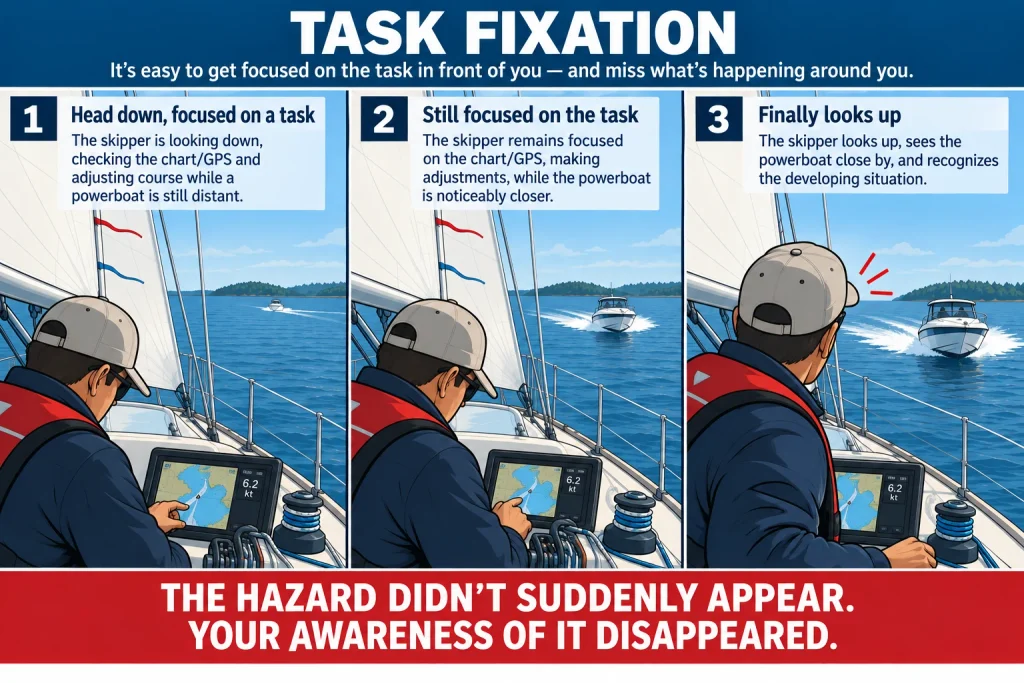
Some of the most dangerous distractions aboard a sailboat are completely legitimate sailing tasks.
Imagine your jib telltales aren’t behaving properly.
You look at them.
You adjust the sheet.
You look again.
You make another adjustment.
You move to see the leeward telltales.
You talk to another crew member about the trim.
Several minutes pass.
The problem isn’t that sail trim is unimportant.
The problem is that your attention became trapped on one task.
That is fixation.
You can fixate on almost anything:
- sail trim;
- a jammed line;
- the chartplotter;
- your phone;
- an engine problem;
- docking preparations;
- a navigation calculation;
- a reefing problem;
- a conversation with crew.
Reading sail telltales can greatly improve your sail trim, but staring at them while failing to monitor surrounding traffic turns a useful sailing task into a distraction.
This is why good lookout behaviour is cyclical.
Work on the problem.
Look up.
Check the surroundings.
Work on the problem.
Look up again.
Maintain the bigger picture.
Task Saturation: When Too Many Things Need Attention
Fixation is one problem.
Sometimes the opposite happens.
Instead of one task consuming your attention, too many tasks demand it at once.
The wind increases.
A sheet needs attention.
A crew member asks a question.
The VHF comes alive.
Traffic is approaching.
The depth is decreasing.
Something starts banging below.
There is a limit to how much information one person can process effectively.
Eventually, adding another task doesn’t make you more productive.
It makes you less aware.
This is task saturation.
A beginner’s instinct may be to work faster.
That isn’t always the best response.
Sometimes the better response is to make the situation simpler.
Depending on the circumstances, that might mean:
- reducing speed;
- creating more sea room;
- postponing a nonessential task;
- asking a crew member for help;
- stabilizing the boat;
- moving away from a developing hazard;
- abandoning troubleshooting temporarily;
- reducing sail;
- reassessing the plan.
Knowing how to stop a sailboat is therefore more than a manoeuvring skill.
In the right situation, reducing speed or stopping can create something extremely valuable:
time to think.
But remember that even stopping must be appropriate to the surroundings. You would not blindly stop in a traffic lane, close to a lee shore or where doing so created a new hazard.
The broader lesson is:
When overloaded, simplify the situation without creating another problem.
[DIAGRAM — TASK SATURATION FUNNEL: Wind, Traffic, Crew, Navigation, Sail Handling, Equipment and VHF enter a funnel labelled LIMITED ATTENTION. Below: PRIORITIZE → SIMPLIFY → STABILIZE → REASSESS.]
Not Every Problem Deserves Equal Attention
Imagine this situation.
Your jib trim isn’t quite right.
One crew member is mildly uncomfortable.
The wind has increased.
Another vessel appears to be getting closer while its bearing changes little.
The chartplotter sounds an alert.
Someone asks for a drink.
Which problem should you deal with first?
That question is more useful than memorizing another sailing term.
Skippers constantly deal with competing demands.
The skill is not simply knowing how to solve each problem.
It is deciding which problem deserves attention first.
As a beginner mental model—not a rigid maritime rule—you can often think in this order:
Immediate threats to people, collision or grounding → maintaining control of the boat → developing environmental or navigation risks → equipment and performance → comfort and nonessential tasks.
Circumstances can change that order instantly.
A crew member asking for water may be low priority.
A crew member falling overboard is not.
A person overboard immediately becomes the dominant emergency priority, while the skipper still has to maintain control of the vessel and avoid creating additional hazards during the recovery.
Poor sail trim might normally be worth correcting.
A possible collision situation can make it temporarily irrelevant.
This is the beginning of skipper thinking.
You are moving beyond:
What should I do?
toward:
What matters most right now—and why?
Use Your Crew to Extend Your Awareness
You do not have to see everything personally.
Crew can dramatically improve the boat’s collective awareness.
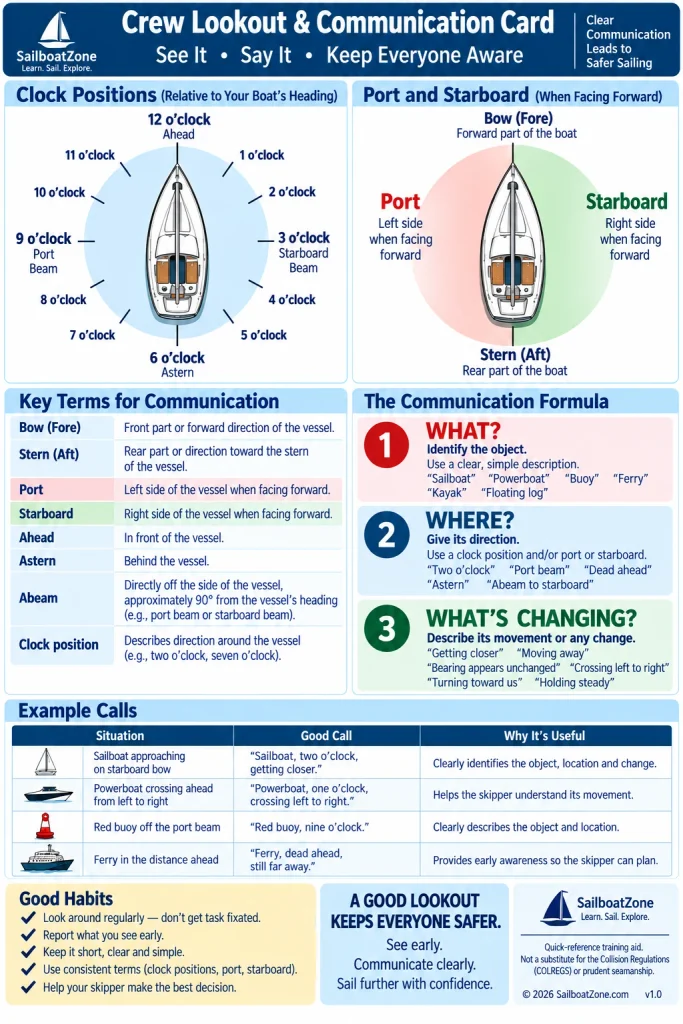
But “tell me if you see anything” is not a very useful briefing.
Give crew a simple way to report what they observe.
For example:
“Powerboat, two o’clock.”
“Sailboat astern.”
“Red buoy off the port bow.”
“Log ahead.”
“Ferry still on the starboard bow and getting closer.”
Useful reports answer basic questions:
What is it?
Where is it?
What is changing?
The skipper can then ask for more information.
“Keep watching it.”
“Is the bearing changing?”
“Tell me if it gets closer.”
Crew should understand that reporting change is often more useful than simply reporting that an object exists.
Later in the course, How to Assess, Brief and Manage a Sailing Crew will expand this idea by showing how a skipper assigns tasks according to the actual experience, confidence and limitations of the people aboard.
Electronics Can Help—but They Don’t Replace a Proper Lookout
Modern sailors may have access to excellent tools:
- chartplotters;
- depth sounders;
- AIS;
- radar;
- GPS;
- electronic charts.
Used properly, these can improve situational awareness.
Used badly, they can become another form of fixation.
A chartplotter can display your charted position.
It cannot guarantee there isn’t a floating log directly ahead.
AIS can provide valuable information about vessels transmitting appropriate AIS information.
It does not mean every vessel, paddler, log, buoy or hazard around you will appear on the display.
Radar can be extremely useful, but it requires proper operation and interpretation.
Rule 7 goes further: if radar is fitted and operational, proper use should be made of it, including long-range scanning for early warning and radar plotting or equivalent systematic observation of detected objects.
That is an important distinction.
Electronics are not separate from the lookout.
When appropriate and available, they are part of the information used to build the lookout picture.
But none of them gives you permission to stop looking and listening outside.
A useful question whenever you find yourself staring at a display is:
How long has it been since I looked outside?
This will become increasingly important as you move into navigation. A later lesson, Aids to Navigation for Beginners, will show how to relate buoys, marks, lights and daymarks seen outside the boat to charted navigation information.
Your Lookout Must Change With the Conditions
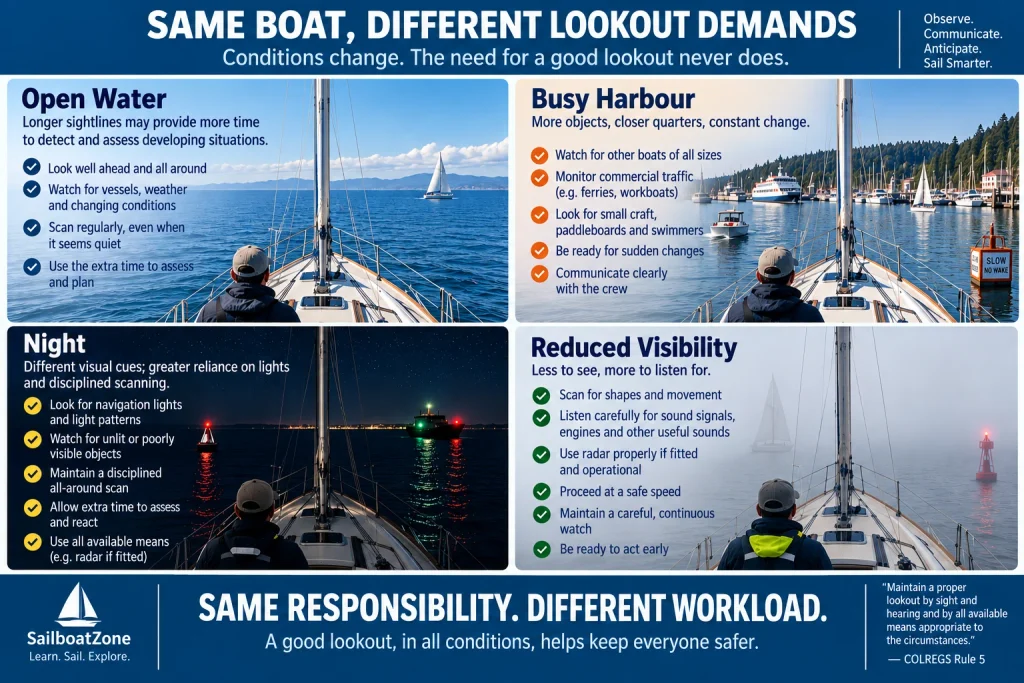
Picture your boat on a clear summer afternoon.
Visibility is excellent.
There is little traffic.
You’re in open water with plenty of sea room.
Now put the same boat at a busy harbour entrance near dusk.
Rain is reducing visibility.
Fishing boats, ferries and recreational traffic are moving nearby.
Shore lights make vessel lights harder to distinguish.
Your obligation to keep a proper lookout is the same.
But the work required to do it properly has increased dramatically.
Factors that affect lookout demands include:
- visibility;
- traffic density;
- darkness;
- glare;
- fog or rain;
- sea state;
- confined water;
- proximity to hazards;
- boat speed;
- crew workload;
- rapidly changing conditions.
The important beginner lesson is simple:
As the situation becomes more complicated, your lookout must become more deliberate.
This also connects with safe speed. Rule 6 requires vessels to proceed at a safe speed that allows proper and effective action to avoid collision and permits the vessel to be stopped within an appropriate distance for the conditions.
So lookout and speed are not separate ideas.
If you cannot properly assess and respond to what is developing around you, your speed itself may be part of the problem.
Your Ears Are Part of the Lookout
It is easy to think of lookout as a visual task.
It isn’t.
Rule 5 explicitly includes hearing.
You may hear an engine approaching from astern before you see the vessel.
You may hear a fog signal.
You may hear surf or breaking water.
You may hear a crew member call a warning.
You may hear an unusual sound aboard your own boat.
You may hear relevant VHF traffic.
That means anything that unnecessarily blocks your ability to hear what is happening around you can reduce your situational awareness.
The lesson is not that music can never be played aboard.
It is that entertainment should never interfere with your ability to maintain an effective lookout.
Keep Looking While You’re Manoeuvring
One of the easiest times to lose situational awareness is during a manoeuvre.
Tacking is a good example.
The helm is turning the boat.
The jib is crossing.
One sheet is being eased.
The other is being trimmed.
Crew members are moving.
Everyone’s attention naturally turns inward toward the manoeuvre.
But the outside world hasn’t stopped.
The ferry is still moving.
The shoreline is still there.
The other sailboat is still approaching.
The boat is still travelling through the water.
During tacking, jibing or any other manoeuvre, preparation reduces the number of surprises demanding attention at once.
The same is true of sail handling.
If lines are organized, crew know what is expected and the sequence has been discussed before the manoeuvre begins, more attention remains available for traffic, hazards and changing conditions.
That is one reason good seamanship often looks calm.
Preparation creates mental capacity.
The skipper has fewer unnecessary problems to process at once.
Skipper Thinking: The Trim Problem That Doesn’t Matter Anymore
Return to the situation from the beginning of this lesson.
You are sailing on a reach.
The boat seems slightly slow.
The jib telltales aren’t flowing properly.
You begin troubleshooting.
You look at the sail.
You adjust the sheet.
You check again.
Then you finally scan the water.
The powerboat you noticed earlier is considerably closer.
More importantly, it still appears in approximately the same direction from your boat.
Stop here.
Think like the skipper.
What changed?
The sail-trim problem didn’t suddenly become worse.
The traffic situation did.
What might little or no bearing change combined with decreasing distance suggest?
There may be a risk of collision.
What deserves your attention now?
The developing traffic situation.
What happened to the sail-trim problem?
Nothing.
It’s still there.
It just became less important.
That distinction matters enormously.
Skipper thinking is not simply solving problems.
It is continuously reprioritizing problems as new information arrives.
Your reasoning might look like this:
OBSERVE
The powerboat is closer.
↓
RECOGNIZE CHANGE
Its bearing appears to have changed little while range has decreased.
↓
ASSESS
Treat the situation as a possible collision risk and gather the information needed to understand it.
↓
PRIORITIZE
Traffic now matters more than sail trim.
↓
ACT
Apply the appropriate collision-avoidance rules and take whatever action the situation requires.
↓
REASSESS
Did the risk decrease?
What is the other vessel doing now?
What changed while you dealt with it?
Only after the higher-priority situation is under control does the sail-trim problem deserve your attention again.
This pattern will appear repeatedly as you develop as a skipper.
Weather changes.
Crew condition changes.
Equipment fails.
A route becomes less attractive.
Daylight becomes limited.
New information arrives.
Good skippers do not cling to the old priority because it was the problem they happened to be working on.
They update the plan.
“Stand-On” Does Not Mean “I Have the Right to Hit You”
Beginners often hear the phrase right of way.
It is convenient everyday language, and SailboatZone uses it in the title of its Sailing Right of Way Rules guide.
But when teaching the Collision Regulations precisely, it is better to think in terms of stand-on vessel and give-way vessel.
Those terms describe responsibilities in an encounter.
They do not give one skipper an absolute entitlement to continue regardless of danger.
Even if your vessel is the stand-on vessel, you must continue monitoring the encounter.
You do not stop keeping a lookout.
You do not assume the other vessel has seen you.
You do not allow a dangerous situation to develop simply because you believe the rule initially required the other vessel to manoeuvre.
The practical lesson is:
The rules help vessels avoid collisions. They are not permission to insist on being correct while a collision develops.
Your next lesson will examine those responsibilities in detail.
Common Beginner Lookout Mistakes
Most lookout failures don’t begin with someone deciding to ignore danger.
They begin with small habits.
Looking only forward.
Traffic can approach from almost any direction, including astern.
Looking once and forgetting.
A vessel that poses little concern now can become important later.
Assuming the other vessel sees you.
You cannot build your safety plan around another skipper’s awareness.
Staring at the sails.
Sail trim matters. Collision avoidance matters more when the two compete for attention.
Becoming absorbed in electronics.
Displays provide useful information but can narrow your attention dramatically.
Ignoring traffic astern.
A faster vessel approaching from behind can become highly relevant.
Treating stand-on status as an absolute right.
Continue monitoring the encounter regardless of which vessel is initially required to manoeuvre.
Assuming bearing change eliminates risk.
Rule 7 specifically warns that this is not always true.
Using a stanchion as though it were a precision bearing instrument.
It is only a rough visual reference and becomes less useful when your heading changes.
Maintaining the same lookout in worsening conditions.
More complicated situations require more deliberate monitoring.
Allowing a minor problem to consume major attention.
Not everything needs to be fixed immediately.
Failing to reassess after acting.
Turning isn’t the end of the process.
Slowing down isn’t the end.
Solving the equipment problem isn’t the end.
Look again.
Did the action actually improve the situation?
A Simple Lookout Routine You Can Use on Every Sail
You do not need a complicated cockpit checklist to begin improving your situational awareness.
Remember five words:
SCAN → COMPARE → PRIORITIZE → ACT → REASSESS
SCAN
Look around the boat.
Traffic.
Hazards.
Position and depth.
Wind and weather.
Boat.
Crew.
Available safe water.
COMPARE
Ask:
What changed since the last time I looked?
That question turns random looking into useful observation.
PRIORITIZE
Ask:
What matters most right now?
Do not automatically continue whatever task you were already doing.
New information may have changed the priority.
ACT
Respond appropriately to the situation.
Sometimes the correct action is continued monitoring.
Sometimes action needs to happen early.
Sometimes it needs to happen immediately.
The circumstances and applicable navigation rules determine which.
REASSESS
Look again.
Did the situation improve?
What is the other vessel doing now?
Has the wind changed?
Where is the crew?
Where has your own vessel moved while your attention was elsewhere?
What is developing next?
Then begin the cycle again.
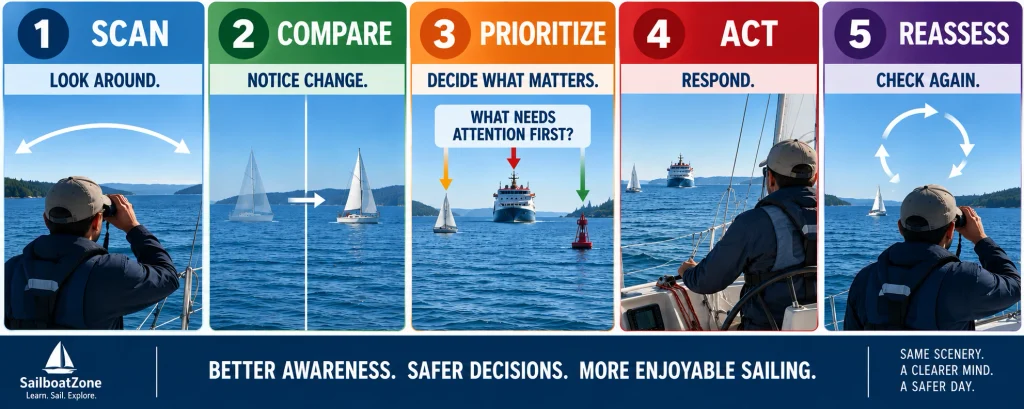
This is more than a lookout technique.
It is one of the foundations of thinking like a skipper.
Key Takeaways
A proper lookout is continuous, not something you do occasionally when you remember.
Look all around the boat—not just ahead—and use sight, hearing and other appropriate available means.
Don’t simply notice other vessels. Track how the situation changes over time.
Little or no change in the bearing of an approaching vessel combined with decreasing distance should be treated as a possible collision risk and assessed promptly.
A changing bearing does not automatically eliminate collision risk.
A stanchion, shroud or other fixed part of the boat may provide a rough visual reference, but it is not a substitute for proper collision-risk assessment.
Situational awareness includes Boat, Crew, Environment and Route/Traffic, not just other vessels.
Recognize fixation when one task consumes too much attention and task saturation when too many demands compete for the attention available.
When overloaded, simplify the situation when it is safe and appropriate to do so.
Use priority hierarchies as mental aids, not rigid rules.
If someone falls overboard, recovery becomes the dominant emergency priority while you continue maintaining control of the vessel and avoiding additional hazards.
Electronics support the lookout; they do not eliminate the need to look and listen outside.
Even a stand-on vessel must continue monitoring the situation.
After taking action, always reassess.
Above all:
The best lookout isn’t simply the sailor with the sharpest eyesight. It is the sailor who keeps noticing change.
Knowledge Check
1. Why isn’t looking forward enough to constitute a proper lookout?
2. What does Rule 5 require in addition to visual observation?
3. You observe another vessel once and decide it isn’t a problem. What information are you missing?
4. A powerboat remains near the same visual reference while appearing progressively closer. What might this indicate?
5. Why should a stanchion or shroud be treated only as a rough visual reference?
6. Does an appreciable bearing change always mean collision risk is gone? Why not?
7. What is the difference between fixation and task saturation?
8. Why can slowing down or simplifying the situation help an overloaded skipper?
9. What four broad areas make up the situational-awareness picture used in this lesson?
10. Why must a stand-on vessel continue monitoring an encounter?
11. What should happen after you take action to deal with a developing hazard?
Quiz
1. What best describes a proper lookout?
A. Watching directly ahead whenever the boat is moving
B. Checking for boats before changing course
C. Continuously gathering and assessing information using appropriate available means
D. Watching the chartplotter whenever traffic is present
2. Rule 5 specifically includes which two human senses?
A. Sight and touch
B. Sight and hearing
C. Hearing and smell
D. Sight and balance
3. Another vessel’s bearing changes little while its distance from you decreases. What is the best response?
A. Assume a collision will definitely happen
B. Treat it as a possible collision risk and assess the situation promptly
C. Assume the other skipper will turn
D. Ignore it until the vessel is much closer
4. Which statement about changing bearing is most accurate?
A. Any bearing change proves there is no collision risk
B. Bearing changes are irrelevant
C. Collision risk can sometimes still exist despite an appreciable bearing change
D. Only powerboats need to consider bearing
5. What is the proper use of a stanchion when watching another vessel?
A. It gives a precise compass bearing
B. It can provide a rough visual reference while your heading remains reasonably steady
C. It proves which vessel is stand-on
D. It replaces repeated observations
6. Which is the best example of fixation?
A. Repeatedly scanning traffic
B. Watching telltales so intently that you stop monitoring the surroundings
C. Asking crew to report traffic
D. Checking the depth sounder briefly
7. What is task saturation?
A. Sailing too slowly to steer
B. Having more demands competing for attention than you can effectively process
C. Becoming bored during a long sail
D. Assigning two tasks to one crew member
8. Which crew report is most useful?
A. “There’s something over there.”
B. “Look at that boat.”
C. “Powerboat, two o’clock, appears to be getting closer.”
D. “We’re probably okay.”
9. Which statement about electronics is correct?
A. AIS replaces visual lookout
B. Radar replaces hearing
C. Electronics may form part of the available means used for lookout and collision assessment but do not replace looking and listening
D. A chartplotter shows every nearby hazard
10. What should happen immediately after taking action to reduce a developing risk?
A. Return to sail trim
B. Assume the problem is solved
C. Reassess the situation
D. Stop monitoring the other vessel
11. Which sequence best represents the lookout routine taught in this lesson?
A. Look → Steer → Trim → Relax
B. Scan → Compare → Prioritize → Act → Reassess
C. Observe → Turn → Accelerate → Continue
D. Scan → Act → Forget → Repeat
12. Your sail trim is poor while another vessel appears to present a developing collision risk. What should determine which problem you address first?
A. Which problem you noticed first
B. Which task is easier
C. Which issue presents the greater immediate risk
D. Which crew member complains loudest
Answer Key
1. C — Continuously gathering and assessing information using appropriate available means.
A proper lookout is continuous and uses more than forward vision.
2. B — Sight and hearing.
Rule 5 expressly requires both, as well as other available means appropriate to the circumstances.
3. B — Treat it as a possible collision risk and assess the situation promptly.
Little or no bearing change combined with decreasing range is a warning sign.
4. C — Collision risk can sometimes still exist despite an appreciable bearing change.
Rule 7 specifically warns of this, particularly with very large vessels, tows and vessels at close range.
5. B — It can provide a rough visual reference while your heading remains reasonably steady.
It is not a precision bearing instrument.
6. B — Watching telltales so intently that you stop monitoring the surroundings.
The sailing task is legitimate. Losing the larger picture is the problem.
7. B — Having more demands competing for attention than you can effectively process.
Task saturation can reduce both awareness and decision quality.
8. C — “Powerboat, two o’clock, appears to be getting closer.”
It identifies what the crew member sees, where it is and what appears to be changing.
9. C — Electronics may support lookout and collision assessment but do not replace looking and listening.
When radar is fitted and operational, Rule 7 specifically requires proper use of it.
10. C — Reassess the situation.
Never assume your action produced the result you expected.
11. B — Scan → Compare → Prioritize → Act → Reassess.
12. C — Which issue presents the greater immediate risk.
Skipper thinking requires priorities to change when the situation changes.
Scoring Guide
11–12 correct: Excellent. You understand the fundamental lookout and situational-awareness concepts and are ready to apply them to collision-avoidance rules.
9–10 correct: Strong understanding. Review Rule 7, particularly the limitations of relying only on apparent bearing changes.
7–8 correct: Good foundation, but revisit the sections on collision-risk assessment, fixation and reassessment.
5–6 correct: Review the lesson before moving on. Concentrate on tracking vessels over time rather than relying on single observations.
0–4 correct: Work through the lesson again. Focus first on Rule 5, Rule 7 and the SCAN → COMPARE → PRIORITIZE → ACT → REASSESS process.
Summary: Keep Updating the Picture
A proper lookout isn’t a person standing at the bow staring at the horizon.
It is a continuous process of gathering information and updating your understanding of the situation.
You scan.
You compare what you see with what you saw before.
You notice change.
You decide what matters most.
You act when necessary.
Then you look again.
As your sailing skills improve, this habit becomes even more important because increased competence gives you more things aboard that you know how to adjust, troubleshoot and manage.
Don’t let learning to operate the boat make you forget to sail the whole situation.
Remember:
SCAN → COMPARE → PRIORITIZE → ACT → REASSESS
In this lesson, you learned how to detect, monitor and assess a developing traffic situation.
The next step is understanding the responsibilities that apply when vessels interact. Continue to Sailing Right of Way Rules: The Essential Beginner Guide to learn how stand-on and give-way responsibilities work under the Collision Regulations.