
Quick Summary
By the end of this article you’ll understand what sailors mean by ‘reading the wind’ and why it is one of the most important skills you can learn. Although wind is invisible, it constantly leaves clues on the water, on shore, and even on your own boat. This article will teach you how to read the wind, and specifically to recognize those clues before they affect your sailing.
1. What Does It Mean to Read the Wind?
When most beginners imagine sailing, they picture learning how to steer, trim the sails, or tie knots. However, experienced sailors know that nearly every decision begins with one simple question: Where is the wind? Reading the wind is the skill of answering that question accurately and continuously.
Unlike the steering wheel of a car, the controls of a sailboat only work well when you understand what the wind is doing. Because the wind is always changing, successful sailors never stop observing it. Instead of guessing, they gather information from dozens of small clues around them.
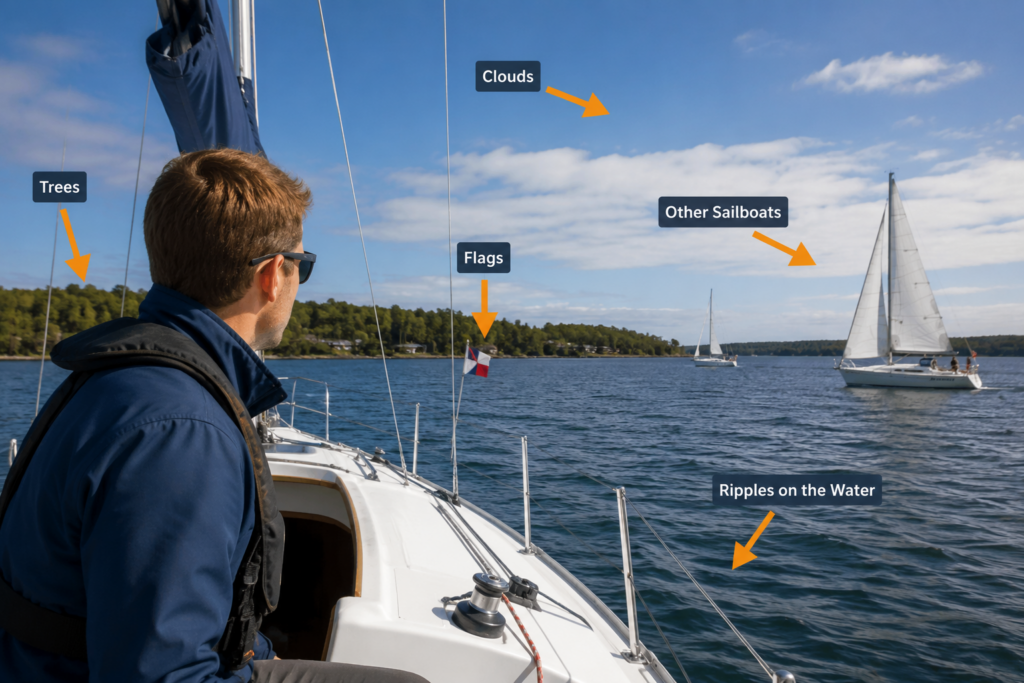
The important thing to remember is that you cannot actually see the wind itself. You only see its effects. Ripples spread across the water. A flag begins to flutter. Leaves move in the trees. Another sailboat heels over as a gust arrives. As a result, experienced sailors learn to watch these signs almost without thinking.
Fortunately, this is not a mysterious talent that only experts possess. It is simply a habit that anyone can develop with practice. First, you learn where to look. Next, you learn what each clue means. Finally, you learn to combine several clues before making a decision.
Reading the wind improves far more than your boat speed. It helps you steer smoother courses, trim your sails more accurately, avoid unnecessary maneuvers, and feel more relaxed on the water. Likewise, it increases safety because surprises become less common when you can see changing conditions approaching.
Internal Links: How to Sail a Sailboat • Points of Sail Explained • How to Steer a Sailboat
2. Understanding Wind Before You Try to Read It
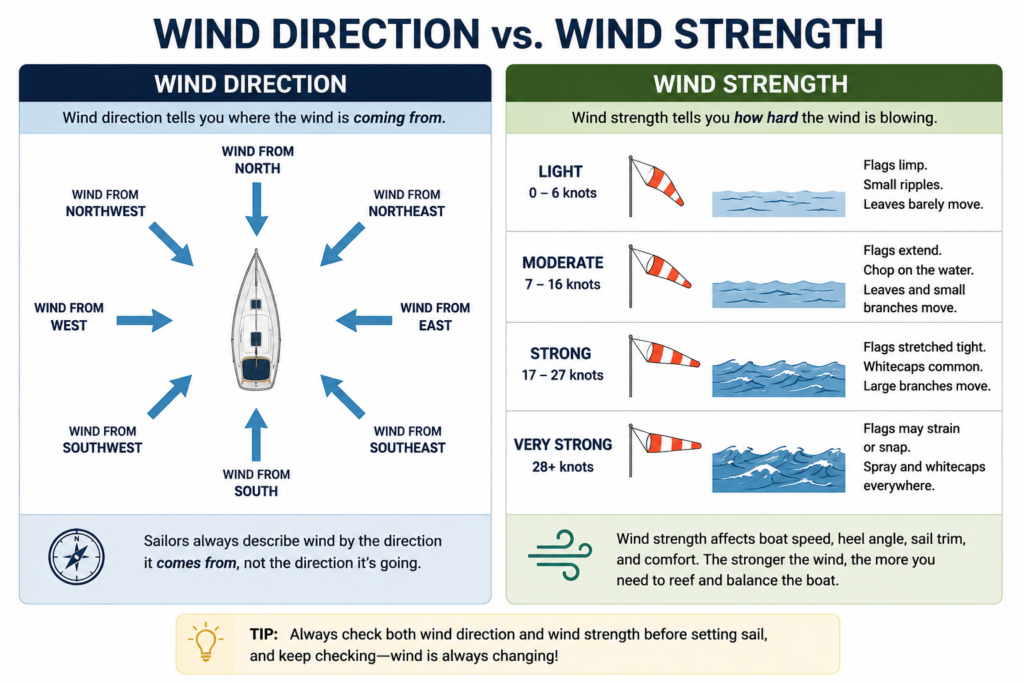
Before you can read the wind, you need to understand two simple ideas: wind direction and wind strength. Wind direction tells you where the wind is coming from—not where it is going. This small distinction is one of the first concepts every sailor must master.
Wind strength describes how hard the wind is blowing. Sailors often think in broad categories such as light, moderate, and strong. These categories matter because they affect boat speed, heel angle, sail trim, and comfort. In contrast, a light breeze may barely move the boat, while a stronger breeze demands quicker reactions.
Meanwhile, remember that wind is almost never constant. Gusts briefly increase the wind. Lulls reduce it. Shifts change its direction. Seasonal weather patterns and local geography influence all of these changes. Therefore, reading the wind is never a one-time task before leaving the dock; it continues throughout every sail.
If you’d like to learn more about how weather systems create changing wind conditions, the Environment and Climate Change Canada National Marine Weather Guide is an excellent beginner-friendly resource.
In the next section, you’ll learn the practical techniques sailors use every day to discover where the wind is coming from, even when they don’t have electronic instruments.
Internal Links: True Wind vs. Apparent Wind (future) • Weather Basics for Sailors (future)
3. The Best Ways to Find Wind Direction
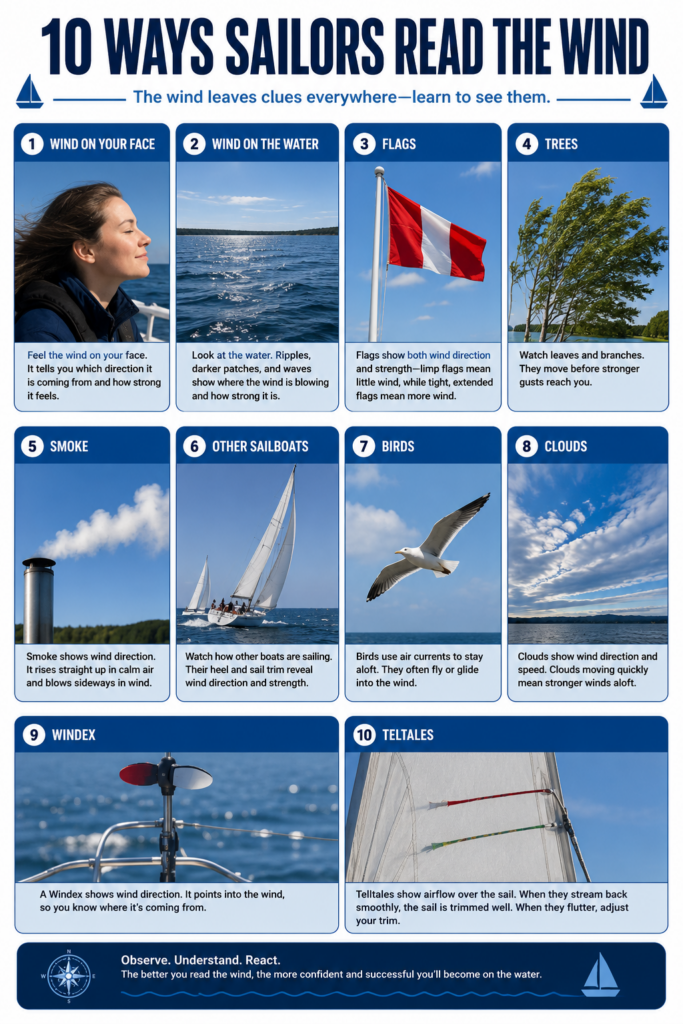
This section is where the skill of **how to read the wind** becomes practical. Although the wind itself is invisible, it constantly reveals its presence through the world around you. Experienced sailors rarely rely on a single clue. Instead, they compare several signs before deciding where the wind is coming from.
Feel the Wind
First, use your own body. The skin on your face, ears, neck, and hands is surprisingly sensitive to moving air. Stand still for a few moments and notice which side of your face feels cooler. That is usually the side facing the wind. However, avoid making a decision while you are walking quickly because your movement creates its own airflow.
Watch the Water
Next, look across the surface of the water. Small ripples usually appear where the breeze is blowing. Darker patches often indicate stronger wind because the rougher surface reflects less light. Meanwhile, smoother patches may reveal lighter wind or temporary lulls. As a result, many sailors spend more time looking at the water ahead than at their sails.
Watch Flags
Flags are one of the easiest wind indicators to understand. A limp flag suggests little wind, while a fully extended flag indicates stronger conditions. For example, a marina flag can help you estimate both direction and strength before you even leave the dock.
Watch Trees and Grass
Trees and grass provide excellent clues when sailing close to shore. Leaves begin moving before larger branches, while tall grass bends with even a gentle breeze. Therefore, comparing several trees gives a better picture than watching only one.
Watch Smoke
Smoke rises almost straight upward in calm conditions. In contrast, stronger wind pushes smoke sideways. Because smoke responds quickly to changing air, it can reveal shifts before you notice them on the water.
Watch Other Sailboats
Fortunately, other boats are moving wind indicators. Notice the angle of their sails, how much they heel, and the direction they are travelling. Likewise, if several boats suddenly lean farther over, a gust is probably approaching your position.
Watch Birds
Finally, pay attention to birds. Seagulls and other soaring birds often use rising air and steady breezes to glide with little effort. Although birds should never be your only source of information, they can confirm what other clues are already telling you.
Beginner Tip: Never rely on a single clue. Learning how to sail a sailboat with skill and efficiency requires more than just technical boat knowledge. The secret of learning how to read the wind is paramount, and the skill of comparing several observations before making a decision is a big part of the equation.
4. Reading the Wind While You’re Sailing
This is where the skill of **how to read the wind** becomes continuous rather than occasional. Although many beginners check the wind before leaving the dock, experienced sailors never stop observing it. Instead, they constantly compare what they see with how the boat is behaving.
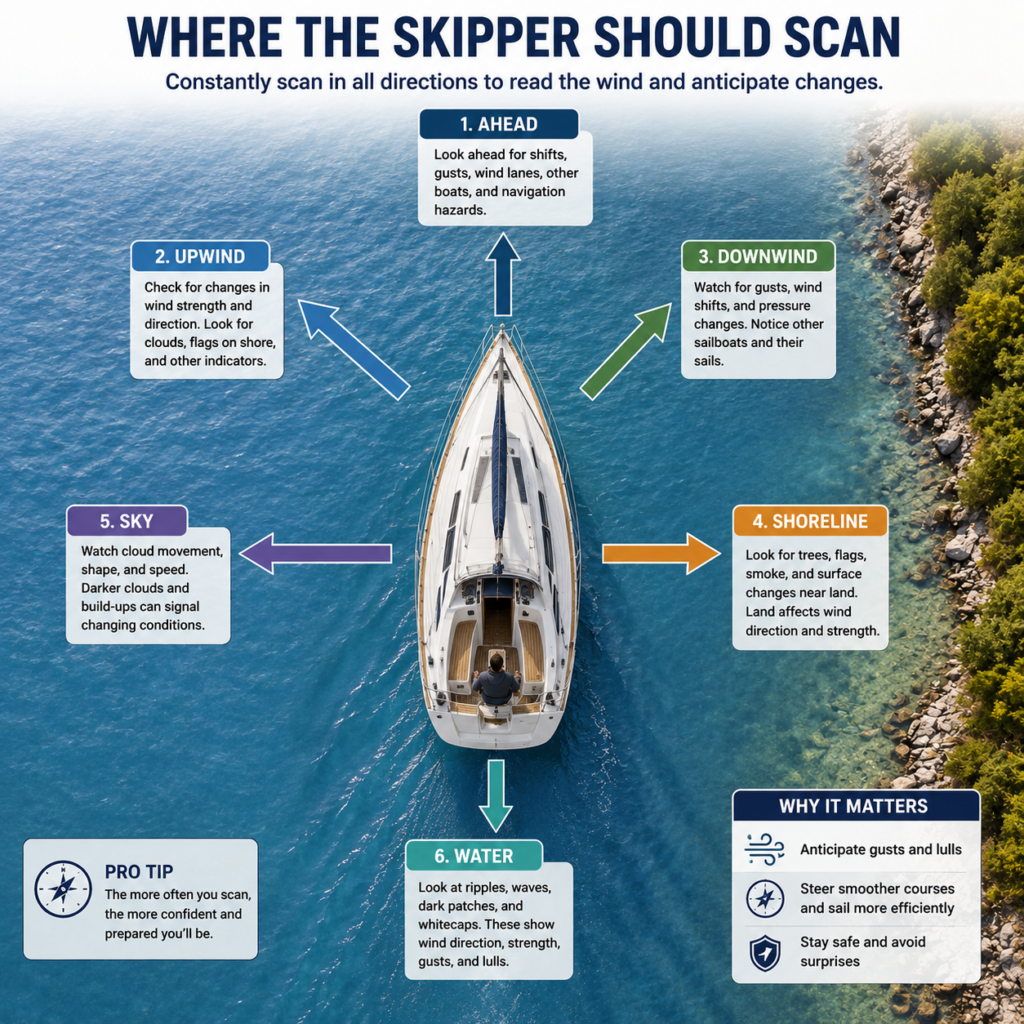
First, develop the habit of scanning. Look ahead, beside the boat, behind you, toward the shoreline, up at the sky, and across the water. As a result, you’ll often notice changes before they reach your boat.
Next, spend extra time looking upwind. Gusts, lulls, and wind shifts almost always arrive from the direction the wind is coming from. For example, a darker patch of rippled water may signal a stronger breeze approaching. Fortunately, seeing it early gives you time to prepare instead of reacting at the last second.
Meanwhile, don’t ignore what’s happening downwind. Other sailboats, changing wave patterns, and even the movement of birds can confirm what you already suspect. Likewise, if several boats suddenly heel more than they were a minute ago, expect the same gust to reach you soon.
Because the wind is always changing, make scanning every few seconds a habit. Eventually this becomes automatic and is one of the defining characteristics of skilled sailors.
5. Wind Indicators Installed on Your Boat
The Windex
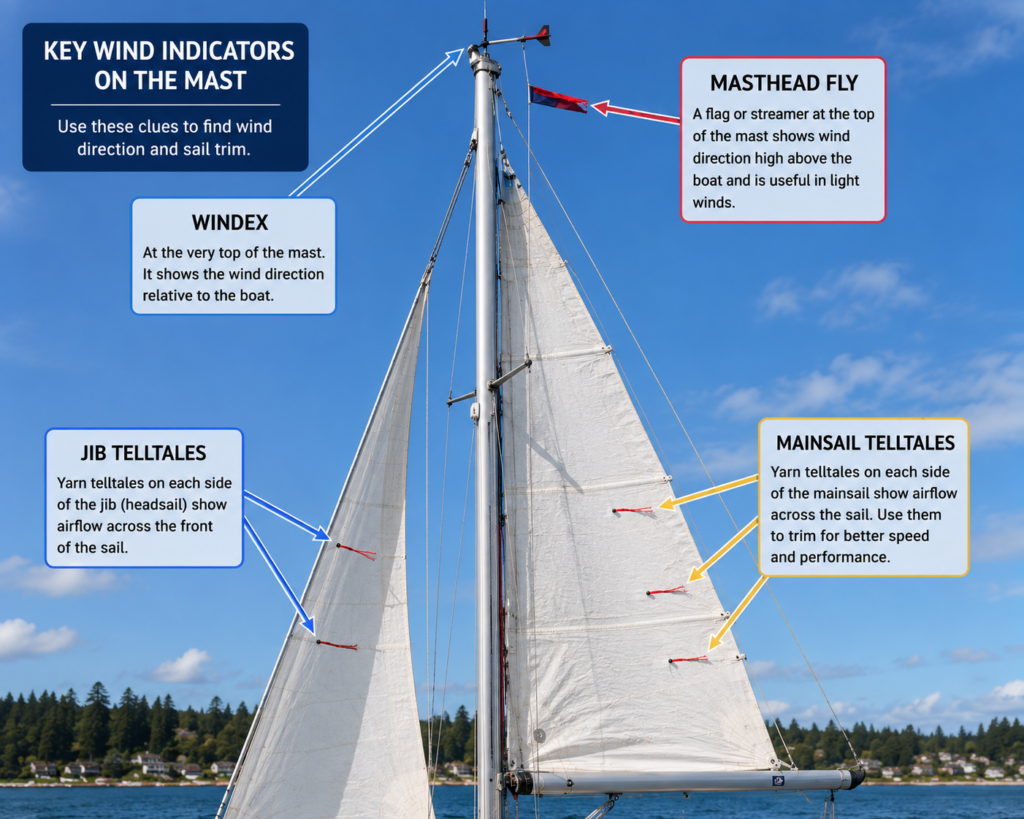
The Windex is one of the simplest and most useful tools for learning how to read the wind. Mounted at the top of the mast, it freely rotates until it points into the apparent wind. Therefore, a quick glance up the mast tells you where the wind is coming from relative to your boat. However, remember that it works best when combined with the other clues you’ve already learned.
Masthead Fly
Some sailboats use a simple masthead fly instead of a Windex. Although it provides less detail, it still gives an immediate indication of wind direction and helps confirm what you observe elsewhere.
Telltales
Telltales are short pieces of yarn or ribbon attached to the sails. They show how smoothly the air is flowing over the sail. In contrast to a Windex, telltales don’t simply show wind direction—they also reveal whether the sail is trimmed efficiently. A full discussion of telltales belongs in the Sail Trim Basics article, but beginners should know that streaming telltales usually indicate smooth airflow while fluttering telltales suggest adjustment is needed.
Electronic Wind Instruments
Finally, many modern sailboats include electronic wind sensors and digital displays. These instruments provide useful information, especially offshore. Nevertheless, beginners should avoid relying on electronics alone. If an instrument fails, your ability to read the water, flags, other boats, and your own sails will still allow you to make good decisions.
Beginner Tip: Treat your Windex as one clue, not the only clue. The best sailors compare the Windex with the water, the sails, and the world around them before making a decision.
Internal Links: • Understanding Telltales (future)
6. Reading Gusts and Lulls
Once you understand the basics of how to read the wind, the next step is recognizing that the wind is constantly changing. Although it may seem steady from a distance, it naturally increases, decreases, and shifts throughout the day.
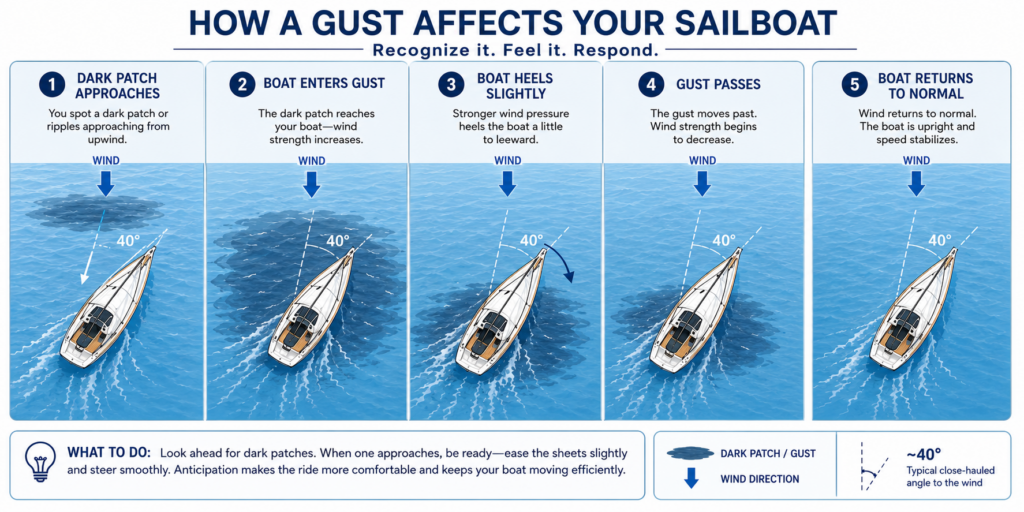
A gust is a temporary increase in wind strength. First, learn to look for gusts before they arrive. Darker patches of textured water often move across the surface ahead of your boat. As a result, you have time to prepare instead of being surprised by a sudden increase in heel.
A lull is the opposite. It is a temporary decrease in wind strength. Meanwhile, you may notice the boat slowing down, the sails becoming softer, and the heel angle decreasing. Because you expected the lull, you’ll be less tempted to make unnecessary steering corrections.
Fortunately, you do not need to react dramatically. Instead, make smooth, deliberate adjustments. Keep steering steady, anticipate the change, and avoid overcorrecting. Detailed sail trim techniques are covered in another article.
Internal Links: • Boat Heel Explained (future)
7. Reading Wind Shifts
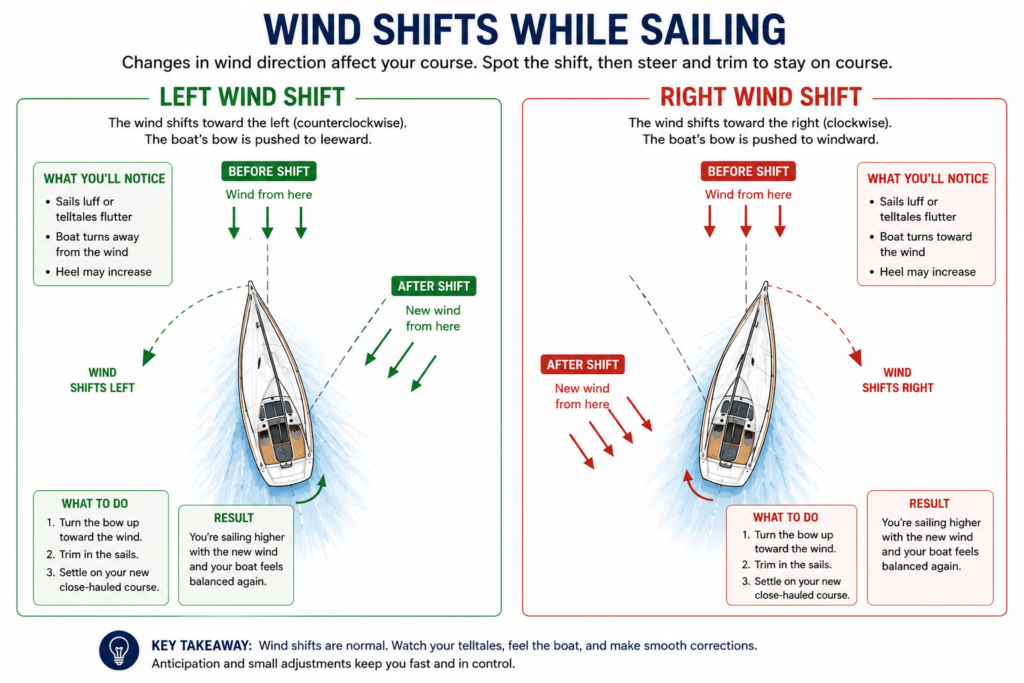
A wind shift occurs when the wind changes direction instead of simply becoming stronger or weaker. Therefore, learning to recognize shifts is one of the most valuable parts of learning how to read the wind.
A left shift means the wind begins coming from farther to your left. In contrast, a right shift means it begins coming from farther to your right. Although the changes are often small, they can noticeably affect your point of sail, steering, and sail trim.
For example, if your sails suddenly begin luffing even though you have not moved the helm, the wind may have shifted. Likewise, if another sailboat changes course without adjusting its sails, it may be responding to the same shift.
Rather than chasing every tiny movement, continue observing the water, nearby boats, and your wind indicator together. As a result, you’ll respond to genuine changes instead of imagined ones.
8. Reading Wind Near Shore
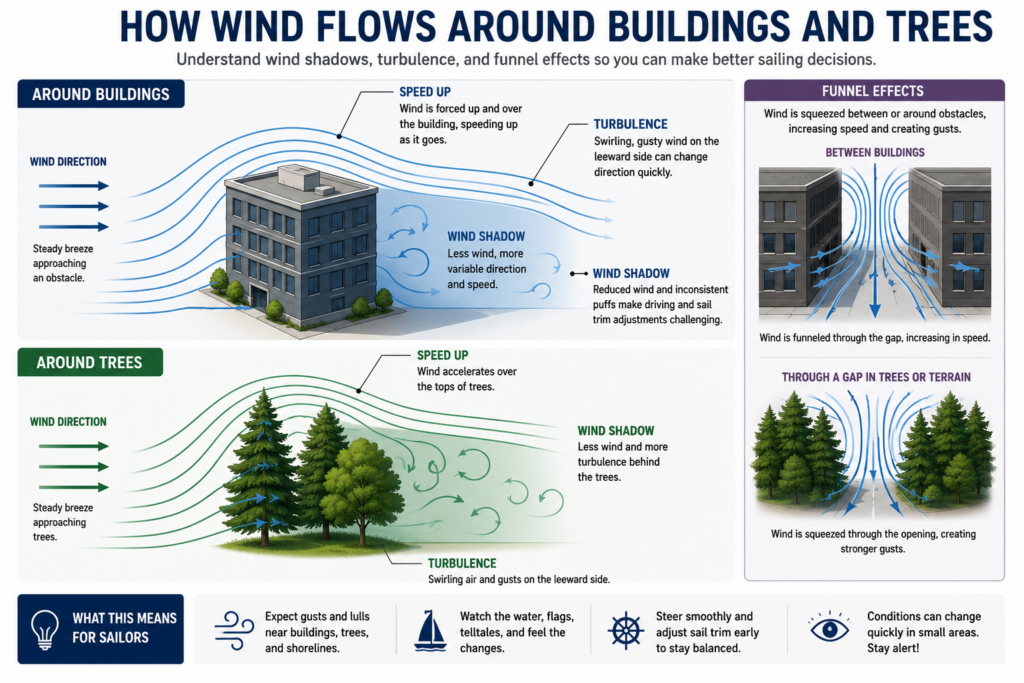
Wind shadows form on the sheltered side of obstacles. Because less wind reaches these areas, boats may suddenly slow down. Meanwhile, turbulent air can make steering feel inconsistent.
On the other hand, valleys, narrow channels, and gaps between buildings can create a funnel effect that accelerates the wind. Fortunately, recognizing these locations helps you anticipate stronger conditions before you reach them.
Before every trip, it’s a good habit to check an official marine forecast. The NOAA National Weather Service Marine Weather page provides marine forecasts, safety information, and weather resources that help sailors prepare for changing conditions.
Finally, remember that wind behaves differently near land than it does in open water. Hills, trees, buildings, and cliffs all disturb the airflow.
Marinas deserve special attention. Wind may bounce off docks, buildings, and rows of boats, making the apparent direction confusing. Therefore, slow down, keep looking for multiple clues, and never rely on a single observation when manoeuvring in confined spaces.
Beginner Tip: The best sailors aren’t reacting to the wind—they’re anticipating it.
Internal Links: Docking a Sailboat (future) • Leaving the Dock (future) • Weather Basics for Sailors (future)
9. Common Beginner Mistakes
Watching the sails instead of the wind
Although your sails provide useful feedback, they react after the wind changes. Instead, keep looking ahead for clues on the water.
Checking the wind only once
First check before leaving the dock. Next, continue observing throughout your sail because the wind is constantly changing.
Ignoring water texture
Dark patches, ripples, and smooth areas often reveal gusts and lulls before they reach your boat. Therefore, make the water your primary source of information.
Trusting instruments alone
A Windex is valuable. However, the best sailors compare it with flags, water, trees, and other boats.
Reacting too late
As a result of waiting until the boat heels or the sails luff, beginners often oversteer. Fortunately, learning **how to read the wind** helps you anticipate changes instead of chasing them.
Beginner Tip: The best sailors aren’t reacting to the wind—they’re anticipating it.
10. Practical Exercises Before Heading Out
Exercise 1: Stand on shore and estimate the wind direction before checking a nearby flag.
Exercise 2: Watch the water for five minutes and identify gusts, lulls, and darker wind patches.
Exercise 3: Guess the wind direction before looking at the Windex.
Exercise 4: Observe another sailboat and estimate its point of sail, heel angle, and sail trim.
Quick Reference Table
| Wind Clue | What It Tells You | Best Used For |
| Face | Direction | Quick checks |
| Flags | Direction & strength | Before launching |
| Water texture | Gusts & lulls | While sailing |
| Windex | Exact direction | Steering |
| Telltales | Airflow | Sail trim |
| Trees | General direction | Shore observations |
| Other boats | Wind & sail trim | Confirmation |
Frequently Asked Questions
• Can you sail without a Windex? Yes. Sailors did for centuries by observing natural wind clues.
• How often should I check the wind? Continuously. Reading the wind is an ongoing habit.
• Why does the water look darker sometimes? Rougher water reflects light differently and often indicates stronger wind.
• Can the wind change suddenly? Yes. Gusts, lulls, and shifts are normal.
• Do experienced sailors still use wind indicators? Absolutely. They simply combine them with observation.
Key Takeaways
• Wind is invisible, but its effects are everywhere.
• Learning how to read the wind is a continuous process, not a one-time check.
• Use several clues together rather than relying on only one.
• Water texture often reveals changes before they reach your boat.
• Gusts, lulls, and shifts all influence steering and sail trim.
• Practice every time you’re near the water, even when you are not sailing.
Knowledge Check
1. Wind direction tells you:
A. Where the wind is going
B. Where it is coming from
C. Boat speed
D. Wave height
2. Dark patches on the water often indicate:
A. Rocks
B. Stronger wind
C. Shallow water
D. Current
3. A lull is:
A. Stronger wind
B. No waves
C. Temporary decrease in wind
D. Fog
4. A gust is:
A. Wind shift
B. Temporary increase in wind
C. Tide
D. Rain
5. Which clue should you rely on most?
A. Windex only
B. Flags only
C. One clue
D. Several clues together
6. Where should you look most often?
A. Cabin
B. Upwind
C. Anchor
D. Keel
7. Wind shadows form:
A. Behind obstacles
B. Offshore only
C. At night
D. In deep water
8. Telltales primarily indicate:
A. Airflow over sails
B. Water depth
C. Compass heading
D. Tide
9. Experienced sailors read the wind:
A. Before leaving only
B. Every few seconds
C. Once an hour
D. Only racing
10. The main goal of learning how to read the wind is:
A. Sail faster only
B. Avoid looking around
C. Make safer and more confident sailing decisions
D. Use electronics less
Recommended External Resources
• Royal Yachting Association (RYA) – Beginner seamanship resources.
• NOAA National Weather Service – Marine weather fundamentals.
• Environment and Climate Change Canada – Marine weather forecasts.
Knowledge Check Answer Key
1. Wind direction tells you:
✅ B. Where it is coming from
Explanation: Sailors always describe wind by the direction it comes from, not the direction it is blowing toward.
2. Dark patches on the water often indicate:
✅ B. Stronger wind
Explanation: Stronger wind roughens the water surface, making it appear darker from a distance.
3. A lull is:
✅ C. Temporary decrease in wind
Explanation: During a lull, the boat may slow down, heel less, and the sails may begin to soften.
4. A gust is:
✅ B. Temporary increase in wind
Explanation: Gusts briefly increase wind strength and can cause the boat to heel more if you’re not prepared.
5. Which clue should you rely on most?
✅ D. Several clues together
Explanation: Good sailors combine information from the water, flags, trees, telltales, instruments, and other boats instead of relying on a single indicator.
6. Where should you look most often?
✅ B. Upwind
Explanation: Most changes in the wind—including gusts, lulls, and shifts—approach from upwind, giving you time to prepare.
7. Wind shadows form:
✅ A. Behind obstacles
Explanation: Trees, buildings, hills, and cliffs can block the wind, creating calmer areas known as wind shadows.
8. Telltales primarily indicate:
✅ A. Airflow over sails
Explanation: Telltales show whether air is flowing smoothly over the sail and help sailors adjust sail trim.
9. Experienced sailors read the wind:
✅ B. Every few seconds
Explanation: Reading the wind is a continuous habit. Experienced sailors are constantly scanning the water, sky, and surroundings for changing conditions.
10. The main goal of learning how to read the wind is:
✅ C. Make safer and more confident sailing decisions
Explanation: Reading the wind helps you anticipate changes, steer more smoothly, trim your sails more effectively, and sail with greater confidence and safety.
Comments
Pingback: Sailing Right of Way Rules: The Essential Beginner Guide -