
Learning how to make a sailboat move is exciting.
Learning how to make it stop is seamanship.
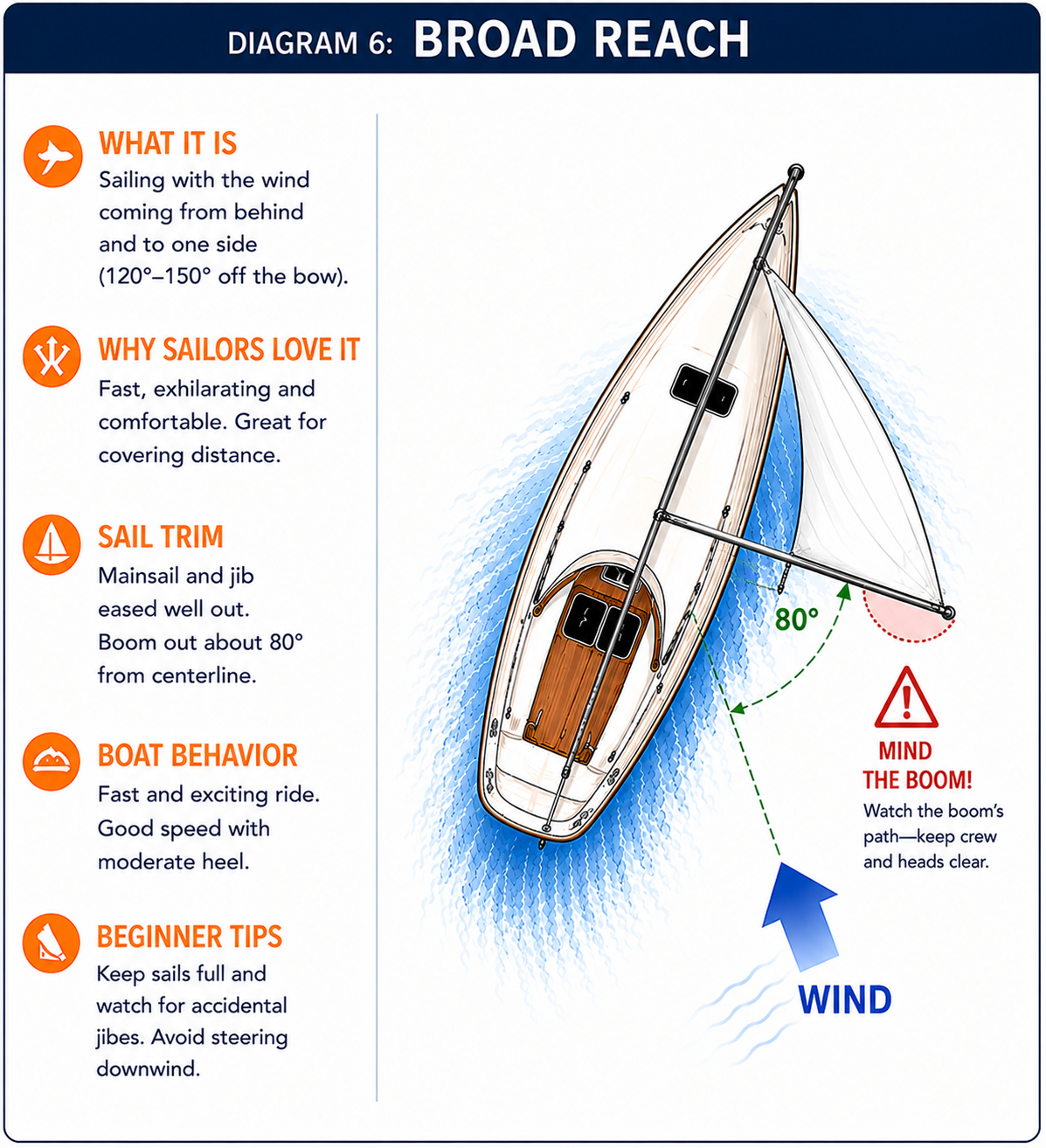
By this point in your sailing journey, you may already know how to steer a sailboat, trim the sails, tack, jibe, sail upwind, sail downwind, and sail on a reach. Those skills allow you to control where the boat goes.
But eventually, you need the boat to stop going somewhere.
Perhaps you want to pause for a moment while another boat passes. Maybe you are approaching a dock or mooring and need to reduce speed. You might need extra time to organize the cockpit, retrieve something from the water, or simply regain control when things start happening too quickly.
Whatever the reason, every sailor needs to know how to slow and stop a sailboat deliberately.
There is just one complication:
A sailboat doesn’t have brakes.
Instead, you stop a sailboat by controlling the forces that are moving it. You reduce the power generated by the sails, turn the boat toward the wind, allow the sails to luff, and use the boat’s remaining momentum to coast to a controlled stop.
The basic idea is simple:
Reduce power → Head toward the wind → Luff the sails → Coast → Stop
However, doing this well requires an understanding of momentum, sail trim, wind direction, and steerage.
In this guide, you’ll learn exactly how to slow and stop a sailboat, how to stop near a chosen location, what happens to steering as the boat loses speed, and how to get sailing again afterward.
We’ll also introduce heaving-to, an important technique for holding a sailboat in a relatively stable, low-speed configuration. Heaving-to deserves its own lesson, but understanding how it differs from simply stopping a sailboat is an important step toward becoming a capable sailor.
Quick Summary: How Do You Stop a Sailboat?
To stop a sailboat under sail:
- Check that you have enough clear water around the boat.
- Identify the wind direction.
- Ease the sails to reduce power.
- Turn the bow gradually toward the wind.
- Continue easing the sails until they begin to luff.
- Keep steering while the boat still has enough speed for the rudder to work.
- Allow the boat’s remaining momentum to carry it forward.
- Settle with the sails luffing and the boat moving very slowly or nearly stopped.
The key is to remove sail power before you run out of steering control.
A good stop is therefore not an abrupt maneuver.
It is a controlled transition from sailing normally to moving slowly and predictably.
What Does It Mean to “Stop” a Sailboat?
Before learning the maneuver, we need to clarify what stopping actually means.
A car can stop relative to the road.
A sailboat operates in moving water and moving air.
Even when the boat has almost no speed through the water, the entire boat may still be moving across the earth because of current. Wind may also push the hull sideways.
For that reason, a sailboat that appears “stopped” is rarely completely motionless.
In practical sailing terms, stopping usually means:
Reducing the boat’s speed through the water until it has little or no useful forward motion.
That distinction becomes important when stopping near docks, moorings, other boats, or fixed objects.
Imagine that you stop the boat in a two-knot current.
The sails may be completely luffing and the boat may have very little speed through the surrounding water, yet the current is still carrying the boat toward something.
The boat is stopped under sail.
It is not necessarily stopped relative to the shoreline.
Beginner Tip
When practicing stopping manoeuvres, choose open water with plenty of room.
Stopping beside a dock, mooring, or another boat adds additional variables. First learn to control speed in open water. Precision comes later.
Why Sailboats Don’t Stop Like Powerboats
On a powerboat, slowing down can be relatively intuitive.
Reduce the throttle and the engine produces less thrust.
On many powerboats, you can also engage reverse thrust to slow the boat more aggressively.
A sailboat under sail works differently.
The sails generate aerodynamic force from the wind. As long as the sails remain properly trimmed and the boat remains on a course where the sails can produce useful force, the boat continues to accelerate or maintain speed.
To slow down, you therefore need to reduce the amount of useful force being generated by the sails.
There are two primary ways to do that:
- change the sail trim;
- change the boat’s heading.
Usually, you use both.
Ease the sheets and the sails produce less driving force.
Turn toward the wind and the sails eventually lose their ability to remain filled.
When the sails begin flapping rather than maintaining their aerodynamic shape, they are luffing.
At that point, much of the sail’s useful driving force has disappeared.
But the boat doesn’t stop immediately.
Why?
Because it has momentum.
Understanding Momentum
Imagine riding a bicycle quickly and suddenly stopping pedaling.
The bicycle doesn’t stop immediately.
It coasts.
A sailboat behaves in much the same way.
When the sails stop producing useful driving force, the boat continues moving because the hull and everything aboard it have momentum.
Gradually, resistance from the water slows the boat.
How far the boat travels before stopping depends on several factors:
- its initial speed;
- its weight and displacement;
- hull shape;
- wind strength;
- waves;
- current;
- how quickly sail power is removed.
A lightweight dinghy may lose speed quickly.
A heavy cruising sailboat moving at six knots may glide surprisingly far.
That means there is no universal distance at which you should begin stopping.
You need to learn the stopping characteristics of your particular boat.
And there is only one reliable way to do that:
Practice.
The Relationship Between Speed and Steering
Here is one of the most important concepts in this entire lesson:
As the sailboat slows down, the rudder becomes less effective.
The rudder doesn’t magically turn the boat simply because you move the tiller or wheel.
It works because water is flowing across it.
When the boat has good speed through the water, moving the rudder changes the direction of that water flow and generates a turning force.
As the boat slows, less water flows across the rudder.
The steering becomes weaker.
Eventually, the boat may be moving so slowly that turning the wheel or tiller produces very little response.
This creates an important challenge when stopping.
You want to remove the power from the sails.
But you still need enough boat speed to control your heading while doing it.
That is why an effective stopping maneuver is usually progressive rather than sudden.
Reduce the power.
Keep steering.
Reduce more power.
Turn toward the wind.
Use the remaining momentum to complete the maneuver.
Then allow the boat to stop.
Slowing Down Versus Stopping
Beginners often treat “slow down” and “stop” as the same maneuver.
They aren’t.
Sometimes you simply want less speed.
Perhaps you are approaching traffic, entering a crowded area, preparing for another maneuver, or giving yourself more time to think.
In that situation, completely stopping may be unnecessary.
You can often slow the boat simply by depowering the sails.
How to Slow a Sailboat
The simplest method is usually to ease the sheets.
As you ease a sail farther than its ideal trim position, airflow over the sail becomes less efficient and the sail generates less driving force.
Ease farther and the sail begins to luff.
You can therefore think of the sheet as something like a throttle.
Not literally—the physics are different—but the analogy is useful for beginners.
Properly trimmed sail:
More driving force
Over-eased sail:
Less driving force
Luffing sail:
Very little useful driving force
This gives you remarkably fine control over boat speed.
Instead of thinking only:
Sail ON / Sail OFF
begin thinking:
How much power do I want right now?
That change in thinking is an important step in learning boat handling.
How to Stop a Sailboat Step by Step
Let’s put the pieces together.
For your first practice sessions, choose moderate conditions and open water. Avoid practicing close to docks, rocks, swimmers, anchored boats, or heavy traffic.
The objective isn’t to stop at an exact point yet.
First, learn how the boat behaves as you remove its power.
Step 1: Look Around
Before changing course, check your surroundings.
Look:
- ahead;
- behind;
- to windward;
- to leeward.
Make sure you have enough clear water to turn toward the wind and enough space for the boat to coast afterward.
Remember that stopping may require considerably more distance than you expect.
Beginner Tip
Before every stopping exercise, choose an imaginary “stop point” in the water.
It might be beside a floating object, a landmark ashore, or simply a point you estimate visually.
Then see where the boat actually stops.
That comparison teaches you how much momentum your boat carries.
Step 2: Identify the Wind Direction
You need to know where the wind is coming from because your final heading will generally bring the bow toward the wind.
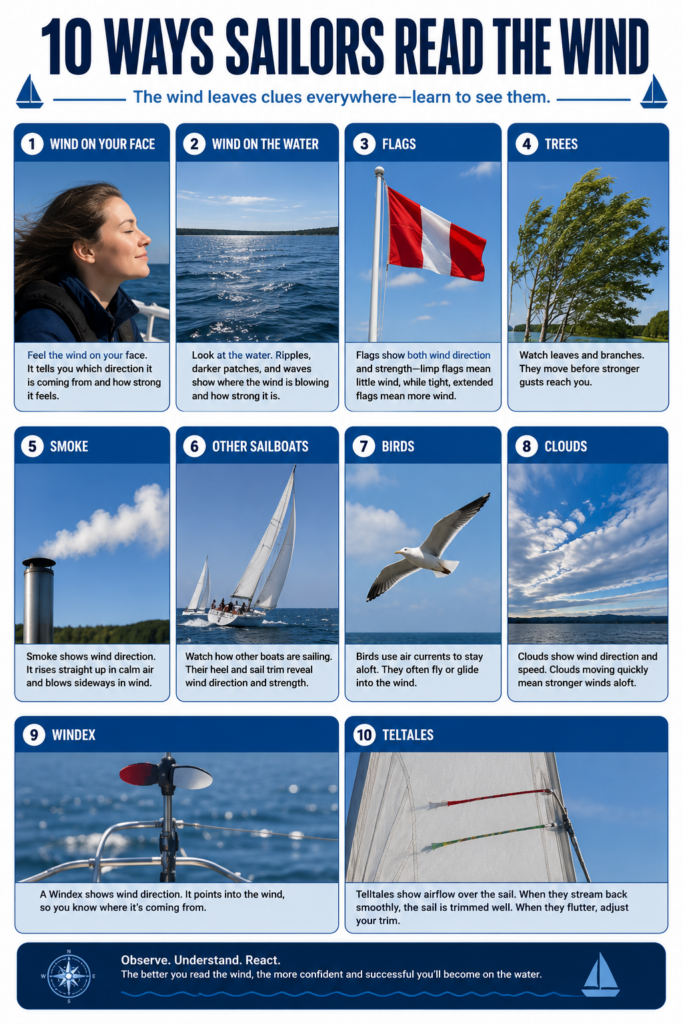
Use the same clues you’ve learned in previous sailing lessons:
- masthead wind indicator;
- telltales;
- flags;
- ripples on the water;
- movement of nearby boats;
- apparent wind across your face.
Before beginning the maneuver, mentally identify where head-to-wind lies.
That gives you a target direction.
Step 3: Begin Reducing Sail Power
Start by easing the sails.
You don’t necessarily need to dump every sheet instantly.
Instead, deliberately reduce the driving force.
Ease the main sheet.
Ease the jib sheet as appropriate.
Watch what happens.
The boat should begin slowing while still retaining enough speed for you to steer effectively.
This is an excellent moment to pay attention to the helm.
Notice how the steering response gradually changes as boat speed decreases.
Step 4: Head Up Toward the Wind
Now begin turning the bow toward the wind.
This is called heading up.
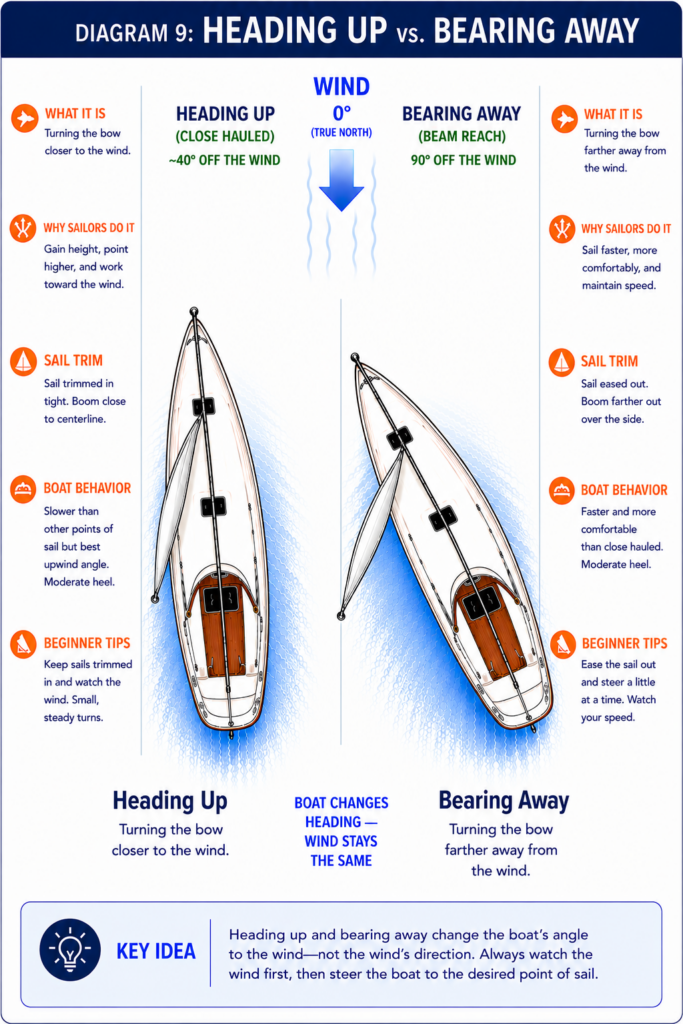
As you head up, the apparent wind moves farther forward relative to the boat.
The sails will need increasingly tighter trim to remain powered.
But you aren’t trying to keep them powered.
You are trying to stop.
So don’t trim them in.
Allow them to become progressively under-trimmed.
Soon the leading edges of the sails will begin to flutter.
Continue heading toward the wind and the sails will luff more strongly.
The engine that has been driving the boat is effectively being switched off.
Step 5: Let the Sails Luff
As the boat approaches head-to-wind, both sails should lose their aerodynamic shape and begin luffing.
You may hear:
flap-flap-flap-flap.
That sound isn’t something you normally want to maintain for long because prolonged violent luffing creates unnecessary wear on sails.
During a stopping maneuver, however, brief luffing is normal.
At this point, the sails are producing very little forward drive.
But the boat is still moving.
Now you are dealing primarily with momentum.
Step 6: Keep Steering While You Still Can
This is where beginners frequently make a mistake.
They assume:
The sails are luffing, so the maneuver is finished.
It isn’t.
The boat may still be traveling at several knots.
Use that remaining speed.
Keep the boat pointed approximately toward the wind while the rudder still has enough water flowing over it to respond.
Make small steering corrections rather than large ones.
As the boat slows, you’ll feel the helm become softer and less responsive.
Eventually, the rudder may have almost no authority.
That is normal.
You are approaching the stop.
Step 7: Coast to a Stop
With the sails luffing and little useful driving force remaining, allow water resistance to slow the hull.
Don’t become impatient.
Let the boat coast.
Watch the water alongside the hull.
Listen to the sound of water passing the boat.
Feel the steering response.
These clues tell you more about your remaining speed than simply staring at the instruments.
Eventually, forward motion will become very small.
You have stopped the sailboat.
Or, more accurately, you have removed most of its forward speed through the water.
What Happens After the Boat Stops?
Something interesting now happens.
The boat probably won’t remain perfectly head-to-wind.
Wind pressure on the sails, mast, rigging, hull, and crew can begin pushing the boat backward or sideways.
Waves may rotate the bow.
Current may carry the entire boat.
The bow may fall away from the wind to one side.
This isn’t necessarily a problem.
It is simply what an unpowered sailboat does.
Once you understand that, you can use it to your advantage when getting underway again.
How to Start Sailing Again After Stopping
Getting moving again is usually straightforward.
The first step is to decide which tack you want.
Suppose you want the wind to come over the port side after you get underway.
Allow or encourage the bow to fall away in that direction.
As the boat turns away from head-to-wind, the sails will begin finding an angle at which they can fill again.
Trim the sails gradually.
As they fill, the boat accelerates.
As speed increases, water flow across the rudder increases.
Steering authority returns.
The sequence becomes:
Bow falls away → Sails fill → Boat accelerates → Rudder becomes effective → Trim for the new course
Avoid hauling the sheets tight while the boat is still pointed directly into the wind.
You cannot trim your way out of head-to-wind.
The boat first needs to turn far enough away from the wind for the sails to fill.
What If the Boat Gets Stuck Head-to-Wind?
This is common, particularly on smaller sailboats.
The boat stops.
The bow remains pointed almost directly into the wind.
The sails flap.
You move the tiller.
Nothing happens.
Congratulations.
You’ve discovered why rudders need water flow.
The boat may begin drifting backward.
That actually gives you a solution.
Using Sternway
When a sailboat moves backward through the water, the rudder begins working again—but its effect on the boat needs to be understood in the context of that reverse movement.
You can use the developing sternway to help the bow fall away from the wind.
Once the bow rotates sufficiently away from head-to-wind, the sails can fill.
Trim them gradually.
The boat begins moving forward again and normal steering returns.
Don’t panic if the boat briefly moves backward during stopping practice.
In open water, it is a useful opportunity to learn how the boat behaves at extremely low speeds.
How to Stop at a Chosen Location
Stopping somewhere in open water is relatively easy.
Stopping at a particular point is a much more useful skill.
Imagine there is a floating marker in the water.
Your objective is to stop beside it without using the engine.
This exercise teaches you to judge three things:
Speed + Distance + Momentum
The basic technique remains the same, but timing becomes important.
Start Conservatively
On your first attempt, begin slowing earlier than you think necessary.
Ease the sails.
Head up.
Luff.
Coast.
Then observe where you stop relative to the target.
If you stop 20 meters short, you’ve learned something.
If you sail 20 meters past it, you’ve learned something else.
Neither attempt is a failure.
You are calibrating your understanding of the boat.
Repeat the exercise.
With each attempt, adjust where you begin depowering.
Eventually, you’ll develop an intuitive sense of how far the boat coasts in different conditions.
That judgment becomes enormously valuable later when you learn more advanced boat-handling skills.
Approach From Downwind When Practical
There is a useful principle behind many controlled sailing approaches:
It is easier to reduce sail power when you have room to head toward the wind.
If your stopping point lies somewhere to windward, you can approach it while gradually heading up and depowering.
If you approach a target from directly upwind while sailing downwind toward it, stopping becomes more complicated because heading toward the wind may require a substantial turn away from the target.
This is one reason sailors think carefully about wind direction before approaching docks, moorings, or objects in the water.
The wind isn’t just something that moves the boat.
It determines your available braking strategy.
The “Escape Route” Principle
Whenever you’re practicing close-quarters manoeuvres under sail, ask yourself:
Where can I go if this doesn’t work?
That question is extremely important.
A good approach leaves you an escape route.
If you are approaching a target and realize you are moving too quickly, you should ideally still have enough room to:
- head up;
- ease the sails;
- turn away;
- sail past;
- abandon the approach and try again.
Never allow pride to trap you into completing a bad approach.
Experienced sailors abandon approaches all the time.
Recognizing early that something isn’t working is good boat handling.
How Wind Strength Changes Your Stop
Stopping distance isn’t constant.
Imagine practicing in eight knots of wind.
You learn that your boat coasts a certain distance after the sails begin luffing.
The next day the wind is blowing 18 knots.
Don’t assume the same technique will produce exactly the same result.
Stronger wind may mean:
- greater initial boat speed;
- more momentum;
- stronger pressure on the rig;
- more sideways drift;
- faster changes in heading.
Waves can also complicate the maneuver.
That means your stopping technique must remain adaptable.
There is no magic formula such as:
Begin stopping five boat lengths away.
Instead, continually evaluate:
How fast am I moving?
How much room do I have?
Where is the wind?
How quickly is the boat slowing?
That is real boat handling.
Current Changes Everything
Current deserves special attention because it can create a dangerous illusion.
Suppose you successfully stop the boat through the water.
The sails are luffing.
There is almost no water moving past the hull.
Yet you’re drifting toward a dock.
Why?
The water itself is moving.
Your boat is traveling with it.
This is why sailors distinguish between speed through the water and speed over the ground.
When current is present, always consider where it will carry the boat during and after the stopping maneuver.
This becomes particularly important around:
- harbour entrances;
- rivers;
- narrow channels;
- tidal passes;
- docks;
- mooring fields.
Wind and current may also oppose one another.
When they do, the boat’s behavior can feel surprisingly different from what you expect.
Never assume that luffing sails mean you are safely stationary.
Keep watching what the boat is doing relative to your surroundings.
Common Beginner Mistakes When Stopping a Sailboat
Stopping sounds simple.
Turn toward the wind and let the sails flap.
But several mistakes appear repeatedly when beginners practice the maneuver.
Mistake 1: Waiting Too Long
The boat is approaching the target quickly.
The skipper waits.
And waits.
And waits.
Then suddenly turns sharply into the wind.
The sails luff.
But the boat still has plenty of momentum.
It sails straight past the intended stopping point.
Do This Instead
Begin reducing power earlier.
Stopping should be a process, not an emergency maneuver.
Mistake 2: Turning Too Quickly
A sharp turn into the wind can remove sail power quickly, but it may also make the maneuver less controlled.
The boat can lose speed before you’ve established the heading you wanted.
Do This Instead
Use a smooth, deliberate turn while monitoring boat speed and sail power.
Mistake 3: Forgetting About Momentum
The sails start luffing and the beginner assumes the boat has stopped.
But the hull continues gliding forward.
Do This Instead
Separate these two moments in your mind:
Sails stop driving.
Then:
Boat stops moving forward.
They are not the same moment.
Mistake 4: Expecting the Rudder to Work Without Speed
The boat is nearly stationary.
The skipper moves the tiller dramatically from side to side.
Nothing useful happens.
Do This Instead
Make heading corrections while the boat still has steerage.
Once speed disappears, accept that normal rudder control will be greatly reduced.
Mistake 5: Pulling the Sails In When the Boat Slows
This is almost instinctive.
The boat becomes slow and unresponsive, so the beginner trims the sails.
Unfortunately, that may power the boat back up.
Do This Instead
Remember your objective.
If you want to stop, allow the sails to remain depowered.
Mistake 6: Staring at the Sails Instead of the Surroundings
Stopping exercises can become visually absorbing.
You watch the jib.
You watch the mainsail.
You watch the telltales.
Meanwhile, the boat drifts toward something.
Do This Instead
Keep scanning.
Sail trim matters, but situational awareness matters more.
Mistake 7: Practicing Too Close to Obstacles
Learning precision stopping beside a dock sounds efficient.
It isn’t.
You are combining two lessons before mastering the first one.
Do This Instead
Practice in open water first.
Give yourself permission to get it wrong safely.
A Simple Stopping Exercise for Beginners
This exercise can dramatically improve your understanding of boat speed.
Choose a day with moderate, relatively steady wind and plenty of open water.
Select an imaginary stopping point ahead.
Then perform the following sequence:
1. Approach under normal sail.
Maintain a comfortable, controlled sailing speed.
2. Choose your stopping point.
Use a floating reference or visual point.
3. Estimate when you should begin slowing.
Don’t overthink it.
Make your best prediction.
4. Ease the sails.
Observe how quickly the boat responds.
5. Head toward the wind.
Allow the sails to luff.
6. Coast.
Do not try to artificially rush the stop.
7. Note where the boat actually stops.
Short?
Long?
Beside the target?
8. Sail away and repeat.
Change only one thing: the point at which you begin slowing.
After several attempts, you’ll begin developing a mental picture of your boat’s stopping distance.
Then repeat the exercise from different initial speeds.
Later, repeat it in slightly different wind conditions.
This simple drill teaches something that reading never can:
How your boat carries momentum.
If you would like to practice these skills with an instructor, US Sailing offers training programs that teach practical sailing and boat-handling skills in a structured environment.
The Next Level: Controlling Energy
Up to this point in your sailing education, much of your attention has probably been focused on creating useful movement.
How do I make the boat accelerate?
How do I point higher?
How do I trim the sail correctly?
How do I tack efficiently?
How do I jibe safely?
How do I sail downwind?
Stopping introduces a different way of thinking.
Instead of asking:
How can I create more useful force?
you begin asking:
How much energy does the boat have, and how can I reduce it?
That question appears throughout seamanship.
You’ll use it when:
- approaching a mooring;
- docking;
- sailing in strong wind;
- reefing;
- responding to unexpected situations;
- maneuvering around traffic;
- recovering a person from the water.
A sailor who knows how to make a boat move is learning to sail. For sailors who want to continue developing their practical boat-handling skills, the Royal Yachting Association provides additional guidance and training resources for recreational sailing.
A sailor who can confidently control the boat while reducing speed is beginning to learn boat handling.
Is Stopping the Same as Heaving-To?
No.
This distinction is important.
A simple stop removes most of the boat’s forward momentum by depowering the sails and allowing the boat to slow.
Heaving-to is a deliberate sailing configuration designed to keep the boat moving slowly and relatively steadily without continuing normal sailing.
On many boats, the jib is backed while the mainsail and rudder are arranged so that opposing forces partially balance one another.
The boat does not become anchored in place.
It will still drift.
But instead of simply luffing head-to-wind and behaving unpredictably as speed disappears, a properly hove-to sailboat can settle into a comparatively stable attitude.
That can give the crew time to:
- take a break;
- organize the cockpit;
- deal with a problem;
- wait;
- prepare for another maneuver;
- reduce workload in difficult conditions.
The exact behavior varies considerably between sailboats, so heaving-to is a technique that needs to be practiced on your own boat.
We’ll cover the complete procedure in the next SailboatZone lesson:
How to Heave To in a Sailboat: A Step-by-Step Beginner’s Guide.
For now, remember the distinction:
Stopping = removing forward sailing speed.
Heaving-to = deliberately configuring the boat to remain in a controlled, low-speed sailing state.
Safety Considerations When Stopping Under Sail
Stopping practice should initially be performed in open water.
Before beginning, make sure:
- the area is clear;
- you understand the wind direction;
- you know whether significant current is present;
- you have enough room to drift;
- everyone aboard understands what you are doing.
Also remember that a sailboat with luffing sails is not necessarily under precise control.
As speed decreases, steering decreases.
Wind and current become increasingly influential.
Never deliberately stop in a position where losing steering control would immediately create danger.
That includes directly:
- upwind of rocks;
- near swimmers;
- in a busy channel;
- beside another boat;
- near a lee shore;
- in the path of commercial traffic.
When in doubt, maintain steerage and sail into clearer water.
Frequently Asked Questions About Stopping a Sailboat
Can a sailboat stop without an engine?
Yes.
A sailboat can be slowed and stopped under sail by reducing sail power, heading toward the wind, allowing the sails to luff, and letting water resistance remove the boat’s remaining forward momentum.
An engine is not required for the basic maneuver.
How quickly can a sailboat stop?
It depends on the boat and conditions.
A lightweight dinghy traveling slowly may stop quickly. A heavy cruising sailboat traveling several knots can coast much farther.
Wind, waves, current, hull shape, displacement, and initial speed all influence stopping distance.
Practice is the best way to learn your boat’s behavior.
Why doesn’t the sailboat stop as soon as the sails luff?
Momentum.
Luffing removes most of the driving force from the sails, but it doesn’t instantly remove the motion already stored in the moving boat.
The hull continues coasting until water resistance slows it.
Why can’t I steer when the boat stops?
A rudder requires water flow to generate useful turning force.
When the boat has little or no speed through the water, there may not be enough flow across the rudder for normal steering.
Steering authority returns when the boat begins moving through the water again.
Should I release the main sheet completely when stopping?
Not necessarily.
The goal is to depower the sail sufficiently for the maneuver while maintaining control of the lines and sails.
How far you need to ease depends on your point of sail, boat, rig, and conditions.
Avoid letting lines run uncontrolled.
Can I stop while sailing downwind?
You can slow from a downwind course, but simply easing the sails may not remove power as effectively as it does on other points of sail.
To make a conventional stop under sail, you will generally need to change course and head toward the wind.
Always check for traffic before making that turn.
Is a sailboat really stopped if it is drifting?
It can be stopped through the water while still moving over the ground because of current.
Wind can also create sideways drift.
That is why sailors must continue monitoring their position even after forward sailing speed has disappeared.
What’s the difference between stopping and heaving-to?
Stopping removes most forward sailing speed.
Heaving-to deliberately balances sail and rudder forces so the sailboat settles into a relatively stable, low-speed configuration.
The boat remains underway and continues drifting while hove-to.
Beginner Stopping Checklist
Before practicing, remember:
SPACE
Do I have enough room?
WIND
Where is the wind coming from?
SPEED
How fast am I moving?
EASE
Reduce sail power.
HEAD UP
Turn progressively toward the wind.
LUFF
Allow the sails to stop producing useful drive.
STEER
Use the rudder while you still have water flow.
COAST
Let momentum dissipate.
STOP
Observe where the boat actually settles.
RECOVER
Choose a tack, fall away, fill the sails, and accelerate.
If you can perform that sequence deliberately rather than reactively, you are developing an important boat-handling skill.
Key Takeaways
Learning how to stop a sailboat is really about learning how to control its energy.
A sailboat doesn’t have conventional brakes.
Instead, you control speed using heading and sail trim.
Ease the sails and you reduce their driving force.
Head toward the wind and they eventually luff.
Once the sails stop driving the boat, water resistance gradually removes the remaining momentum.
But remember the most important complication:
Steering authority decreases as boat speed decreases.
A controlled stop therefore requires you to manage sail power, heading, momentum, and steerage together.
Practice in open water.
Choose a target.
Predict where the boat will stop.
Try it.
Observe what happens.
Then try again.
Eventually, you’ll stop thinking only about whether the sails are full or luffing.
You’ll begin sensing how much energy the boat is carrying and how much room it needs to lose that energy.
That awareness will become essential when you begin approaching moorings, docks, anchorages, and other situations where simply making the boat move isn’t enough.
You need to make it move exactly as much as you want it to.
And sometimes, you need it to stop.
What’s Next? Learn How to Heave-To
Now you know how to remove sail power and bring the boat to a controlled stop.
But what if you don’t simply want to stop?
What if you want the sailboat to settle into a relatively stable, low-speed configuration while you take a break, organize the crew, deal with a problem, or prepare for changing conditions?
That’s where heaving-to comes in.
It is one of the most useful seamanship techniques a sailor can learn.
Test Your Knowledge: How to Stop a Sailboat
Before moving on to heaving-to, test your understanding of how to slow and stop a sailboat under sail.
Try answering each question before checking the answers below.
Question 1
Why doesn’t a sailboat stop immediately when its sails begin to luff?
A. The rudder continues pushing the boat forward
B. The boat still has momentum
C. The wind pushes directly against the mast
D. The keel produces forward thrust
Question 2
What is usually the best basic sequence for bringing a sailboat to a controlled stop?
A. Trim the sails → Bear away → Turn the rudder sharply
B. Head downwind → Ease the sails → Turn into the wind suddenly
C. Reduce sail power → Head toward the wind → Luff the sails → Coast
D. Release every line → Turn the rudder → Wait
Question 3
What happens to rudder effectiveness as a sailboat slows down?
A. It increases
B. It remains exactly the same
C. It decreases
D. The rudder begins acting like a brake
Question 4
Why should beginners practice stopping in open water before trying to stop beside a dock or mooring?
A. Sailboats cannot stop near docks
B. Open water provides room to make mistakes safely and learn the boat’s stopping characteristics
C. Wind is always weaker in open water
D. Current only exists near docks
Question 5
Your sails are completely luffing, but the boat is still moving forward. What should you do?
A. Immediately trim both sails tightly
B. Allow the boat’s remaining momentum to dissipate while maintaining control
C. Jibe
D. Turn directly downwind
Question 6
Why can a sailboat with almost no speed through the water still move relative to the shoreline?
A. The rudder creates movement
B. The keel continues producing lift
C. Current can carry the boat over the ground
D. A sailboat can never actually slow down
Question 7
You are approaching your intended stopping point too quickly. What is generally the best response?
A. Continue the approach because changing plans is dangerous
B. Trim the sails harder to improve steering
C. Reduce power earlier or abandon the approach while you still have room
D. Wait until the last possible moment and turn sharply
Question 8
Why is it useful to choose a target when practicing stopping?
A. It allows you to measure your boat’s stopping behavior and improve your judgment of speed, distance, and momentum
B. Sailboats can only stop beside fixed objects
C. It eliminates the effect of current
D. It prevents the sails from luffing
Question 9
What should you do if your sailboat stops head-to-wind and the rudder no longer seems effective?
A. Assume the rudder is broken
B. Keep moving the helm rapidly from side to side
C. Allow the boat to develop some movement, including sternway if necessary, so the bow can fall away and the sails can fill again
D. Pull both sails as tight as possible while remaining head-to-wind
Question 10
What is the main difference between simply stopping and heaving-to?
A. There is no difference
B. Stopping removes most forward sailing speed, while heaving-to deliberately balances the boat in a relatively stable, low-speed configuration
C. Heaving-to requires starting the engine
D. A stopped sailboat drifts, but a hove-to sailboat never moves
Quiz Answers
1. B — The boat still has momentum.
Removing sail power doesn’t instantly remove the energy of the moving boat. The hull continues coasting until resistance from the water slows it.
2. C — Reduce sail power → Head toward the wind → Luff the sails → Coast.
This progressively removes the force driving the boat while allowing you to maintain steering control for as long as possible.
3. C — Rudder effectiveness decreases.
A rudder needs water flowing across it. As speed through the water decreases, steering authority decreases too.
4. B — Open water gives you room to learn safely.
Stopping distance varies considerably between boats and conditions. Practice away from obstacles until you understand how your boat behaves.
5. B — Allow the remaining momentum to dissipate.
Luffing sails mean you’ve largely removed the driving force. The boat still needs time and distance to coast to a stop.
6. C — Current can carry the boat over the ground.
A boat can have almost no speed through the surrounding water while the entire body of water carries it relative to land.
7. C — Reduce power earlier or abandon the approach.
A good sailor doesn’t force a bad approach. Maintain an escape route and try again if necessary.
8. A — It develops your judgment.
Repeatedly stopping near a chosen target teaches you how your boat carries momentum and how much distance it needs to slow.
9. C — Allow movement to develop so you can regain control.
With little water flowing over the rudder, normal steering becomes ineffective. Once the boat begins moving through the water again, the rudder can regain authority and help the bow fall away.
10. B — Heaving-to is a deliberately balanced low-speed configuration.
Simply stopping removes most forward sailing speed. Heaving-to deliberately uses the sails and helm to settle the boat into a comparatively stable state.
How Did You Do?
9–10 correct: Excellent. You understand the principles behind slowing, stopping, momentum, and maintaining control.
7–8 correct: You’re ready to practice. Review the sections on momentum and rudder effectiveness before heading onto the water.
5–6 correct: You’re getting there. Review the step-by-step stopping procedure and try the quiz again.
Fewer than 5 correct: Revisit the sections on reducing sail power, heading toward the wind, luffing, momentum, and steerage. Those five concepts are the foundation of a controlled stop.
Once you’re comfortable with them, you’re ready for the next skill: learning how to heave-to.