
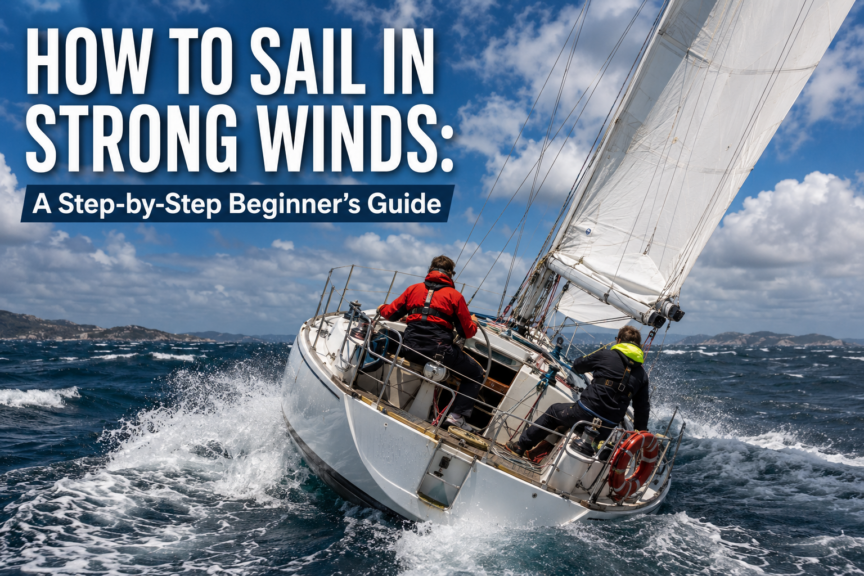
There comes a point in almost every sailor’s learning journey when the wind becomes stronger than expected.
Perhaps you left the dock in a comfortable breeze. An hour later, whitecaps are beginning to appear. The boat heels farther in the gusts. The mainsheet feels heavily loaded. The helm that felt light earlier now pulls firmly against your hand.
Every gust seems to demand more attention.
For a beginner, it can feel as though the boat is becoming harder and harder to control.
Usually, the boat is telling you something much more useful:
It has more sail power than it can comfortably use.
Learning how to sail in strong winds is largely about learning to recognize that message early.
Instead of fighting the boat, you reduce excessive power, restore balance, preserve steering control and give yourself enough time and space to make good decisions.
That means anticipating gusts, depowering intelligently, reefing before conditions become difficult, steering smoothly, keeping the boat reasonably flat, managing the crew and continually reassessing whether continuing still makes sense.
Strong-wind sailing teaches one of sailing’s most valuable lessons:
More wind does not require more effort. It requires better control.
And as you develop as a skipper, there is an even deeper lesson:
You do not need to wait until you lose control before changing the plan.
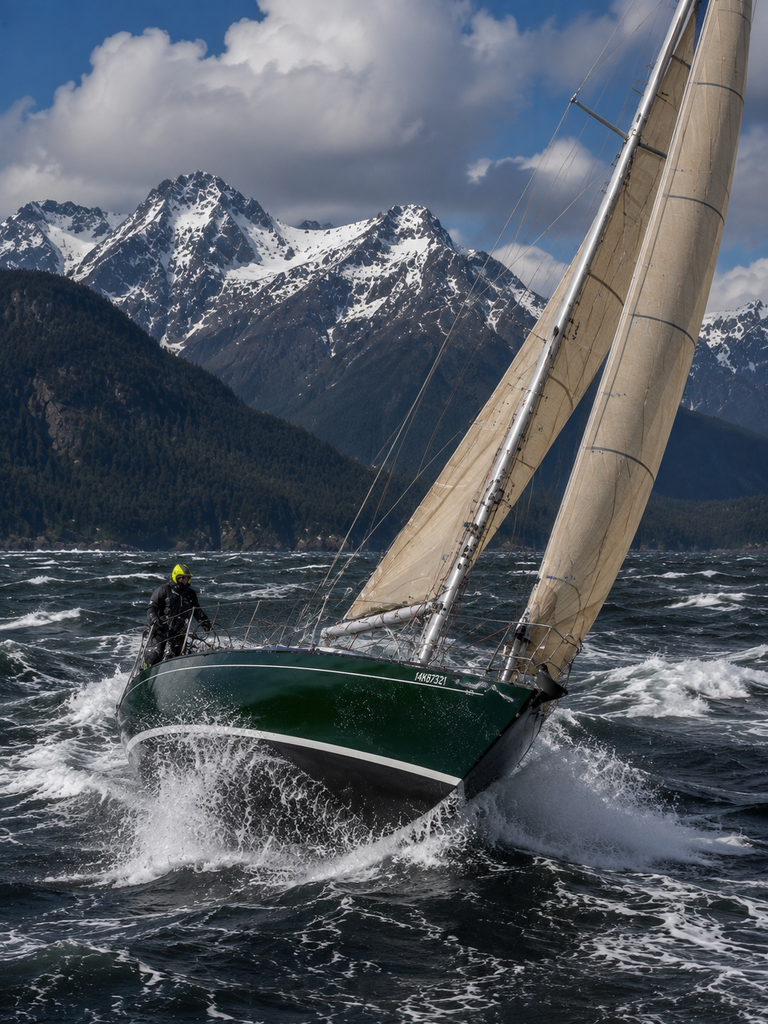
Quick Summary: How to Sail in Strong Winds
When the wind begins to increase, use this sequence:
OBSERVE → ANTICIPATE → DEPOWER → REDUCE SAIL → REBALANCE → REASSESS → CHANGE THE PLAN IF NEEDED
Watch what the wind, water, boat and crew are telling you. Look ahead for gusts rather than waiting for them to arrive. Reduce unnecessary sail power while preserving enough drive for steering. Reef before the boat becomes badly overpowered. After reefing, check whether heel and helm actually improved. Give yourself more room for manoeuvres. Keep the crew secure. And if your safety margin continues shrinking, change the plan while several good options still remain.
Strong-wind sailing is not about proving how much wind you can tolerate.
It is about remaining comfortably in control.
Do not overlook the need to properly prepare yourself for the physical demands of increasing wind. Proper wet weather gear can ensure you aren’t fighting exposure to the elements or worse, hypothermia.
What Counts as Strong Wind for Sailing?
Beginners understandably want a number.
“How many knots is too much?”
There is no universal answer.
The same wind can produce very different conditions on different boats.
A moderate breeze aboard a heavy cruising keelboat might feel demanding aboard a lightweight dinghy. Flat protected water can make a wind speed feel manageable that would be uncomfortable in steep, closely spaced waves.
The answer also changes with sail area, gust strength, crew experience, boat design, wave conditions, hazards, distance from shelter and the point of sail.
A boat may also be physically capable of handling conditions that its crew should not continue sailing in.
That leads to one of the most important questions in this lesson.
Instead of asking only:
Can the boat handle this?
ask:
Should this boat, with this crew, in these conditions, continue?
Those are not the same question.
A developing skipper considers not only what is happening now, but also what could happen next.
Will the wind increase?
Will the waves grow?
Will the trip home be harder?
Will the crew still be capable after another hour?
Are safe alternatives increasing—or disappearing?
Strong-wind sailing is therefore a judgment problem before it becomes a boat-handling problem. That judgment begins before leaving the dock, which is why the next lesson, Sailing Weather for Beginners: Should You Leave the Dock?, focuses on turning a forecast into a practical go/no-go decision.
Why Strong Winds Make a Sailboat Harder to Control
The sails are the boat’s engine. If you need a refresher on the forces involved, How Sails Work explains how apparent wind, aerodynamic force and the keel work together to move the boat.
As wind flows around the sails, aerodynamic forces are created. As the wind becomes stronger, those forces increase rapidly.
Some of that force drives the boat forward. Some contributes to heel and sideways force. Meanwhile, the sails, sheets, rigging and steering system experience greater loads.
Eventually, more wind stops producing much useful additional speed.
Instead, more of the available energy begins showing up as excessive heel, heavy helm, drag and increasing crew workload.
This is why an overpowered sailboat can sometimes sail no faster—and may even sail slower—than the same boat carrying less sail.
The goal is not to capture every possible bit of wind.
The goal is to use the amount of power the boat can convert into useful, controllable motion.
Heel Is Not the Same Thing as Speed
A heavily heeled sailboat can feel fast.
The water rushes past. The rail gets closer to the surface. Everyone braces against the cockpit.
It can certainly feel dramatic.
But drama and efficiency are not the same thing.
As heel becomes excessive, the underwater shape of the hull changes, the rudder can become less effective, weather helm can increase, drag may rise and crew movement becomes more difficult.
The boat may become harder to steer even though it is not meaningfully faster.
A well-managed boat in strong wind often looks surprisingly controlled.
It can still heel. Heel itself is not a problem.
The question is whether the heel remains manageable and efficient.
Think of heel as something the skipper monitors and manages—not something the crew simply endures.
Learn to Recognize an Overpowered Sailboat
There is rarely one unmistakable moment when a boat becomes overpowered.
Instead, several clues usually begin appearing together.
Heel becomes excessive. The helm grows noticeably heavier. The boat begins trying to round toward the wind during gusts. Larger rudder corrections are required to hold course. Sheets become more heavily loaded. Routine manoeuvres require increasing effort. Crew members become less comfortable.
And despite all the additional drama, the boat may gain very little speed.
One of your best clues is the helm.
Some weather helm—a tendency for the boat to turn toward the wind—is normal on many sailboats.
Excessive weather helm is different.
If you are continually pulling hard on the tiller or holding substantial wheel pressure just to keep the boat on course, the rudder may be compensating for an imbalance elsewhere. How Sailboat Steering Works explains why large rudder angles create drag and why helm pressure can be valuable feedback.
The better question is:
Why has the helm become heavy?
Has the wind increased?
Has heel increased?
Are the sails generating more force than the boat can use efficiently?
Does the sail plan need depowering?
Is it time to reef?
Has the balance between mainsail and headsail changed?
Helm pressure is information.
Do not simply fight it. Diagnose it.
Skipper Thinking: The Heavy Helm
Imagine sailing upwind.
Ten minutes ago, the tiller required only light pressure.
Now the wind has increased. The boat heels substantially farther in the gusts and the tiller pulls hard against your hand.
A beginner may think:
I need to pull harder.
A developing skipper thinks:
Why did the helm become heavier?
That change in thinking is important.
Sailing develops when you stop seeing heel, helm pressure and boat motion as annoyances and start reading them as information.
The Strong-Wind Control Hierarchy
When conditions begin building, use one simple hierarchy:
OBSERVE → ANTICIPATE → DEPOWER → REDUCE SAIL → REBALANCE → REASSESS → CHANGE THE PLAN IF NEEDED
Observe what is changing.
Anticipate what is likely to happen next.
Depower before fighting the helm.
Reduce sail when trim adjustments are no longer enough.
Rebalance the boat after changing the sail plan.
Reassess whether the adjustment actually improved control.
And if the margin continues shrinking, change the plan.
Strong-wind sailing is not one manoeuvre.
It is an ongoing decision loop.
Step 1: Keep Your Eyes Out of the Boat
One of the biggest differences between reactive and confident strong-wind sailing is where the skipper is looking.
Imagine driving while staring only at the hood of your car.
Every corner would arrive as a surprise.
Sailing works the same way.
Look ahead.
A gust may appear as a darker or more textured patch of water. You might see increased ripples, whitecaps or bands of disturbed water.
Look farther away too.
Has another sailboat suddenly heeled?
Are flags ashore moving differently?
Are shoreline trees bending more strongly?
Are the clouds changing?
Is your wind instrument showing a rising trend?
The objective is not to predict every gust perfectly.
It is to move from:
Gust hits → boat heels → skipper reacts
to:
Skipper sees possible gust → anticipates → prepares → gust arrives → skipper responds smoothly
That is a major step toward skipper thinking. If reading gusts and shifts still feels unfamiliar, revisit How to Read the Wind.
Skipper Thinking: Look 30 Seconds Ahead
You are sailing comfortably on a close reach.
A darker patch of water is moving toward you. Farther upwind, another sailboat suddenly heels.
Nothing has happened to your boat yet.
What is probably about to happen?
What control might you need?
Does the crew need warning?
Do you have enough room?
What will you do if the gust is stronger than expected?
The best time to manage many gusts is before they reach the boat.
Step 2: Depower Before Fighting the Helm
Suppose the wind is increasing but the boat is not yet seriously overpowered.
You may be able to reduce unnecessary sail power without immediately reducing sail area.
The key word is unnecessary.
Depowering does not mean removing every bit of drive.
A sailboat still needs enough speed for effective steering and for the keel and rudder to work efficiently. This becomes particularly important in waves, where excessive depowering can leave the boat struggling to maintain momentum.
The goal is controlled power. North Sails’ guide to heavy-weather sailing techniques makes the same central point: flatten, twist and reduce angle of attack as conditions build, while retaining enough power to maintain control and work through waves.
Flatten the Sails Where Appropriate
A fuller sail generally produces more power than a flatter sail.
As the wind increases, the outhaul can often be used to flatten the lower part of the mainsail.
Luff tension also matters.
Halyard tension or a Cunningham, where fitted, can help maintain appropriate luff tension and prevent the sail’s draft from moving excessively aft.
The Cunningham should therefore be thought of primarily as a luff-tension and draft-position control, not simply as a generic “flattening control.”
Other controls, including backstay tension on suitable rigs, may also affect sail shape.
Not every boat has the same controls.
Learn the system aboard the boat you actually sail.
Use the Mainsheet to Manage Gust Power
The mainsheet is often one of the quickest ways to change mainsail power.
Imagine a gust arrives and the boat suddenly heels harder.
Rather than gripping the helm and waiting for the boat to recover, an appropriate response on many boats is to ease the mainsheet enough to reduce excessive power.
The boat stands more upright.
Helm pressure may decrease.
The rudder can regain effectiveness.
As the gust passes, the sail can be trimmed again.
This does not mean dumping the mainsheet wildly every few seconds.
Strong-wind sail handling should become smooth and deliberate.
Ease as necessary.
Observe the response.
Retrim as the pressure changes.
Remember, loaded sheets such as the mainsheet or jib sheets require a firm grip. Easing a sheet out generates tremendous friction if the rope slides in your hands. Protect yourself from rope burns, blisters, or other damage to your hands with a sturdy set of sailing gloves.
If you need to review how sheet position changes sail angle and power, see How to Trim a Sail.
Use the Traveller Where Appropriate
If the boat has a mainsail traveller, it may be useful in strong wind.
Depending on the rig, sail plan and point of sail, lowering the traveller to leeward can reduce the mainsail’s angle of attack while preserving useful mainsheet tension.
That can depower the mainsail without changing every aspect of its shape.
But avoid turning this into a universal rule.
Some boats do not have travellers. On others, traveller position becomes less influential on certain points of sail.
The correct lesson is not:
Traveller down always fixes strong-wind heel.
It is:
Use the sail controls your boat provides to reduce excessive power while maintaining useful shape and control.
Allow Appropriate Twist
Mainsheet and vang adjustments can affect leech tension and twist.
Allowing appropriate twist can let the upper part of the sail open and reduce power aloft.
Again, this varies with boat, rig and point of sail.
Strong-wind trim is not about memorizing one control position.
It is about recognizing the result you want:
Less excessive force. More balance. Better control.
Don’t Forget the Headsail
The mainsail is only part of the sail plan.
Headsail size and trim can have a major effect on power and balance.
On some boats, reducing headsail area may be an early part of the strong-wind sail plan. On others, the mainsail is reefed first.
Avoid universal rules such as:
Always reef the main first.
or:
Always reduce the headsail first.
The correct sequence depends on the boat, its rig, the sails available and the manufacturer’s or skipper’s established procedures.
What matters is the result.
Is the boat appropriately powered and balanced?
Make One Useful Change and Observe
Strong-wind sailing becomes easier to understand when you treat adjustments as experiments.
Make a useful change.
Then ask:
Did heel decrease?
Did helm pressure decrease?
Did steering become easier?
Did the boat maintain useful speed?
If the answer is yes, you have learned something about your boat.
If the answer is no, reassess.
Step 3: Reef Before You Need To
Eventually, depowering alone may not be enough.
That is where reefing becomes important.
The purpose of reefing is not simply to make the boat slower.
It is to reduce sail area so the boat can return to a more manageable operating range.
One of the classic beginner mistakes is waiting until reefing becomes obviously necessary.
By then the boat may already be heeling heavily, sheets may be strongly loaded, waves may be building and the crew may already be uncomfortable.
Everything is now harder.
A better approach is to reef while conditions are still manageable.
A useful traditional rule is:
If you are seriously wondering whether you should reef, it is worth preparing to reef.
You can always increase sail later if conditions improve.
The exact timing depends on the boat, crew and conditions.
Do not wait for a universal wind number.
Read the boat.
If excessive heel repeatedly returns, weather helm is increasing, major depowering adjustments are required just to maintain control, or routine handling is becoming difficult, the boat may be telling you that it wants less sail.
For the full procedure, use How to Reef a Sailboat before practising in stronger conditions.
Reefing Early Is Usually Easier
Compare two situations.
In the first, the wind is increasing, but the boat remains well controlled. The crew prepares and reefs before things become difficult.
In the second, everyone waits.
Now the boat is heeling hard, sheets are loaded, waves are larger and the reef must be completed while everything aboard is moving faster.
Which situation gives the crew more margin?
Reefing early is not a sign of weakness.
It is a method of keeping the situation manageable.
A Reefed Boat May Sail Better
Beginners sometimes imagine that reefing must make the boat dramatically slower.
That is not necessarily true.
If the boat was severely overpowered, reducing sail may decrease heel, reduce helm pressure and allow the rudder and hull to work more efficiently.
The result can be a boat that feels calmer, tracks better and may maintain similar useful speed.
The goal is not maximum sail area.
The goal is efficient, controllable power.
One Reef Does Not End the Decision Process
Suppose you reef.
The boat feels much better.
Twenty minutes later, the wind builds again.
Heel increases.
The helm gets heavier.
Saying:
“We already reefed.”
does not solve the new problem.
The correct question is:
Is the boat appropriately powered now?
Strong-wind decisions expire as conditions change.
A reef is not a certificate saying the boat is now safe for the rest of the day.
It is one adjustment in a continuing process.
Step 4: Rebalance the Boat
After reducing sail, assess the result.
Does the boat stand more upright?
Has excessive weather helm decreased?
Does it track more naturally?
Are smaller rudder corrections sufficient?
Does it still have enough drive to sail through the waves?
Is the crew workload lower?
The objective is an appropriately powered, balanced and controllable boat.
Some weather helm may remain and can be normal.
But if the rudder must constantly be held at a substantial angle, continue asking why.
Heavy helm is a symptom worth investigating.
Reef → Rebalance → Reassess
This three-step habit is worth remembering:
REEF
Reduce sail before control seriously deteriorates.
REBALANCE
Observe heel, helm, steering and sail-plan balance.
REASSESS
Ask whether the wind, waves, crew and available options still leave a comfortable margin.
Never stop at:
We reefed.
Ask:
Is the boat balanced now?
Step 5: Learn to Sail Through Gusts
Gust management changes with your point of sail.
This is why strong-wind sailing cannot be reduced to one steering instruction.
Sailing Upwind in Strong Wind
Strong-wind sailing upwind often reveals immediately whether the boat is balanced.
An overpowered boat may heel excessively, develop heavy weather helm, repeatedly try to round up and require large steering corrections.
When an approaching gust arrives, you may be able to reduce mainsail power and, where appropriate, feather slightly toward the wind.
The word slightly matters.
You are not trying to tack.
You are changing the angle just enough to manage excessive power.
But avoid blindly pointing higher every time the wind increases.
In waves, pinching too aggressively can slow the boat, stall the sails and leave you without enough momentum to drive through the next wave.
Sometimes maintaining or rebuilding useful boat speed requires sailing slightly lower.
The objective is not simply:
Point higher.
It is:
Manage power while preserving speed and steerage.
If the mechanics of close-hauled sailing need refreshing, review How to Sail Upwind.
Reaching in Strong Wind
A reaching sailboat can become extremely powerful.
Acceleration can be exciting, but speed can hide deteriorating control.
If the boat becomes overpowered, ease or otherwise depower appropriately, reduce sail if necessary, maintain smooth steering and keep adequate sea room.
Do not respond to increasing power by simply tightening everything.
Over-trimming may add heel without producing useful speed.
A balanced fast boat is one thing.
A fast boat that is difficult to steer is another.
Downwind Can Be Deceptive
Downwind sailing deserves particular attention in strong wind.
Because the boat is travelling in roughly the same direction as the true wind, the apparent wind aboard may feel less dramatic.
That can create a false sense of security.
The true wind may still be strong.
When you eventually turn back toward the wind, apparent wind may increase dramatically.
Do not judge conditions solely by how much wind you feel on your face.
Look at the water, waves, whitecaps, flags, nearby boats, forecast and instruments.
Strong downwind sailing can also increase rolling and make an accidental jibe significantly more serious.
Depending on the boat, waves and available sea room, a controlled broad reach may sometimes improve steering stability or reduce accidental-jibe risk compared with sailing directly downwind.
But it is not automatically a safer low-load option.
Turning onto a reach can increase apparent wind and sail loads.
Choose the course that provides the best overall control for your particular circumstances. For a fuller explanation of apparent wind, sail stability and accidental-jibe risk, see How to Sail Downwind.
Be Extremely Careful With the Boom
The boom becomes substantially more dangerous as wind strength increases.
This is especially important downwind.
During a jibe, the boom crosses from one side of the boat to the other.
In light air, the movement may appear relatively gentle.
In strong wind, the same movement can happen with considerable speed and force.
An accidental jibe can injure crew, damage equipment and cause a sudden loss of control.
Everyone aboard should know where the boom is and remain clear of its path.
Do not allow the mainsail and boom to crash uncontrolled across the boat.
And before making a strong-wind jibe, ask:
Do we actually need to jibe?
Sometimes choosing a different route or tacking through the wind—the long way around—may provide greater margin.
Seamanship is not choosing the most impressive manoeuvre.
It is choosing the manoeuvre that best manages the risk.
Step 6: Steer for Control, Not Drama
Strong wind exaggerates poor steering.
Large rudder movements create drag.
Abrupt corrections can destabilize the boat.
Look ahead.
Feel changes in helm pressure.
Use smooth steering.
The rudder should steer a reasonably balanced boat, not spend the entire trip compensating for excessive sail power.
If you are continually using large rudder angles simply to keep the boat pointed where you want it, reconsider the sail plan.
Strong Wind Plus Waves Is a Different Problem
A given wind speed over protected flat water can feel completely different from the same wind over open water.
Wave height matters.
Wave period matters.
Wind opposing current can produce steeper and more closely spaced seas.
Too little speed may leave the boat struggling to make progress through the waves.
Too much speed can produce uncomfortable slamming or make the boat harder to control.
The helmsperson may need to adjust course through individual waves rather than trying to hold an absolutely fixed heading every second.
Crew movement becomes harder.
Loads become more abrupt.
Fatigue develops faster.
Strong-wind sailing is therefore not simply about wind.
It is about the entire system:
wind + waves + boat + crew + surroundings.
Step 7: Use Crew Weight Appropriately
Crew position can make a noticeable difference, particularly on smaller boats.
When sailing upwind, positioning crew toward the windward side may help counteract heel.
On a cruising keelboat, this might simply mean sitting on the windward cockpit seat.
On a small performance-oriented boat or dinghy, crew position may have a much greater effect.
But do not turn weight placement into gymnastics.
Safety comes first.
Crew should move only when necessary, stay low when appropriate, maintain secure handholds and avoid unnecessary movement around the deck.
A perfectly positioned crew member who falls overboard has not improved the boat’s performance.
Crew Safety Becomes Part of Sailing the Boat
As conditions become stronger, small mistakes carry larger consequences.
Loose gear moves harder.
Loaded lines become more dangerous.
The boom moves faster.
People have more difficulty maintaining footing.
Routine communication becomes more important.
Your crew must wear an appropriate, properly fitted lifejacket or PFD. Strong wind, waves and cold water are particularly poor conditions in which to rely on putting flotation on after entering the water. Transport Canada’s lifejacket and PFD guidance explains Canadian approval standards, selection and proper use.
Keep the cockpit organized.
Secure loose gear.
Keep hands and feet away from heavily loaded lines.
Keep everyone clear of the boom.
Minimize unnecessary deck movement.
And communicate before acting.
Prepare First, Communicate, Then Act
Strong-wind manoeuvres should not surprise the crew.
Before tacking, jibing or reefing, everyone should know what is about to happen.
A simple pattern works:
Prepare first. Communicate. Act second.
That one habit can prevent a great deal of confusion.
Step 8: Give Yourself More Room
One of the simplest ways to make strong-wind sailing safer is to create more space.
Everything tends to happen faster as the wind increases.
The boat accelerates faster.
Loads rise.
Manoeuvres happen more quickly.
Mistakes can take longer to recover from.
So create room before you need it.
Do not wait until you are close to shore before tacking.
Do not squeeze unnecessarily between boats.
Do not begin a complicated manoeuvre beside a dock if you can prepare farther away.
Avoid allowing yourself to become trapped against a lee shore or other hazard.
Space gives you time.
And time gives you choices.
A capable strong-wind sailor often appears calm because decisions are being made before they become urgent.
Tacking in Strong Wind
The fundamentals of tacking do not change, but preparation matters more.
Check that the new course is clear.
Prepare the crew and sheets.
Maintain enough boat speed to complete the tack.
If waves are present, choose an appropriate moment where possible.
Begin the turn smoothly.
Avoid simply throwing the helm hard over.
As the bow passes through the wind, manage the headsail according to the normal procedure for your boat.
Once on the new course, stabilize the heading and allow the boat to accelerate again.
Smoothness is more valuable than drama.
Jibing in Strong Wind
Jibing deserves considerably more caution.
Before beginning, establish a stable course, check the surrounding area, alert everyone aboard and ensure nobody is in the boom’s path.
Control the mainsail according to the procedures appropriate for your boat.
Many cruising sailors bring the mainsail in before a controlled jibe so the boom travels a shorter distance before crossing, then ease it again on the new side.
The exact technique depends on the rig and circumstances.
If the manoeuvre does not feel appropriate for the conditions, reconsider whether it is necessary.
Heaving-To: Create Time to Think
Heaving-to can be a valuable way of reducing workload on suitable boats in suitable conditions.
It may give the crew time to organize the cockpit, deal with equipment, rest, prepare a reef or simply make a decision without continuing toward the original destination.
But heaving-to is boat-dependent.
Different boats behave differently.
The boat continues to drift.
It may be unsuitable near hazards, in limited sea room or in certain wind-and-wave combinations.
Practise heaving-to on your particular boat in controlled conditions before expecting it to solve a difficult situation. The complete entry, balance and exit procedure is covered in How to Heave To in a Sailboat.
Skipper Thinking: Create Time
Imagine the wind is increasing.
Nothing is immediately dangerous, but one crew member feels seasick. The cockpit has become disorganized and another person is uncertain which reefing line to use.
Do you have to continue charging toward the destination while trying to solve everything?
No.
Ask:
How can I reduce workload and create time?
The answer might involve reducing sail, changing course, seeking protected water, heaving-to or returning.
You do not always have to keep doing what you were doing.
Using Auxiliary Power
Starting the engine may sometimes be useful.
It is not a magic escape button.
If the engine is running, keep sheets and other loose lines clear of the water and propeller.
Consider sea conditions, propeller effectiveness, fuel, cooling and the limitations of your installation.
Use auxiliary power when it makes sense for the particular boat and situation.
Fatigue Changes the Safety Margin
A skipper must assess the crew as carefully as the sails.
Cold matters.
Seasickness matters.
Fear matters.
Hunger and dehydration matter.
Repeated physical work matters.
This means:
The weather has not changed does not necessarily mean our safety margin has not changed.
The crew may have changed.
If people are becoming frightened, exhausted, cold or unable to perform necessary jobs, that information belongs in the decision.
Your Escape Route Is Part of the Plan
Destination fixation is a common human problem.
“We said we were going to the island.”
“We planned lunch at the next harbour.”
“We’re already halfway there.”
Conditions do not care.
A developing skipper continually asks:
Where is shelter?
Where are the hazards?
Is there a lee shore?
Would another course improve the situation?
How much daylight remains?
What happens if the wind increases another step?
Can we reduce sail again?
Can the crew still perform the necessary manoeuvres?
Will getting home be harder than getting there?
The original destination is not sacred.
Don’t Spend Your Options
Think of your available choices as a bank account.
Early in the trip you may have many of them.
Continue.
Return.
Reef.
Change destination.
Enter another harbour.
Move into protected water.
As conditions deteriorate, those options may disappear.
Perhaps returning becomes a difficult upwind leg.
Perhaps the harbour entrance becomes less attractive.
Perhaps darkness approaches.
Perhaps the crew becomes exhausted.
Good skippers preserve options.
They do not casually spend them until only one difficult choice remains.
When Should a Beginner Turn Back?
There is no universal wind speed at which every beginner should return.
Instead, think in terms of margin.
Green: Comfortable Margin
The boat is balanced.
The crew is comfortable.
Controls are manageable.
Conditions are within expectations.
Several alternatives remain.
Continue monitoring.
Yellow: Margin Shrinking
Heel is increasing.
The helm is getting heavier.
Waves are growing.
Gust management is becoming frequent.
The crew is tiring.
Another reef is being discussed.
The return trip is becoming more difficult.
Yellow does not necessarily mean:
Turn around immediately.
It means:
Make decisions now, while they are still easy.
Red: Control or Options Deteriorating
The boat remains overpowered despite adjustments.
Crew members are frightened, exhausted or unable to perform necessary jobs.
Equipment is malfunctioning.
Visibility is deteriorating.
Shelter is becoming harder to reach.
Conditions are approaching the limits of the skipper’s competence.
At that point, continuing simply because it was the original plan is poor reasoning.
Change the plan while a safe alternative still exists.
Skipper Thinking: Could We Continue—or Should We?
You are halfway to the planned destination.
The wind increased faster than forecast.
You have reefed.
The boat is still controllable, but the waves are growing and one crew member is uncomfortable.
The forecast predicts further strengthening.
You could probably continue.
Should you?
Ask:
What will the return require?
What safe alternatives exist?
What happens if the forecast is correct?
What if it underestimates the increase?
What will the crew be capable of in another two hours?
Which options disappear if you continue?
That is the difference between simply operating a sailboat and thinking like its skipper.
Strong Wind Is Not the Same as Heavy Weather
This lesson deals with strong-wind recreational and coastal sailing.
It is not intended as a complete guide to severe offshore storm conditions.
Storm sails, drogues, sea anchors, severe breaking seas and specialized offshore storm tactics belong to a more advanced level of seamanship.
The objective here is earlier and more useful for the developing sailor:
Recognize increasing conditions and manage them before ordinary strong-wind sailing becomes an emergency.
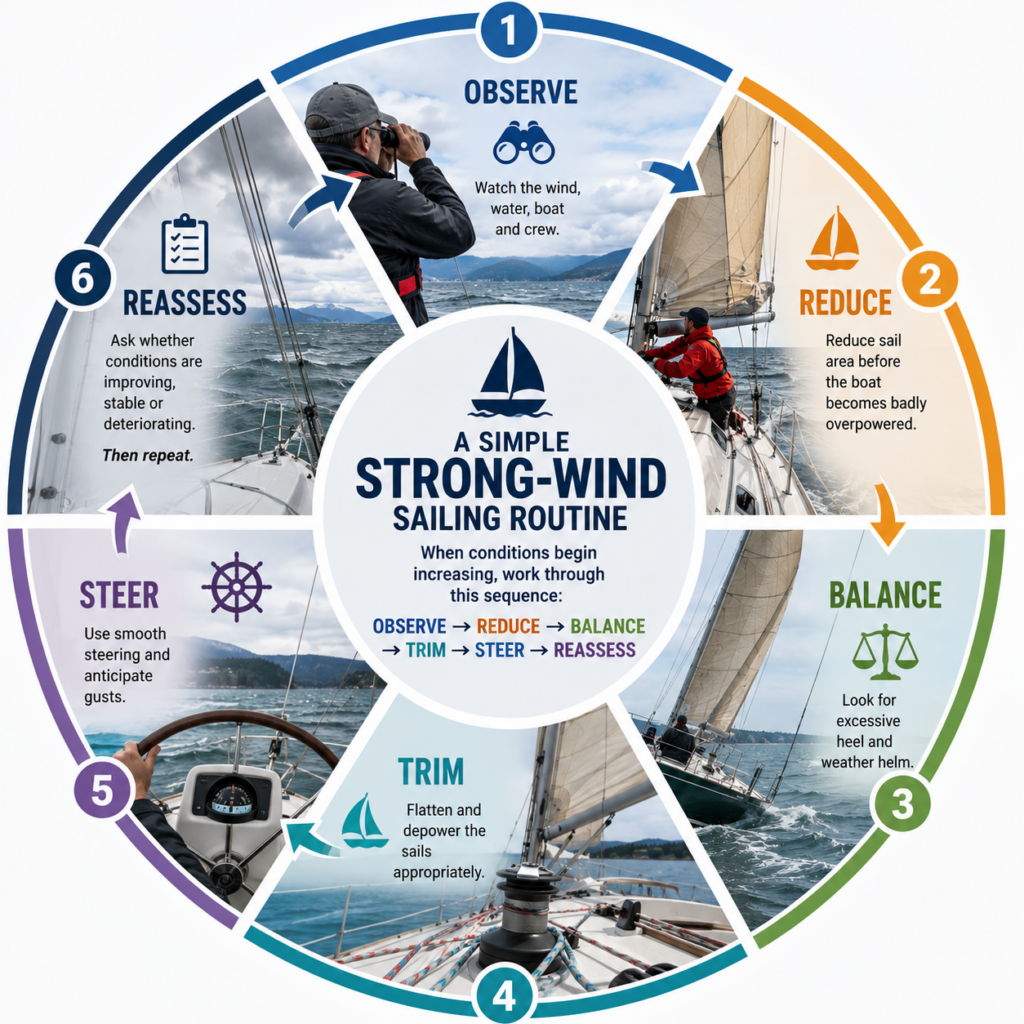
A Simple Strong-Wind Sailing Routine
When conditions begin increasing, work through this sequence:
Observe → Reduce → Balance → Trim → Steer → Reassess
Observe
Watch the wind, water, boat and crew.
Reduce
Reduce sail area before the boat becomes badly overpowered.
Balance
Look for excessive heel and weather helm.
Trim
Flatten and depower the sails appropriately.
Steer
Use smooth steering and anticipate gusts.
Reassess
Ask whether conditions are improving, stable or deteriorating.
Then repeat.
↓
FINAL QUESTION
Are my options remaining open—or disappearing?
Good skippers do not wait for control to disappear before changing the plan.
Skipper Thinking Scenario: The Wind Is Building
Imagine leaving the harbour in approximately 12 knots.
The forecast calls for the wind to increase.
The boat is comfortable under full sail.
The exact numbers in this example are illustrative only. They are not universal reefing thresholds.
Stage 1: Comfortable Conditions
The boat is balanced.
Helm pressure is light.
The crew is relaxed.
Nothing requires immediate action.
But you know the forecast.
You remain aware.
Stage 2: Gusts Begin Increasing
The water becomes more textured.
Whitecaps start appearing farther upwind.
The boat heels noticeably in the gusts.
Ask:
What changed?
What clues do I have?
What is likely to happen next?
Can I prepare now instead of reacting later?
This might be the time to make appropriate depowering adjustments and prepare the crew for a reef.
Stage 3: The Boat Starts Talking Louder
The helm is noticeably heavier.
The boat repeatedly heels hard.
Large steering corrections become more common.
The important evidence is not simply the number on the wind instrument.
It is the boat’s behaviour.
If normal depowering adjustments are no longer enough, reduce sail.
Stage 4: Reefed but Still Building
The reef works.
The boat stands more upright.
The helm feels better.
Twenty minutes later, the wind increases again.
What now?
Do not say:
We already reefed.
Ask:
Is the boat appropriately powered now?
Stage 5: The Crew Changes
One person becomes seasick.
The waves grow.
The destination is still reachable, but returning later will require sailing upwind in stronger conditions.
The forecast predicts another increase.
At this point the problem is no longer simply:
How should I trim the sails?
The question has become:
What decision preserves the most margin?
That is skipper thinking.
The Strong-Wind Decision Loop
Use this loop throughout the lesson and throughout your sailing:
OBSERVE → ANTICIPATE → DIAGNOSE → DEPOWER → REDUCE → BALANCE → DECIDE → ACT → REASSESS → OBSERVE AGAIN
Ask:
What changed?
What may happen next?
What is the boat telling me?
How much power is appropriate?
Did my adjustment improve heel, helm and control?
Should we continue?
Should we reef again?
Should we change course?
Should we seek shelter?
Should we return?
Then act and reassess.
There is no permanent “done.”
The environment continues changing.
Your assessment should too.
Common Beginner Mistakes in Strong Winds
Waiting too long to reef is perhaps the most common mistake. Reef while you still have comfortable control.
Another common mistake is fighting the helm. Heavy weather helm is information. Reduce the causes rather than simply using more rudder.
Do not assume dramatic heel means useful speed. Excessive heel can increase drag and reduce control.
Do not stare only at the sails. Look at the water and weather ahead.
Avoid over-trimming. Stronger wind does not mean every control should be pulled tighter.
Do not make large steering corrections unless the situation genuinely requires them. Smooth corrections are normally better.
Do not forget the return trip. A comfortable downwind leg can hide what the wind will feel like when you turn back.
Do not ignore the crew. Fear, fatigue, seasickness and cold affect your margin.
Do not continue solely because “we’re already out here.”
And do not change every control at once when conditions allow a more deliberate response. Make useful changes and learn from their effect.
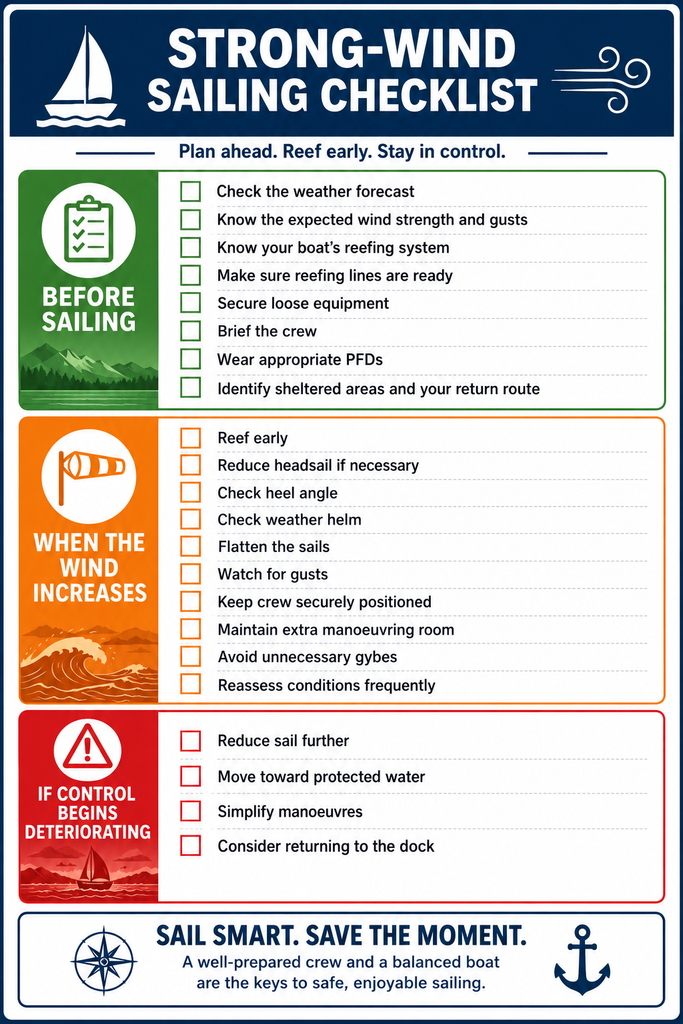
Strong-Wind Sailing Checklist
- Check the forecast and expected gusts before leaving.
- Know your boat’s reefing system before conditions build.
- Make sure reefing lines and sail controls are ready to use.
- Secure loose equipment.
- Brief the crew and establish clear commands.
- Wear appropriate, properly fitted flotation.
- Identify shelter, hazards and the return route.
- Watch ahead for gusts and changing water.
- Monitor heel and helm pressure.
- Depower appropriately before fighting the rudder.
- Reef before control seriously deteriorates.
- Rebalance and reassess after every sail reduction.
- Keep crew secure and use crew weight only where safe and appropriate.
- Give yourself extra room for tacks, jibes, docks and hazards.
- Avoid unnecessary complicated manoeuvres.
- Monitor fatigue and crew confidence.
- Reduce sail further if conditions continue building.
- Seek protected water or turn back while those choices remain straightforward.
The Biggest Lesson: Don’t Fight the Boat
Beginners often respond to increasing wind by increasing their physical effort.
They grip the helm harder.
They pull the sheets harder.
They brace themselves harder.
They concentrate harder.
Strong-wind sailing gradually teaches the opposite lesson.
When the boat becomes difficult to control, ask:
What force can I reduce?
Can I ease appropriately?
Can I flatten the sail?
Can I reef?
Can I reduce headsail area?
Can I change course?
Can I give myself more room?
Can I anticipate the next gust instead of reacting after it arrives?
Can I change the destination?
Good sailing is rarely about overpowering the boat.
It is about restoring balance.
Strong-Wind Practice Session
Do not learn strong-wind sailing by deliberately heading into conditions beyond your ability.
Instead, choose manageable conditions and practise with an experienced sailor or qualified instructor aboard.
Practise recognizing approaching gusts.
Compare helm pressure before and after depowering.
Reef before it becomes urgent.
Sail with a reef in.
Practise tacking reefed.
Compare heel and steering before and after sail reduction.
Practise heaving-to on your boat.
Experiment with changing course to reduce workload.
Discuss the point at which you would turn back.
After each exercise, ask:
What changed?
What did the boat tell me?
Did my action improve control?
Did it improve our margin?
That is how boat handling becomes seamanship.
Knowledge Check
- Why isn’t there one universal wind speed at which every sailboat should reef?
- Why can excessive heel make a sailboat less efficient?
- What might increasingly heavy weather helm be telling you?
- Why should you watch the water ahead instead of looking only at the sails?
- Why doesn’t one reef end the strong-wind decision process?
- Why can sailing downwind make strong true wind feel deceptively comfortable?
- Why isn’t changing onto a broad reach automatically the correct solution in strong downwind conditions?
- Why does crew fatigue matter even if the wind has not increased?
- Why should the skipper think about the return leg before continuing?
- What is the difference between asking “Can we continue?” and “Should we continue?”
Key Takeaways
See it early. Look ahead for gusts and changing conditions.
Anticipate what comes next. Do not wait for every change to become a surprise.
Reduce power early. Avoid waiting until the boat becomes difficult to control.
Maintain useful drive. Depowering does not mean eliminating the power required for steering and waves.
Reef before conditions become difficult. Sail reduction is easier while the boat remains manageable.
Rebalance after reefing. A reef is useful because of what it does to the boat—not simply because you completed the procedure.
Keep the boat balanced. Heel and helm pressure are valuable feedback.
Give yourself more room. Space creates time, and time creates choices.
Manage the crew as well as the sails. Security, communication and fatigue matter.
Preserve your options. Consider shelter, hazards, daylight, crew capability and the return route.
Reassess continuously. Conditions do not stop changing because you made one good decision.
Most importantly:
You do not become a better strong-wind sailor by learning to tolerate an out-of-control boat.
You become better by learning to prevent the boat from becoming out of control in the first place.
Strong-Wind Sailing Quiz
- Heel and helm pressure are both increasing. What should you consider first?
A. Pull harder on the helm.
B. Whether the boat is becoming overpowered or unbalanced.
C. Immediately steer dead downwind.
D. Tighten every control. - You see darker, textured water approaching from upwind. What should you do?
A. Ignore it until the boat heels.
B. Drop all sails immediately.
C. Anticipate a possible gust and prepare.
D. Start the engine automatically. - Reasonable depowering adjustments no longer control excessive heel. What should you consider?
A. More rudder.
B. Reducing sail area.
C. Tightening everything.
D. Ignoring the heel. - You reefed earlier, but the wind has continued building. What now?
A. Nothing—you already reefed.
B. Reassess the current sail plan and conditions.
C. Remove the reef.
D. Ignore the helm. - Why might a reefed boat sometimes perform as well as—or better than—an overpowered boat?
A. Reefing increases the wind.
B. Reduced heel and rudder drag can improve efficiency and control.
C. Smaller sails always make boats faster.
D. Reefing changes the current. - Why can downwind sailing disguise strong conditions?
A. True wind disappears.
B. Boat velocity can reduce the apparent wind experienced aboard.
C. Wind is always weaker downwind.
D. Sails block the wind. - Why isn’t moving onto a broad reach always the answer in strong wind?
A. Sailboats cannot broad reach in strong wind.
B. It may increase apparent wind and sail loads even if it improves another aspect of control.
C. Broad reaching eliminates steering.
D. The sails stop generating force. - One crew member is exhausted and another seasick. What should the skipper do?
A. Ignore them while the boat remains intact.
B. Include crew capability in the decision about continuing.
C. Add more sail.
D. Send them forward. - Which describes good strong-wind steering?
A. Use large rudder movements whenever possible.
B. Use the rudder continuously to fight excessive sail power.
C. Maintain a reasonably balanced boat and use smooth corrections.
D. Lock the helm. - Which best describes strong-wind skipper thinking?
A. React → fight → continue.
B. Reef once → problem solved.
C. Observe → anticipate → diagnose → act → reassess.
D. Continue until control becomes difficult.
Quiz Answer Key
1. B. Increasing heel and helm pressure may indicate that the boat is becoming overpowered or unbalanced.
2. C. Looking ahead allows you to prepare for a possible gust before it arrives.
3. B. When appropriate trim adjustments no longer provide enough control, reducing sail area may be necessary.
4. B. Reefing is part of an ongoing decision process. Conditions can continue changing.
5. B. Reducing excessive heel and rudder drag can improve control and sometimes useful performance.
6. B. Boat motion in the same general direction as the wind can reduce apparent wind experienced aboard even though the true wind remains strong.
7. B. A broad reach may sometimes improve steering or reduce accidental-jibe risk, but it can also increase apparent wind and loads.
8. B. Crew capability is part of the boat’s overall safety margin.
9. C. The rudder should steer a reasonably balanced boat rather than continually compensate for excessive sail power.
10. C. Strong-wind sailing is a repeating process of observation, anticipation, action and reassessment.
Scoring Guide
9–10 Correct — Strong Understanding
You understand the central lesson: recognize changing conditions, manage sail power, preserve control and continually reassess your options.
7–8 Correct — Good Progress
You understand most of the concepts. Review the areas you missed, particularly heel, helm pressure, sail balance and changing conditions.
5–6 Correct — Review Before Moving On
Return to the sections on recognizing an overpowered boat, depowering, reefing and the Strong-Wind Decision Loop.
0–4 Correct — Revisit the Lesson
Strong-wind sailing combines several earlier skills. Review sail trim, steering and reefing before progressing.
Final Skipper Thinking Challenge
You are still in control.
Nothing has broken.
Nobody is in immediate danger.
But the wind is increasing.
The waves are building.
One crew member is becoming tired.
Your route home will become harder if you continue.
When should you change the plan?
A beginner may wait for something to go wrong.
A developing skipper recognizes something earlier:
A shrinking safety margin is itself important information.
You do not need to wait until you lose control before making a conservative decision.
That is one of the most important lessons in becoming an independent skipper.
Remember
See it early.
Anticipate what comes next.
Reduce power early.
Reef before control deteriorates.
Keep the boat balanced.
Give yourself room.
Preserve your options.
Reassess continuously.
Continue Your Learn to Sail Course
Previous Lesson — Lesson 27: How to Reef a Sailboat
You learned how to reduce sail area before a boat becomes badly overpowered and why reefing early is usually easier than reefing late.
Current Lesson — Lesson 28: How to Sail in Strong Winds
You learned how to combine sail trim, reefing, steering, crew management and judgment as conditions become more demanding.
Next Lesson — Lesson 29: Sailing Weather for Beginners: Should You Leave the Dock?
The next step moves the decision process even earlier: reading the forecast and conditions well enough to decide whether leaving the dock is the right choice in the first place.
Return to the complete Learn to Sail course at any time to review the full lesson sequence.