
Jibing often feels more intimidating than tacking the first few times you see it happen. The reason is easy to understand: during a jibe, the boom and mainsail move from one side of the boat to the other while the boat is still sailing downwind and the sail may still be carrying considerable wind pressure.
That movement can look sudden. On a poorly controlled jibe, it can be sudden.
But a proper jibe is not a violent or unpredictable maneuver. It is a deliberate sequence in which the skipper prepares the boat, communicates with the crew, controls the sails, steers the stern through the wind, and then settles the boat onto a new course.
The most important idea to remember is this:
A good jibe is prepared before the boat begins turning.
If you understand where the wind is coming from, where you want the boat to go, what the boom is about to do, and what each crew member needs to do, the maneuver becomes much easier to anticipate.
In this guide, you will learn how to jibe a sailboat step by step. More importantly, you will learn why each step matters, what you should expect to see and feel, and how to avoid the mistakes that make jibing unnecessarily difficult.
What Does It Mean to Jibe a Sailboat?
A jibe is a sailing maneuver in which the stern of the boat passes through the direction of the wind while the boat is sailing downwind. As the stern crosses the wind, the wind begins acting on the opposite side of the mainsail. The mainsail and boom then move across the boat, and the sailboat continues on the opposite tack.
If you remember only one geometric difference between a tack and a jibe, remember this:
During a tack, the bow passes through the wind. During a jibe, the stern passes through the wind.
Picture a sailboat traveling downwind on a broad reach with the boom extended to one side. The skipper gradually changes course so the stern moves toward the direction the wind is coming from.
As the stern reaches and crosses that line, the wind shifts from one side of the mainsail to the other. The boom crosses the cockpit, the mainsail fills on the opposite side, and the boat continues downwind on its new heading.
That crossing of the stern through the wind is what defines the jibe.
The word gybe is another spelling of the same maneuver. It is commonly used in Britain and in many Commonwealth sailing references. SailboatZone uses jibe, which is the more common North American spelling.
Intentional vs. Accidental Jibes
A controlled jibe is planned.
The skipper checks the new course, warns the crew, prepares the sails, and deliberately steers through the maneuver.
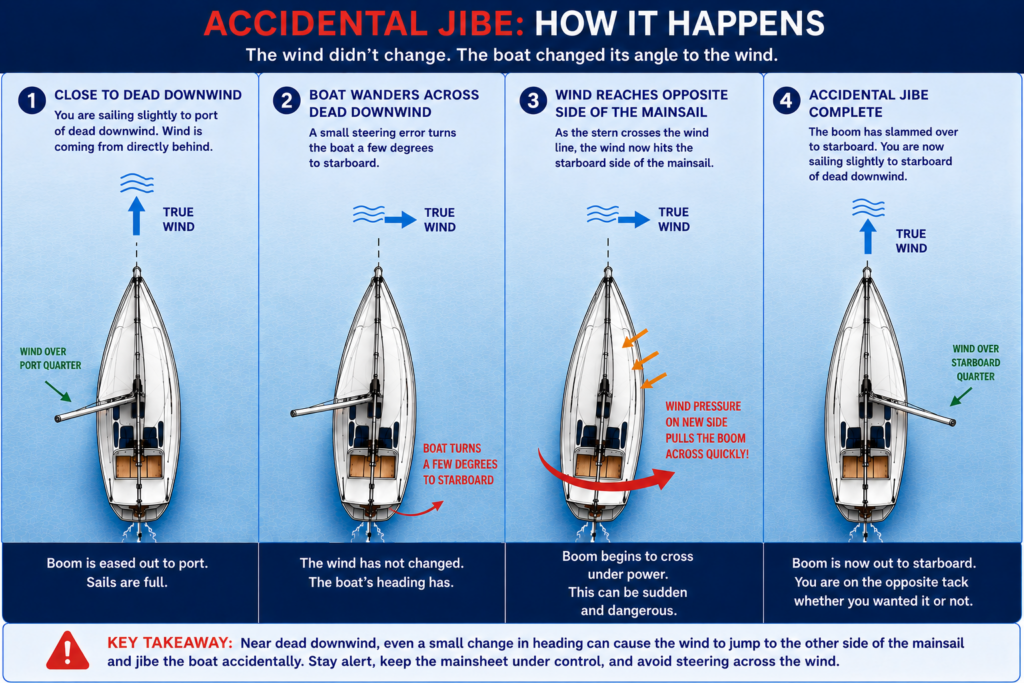
An accidental jibe happens when the boat’s heading or the wind direction changes enough that the wind suddenly catches the opposite side of the mainsail. The boom may then cross the cockpit unexpectedly.
Later in this guide, we will look closely at why accidental jibes happen and how to prevent them.
If terms such as stern, boom, main sheet, windward, leeward, or tack are still unfamiliar, reviewing SailboatZone’s beginner guide to basic sailing terminology will make the rest of this maneuver easier to understand.
Why Do Sailboats Need to Jibe?
Sailors jibe because they sometimes need to change direction while traveling downwind.
Suppose your destination lies generally in the same direction the wind is blowing. You may be able to sail toward it on a broad reach, but the best route may not take you directly there in one straight line.
You might jibe to:
- change your downwind sailing angle;
- follow a better route toward a destination;
- avoid another boat or obstruction;
- respond to changing wind or waves;
- reposition the boat for the next part of your sail;
- or move from one broad reach to another on the opposite tack.
The need to jibe becomes easier to understand once you recognize that a sailboat’s course is always related to the direction of the wind.
A sailor does not simply point the bow toward a destination and ignore the wind. Instead, the skipper chooses a course that allows the sails to work efficiently and then changes course when necessary.
If you are still learning how boat heading and wind direction fit together, review the points of sail before practicing jibing. That relationship explains why a broad reach on one tack can become a broad reach on the opposite tack after a jibe.
Jibing vs. Tacking: What’s the Difference?
Tacking and jibing both accomplish one important thing:
They change the boat from one tack to the other.
However, they do it on opposite sides of the wind.
| Tacking | Jibing |
|---|---|
| Bow passes through the wind | Stern passes through the wind |
| Boat turns through the upwind side | Boat turns through the downwind side |
| Sails usually lose most of their driving force briefly | Mainsail may remain significantly powered |
| Boom generally crosses with less force | Boom movement requires more deliberate control |
| Boat changes tack | Boat changes tack |
During a tack, the boat turns toward the wind until the bow crosses through it. As the bow moves through the wind, the sails usually luff and temporarily lose much of their driving force.
During a jibe, the boat turns through the downwind side instead. The stern crosses through the wind, and the mainsail may remain powered for much more of the maneuver.
That difference is one reason jibing deserves extra attention.
Why Jibing Often Feels More Dramatic
When sailing on a broad reach or run, the boom may already be well away from the centerline of the boat. During the jibe, it has to move from one side to the other.
If nothing is done to control that movement, the boom can accelerate through a large arc before reaching the opposite side.
That is very different from simply saying that “jibing is dangerous.” The important lesson is understanding why the forces are greater and how sailors manage them.
A controlled jibe reduces the uncontrolled distance the boom can travel, keeps the crew clear of its path, and coordinates steering with sail handling.
If you want a deeper comparison between these two manoeuvres, SailboatZone’s guide to the difference between tacking and jibing explains when each maneuver is used and what happens to the sails during both.
The next step is to slow the jibe down mentally and examine exactly what happens to the boat, the wind, and the sails as the stern passes through the wind.
What Happens to the Boat During a Jibe?
Before learning the individual steps of a jibe, it helps to slow the entire maneuver down in your mind.
Imagine the boat sailing on a broad reach. The wind is coming from behind and from one side of the boat, and the mainsail is eased well away from the centerline.
The skipper has decided to change to a downwind course on the opposite tack.
Here is what happens:
- The boat approaches the jibe on a stable downwind course. The skipper knows where the wind is coming from and has already chosen the new heading.
- The skipper checks the new course. Before turning, there must be enough clear water for the maneuver.
- The crew prepares. Jib sheets are organized, the main sheet is ready, and everyone moves clear of the boom and main sheet.
- The mainsail is brought under greater control. Bringing the boom closer to the boat’s centerline reduces the distance it can travel when it crosses.
- The skipper begins a smooth turn. As the boat turns farther downwind, the stern moves toward the direction the wind is coming from.
- The stern passes through the wind. This is the defining moment of the jibe.
- The wind begins acting on the opposite side of the mainsail. The mainsail and boom cross the boat.
- The jib transfers to the opposite side. The old working jib sheet is released and the new sheet takes over.
- The skipper stops the turn. The boat settles onto the intended downwind course on the opposite tack.
- The sails are adjusted. The mainsail is eased to its appropriate position, and the jib is trimmed for the new heading.
The important point is that these events should not happen randomly. The skipper and crew are deliberately setting them in motion.
What Will You See and Feel?
As the boat turns farther downwind, the pressure you feel through the sails and helm may change. The jib may become less stable or briefly collapse as the boat approaches dead downwind.
Then the mainsail crosses.
You may hear the sail fill on the opposite side and feel the boat react as the wind loads it again. Depending on the boat and conditions, the boat may also heel briefly as the mainsail fills.
Once the skipper stops the turn and the sails are adjusted, the boat should settle back into a stable course.
Understanding this sequence is important because it allows you to anticipate the boat instead of reacting after something happens.
Understanding the Boom Before You Jibe
The boom deserves special attention because it behaves differently during a jibe than it does during a tack.
When sailing downwind, the mainsail is normally eased out. On a broad reach, the boom may extend well away from the centerline of the boat.
Now consider what must happen during the jibe.
The boom begins on one side of the boat and must eventually end up on the other. If it is allowed to travel that entire distance uncontrolled, it can accelerate rapidly before reaching the opposite side.
The stronger the wind, the greater the forces can become.
This is why experienced sailors do not simply turn the boat and wait for the boom to crash across. Controlling the boom is a fundamental part of good jibing technique; US Sailing’s instructional standards similarly emphasize completing the jibe smoothly with the boom under control.
Why Sailors Control the Mainsheet Before the Jibe
The main sheet is the line used to control the position of the boom and mainsail.
Before the stern passes through the wind, the main sheet is commonly brought in to reduce how far the boom must travel when the sail changes sides.
Think about the difference between allowing a door to slam through a wide arc and controlling it through a much smaller movement. The boom is not a door, but the basic principle is useful: reducing uncontrolled travel reduces the opportunity for the boom to build speed.
Exactly how much main sheet should be brought in depends on the boat, its rigging, wind strength, sea conditions, and the technique being used. Therefore, a beginner should not memorize a rule such as “pull the main sheet all the way in.”
Instead, understand the objective:
Bring the mainsail under control before it crosses.
If you are unfamiliar with how the main sheet and other sail controls work, SailboatZone’s guide to sail controls explains how these lines affect the sails.
The Boom Is Not the Only Thing to Avoid
During a jibe, beginners naturally focus on keeping their heads below the boom. That is important, but the boom is only part of the moving system.
The main sheet and its blocks may also move quickly as the boom changes sides. Depending on the boat’s layout, sections of main sheet can sweep through or tighten across parts of the cockpit.
Keep hands, feet, clothing, and loose equipment clear of loaded lines and moving hardware.
Never wrap a sheet around your hand to gain a better grip.
Before the maneuver begins, everyone aboard should know where the boom and main sheet are going to move and position themselves accordingly.
Preparing to Jibe
The actual turn should begin only after the boat and crew are ready.
Preparation starts with deciding where you want to go.
Choose Your New Course
Look ahead and identify the heading you want the boat to follow after the jibe.
This sounds obvious, but it prevents a common beginner problem: continuing to turn after the sails have crossed because no one decided beforehand where the turn should stop.
Know your destination before moving the helm.
Check the Water Around You
Before beginning the jibe, look around the boat rather than only toward the sails.
Check for:
- other sailboats and powerboats;
- swimmers, paddlers, or small craft;
- navigation marks;
- docks and shorelines;
- floating debris or other hazards;
- and enough open water to complete the maneuver.
The skipper remains responsible for what is happening around the boat throughout the jibe. Before changing course, keep the U.S. Coast Guard Navigation Rules in mind and make sure your jibe will not create a collision risk with nearby vessels.
Confirm the Wind Direction
Next, make sure you know where the wind is coming from.
Look at several clues rather than relying on only one. A masthead wind indicator, telltales, flags, ripples on the water, and the behavior of the sails can all help.
Knowing the wind direction lets you anticipate when the stern is approaching the point where the mainsail will change sides.
SailboatZone’s guide to reading the wind explains how to combine these clues instead of relying on guesswork.
Prepare the Crew and Sheets
Tell the crew that a jibe is coming before you begin steering.
A basic exchange might be:
Skipper: “Prepare to jibe.”
The crew organizes the sheets, moves into a safe position, checks that the cockpit is clear, and confirms readiness.
Crew: “Ready.”
Only then does the skipper begin the maneuver:
Skipper: “Jibing.”
Different instructors and crews use different commands. The exact words matter less than having a clear system in which everyone knows that the maneuver is coming and confirms that they are ready.
Finally, check the jib sheets. The sheet currently controlling the jib should be ready to release, while the sheet that will control the jib after the jibe should be free to run and ready to trim.
Check the main sheet as well.
At this point, the new course is clear, the wind direction is known, the crew is ready, the sheets are organized, and the boat is stable.
Now the jibe can begin.
How to Jibe a Sailboat Step by Step
Once the boat and crew are prepared, the jibe itself becomes a sequence of coordinated actions.
The goal is not to rush through these steps. A well-executed jibe should feel deliberate: prepare the boat, begin the turn, control the sails as they cross, and then stop the turn on the new course.
Here is how to jibe a sailboat step by step.
Step 1 — Check the New Course
Before touching the helm, look toward the course you intend to sail after the jibe.
Make sure there is enough room to complete the turn and check again for boats, navigation marks, shoreline, floating objects, and other hazards.
This final check matters because conditions around the boat may have changed while the crew was preparing.
Know approximately where you want the bow pointing when the maneuver is finished. This gives you a clear point at which to stop turning.
Common mistake: Watching the sails instead of looking where the boat is going.
Step 2 — Tell the Crew You Are Jibing
Give the agreed command:
“Prepare to jibe.”
Wait for the crew to confirm:
“Ready.”
Then announce:
“Jibing.”
Everyone should now be in a safe position with heads and bodies clear of the boom and main sheet.
Do not begin simply because you have issued the command. If someone is still moving, a sheet is tangled, or a crew member says they are not ready, delay the maneuver.
Common mistake: Beginning the turn while the crew is still preparing.
Step 3 — Prepare the Jib Sheets
Identify which jib sheet is currently doing the work and which will take over after the jibe.
The working sheet is the sheet currently controlling the jib. The sheet on the opposite side is often called the lazy sheet because it is not carrying the sail’s load.
Make sure the new sheet is free to run. Check that it is not trapped under someone’s foot, wrapped around equipment, or tangled in the cockpit.
The crew handling the jib should be ready to release the old sheet and take up the new one as the sail crosses.
Common mistake: Discovering during the turn that the new jib sheet is trapped or tangled.
Step 4 — Bring the Mainsail Under Control
Before the stern crosses through the wind, bring in the main sheet to reduce the distance the boom will travel during the jibe.
The objective is not necessarily to haul the boom all the way to the centerline. The appropriate amount depends on the boat and conditions.
Instead, remember the purpose:
Reduce the uncontrolled movement of the boom before it changes sides.
Keep control of the main sheet and make sure everyone remains clear of both the boom and the line itself.
This is one of the most important differences between a controlled jibe and simply turning the boat until the boom slams across.
Common mistake: Leaving the mainsail fully eased and allowing the boom to accelerate across the entire cockpit.
Step 5 — Begin a Smooth Turn
Now begin steering the boat gradually farther downwind.
Avoid throwing the wheel or tiller hard over. A sudden steering movement makes the maneuver happen faster and gives the crew less time to coordinate the sails.
As the boat turns, watch both the heading and the sails.
The stern is now moving toward the direction the wind is coming from. At the same time, the mainsail is approaching the point where the wind will begin acting on its opposite side.
Keep the turn steady and predictable.
If you are still developing a feel for controlled helm movements, SailboatZone’s guide to steering a sailboat explains how small helm inputs affect the boat’s direction.
Common mistake: Turning aggressively because the skipper believes a jibe needs to happen quickly.
Step 6 — Control the Boom as the Stern Passes Through the Wind
This is the defining moment of the maneuver.
As the stern passes through the wind direction, the wind begins acting on the opposite side of the mainsail.
The mainsail changes sides, and the boom crosses the boat.
Because you brought the mainsail under control before reaching this point, the boom has less uncontrolled distance to travel. Maintain control of the main sheet as the sail crosses rather than simply letting everything go.
Keep your head and body out of the boom’s path, and make sure the crew does the same.
You may hear the sail fill and feel the boat respond as the mainsail loads on the new side. In stronger wind, that response can be more pronounced.
Do not become so focused on watching the boom that you lose track of where the boat is pointing.
Common mistake: Watching the boom cross while allowing the boat to continue turning unchecked.
Step 7 — Transfer the Jib
As the boat passes through the jibe, the jib also needs to move to the opposite side.
Ease and release the old working sheet so the jib can cross ahead of the mast. Then take up slack on the new sheet as it becomes the working sheet.
Avoid hauling the new sheet tight too early. Let the sail move across first, then bring it under control and prepare to trim it for the new heading.
On some downwind courses, the jib may become unstable or briefly collapse as the boat passes through dead downwind. That does not necessarily mean anything has gone wrong.
The important thing is to keep the sheets organized and allow the sail to transfer without becoming caught.
Common mistake: Pulling hard on the new jib sheet before the sail has had time to cross.
Step 8 — Steady the Boat on the New Course
Once the sails have changed sides, the jibe is not quite finished.
You still need to stop the turn.
Bring the helm back toward its neutral position as the boat approaches the heading you selected before the maneuver began.
The boat should settle onto a stable downwind course on the opposite tack.
Beginners sometimes become so focused on getting the sails across that they continue steering long after the jibe itself has occurred. The boat may then turn much farther than intended.
Think of the maneuver as having three distinct phases:
Enter the turn → cross the wind → stop the turn.
Common mistake: Allowing the boat to keep turning after the sails have successfully crossed.
Step 9 — Ease and Trim the Sails for the New Heading
The boom was brought under greater control for the jibe. Once the boat is established on its new heading, the mainsail usually needs to be eased back out to suit the new point of sail.
Do this under control rather than simply releasing the main sheet.
Next, trim the jib using the new working sheet.
Look at the sails and observe how they respond. If you are on a broad reach, both sails should be adjusted for that course rather than left in the temporary positions used during the maneuver.
This is where your broader sail-trim skills come back into play. SailboatZone’s guide to trimming a sail explains how to adjust the sails once the boat is established on its new heading.
Finally, look around.
Check the new course, surrounding traffic, crew, and boat.
A jibe is complete only when the boat is stable, the sails are working properly, and the skipper has returned full attention to sailing the new course.
The Complete Jibe in One Sequence
Once you understand the individual steps, the whole maneuver can be reduced to a short mental routine:
Check the course → warn the crew → prepare the sheets → control the mainsail → turn smoothly → control the boom across → transfer the jib → stop the turn → trim the sails.
At first, consciously think through each part.
With practice, these actions begin to connect. The crew prepares while the skipper checks the course. The mainsail is controlled before the turn reaches the critical point. The jib transfers as the boat changes tack. The skipper anticipates the new heading and stops the turn rather than correcting it afterward.
That coordination is what transforms a jibe from a collection of reactions into a controlled sailing maneuver.
How to Handle the Jib Sheets During a Jibe
During a jibe, the mainsail often gets most of the attention because of the boom. However, the jib also needs to move from one side of the boat to the other.
Understanding the two jib sheets makes this much easier.
The working sheet is the line currently controlling the jib. It is carrying the load of the sail.
The lazy sheet is attached to the opposite side of the jib but is not currently controlling it. After the jibe, their jobs switch: the old working sheet becomes the lazy sheet, and the old lazy sheet becomes the new working sheet.
When Should You Release the Old Jib Sheet?
As the boat turns through the jibe, the jib becomes less effective and may begin to collapse as the boat approaches dead downwind.
At this point, the crew eases and releases the old working sheet so the jib can move across the front of the boat.
Avoid releasing the sheet unnecessarily early. Doing so can leave the jib uncontrolled before it needs to cross.
At the same time, do not hold the old sheet so long that it prevents the sail from transferring.
The exact timing varies somewhat with the boat, wind strength, sail size, and course. The goal is more important than memorizing a precise instant:
Let the old sheet go when the jib is ready to cross, then take control with the new sheet.
Taking Up the New Sheet
As the jib moves across, take up slack in the new working sheet.
Do not immediately haul the sail tight. First allow it to cross cleanly. Once the boat settles onto its new heading, trim the jib for that point of sail.
Keep both sheets organized throughout the maneuver. A loose jib sheet can easily end up under someone’s foot, around cockpit hardware, or tangled with another line.
Never wrap a sheet around your hand. Keep fingers away from loaded blocks and winches, and avoid standing inside loops of line.
Good line handling is rarely dramatic. The sheet simply leaves one side, crosses cleanly, and comes under control on the other.
Skipper and Crew Coordination During a Jibe
A smooth jibe depends less on speed than coordination.
The skipper and crew should know their responsibilities before the maneuver begins. That way, nobody has to guess what another person is about to do.
Skipper Responsibilities
The skipper is responsible for the overall maneuver.
That includes:
- choosing when and where to jibe;
- checking the new course;
- knowing the wind direction;
- warning the crew;
- confirming that everyone is ready;
- steering at a controlled rate;
- monitoring the boom and sails without losing awareness of the boat’s heading;
- and stopping the turn on the intended new course.
On a small boat, the skipper may also handle the main sheet. On a larger boat or with additional crew, that job may be assigned to someone else.
Either arrangement can work. What matters is that everyone knows who is responsible for each control before the jibe begins.
Crew Responsibilities
Crew members should prepare themselves and the boat before answering “Ready.”
Depending on the boat and crew arrangement, their responsibilities may include:
- checking that jib sheets are free;
- preparing the old and new working sheets;
- helping control the main sheet if assigned;
- staying clear of the boom and moving main sheet;
- releasing the old jib sheet at the appropriate time;
- taking up the new sheet;
- trimming the jib after the turn;
- and immediately telling the skipper if something goes wrong.
If a sheet jams or a crew member is not ready, say so.
A clear “Not ready” is far more useful than trying to fix a problem silently while the boat continues through the maneuver.
A Simple Beginner Crew Sequence
A beginner crew can practice the jibe as a short verbal routine:
Skipper: “Prepare to jibe.”
Crew: Checks sheets, moves into position and confirms the cockpit is clear.
Crew: “Ready.”
Skipper: Brings the mainsail under control.
Skipper: “Jibing.”
Skipper: Begins the turn.
Crew: Releases the old jib sheet and prepares the new sheet as the jib crosses.
Skipper or main sheet trimmer: Controls the boom as the mainsail changes sides.
Skipper: Stops the turn on the new course.
Crew: Trims the jib.
Skipper or main sheet trimmer: Eases the mainsail appropriately for the new heading.
Practising this sequence slowly helps establish the order of events before stronger wind or a busy sailing environment adds more pressure.
The Most Common Jibing Mistakes Beginners Make
Most poor jibes are not caused by one mysterious mistake. Usually, one part of the sequence happens too early, too late, or without enough preparation.
Learning to recognize these patterns makes troubleshooting much easier.
1. Starting Before the Crew Is Ready
Mistake: The skipper announces the jibe and immediately begins turning.
Why it happens: The command is treated as an announcement rather than a request for readiness.
What to do instead: Wait for confirmation. If the crew is not ready, maintain a stable course until they are.
2. Failing to Check the New Course
Mistake: Everyone focuses on the sails while nobody looks where the boat is going.
Why it happens: Sail handling feels like the most complicated part of the maneuver.
What to do instead: Choose and check the new course before turning, then maintain situational awareness throughout the jibe.
3. Letting the Boom Slam Across
Mistake: The boom travels rapidly from one side of the boat to the other.
Why it happens: The mainsail was left too far out or the main sheet was not adequately controlled.
What to do instead: Bring the mainsail under control before the stern passes through the wind and manage the main sheet as the boom crosses.
4. Turning Too Quickly
Mistake: The skipper makes a large, abrupt helm movement.
Why it happens: Beginners sometimes believe they need to “get through” the jibe quickly.
What to do instead: Use a smooth, deliberate turn that gives the crew and sails time to respond.
5. Turning Too Far
Mistake: The sails cross successfully, but the boat keeps turning.
Why it happens: The skipper watches the sails instead of anticipating the new heading.
What to do instead: Choose the final course beforehand and begin straightening the helm as the boat approaches it.
6. Losing Track of the Wind Direction
Mistake: The skipper is surprised by when the boom crosses.
Why it happens: Attention shifts to the cockpit, sheets, or crew instead of maintaining a mental picture of the wind.
What to do instead: Identify the wind direction before the maneuver and continue monitoring it as the boat turns.
7. Poor Jib-Sheet Timing
Mistake: The old sheet is released much too early, held too long, or the new sheet is pulled tight before the jib has crossed.
Why it happens: The crew is following memorized motions rather than watching what the sail is actually doing.
What to do instead: Allow the jib to become ready to cross, ease the old sheet, let the sail transfer, then take up and trim the new sheet.
8. Tangled Jib Sheets
Mistake: The new working sheet will not run when needed.
Why it happens: Sheets were not organized before the maneuver.
What to do instead: Check both sheets before calling “Ready.” Make sure they are clear of feet, knots, winches, and other cockpit equipment.
9. Standing in the Boom or Mainsheet Hazard Zone
Mistake: A crew member ducks at the last second or finds a moving sheet crossing their position.
Why it happens: The crew reacts to the boom only after it starts moving.
What to do instead: Before turning, identify where the boom, main sheet, and blocks will travel and move clear of those areas.
10. Forgetting Everything Except the Sails
Mistake: The jibe itself goes well, but the skipper loses awareness of traffic or the boat’s position.
Why it happens: The maneuver consumes all of the skipper’s attention.
What to do instead: Prepare early enough that sail handling does not require constant last-second decisions. Look outside the boat before, during, and immediately after the turn.
The common thread behind nearly all of these mistakes is preparation.
When the course is chosen, the wind direction is understood, the sheets are organized, the crew knows their jobs, and the mainsail is controlled before the turn, there is much less to fix while the boat is actually jibing.
That becomes especially important when something else changes unexpectedly, such as the wind direction or the boat’s heading. Those changes can produce a jibe that nobody intended to make.
What Is an Accidental Jibe?
An accidental jibe happens when the stern crosses through the wind without the skipper deliberately initiating a jibe. The wind catches the opposite side of the mainsail, causing the sail and boom to cross the boat unexpectedly.
Because nobody has prepared for the maneuver, the main sheet may not be controlled and the crew may not be positioned safely. For that reason, preventing accidental jibes is an important part of learning to sail downwind.
Why Accidental Jibes Happen
A sailboat sailing close to dead downwind has the wind coming from almost directly behind it.
In this position, relatively little separates one tack from the other. A small change in the boat’s heading can move the wind from one side of the mainsail to the other.
Several things can cause that change:
- the skipper allows the boat to wander off course;
- a wave pushes the stern sideways;
- the wind shifts direction;
- the skipper becomes distracted;
- or the boat sails too close to dead downwind without careful attention to its heading.
Once the wind reaches the opposite side of the mainsail, it can push the sail across quickly.
This is why an accidental jibe may feel very different from the controlled maneuver described earlier. The boom is crossing because conditions have forced the change, not because the skipper and crew deliberately prepared for it.
How to Reduce the Risk of an Accidental Jibe
Prevention begins with knowing where the wind is coming from.
Continue checking wind indicators, telltales, flags, the water, and the behavior of the sails while sailing downwind. SailboatZone’s guide to reading the wind explains how to use several of these clues together.
Also maintain a steady heading. Small steering corrections are usually better than allowing the boat to wander and then making large corrections.
When conditions and your intended route allow it, beginners may also find a broad reach easier to manage than sailing directly downwind. This provides more margin before a small change in heading or wind direction causes the mainsail to change sides.
Some sailboats also use equipment such as a preventer, which can help control unwanted boom movement. However, equipment does not replace awareness of the wind, proper steering, or good seamanship. The correct use of a preventer also requires understanding its setup and the loads involved.
Jibing in Stronger Wind
As wind speed increases, so do the forces acting on the sails, sheets, rigging, and boat.
That does not fundamentally change what a jibe is. The stern still passes through the wind, the mainsail still changes sides, and the boat still settles onto the opposite tack.
What changes is how much consequence there can be for poor timing or control.
In stronger wind:
- loads on the main sheet increase;
- the boom can accelerate more rapidly;
- sail handling requires greater care;
- steering errors can have larger consequences;
- crew coordination becomes more important;
- and the boat may heel more abruptly when the mainsail fills on the new side.
For a beginner, stronger wind is not the ideal time to learn the basic sequence.
Build the skill first in manageable conditions with plenty of open water. Learn to recognize the wind direction, control the boom, coordinate the jib sheets, and stop the turn accurately before adding more wind and larger loads.
You Do Not Have to Jibe Immediately
One of the most useful lessons in sailing is that knowing how to perform a maneuver does not mean you must perform it at the first opportunity.
If conditions make you uncomfortable, you may have other options depending on your boat, location, traffic, sea room, and sailing plan.
You may be able to wait for a better location, reduce sail before the maneuver, change your plan, or ask a more experienced sailor or instructor to take over.
In some situations, sailors may choose to change tack by turning the boat through the wind in a tack rather than performing a downwind jibe. This requires substantially more room and changes the boat’s course through a much larger arc, so it is not automatically the correct alternative.
The important principle is not “never jibe in strong wind.”
It is to recognize when the conditions and loads have moved beyond your current level of experience.
How to Practise Jibing Safely
Jibing becomes much easier when you practice it deliberately rather than waiting until a real sailing situation forces you to perform one.
Choose a day with manageable wind and an area of open water where you have plenty of room.
Then practice the maneuver as a repeatable routine.
1. Identify the Wind Direction
Before beginning, point out exactly where the wind is coming from.
Use the boat’s wind indicators and confirm them against what you see on the water and in the sails.
2. Establish a Stable Broad Reach
Settle the boat onto a broad reach and trim the sails appropriately.
Do not begin the exercise while the boat is still turning or the crew is reorganizing the cockpit.
Start from a stable boat.
3. Talk Through the Jibe
Before moving the helm, describe what is about to happen.
Where will the stern move?
When will the boom cross?
Which jib sheet will be released?
Which sheet will become the new working sheet?
Where should each person be positioned?
This verbal rehearsal is especially valuable for a new crew.
4. Perform One Controlled Jibe
Use the complete sequence:
Check → communicate → prepare → control the mainsail → turn → control the boom → transfer the jib → stop the turn → trim.
Do not try to make it fast.
5. Stabilize the Boat
Once the sails have crossed, settle onto the new broad reach.
Adjust the mainsail and jib, straighten the course, and look around the boat.
Only then is the exercise finished.
6. Review What Happened
Ask a few useful questions:
Did the boom cross under control?
Did the jib transfer cleanly?
Did the skipper stop the turn at the intended heading?
Was anyone surprised by what happened?
If something went wrong, identify which part of the sequence caused it rather than simply calling the whole jibe “bad.”
7. Repeat on the Opposite Tack
Once the boat is stable, prepare another jibe in the opposite direction.
Repeated practice allows both skipper and crew to experience the maneuver from each side of the boat.
As the sequence becomes familiar, less verbal prompting will be necessary.
The goal is accuracy before speed.
A good beginner jibe is not the fastest jibe. It is one in which everyone knows what is about to happen, the boom crosses under control, the sails transfer correctly, and the boat finishes on the intended course.
Beginner Jibing Checklist
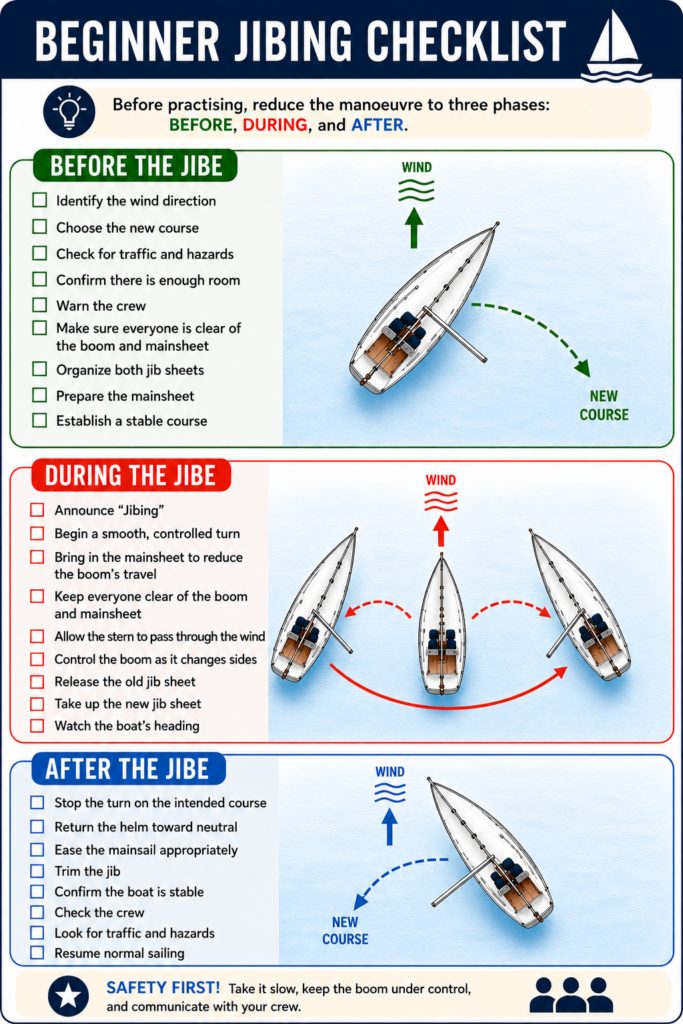
Before practicing, reduce the maneuver to three phases: before, during, and after.
Before the Jibe
□ Identify the wind direction
□ Choose the new course
□ Check for traffic and hazards
□ Confirm there is enough room
□ Warn the crew
□ Make sure everyone is clear of the boom and main sheet
□ Organize both jib sheets
□ Prepare the main sheet
□ Establish a stable course
During the Jibe
□ Announce “Jibing”
□ Begin a smooth, controlled turn
□ Bring the mainsail under control
□ Keep everyone clear of the boom and main sheet
□ Allow the stern to pass through the wind
□ Control the boom as it changes sides
□ Release the old jib sheet
□ Take up the new jib sheet
□ Watch the boat’s heading
After the Jibe
□ Stop the turn on the intended course
□ Return the helm toward neutral
□ Ease the mainsail appropriately
□ Trim the jib
□ Confirm the boat is stable
□ Check the crew
□ Look for traffic and hazards
□ Resume normal sailing
At first, that may seem like a long checklist for a maneuver that happens in only a few seconds.
With practice, however, many of these actions begin to overlap naturally. The crew organizes the sheets while the skipper checks the new course. Everyone moves into position before the turn begins. The skipper anticipates the boom crossing rather than reacting to it.
Eventually, the checklist becomes a familiar rhythm:
Prepare. Turn. Control. Settle.
Beginner Jibing Knowledge Check
Before moving on, see whether you can answer these questions without looking back through the article.
1. During a jibe, which end of the sailboat passes through the wind?
The stern passes through the wind. This is the defining difference between a jibe and a tack, where the bow passes through the wind.
2. Why should you bring the mainsail under greater control before the stern passes through the wind?
Bringing in the main sheet reduces the distance the boom can travel as the mainsail changes sides. This helps prevent the boom from accelerating through a large uncontrolled arc.
3. What should the skipper check before beginning a jibe?
The skipper should know the wind direction, choose the intended new course, check for traffic and hazards, confirm there is enough room, and make sure the crew and sheets are ready before beginning the turn.
4. What can cause an accidental jibe?
An accidental jibe can result from the boat wandering across dead downwind, a steering error, waves changing the boat’s heading, or a shift in wind direction. In each case, the wind moves from one side of the mainsail to the other without a planned maneuver.
5. What should the skipper do after the sails cross?
Stop the turn on the intended heading, bring the helm back toward neutral, ease and trim the sails for the new course, and check the boat’s surroundings.
If those answers make sense rather than simply sounding familiar, you understand the basic mechanics of a jibe.
Frequently Asked Questions About Jibing a Sailboat
Is Jibing Harder Than Tacking?
Not necessarily, but jibing usually requires more deliberate boom control. During a tack, the sails normally lose much of their driving force as the bow passes through the wind. During a jibe, the mainsail may remain powered, so controlling its movement from one side of the boat to the other becomes especially important.
Is Jibing Dangerous?
A poorly controlled jibe can create a genuine risk because the boom, main sheet, and associated hardware may move quickly across the boat.
A planned jibe manages that risk through preparation. The crew stays clear of moving equipment, the mainsail is brought under control, and the skipper steers deliberately through the maneuver.
Why Does the Boom Move So Fast During a Jibe?
When sailing downwind, the boom may be well away from the boat’s centerline. As the stern passes through the wind, the wind begins acting on the opposite side of the mainsail.
If the main sheet has not been controlled, the boom can accelerate through a large arc before reaching the other side. Stronger wind can increase these forces considerably.
Should I Pull In the Mainsheet Before Jibing?
Generally, the mainsail should be brought under greater control before the boom crosses, which often means bringing in the main sheet.
However, there is no single amount that is correct for every sailboat. Boat size, rigging, wind strength, sea conditions, and the technique being used all matter.
Learn the procedure appropriate to the particular boat you are sailing.
When Should I Release the Jib Sheet During a Jibe?
As the boat turns downwind, the jib may lose its shape or begin to collapse. Ease and release the old working sheet when the sail is ready to transfer, allowing the jib to cross before taking up the new working sheet.
Watch what the sail is doing rather than relying only on a memorized moment in the turn.
What Is an Accidental Jibe?
An accidental jibe occurs when the stern crosses the wind unintentionally and the wind catches the opposite side of the mainsail.
This can happen because of a steering error, a wind shift, waves changing the boat’s heading, or sailing close to dead downwind without maintaining adequate course awareness.
Can I Tack Instead of Jibe?
Sometimes. A sailor can potentially change tack by turning the bow through the wind instead of taking the stern through it.
However, this means steering through a much larger turn and requires adequate room. Traffic, wind, sea state, the boat, and your intended course all affect whether it is a sensible alternative.
What Is the Difference Between “Jibe” and “Gybe”?
There is no difference in the maneuver.
Jibe is the common North American spelling, while gybe is widely used in Britain and elsewhere. Both describe a maneuver in which the stern passes through the wind and the sails change sides.
Key Takeaways
If you remember only the essentials of how to jibe a sailboat, remember these:
- During a jibe, the stern passes through the wind and the boat changes tack.
- A good jibe begins with preparation, not with turning the helm.
- Know the wind direction and choose your new course before starting.
- Tell the crew what is about to happen and make sure everyone is clear of the boom and main sheet.
- Bring the mainsail under control before it changes sides.
- Steer smoothly and anticipate when to stop the turn.
- Transfer the jib sheets in an organized sequence and then trim both sails for the new course.
- Practise in manageable conditions until the maneuver becomes predictable rather than rushed.
From Jibing to Controlling the Sailboat
Learning to jibe represents more than adding another maneuver to your sailing vocabulary.
When you learned to tack, you learned how to change from one tack to the other by turning the bow through the wind. Jibing gives you the corresponding maneuver on the downwind side: changing tack by taking the stern through the wind.
Together, these skills give you much greater control over where the boat goes.
You can sail toward the wind, change tack, bear away onto a reach, continue downwind, jibe onto the opposite tack, and then establish a new course. Steering, wind awareness, sail trim, and crew coordination begin working together as parts of one system.
That is an important transition for a beginner.
You are no longer simply learning what individual sailing terms and controls mean. You are learning to anticipate what the boat will do before you move the helm or adjust a line.
Continue developing that skill by practicing how to steer a sailboat and how to trim your sails on different points of sail. The better you become at predicting how the boat, wind, and sails interact, the more natural manoeuvres such as tacking and jibing will become.
A controlled jibe ultimately follows the same principle that applies to good sailing in general:
Know what you want the boat to do, prepare for it, and then make deliberate adjustments that allow the boat to respond.