
You are sailing comfortably across the bay when you look ahead and realize where you want to go is almost directly upwind.
Your first instinct might be to simply steer toward your destination. But as the bow turns closer to the wind, the sails begin to flutter. The boat slows. Turn farther, and eventually the sails flap uselessly while the boat loses most of its forward momentum.
Nothing is wrong with the boat. You have simply discovered one of the fundamental limitations of sailing: a sailboat cannot sail directly into the wind.
The solution is to tack.
Learning how to tack a sailboat is one of the first major practical skills in sailing. At first, a tack can seem like a complicated sequence involving steering, sails, ropes, crew commands and people changing sides of the boat. Once you understand what is actually happening, however, the maneuver becomes surprisingly logical.
A good tack is simply a controlled turn through the wind.
In this guide, you will learn what tacking means, why we do it, how to steer through a tack, when to release and trim the jib sheets, how the crew works together and how to recognize and correct the mistakes beginners commonly make.
Most importantly, you will understand why each step happens when it does.
Quick Answer: What Is Tacking?
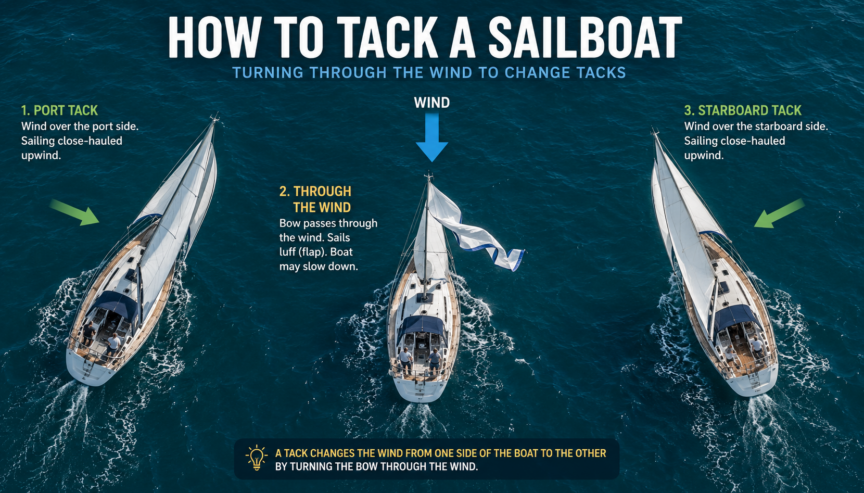
Tacking is the maneuver of turning the bow of a sailboat through the wind so that the wind changes from one side of the boat to the other.
Imagine that you are sailing with the wind coming over the left, or port, side of the boat. You turn toward the wind, the bow passes briefly through the direction the wind is coming from, and you continue turning until the wind reaches the boat from the right, or starboard, side.
You have completed a tack.
The sails also change sides during the maneuver. The jib crosses the front of the boat, while the mainsail moves from one side to the other as the wind changes sides.
A tack is different from a jibe. During a tack, the bow passes through the wind. During a jibe, the stern passes through the wind.
If those terms are still new to you, review The Difference Between Tacking and Jibing before worrying about the finer details.
There is another use of the word tack that beginners should understand.
When sailors say a boat is on starboard tack or on port tack, they are describing which side of the boat the wind is coming from. That is different from tacking, which describes the maneuver used to change from one tack to the other.
Why Do Sailboats Need to Tack?
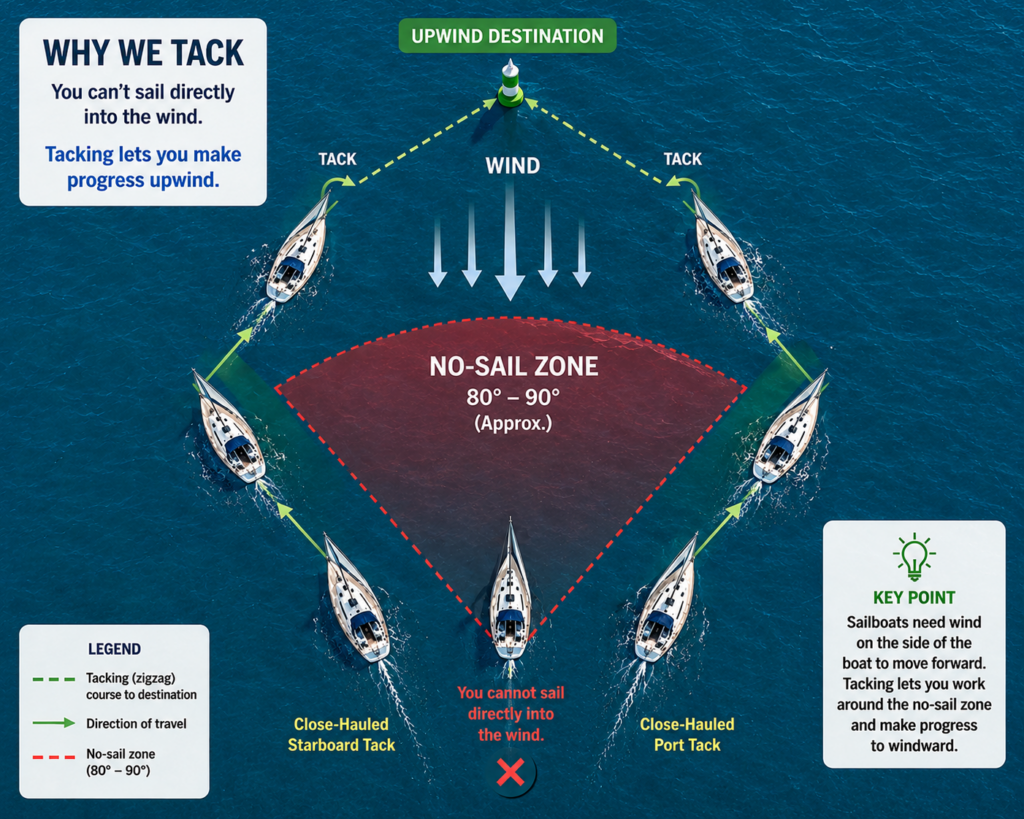
The easiest way to understand tacking is to imagine that your destination is directly upwind.
Unfortunately, you cannot simply point the bow at it.
There is an area on either side of directly into the wind where a conventional sailboat cannot sail effectively. This is commonly called the no-sail zone or no-go zone.
As you steer progressively closer to the wind, eventually the sails can no longer maintain the airflow they need to drive the boat forward. They begin to luff—or flap—and the boat slows.
The closest useful sailing course to the wind is called close-hauled.
The exact angle varies with the boat, sails and conditions, but for beginner purposes you can picture a close-hauled boat sailing roughly 40–45 degrees away from the direction the wind is coming from.
The Royal Yachting Association describes sailing upwind as zigzagging from one side of the no-go zone to the other. Each change from one close-hauled course to the other requires the boat to tack through the wind.
So rather than trying to sail straight toward an upwind destination, you sail diagonally toward it on one tack, turn through the wind, and then sail diagonally toward it on the other.
Viewed from above, your route begins to look like a zigzag.
Each individual leg may point away from the destination somewhat, but together they allow you to make steady progress to windward—toward the direction the wind is coming from.
If the relationship between your boat and the wind still feels confusing, review Points of Sail Explained and How to Read the Wind. Those concepts make tacking much easier to understand.
Before Learning to Tack
A tack combines several basic sailing skills that you may already have learned separately.
You need to recognize where the wind is coming from. You need to understand close-hauled sailing. You need enough steering control to turn the boat smoothly. And you need a basic understanding of what the sheets do.
If you’re still learning these fundamentals, that is completely normal. Tacking is often the maneuver that begins bringing them together.
These earlier lessons can help:
- Basic Sailing Terminology Explained
- How to Steer a Sailboat
- How to Trim a Sail
- Sail Controls Explained
- How to Read Sail Telltales
You do not need to master every one of these subjects before practicing a tack. You simply need enough understanding to recognize what the boat, wind and sails are doing.
The Anatomy of a Tack
Before worrying about crew commands or exactly when to release a sheet, understand the overall movement.
Suppose you are sailing close-hauled.
The sails are filled, the boat has good forward momentum and the bow is pointing as close toward the wind as the boat can sail efficiently.
You decide to tack.
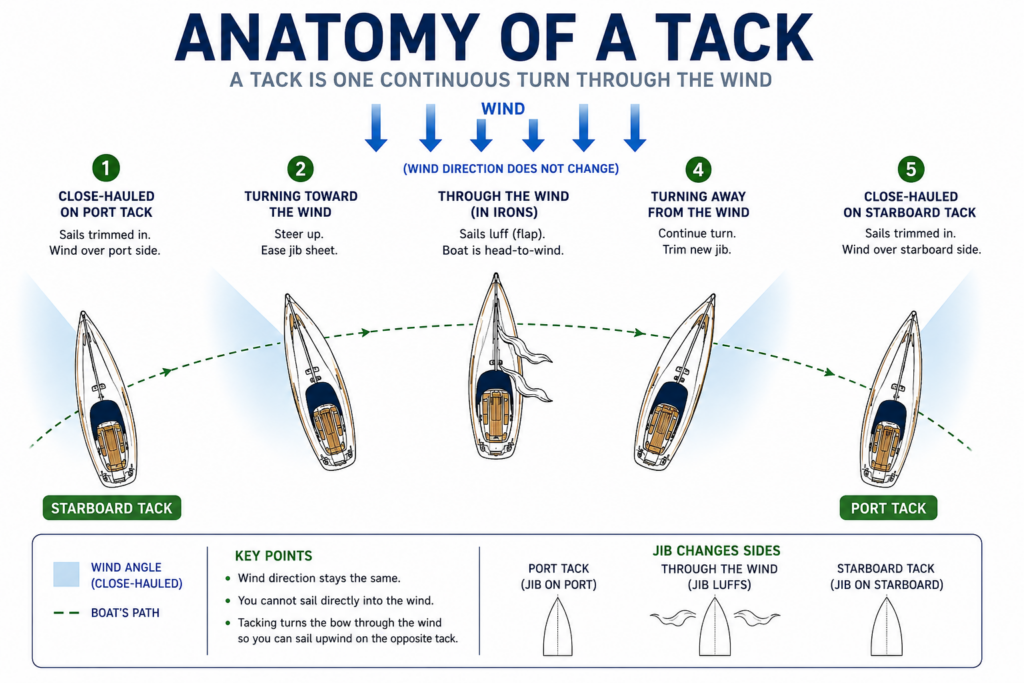
The sequence looks like this:
- Establish a close-hauled course with adequate boat speed.
- Check that there is enough clear water to complete the maneuver safely.
- Prepare the crew.
- Turn the bow smoothly toward the wind.
- Continue the turn as the sails begin to luff.
- Pass briefly through head-to-wind.
- Allow the jib to cross to the opposite side.
- Release the old working jib sheet.
- Trim the new working sheet.
- Continue onto the new close-hauled heading.
- Straighten the helm and allow the boat to accelerate.
Before the tack, the wind is coming from one side of the boat.
After the tack, it is coming from the other.
That is the entire maneuver.
The details that follow simply make this basic turn controlled, efficient and repeatable.
How to Tack a Sailboat Step by Step
Now let’s perform the maneuver as though you were aboard the boat.
Step 1: Establish Good Boat Speed
A successful tack actually begins before you turn the helm.
Get the boat sailing efficiently.
For a basic upwind tack, you will normally begin close-hauled. The sails should be properly trimmed and the boat should have steady forward momentum.
Speed matters because the sails temporarily stop producing useful driving force while the bow passes through the wind.
During that short period, the boat relies largely on its existing momentum to carry it through the turn.
Think of it like riding a bicycle up a short rise. Starting with some momentum makes getting over the top much easier.
If you begin a tack when the boat is already barely moving, it may lose its remaining momentum before the bow gets through the wind.
That is one common way beginners become stuck in irons, which we’ll cover shortly.
Step 2: Look Around Before Turning
Before changing course, look around the boat.
Check ahead.
Check to leeward.
Look behind you.
Make sure another boat, dock, shoreline, navigation mark or other obstruction will not become a problem as your boat turns.
This is an easy step to forget because beginners naturally become focused on the sails and ropes.
But a perfect tack into the path of another vessel is not a successful tack.
Good seamanship means maintaining awareness of what is happening outside your own boat.
Step 3: Prepare the Crew
If you have crew aboard, tell them that you intend to tack before you begin turning.
A traditional command is:
“Ready about?”
The crew prepares the jib sheets and confirms:
“Ready.”
On many recreational boats, one person will prepare to release the current working jib sheet while another—or sometimes the same person—prepares to trim the sheet on the opposite side.
The exact arrangement depends on the boat and number of people aboard.
What matters is that everyone knows what is about to happen.
There is no prize for shouting traditional sailing commands perfectly. Clear communication is more important.
Step 4: Turn Smoothly Toward the Wind
Once the boat and crew are ready, begin turning the bow toward the wind.
This is called heading up.
Traditional commands such as “Helm’s a-lee” or “Hard alee” may be used as the turn begins, although terminology varies among boats, instructors and sailing traditions.
The important part is the action.
Turn positively enough that the boat continues through the maneuver, but do not violently throw the helm over.
The goal is a smooth, continuous turn.
If you steer with a wheel, turn the wheel in the direction you want the bow to go.
If you steer with a tiller, the tiller moves in the opposite direction from the direction you want the bow to turn.
That opposite tiller movement initially feels strange to many beginners. How to Steer a Sailboat explains the relationship in more detail.
Step 5: Pass Through Head-to-Wind
As the bow approaches the wind, the sails will begin to luff.
You may hear them flutter or flap.
The boat may become more upright as pressure comes off the sails, and you may feel the helm change as the sails temporarily stop driving the boat normally.
Keep the turn going.
For a brief moment, the bow will point almost directly into the wind.
This is head-to-wind.
Normally, you do not want to stop here. The boat cannot continue sailing effectively in this position.
Instead, its existing momentum carries it through the no-sail zone while the rudder helps continue the turn.
Step 6: Release the Old Working Jib Sheet
As the bow passes through the wind, the jib needs to move to the opposite side of the boat.
The sheet that had been holding the jib is the old working sheet.
It must be released so the jib can cross.
Timing matters.
Release it too early and the jib loses useful drive before necessary, which can contribute to the boat slowing during the tack.
Hold it too long and the jib may remain backed on the old side, making the sail harder to bring across and potentially affecting the turn.
On many boats, the old sheet is released as the bow passes through the wind and the jib begins to lose its load.
The precise timing varies somewhat with the boat, wind strength and sail arrangement, so beginners should learn the behavior of the particular boat they are sailing rather than treating one instant as universal.
Step 7: Trim the New Jib Sheet
The sheet that was previously loose—the lazy sheet—now becomes the new working sheet.
As the jib crosses the fore-deck, take in the slack.
Then trim the sail as it fills on the new side.
This is usually easier if much of the slack is gathered before the sail becomes heavily loaded.
As the sail fills, the sheet becomes progressively harder to pull.
Larger boats may use a winch to provide the mechanical advantage required for final trimming.
Keep fingers clear of winches, blocks and heavily loaded lines. Never allow a hand to become wrapped in a sheet.
Step 8: Find the New Close-Hauled Course
Do not forget that you are still steering.
One of the easiest beginner mistakes is becoming so interested in the jib that the boat continues turning too far.
As the bow reaches the new close-hauled heading, begin reducing the steering input.
Straighten the helm and establish the new course.
You started close-hauled with the wind coming from one side.
You should now be close-hauled with the wind coming from the other.
Step 9: Let the Boat Accelerate
Immediately after the tack, the boat may be moving more slowly than it was before the maneuver.
Give it a moment to accelerate.
Check your heading.
Look at the sails.
Check the jib telltales.
Make small steering or trim corrections rather than immediately making large adjustments.
As airflow re-establishes itself over the sails, the boat should begin building speed again.
You have completed the tack.
What Happens to the Jib During a Tack?
The jib is usually the busiest sail during a tack.
Before the maneuver begins, the jib is held in position by one of its two sheets. This is the working sheet because it is currently carrying the load of the sail. The sheet on the opposite side is relatively loose and is called the lazy sheet.
During the tack, those jobs switch.
As the bow turns toward the wind, the jib begins to lose pressure. Once the bow passes through the wind, the jib needs to cross the boat and fill on the opposite side.
The old working sheet is released. The old lazy sheet is pulled in. Once the jib fills on its new side, that formerly lazy sheet has become the new working sheet.
It helps to think of the process as a hand-off:
Working sheet → release → jib crosses → opposite sheet takes over.
You do not need to memorize the names while everything is happening. With practice, it becomes much more intuitive: release the sheet on the old side and trim the sail from the new side.
Why Jib Sheet Timing Matters
Beginners often assume the faster they release the jib, the better.
Not necessarily.
If the working sheet is released too early, the jib begins luffing while the boat is still approaching the wind. You have unnecessarily removed some of the sail’s drive before the boat reaches the part of the tack where it needs to coast through the no-sail zone.
At the other extreme, holding the old sheet too long can leave the jib backed—filled by the wind on what has become the wrong side. Depending on the boat and situation, a backed jib can affect how the bow turns and make the sheet more difficult to release under load.
For normal beginner tacking, the goal is straightforward: keep the jib working during the early part of the turn, release it as it loses its load around head-to-wind, and bring in the new sheet as the sail crosses.
You will gradually learn to recognize the correct moment by sight, sound and feel rather than by trying to time it to an exact number of seconds.
Don’t Fight a Loaded Sheet
There is also a practical reason to take in the new jib sheet promptly.
When the jib first crosses the boat, the new sheet has relatively little load on it. This is your easiest opportunity to remove most of the slack.
Once the sail fills with wind, the load increases dramatically.
On a small sailboat, you may still be able to trim the sheet directly by hand. On a larger keel boat or cruising sailboat, you will usually use a winch for the final trim.
This is one reason an experienced crew can appear so relaxed during a tack. They are not necessarily stronger or moving faster. They are doing each job when it is easiest to do.
If you would like a deeper explanation of sheets, winches and other sail controls, see Sail Controls Explained.
What Should the Mainsail Do During a Tack?
Compared with the jib, the mainsail usually requires surprisingly little attention during a basic tack.
As the boat turns toward the wind, the mainsail begins to luff. As the boat passes through head-to-wind and continues onto the new tack, the mainsail crosses the boat and fills on the opposite side.
In many ordinary recreational tacks, you do not need to make a major main sheet adjustment during the maneuver.
That is useful news for a beginner.
You already have several things happening at once. There is no need to invent another job if the mainsail was appropriately trimmed before the tack and you are finishing on a similar close-hauled course on the opposite side.
Concentrate first on steering the boat cleanly and handling the jib correctly.
Once the boat is established on its new heading, look at the mainsail and make any necessary trim adjustments.
How to Trim a Sail explains how sail trim changes as your heading relative to the wind changes.
Watch the Boom
Although the main sheet may not require much adjustment, the boom still changes sides.
As the wind crosses from one side of the boat to the other, the mainsail and boom move across the centerline.
During a controlled tack in moderate conditions, this is generally much less violent than the boom movement that can occur during a poorly controlled jibe. Nevertheless, everyone aboard should know that the boom is moving and keep heads and bodies clear of its path.
This is another reason to prepare the crew before beginning the maneuver rather than surprising everyone with a sudden turn.
Steering Through a Tack
The sails are visually dramatic during a tack, so beginners naturally watch them.
But the skipper’s most important job is still steering the boat.
The rudder must guide the boat through three distinct phases:
Before the tack: establish speed and a stable course.
During the tack: maintain a smooth, positive turn through the wind.
After the tack: stop the turn on the new course and allow the boat to accelerate.
The key word is smooth.
Don’t Turn Too Slowly
A very slow turn can cause the boat to spend too much time in the no-sail zone.
Remember what happens as the bow approaches the wind: the sails lose their ability to drive the boat forward.
The boat is temporarily spending the speed it built before the tack.
If the turn takes too long, that momentum can disappear before the bow reaches the other side.
The boat may stop with its bow pointing into the wind.
Don’t Throw the Helm Over Either
The opposite mistake is treating a tack like an emergency turn.
A large, abrupt rudder angle creates considerable drag. Instead of simply redirecting the boat, the rudder can act partly like a brake.
A rushed turn can also make it harder for the crew to coordinate the sheets and harder for the skipper to stop accurately on the new heading.
The objective is not:
Turn as fast as possible.
It is:
Carry the boat smoothly and positively through the wind without wasting unnecessary speed.
Different boats respond differently. A light dinghy can turn very quickly. A heavier cruising keel boat may carry momentum well but respond more slowly. Conditions matter too.
As you practice on the same boat, you begin learning how much helm it needs.
Look Where You Want to Go
Another simple habit makes tacking much easier: look toward your new course.
Before the tack, you can identify roughly where you expect the boat to end up.
As the boat turns, shift your attention toward that new heading.
This helps prevent a surprisingly common beginner mistake—continuing the turn long after the boat has already passed the correct close-hauled course.
Once you approach your new heading, begin straightening the helm.
If you use a tiller, remember that the tiller moves opposite the direction the bow turns. If this still requires conscious thought, How to Steer a Sailboat is worth reviewing before practicing repeated tacks.
Crew Movement and Communication
A good tack should feel organized rather than frantic.
That begins before the helm moves.
Everyone aboard should know that the tack is coming and understand their role.
On a small boat with two people, one person might steer while the other handles both jib sheets.
On a larger boat, one crew member might ease the old working sheet while another trims the new one.
On some small dinghies, the skipper may steer, handle a sheet and move across the boat during the same maneuver.
The details vary.
The principle does not:
Prepare first. Turn second.
Traditional Tacking Commands
You may hear a sequence such as:
Skipper: “Ready about?”
Crew: “Ready.”
Skipper: “Helm’s a-lee.”
The first command tells the crew that a tack is coming.
The response confirms that the crew is prepared.
The final command indicates that the skipper is beginning the turn.
Different sailing schools, countries and crews use somewhat different wording. Some crews simply say “Ready to tack?” followed by “Tacking.”
For a beginner, clear communication is more important than sounding traditional.
The worst command is the one nobody understands.
Move Deliberately, Not Quickly
Depending on the boat, crew members may also need to change where they are sitting as the boat changes tack.
Do this deliberately.
Keep your weight controlled. Use secure handholds where appropriate. Watch the boom. Be aware of the sheets moving through the cockpit.
Most importantly, keep hands, feet, fingers and loose clothing away from loaded lines, winches, blocks and cleats.
A jib sheet under load can carry substantial force.
Never wrap a loaded sheet around your hand to get a better grip.
On larger boats, follow the proper operating technique for the particular winches and equipment aboard.
Good tacking is not about looking fast. It is about everyone completing a small number of jobs in the correct order.
How Do You Know the Tack Worked?
You do not need an instrument to tell you whether you completed a good tack.
The boat gives you plenty of clues.
First, the wind is now coming from the opposite side.
The sails have filled on their new sides.
The jib’s former lazy sheet is now loaded as the working sheet, while the old working sheet has become lazy.
The boat is established on its new heading rather than continuing to turn.
Most importantly, it begins accelerating again.
You may feel pressure return to the helm. The boat may begin heeling gently again as the sails develop power.
Look at the jib telltales as the boat settles.
If the sail and heading are close to correct, the telltales should begin streaming smoothly again as airflow reattaches to the sail.
How to Read Sail Telltales explains exactly what those small pieces of yarn or ribbon are telling you.
A good tack therefore has a recognizable rhythm:
Speed → turn → brief luff → sails cross → new heading → sails fill → acceleration.
Learn to Sail has a great video that demonstrates this entire process. With practice, you begin to feel that sequence without consciously analyzing every part of it.
What Does “Stuck in Irons” Mean?
Sooner or later, nearly every beginner attempts a tack and ends up pointing into the wind with the sails flapping and the boat barely moving.
Congratulations: you have discovered being in irons.
It sounds much more dramatic than it usually is.
A boat is in irons when it has lost enough forward motion that it can no longer complete the tack and remains approximately head-to-wind.
The sails luff.
The boat slows dramatically or stops.
The rudder becomes much less effective because there is little water flowing past it.
This is why simply turning the helm farther may accomplish almost nothing.
Why Boats Get Stuck in Irons
One common cause is beginning the tack without enough boat speed.
Another is turning too slowly and allowing momentum to disappear while the boat is in the no-sail zone.
Choppy water can also stop a light or slow-moving boat surprisingly quickly.
Occasionally, a beginner simply becomes distracted halfway through the maneuver and stops steering.
Whatever the cause, the underlying problem is usually the same:
The boat ran out of useful forward momentum before it finished turning through the wind.
How to Recover From Being in Irons
First, don’t panic and don’t begin frantically pulling every line aboard.
Allow the boat to begin moving backward slightly if necessary.
As it develops stern way—backward movement—the rudder can begin influencing the boat again, but its effect is reversed compared with normal forward motion. Use the helm carefully to help angle the bow away from directly into the wind.
As the bow falls off to one side, the sails can begin filling again.
Once the boat is pointing far enough away from the wind to sail, straighten the helm as appropriate, trim the sails and allow the boat to build forward speed.
On some boats, deliberately backing the jib can also help push the bow onto the desired side, but the exact recovery technique depends on the boat and situation.
For a beginner, remember the central idea:
Get the bow away from directly into the wind so the sails can begin driving the boat again.
Then rebuild speed before attempting another tack.
Becoming stuck in irons is not evidence that you cannot tack.
It is useful feedback.
The boat has just told you that something about your entry speed, steering or timing needs adjustment.
Common Beginner Tacking Mistakes — and How to Fix Them
Tacking is one of those sailing skills that improves quickly once you understand what went wrong.
A poor tack is rarely mysterious. Usually, one part of the sequence happened too early, too late or not quite enough.
Instead of judging a tack simply as “good” or “bad,” learn to diagnose it.
Ask yourself:
Did I have enough speed? Did I maintain the turn? Did the jib cross cleanly? Did I stop on the correct heading?
Those questions will identify most beginner problems.
Problem: The Boat Stops While Pointing Into the Wind
Why it happens: The boat did not have enough momentum to carry it through the no-sail zone.
You may have started the tack too slowly, turned too gradually or encountered waves that quickly reduced the boat’s speed.
What to do instead: Before the next attempt, establish a good close-hauled course and allow the boat to accelerate. Then make a smooth, positive turn without stopping the steering motion while the bow passes through the wind.
Problem: You Release the Jib Sheet Too Early
Why it happens: Beginners often anticipate the tack and release the sheet as soon as the skipper starts turning.
The jib then begins luffing earlier than necessary.
What to do instead: Allow the jib to continue working during the early part of the turn. Release the old working sheet as the boat approaches and passes through head-to-wind and the sail loses its load.
Watch what the sail is doing rather than trying to follow an exact countdown.
Problem: You Hold the Old Jib Sheet Too Long
Why it happens: The boat has passed through the wind, but the old working sheet remains secured.
The jib may fill backward against the wind on the old side.
This is called backing the jib.
Backing a jib is sometimes done deliberately during particular manoeuvres, but during an ordinary beginner tack it usually means the sheet was not released at the intended time.
What to do instead: Be ready before the tack. As the sail unloads and begins crossing, release the old working sheet cleanly.
Problem: The New Jib Sheet Has Too Much Slack
Why it happens: The crew waits until the jib has completely filled before beginning to trim the new sheet.
By then, the sail is loaded and much harder to pull in.
What to do instead: As the jib crosses, gather the slack from the new sheet while the load is still light. Complete the final trim once the sail fills.
Problem: The Jib Is Over-Trimmed After the Tack
Why it happens: Beginners sometimes keep pulling because a tight sheet feels like a properly controlled sheet.
But tighter is not automatically better.
What to do instead: Once the boat is established on its new heading, use the jib telltales and sail shape to make the final adjustment.
How to Read Sail Telltales can help you determine whether the jib is trimmed correctly rather than simply tightly.
Problem: The Boat Turns Too Far
Why it happens: The skipper becomes focused on the jib, crew or sheets and forgets to stop the turn.
Instead of finishing close-hauled, the boat continues turning onto a close reach or even farther away from the wind.
What to do instead: Before beginning the tack, look toward the area where you expect the new heading to be. As the bow approaches that course, begin reducing your steering input and straighten the helm.
Problem: The Boat Loses Lots of Speed Even Though the Tack Succeeds
Some speed loss during a tack is normal.
A very large loss, however, can indicate that the turn was inefficient.
Why it happens: Possible causes include excessive rudder angle, a very slow turn, poor sail-handling timing, rough water or finishing the maneuver with the sails badly trimmed.
What to do instead: Change one thing at a time.
On your next tack, concentrate on entering with better speed. Then evaluate the result.
On another tack, concentrate on using a smoother helm movement.
Learning this way makes it much easier to discover what the boat is telling you.
Problem: Everyone Rushes at Once
Why it happens: The crew knows several things need to happen and tries to perform all of them immediately.
The result can be tangled sheets, missed commands and people moving around the cockpit unnecessarily.
What to do instead: Remember the sequence:
Prepare → Turn → Release → Cross → Trim → Settle
A tack is a sequence, not a race.
Problem: Everyone Is Watching the Sails
The sails are interesting during a tack.
Unfortunately, so are the other boats around you.
Why it happens: Beginners become absorbed in whether the jib is crossing correctly.
What to do instead: The skipper must continue maintaining situational awareness throughout the maneuver.
Check your surroundings before the tack and continue looking where the boat is going.
Safe recreational sailing always takes priority over executing a textbook-perfect maneuver.
Tacking With a Crew vs. Tacking Single-Handed
The physics of a tack do not change because you are sailing alone.
The workload does.
With a crew, jobs can be divided. One person steers while another handles the jib sheets.
When sailing single-handed, the skipper may need to steer, manage the jib sheets and maintain awareness of the surroundings without assistance.
That makes preparation even more important.
Before beginning a single-handed tack, make sure both jib sheets are organized and accessible. Check that nothing is tangled around a cleat, winch or other cockpit fitting.
Look carefully around the boat before beginning the maneuver.
Then perform the same basic sequence:
Establish speed.
Turn smoothly toward the wind.
Release the old jib sheet.
Bring in the new one.
Establish the new heading.
Trim and accelerate.
Do not try to perform every task simultaneously.
Small dinghies, tiller-steered keel boats and larger wheel-steered cruising boats can require different techniques. Self-tacking jibs simplify the process considerably because the jib travels across automatically.
Learn the procedure appropriate to the particular boat you are sailing before attempting to operate it alone.
For your first sailing experiences, learning from a qualified instructor or experienced sailor aboard an appropriate training boat can make developing these habits much easier.
How to practice Tacking
Reading about tacking helps you understand the sequence.
Actually learning to tack requires repetition.
The best practice session is not about completing as many tacks as possible. It is about performing one tack, observing what happened, and then using that information on the next one.
Choose the Right Place and Conditions
practice in open water with plenty of room.
Avoid beginning your first dedicated tacking practice beside a marina entrance, crowded anchorage, rocky shoreline or other area where a failed maneuver immediately creates another problem.
Choose manageable weather rather than strong or gusty conditions.
Before leaving the dock, check the weather and local conditions, make sure the boat carries the required safety equipment, and ensure everyone aboard understands the basic plan.
Transport Canada recommends checking the weather, local hazards and safety equipment and briefing guests before heading out on the water.
If preparing the boat and leaving the marina are still new skills, review How to Rig a Sailboat and How to Leave the Dock in a Sailboat first.
A Simple Tacking Practice Exercise
Once you reach suitable open water, identify the wind direction.
Then establish the boat close-hauled on one tack.
Allow it to settle.
Look at the sails.
Notice the heel.
Feel the pressure through the helm.
Watch the water moving past the hull.
This gives you a baseline.
Now choose a visual reference somewhere ahead or ashore so you remain aware of the boat’s orientation.
Check that the area is clear.
Prepare the crew.
Tack.
Once you are established close-hauled on the opposite side, resist the temptation to tack back immediately.
Instead, ask:
Did we maintain enough speed?
Did the bow move smoothly through the wind?
When did the jib begin luffing?
Did the jib cross cleanly?
Did we stop turning at approximately the right heading?
How quickly did the boat accelerate again?
Sail for a short distance while the crew reorganizes.
Then tack back.
Now you have performed the maneuver in both directions.
Repeat.
You will probably notice that one direction initially feels easier than the other. That is common. Wind, waves, crew position and even which hand performs a task can make one side feel more natural.
The goal is not perfection.
The goal is to make each repetition deliberate.
Change One Thing at a Time
Suppose the boat repeatedly becomes stuck in irons.
Do not simultaneously change the sails, steering, crew timing and starting heading.
First try entering the next tack with more speed.
Did that solve the problem?
If not, examine how quickly you are turning.
This approach turns practice into a simple experiment:
Observe → Adjust → Tack Again → Observe
That is one of the fastest ways to develop a feel for a sailboat.
Beginner Tacking Checklist
Before your next tack, mentally run through this short sequence:
1. Speed
Is the boat moving well and sailing efficiently?
2. Space
Is the surrounding water clear?
3. Crew
Does everyone know the tack is coming?
4. Turn
Steer smoothly and positively toward the wind.
5. Release
Let go of the old working jib sheet as the jib unloads.
6. Trim
Take in the new working sheet as the jib crosses and fills.
7. Course
Stop the turn on the new heading.
8. Accelerate
Check the sails, telltales and heading and let the boat regain speed.
An even shorter version is:
Speed → Space → Crew → Turn → Release → Trim → Course → Accelerate
You will not need to consciously recite this forever.
Eventually, the individual steps blend into one smooth maneuver.
Frequently Asked Questions About Tacking a Sailboat
What Is the Difference Between Tacking and Jibing?
Both manoeuvres change which side of the boat the wind comes from.
During a tack, the bow turns through the wind.
During a jibe, the stern passes through the wind.
Because the sails and particularly the boom behave differently during these manoeuvres, the techniques are not interchangeable.
For a fuller comparison, see The Difference Between Tacking and Jibing.
How Far Does a Sailboat Turn During a Tack?
There is no single angle that applies to every boat.
If a boat sails close-hauled at roughly 40–45 degrees from the true wind on one side and finishes at a similar angle on the other, its heading may change by roughly 80–90 degrees through the tack.
Real boats vary.
Hull design, keel configuration, sails, sea conditions and sailing performance all affect how closely a boat can sail toward the wind.
For a beginner, the important goal is not hitting a particular number of degrees. It is establishing an efficient close-hauled course on the opposite tack.
Can You Tack From Any Point of Sail?
A sailboat can turn its bow through the wind from other headings, but when sailors discuss practicing a conventional tack—especially when sailing upwind—they are usually describing a maneuver from close-hauled on one tack to close-hauled on the other.
Starting from a consistent close-hauled course also makes learning easier because the beginning and ending positions are predictable.
Points of Sail Explained explains how the other sailing headings relate to wind direction.
Why Does My Sailboat Stop During a Tack?
The most likely reason is that the boat lost its forward momentum before completing the turn through the no-sail zone.
You may have entered too slowly, turned too slowly, used excessive rudder, encountered waves or paused with the bow near head-to-wind.
Begin by improving your entry speed and maintaining a smooth, continuous turn.
When Should I Release the Jib Sheet?
For a normal beginner tack, the old working sheet is generally released as the boat approaches and passes through head-to-wind and the jib loses its load.
Do not become obsessed with finding one universal instant.
Different boats and conditions behave differently.
Learn to watch and feel the sail. As the old jib unloads and begins crossing, release the old working sheet and take up the new one.
How Fast Should I Turn During a Tack?
Fast enough to maintain momentum through the no-sail zone, but not so abruptly that excessive rudder drag slows the boat or the maneuver becomes difficult to control.
Think smooth and positive, not fast.
As you become familiar with a particular boat, you will develop a feel for how quickly it prefers to turn.
Can I Tack a Sailboat by Myself?
Yes.
Many sailboats can be tacked single-handed.
However, the skipper must manage steering, sail controls and situational awareness alone. The exact technique depends heavily on the size and design of the boat.
A beginner should become comfortable with tacking under instruction or with experienced crew before assuming that performing the maneuver alone will be equally simple.
Key Takeaways
Tacking may look complicated because several things happen during a few seconds, but the underlying idea is simple:
You are turning the bow through the wind so the boat can continue sailing with the wind coming from the opposite side.
A few principles make almost every tack easier.
Start with speed. The boat needs momentum to cross the part of the turn where the sails cannot provide useful drive.
Look before you turn. Sail handling never replaces situational awareness.
Prepare the crew. Everyone should know what is about to happen.
Steer smoothly. Carry the bow positively through the wind without using the rudder as a brake.
Let the jib change sides. Release the old working sheet and trim the new one as the sail crosses.
Find your new heading. A tack does not finish simply because the sails changed sides.
Let the boat accelerate. Re-establish airflow, check your trim and allow the boat to regain speed.
And when a tack goes badly, treat it as information.
Did you start too slowly?
Did the turn stall?
Was the jib released too early?
Did you overshoot the new course?
Each unsuccessful tack gives you something specific to improve on the next one.
What to Learn Next
Once you can tack confidently, you have learned something much bigger than a single sailing maneuver.
You can now change from one close-hauled course to another by passing the bow through the wind.
That ability is what allows a sailboat to work its way toward an upwind destination rather than being limited to sailing across or away from the wind.
The natural next step is learning how to combine repeated tacks strategically in How to Sail Upwind.
But there is another fundamental way to change from one tack to the other.
Instead of turning the bow through the wind, you can turn the stern through it.
That maneuver is a jibe.
Because the mainsail and boom behave very differently when the stern crosses the wind, jibing requires its own technique and deserves its own lesson.
Once you understand both tacking and jibing, you will no longer simply know how to make a sailboat move.
You will be learning how to choose where it goes.