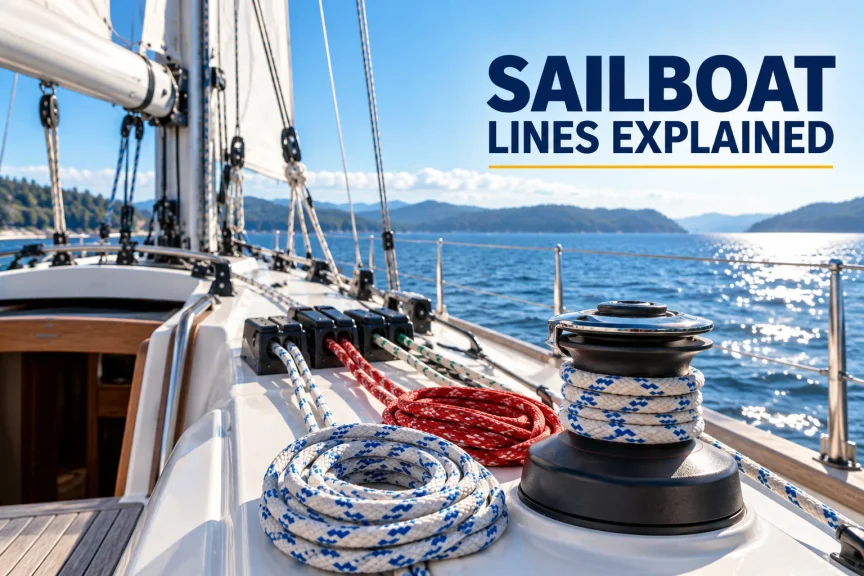
Walk onto a sailboat for the first time and one thing becomes obvious very quickly: there are lines everywhere.
Some disappear up the mast. Others run aft toward the cockpit. Two more lead from the headsail. Several are wrapped around winches or held by clutches. Meanwhile, another collection of lines may be lying on deck waiting for the boat to return to the dock.
To a beginner, they can all look like rope.
Fortunately, you do not need to memorize every line on every type of sailboat. Instead, the useful question is much simpler:
What job does this line do?
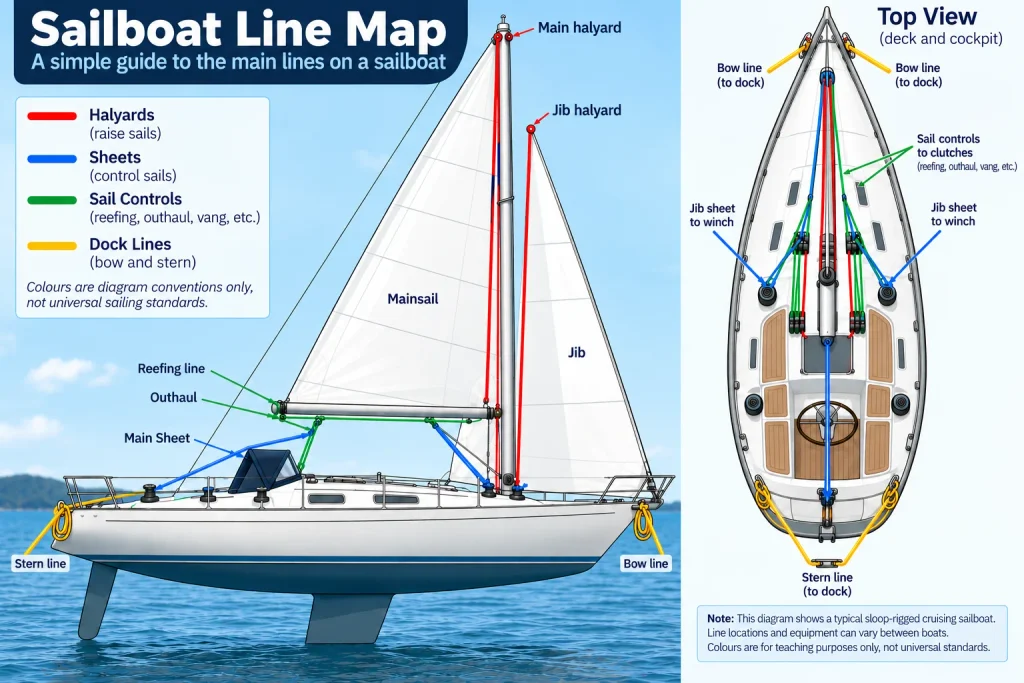
Once you begin identifying lines by function, the apparent tangle starts to make sense. A halyard raises a sail. A sheet controls a sail. A dock line controls the boat beside a dock. A reefing line helps reduce sail area. Different boats arrange these systems differently, but the underlying jobs remain recognizable.
That is the goal of this lesson. We are going to turn “all those ropes” into a small number of understandable systems.
Rope or Line: What Is the Difference?
You will sometimes hear the sailing rule that “there are no ropes on a boat.”
That is memorable, but it is a little too absolute.
Rope describes the cordage itself. Once a piece of rope is assigned a particular job aboard a boat, sailors generally call it a line. Therefore, a length of rope might become a dock line, halyard, sheet or another named control depending on how it is being used.
The important point is not to correct everyone who says “rope.” The important point is to understand why sailors use specific names.
Imagine that you are approaching a dock and the skipper says, “Grab that rope.”
Which one?
Now compare that with, “Prepare the bow line.”
The second instruction tells you both which line and what job it is about to perform.
The same principle appears throughout sailing. If terms such as mast, boom, bow, stern and rigging are still unfamiliar, review Parts of a Sailboat: Complete Beginner’s Guide before continuing. Those parts provide the physical map; the lines in this lesson are some of the controls that make that map work.
The Main Families of Sailboat Lines
Rather than learning a giant vocabulary list, begin by sorting lines according to what they do.
Running rigging includes movable lines used to raise, lower or control sails and related equipment. Halyards and sheets are the two names beginners will encounter most often.
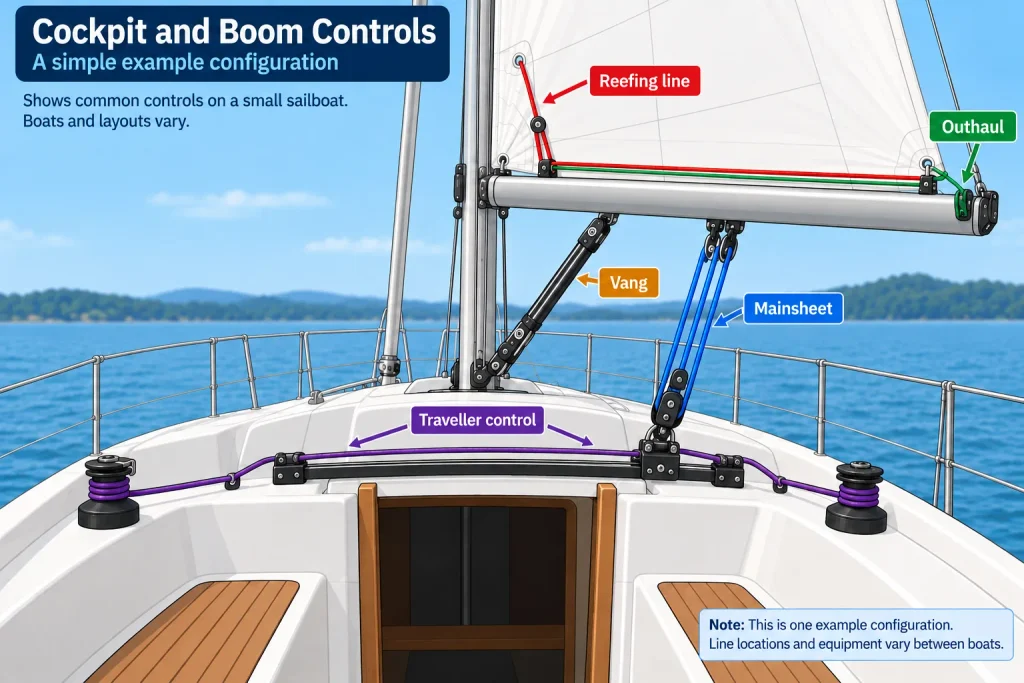
Sail-control lines adjust sail shape or sail-handling systems. Depending on the boat, these may include an outhaul, Cunningham, traveller controls, reefing lines, furling line and boom-vang control.
Dock lines secure or control the boat at a dock. Bow, stern and spring lines belong here.
Finally, an anchoring system may include rope, chain, or both. The complete connection between the boat and anchor is called the rode.
These categories are useful rather than perfectly rigid. For example, many sail-control lines are also part of the running rigging. Boats also vary enormously in how their controls are arranged.
That is why the best beginner habit is not: “memorize where every coloured line goes.”
Instead:
Learn the job first. Then learn the name.
Before working with these lines, it also helps to know how they are secured. SailboatZone’s Five Foundational Sailing Knots introduces the bowline, figure-eight knot, cleat hitch and other practical knots used around a sailboat.
Halyards and Sheets: The Distinction Every Beginner Should Know
If you remember only one terminology distinction from this lesson, make it this one:
A halyard primarily raises or supports a sail. A sheet primarily controls a sail’s angle and trim.
That simple distinction will make many later sailing instructions much easier to understand.
For the practical setup sequence, review How to Rig a Sailboat: The Complete Beginner’s Guide. It shows how halyards, sheets and other running rigging are organized before departure.
What Does a Halyard Do?
A halyard is a line used primarily to hoist and support a sail or, on some boats, another piece of equipment.
Consider the mainsail. On a common cruising sailboat, the mainsail halyard attaches near the head—the upper corner—of the sail. From there, the halyard runs upward toward the top of the mast, changes direction through a sheave or other masthead arrangement, and runs back down. Depending on the boat, the working end may be handled at the mast or led aft to the cockpit through organizers, clutches and a winch.
Pulling the halyard raises the sail. Easing it allows the sail to come down.
A headsail may have its own halyard as well. Therefore, hearing “jib halyard” should immediately suggest the line associated with raising or supporting the jib, not the line used to trim it.
The exact arrangement varies. Some boats use roller-furling headsails that remain installed for long periods, while others regularly hoist and lower individual headsails. However, the most useful beginner memory aid is more precise than simply thinking about direction: halyards hoist; sheets trim.
What Does a Sheet Do?
A sheet does a different job.
Sheets primarily control the angle of a sail relative to the boat and wind. Instead of raising the sail, you trim a sheet in or ease it out.
On many sailboats, the mainsheet controls the mainsail through a block-and-tackle system connected to the boom, directly or through a traveller arrangement. When you trim the mainsheet, you generally pull the boom and sail farther in. When you ease it, you allow the boom and sail farther out, subject to the boat’s point of sail and other controls.
A jib or genoa normally has two sheets, one led down each side of the boat. Only one may be carrying most of the working load during normal sailing. During a tack, however, the old working sheet is eased while the sheet on the new leeward side is trimmed.
That is why an instruction such as “ease the jib sheet” means something very different from “ease the jib halyard.”
One changes trim. The other changes hoist or luff tension.
Halyard vs. Sheet: A Simple Test
When you encounter an unfamiliar line, ask:
Does this line primarily raise/support the sail, or does it primarily trim/control its angle?
If it raises or supports the sail, you are probably dealing with a halyard.
If it trims the sail in and out, you are probably dealing with a sheet.
This is a better memory tool than trying to remember colours because line colours are not standardized from boat to boat.
Next, notice where the line leads. A halyard generally disappears toward the mast and sail head. A sheet generally leads from the clew or boom toward blocks, winches or another cockpit control point.
Later lessons will build directly on this distinction. The upcoming How to Use a Sailboat Winch Safely and How to Hoist, Lower, Furl and Change Sails lessons will show what happens when these lines are actually put to work.
Other Sail-Control Lines You May Meet
Halyards and sheets are the foundation, but they are not the whole story.
The outhaul pulls the clew of the mainsail aft along the boom and helps control tension along the sail’s foot.
A Cunningham, where fitted, tensions the mainsail luff from a point above the tack. Beginners do not need to become sail-shape technicians immediately; simply recognize it as another control rather than another halyard.
Traveller control lines move the mainsheet attachment system from side to side on boats fitted with a traveller.
A boom vang helps control the boom’s vertical movement and affects mainsail shape, particularly when the boom is eased.
A furling line operates a roller-furling system, allowing a sail to be rolled around its stay or into another furling system depending on the boat.
Finally, reefing lines form part of systems used to reduce sail area. SailboatZone’s How to Reef a Sailboat explains that process in detail. For now, recognize the principle: when a reefing line is called for, its job is connected to shortening or securing the sail in its reefed configuration.
The pattern should now be becoming familiar.
Do not begin with the name.
Begin with the job.
Dock Lines: Bow, Stern and Spring Lines
Dock lines deserve their own mental category because they are not primarily controlling sails. They are controlling the boat itself relative to the dock.
That sounds simple until four lines are attached to four cleats and they all appear to be doing roughly the same thing.
They are not.
Bow Line
A bow line leads from the forward part of the boat to the dock.
Its exact angle depends on the berth and how the boat is secured. Its primary beginner-level job is to restrain and position the bow relative to the dock. Depending on its lead, it can also contribute to limiting fore-and-aft movement, but that is not the role to memorize first.
Stern Line
A stern line leads from the aft part of the boat to the dock.
Likewise, its primary job is to restrain and position the stern relative to the dock. Its lead may also provide some fore-and-aft restraint. However, bow and stern lines work with the spring lines as a system rather than acting independently.
A beginner sometimes assumes that if the bow and stern are tied to the dock, the job is finished.
However, the boat can still move along the dock.
That is where spring lines become especially important.
Spring Lines Control Fore-and-Aft Movement
A spring line is led between the boat and dock so that its geometry resists fore-and-aft movement along the dock. It commonly leads diagonally rather than simply straight out from the boat.
Spring-line names can be confusing because conventions may describe where a spring originates or the direction in which it leads. You may hear terms such as forward spring, aft spring, bow spring or stern spring. Therefore, do not rely on the name alone. Trace the line and ask:
Which direction of boat movement will this line resist when it becomes tight?
One spring is arranged to limit the boat’s tendency to move forward. The opposing spring limits its tendency to move aft. Together, properly arranged dock lines keep the boat positioned instead of allowing it to surge back and forth.
BoatUS explains that spring lines help prevent a boat from moving fore or aft while secured alongside. That is the important beginner lesson: a spring line is not merely “another rope to the dock”; its lead gives it a specific job. See the BoatUS guide to dock lines for a practical example.
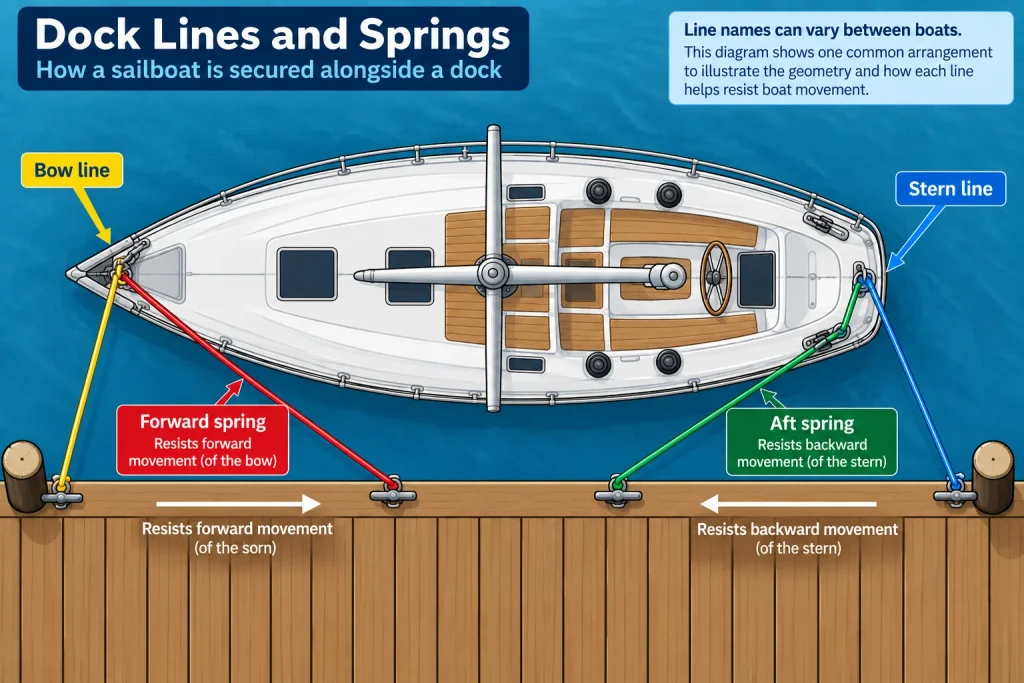
For the complete manoeuvring process, including wind, current, fenders, approach speed and aborting a poor approach, see How to Dock a Sailboat: A Step-by-Step Beginner’s Guide.
Anchor Line or Anchor Rode?
Anchoring introduces another useful term: rode.
The anchor rode is the complete connection between the boat and the anchor. It may be all chain, all rope in some applications, or a combination of rope and chain.
Therefore, calling every anchoring connection an “anchor line” can be imprecise. If part of the system is chain, the broader term rode describes the whole connection more accurately.
You do not need to master anchoring here. SailboatZone’s How to Anchor a Sailboat covers anchor selection, scope, setting and monitoring in detail.
How to Identify an Unfamiliar Line
Now imagine stepping aboard a sailboat you have never sailed before.
The halyards are different colours. The reefing system is unfamiliar. Several controls lead aft beneath a sprayhood. Labels may be faded—or missing entirely.
Guessing is a poor strategy.
Instead, use a four-step method:
Start at the job → trace the line → see where it leads → identify the control point.
First, identify what you are trying to operate. If you need the jib halyard, start by finding the jib and its hoisting arrangement.
Next, physically trace the line. Follow it through blocks, fairleads or deck organizers.
Then see where it ends. Does it lead to a winch? A clutch? A cleat? The mast?
Finally, confirm before loading it.
This habit is especially useful with reefing systems. The How to Reef a Sailboat lesson recommends tracing reefing lines at the dock before strong wind turns a simple identification problem into a stressful one.
Good skippers make this easier. They organize lines, keep working areas tidy, use sensible labels where helpful and brief the crew before a manoeuvre begins.
That is not cosmetic neatness.
It is a way of reducing mistakes.
Loaded Lines Can Be Dangerous
A line that looks harmless while lying loose on deck can behave very differently once it is carrying a heavy load.
Sheets can become highly loaded in strong wind. Halyards can carry substantial sail loads. Dock lines can load suddenly as wind, current or engine thrust moves the boat. Meanwhile, anchor rodes can come under significant tension as the boat pulls against the anchor.
Therefore, treat a loaded line as part of a force system—not simply as something to pull.
Never wrap a loaded line around your hand. Keep fingers away from winches, blocks, clutches, cleats and other pinch points. Likewise, avoid standing with a foot inside a coil or loop that could suddenly run out.
Transport Canada’s Personal Safety on Ships warns that ropes under strain during mooring or towing can whiplash with considerable force if they break and advises people to stand clear of danger areas, particularly rope bights. That guidance was written for commercial-vessel operations, but the underlying lesson transfers directly to recreational line handling: do not place your body where a suddenly moving line can trap, strike or drag you.
Transport Canada’s recreational-boating guidance also recommends briefing guests about the safe operation of the boat before heading out. In practice, line handling belongs in that briefing—not after a sheet or dock line is already under load.
The upcoming How to Use a Sailboat Winch Safely lesson will examine these loads and handling techniques in much greater detail.
From Vocabulary to Seamanship
Knowing the names is useful. Responding correctly when the boat is moving is better.
If the skipper says, “Ease the mainsheet,” you should know that the instruction concerns the mainsail’s trim.
If the skipper asks for the jib halyard, you should look for the line associated with hoisting or supporting the jib.
If you are approaching a dock and told to prepare the bow line, you should not grab the nearest convenient piece of rope.
And if you are asked to take up an aft spring, you should think about the boat’s movement along the dock and the lead of the line—not merely search for a particular colour.
That is the transition from vocabulary to seamanship.
Skipper Thinking: The Wrong Line at the Wrong Time
Imagine this situation:
You are approaching a dock. The skipper says, “Bow line ready.”
A beginner looks down, sees a line in the cockpit and grabs it.
Unfortunately, it is the jib sheet.
What went wrong?
The obvious answer is that the beginner did not know the line names. However, a developing skipper should look one level deeper.
Was the crew briefed before the approach? Were the dock lines already prepared? Was the bow line led clearly and ready to use? Were unused sailing lines organized? Could the crew identify the line by its job and routing, rather than colour?
Good seamanship does not rely on everyone making perfect decisions under pressure. Instead, it creates systems that make the correct action easier.
Before your next docking manoeuvre, ask yourself:
What can I organize now so nobody has to guess later?
Knowledge Check
Before moving on, make sure you can answer these without looking back:
What is the practical difference between rope and a named line?
What is the main difference between a halyard and a sheet?
Why can a headsail have two sheets?
What movement are spring lines especially useful for controlling?
What does the word rode mean in anchoring?
How should you identify an unfamiliar line aboard a new boat?
Name two places where a loaded line can create a pinch or entanglement hazard.
Summary
Sailboat lines become much easier to understand once you stop seeing them as a collection of ropes and start seeing them as tools with jobs.
Halyards primarily raise or support sails. Sheets primarily control sail trim. Other controls adjust sail shape, furling and reefing systems. Bow and stern lines help position the ends of the boat at the dock, while spring lines are especially important for controlling fore-and-aft movement. The anchor rode connects the boat to the anchor and may contain rope, chain or both.
Finally, line handling is not just vocabulary. Trace unfamiliar lines instead of guessing, keep the working area organized, communicate clearly and respect any line under load.
That is how a beginner becomes useful crew—and how useful crew begins to think like a skipper.
Quiz
1. Once rope is assigned a specific job aboard a sailboat, what is it generally called?
A. Cable
B. Line
C. Stay
D. Tackle
2. Which statement best describes a halyard?
A. It primarily raises or supports a sail.
B. It secures the stern to a dock.
C. It controls the boat’s anchor.
D. It primarily turns the rudder.
3. What is the primary job of a sheet?
A. To raise the mast
B. To measure water depth
C. To control sail angle and trim
D. To secure the anchor
4. Why does a jib commonly have two sheets?
A. One is always a spare.
B. They allow the sail to be controlled on either tack.
C. One raises the jib and one lowers it.
D. Both must always carry equal load.
5. What are spring lines especially useful for controlling?
A. Mast bend
B. Fore-and-aft movement along the dock
C. Anchor depth
D. Sail height
6. What is an anchor rode?
A. Only the rope section of an anchoring system
B. Only the chain section
C. The complete connection between boat and anchor
D. A knot used on the anchor
7. What is the best first response when you cannot identify a line?
A. Pull it gently and see what moves.
B. Choose by colour.
C. Trace it and determine its job and routing.
D. Leave every line untouched.
8. Which is safest around a loaded line?
A. Wrap it around your hand for grip.
B. Stand inside a loose coil.
C. Keep hands and feet clear of bights and pinch points.
D. Hold it beside a loaded winch.
9. The skipper asks for the bow line during docking. What should you prepare?
A. The jib sheet
B. A line intended to control or secure the forward part of the boat
C. The mainsail halyard
D. The furling line
10. What is the most useful beginner principle for learning sailboat lines?
A. Memorize every line colour.
B. Learn the job first, then the name.
C. All boats use identical line layouts.
D. Only the skipper needs to know line names.
Quiz Answer Key
1. B — Line. Once rope has a specific job aboard, sailors generally refer to it as a line with a functional name.
2. A — It primarily raises or supports a sail. Think “hoist” when you hear halyard.
3. C — To control sail angle and trim. Sheets are trimmed in and eased out as the sail is adjusted.
4. B — They allow the sail to be controlled on either tack. During a tack, one jib sheet is eased and the other becomes the working sheet.
5. B — Fore-and-aft movement along the dock. The diagonal lead of spring lines makes them especially useful for limiting surging forward or aft.
6. C — The complete connection between boat and anchor. A rode may be rope, chain, or a combination.
7. C — Trace it and determine its job and routing. Never rely only on colour or guesswork.
8. C — Keep hands and feet clear of bights and pinch points. Loaded lines can move suddenly and with substantial force.
9. B — A line intended to control or secure the forward part of the boat. The instruction identifies the line by its docking function.
10. B — Learn the job first, then the name. Function is the most transferable way to understand line systems across different sailboats.
How Did You Do?
9–10 correct — Excellent. You have a strong beginner understanding of the major line families and can distinguish the most important functions.
7–8 correct — Good work. You understand the fundamentals. Review halyards versus sheets and the different dock-line jobs before moving on.
5–6 correct — Almost there. Revisit the line map, docking geometry and trace-the-line method. Concentrate on what each line actually does.
0–4 correct — Give the lesson another read. Focus first on three ideas: halyards hoist, sheets trim, and dock lines control the boat relative to the dock. Then rebuild from there.