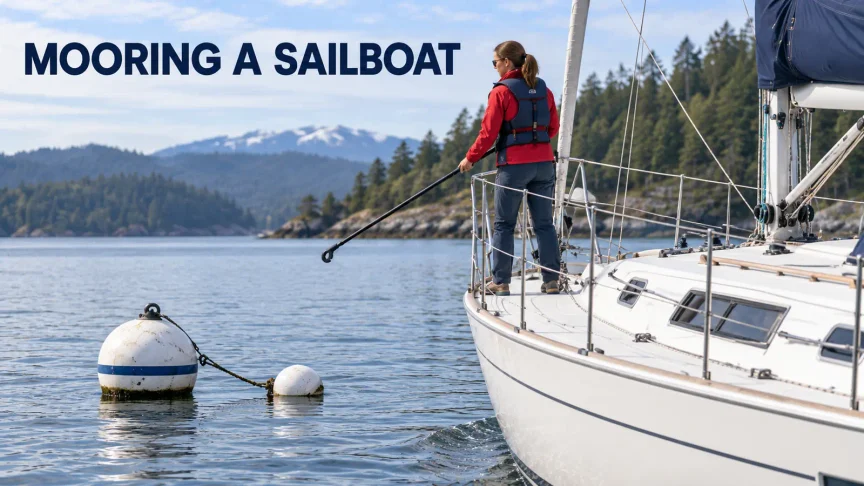
A mooring pickup can look deceptively simple: approach a buoy, catch a line and secure the boat.
But the buoy is only the visible part of a larger system. Wind and current may be pushing the boat in different directions. The line you retrieve may not be the line intended to hold the boat. Nearby vessels may swing differently, and a mooring that appears vacant may be privately owned, unsuitable for your boat or unavailable in the expected weather.
Good mooring is therefore not a test of whether the bow crew can reach far enough with a boat hook. It is a controlled boat-handling exercise built around assessment, preparation, communication and an early willingness to abandon a poor approach.
By the end of this lesson, you should understand how a mooring works, how to prepare the boat and crew, how to make a controlled approach under power or sail, how to secure and inspect the boat, and how to leave without putting a line near the propeller.
Beginner principle: Arrive slowly enough that a missed pickup remains an ordinary second attempt—not an emergency.
Quick Summary: How to Pick Up a Mooring
Use this sequence:
ASSESS → PREPARE → APPROACH → SECURE → CHECK
Before entering the mooring field, confirm that the mooring is available and suitable. Observe how nearby boats lie to the wind and current. Prepare the boat hook, lines and crew while there is still room. Approach at minimum controllable speed, usually toward the force that is most strongly controlling the boat. Bring the bow to the pickup point rather than driving over it. Retrieve the pickup system, transfer the load to the correct mooring pendant and suitable bow strong points, then check the attachment, chafe, depth and swinging room.
At any stage, if control or margin is being lost:
ABORT → MOVE CLEAR → RESET → TRY AGAIN OR CHANGE THE PLAN
What Is a Mooring?
In this lesson, mooring means a swing mooring or mooring-buoy system secured to the seabed. In broader maritime use, mooring can also describe securing a vessel to a dock, pier or other fixed structure. Mooring-buoy systems may be permanent, seasonal or installed temporarily for a particular use, but their holding components remain in place rather than being carried and deployed as the boat’s own anchor.
The terms are easy to mix up:
- A mooring is the entire holding system.
- A mooring buoy is the floating, visible part that marks or supports part of the system.
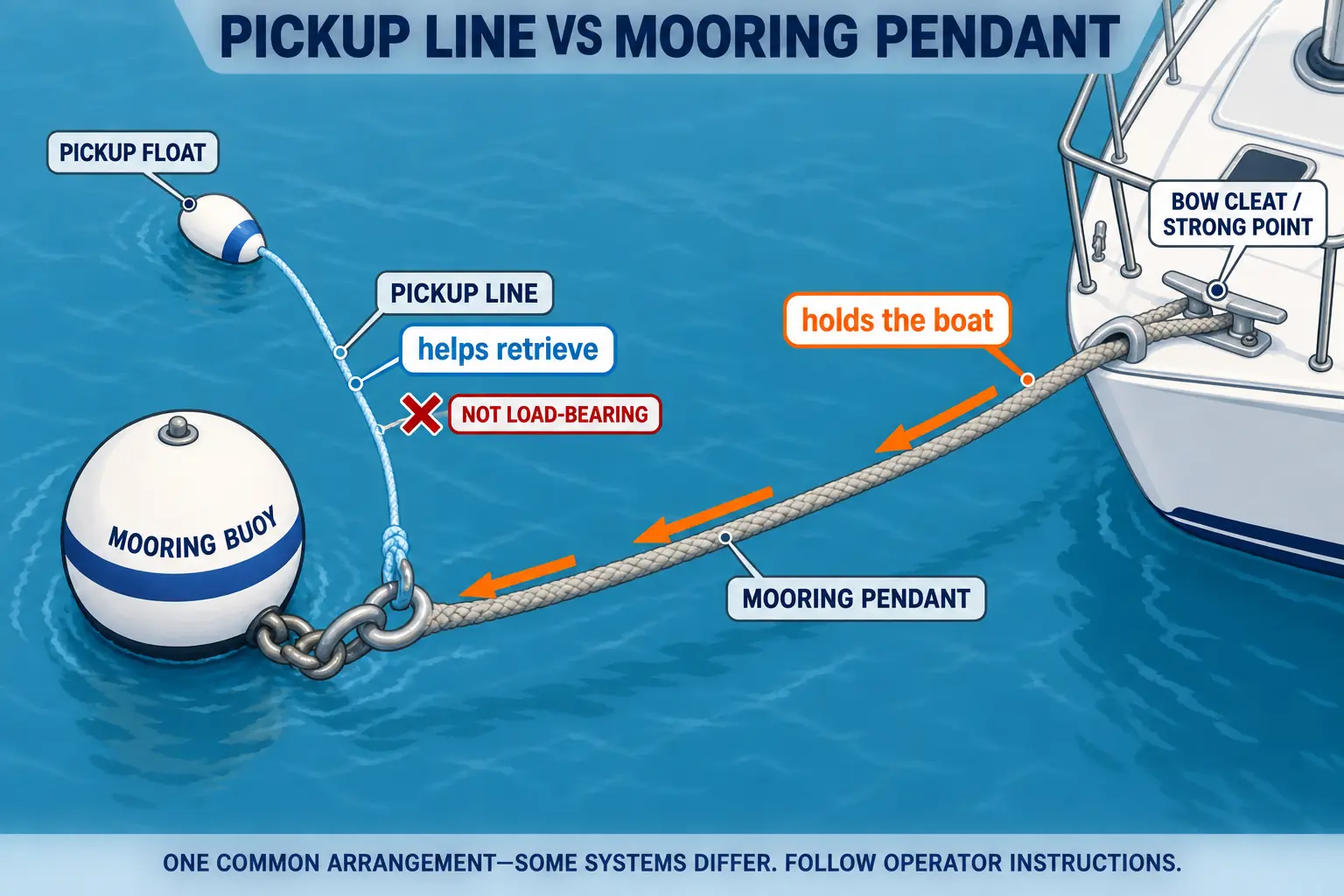
- A pickup buoy or pickup float helps the crew retrieve a line or pendant.
- A pickup line is normally used to bring the load-bearing part of the system aboard. It may not be designed to hold the yacht.
- A mooring pendant—also commonly called a mooring pennant—is the line or assembly that connects the mooring to the boat.
- Ground tackle is the equipment below the buoy, which may include a block, anchor, chain, rode, shackles and a swivel.
- An anchor is carried by the boat and deployed by its crew. A permanent mooring remains installed at its location.
- A dock or slip secures the boat beside a fixed or floating structure rather than allowing it to swing around one point.
Moorings vary considerably. Some have a clearly marked pickup float attached to a heavy pendant. Some present a ring or eye through which the visiting boat must lead its own line. Some use one pendant, while others use two. Never assume that the arrangement on one mooring will be repeated on the next.
How a Mooring System Holds the Boat
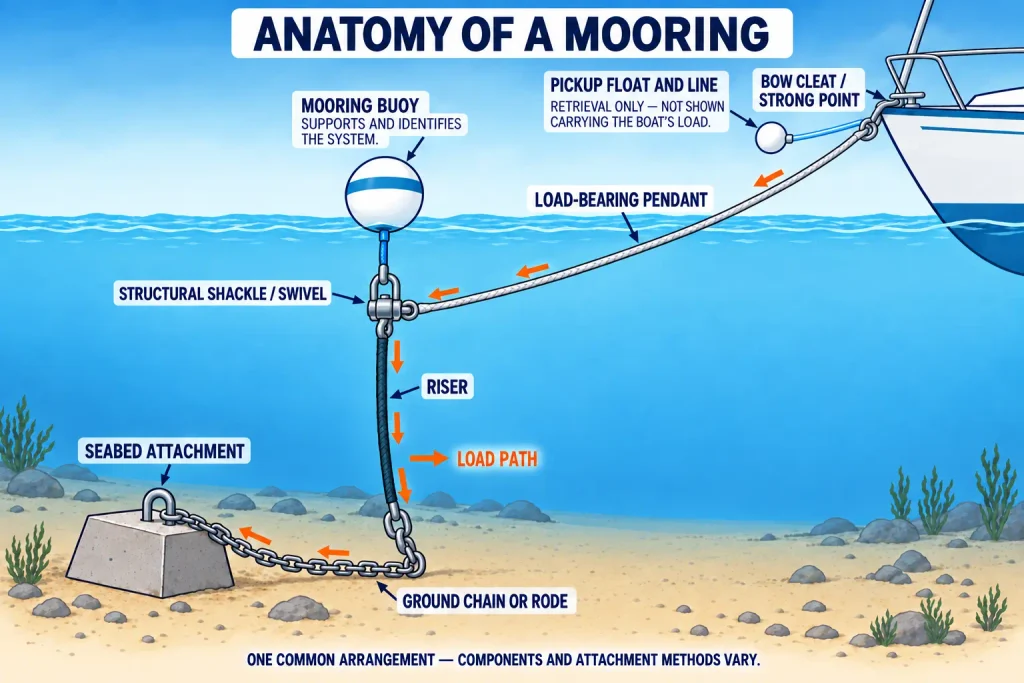
A typical permanent mooring may include:
- a seabed anchor, helical screw or heavy block;
- ground chain or another rode;
- shackles and, in some systems, a swivel;
- riser chain or line leading toward the surface;
- a mooring buoy;
- a pickup line or pickup float; and
- one or more load-bearing pendants connected to the yacht.
The important idea is the load path. Wind, current and waves load the boat. That load travels from a suitable bow strong point, through the pendant and the rest of the mooring tackle, to the seabed attachment.
The pickup float, light retrieval line and boat hook may help you reach the system, but they are not necessarily part of that load path. Do not leave the yacht hanging from a light pickup line unless the mooring operator has specifically designed and identified it for that purpose. Never use the boat hook as a load-bearing connection.
The same habits taught in Sailboat Lines Explained apply here: identify what each line does, keep it properly led, protect hands from loaded lines and never wrap a line around a hand or limb.
Before You Use Any Mooring
An empty buoy is not automatically available, and a buoy that can physically be reached is not automatically suitable.
Before committing, determine:
- who owns or operates the mooring;
- whether permission, registration, payment or a reservation is required;
- the maximum permitted vessel length, displacement or wind conditions;
- whether rafting another boat is prohibited;
- whether the water will remain deep enough through the full tidal range;
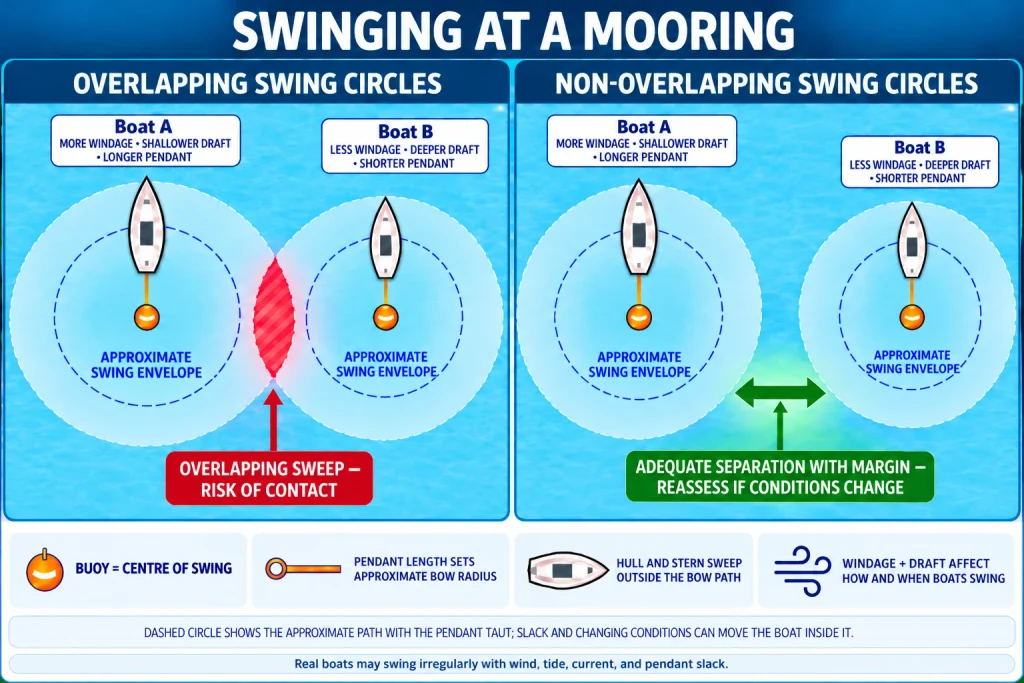
- whether your boat has enough room to swing without contacting another vessel, shore, a shoal or an obstruction;
- what weather and sea conditions are expected;
- whether the visible buoy, pickup gear and pendant appear serviceable; and
- what is known—and not known—about the underwater tackle.
Local rules can be very specific. For example, Parks Canada’s Gulf Islands boating guidance publishes vessel-size limits for its mooring buoys, changes those limits with wind strength, prohibits rafting and explains when fees apply. Treat the operator’s current instructions as part of the mooring system, not as optional fine print.
You cannot fully inspect underwater components from the deck. If the mooring’s ownership, rating, maintenance or condition is unknown, do not treat its presence as proof that it can hold your boat. Choose a known, authorized mooring or another safe option.
Read Wind, Current and Boat Motion
Beginners are often told to approach “into the wind.” That is frequently useful, but it is not a universal rule.
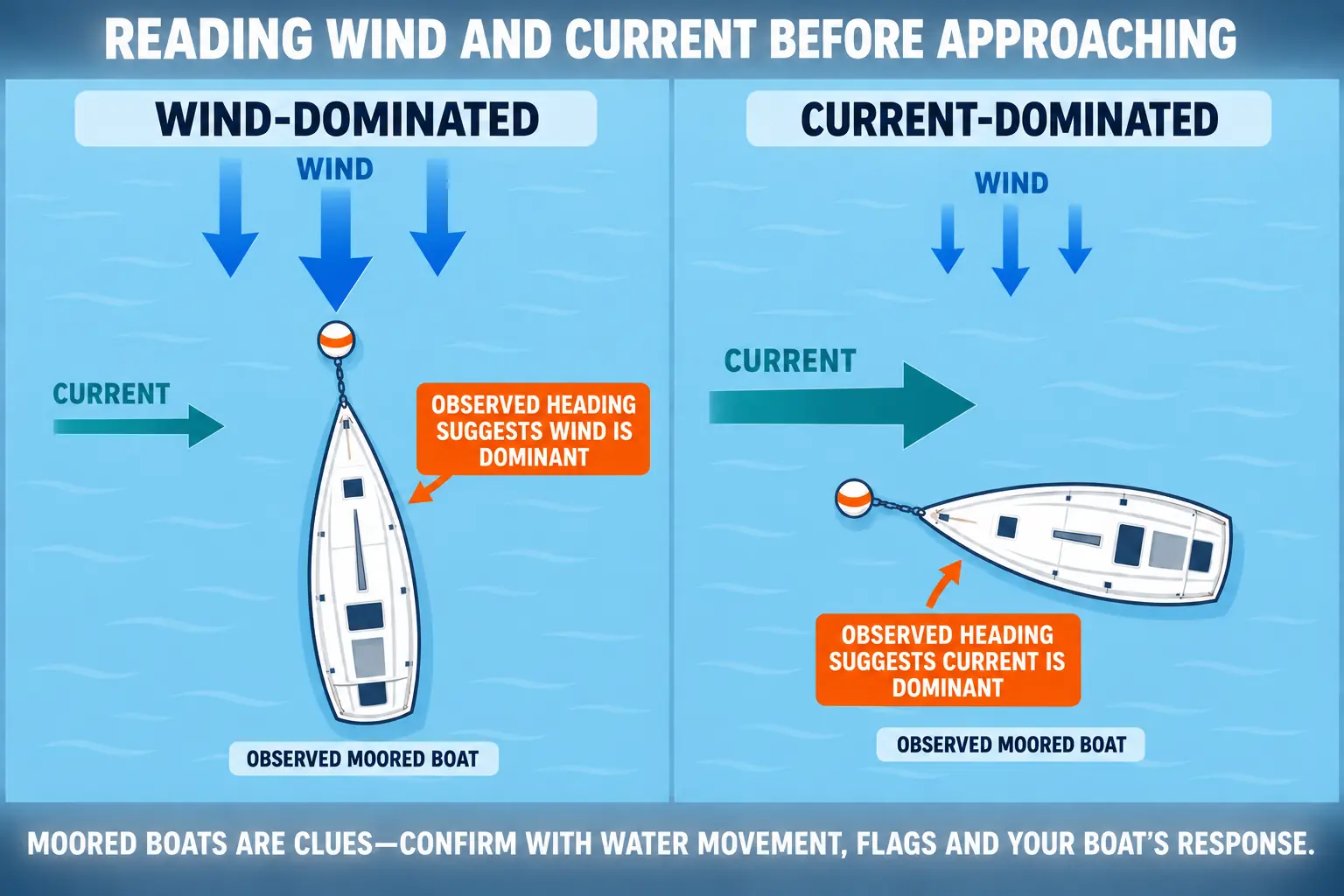
Wind acts most strongly on the hull, rig and other surfaces above the water. Current acts on the hull, keel and rudder below the water. Either may dominate, and the dominant force may change across a mooring field or during the approach.
Use several clues:
- flags, ripples, telltales and anchored or moored boats can indicate wind;
- floating weed, wake patterns and fixed objects can reveal current;
- nearby boats show the combined result of wind and current;
- the way your own boat drifts at low speed provides another clue.
Do not assume every neighbouring vessel will point the same way. A light powerboat with high windage may respond differently from a deep-keel sailboat. Boats on different-length moorings may also occupy different parts of their swing circles.
The lessons in How Sailboat Steering Works explain why you need water flow across the rudder for steerage and why the stern sweeps sideways during a turn. Both effects matter in a crowded mooring field.
Plan Before Entering the Mooring Field
Slow down and prepare while you still have room. A rushed crew on the bow is often evidence that the planning began too late.
Identify the mooring and the hazards
Confirm the intended buoy from a safe distance. Look for shallow water, rocks, shorelines, unoccupied pickup lines, dinghies, swimmers, traffic and boats that may swing across your path. Continue the full scan described in How to Keep a Proper Lookout While Sailing; staring only at the target buoy creates dangerous task fixation.
If you must enter a marked or constrained mooring area, use the chart and Aids to Navigation for Beginners to confirm the safe approach rather than treating the buoy field itself as proof of adequate depth.
Choose the approach and escape route
Plan an approach that lets the dominant wind or current help remove speed as you near the pickup. Decide which side of the bow the crew will work from and what the helm will do if the pickup is missed.
Your escape route should lead into clear water without crossing another mooring line, reversing toward a person or forcing a sharp turn beside another boat. The decision habits developed in Route Hazards and Route Evaluation apply on this smaller scale: compare the direct route with the route that preserves depth, clearance and a way out.
Prepare the boat and brief the crew
Before the final approach:
If approaching under power, lower or furl the sails in open water before entering the mooring field unless the skipper is deliberately using a boat-specific procedure that keeps a sail available. Do not wait until the final approach to deal with flogging sails, sheets or halyards.
- ready the boat hook and any vessel-supplied line;
- clear the foredeck of loose gear and trip hazards;
- open lifeline gates only if the boat’s procedure requires it and doing so is safe;
- rig fenders where incidental contact is possible, but never use them to justify an approach that lacks safe clearance; if contact with another boat appears likely, abandon the approach;
- identify the correct bow strong points and fairleads;
- ensure the mooring line can be led without crossing lifelines or sharp edges;
- assign one person to the bow and one to the helm when crew are available;
- agree on short commands and hand signals; and
- confirm what “secured” will mean.
Useful bow-to-helm calls include:
- “Buoy two boat lengths ahead.”
- “Buoy on port bow.”
- “One metre ahead.”
- “Stop.”
- “Pickup line aboard—not secured.”
- “Pendant on the cleat—secure.”
- “Missed—go around.”
“I have it” is too vague. Does the crew have the float, the light pickup line, the actual pendant or a fully loaded attachment? Say what is true.
Transport Canada’s pre-departure guidance reinforces the larger habit: check weather and local restrictions, carry appropriate charts and brief guests before getting underway. Those checks still matter when the day’s destination is a mooring rather than a dock.
Keep the Bow Crew Safe
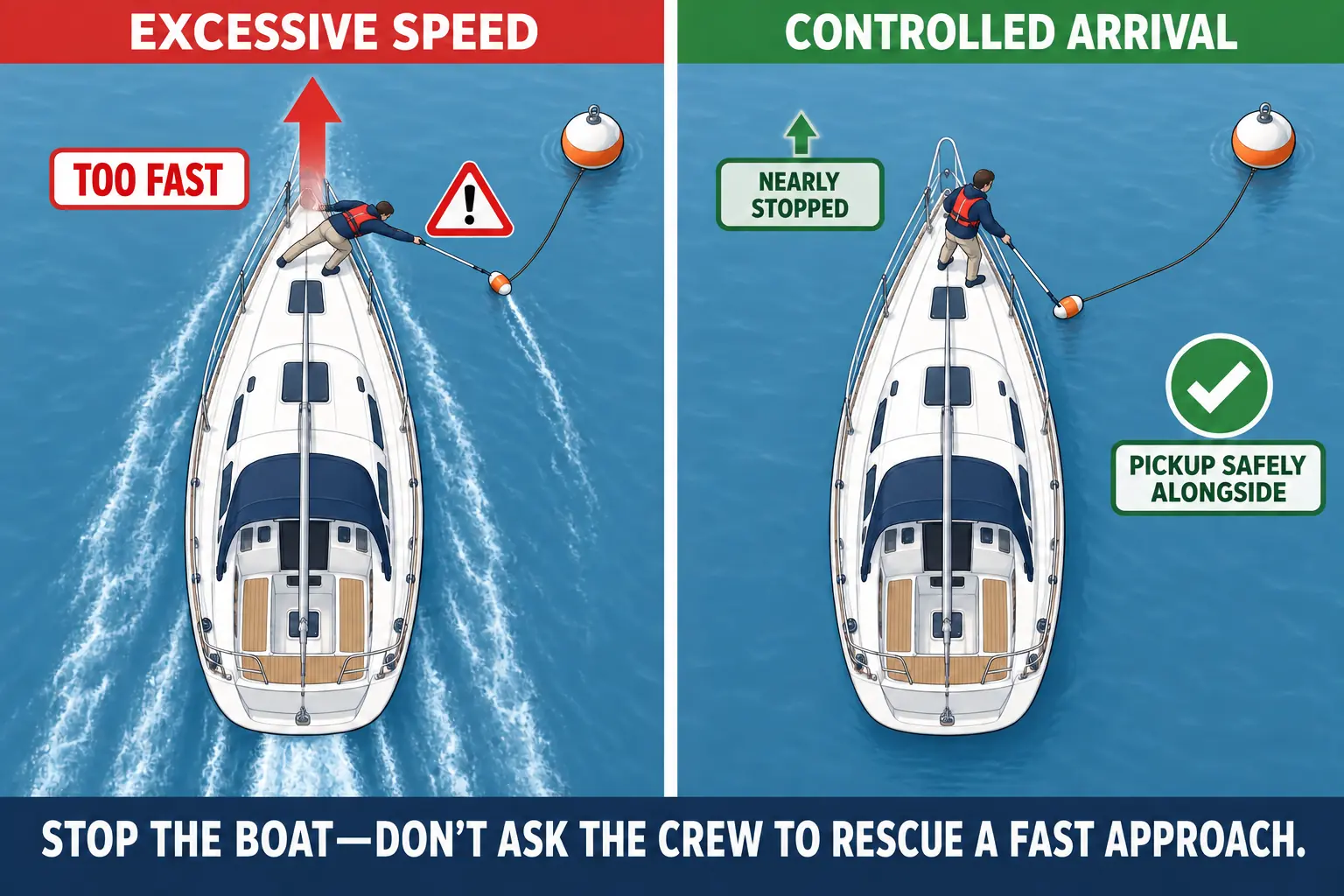
The bow crew’s job is to retrieve and secure the correct equipment—not to rescue a fast or badly aligned approach.
The crew member should:
- wear an appropriate PFD or lifejacket;
- work from a stable position with secure footing;
- remain inside the lifelines unless the vessel’s safe procedure specifically requires otherwise;
- communicate continuously with the helm;
- reach with the boat hook without leaning dangerously;
- keep fingers away from cleats, fairleads and loaded line;
- never wrap a line around a hand;
- avoid standing in a bight of line; and
- let go rather than be pulled overboard.
Do not ask the bow crew to jump onto a buoy, another boat or a slippery structure. If the pickup is out of safe reach, the approach has not succeeded. Go around.
Make a Controlled Approach Under Power
No single throttle setting or approach angle works for every boat. Propeller location, windage, keel shape, steering system and engine response all matter. Practise on the actual boat in benign conditions.
1. Approach from outside the field
Line up early enough to make small corrections. Keep enough distance from other vessels to account for their swing and your own stern movement.
2. Reduce speed early
Use minimum controllable speed: enough water flow for useful steering, but as little momentum as practical. Shift into neutral early enough to learn how far the boat coasts. A short application of reverse may help some boats stop, but reverse response, prop walk and reduced rudder authority vary.
3. Let the dominant force help stop the boat
Approach generally into the force that is controlling the boat so that reducing propulsion allows the boat to lose speed rather than accelerate sideways or downwind. Keep watching the boat’s actual motion; do not cling to a plan disproved by what you see.
4. Put the bow beside the pickup point
The objective is not to hit the buoy. Bring the working side of the bow close enough for a safe pickup while keeping the buoy and floating lines visible. Avoid driving directly over the system.
5. Stop the boat—not the crew
Arrive with little or no forward motion. The bow crew should be able to lift the pickup line rather than arrest the yacht’s momentum with arms, hook or line.
6. Keep propulsion away from loose lines
Once a floating line is close to the hull, know where it is before engaging the propeller. If its position is uncertain, do not reverse blindly. A fouled propeller can remove propulsion precisely when you need control and may put anyone attempting to clear it in danger.
Pick Up the Mooring and Transfer the Load
Getting hold of the pickup system is not the same as securing the boat.
The exact procedure depends on the mooring. Some systems provide a pendant eye that goes directly over a bow cleat; others require the visiting boat’s own line to be passed through a thimble or ring and returned to the boat. Follow the operator’s instructions rather than transferring one method to another system.
The usual logic is:
- Retrieve the pickup float or line with the boat hook.
- Bring the actual mooring pendant, eye or attachment aboard.
- Keep the boat hook unloaded; it is a retrieval tool.
- Lead the load-bearing connection through the proper fairlead to a suitable bow cleat or other designated strong point.
- If the mooring requires your own line through an eye, use the arrangement specified by the operator or boat procedure.
- Transfer the load gradually and confirm that the intended component—not merely a light pickup line—is holding the boat.
- Tell the helm clearly when the yacht is truly secure.
Avoid improvising a line path that bears against lifelines, pulpits, stanchions, sharp edges or fittings not designed for mooring loads. If the system requires two pendants or a bridle, use the specified arrangement. Do not assume that doubling a line in an unapproved way automatically makes the system safer.
Check the Boat After Securing
Do not walk away as soon as the line reaches the cleat. Let the boat settle back and inspect the entire situation.
Check:
- Attachment: Is the correct pendant or approved line secured to a suitable strong point?
- Lead: Does the line pass cleanly through the intended fairlead without loading lifelines or weak fittings?
- Chafe: Is the line rubbing against a rough edge, bow roller or fitting as the boat moves?
- Redundancy: If the system calls for two pendants or a backup, are they rigged correctly without interfering with each other?
- Depth: Will the keel and rudder remain clear at the lowest expected water level?
- Swing: Is there adequate separation from boats, buoys, shore and obstructions through the likely swing circle?
- Weather: Is the mooring still suitable for the strongest expected conditions—not merely the conditions at arrival?
- Boat condition: Are halyards quiet, sails secured, loose gear stowed and hatches arranged appropriately?
Watch long enough to see how the boat behaves. Nearby vessels may not swing at the same rate or in the same direction. A safe gap at one moment can shrink as wind, current or tide changes.
If You Miss the Mooring
A missed pickup is not an emergency.
If the bow crew misses, cannot identify the correct line or cannot reach safely:
- call “missed” immediately;
- stop trying to salvage the pickup;
- maintain control and move into the planned escape route;
- keep the propeller clear of floating lines;
- regain open water;
- reset the boat and crew; and
- decide whether to repeat, change the approach, choose another mooring or stop.
Abandon early. Waiting until the buoy disappears under the hull, the bow blows sideways or the boat is beside a neighbour leaves fewer safe options.
Do not reverse simply because you have passed the pickup. The line may now be under the boat. Move clear using the safest available direction, verify where the line is and then reset.
Mooring Under Sail
Picking up a mooring under sail demands more accurate prediction because the engine is not available to correct speed or recover from a poor final position.
Before attempting it:
- choose benign conditions and ample open water;
- confirm that the crew and boat can perform the manoeuvre safely;
- reduce sail early enough to control power;
- select a final approach that allows the boat to luff or otherwise depower;
- preserve enough speed for steerage without carrying excess momentum;
- leave room to bear away, tack or circle for another attempt; and
- prepare the mooring equipment before the final run.
The principles in How Sails Work help explain why heading toward the wind reduces sail drive, while How to Hoist, Lower, Furl and Change Sails provides the preparation needed to reduce or control sail without creating a foredeck tangle.
Do not plan to stop by crashing the sail into the wind at the last possible moment. Depower progressively and expect momentum to carry the boat after drive is reduced. It is generally safer to stop short with room to make another approach than to overshoot into the mooring or another yacht.
Strong Wind, Strong Current and Changing Conditions
As wind or current increases:
- the boat accelerates more quickly when control is lost;
- stopping distance and sideways drift become harder to judge;
- loads rise on the pendant, fittings and crew;
- the safe time for correcting a poor approach shrinks; and
- the consequences of a fouled line or missed pickup increase.
If strong wind is already testing sail balance or crew confidence, review How to Sail in Strong Winds before adding a close-quarters pickup. Reduce sail before entering, or use another suitable method if the boat and conditions allow.
A buoy being available does not mean you must use it. Select another mooring with more room, wait for conditions to moderate, anchor in a suitable location, return to a dock or change the destination. Deciding not to attempt the manoeuvre can be the best evidence of good seamanship.
Leave a Mooring Deliberately
Departure deserves the same preparation as arrival.
Before releasing
- observe wind, current, traffic and the movement of nearby boats;
- choose the intended departure direction and an alternate;
- brief the crew;
- prepare the engine and confirm it is operating normally, or prepare the appropriate sails if leaving under sail;
- remove unnecessary secondary lines while retaining a secure final connection;
- confirm that no line can fall near the propeller, keel or rudder; and
- establish which person will release the final connection and how they will report it.
The planning sequence in How to Leave the Dock transfers directly: understand the forces first, release the final restraint deliberately and establish steerage before entering traffic.
Release and move clear
Release the final line only when the helm is ready and the path is clear. Feed or drop the pendant so that it remains ahead and clear of the boat rather than being dragged along the hull. Confirm verbally that all lines are in the water and clear.
Allow the boat to fall or move into a safe orientation as planned, then apply only the propulsion or sail power needed to establish control. Keep looking astern and to both sides. Do not accelerate through the mooring field merely because the boat is no longer attached.
Common Mooring Mistakes
- Approaching too fast: Excess momentum forces the bow crew to absorb the boat’s motion and leaves the helm less time to respond.
- Looking only at the buoy: Task fixation hides traffic, shallow water, swing and a disappearing escape route.
- Assuming wind always controls the boat: Current may dominate or combine with wind to create an unexpected approach angle.
- Expecting the bow crew to save the manoeuvre: Overreaching or hanging onto a loaded hook or line risks injury without correcting the approach.
- Confusing pickup line with pendant: Retrieving something does not mean the yacht is attached to the load-bearing system.
- Driving or reversing over floating line: The propeller, rudder or keel may become fouled.
- Using a weak or poorly led attachment: Lifelines, stanchions and unsuitable fittings cannot replace designated strong points.
- Ignoring chafe and swing: A safe-looking connection can become unsafe as the boat moves through tide and weather changes.
- Assuming a vacant mooring is usable: Ownership, authorization, capacity and underwater condition still need confirmation.
- Forcing a deteriorating approach: “Almost reachable” is not a reason to give up control and escape room.
Skipper Thinking: Five Mooring Decisions
These situations do not test whether you remember a fixed set of helm movements. They test whether you can preserve control and margin as the situation changes.
Scenario 1: A strong crosswind
The intended mooring is open, but a gusty crosswind is setting your boat toward a neighbouring yacht. The direct approach leaves little room on the downwind side.
Your decision: Continue, change the approach, abort and reset, or select another mooring?
Notice: Available downwind clearance, gust strength, the neighbour’s swing, your stopping ability and whether a clean escape route remains.
Preferred reasoning: Do not begin or continue an approach that depends on the bow crew making a perfect pickup before the boat reaches the neighbour. A different approach may be defensible if it creates a reliable stop and escape route. Otherwise, choose another mooring or abandon the attempt.
What changed? If the wind eases and a wider mooring becomes available, does the preferred decision change? If the gusts strengthen, how much earlier should the decision be made?
Scenario 2: Wind and current disagree
Your wind indicator suggests approaching from the west. Several deep-keel sailboats, however, lie with their bows northwest, and floating weed is moving southeast.
Your decision: Which evidence should shape the final approach?
Notice: The nearby boats reveal the combined result of wind and current. Their design may differ from yours, so use their behaviour as evidence rather than an exact prediction.
Preferred reasoning: Make a cautious observation pass or pause in clear water to see how your own boat drifts. Build the approach around the force actually controlling the boat, not the wind arrow alone.
What changed? What if the tide turns during your stay and the boats begin lying in different directions?
Scenario 3: The crew misses the pickup
The bow crew misses. The buoy is moving down the starboard side and will soon disappear from view. The skipper considers reversing to bring it back.
Your decision: What happens next?
Notice: The location of the floating line is now uncertain, and reverse propulsion could draw it toward the propeller.
Preferred reasoning: Call the miss, follow the escape route and move clear without blindly reversing across the mooring. Reset for another attempt.
What changed? If the crew safely controls the pickup line but has not reached the pendant, what must be communicated to the helm?
Scenario 4: The unknown mooring
A vacant buoy is conveniently located, but it has no readable identification. No one aboard knows its owner, rating, maintenance history or rules.
Your decision: What information is required before relying on it?
Notice: Availability, permission, boat limits, depth, swing room, forecast conditions, visible condition and unknown underwater condition.
Preferred reasoning: Do not use the buoy merely because it exists. Confirm it through the harbour, marina, park or owner. If its suitability cannot be established, use a known alternative.
What changed? Would a calm afternoon make the unknown underwater tackle reliable? No. Lower loads reduce immediate demand, but they do not establish ownership, condition or capacity.
Scenario 5: Conditions are deteriorating
Two approaches have failed. The crew is tense, the wind is building and the boat is being set closer to other vessels on each pass.
Your decision: Try again immediately or stop?
Notice: Fatigue, communication quality, shrinking room, rising loads, changing drift and the availability of safer alternatives.
Preferred reasoning: Move to open water and reassess. A third attempt is reasonable only if the cause of the failures can be corrected and adequate margin remains. Otherwise, choose another plan.
What changed? If the crew identifies that the wrong pickup side was prepared and the boat can safely reset in open water, another attempt may be reasonable. If the wind is still rising, the larger change may outweigh that correction.
Practise in Benign Conditions
Use an instructor or experienced skipper, a suitable boat and a lightly occupied mooring area with permission. Build the skill progressively:
- Observe how different moored boats lie and swing.
- Identify wind and current clues.
- Practise minimum-controllable-speed steering and stopping in open water.
- Choose a suitable mooring and plan both approach and escape route.
- Prepare equipment and brief the crew.
- Make an approach but deliberately abort while plenty of room remains.
- Discuss whether the escape route worked.
- Make a second controlled approach.
- Retrieve the pickup system and secure the correct pendant.
- Inspect line lead, chafe, depth and swing.
- Plan and complete a controlled departure.
The deliberate abort is essential. It turns “going around” from an improvised reaction into a practised boat-handling skill.
Knowledge Check
- What is the difference between a pickup line and a load-bearing mooring pendant?
- Why might a boat not lie exactly head-to-wind on a mooring?
- What should the skipper identify before beginning the final approach, in addition to the target buoy?
- The bow crew has retrieved a small pickup float. What must happen before the helm can assume the boat is secure?
- Why can reversing after a missed pickup be dangerous?
- Name four checks to make after the boat is attached.
- Two approaches have failed and the wind is increasing. What facts would support ending the attempt rather than trying again?
If any answer depends on the bow crew using strength, leaning farther or catching the buoy at all costs, revisit the sections on approach control and missed pickups.
Summary and Key Takeaways
- A mooring is a complete holding system; the buoy is only its visible part.
- Confirm ownership, permission, capacity, depth, forecast conditions and swing room before relying on a mooring.
- Observe how the boat actually responds to wind and current instead of following one universal approach direction.
- Prepare equipment, crew communication and an escape route before the final approach.
- Arrive at minimum controllable speed and bring the bow beside the pickup without driving over floating lines.
- The bow crew should retrieve the system, not stop the yacht.
- Distinguish the pickup line from the load-bearing pendant.
- Attach the boat to suitable strong points with clean line leads and chafe protection as required.
- Keep every line clear of the propeller, rudder and keel.
- A missed pickup is a reason to move clear and reset, not to force the manoeuvre.
- After securing, reassess attachment, chafe, depth, swing, weather and neighbouring boats.
- Good seamanship includes deciding that the mooring or conditions are not suitable.
Quiz
1. What does the term “mooring” normally describe?
A. Only the floating buoy
B. The complete fixed holding system
C. Any anchor carried aboard
D. A dock line tied to shore
2. What is the safest assumption about a light pickup line?
A. It is always designed to hold the yacht overnight
B. It is stronger than the pendant
C. It may only retrieve the load-bearing part of the system
D. It should be tied to a lifeline
3. A nearby flag indicates wind from the west, but most deep-keel boats lie northwest. What is the best response?
A. Ignore the boats because flags are always more accurate
B. Approach from the west at high speed
C. Investigate the combined effect of wind and current before choosing the approach
D. Approach from whichever direction is shortest
4. Put these actions in the best general order.
A. Secure → assess → approach → prepare → check
B. Assess → prepare → approach → secure → check
C. Prepare → secure → assess → check → approach
D. Approach → assess → secure → prepare → check
5. The bow crew misses the pickup and the line disappears beside the hull. What should the helm normally avoid?
A. Calling the miss clearly
B. Moving into the planned escape route
C. Reversing blindly near the line
D. Resetting for another approach
6. True or false: An apparently vacant mooring may be used if the weather is calm.
7. What is the bow crew’s primary role during the final approach?
A. Stop the moving yacht with the boat hook
B. Compensate for any helm error
C. Retrieve and secure the correct mooring equipment from a safe position
D. Stand outside the lifelines for better reach
8. Which attachment is generally most appropriate?
A. A designated pendant led to a suitable bow strong point
B. A pickup float tied to a stanchion
C. A boat hook wedged under a cleat
D. A light line wrapped around the pulpit
9. Why can two boats on nearby moorings swing differently?
A. Every mooring turns in a random direction
B. Hull shape, windage, draft and pendant length can change their response
C. Current affects powerboats but not sailboats
D. Sailboats do not respond to wind when secured
10. You are approaching slowly, but a gust begins setting the boat toward another yacht and the escape route is closing. What is the best seamanship response?
A. Continue because the bow crew is almost within reach
B. Increase speed so the pickup happens sooner
C. Abort while control and clearance remain
D. Ask the bow crew to jump for the buoy
11. Which item is not normally part of the after-securing check?
A. Chafe at the bow
B. Swinging room
C. Expected tidal depth
D. Whether the sails have matching colours
12. When leaving a mooring under power, when should the final connection be released?
A. Before the engine and crew are ready
B. When the path is clear, propulsion is ready and the crew understands the plan
C. As soon as anyone aboard requests it
D. Only after engaging reverse over the pendant
13. After two failed approaches, the wind is increasing and the crew is no longer communicating clearly. Which decision is most defensible?
A. Repeat the identical approach immediately
B. Move to open water and reassess whether to change or end the attempt
C. Approach faster to shorten the discussion
D. Put two crew members on the boat hook
14. What is the best reason to approach at minimum controllable speed?
A. It eliminates all effect from current
B. It preserves useful steerage while limiting momentum
C. It guarantees the boat will stop without reverse
D. It prevents neighbouring boats from swinging
15. A mooring operator requires two pendants, but the boat is attached with one because conditions are currently calm. What should the skipper do?
A. Leave it because calm conditions cancel the rule
B. Follow the specified arrangement before relying on the mooring
C. Substitute the pickup line for the second pendant
D. Tie the first pendant to a lifeline as backup
Quiz Answer Key
- B — The complete fixed holding system. The buoy is normally only one visible component.
- C — It may only retrieve the load-bearing part. Treating an unidentified light line as the permanent connection can leave the yacht secured to equipment that was never designed for the load.
- C — Investigate the combined effect. Nearby boats provide evidence of current as well as wind, although their behaviour will not predict your boat perfectly.
- B — Assess → prepare → approach → secure → check. Each stage protects the next one; approaching before preparation removes time and options.
- C — Reversing blindly near the line. The line may be under the hull or close to the propeller. Move clear through the safest available route and reset.
- False. Calm weather does not establish ownership, permission, capacity, depth or the condition of underwater equipment.
- C — Retrieve and secure the correct equipment safely. The crew should never be expected to arrest the yacht’s momentum or risk a fall to save the approach.
- A — A designated pendant led to a suitable bow strong point. Actual arrangements vary, so follow the operator’s and vessel’s procedures.
- B — Hull shape, windage, draft and pendant length can change their response. Never use a neighbouring boat as an exact model of your own swing.
- C — Abort while control and clearance remain. “Almost there” is not a reason to surrender the escape route.
- D — Sail colour. Attachment, chafe, depth and swing all affect whether the boat is safely moored.
- B — When the path is clear, propulsion is ready and the crew understands the plan. Releasing first creates an avoidable period without secure attachment or assured control.
- B — Move to open water and reassess. Another attempt is only reasonable if the cause can be corrected and adequate margin remains; ending the attempt may be the best decision.
- B — It preserves useful steerage while limiting momentum. Going as slowly as physically possible can remove rudder authority; going faster increases stopping distance and load on the crew.
- B — Follow the specified arrangement. The operator’s requirement reflects the design or rules of that system. A pickup line or lifeline is not an acceptable improvised substitute.
Scoring Guide
14–15 correct — Ready to Practise
You show a strong understanding of the procedure and the judgement behind it. Practise in benign conditions with an experienced skipper or instructor who knows the boat and local mooring system.
11–13 correct — Nearly There
Review the questions you missed, especially the sections on wind and current, pickup line versus pendant, aborting and propeller hazards.
0–10 correct — Review Before Practising
Return to approach planning, crew safety, securing the yacht and missed-approach procedures before attempting a pickup.
Passing an online quiz does not by itself make anyone ready to handle an unfamiliar boat, mooring system or difficult conditions without appropriate supervision.
Next Lesson: How to Anchor a Sailboat
A mooring provides installed ground tackle. Anchoring requires you to choose the location, deploy your own equipment, establish suitable scope, set the anchor and confirm that it is holding.
Continue to How to Anchor a Sailboat: A Step-by-Step Beginner’s Guide to learn how the anchor, rode, seabed, depth and swinging room work together—and how to decide whether the boat is truly secure.