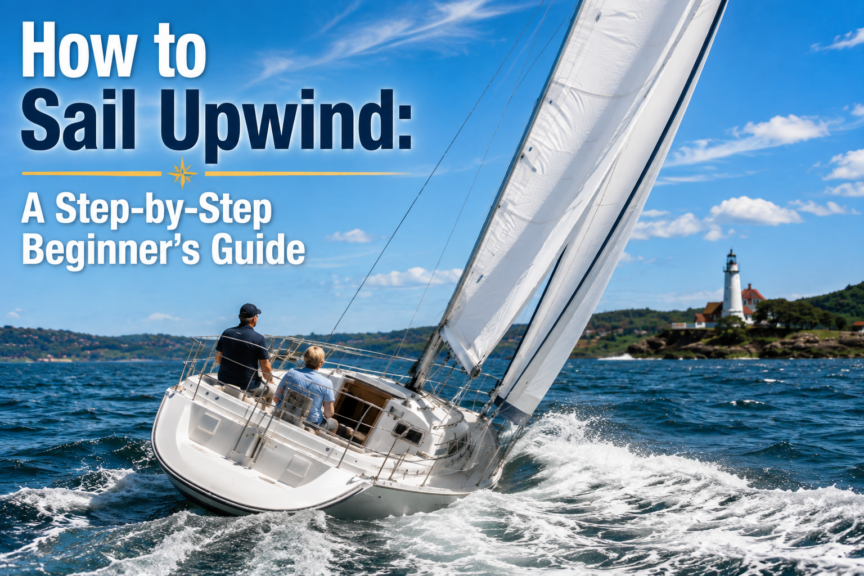
Imagine leaving a harbour and seeing your destination a few miles ahead. Unfortunately, the wind is blowing directly from where you want to go.
Your first instinct might be to point the bow toward your destination and trim the sails. But as the boat turns toward the wind, the sails begin to flutter. The boat slows. Keep turning, and eventually the sails are flapping while the boat makes almost no useful forward progress.
So how do you get there?
This is the puzzle at the heart of how to sail upwind.
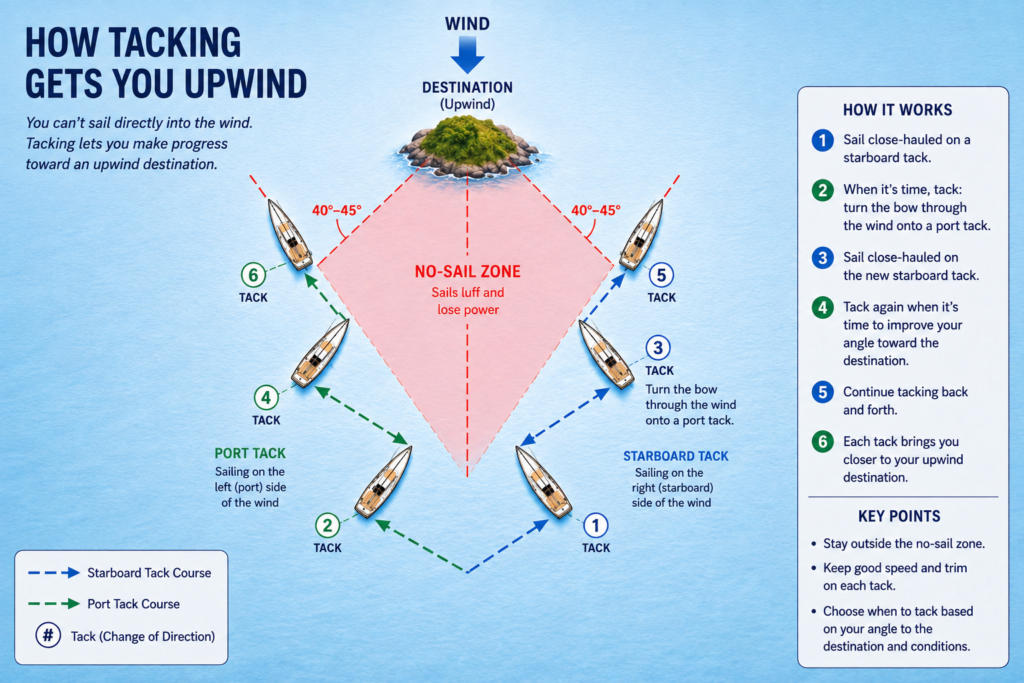
A sailboat cannot normally sail directly into the wind. Instead, it sails toward an upwind destination by traveling at an angle to the wind, first on one side and then the other. By alternating between these angled courses, the boat can gradually work its way toward a destination that lies directly upwind.
The important distinction is this:
You do not sail directly upwind. You sail toward an upwind destination.
Doing that well brings together several fundamental sailing skills. You need to know where the wind is coming from, establish a close-hauled course, steer accurately, trim the sails, read the telltales, and tack when necessary.
If identifying wind direction is still difficult, start with our guide to How to Read the Wind. Once you know where the wind is coming from, the rest of the upwind puzzle becomes much easier to understand.
Can a Sailboat Sail Upwind?
Yes. A sailboat can make progress toward an upwind destination, but it cannot normally sail directly into the wind. Instead, it sails close-hauled at an angle to the wind and alternates between port and starboard tack.
Think of the route as a zigzag.
Suppose an island lies directly upwind of you. Pointing the bow straight at the island will also point the boat straight into the wind—and the sails will eventually lose the airflow they need to keep driving the boat.
Instead, you steer to one side of the island and sail close-hauled. Although you are not pointing directly at your destination, part of your movement is taking you closer to it.
Eventually, you tack and sail close-hauled in the opposite direction. Once again, the boat moves partly sideways but also farther toward the island.
Repeat the process and you can eventually reach a destination that you could never have sailed toward in a straight line.
This is commonly called tacking upwind or beating to windward.
It may look inefficient because the boat travels farther than the straight-line distance. But the straight-line route isn’t a usable sailing course when it points directly into the wind.
Why Can’t a Sailboat Sail Directly Into the Wind?
Sails need air to flow across them in the correct way to produce useful driving force.
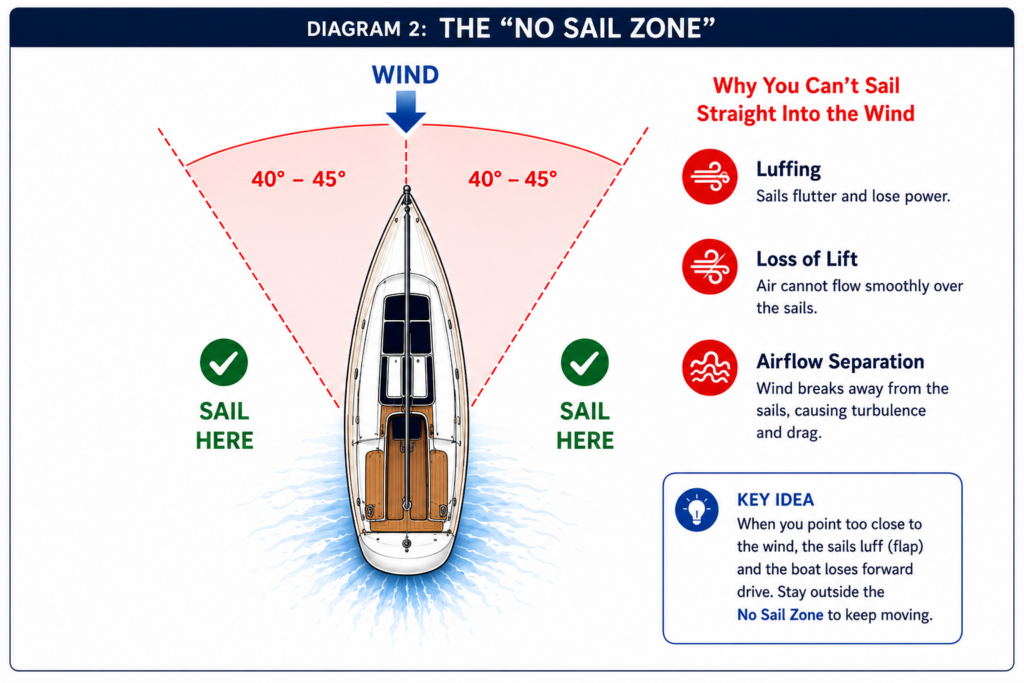
As you steer closer toward the wind, there comes a point where the sails can no longer maintain the airflow needed to keep the boat sailing efficiently. Every sailboat has a range of headings near the wind where normal sailing becomes impractical.
This is called the no-sail zone.
The No-Sail Zone
For a typical cruising sailboat, you can think of the no-sail zone as extending roughly 40–45° to either side of the true wind direction. The exact angle varies considerably with the boat, sails, wind strength, waves, and other conditions, so 40–45° should be treated as a useful beginner reference rather than a universal rule.
If you steer into this zone, the sails begin losing their ability to drive the boat effectively.
You may notice:
- the front edge, or luff, of the jib beginning to flutter;
- the windward jib telltales lifting or becoming unstable;
- the sails beginning to luff;
- boat speed decreasing; and
- steering becoming less responsive as the boat slows.
Continue turning toward the wind and eventually the sails may flap from side to side rather than remaining filled.
This doesn’t mean anything has gone wrong with the boat. You have simply pointed too close to the wind for the sails to work efficiently.
Our Points of Sail Explained guide examines the no-sail zone and the different sailing angles in more detail, while How to Read Sail Telltales explains how the telltales can warn you that you’re approaching the edge of an efficient upwind course.
What Does Close-Hauled Mean?
Close-hauled means sailing toward the wind at approximately the closest angle the boat can maintain efficiently.
This is the point of sail you will use when trying to make maximum practical progress toward something located upwind.
On a close-hauled course, the sails are trimmed relatively close to the boat’s centerline and the boat is sailing near—but outside—the no-sail zone.
The word efficiently is important.
Close-hauled does not mean turning the bow as close to the wind as you can possibly manage.
Your goal is to sail close to the wind while still maintaining:
- useful airflow over the sails;
- driving force;
- boat speed; and
- steering control.
Close-Hauled vs. Pinching
One of the most common beginner mistakes when sailing upwind is trying to point just a little higher.
The destination is upwind, so it seems logical: if you can point the bow a few degrees closer to it, surely you’ll arrive sooner.
Not necessarily.
If you steer too close to the wind, the boat begins pinching. The sails may still appear mostly filled, but airflow deteriorates and the boat loses power and speed.
You may be pointing more directly toward your destination while actually making less effective progress toward it.
Bearing away a few degrees can restore airflow, increase boat speed, and make the rudder more effective. The bow may now point slightly farther away from your destination, but the boat can be traveling through the water much more efficiently.
That leads to one of the most useful lessons in upwind sailing:
The highest course you can point is not necessarily the fastest way to get upwind.
The objective is to find the balance between pointing toward the wind and keeping the boat moving efficiently.
In the next section, we’ll use that principle to solve the upwind puzzle: how two apparently indirect courses can combine to take you directly toward an upwind destination.
How Does a Sailboat Actually Make Progress Upwind?
Once you understand the no-sail zone, the solution to sailing upwind becomes much easier to see.
Imagine that your destination is directly upwind. You cannot point the bow straight toward it because doing so would put the boat inside the no-sail zone.
Instead, you choose a close-hauled course on either side of the wind.
On your first tack, the boat travels diagonally across the water. Some of that movement takes you sideways relative to your destination, but an important part of it also takes you closer to the destination.
After sailing far enough on that course, you tack.
The bow turns through the wind, the sails move to the opposite side of the boat, and you establish another close-hauled course. Now you are traveling diagonally in the opposite direction while continuing to make progress upwind.
The basic pattern looks like this:
- Sail close-hauled on one tack.
- Make useful progress toward the upwind destination.
- Tack.
- Establish a close-hauled course on the opposite tack.
- Continue making progress upwind.
- Repeat as necessary until you reach your destination.
This process is called tacking upwind or beating to windward.
If you’re not yet comfortable with the maneuver itself, our How to Tack a Sailboat guide explains the complete procedure, including steering through the tack, handling the jib sheets, and coordinating the crew.
Think in Diagonals, Not Straight Lines
For beginners, one of the biggest adjustments is learning to stop steering directly toward the destination.
On land, we usually think in straight lines. If something is directly ahead, we walk, drive, or cycle toward it.
A sailboat doesn’t always work that way.
When your destination lies inside the no-sail zone, the shortest possible route is not a sail-able route. Your actual course must consist of two or more diagonal legs.
Imagine climbing a steep mountain on a trail filled with switchbacks. Walking straight up the slope might be shorter on a map, but it may be too steep to climb. The switchbacks make the journey longer while providing a route that actually works.
Sailing upwind follows a similar principle.
Each close-hauled leg should move you closer to an imaginary line running across the water through your destination. Tack back and forth, and those diagonal gains eventually add up.
You are not trying to make the boat point directly upwind.
You are trying to make the boat progress upwind.
How to Find Your Best Upwind Sailing Angle
Knowing that you need to sail close-hauled is one thing. Finding that course while actually sailing is another.
A beginner might be tempted to memorize an angle such as 45° to the wind and simply try to steer it.
That isn’t the best approach.
There is no single perfect upwind angle for every sailboat. Hull design, keel design, sail condition, wind strength, waves, current, and even how accurately the sails are trimmed can change how close a particular boat can sail to the wind efficiently.
Instead of chasing an exact number, learn to let the boat show you where its efficient upwind course is.
Start on a Close Reach
Begin from a comfortable close reach, with the boat moving well and both sails producing steady power.
Starting with boat speed makes the process easier. Water is already flowing over the rudder, the sails are working, and the boat should respond predictably to the helm.
From there, gradually turn toward the wind.
Head Up Gradually
Make a small steering adjustment to head up, then give the boat time to respond.
As you move closer to the wind, watch several things at once:
- the jib;
- the jib telltales;
- boat speed;
- the amount of heel; and
- the feel of the helm.
Don’t make one large turn and then try to determine what happened. Small changes provide much clearer feedback.
Continue heading up gradually while the boat remains powered.
Watch for the Edge
As you approach an efficient close-hauled course, the boat becomes increasingly sensitive to small changes in heading.
The windward jib telltales may begin reacting first. The front of the jib may also show the earliest signs that airflow is becoming unstable.
This is useful information.
You are finding the boundary between an efficient close-hauled course and pointing too high.
If the sails remain powered, the telltales are flowing well, and the boat maintains good speed, hold the course.
If the Sails Begin to Luff
If the front of the sail begins fluttering or the windward telltales repeatedly lift, you may have headed too far toward the wind.
The correction is simple:
Bear away slightly.
Do not make a dramatic turn. Move the bow a few degrees away from the wind and allow the sails and boat speed to recover.
Then observe again.
This creates a practical feedback loop you can use on almost any sailboat:
Head up → observe the sails and telltales → too high? → bear away slightly → stabilize.
With practice, you stop thinking about close-hauled as a specific angle and begin recognizing it from the behavior of the boat.
Pinching vs. Efficient Pointing
This distinction becomes especially important when you have a destination in sight.
Suppose another sailor is beside you. Their boat is pointing slightly farther away from the wind than yours, while you’re steering as high as possible.
At first, your course may look better.
But if you’re pinching along slowly while the other boat is moving quickly with clean airflow over its sails, the other boat may make better progress upwind.
This is why successful upwind sailing is a balance between direction and speed.
Point too low and you may sail quickly but travel farther than necessary.
Point too high and you may aim closer to the destination but lose so much speed that the advantage disappears.
The useful course lies between those extremes.
For a beginner, don’t worry about finding a mathematically perfect angle. Concentrate on something much more practical:
Sail as high as the boat can comfortably sail while keeping the sails working and the boat moving.
Once you’ve found that course, the next challenge is keeping the boat there. That requires the sails, telltales, and steering to work together—which is where we’ll turn next.
How to Trim the Sails for Upwind Sailing
Once you have established a close-hauled course, the sails need to be trimmed for that angle to the wind.
Upwind sailing generally requires the sails to be trimmed relatively close to the boat’s centerline. But there is an important distinction:
Trimmed in does not mean pulled in as tightly as possible.
The goal is still efficient airflow over the sails. If you simply haul every sheet tight, you can distort the sail shape and reduce performance.
Instead, trim each sail until it works efficiently with your close-hauled course.
Trim the Jib
When sailing close-hauled, the jib is normally trimmed farther in than it would be on a reach.
Pull in the working jib sheet gradually while watching the sail.
The jib should be relatively close to the centerline, but it should still maintain a smooth, useful shape. Exactly how far you trim it depends on the boat, its rig, and the conditions.
The telltales provide much better information than trying to judge the sheet position alone.
If you are unfamiliar with how the jib sheets control the sail, our Sail Controls Explained guide covers the basic controls and what each one does.
Trim the Mainsail
The mainsail is also trimmed relatively close when sailing upwind.
Use the main sheet to bring the boom in from the position you would normally use on a reach. On many boats, the boom will be relatively close to the centerline when sailing close-hauled, although its exact position depends on the boat and conditions.
Again, don’t assume tighter is automatically better.
The objective is to create an efficient sail shape for the wind you have—not to pull the boom as far toward the centerline as the hardware allows.
Our How to Trim a Sail guide explains sail trim in greater detail. For now, remember the principle that matters most when learning to sail upwind:
Trim for airflow, not tightness.
Use Telltales to Sail Upwind More Efficiently
When sailing close-hauled, telltales become one of the most useful feedback systems on the boat.
They help answer an important question:
Am I still sailing at an efficient angle to the wind?
This is especially valuable because the wind is not perfectly steady. Even if you hold the tiller or wheel in exactly the same position, small changes in wind direction can change your relationship to the wind.
Your telltales reveal those changes.
Both Telltales Streaming
When the windward and leeward jib telltales are streaming smoothly aft, airflow is generally attached to both sides of the sail.
That’s a good sign.
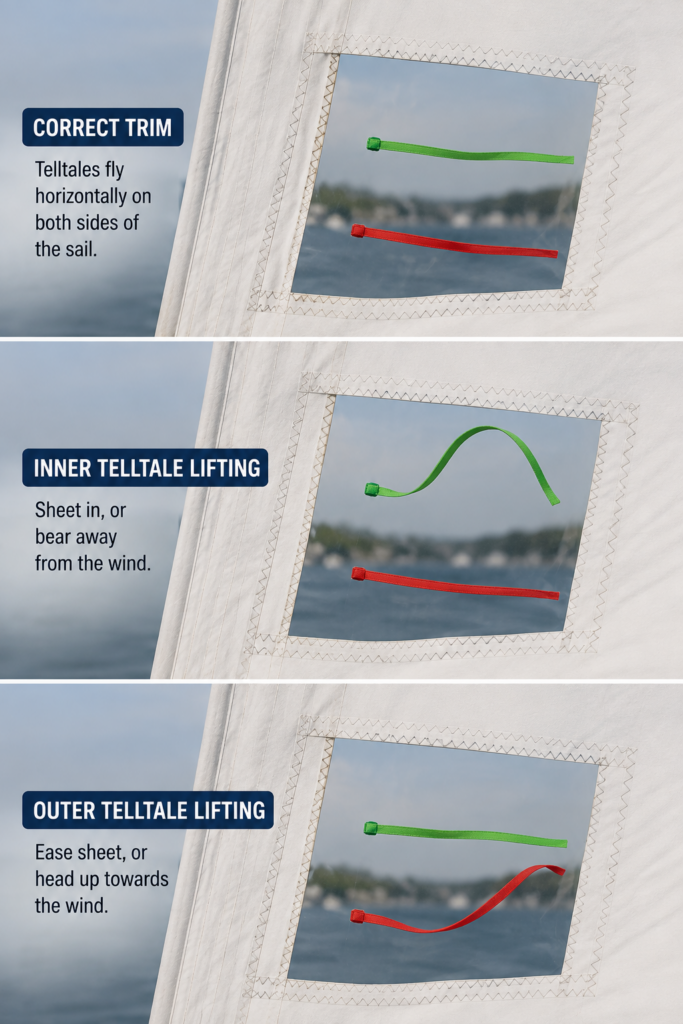
If the boat is moving well and your course is taking you where you want to go, avoid making unnecessary adjustments.
Sometimes the best steering correction is no correction at all.
Windward Telltale Lifts
If the windward telltale begins to lift, flutter, or point upward while the leeward telltale continues streaming, the boat may be getting too close to the wind.
For a beginner sailing close-hauled, the usual steering response is:
Bear away slightly.
Often only a very small course change is required.
As the bow moves a few degrees away from the wind, the windward telltale should settle and begin streaming aft again.
This is one of the easiest ways to recognize that you’re beginning to pinch before the entire sail starts luffing.
Leeward Telltale Misbehaves
If the leeward telltale is lifting or behaving erratically while the windward telltale streams normally, the boat may be sailing slightly too low for the current sail trim, or the jib may be over-trimmed.
That doesn’t automatically mean you should turn the boat.
You have two related variables:
course and sail trim.
You may need to head up slightly, adjust the jib sheet, or make a combination of small changes.
This is why telltales should not be treated as simple traffic lights that always demand one specific response. They are clues about how air is flowing over the sail.
Our How to Read Sail Telltales guide explains these patterns in detail.
For upwind sailing, the main lesson is simpler: use the telltales to help keep the boat in the narrow range where it can point well without sacrificing efficient airflow and boat speed.
How to Steer Efficiently While Sailing Upwind
Good upwind sailing requires surprisingly little movement at the helm.
Once the boat is balanced and sailing efficiently, your job is not to constantly steer it back onto an imaginary perfect line. Your job is to keep it within a useful range as the wind and water change around you.
Use small, smooth corrections.
Look ahead at the water and your surroundings. Periodically glance at the telltales. Notice the pressure on the tiller or wheel. Watch how the boat responds to gusts and waves.
Avoid staring continuously at any one instrument or indicator.
In particular, don’t steer only toward your destination. Remember that an upwind destination may lie inside the no-sail zone. Your bow may need to point noticeably to one side of where you ultimately want to go.
Likewise, don’t chase every tiny flick of a telltale. Wind is constantly changing, and reacting to every momentary movement can lead to unnecessary steering.
Why Boat Speed Matters
Boat speed is not just about getting somewhere faster.
It also helps you steer.
The rudder works because water flows across it. As the boat moves through the water, the rudder can redirect that flow and turn the boat.
If you pinch until the boat nearly stops, the rudder becomes less effective. You may then turn the helm farther in an attempt to correct the course, creating additional drag while the boat is already struggling to regain speed.
This can turn a small mistake into a frustrating cycle.
If you have pointed too high and lost speed, bear away enough to restore airflow over the sails and allow the boat to accelerate again. Once the boat is moving well, gradually return to an efficient close-hauled course.
Our How to Steer a Sailboat guide covers helm control and boat response in more detail.
The important upwind lesson is this:
Protect your boat speed.
Efficient upwind sailing is not about forcing the bow as close to the wind as possible. It is about balancing heading, sail trim, airflow, and speed.
Once you can maintain that balance on one close-hauled course, the next question becomes navigational rather than mechanical:
How long should you stay on this tack—and when should you change to the other one?
When Should You Tack While Sailing Upwind?
Knowing how to tack is only part of sailing upwind.
You also need to decide when to tack.
When you’re learning, it can be tempting to tack simply because you’ve been sailing in one direction for a while. But every tack should have a purpose.
Before changing course, ask yourself:
If I stay on this tack, am I still making useful progress toward where I want to go?
If the answer is yes, there may be no reason to tack yet.
If the answer is no—or if something ahead makes continuing unsafe or impractical—it may be time to change tacks.
Common reasons include:
- your destination is becoming more favorable on the opposite tack;
- you’re approaching a shoreline, shoal, or other obstruction;
- another vessel affects your intended course;
- water depth is becoming a concern;
- the wind has shifted;
- current is pushing you away from your intended route; or
- continuing on the present tack would take you unnecessarily far from your destination.
Look at Where Each Tack Takes You
One of the biggest changes in thinking when learning to sail upwind is learning to look beyond the bow.
Your bow tells you where the boat is pointing right now. It does not necessarily tell you whether you’re choosing the best route toward your destination.
Imagine you’re sailing toward a marker directly upwind.
On starboard tack, the marker might appear well off your port bow. After tacking onto port tack, it might appear well off your starboard bow.
That’s normal.
Neither tack points directly at the marker because doing so would put you in the no-sail zone.
Instead of asking, Am I pointing at my destination? ask:
Is this tack bringing me closer to my destination?
That is a much more useful question.
You also need to consider what will happen after the tack. Before turning, look toward the course you expect to sail next. Check for other boats, shallow water, docks, rocks, shorelines, and anything else that could affect the maneuver. In busy waterways, Transport Canada’s guidance for sharing the waterways is a useful reminder to maintain a proper lookout and understand how your course may interact with larger vessels and other traffic.
The tack itself should not be a surprise.
Our How to Tack a Sailboat guide explains the full maneuver, including crew communication, steering through the wind, and handling the jib sheets. Here, the important lesson is deciding when that maneuver helps you continue making useful progress upwind.
How to Sail Upwind Step by Step
Now we can put the entire process together.
The exact course, sail settings, and timing will change with the boat and conditions, but the basic sequence remains remarkably consistent.
Step 1: Identify the Wind Direction
Before deciding how to sail upwind, you need to know where upwind actually is.
Look for several clues rather than relying on only one. Flags, masthead indicators, ripples on the water, telltales, and the feel of the wind can all help establish wind direction.
If you’re uncertain, review How to Read the Wind before practicing this exercise.
Once you’ve identified the wind direction, mentally picture the no-sail zone extending downwind from it.
That tells you which courses are unavailable.
Step 2: Identify Your Upwind Destination
Now identify where you actually want to go.
It could be a buoy, harbour entrance, landmark, or simply a practice point on the water.
If the destination lies directly or nearly upwind, don’t try to steer straight toward it.
Instead, begin thinking about the two close-hauled courses that can eventually take you there.
Step 3: Choose Your First Tack
Decide whether to begin on port or starboard tack.
For a simple practice exercise in open water, either may work. In real situations, one tack may make more sense because of traffic, shoreline, water depth, current, wind shifts, or the location of your destination.
Look ahead before committing.
You want enough clear water to establish a steady close-hauled course without immediately needing another maneuver.
Step 4: Establish a Close-Hauled Course
If you’re currently sailing on a reach, gradually head up toward the wind.
Don’t turn sharply toward your theoretical close-hauled angle.
Head up a little and observe the boat.
Continue until you’re sailing near the wind while still maintaining useful airflow and boat speed.
If the windward telltales begin lifting or the front of the jib starts luffing, you’ve probably gone slightly too high.
Bear away a few degrees and allow the boat to settle.
Step 5: Trim the Jib and Mainsail
As you head up, the sails need to come in.
Trim the jib for the close-hauled course, then trim the mainsail appropriately.
Remember the principle from earlier:
Upwind trim is about efficient airflow, not maximum sheet tension.
Don’t simply pull both sails as tight as possible.
Step 6: Check the Telltales
Once the boat is settled, check the jib telltales.
If both are streaming smoothly, you likely have useful attached airflow.
If the windward telltale repeatedly lifts, you may be sailing too high. Bear away slightly.
If the leeward telltale is consistently misbehaving, consider whether your heading or jib trim needs a small adjustment.
Make one small change, observe the result, and then adjust again if necessary.
Step 7: Maintain Speed and Course
Now let the boat sail.
Look ahead rather than staring continuously at the sails.
Use small steering corrections. Monitor the telltales periodically and notice changes in helm pressure, heel, wind strength, and boat speed.
Avoid the temptation to squeeze a few extra degrees toward the wind.
A slightly lower course with good speed may produce better upwind progress than a higher course with the boat struggling.
Step 8: Decide When to Tack
As the leg continues, keep evaluating your route.
Ask:
Is this tack still taking me somewhere useful?
Also look ahead for traffic, hazards, shallow water, or an approaching shoreline.
If the opposite tack now offers a better route—or continuing has become impractical—prepare to tack.
Step 9: Tack Onto the Opposite Course
Before tacking, check the area the boat will turn into and make sure the crew is ready.
Then perform a controlled tack.
The bow turns toward the wind, passes through it, and continues onto the opposite side. The jib changes sides and the boat establishes a new close-hauled course. For another explanation of what happens as the boat changes from one close-hauled course to the other, US Sailing’s guide to tacking provides a useful technical reference – though this particular link is in reference to racing, not building beginner skills.
Avoid turning much farther than necessary. Your objective is to finish the tack on another efficient close-hauled heading, not continue turning onto a reach.
Step 10: Re-establish Upwind Trim
A tack isn’t finished simply because the sails have changed sides.
Let the boat accelerate on its new heading.
Trim the jib and mainsail for close-hauled sailing, check the telltales, and make small steering adjustments until the boat is powered and moving efficiently again.
Then look up.
Reassess the destination and the water ahead.
Step 11: Repeat as Necessary
Continue sailing close-hauled until another tack becomes useful or necessary.
Then repeat the process:
Sail efficiently → evaluate your progress → tack → rebuild speed → sail efficiently again.
Eventually, your alternating diagonal courses will bring you close enough that the destination is reachable without another tack.
That is how a sailboat reaches something directly upwind.
You haven’t defeated the wind or forced the boat to sail where it cannot.
You’ve worked within the boat’s available sailing angles and turned a series of efficient close-hauled legs into deliberate progress toward your destination.
Common Upwind Sailing Mistakes Beginners Make
Sailing upwind requires several skills to work together. That means a small mistake in steering, sail trim, or course selection can affect everything else.
If you’re struggling to make progress upwind, don’t assume you’re simply bad at it. Look for a specific cause and make one correction at a time.
1. Trying to Point Directly at the Destination
Why it happens: Your destination is visible ahead, so naturally you want to steer toward it.
What to do instead: If the destination lies inside the no-sail zone, accept that you cannot sail directly toward it. Choose a close-hauled course to one side and make progress diagonally.
Think about where you’re trying to get, not simply where the bow is pointing.
2. Pinching
Why it happens: Beginners often try to gain a few extra degrees toward the wind.
The boat may continue moving, but the windward telltales begin lifting, sail power decreases, and speed falls.
What to do instead: Bear away slightly and let the boat accelerate. A boat sailing a little lower and significantly faster may make better progress upwind.
3. Over-Trimming the Sails
Why it happens: Upwind sailing requires relatively close trim, so it is easy to assume tighter must be better.
What to do instead: Trim for efficient airflow and sail shape rather than maximum sheet tension. If the sails are hauled in excessively, ease them slightly and observe the result.
4. Under-Trimming the Sails
Why it happens: The boat may still move with the sails eased, making the problem less obvious.
What to do instead: As you head toward a close-hauled course, bring the jib and mainsail in appropriately. The sails generally need to be trimmed farther in than they would be on a reach.
5. Ignoring the Telltales
Why it happens: There is already plenty to watch—the destination, sails, traffic, wind, and helm.
What to do instead: Include the telltales in your normal scanning routine. They provide early feedback when your heading or trim is becoming inefficient.
You don’t need to stare at them continuously. Check them, make a small adjustment if necessary, then look ahead again.
6. Making Large Steering Corrections
Why it happens: When something looks wrong, beginners often make a large helm movement to fix it quickly.
What to do instead: Make small corrections and give the boat time to respond.
Constantly turning above and below your useful close-hauled course wastes energy and makes it harder to recognize what good upwind sailing feels like.
7. Tacking Too Often
Why it happens: Tacking feels like progress because something is happening.
What to do instead: Give each tack enough time to produce useful progress unless traffic, hazards, water depth, or changing conditions require an earlier maneuver.
Every tack temporarily disrupts speed and sail trim, so there is little benefit in tacking repeatedly without a reason.
8. Staying on One Tack Too Long
Why it happens: Once the boat is sailing comfortably, it can be tempting to keep going.
What to do instead: Periodically reassess your destination. If your current tack is taking you increasingly away from a useful route, consider whether the opposite tack would be better.
9. Looking Only at the Boat
Why it happens: Sail trim and telltales demand attention when you’re learning.
What to do instead: Keep your head up.
Monitor other boats, shoreline, shallow water, weather, waves, and your destination. Efficient sail trim means very little if you’re no longer aware of what is happening around you.
What If the Boat Won’t Sail Upwind?
Sometimes the problem feels more basic: you turn toward the wind, but the boat simply won’t seem to go where you want.
Start with the simplest possibilities.
Are the sails beginning to luff?
You are probably pointing too high. Bear away slightly and allow the boat to regain speed.
Are the sails eased too far?
Trim them appropriately for close-hauled sailing.
Are the telltales showing poor airflow?
Use them to determine whether a small change in heading, sail trim, or both improves the flow.
Is the boat moving slowly after a tack or steering mistake?
Don’t immediately try to point as high as possible. Sail slightly lower while the boat accelerates, then gradually return to your efficient close-hauled course.
Does the boat seem to be sailing well but making little progress toward the destination?
Look beyond sail trim.
Current may be pushing the boat sideways or backward relative to the ground even though it is moving normally through the water.
This distinction becomes increasingly important as your sailing develops:
A boat can be sailing efficiently through the water without traveling over the ground exactly where its bow is pointing.
How Wind, Waves, and Current Affect Upwind Sailing
The close-hauled angle you find on a calm practice day will not necessarily be the best angle in every condition.
Real water is constantly changing.
Wind
Changes in wind direction change your relationship to the no-sail zone.
A heading that worked perfectly a few minutes ago may suddenly leave the boat pointing too high—or allow you to point slightly closer toward your destination.
Rather than trying to preserve one exact compass heading, continue monitoring the wind and the boat’s feedback. Before heading out, check the latest conditions and warnings for your sailing area using Environment and Climate Change Canada’s marine forecasts and warnings.
Waves
Choppy water can make sailing very close to the wind difficult.
Each wave can slow the boat, disturb airflow over the sails, and knock the bow away from its intended course.
In these conditions, trying to point as high as possible can leave the boat repeatedly losing speed.
Often, the better beginner strategy is to sail slightly lower and faster, maintaining enough momentum to move through the waves.
Current
Current adds another layer because it moves the entire boat and the water around it.
You might be sailing close-hauled efficiently while a strong current carries you sideways relative to your destination.
That means:
Where the bow is pointing is not necessarily where the boat is traveling over the ground.
As you gain experience, you’ll learn to include current, wind shifts, and other factors when deciding which tack is most useful. For now, simply recognize that poor progress toward a destination is not always caused by poor steering or sail trim.
Beginner Upwind Sailing Practice Exercise
The best way to understand upwind sailing is to practice it somewhere you have room to make mistakes.
Choose open water, manageable wind, good visibility, and plenty of distance from shorelines, shallow areas, docks, and other traffic.
Then work through this exercise:
- Identify the wind direction. Use several clues until you’re confident about where the wind is coming from.
- Establish a close reach. Begin with the boat comfortably powered and moving well.
- Head up gradually. Turn toward the wind in small increments.
- Find close-hauled. Continue until you’re sailing efficiently near the wind without pinching.
- Observe the telltales. Notice what they look like when the boat is properly powered.
- Hold the course. practice using small steering corrections while maintaining speed.
- Choose a reference point upwind. A distant landmark or suitable fixed marker works well.
- Sail one useful leg. Notice how you move closer to the reference point even though you’re not pointing directly at it.
- Prepare to tack. Check the new course and make sure the surrounding water is clear.
- Tack onto the opposite course.
- Re-establish close-hauled. Trim the sails, check the telltales, and rebuild speed.
- Look at your reference point again. Notice how the second diagonal course continues moving you toward it.
Then repeat the exercise.
Don’t judge success by how close you can force the bow toward the wind.
Judge it by something more useful:
Are you maintaining control, keeping the boat moving efficiently, and getting closer to your upwind destination?
That is the skill you’re actually trying to learn.
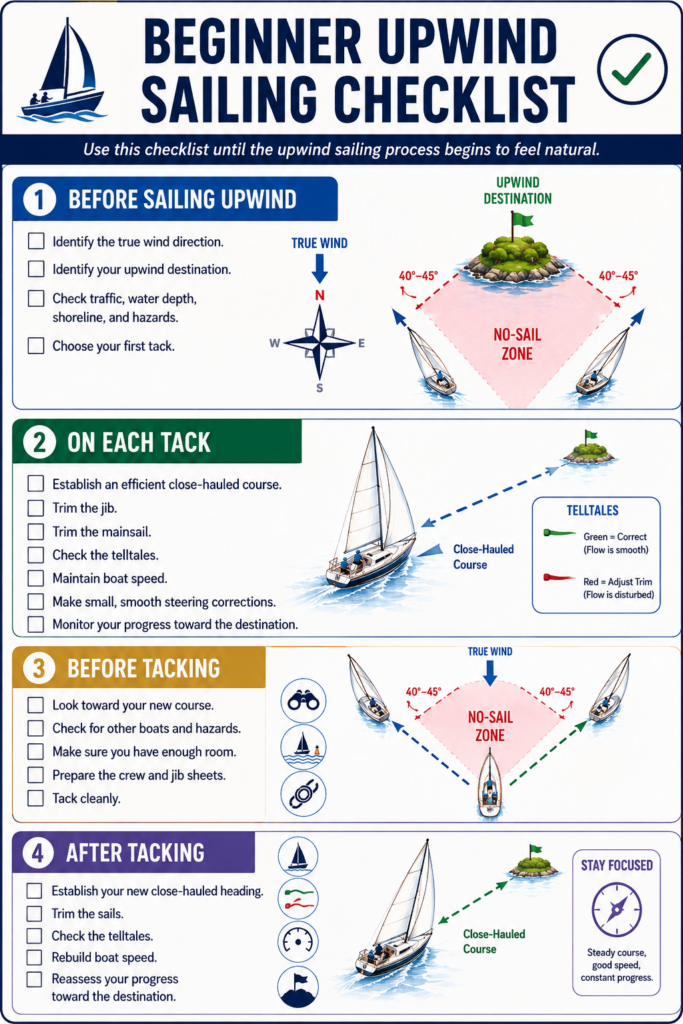
Beginner Upwind Sailing Checklist
Use this checklist until the upwind sailing process begins to feel natural.
Before Sailing Upwind
□ Identify the true wind direction.
□ Identify your upwind destination.
□ Check traffic, water depth, shoreline, and hazards.
□ Choose your first tack.
On Each Tack
□ Establish an efficient close-hauled course.
□ Trim the jib.
□ Trim the mainsail.
□ Check the telltales.
□ Maintain boat speed.
□ Make small, smooth steering corrections.
□ Monitor your progress toward the destination.
Before Tacking
□ Look toward your new course.
□ Check for other boats and hazards.
□ Make sure you have enough room.
□ Prepare the crew and jib sheets.
□ Tack cleanly.
After Tacking
□ Establish your new close-hauled heading.
□ Trim the sails.
□ Check the telltales.
□ Rebuild boat speed.
□ Reassess your progress toward the destination.
Beginner Knowledge Check
Before moving on, see if you can answer these questions.
1. Why can’t a sailboat point directly into the wind and continue sailing normally?
Because once the boat points too close to the wind, the sails can no longer maintain the airflow needed to produce useful driving force. They begin to luff and the boat slows.
2. What does close-hauled mean?
Close-hauled means sailing approximately as close to the wind as the boat can efficiently maintain while preserving useful airflow, power, speed, and steering control.
3. Why can pointing higher actually reduce your progress upwind?
If you point too high, the boat may begin pinching. The bow points closer toward the wind, but reduced sail power and boat speed can result in worse overall upwind progress.
4. What does a lifting windward jib telltale often indicate?
When sailing close-hauled, it often indicates that you’re steering too close to the wind. Bearing away slightly will often restore good airflow.
5. Why do sailors tack when traveling toward an upwind destination?
Because the destination may lie inside the no-sail zone. Tacking allows the boat to alternate between close-hauled courses and gradually make progress toward it.
6. What should you do after completing a tack?
Establish the new close-hauled heading, trim the sails, check the telltales, rebuild boat speed, and reassess your route.
Frequently Asked Questions About Sailing Upwind
Can a Sailboat Sail Directly Into the Wind?
No. A sailboat cannot normally maintain useful forward sailing progress when pointed directly into the wind. Instead, it sails close-hauled at an angle to the wind and tacks between alternating courses.
How Close to the Wind Can a Sailboat Sail?
It depends on the boat and conditions. Many beginners use approximately 40–45° from the true wind as a general reference for close-hauled sailing, but this is not a universal number. Boat design, sails, wind strength, waves, and technique all affect how efficiently a boat can point.
Why Do Sailboats Zigzag Upwind?
A destination directly upwind lies inside the no-sail zone. By sailing close-hauled on alternating tacks, the boat can make progress toward that destination even though it cannot point directly at it.
What Is Close-Hauled Sailing?
Close-hauled sailing means sailing toward the wind at approximately the closest angle the boat can maintain efficiently. The sails are trimmed relatively close, and the boat remains just outside its effective no-sail zone.
What Does “Beating to Windward” Mean?
Beating to windward means making progress toward an upwind destination by sailing a series of close-hauled legs and tacking from one side of the wind to the other.
Why Does My Sailboat Slow Down When I Point Higher?
You may be pinching. As the boat gets too close to the wind, airflow over the sails becomes less effective and driving force decreases. Bearing away slightly can restore power and boat speed.
How Do I Know When to Tack?
Tack when the opposite tack provides a more useful route or when traffic, shoreline, shallow water, obstacles, wind shifts, current, or other conditions make continuing on your present tack undesirable.
Is Sailing Upwind Slower Than Sailing Across the Wind?
Often, yes. Sailing toward an upwind destination usually requires a longer zigzag route, and many sailboats also achieve better speed on a reach than when sailing close-hauled. The exact difference depends on the boat and conditions.
Key Takeaways
Learning how to sail upwind is less about memorizing angles and more about learning to combine several sailing skills.
Remember:
- A sailboat cannot normally sail directly into the wind.
- It can still reach a destination located upwind.
- Close-hauled is the primary point of sail used for upwind progress.
- Pointing higher does not always mean getting there faster.
- Maintaining boat speed is important for both progress and steering control.
- Telltales help you balance heading and sail trim.
- Tacking allows you to alternate between close-hauled courses.
- Wind, waves, and current can change which course works best.
- Good upwind sailing means making efficient progress—not simply pointing the bow as high as possible.
When the Pieces Start Working Together
Sailing upwind is an important milestone because it is where many individual beginner sailing skills finally start working together.
First, you learned to read the wind.
Then you learned the points of sail.
You learned how to steer the boat, trim the sails, read the telltales, and tack.
Individually, each is an important skill.
Together, they allow you to do something much more useful: deliberately navigate a sailboat toward a destination that initially appeared impossible to reach.
That’s the larger lesson behind sailing upwind.
Sailing isn’t simply about pointing the bow where you want to go. You work with the wind available to you, choose a course the boat can actually sail, listen to the feedback the boat gives you, and change your plan when necessary.
Once that process begins to feel natural, you’ve moved beyond simply controlling a sailboat.
You’re beginning to sail with purpose.
And, of course, not every destination is upwind. When the wind is behind you, the sails, steering, and strategy change considerably.