

Introduction
Sailing has a reputation for being difficult. From the dock, you see ropes running in every direction, sails moving in the wind, and sailors using unfamiliar terminology. It is easy to assume that you need years of experience before you can enjoy being on the water. Fortunately, that is not true.
Every experienced sailor began exactly where you are now—with little or no knowledge of how to sail a sailboat. The difference between a beginner and an experienced sailor is not natural talent. Instead, it is simply a matter of learning one concept at a time and practicing it until it becomes familiar.
This guide was written specifically for beginners. Rather than overwhelming you with every detail, it introduces the essential ideas in the same order you would encounter them during your first day on the water. As a result, each lesson builds naturally on the one before it.
By the time you finish this guide, you will understand how to sail a sailboat, meaning: how a sailboat moves, recognize its major parts, become comfortable with common sailing terminology, and see how those concepts fit together during a typical sailing trip. More detailed articles throughout SailboatZone.com will expand on each topic as your confidence grows.
Before You Learn How to Sail a Sailboat, Understand One Simple Idea
The Wind Is Your Engine
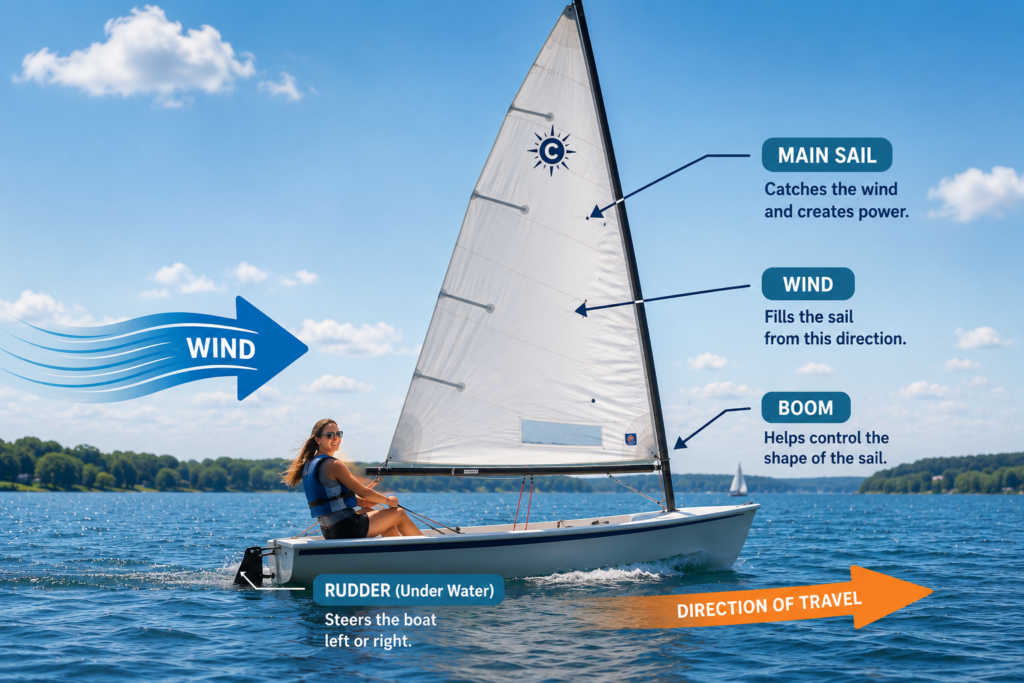
The single most important concept in sailing is surprisingly simple: the wind is your engine. Unlike a powerboat, a sailboat does not rely on an engine for propulsion while under sail. Instead, it captures energy from the wind and converts it into forward motion.
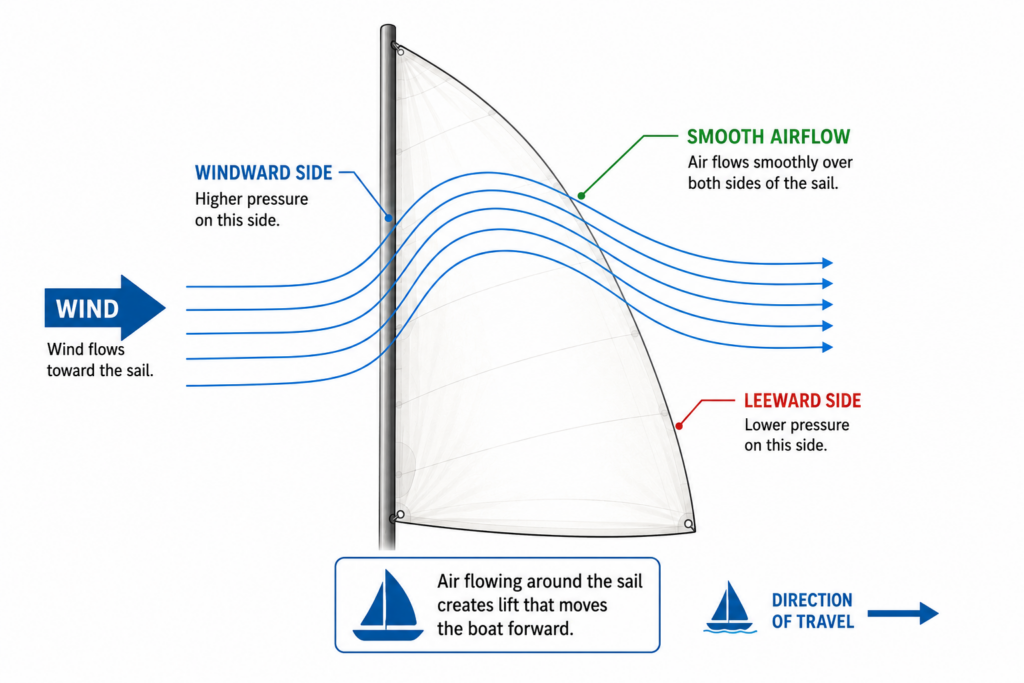
However, the wind does not simply push the boat from behind. The sails act like an aircraft wing, creating lift as air flows over both sides. Meanwhile, the keel beneath the boat resists sideways movement, and the rudder allows you to steer. Because these systems work together, a sailboat can even travel at angles that seem to lead toward the wind. We’ll get more into this in the article on the Points of Sail.
Successful sailing is not about fighting the wind. Instead, it is about understanding it. First identify where the wind is coming from. Next position the boat at the appropriate angle. Finally, adjust the sails so they work efficiently. Although this process sounds technical, it quickly becomes second nature with practice.
BEGINNER TIP
Don’t worry about memorizing the science behind sail lift yet. Simply remember this: the wind provides the power, and your job is to position the boat so it can use that power efficiently.
Before every sailing trip, check the latest marine forecast. The NOAA Marine Weather Forecasts are an excellent example of the type of wind, wave, and weather information sailors rely on before heading onto the water.
Learn the Parts of a Sailboat
Before you begin learning to sail a sailboat, basic steering techniques or the proper trimming of sails, it helps to recognize the major parts of the boat. Fortunately, you do not need to memorize dozens of names on your first day in order to learn how to sail a sailboat.
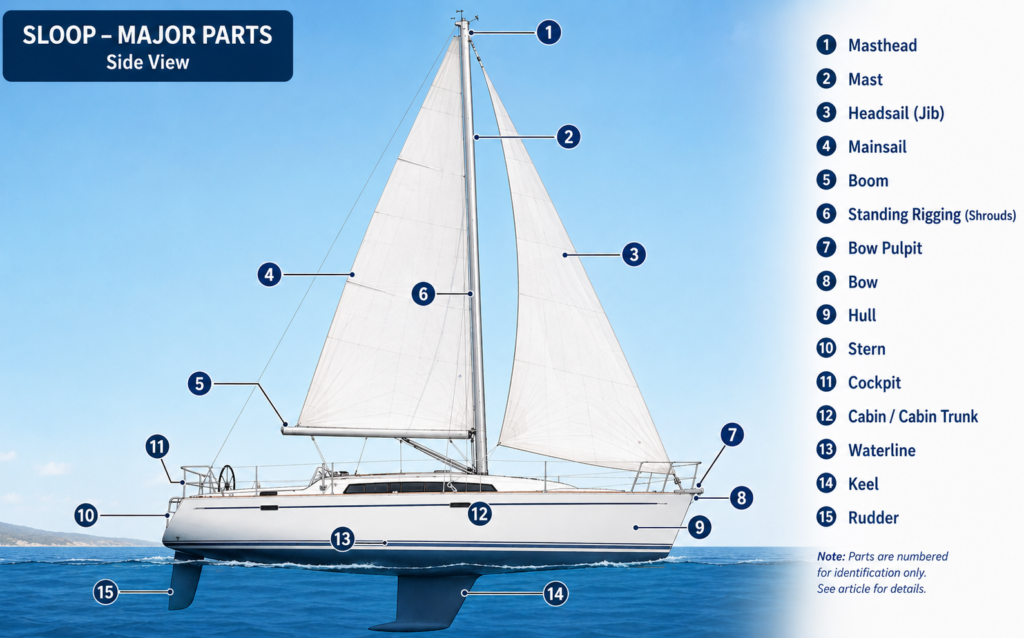
Start with the hull, which is the body of the boat that floats on the water. Rising from the hull is the mast, which supports the sails. Attached to the mast is the boom, which holds the lower edge of the mainsail.
Below the waterline, the keel provides stability and helps prevent the boat from sliding sideways. At the stern, the rudder controls the boat’s direction. Together, these components form the foundation of every modern cruising sailboat.
The mainsail and headsail provide the driving force that moves the boat. Likewise, the standing rigging supports the mast, while the running rigging consists of the lines you adjust while sailing.
For now, your goal is recognition rather than memorization. As you continue through the beginner curriculum, each of these parts will become familiar through repeated use.
LEARNER OUTCOME
After completing this section, you should be able to identify the major parts of a typical cruising sailboat and describe the basic job each one performs.
COMMON BEGINNER MISTAKES
Trying to memorize every piece of equipment at once. Focus on the major components first. The smaller details will make much more sense after you have spent time on the water.
Learn the Basic Sailing Terminology
Learning a few essential sailing terms is one of the quickest ways to feel more confident on the water. At first, the language sailors use can seem unfamiliar. Fortunately, you do not need to memorize an entire nautical dictionary before you step aboard. Instead, focus on the words you are most likely to hear during a typical sailing lesson. Once these become familiar, the rest of sailing becomes much easier to understand.
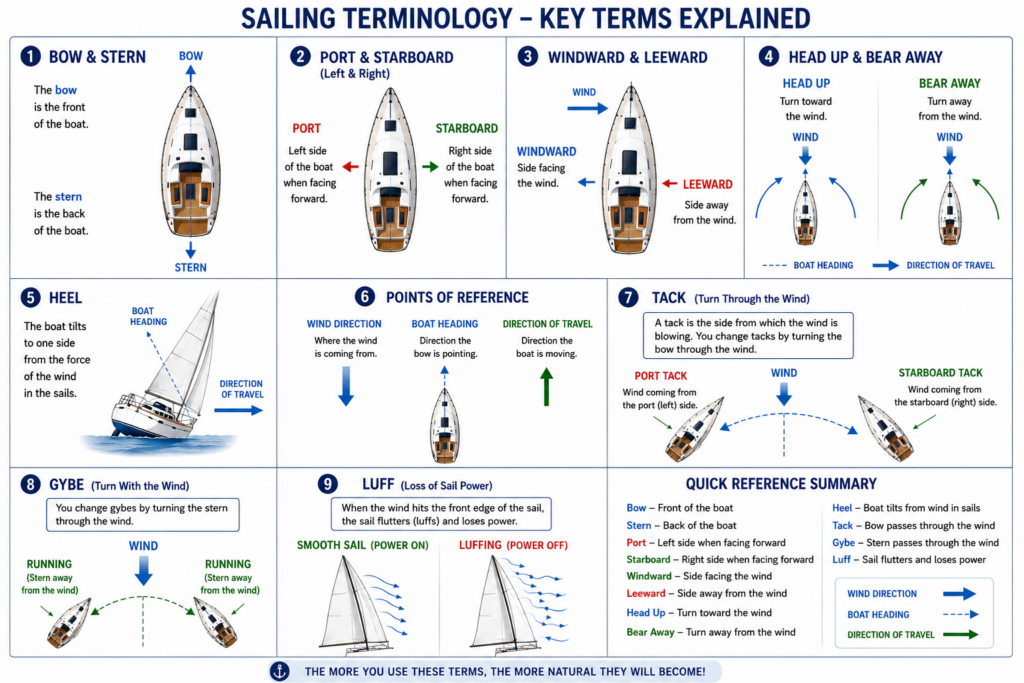
First, learn the difference between the bow and the stern. The bow is the front of the boat, while the stern is the back. These terms are used constantly because they identify locations without causing confusion.
Next, learn port and starboard. Port is always the left side of the boat when facing the bow, while starboard is always the right side. Unlike left and right, these names never change regardless of which direction you are standing or looking. As a result, every person aboard understands exactly which side is being discussed.
Meanwhile, become familiar with the terms windward and leeward. Windward is the side of the boat facing the wind, while leeward is the sheltered side. These words appear repeatedly in sailing instructions because the wind influences nearly every decision you make.
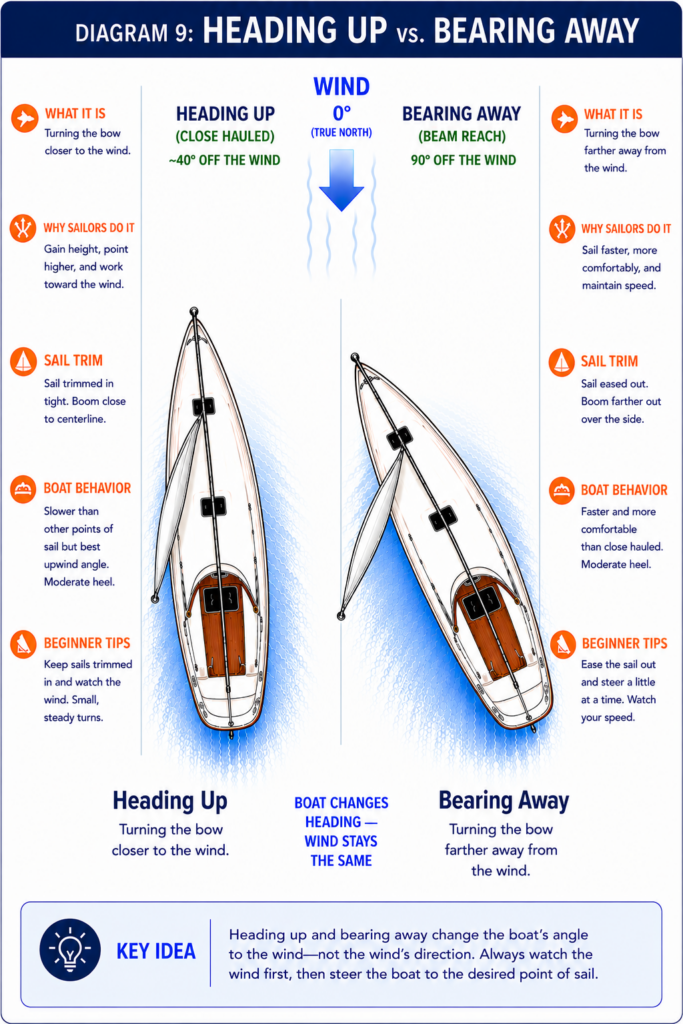
You will also hear the helm commands ‘head up’ and ‘bear away.’ Heading up means turning the bow toward the wind. Bearing away means turning the bow away from the wind. Although these movements are small, they have a significant effect on both boat speed and sail trim.
Finally, understand four terms that describe common sailing manoeuvres and boat behaviour. A tack turns the bow through the wind. A gybe turns the stern through the wind. Luffing occurs when a sail begins flapping because smooth airflow has been lost. Heel describes the natural lean of the boat caused by wind pressure on the sails. Fortunately, a moderate heel is perfectly normal and is often a sign the boat is sailing efficiently.
BEGINNER TIP
Don’t try to memorize every sailing term at once. Learn a few words, hear them used on the water, and then add more to your vocabulary each time you sail.
LEARNER OUTCOME
After completing this section, you should understand the everyday language commonly used during a beginner sailing lesson without feeling overwhelmed.
Understand the Points of Sail
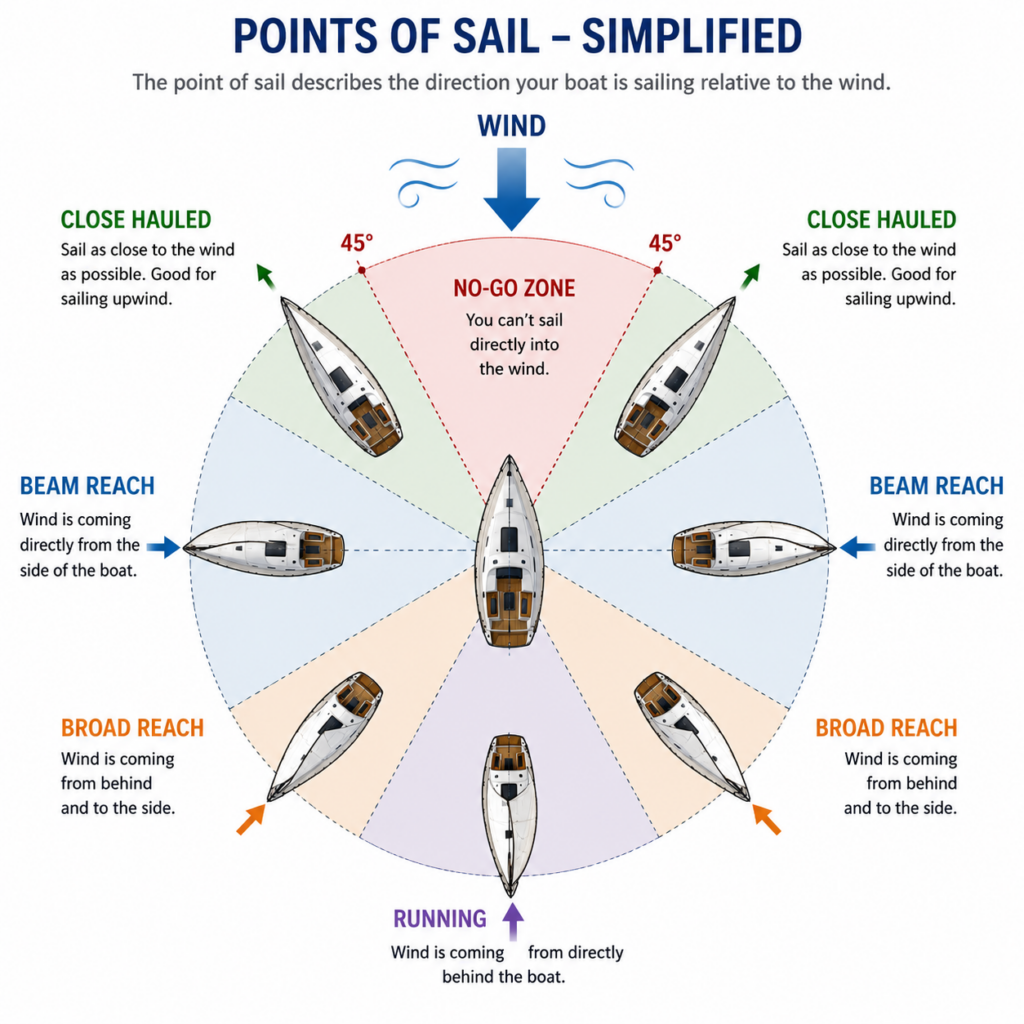
Once you know the basic vocabulary, you are ready to learn one of the most important concepts in how to sail a sailboat: the points of sail. A point of sail describes your boat’s direction relative to the wind—not its compass heading. Every steering decision begins here.
First comes the no-go zone. A sailboat cannot sail directly into the wind because the sails cannot generate lift when the airflow breaks down. Therefore, sailors always choose an angle on either side of the wind before attempting to sail upwind.
The closest practical angle is called close hauled. Here, the sails are trimmed tightly and the boat sails as close to the wind as possible while still moving efficiently. Because the sails are working hard, this point of sail often produces the greatest heel.
Next is the beam reach, where the wind blows across the side of the boat. Many sailors consider this the easiest and most enjoyable point of sail because the boat feels balanced, comfortable, and responsive.
As you continue turning away from the wind, you enter a broad reach. The sails are eased farther out, heel usually decreases, and the boat often maintains excellent speed with little effort.
Finally, running places the wind almost directly behind the boat. Although this may appear to be the simplest point of sail, it requires careful attention because an accidental gybe can cause the boom to swing across the cockpit with considerable force.
Every sailing decision starts by identifying where the wind is coming from. As a result, understanding the points of sail makes steering, trimming the sails, choosing a course, and solving problems on the water much easier.
COMMON BEGINNER MISTAKE
Looking only at the compass instead of the wind. Before making any steering decision, ask yourself where the wind is coming from. That answer determines your point of sail when you’re learning to sail a sailboat.
Steering the Sailboat
With the sails drawing and the engine off, you are finally sailing under wind power. This is the moment many beginners have been looking forward to. However, steering a sailboat feels different from steering a car or even a powerboat. Every movement of the helm changes the boat’s angle to the wind, and that affects the sails, the boat’s speed, and its overall balance.
First, learn to find the wind. Watch a Windex at the masthead, the telltales on the sails, nearby flags, or the ripples on the water. Likewise, pay attention to the breeze on your face. These simple clues tell you far more than a compass when you are actively sailing.
Next, make small helm movements. Instead of turning the wheel or tiller sharply, make gentle corrections and then wait for the boat to respond. Because sailboats continue moving after the helm is turned, beginners often oversteer and create an unnecessary weaving course.
Meanwhile, keep your eyes looking well ahead instead of staring at the bow. Looking ahead gives you more time to anticipate wind shifts, waves, other boats, and changes to your course.
BEGINNER TIP
Think of steering as guiding rather than forcing the boat. Small, patient corrections almost always produce smoother sailing.
Adjusting the Sails
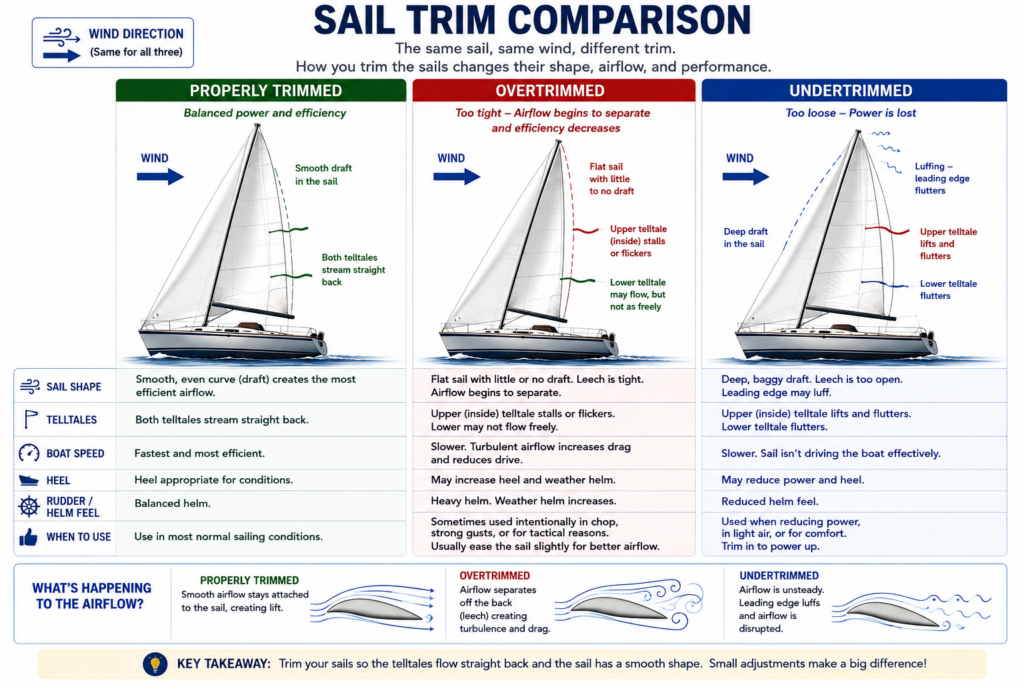
Once the boat is on the desired point of sail, adjust the sails to match the wind. Pulling the sheets in moves the sails closer to the centerline, while easing the sheets allows them to move farther out. Every point of sail requires a slightly different sail position.
Fortunately, the sails provide immediate feedback. If the front edge begins to luff, sheet in just enough for the flapping to stop. On the other hand, pulling the sails in too tightly reduces efficiency because the airflow can no longer follow the sail’s shape.
Likewise, watch the telltales attached to the sails. When they stream smoothly, the sail is producing efficient lift. When they flutter or disappear behind the sail, make small steering or trimming adjustments until they flow evenly again.
With experience you will discover a ‘sweet spot’ where the boat feels balanced, the helm is light, and the sails become quiet. That combination is often a sign that the boat is sailing efficiently.
COMMON BEGINNER MISTAKE
Making large sail trim adjustments. Most improvements come from moving the sheets only a few centimetres at a time.
Turning the Boat
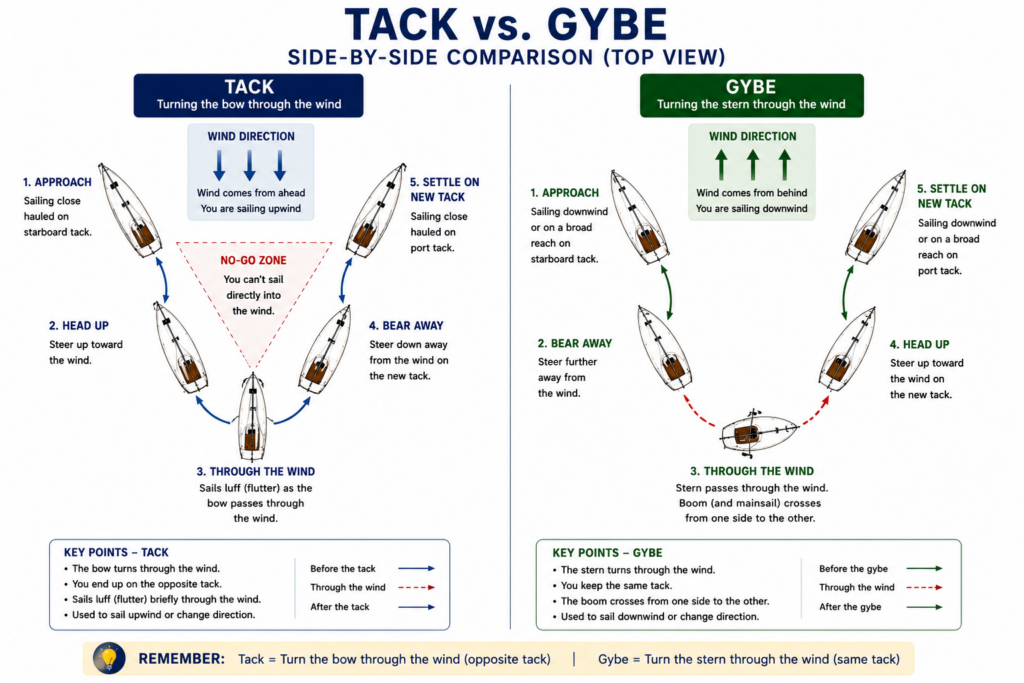
Eventually every sailor needs to change direction. The two fundamental turning manoeuvres are the tack and the gybe.
A tack turns the bow through the wind. First, check that the area is clear. Next, tell your crew what you are about to do. Turn the helm smoothly toward the wind, allow the headsail to pass across the boat, and then trim it on the new side. Because the boom crosses under relatively light load, tacking is the preferred way to change direction when sailing upwind.
A gybe turns the stern through the wind. Although the maneuver looks similar, the boom swings across much faster because the wind pushes it from behind. Therefore, control the boom carefully, communicate clearly, and make sure everyone keeps their head below its path.
Fortunately, most beginner mistakes—turning too quickly, forgetting the headsail sheets, or watching only the sails instead of where the boat is going—become less common with practice and repetition.
LEARNER OUTCOME
You should now understand the basic steering, sail-trimming, tacking, and gybing skills needed to control a sailboat safely in light conditions.
Looking Ahead
You are nearly finished the theoretical part of learning how to sail a sailboat. Now that you know how to steer, trim the sails, and change direction, the final section focuses on sailing efficiently, returning safely to the marina, avoiding common beginner mistakes, and continuing your sailing journey with confidence.
Sailing Efficiently
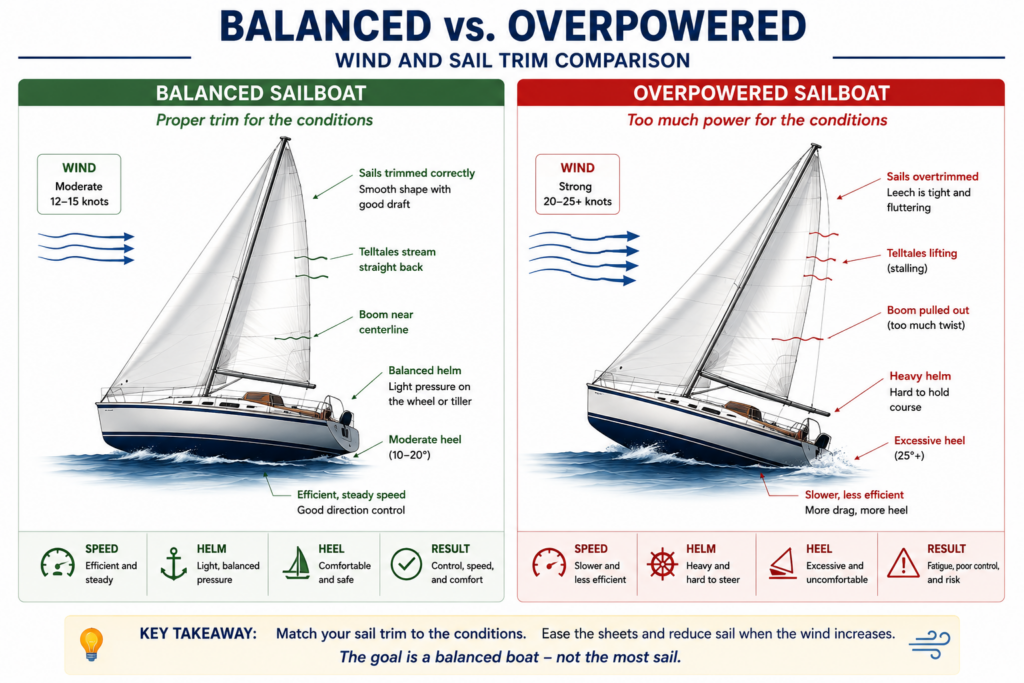
As your confidence grows, your focus gradually shifts from simply making the boat move to making it move well. Efficient sailing is rarely about pulling harder on a rope or steering more aggressively. Instead, it comes from observation, balance, and small, deliberate adjustments.
A well-balanced sailboat feels predictable and easy to steer. The helm should feel light in your hands, and the boat should maintain its course without constant correction. Moderate heel is perfectly normal and often indicates the sails are working efficiently. However, excessive heel usually means it is time to ease the sails, head up slightly, or reduce sail area if the wind continues to increase.
Likewise, pay attention to how the rudder feels. A heavy helm often signals that something is out of balance rather than suggesting you need to steer harder. Small changes to sail trim or course usually solve the problem more effectively.
Meanwhile, continue looking well ahead instead of focusing only on the sails. Because wind shifts, waves, and boat traffic are constantly changing, looking ahead gives you time to make smooth corrections instead of sudden reactions.
BEGINNER TIP
If the boat feels relaxed and easy to steer, resist the temptation to keep adjusting everything. Often the best trim is the one that requires the fewest corrections.
Returning to the Marina
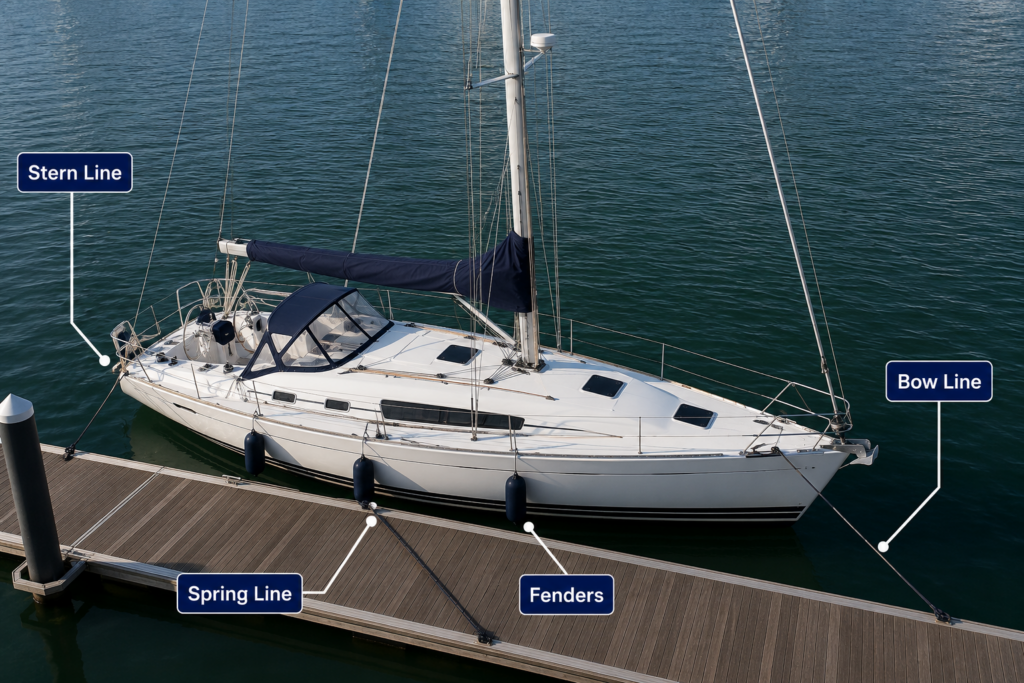
Every sailing trip eventually comes to an end, and returning to the marina deserves just as much attention as leaving it. First, lower or furl the sails in open water where there is plenty of room to maneuver. Next, start the engine and prepare your dock lines and fenders before entering the marina.
Approach your slip slowly. Fortunately, slow speed gives you more time to think, communicate, and correct small mistakes. Meanwhile, assign simple jobs to each crew member so everyone knows which line they will handle.
Once alongside, secure the bow line, stern line, and spring line before shutting down the engine. Finally, check that the fenders are positioned correctly to protect the hull from the dock and neighboring boats.
COMMON BEGINNER MISTAKE
Trying to dock too quickly. Nearly every docking maneuver becomes easier when the boat is moving slowly under control. Remember, only go as fast as you’d want to be going if you accidently hit the dock or another vessel.
Common Beginner Mistakes
Every sailor makes mistakes while learning how to sail a sailboat. Fortunately, they are part of the learning process and become less common with experience.
• Looking at the boat instead of ahead.
• Oversteering the helm.
• Ignoring wind direction.
• Pulling every rope without understanding its purpose.
• Sailing too fast around the marina.
• Forgetting to keep a proper lookout.
LEARNER OUTCOME
You should now understand the complete sequence of a basic sailing trip—from preparing the boat to returning safely to the dock.
Frequently Asked Questions
Is sailing difficult?
The basics are easier than many people expect. Confidence grows through regular practice.
Can one person sail a sailboat?
Yes. Many 20–30 foot sailboats are designed to be sailed by one person.
How much wind do beginners need?
Light to moderate winds are ideal for learning.
What size sailboat is easiest to learn on?
Most beginners find boats between 20 and 30 feet forgiving and easy to handle.
Can you sail without an engine?
Yes. Sailboats can sail without engines, although engines make docking and marina manoeuvring much easier.
How long does it take to learn?
Most people understand the fundamentals after a few outings, while proficiency develops over time.
Key Takeaways
• The wind is your engine.
• Learn the major parts before memorizing details.
• Understand the basic sailing terminology.
• Identify your point of sail before trimming the sails.
• Steer with small, smooth movements.
• Trim the sails continuously.
• Practise tacks and gybes deliberately.
• Prepare early when returning to the dock.
• Confidence grows one sailing trip at a time.
What’s Next?
Continue your learning with:
• Parts of a Sailboat
• Basic Sailing Terminology
• Points of Sail
• How to Steer a Sailboat
• Sail Trim Basics
• How to Tack
• How to Gybe
• How Sails Work
• Docking a Sailboat
• Anchoring a Sailboat
Congratulations! You have completed the foundation of beginner sailing. Each article in the SailboatZone curriculum explores one of these topics in greater depth, allowing you to build knowledge and confidence one skill at a time.
If you’d like to explore additional sailing terms and learn more about internationally recognized sailing instruction, the Royal Yachting Association (RYA) provides a wealth of beginner-friendly sailing resources.