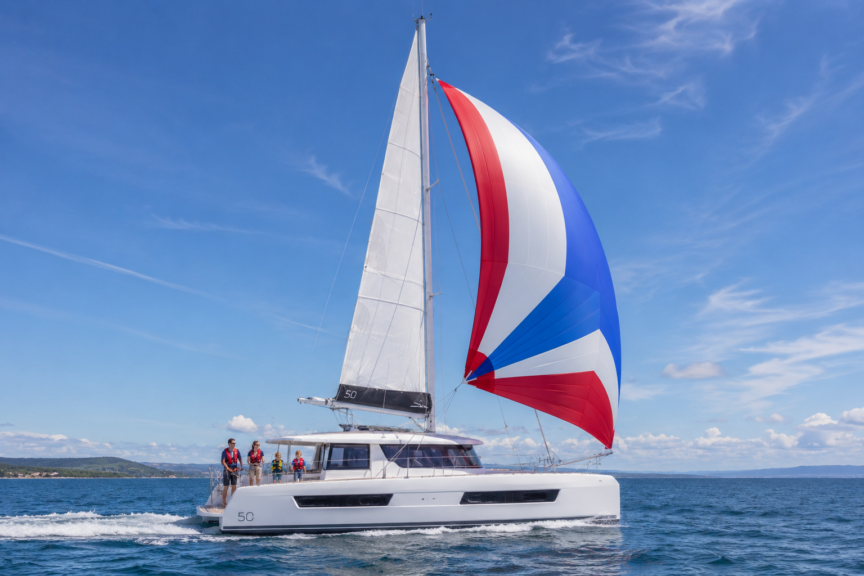
Sailing downwind can feel surprisingly relaxed the first time you try it.
The boat usually heels less. The apparent wind feels lighter. The sails are eased farther from the centerline, and the boat may seem to glide quietly across the water.
That can make downwind sailing appear simple.
Point the boat away from the wind, let the sails out, and go. Right?
Not quite.
Learning how to sail downwind well requires you to understand what is happening to the wind, your sails, and your boat as you turn away from the wind. You also need to learn to control the boom, recognize when the jib is being blanketed by the mainsail, and avoid an accidental gybe.
Fortunately, you don’t have to begin by sailing directly away from the wind.
In fact, one of the most important lessons in this guide is that sailing downwind does not necessarily mean sailing directly downwind.
For a beginner, a broad reach is often a much more comfortable place to start.
If you have already learned How to Sail Upwind, you are about to discover that many of the same skills still matter. You will steer according to the wind, adjust your sails as your course changes, and continuously observe what the boat is telling you.
The difference is that the sails are now being eased rather than pulled closer to the boat.
Let’s work through it one step at a time.
Quick Answer: How Do You Sail Downwind?
To sail downwind, steer the boat so the wind is coming from behind the beam, then ease the sails until they are properly trimmed for your new course.
A broad reach, with the wind coming over one of the boat’s rear quarters, is usually the best place for a beginner to start.
As you turn farther away from the wind toward a run:
- Bear away gradually.
- Ease the main sheet as the boat turns.
- Ease the jib sheet.
- Watch the sails for signs of poor trim.
- Maintain a steady heading.
- Keep everyone clear of the boom.
- Watch carefully for changes in wind direction.
- Avoid accidentally sailing by the lee.
The farther downwind you sail, the farther the sails generally need to be eased.
However, do not simply release the main sheet and let the boom go as far as possible.
The correct position depends on your course, wind strength, boat, rig, and conditions.
Think of downwind sail trim as a continuous process:
Change course → adjust sails → observe → adjust again.
What Does Sailing Downwind Mean?
Before discussing technique, we need to clarify what downwind actually means.
You may remember from the Points of Sail section that a sailboat’s course is described according to its angle to the wind.
As you turn progressively away from the wind, you move through:
Close-hauled → Close reach → Beam reach → Broad reach → Run
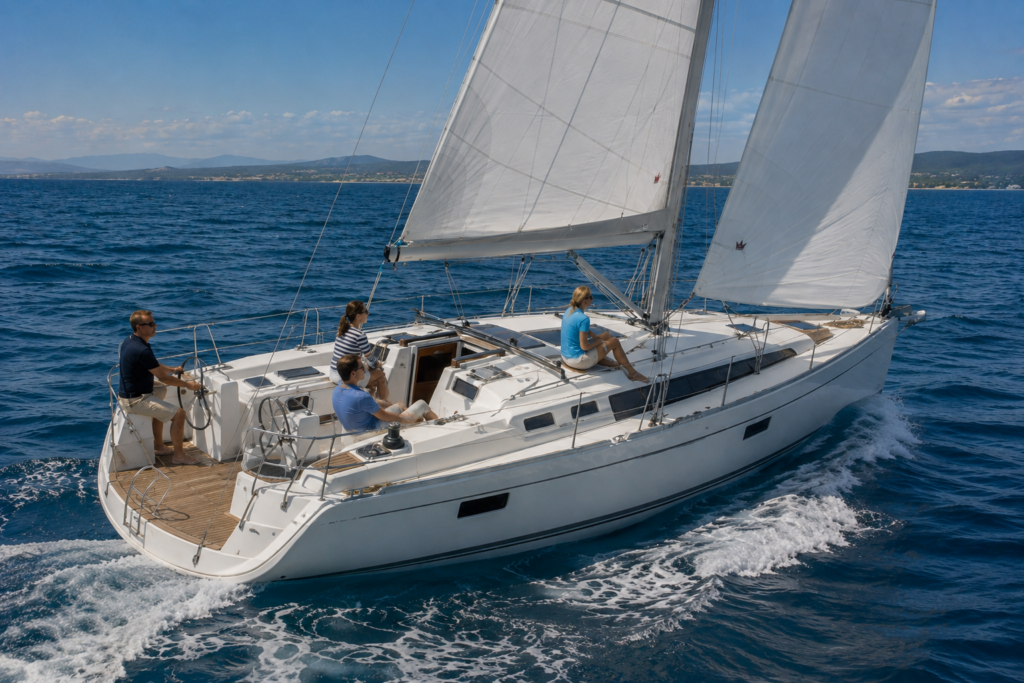
A boat on a broad reach is already sailing downwind even though it isn’t pointing directly away from the wind.
On a broad reach, the wind comes from behind the boat’s beam and across one of its aft quarters.
Continue turning away from the wind and eventually the wind will be coming almost directly over the stern. The boat is now sailing on a run.
This distinction matters.
Beginners sometimes assume that if their destination is downwind, the boat should point directly at it. But sailboats don’t always travel most comfortably or efficiently by following the straightest possible line.
The same principle applies when sailing upwind. You cannot simply point directly into the wind, so you sail at an angle and tack toward your destination.
Downwind, you have more options.
You may sail directly toward your destination on a run, or you may sail a series of broad reaches.
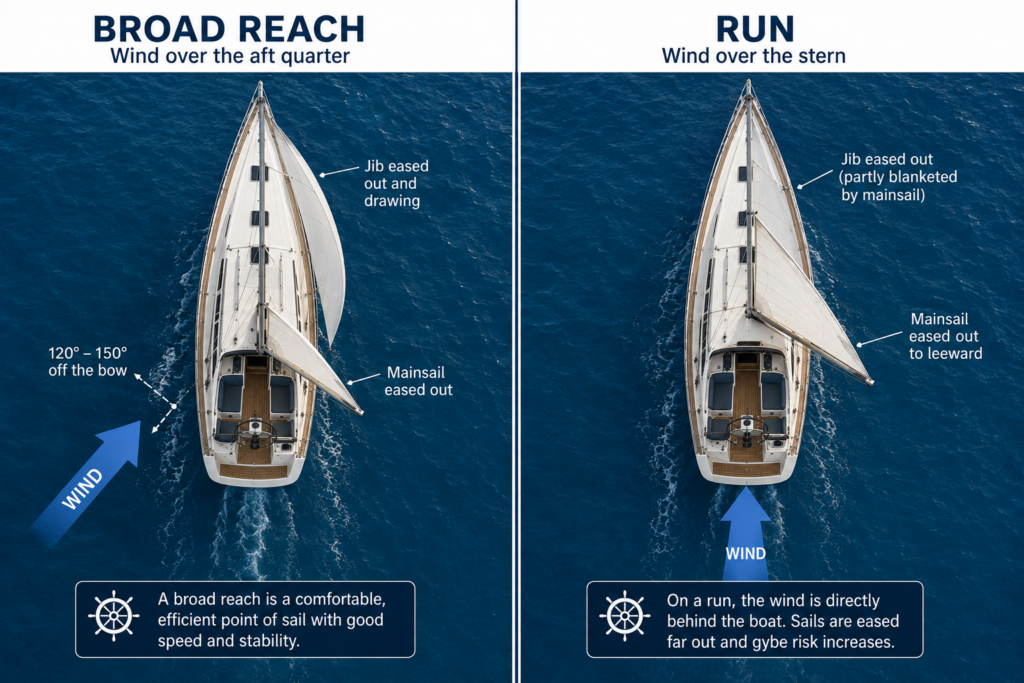
Broad Reach
On a broad reach:
- Wind comes from behind the beam.
- The mainsail is eased well away from the centerline.
- The jib is also eased.
- Both sails generally remain more stable than they do on a dead run.
- The boat is less likely to gybe accidentally than when sailing directly downwind.
Run
On a run:
- The wind is approximately behind the boat.
- The mainsail is eased far out.
- The jib may become difficult to keep filled.
- Small course changes become increasingly important.
- An accidental gybe becomes a more significant concern.
Both are legitimate ways of sailing downwind.
For a beginner, however, they don’t feel the same.
Broad Reach vs. Running Downwind
If you’re learning how to sail downwind, start by becoming comfortable on a broad reach.
Why?
Because it gives you more margin for error.
The sails usually remain filled more consistently. The jib is less likely to collapse behind the mainsail. You also have a clearer sense of which side of the boat the wind is coming from.
Most importantly, you are farther away from the point where the mainsail could unexpectedly gybe across the boat.
That doesn’t make a broad reach risk-free. You still need to steer accurately, monitor conditions, and respect the boom.
However, it is generally a forgiving place to practice.
BEGINNER TIP:
Don’t be in a hurry to sail directly downwind. Practise broad reaching in both directions first. Learn what properly eased sails look like and how the helm feels before experimenting with a dead run.
Why Sailing Downwind Feels Different
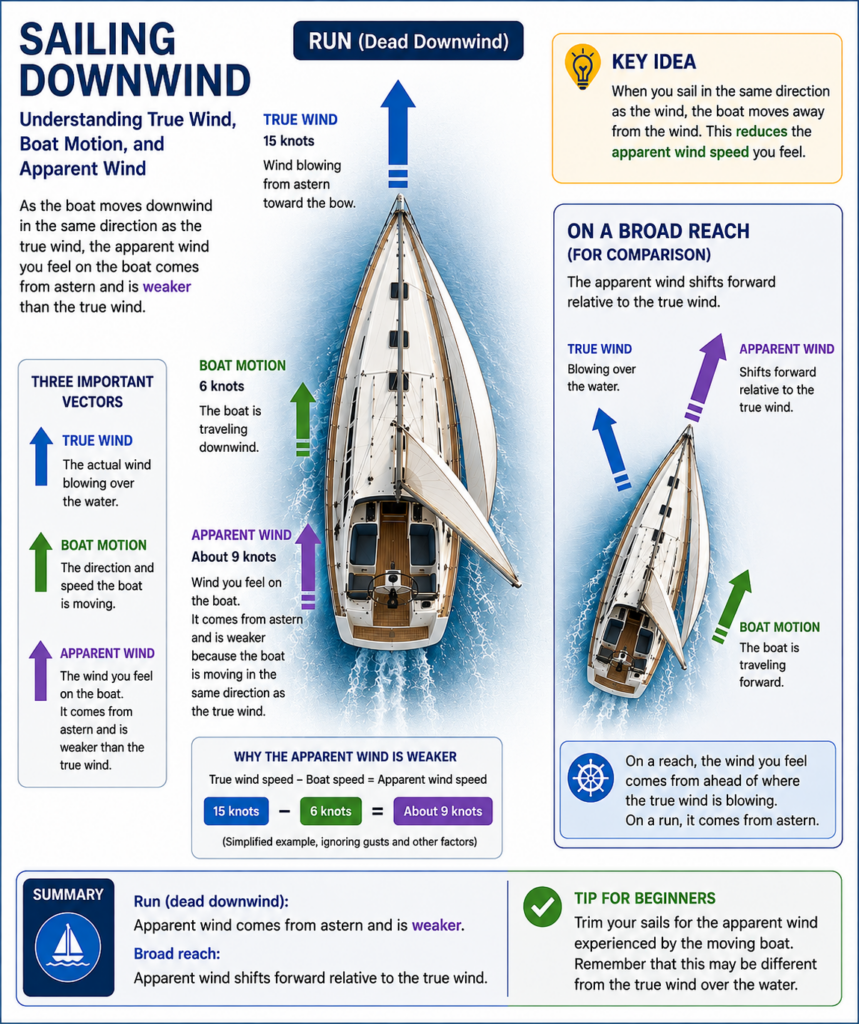
One of the strangest things about sailing downwind is how much lighter the wind can feel.
The actual wind may not have changed at all.
What changed is your movement relative to it.
True Wind vs. Apparent Wind
Imagine standing still while a 12-knot wind blows past you.
You feel approximately 12 knots of wind.
Now imagine traveling in roughly the same direction as that wind.
You are moving away from it.
The wind you experience aboard the moving boat can therefore feel weaker.
The wind you experience on the boat is called apparent wind.
If you’re not yet comfortable distinguishing true wind from apparent wind, review How to Read the Wind before spending much time running directly downwind.
As a sailboat travels downwind, its forward motion generally reduces the apparent wind speed compared with the true wind speed.
This explains something that can catch beginners by surprise.
You may be sailing comfortably downwind thinking:
“There isn’t much wind today.”
Then you turn the boat toward a beam reach or close reach.
Suddenly, the apparent wind strengthens.
The true wind did not suddenly appear. Your boat changed direction, which changed the apparent wind you experienced aboard it.
The Boat Often Feels Flatter
Upwind sailing often involves noticeable heeling because of the sideways component of aerodynamic force on the sails.
Downwind, the boat will often sail more upright.
For a nervous beginner, this can feel wonderfully comfortable.
But don’t confuse a flatter boat with a boat that requires less attention.
The boom is now farther outboard. The apparent wind direction can change with your speed and course. Waves can alter your heading. The boat may begin yawing from side to side.
You still need to sail the boat.
Step-by-Step: How to Sail Downwind
Now let’s put the concepts together.
Suppose you’re sailing comfortably on a beam reach and want to turn onto a broad reach.
Here’s the sequence.
Step 1: Determine Where the Wind Is Coming From
Before changing course, establish the wind direction.
Look beyond a single instrument.
You might use:
- A masthead wind indicator
- Flags ashore
- Ripples on the water
- Telltales
- Other sailboats
- The feel of the wind across your face
Remember that some indicators aboard your moving boat show apparent wind, not true wind.
How to Read the Wind explains these clues in more detail.
Knowing the wind direction allows you to visualize where your boat will be relative to it after the turn.
Step 2: Check the Area Downwind
Don’t become so focused on the sails that you forget where the boat is going.
Before bearing away, look ahead and around the boat.
Check for:
- Other sailboats
- Powerboats
- Paddlers
- Navigation marks
- Shorelines
- Shallow water
- Floating debris
- Fishing gear
- Other hazards
Continue keeping a proper lookout throughout the maneuver and while sailing your new course.
Sailing rules also continue to apply regardless of your point of sail. World Sailing publishes the current Racing Rules of Sailing for sailors participating in racing.
For recreational boating safety and operating guidance, consult the appropriate navigation and boating regulations for the waters where you sail.
Step 3: Bear Away Gradually
To bear away means to turn the bow farther away from the wind.
Make the change smoothly.
Don’t suddenly turn 40 or 50 degrees and then try to catch up with the sails.
Instead:
Turn a little → ease the sails → observe the boat → continue turning.
This allows the sails and steering to change together.
If you’re still developing confidence with the helm, How to Steer a Sailboat explains how small inputs produce controlled course changes.
Step 4: Ease the Mainsail
As you bear away, the mainsail needs to move farther outboard.
Ease the main sheet under control.
Do not simply release it.
As the boat turns, let the boom move outward gradually while watching the sail.
The exact amount depends on the boat and conditions, so avoid memorizing a single boom angle.
Instead, learn to recognize proper trim.
Step 5: Ease the Jib
The jib also needs to be eased.
Release the working jib sheet gradually so the sail moves outward.
Don’t dump the sheet completely.
Instead, ease it until the jib remains filled without being unnecessarily tight.
As the boat sails deeper downwind, you’ll eventually notice that the jib becomes less stable.
We’ll return to why shortly.
Step 6: Establish Your New Course
Once you’ve reached your intended broad reach, stop the turn.
Choose a visual reference ahead of the boat.
It might be:
- A distant tree
- A headland
- A building
- A mountain
- A navigation mark
A distant reference makes small course changes easier to recognize.
Your compass can also provide a useful reference, but don’t stare at it continuously.
Look outside the boat.
Step 7: Check Your Sail Trim
Now assess both sails.
If a sail is pulled in farther than necessary for your course, it is over-trimmed.
Ease it gradually and observe what happens.
On many points of sail, a useful basic method is to ease a sail until the forward part begins to luff, then trim it back in just enough for it to fill again. As you approach a dead run, however, sail behavior changes and that simple method becomes less useful.
How to Trim a Sail covers the basic trim process in more detail.
Step 8: Watch the Sails and Telltales
Telltales can still provide useful information while reaching, but don’t expect them to behave exactly as they do upwind.
As you sail deeper downwind, airflow around the sails changes. Eventually, particularly on a run, telltales become less useful as a simple “both streaming straight back” trim indicator.
Use several clues together:
- Sail shape
- Telltales
- Boat speed
- Helm feel
- Sail stability
- Apparent wind
How to Read Sail Telltales explains what these small pieces of yarn can—and cannot—tell you.
Step 9: Make Small Steering Corrections
Once established downwind, resist the temptation to constantly move the helm.
Small corrections are usually better than large ones.
Look well ahead.
Anticipate what the boat is doing instead of reacting after it has already wandered well off course.
Step 10: Keep Reassessing
Downwind sailing isn’t a “set it and forget it” activity.
Keep checking:
Wind → Course → Sails → Traffic → Waves → Crew
Then repeat.
Conditions change.
Your job is to notice those changes early.
How to Trim the Mainsail Downwind
As you bear away, the mainsail generally needs to be eased progressively farther out.
The important word is progressively.
A beginner may hear “ease the mainsail downwind” and interpret that as:
“Let the boom all the way out.”
That’s not a reliable trimming method.
Instead, ease the main sheet while observing the sail.
On a broad reach, the boom will normally be noticeably outboard, but the exact position varies according to the boat, rig, wind, sea state, and course.
Watch the Boom
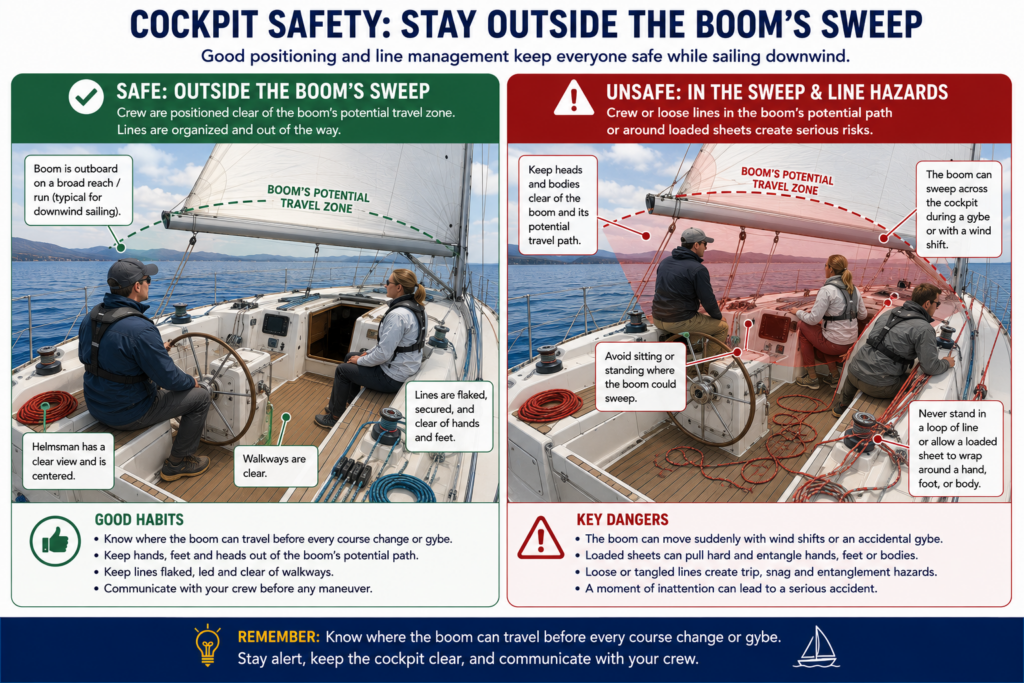
The boom deserves particular attention downwind because it may be positioned across a large part of the cockpit.
Everyone aboard should understand where it is and where it could move.
Keep:
- Heads clear
- Hands clear
- Bodies out of its travel path
- Loose equipment secured
- main sheet and other loaded lines clear of feet and hands
COMMON MISTAKE:
A beginner eases the main sheet rapidly without looking at the boom.
Correction: Ease the sheet under control and know where the boom is going before you release line.
How to Trim the Jib Downwind
The jib presents another challenge.
On a broad reach, it can still work effectively.
As the boat turns closer to a dead run, however, the mainsail can begin blocking some of the wind reaching the jib.
This is called blanketing.
The jib may:
- Become soft
- Flutter
- Collapse
- Refill
- Collapse again
Beginners often respond by repeatedly adjusting the jib sheet.
But the problem may not be the sheet.
It may be the course.
Try steering slightly onto a broad reach.
If the jib suddenly fills and becomes stable, you’ve learned something important: the sail wasn’t necessarily badly trimmed. It was struggling to receive clean airflow on your previous heading.
BEGINNER TIP:
When a jib repeatedly collapses on a run, don’t immediately start pulling ropes. First ask, “Would a small course change give this sail cleaner air?”
Sailing on a Broad Reach
For many beginners, the broad reach is the sweet spot of downwind sailing.
The boat is heading substantially downwind, but the wind is still clearly coming from one side.
This provides several advantages.
The sails tend to remain more stable.
The jib is more likely to stay filled.
You have greater separation from an accidental gybe.
The boat may also make good speed because the sails continue working with useful airflow across them rather than simply being pushed from behind.
This leads to an interesting idea.
The shortest route isn’t always the best sailing route.
Suppose your destination is almost directly downwind. You could point straight toward it.
Alternatively, you could sail one broad reach and then gybe onto another broad reach.
The second route covers more distance, but under some conditions the boat may sail faster and more comfortably.
You don’t need to optimize these angles as a beginner.
For now, remember this:
You are allowed to choose the course that gives you better control.
Sailing Directly Downwind
Eventually you’ll want to experience sailing on a run.
This is where the wind comes from approximately behind the boat.
Before doing it, choose suitable conditions:
- Moderate, manageable wind
- Plenty of open water
- Limited traffic
- Good visibility
- A competent person aboard if possible
Begin from a broad reach.
Bear away gradually.
As you turn, ease the mainsail farther and continue adjusting the jib.
Now pay close attention to the boat.
Your Margin Between Tacks Becomes Smaller
When broad reaching, the wind clearly comes over one aft quarter.
On a dead run, the boundary between having the wind on one side and the other is directly behind you.
A relatively small course change—or a change in wind direction—can move the wind across the stern.
That’s where gybe awareness becomes especially important.
The Jib May Become Unstable
As discussed earlier, the mainsail can blanket the jib.
If the jib repeatedly collapses, you have several choices.
You can:
- Change course onto a broad reach
- Accept some instability temporarily
- Under appropriate conditions, set the jib on the opposite side for wing-on-wing sailing
For a beginner, the first option is often the simplest.
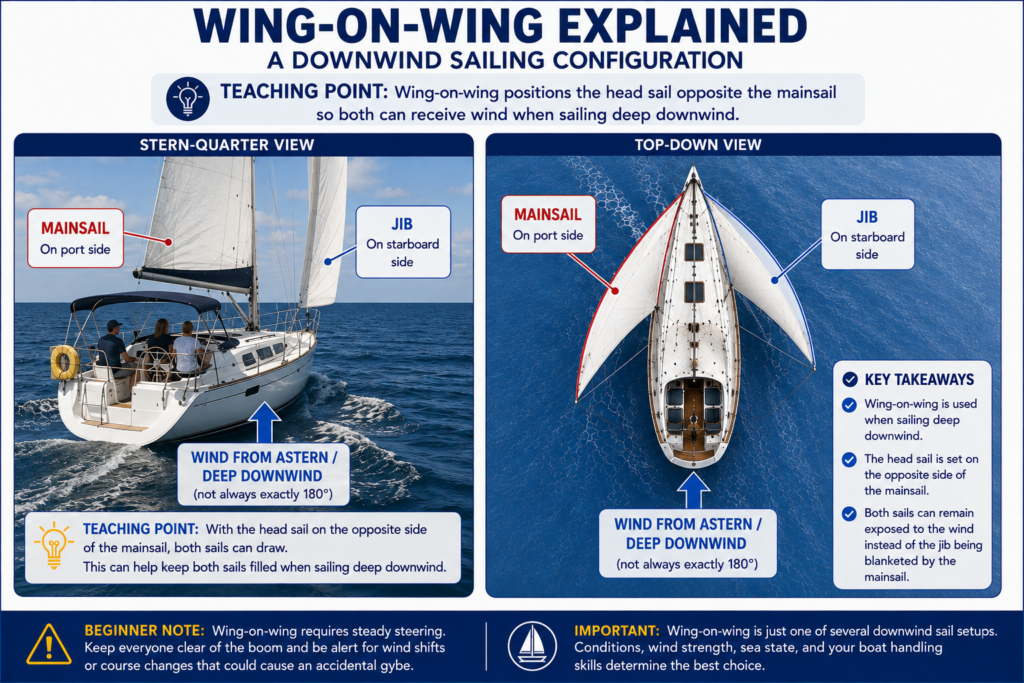
What Is Wing-on-Wing Sailing?
You’ve probably seen photographs of a sailboat traveling downwind with the mainsail on one side and the jib on the other.
That’s commonly called wing-on-wing sailing.
Instead of allowing the jib to sit behind the mainsail, the jib is positioned on the opposite side of the boat so each sail can catch wind.
It can be an effective way to sail directly downwind.
It also requires more careful steering.
If your course wanders too far, one of the sails can lose its wind or the boat can approach an unintended gybe.
Depending on the boat and setup, additional equipment may also be used to control the sails.
For your first downwind lessons, you don’t need to master wing-on-wing sailing.
First become comfortable broad reaching and running with good course control.
Then build on those skills.
Understanding the Accidental Gybe
This is the most important safety concept in this article.
A gybe occurs when the stern passes through the wind and the mainsail moves from one side of the boat to the other.
A controlled gybe is a normal sailing maneuver.
You intentionally change course, prepare the boat and crew, control the mainsail, and complete the turn.
How to Jibe a Sailboat teaches that process step by step.
An accidental gybe is different.
The boat crosses the wind unintentionally.
When the mainsail is far outboard and filled with wind, the boom may sweep rapidly across the boat.
That’s why the danger isn’t the word gybe.
The danger is an uncontrolled boom.
What Causes an Accidental Gybe?
Several things can cause one:
- Steering too far
- Losing concentration
- A sudden wind shift
- Waves turning the stern
- Over-correcting the helm
- Sailing too close to dead downwind without recognizing it
- Accidentally sailing by the lee
What Is Sailing by the Lee?
This term sounds complicated but the basic idea is simple.
Imagine the mainsail is extended on one side of the boat.
Normally, you expect the wind to be coming from the opposite side and holding the sail there.
If you steer far enough that the wind begins coming from the same side as the mainsail, you are sailing by the lee.
The sail may initially remain where it is.
That can fool you into thinking everything is fine.
But you’ve entered a position where the wind can push the mainsail across the boat.
For an experienced sailor, sailing by the lee can sometimes be deliberate.
For a beginner who arrives there unintentionally, treat it as a warning.
Warning Signs
Watch for:
- The mainsail becoming unstable
- Changes in pressure on the sail
- A sudden change in wind feel
- The boat wandering across its intended heading
- Wind indicators showing the wind moving toward the sail’s side
- Waves repeatedly pushing the stern sideways
If you’re uncomfortable with the boat’s behavior, don’t insist on maintaining a dead run.
Head up slightly onto a broad reach.
That small course change can restore a clearer wind angle and give you more room before an accidental gybe.
What About a Preventer?
A preventer is a line or system used to help control the boom and reduce the risk of it swinging uncontrollably across the boat.
However, a preventer introduces loads and rigging considerations of its own.
It should be rigged correctly for the particular boat rather than improvised without understanding the forces involved.
We’ll cover that separately.
Steering Downwind
Good downwind steering is often less about moving the helm and more about knowing when not to move it.
Beginners tend to steer reactively.
The bow drifts left.
Correct right.
It moves too far right.
Correct left.
Soon the boat is weaving back and forth.
On a broad reach this wastes energy and makes sail trim inconsistent.
Near a dead run it can also move the boat toward an accidental gybe.
Instead, look well ahead.
Pick a distant reference.
Notice trends early.
Then make small corrections.
Don’t Steer by the Sails Alone
Sails are valuable indicators, but your primary responsibility remains controlling the boat and maintaining a lookout.
Don’t become so fascinated by a collapsing jib that you stop watching where you’re going.
The same applies to instruments.
Glance at them.
Don’t stare at them.
WHY THIS WORKS:
A sailboat has momentum. Small steering inputs made early give the boat time to respond. Large corrections made late often require an equally large correction in the opposite direction.
Sailing Downwind in Waves
Flat-water downwind sailing and wave sailing can feel surprisingly different.
Imagine a wave approaching from behind.
As it reaches the stern, it may lift the boat and push it forward.
It can also push the stern sideways.
The bow may then swing in the opposite direction.
This side-to-side wandering is called yawing.
On a broad reach, some yawing may simply require gentle steering corrections.
On a run, however, a significant yaw can change your angle to the wind enough to bring the boat closer to an accidental gybe.
The natural beginner response is often to fight every movement with the helm.
Try not to.
Watch the waves approaching from behind and anticipate what they are likely to do.
Use measured steering inputs rather than chasing the bow from side to side.
As wind and wave conditions increase, the demands of downwind sailing also increase significantly. Sail reduction, boat-specific handling and heavy-weather techniques deserve their own lessons.
Crew Position and Boat Balance
Where people sit matters.
Downwind, the boat may be sailing flatter, so beginners sometimes assume crew position no longer matters.
It does.
First, keep crew away from the boom’s potential travel path.
That becomes especially important as the mainsail is eased farther out.
Second, keep everyone clear of loaded lines.
A main sheet, jib sheet, preventer, or other line under load should never be wrapped around a hand, foot, or body part.
Third, distribute crew weight sensibly.
You generally don’t want everyone suddenly moving from one side of the boat to the other without a reason.
Smooth, deliberate movement helps maintain balance.
Before a maneuver such as a gybe, communicate clearly so everyone knows what is going to happen.
Transport Canada’s current Safe Boating Guide provides broader guidance on safe and responsible recreational boating, including safety equipment and PFDs.
Transport Canada also recommends checking that the load aboard a pleasure craft is well distributed and briefing guests about safe operation and safety equipment before departure.
The Canadian Safe Boating Council recommends wearing a life jacket or PFD while underway aboard pleasure craft, including sailboats.
Common Beginner Downwind Sailing Mistakes
Most downwind mistakes aren’t complicated. They usually come from misunderstanding the wind, sail trim, or the amount of attention required.
Here are ten to watch for.
1. Assuming Downwind Means Dead Downwind
Mistake: Pointing directly away from the wind simply because the destination is there.
Better approach: Consider whether a broad reach gives you better control, sail stability, and comfort.
2. Over-Trimming the Sails
Mistake: Leaving the sails pulled in as the boat bears away.
What you’ll notice: The sails remain filled, so the problem may not seem obvious, but they may be unnecessarily tight for the course.
Better approach: Ease progressively as you bear away and observe the result.
3. Dumping the main sheet
Mistake: Releasing a large amount of main sheet at once.
Better approach: Ease under control while monitoring the boom.
4. Fixating on the Jib
Mistake: Constantly adjusting the jib because it collapses on a run.
Better approach: Consider whether the mainsail is blanketing it. A slight course change may solve the problem.
5. Making Large Steering Corrections
Mistake: Waiting until the boat is well off course and then turning aggressively.
Better approach: Look farther ahead and correct earlier with smaller inputs.
6. Ignoring Apparent Wind
Mistake: Assuming the true wind is weak because the breeze feels light while running.
Better approach: Remember that your movement downwind reduces apparent wind speed. Conditions may feel dramatically stronger when you turn across or toward the wind.
7. Sailing by the Lee Without Realizing It
Mistake: Allowing the wind to cross to the same side as the mainsail while continuing to sail as though nothing has changed.
Better approach: Monitor wind direction and course. If you’re uncertain, head up onto a more definite broad reach.
8. Putting Crew in the Boom’s Path
Mistake: Treating the cockpit as safe simply because the boat is sailing flat.
Better approach: Establish the boom’s possible travel zone and keep people out of it.
9. Watching the Sails Instead of the Water
Mistake: Spending too much time looking upward or backward.
Better approach: Maintain a proper lookout. Sail trim matters, but avoiding another boat matters more.
10. Waiting for the Gybe to Become a Surprise
Mistake: Treating a gybe as something that suddenly “happens.”
Better approach: Track your heading, wind direction, sail position and waves. Most accidental gibes develop from changes that can be recognized.
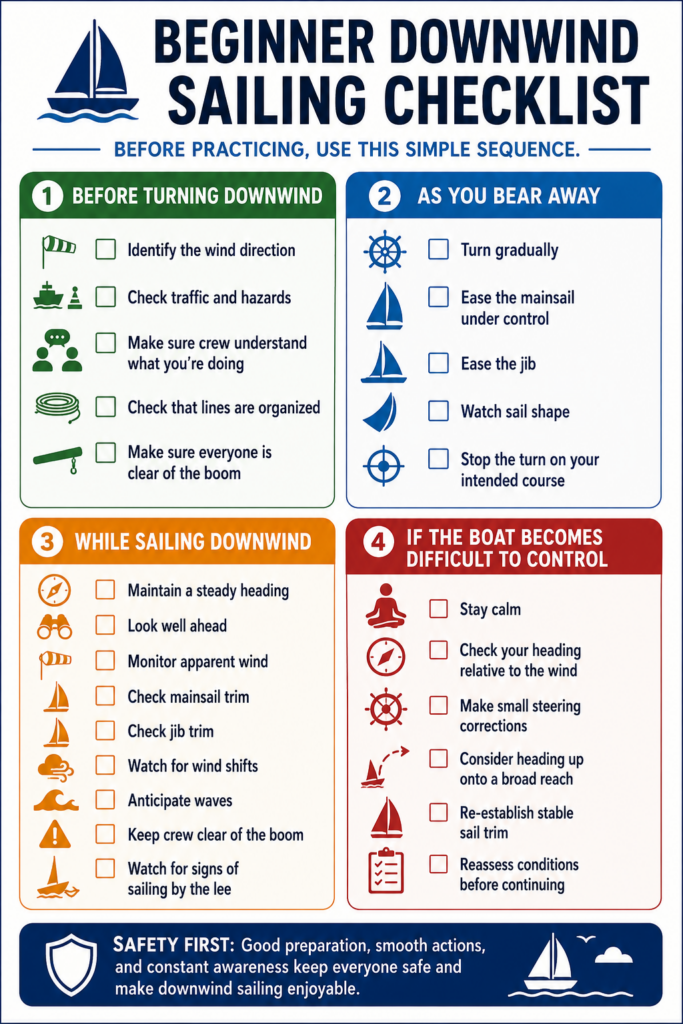
Beginner Downwind Sailing Checklist
Before practicing, use this simple sequence.
Before Turning Downwind
☐ Identify the wind direction
☐ Check traffic and hazards
☐ Make sure crew understand what you’re doing
☐ Check that lines are organized
☐ Make sure everyone is clear of the boom
As You Bear Away
☐ Turn gradually
☐ Ease the mainsail under control
☐ Ease the jib
☐ Watch sail shape
☐ Stop the turn on your intended course
While Sailing Downwind
☐ Maintain a steady heading
☐ Look well ahead
☐ Monitor apparent wind
☐ Check mainsail trim
☐ Check jib trim
☐ Watch for wind shifts
☐ Anticipate waves
☐ Keep crew clear of the boom
☐ Watch for signs of sailing by the lee
If the Boat Becomes Difficult to Control
☐ Stay calm
☐ Check your heading relative to the wind
☐ Make small steering corrections
☐ Consider heading up onto a broad reach
☐ Re-establish stable sail trim
☐ Reassess conditions before continuing
Frequently Asked Questions About Sailing Downwind
Is Sailing Downwind Easier Than Sailing Upwind?
In some ways, yes.
The boat often heels less and the apparent wind may feel lighter. You also don’t have to maintain the relatively narrow wind angle required when sailing close-hauled.
However, downwind sailing introduces different challenges.
Sail stability, apparent wind, boom position, course control and accidental gibes all require attention.
Think of it as a different skill rather than simply an easier one.
What Is the Best Point of Sail for Going Downwind?
There isn’t one universal answer.
For a beginner, a broad reach is often an excellent downwind course because the sails tend to remain stable and you have more margin before an accidental gybe.
The fastest or most efficient course depends on the boat and conditions.
Is a Broad Reach Faster Than a Run?
It often can be.
A sailboat may generate better airflow over its sails on a broad reach and therefore travel faster through the water than when pointed directly downwind.
However, sailing a broad reach toward a destination directly downwind also means covering more distance.
Advanced sailors compare boat speed, sailing angle and distance to determine the fastest route.
As a beginner, prioritize control and good sail trim rather than chasing the theoretically fastest course.
Why Does My Jib Collapse When Sailing Downwind?
The mainsail may be blocking—or blanketing—the wind reaching the jib.
This becomes increasingly common as you approach a dead run.
Try altering your course slightly toward a broad reach.
If the jib fills again, the problem was probably airflow rather than simply sheet tension.
How Far Should I Let the Mainsail Out?
There is no single angle that applies to every boat and condition.
Generally, the mainsail is progressively eased as you bear away.
Rather than memorizing an angle, learn to trim according to the boat’s course, sail behavior, wind and rig.
Avoid simply letting the boom go as far as possible.
What Causes an Accidental Gybe?
An accidental gybe occurs when the wind crosses the stern unintentionally and causes the mainsail and boom to move to the opposite side.
Possible causes include steering errors, wind shifts, waves, over-correction and accidentally sailing by the lee.
Accurate steering and awareness of wind direction are your first defenses.
Is Wing-on-Wing Sailing Safe for Beginners?
It can be done safely under suitable conditions, but it requires more precise steering and good awareness of boom position and wind direction.
A beginner should first become comfortable broad reaching and controlling the boat on a normal run.
Then learn wing-on-wing sailing as a separate skill.
Why Does the Wind Feel Weaker When I Sail Downwind?
Because you’re moving in roughly the same direction as the wind.
Your movement reduces the apparent wind speed you feel aboard the boat.
Turn toward a reach or upwind and the apparent wind will usually increase.
Key Takeaways
If you remember only a few things from this lesson, remember these:
- Downwind does not necessarily mean dead downwind.
- A broad reach is an excellent place for beginners to learn downwind sailing.
- Ease the sails progressively as you bear away.
- Don’t simply release the main sheet and let the boom go.
- Apparent wind usually feels lighter when traveling downwind.
- The mainsail can blanket the jib when sailing on a run.
- A collapsing jib doesn’t automatically mean the jib sheet is wrong.
- Small steering corrections are better than large reactive ones.
- Keep crew clear of the boom and loaded lines.
- Know what sailing by the lee looks like.
- Treat an accidental gybe primarily as a problem of uncontrolled boom movement.
- If a dead run becomes uncomfortable or unstable, heading up onto a broad reach is often a sensible option.
- Keep looking outside the boat. Traffic, wind, waves and your course matter more than perfect sail trim.
What Should I Learn Next?
You now have another major piece of the sailing puzzle.
You’ve learned that how to sail downwind isn’t simply a matter of pointing away from the wind. You need to coordinate steering and sail trim while understanding apparent wind, sail blanketing and boom control.
You should now be able to move from a reach onto a broad reach, progressively ease the sails, establish a stable downwind course and recognize when you’re approaching the limits of a comfortable run.
If you haven’t already mastered controlled gybing, that’s your most important next lesson.
Once you’re comfortable with gybing, the next stage is learning how to make direct downwind sailing more controlled and effective.
After that, you can explore boom-control systems such as preventers and eventually specialized downwind sails.
Don’t rush those steps.
Get comfortable on a broad reach first.
Learn to recognize the wind without constantly thinking about it. Learn what properly eased sails look like. Develop a steady hand on the helm.
Then move progressively closer to a run.
That’s how you turn downwind sailing from something that merely feels easy into something you actually understand.
Knowledge Check: How Well Do You Understand Downwind Sailing?
Try answering these questions without looking back through the article.
1. Which of these is a downwind point of sail?
A. Close-hauled
B. Close reach
C. Broad reach
D. No-sail zone
2. Why is a broad reach often a good downwind course for beginners?
A. The sails don’t require trimming
B. The sails tend to remain more stable and there is more margin before an accidental gybe
C. The boat cannot heel
D. Steering is unnecessary
3. What should happen to the sails as you bear away from a beam reach toward a broad reach?
A. Both sails should generally be eased progressively
B. Both sails should be pulled tightly toward the centerline
C. The mainsail should be lowered
D. The jib should always be furled
4. Why can the wind feel weaker while sailing downwind?
A. The sails block all the wind
B. Wind always becomes weaker behind a sailboat
C. The boat is traveling in roughly the same direction as the wind, reducing apparent wind speed
D. The mast slows the wind
5. Your jib repeatedly collapses while you’re sailing on a run. What could be happening?
A. The mainsail may be blanketing the jib
B. The rudder is too large
C. The mast is too tall
D. The boat must be turned directly into the wind
6. What is an accidental gybe?
A. A tack performed too slowly
B. An unplanned crossing of the wind at the stern that causes the mainsail and boom to change sides
C. A jib that collapses
D. A boat turning into the no-sail zone
7. Why can sailing by the lee be a concern for a beginner?
A. It automatically stops the boat
B. It makes the rudder stop working
C. It can put the boat in a position where the mainsail may gybe unexpectedly
D. It prevents the jib from being adjusted
8. What should you generally do if a dead run begins to feel unstable or difficult to control?
A. Make increasingly large steering movements
B. Head up slightly toward a broad reach and re-establish control
C. Release every sheet completely
D. Turn immediately head-to-wind
9. What is wing-on-wing sailing?
A. Sailing with two mainsails
B. Sailing with the mainsail and jib set on opposite sides of the boat while traveling downwind
C. Sailing without a jib
D. Sailing directly into the wind
10. Which steering technique is generally preferable when sailing downwind?
A. Large alternating corrections
B. Constantly moving the helm
C. Small, early corrections while looking well ahead
D. Steering only when the jib collapses
11. Why can following waves make a downwind run more challenging?
A. They can push the stern sideways and cause the boat to yaw
B. They eliminate apparent wind
C. They automatically tighten the sails
D. They prevent the rudder from moving
12. What is the most important thing to remember about the boom when sailing downwind?
A. It should always be centered
B. Everyone should remain aware of its position and stay clear of its potential travel path
C. Someone should hold it in place
D. It cannot move unless the main sheet is released
Answer Key
1. C — Broad reach
A broad reach is a downwind point of sail even though the boat isn’t traveling directly away from the wind.
2. B — The sails tend to remain more stable and there is more margin before an accidental gybe.
This is one reason broad reaching is such a useful training ground for beginners.
3. A — Both sails should generally be eased progressively.
As you bear away, the sails move progressively farther from the boat’s centerline.
4. C — The boat is traveling in roughly the same direction as the wind, reducing apparent wind speed.
This is why the conditions can feel deceptively calm on a run.
5. A — The mainsail may be blanketing the jib.
Before endlessly adjusting the jib sheet, consider changing course slightly.
6. B — An unplanned crossing of the wind at the stern that causes the mainsail and boom to change sides.
The uncontrolled movement of the boom is the primary danger.
7. C — It can put the boat in a position where the mainsail may gybe unexpectedly.
Beginners should learn to recognize when the wind has moved onto the same side of the boat as the mainsail.
8. B — Head up slightly toward a broad reach and re-establish control.
You don’t have to remain on a dead run simply because your destination is directly downwind.
9. B — Sailing with the mainsail and jib set on opposite sides of the boat while traveling downwind.
This allows both sails to receive wind that might otherwise be blocked by the mainsail.
10. C — Small, early corrections while looking well ahead.
Anticipating changes is generally better than making large corrections after the boat has wandered off course.
11. A — They can push the stern sideways and cause the boat to yaw.
Anticipating the movement of following waves helps you avoid over-correcting.
12. B — Everyone should remain aware of its position and stay clear of its potential travel path.
As the mainsail is eased downwind, the boom occupies a larger area and can cross the boat rapidly during a gybe.