
A beam reach is one of the best points of sail for learning how a sailboat really works.
The wind comes across the side of the boat rather than from ahead or behind. The sails are eased away from the centerline. The boat usually develops good speed without requiring the precise steering and tight sail trim needed when sailing upwind.
For a beginner, this creates an ideal learning environment.
You can concentrate on steering. You can experiment with sail trim. You can watch the telltales. Most importantly, you can deliberately turn slightly toward or away from the wind and immediately see how the sails need to change.
That is why learning how to sail a beam reach should involve more than simply finding a 90-degree angle to the wind and holding it.
In this guide, you’ll use the beam reach as your starting point for learning the entire family of reaching in sailing. You’ll learn how to establish a beam reach, steer it accurately, trim the mainsail and jib, use telltales, respond to gusts, and then transition smoothly between a close reach, beam reach, and broad reach.
By the end, reaching should feel less like three separate points of sail and more like one continuous sailing skill.
Quick Summary: How to Sail a Beam Reach
To sail a beam reach:
- Identify the true wind direction.
- Steer so the wind is coming approximately across the side, or beam, of the boat.
- Establish a steady course before making fine sail adjustments.
- Ease the mainsail away from the centerline until it approaches the point of luffing, then trim it in slightly.
- Ease the jib and use its telltales to find efficient trim.
- Keep your eyes mostly outside the boat and steer a smooth, consistent heading.
- If you head up toward the wind, trim the sails in.
- If you bear away from the wind, ease the sails out.
- Recheck sail trim whenever the course or wind changes.
The fundamental reaching rule is simple:
Head up → trim in.
Bear away → ease out.
Master that relationship and you have learned one of sailing’s most important skills.
What Is a Beam Reach?
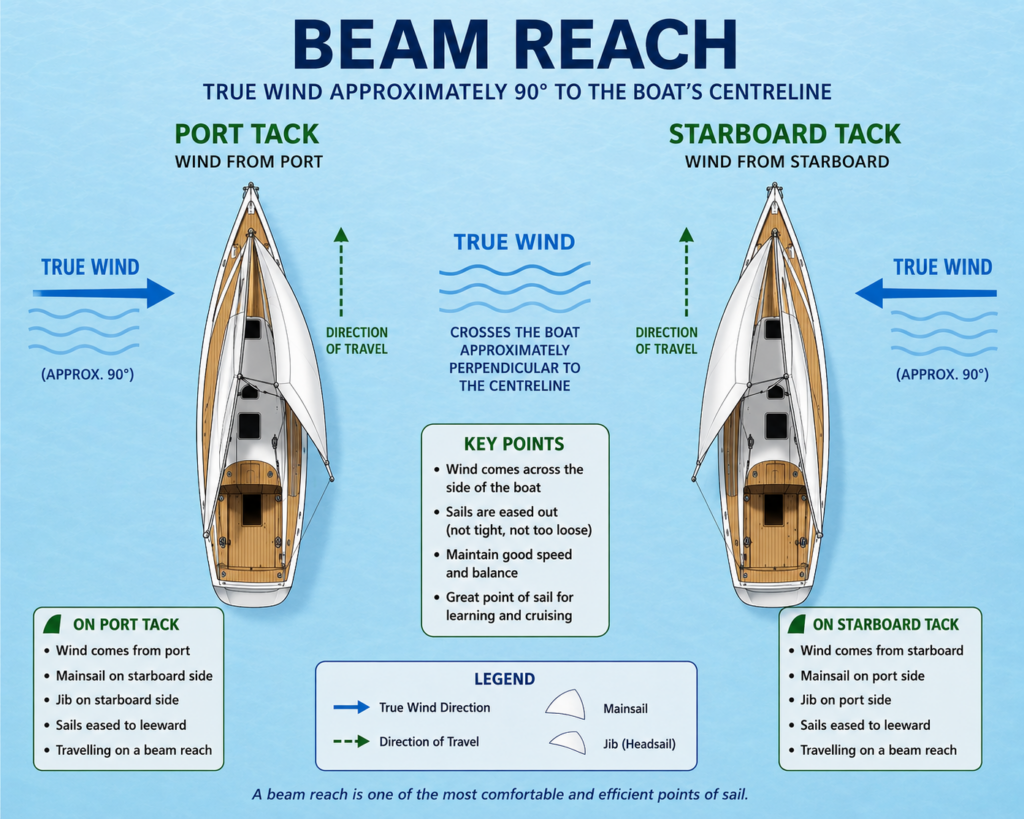
A beam reach is a point of sail where the wind is coming approximately across the side of the sailboat.
The word beam refers to the width of the boat. Therefore, when the wind is approximately perpendicular to the boat’s centerline, you are sailing on a beam reach.
The Royal Yachting Association describes the beam reach as the point of sail where the wind is on the side, or beam, of the boat, with the sails eased substantially compared with upwind sailing.
Think of the boat as the hand of a clock.
If the bow is pointing toward 12 o’clock, wind coming from roughly 3 o’clock or 9 o’clock places the boat on a beam reach.
In simplified sailing diagrams, a beam reach is usually represented as approximately 90 degrees to the true wind.
Don’t become obsessed with maintaining an exact 90-degree angle.
Real wind moves. Boats move. Waves turn the boat. Apparent wind changes with boat speed. Different boats also perform somewhat differently.
For the beginner, the useful definition is simpler:
On a beam reach, the wind is coming broadly across the side of the boat and the sails are eased substantially farther out than they would be when sailing upwind.
Why the Beam Reach Is Such an Important Beginner Skill
When you first learn to sail, several things compete for your attention at once.
You are trying to steer.
You are watching the wind.
You are thinking about other boats.
You are adjusting sails.
You may also be trying to remember unfamiliar terminology while wondering whether the boat is heeling too much.
A beam reach removes some of that workload.
Unlike sailing close-hauled, you aren’t trying to maintain a narrow angle near the edge of the no-sail zone.
Unlike sailing on a run, the mainsail isn’t sitting far out beside the boat with the possibility of an accidental gybe if the stern crosses the wind.
Instead, the boat generally has good speed and the sails respond clearly to changes in course and trim.
That makes beam reach sailing an excellent place to develop feel.
You begin to notice that easing a sheet changes the sail’s angle.
You feel the boat accelerate when the trim improves.
You see telltales change when airflow becomes disturbed.
You notice the boat heel when a gust arrives.
And you begin connecting steering with sail trim.
Those observations are the foundation of becoming an independent sailor.
Beam Reach vs Close Reach vs Broad Reach
A beam reach is only one part of a larger family of sailing angles known as reaching.
The three main reaches are:
| Point of Sail | Wind Position | General Sail Position |
|---|---|---|
| Close reach | Forward of the beam | Moderately trimmed in |
| Beam reach | Approximately across the beam | Moderately eased |
| Broad reach | Behind the beam | Eased farther out |
The important thing is that there aren’t invisible walls separating them.
If you’re sailing on a beam reach and slowly turn toward the wind, you gradually enter a close reach.
If you turn away from the wind, you gradually enter a broad reach.
The sails must move with you.
That’s the real lesson.
Rather than memorizing three sail positions, learn the relationship between wind angle, heading, and sail trim.
Step 1: Find the Wind Before Establishing Your Beam Reach
Before you can put the boat on a beam reach, you need to know where the wind is coming from.
Don’t rely on a single clue.
Look at several.
You might use:
- a masthead wind indicator
- shroud telltales
- flags ashore
- ripples on the water
- smoke
- other sailboats
- the feel of the wind on your face
Once you’ve established the approximate wind direction, imagine a line running across the water perpendicular to it.
That is roughly your beam-reach course.
Turn the boat onto that heading.
Then give yourself a few seconds.
Don’t immediately start making constant adjustments.
Let the boat accelerate and settle.
Remember Apparent Wind
The wind you experience aboard a moving sailboat is not necessarily the same as the true wind blowing across the water.
The boat’s movement creates its own airflow, which combines with the true wind to produce apparent wind.
As the boat accelerates, the apparent wind usually shifts somewhat forward.
This is one reason experienced sailors don’t spend their entire time trying to maintain a mathematically perfect 90-degree angle to the true wind.
Instead, they observe the boat.
They look at the sails.
They watch the telltales.
They feel the helm.
They adjust.
For a beginner, start with the true wind to establish the approximate point of sail, then use the behavior of the boat and sails to refine what you’re doing.
Step 2: Establish a Steady Course
Once you’re approximately on a beam reach, concentrate on steering.
This comes before perfect sail trim.
Pick a distant object ahead of the boat: a point of land, building, mountain, buoy, or another stationary reference.
Use that as your steering reference.
Make small corrections.
One of the most common beginner habits is over steering.
The boat wanders slightly left, so the skipper makes a large correction right. Then the boat turns too far right, causing another large correction left.
Soon the boat is zigzagging.
Meanwhile, the sails never stay correctly trimmed because the wind angle is constantly changing.
Instead, use small, smooth steering inputs.
Give the boat time to respond.
Remember that a sailboat has momentum. The effect of a steering adjustment may continue even after you’ve returned the tiller or wheel toward center.
The goal isn’t to draw a perfectly straight line across the water.
The goal is to develop a stable average heading without constantly disturbing the boat.
Look Ahead, Not at the Tiller
Your eyes should spend most of their time outside the boat.
Look ahead.
Check traffic.
Watch the water.
Observe the wind.
Glance at your sails and telltales.
Then look ahead again.
Your hands steer the boat, but your eyes tell your hands what to do.
Step 3: Trim the Mainsail for a Beam Reach
Now that your course is stable, turn your attention to the sails.
Start with the mainsail.
A beginner may hear that the mainsail should be “halfway out” on a beam reach.
That’s a useful starting point, but it isn’t a precise trim instruction.
The correct mainsail position depends on the boat, wind strength, sea conditions, sail shape, and exact heading.
Fortunately, there’s a much better method.
Ease Until It Luffs, Then Trim Slightly
Slowly ease the main sheet.
Watch the forward portion of the mainsail.
Eventually, the sail will begin to flutter or luff near its leading edge.
You have eased it too far.
Now trim the main sheet in slowly.
As soon as the luffing disappears and the sail fills smoothly, stop.
You are now close to an efficient mainsail angle for your course.
This technique is extremely useful because it works across much of the sailing range.
Instead of asking:
“How many centimeters of main sheet should I let out?”
Ask:
“Can I ease the sail farther without it beginning to luff?”
If you can, the sail may still be over-trimmed.
Why Over-Trimming Is So Common
Beginners often pull sails in too tightly.
A tight sheet feels controlled.
A loose sheet feels uncertain.
Unfortunately, sails don’t care what feels tidy.
A sail needs to meet the wind at an efficient angle.
If the mainsail is pulled too close to the center line while you’re sailing on a beam reach, the airflow may not remain efficient and the boat can heel more without gaining useful forward speed.
When in doubt, experiment.
Ease the main sheet slowly.
If the boat maintains or gains speed, you were probably too tight.
If the front of the sail begins luffing, trim it back in slightly.
You have now found the boundary.
Step 4: Trim the Jib Using the Telltales
Once the mainsail is reasonably trimmed, look at the jib.
The jib is particularly useful for learning sail trim because its telltales provide immediate feedback about airflow.
Ideally, the windward and leeward telltales should stream smoothly aft most of the time.
If they do, airflow is generally attached to both sides of the sail.
If one begins lifting, dancing, or collapsing, the sail is telling you something.
A Simple Beginner Jib-Trimming Method
On your established beam-reach course:
Ease the jib sheet gradually.
Watch the luff of the jib.
When the sail begins to flutter or the telltales indicate that you’ve eased too far, trim the sheet back in slightly.
Then watch the telltales.
You are looking for smooth, reasonably parallel airflow.
Don’t chase every flicker.
Wind is rarely perfectly steady.
A telltale that moves for a second in a small gust doesn’t require an immediate dramatic sheet adjustment.
Look for patterns.
Windward Telltale Lifting
If the windward telltale repeatedly lifts while the leeward telltale streams normally, the sail may need to be trimmed in slightly — or the boat may be steering too close to the wind for the current trim.
Leeward Telltale Lifting
If the leeward telltale repeatedly misbehaves while the windward telltale streams, the jib may be trimmed too tightly.
Ease slightly and observe again.
The key word is slightly.
US Sailing’s beginner instruction similarly emphasizes trimming the jib for the point of sail, using jib telltales to judge trim, and understanding the difference between true and apparent wind.
Good sail trim usually comes from a series of small adjustments rather than one enormous pull on the sheet.
Step 5: Balance Steering and Sail Trim
Now comes the part that turns several separate beginner skills into actual sailing.
Change course deliberately.
Start on a stable beam reach with the sails correctly trimmed.
Then head up slightly.
Watch what happens.
As you turn toward the wind, the sails begin to luff because the boat’s angle to the wind has changed.
Trim them in.
Continue heading up gradually and continue trimming.
You are transitioning from a beam reach toward a close reach.
Now reverse the exercise.
Bear away.
As the bow turns away from the wind, the sails become too tightly trimmed for the new course.
Ease them.
Continue bearing away and easing.
Now you are transitioning from a beam reach toward a broad reach.
This is one of the most valuable sailing exercises a beginner can practice.
You are learning that steering and sail trim are connected.
Sailing on a Close Reach
A close reach places the boat closer to the wind than a beam reach but not as close as close-hauled.
The wind is now coming from ahead of the beam.
Compared with beam reach sail trim, both mainsail and jib need to come in.
But don’t simply pull everything tight.
That would eventually create close-hauled trim even though you’re still reaching.
Instead, head up gradually and trim gradually.
Watch the sails.
Watch the telltales.
Feel the boat.
A well-trimmed close reach can be fast and powerful.
It also gives the beginner an important lesson: you don’t need to sail close-hauled every time you want to make progress toward the wind.
If your destination is somewhat upwind but doesn’t require maximum windward progress, a close reach may provide a comfortable and efficient course.
Close Reach vs Beam Reach
The difference is primarily your angle to the wind.
On a close reach:
- the wind comes from forward of the beam
- sails are trimmed farther in
- the boat is traveling more toward the wind
On a beam reach:
- the wind comes approximately across the beam
- sails are eased farther
- the boat travels more nearly across the wind
The transition should feel gradual, not abrupt.
Sailing on a Broad Reach
Return to your beam reach.
Now bear away.
The wind begins moving aft relative to the boat.
You’re entering a broad reach.
As you turn away from the wind, ease the sails farther.
Again, don’t memorize a particular sheet position.
Let the sail tell you what it needs.
Ease until you’re approaching the point where the sail is no longer working efficiently, then trim slightly.
Why Broad Reaching Feels Different
As you sail farther downwind, apparent wind often decreases and shifts.
The boat may feel more upright.
The wind across your face may feel weaker.
The jib may become less stable, especially as you approach a run and the mainsail begins interfering with its airflow.
That doesn’t necessarily mean the actual wind has weakened.
Your boat is now traveling more nearly in the same direction as the true wind, reducing the apparent wind you feel aboard.
This is an important sensation to recognize.
Watch the Boom
As you bear away, the mainsail moves farther from the centerline and the boom moves farther outboard.
That changes the cockpit environment.
Keep crew members clear of the boom and main sheet system.
It becomes especially important as you approach a run, where an unintended course change can potentially cause an accidental gybe.
A broad reach is still different from a run, however.
The wind remains clearly on one side of the boat rather than directly astern.
For a beginner, that often makes a broad reach easier and more stable than sailing dead downwind.
How Sail Trim Changes Across All Three Reaches
Here’s the pattern you should learn:
| Change of Course | Mainsail | Jib |
|---|---|---|
| Close reach → Beam reach | Ease | Ease |
| Beam reach → Broad reach | Ease more | Ease more |
| Broad reach → Beam reach | Trim in | Trim in |
| Beam reach → Close reach | Trim in more | Trim in more |
Notice what isn’t in the table:
Exact sheet measurements.
There is no universal “beam reach main sheet position.”
There is no exact number of turns on a winch.
Instead:
The farther you turn away from the wind, the farther the sails generally need to be eased.
The farther you turn toward the wind, the farther the sails generally need to be trimmed in.
This relationship is much more useful than memorizing diagrams.
What Should a Properly Sailed Beam Reach Feel Like?
Sailing isn’t only visual.
Start paying attention to physical feedback.
On a well-balanced beam reach in moderate conditions, the boat should generally feel purposeful and steady.
You may feel moderate heel.
Water should move cleanly along the hull.
The helm should respond predictably.
The sails should remain filled.
The boat should maintain good speed without requiring constant steering corrections.
If the boat feels sluggish despite substantial wind, something may be wrong.
Check your trim.
Are the sails too tight?
Are they luffing?
Has your heading changed?
Are you actually on the point of sail you think you are?
Likewise, excessive heel isn’t automatically evidence of excellent sailing.
A boat leaning dramatically while making mediocre speed may simply have too much sail power or poor trim.
Your goal isn’t maximum drama.
Your goal is controlled, efficient forward motion.
How to Handle Gusts on a Beam Reach
A gust can make a beam reach suddenly feel much more powerful.
The boat accelerates.
Heel increases.
The helm may load up.
For a new sailor, the instinct is often to grip the tiller or wheel and simply endure it.
There are better options.
If you’re trying to maintain your course, one of the simplest responses is to ease the main sheet enough to reduce power.
You don’t need to dump the entire sail.
Ease enough to reduce heel and regain control.
Once the gust passes, trim back in.
On some boats and in some situations, heading up slightly can also reduce the load, but that changes your course and must only be done when it is safe to do so.
Always maintain awareness of traffic, hazards, depth, and other boats before deliberately altering course.
Reef Before You’re Overpowered
Repeatedly struggling with excessive heel is not a sign that you need stronger arms.
It may be a sign that you’re carrying too much sail.
As wind increases, reducing sail area can make the boat faster, safer, and easier to control.
A reefed boat sailing efficiently is usually preferable to an overpowered boat being wrestled around the water.
Common Beam Reach Sailing Mistakes
Mistake 1: Over-Trimming the Sails
This is probably the most common beginner error.
The sails look neat and controlled, but they’re pulled too far toward the centerline.
Fix: Ease gradually until the sail approaches luffing, then trim slightly.
Mistake 2: Steering Too Much
Constant steering changes the apparent wind angle and makes consistent trim nearly impossible.
Fix: Pick a distant reference and make small corrections.
Mistake 3: Watching the Sails Instead of the Water
Sail trim matters, but collision avoidance matters more.
Fix: Develop a scanning routine: ahead → traffic → wind/water → sails → instruments → ahead.
Mistake 4: Treating “Halfway Out” as a Rule
“Halfway out” is a useful visual approximation for understanding a beam reach, not a precise setting.
Fix: Trim according to actual airflow and sail behavior.
Mistake 5: Adjusting the Sheets Without Considering Course
Sometimes the sail isn’t the problem.
You’ve changed direction.
Fix: Before adjusting trim, ask yourself: Has my heading changed relative to the wind?
Mistake 6: Turning Without Re-Trimming
The skipper bears away onto a broad reach but leaves the sails in beam-reach trim.
Or heads up onto a close reach without trimming in.
Fix: Connect steering and trimming mentally:
Head up = trim in. Bear away = ease out.
Mistake 7: Ignoring the Telltales
The sail looks full, so the beginner assumes it’s correctly trimmed.
A full sail isn’t necessarily an efficient sail.
Fix: Use telltales to evaluate airflow.
Mistake 8: Making Huge Sheet Adjustments
Large corrections often take you from one bad setting directly to another.
Fix: Make small changes, wait, observe, and adjust again.
Mistake 9: Ignoring Increasing Heel
If the boat becomes increasingly difficult to steer, don’t assume this is simply what stronger wind feels like.
Fix: Ease, depower, flatten sails where appropriate, or reef when conditions call for it.
Mistake 10: Bearing Too Far Away and Accidentally Gybing
A broad reach can gradually become a run if the skipper isn’t paying attention.
Eventually, the stern may cross through the wind and the boom can move violently across the boat.
Fix: Know where the wind is coming from and maintain awareness of your heading whenever sailing well off the wind.
A Simple Beam Reach Practice Exercise
If conditions, traffic, and available water allow, this exercise can teach you more about reaching than simply sailing around randomly.
Choose an open area with plenty of room.
Start on a beam reach.
Exercise 1: Establish the Baseline
Steer a stable beam reach.
Trim the mainsail.
Trim the jib.
Observe:
- boat speed
- heel
- helm pressure
- apparent wind
- mainsail shape
- jib telltales
This is your baseline.
Exercise 2: Find the Luffing Point
Ease the mainsail slowly until the forward portion begins to luff.
Trim it back in until the luffing just disappears.
Repeat with the jib.
You’re teaching yourself to recognize the boundary between too loose and adequately trimmed.
Exercise 3: Head Up
Turn gradually toward the wind.
As you do, trim the sails.
Don’t rush.
Observe how the apparent wind changes and how the sails respond.
Continue until you’re clearly sailing on a close reach.
Hold that course.
Trim carefully.
Notice how it differs from the beam reach.
Exercise 4: Return to the Beam Reach
Bear away slowly.
Ease the sails as you go.
Stop when the wind is again approximately across the beam.
Re-establish efficient trim.
Exercise 5: Bear Away
Continue turning away from the wind.
Ease both sails progressively.
Stop on a broad reach.
Hold the course.
Observe the reduced apparent wind and different feel of the boat.
Exercise 6: Return Again
Head back up to a beam reach.
Trim as you turn.
Now repeat the entire sequence:
Close reach → Beam reach → Broad reach → Beam reach → Close reach.
After several repetitions, stop thinking about the names for a moment.
Instead, concentrate on the relationship:
Turn toward wind → sails come in.
Turn away from wind → sails go out.
That relationship is the real skill you’re trying to learn.
How to Know When You’re Getting Better
Progress in sailing isn’t measured by how rarely you touch the sheets.
It’s measured by how quickly you recognize what the boat needs.
A new sailor may notice:
“The boat seems slow.”
An improving sailor thinks:
“The sails look too tight for this heading.”
A more experienced sailor may feel the boat lose speed before even looking at the sail.
That sensitivity develops through repetition.
As you practice reaching, try to predict what will happen before making a change.
Before heading up, ask:
What will happen to the sails?
They’ll begin to luff unless you trim them.
Before bearing away:
What will happen if I leave the sheets where they are?
The sails will become increasingly over-trimmed.
Before easing the main sheet:
What should I see if I go too far?
The sail will begin to luff.
Now you’re no longer simply reacting.
You’re understanding.
Beam Reach Sailing Checklist
Before settling onto a beam reach, run through this simple mental checklist.
Wind
Where is the wind coming from?
Course
Is the wind approximately across the beam?
Traffic
Is the intended course clear?
Steering
Am I holding a reasonably stable heading?
Mainsail
Can I ease it farther without luffing?
Jib
Are the telltales generally streaming?
Heel
Does the boat feel comfortably powered and under control?
Helm
Does steering feel predictable?
Awareness
Am I still looking outside the boat rather than becoming fixated on the sails?
Re-Trim
Has the wind or my course changed?
If so, adjust.
Frequently Asked Questions About Sailing a Beam Reach
What is a beam reach in sailing?
A beam reach is a point of sail where the wind comes approximately across the side, or beam, of the boat. In simplified diagrams, the boat is sailing roughly 90 degrees to the true wind.
Is a beam reach good for beginners?
Yes. A beam reach is generally one of the easiest points of sail for beginners to learn because the boat can maintain good speed while steering and sail trim remain relatively forgiving.
How should I trim sails on a beam reach?
Begin with the sails moderately eased. Then ease each sail gradually until it approaches the point of luffing and trim it back in slightly. Use jib telltales and the behavior of the boat to refine the trim.
How far should the mainsail be out on a beam reach?
“About halfway out” is a common beginner approximation, but there is no universal position. The correct mainsail angle depends on your boat, heading, wind, and conditions. Use the sail itself to determine correct trim rather than relying on a fixed boom angle.
What is the difference between a close reach and a beam reach?
On a close reach, the wind comes from forward of the beam and the sails are trimmed farther in. On a beam reach, the wind comes approximately across the side of the boat and the sails are eased farther.
What is the difference between a beam reach and a broad reach?
On a broad reach, the wind comes from behind the beam and the sails are eased farther out than on a beam reach. A beam reach places the wind more nearly across the side of the boat.
What happens if I head up while sailing on a beam reach?
As you turn toward the wind, you transition toward a close reach. Unless you trim the sails in, they will eventually begin to luff.
What happens if I bear away from a beam reach?
You transition toward a broad reach. As you bear away, the sails generally need to be eased farther out.
Why is my sailboat heeling so much on a beam reach?
Strong wind, gusts, excessive sail area, or inefficient sail trim can all contribute to excessive heel. Ease the mainsail to reduce power if necessary and consider reefing when conditions require it.
Is a beam reach always the fastest point of sail?
Not necessarily on every boat or in every condition. Boat design, wind strength, sea state, sail configuration, and apparent wind all influence performance. What matters for a beginner is that reaching generally provides an efficient and forgiving sailing mode.
The Skill You’re Really Learning
At first, learning to sail can feel like memorizing a collection of unrelated rules.
Close-hauled means sails in.
Beam reach means sails halfway out.
Broad reach means sails farther out.
Run means sails way out.
That knowledge is useful, but it isn’t the final goal.
Eventually, those separate rules should merge into one continuous understanding.
The wind changes angle relative to the boat.
You respond.
Turn toward the wind and the sails generally come in.
Turn away and they generally go out.
Ease until the sail tells you you’ve gone too far.
Trim until airflow returns.
Watch the telltales.
Feel the helm.
Observe the boat.
Then make another small adjustment.
That’s why the beam reach is such a useful learning position. It sits in the middle of the reaching range and gives you room to experiment in either direction.
Head up and explore the close reach.
Bear away and explore the broad reach.
Return to the beam reach and start again.
After enough practice, you won’t need to ask yourself:
“Where exactly should my sails be?”
You’ll look at the wind, feel the boat, glance at the sails, and know.
And that’s the point where you’re beginning to move beyond memorizing sailing instructions and actually learning to sail.
Key Takeaways
A beam reach places the wind approximately across the side of the sailboat and provides an excellent platform for learning steering and sail trim.
Don’t treat “sails halfway out” as a fixed rule. Instead, ease a sail toward the point of luffing and then trim it back slightly.
Use the jib telltales to evaluate airflow rather than relying only on how full the sail looks.
Maintain a stable heading before attempting fine sail adjustments.
Remember the fundamental relationship:
Head up → trim in.
Bear away → ease out.
A close reach, beam reach, and broad reach aren’t three completely separate skills. They are different positions along a continuous reaching range.
Practise moving deliberately between them while adjusting sail trim.
Once that relationship becomes instinctive, you’ve learned something much more useful than simply how to sail a beam reach.
You’ve learned how to make a sailboat respond as your relationship to the wind changes.