

Quick Summary
• Learn what sail controls are and why they matter.
• Understand the five primary sail controls.
• Discover why every adjustment changes either sail angle or sail shape.
• Learn which controls beginners should master first.
• Build a foundation for efficient, confident sail trim.
Table of Contents
• Introduction
• Why Sailboats Have So Many Lines
• The Beginner’s Biggest Misconception
• Before Learning Individual Controls
• Understanding the Five Primary Sail Controls
Introduction
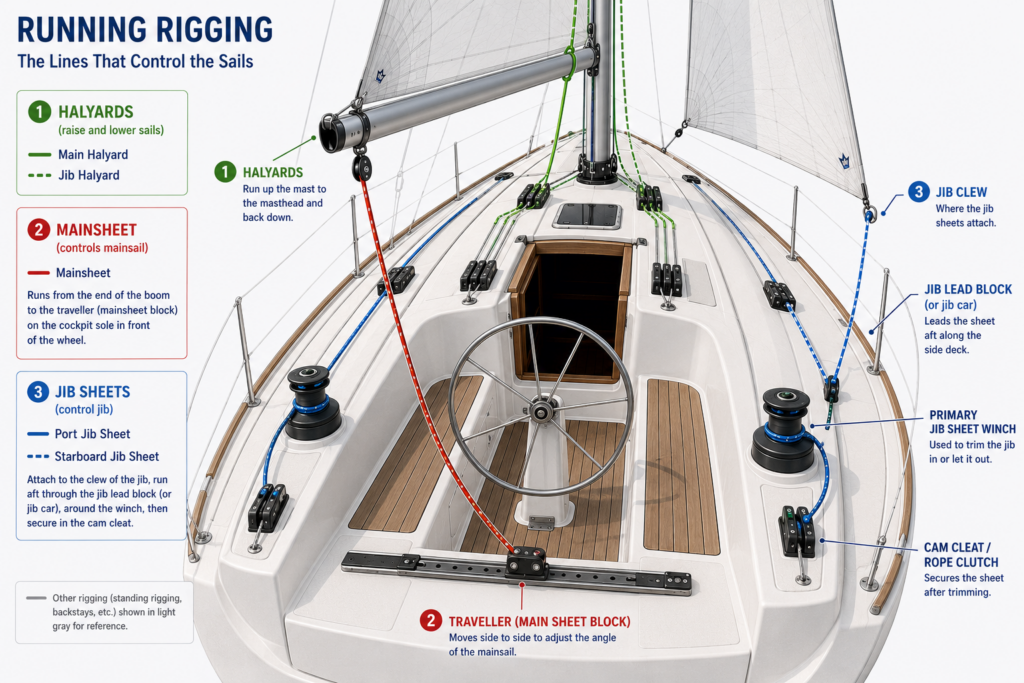
Walk onto almost any sailboat for the first time and one thing immediately stands out: ropes seem to be everywhere. Lines run across the cockpit, disappear into blocks, wrap around winches, and lead toward sails, masts, and booms. For many beginners, this maze of lines feels overwhelming. It is easy to assume that sailing is complicated simply because there appear to be so many sail controls to pull.
Fortunately, the reality is much simpler than it first appears. Every line on a sailboat has a purpose, but only a handful of them are used constantly while sailing. Once you understand those few controls, the rest of the boat begins to make sense.
Throughout this guide, you will discover that sail controls are not random ropes with unrelated jobs. Instead, they are tools that help you shape and position your sails so they can capture the wind efficiently. As a result, your boat becomes faster, easier to steer, more comfortable, and safer in changing conditions.
This article builds on concepts introduced in our guides to Parts of a Sailboat, How to Read the Wind, Points of Sail Explained, How to Steer a Sailboat, and How to Trim a Sail. If you have already read those articles, many of the ideas here will feel familiar. However, even if this is your first lesson on sail controls, everything will be explained from the beginning.
Why Sailboats Have So Many Lines
Many newcomers believe every rope performs a completely different task. Although each control has its own name and location, that way of thinking makes sailing seem far more complex than it really is.
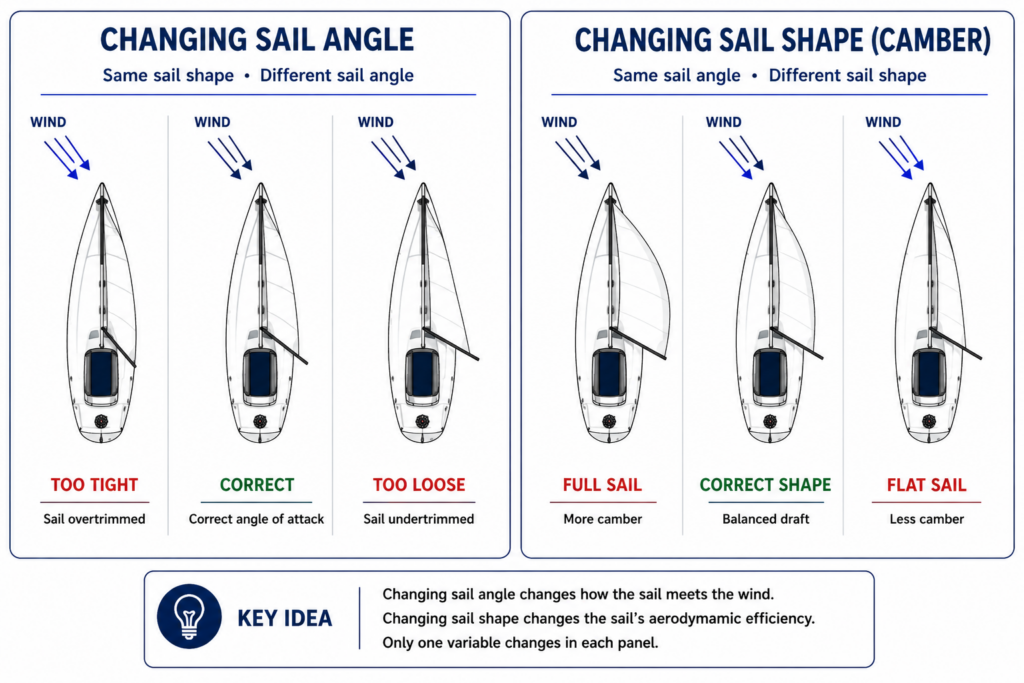
Instead, think of sail controls as adjustments that influence just two characteristics of a sail. Some controls change the angle at which the sail meets the wind, while others change the shape of the sail itself. Everything else—including speed, power, heel, balance, and pointing ability—flows from those two basic ideas.
This simple way of thinking becomes the framework for every trimming decision you will ever make.
Before Learning Individual Controls
Two Things Every Sail Control Can Change
1. Sail Angle
The angle of a sail determines how directly it meets the wind. Sailors often describe this as the sail’s angle of attack. Pull the sail in and the angle changes. Ease it out and the angle changes again. Finding the correct angle allows the wind to flow smoothly over both sides of the sail, producing efficient lift instead of unnecessary drag.
2. Sail Shape
Shape refers to how full or flat the sail is. Sailmakers often call this draft or camber. A deeper sail generates more power in lighter winds, while a flatter sail is generally better when the wind becomes stronger. Therefore, some controls are designed specifically to fine-tune this shape without dramatically changing the sail’s overall position.
Why These Matter
Changing angle and shape affects nearly every aspect of sailing. Proper adjustments influence boat speed, available power, heel angle, weather helm, and how close your boat can sail toward the wind. Because these characteristics are connected, experienced sailors rarely think about one control by itself. They think about the behavior they want from the sail.
Understanding the Five Primary Sail Controls
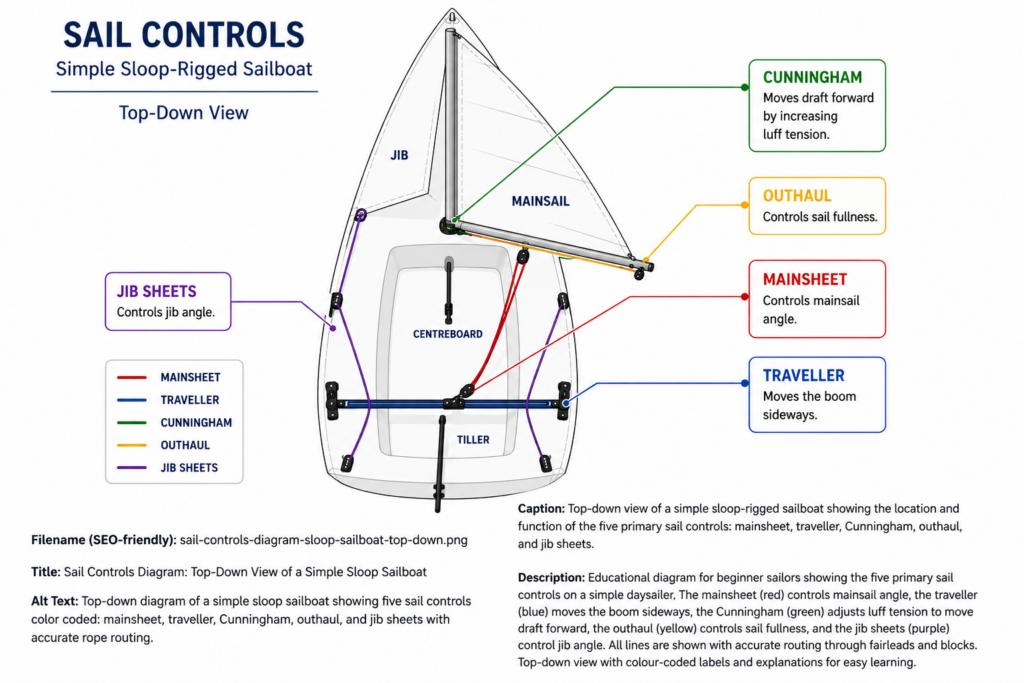
Now that you understand every sail control changes either sail angle or sail shape, it is time to meet the five controls every beginner should recognize. Although a modern sailboat may have dozens of lines, these five form the foundation of sail trim. First, learn what each control does. Next, learn when to use it. Finally, learn how they work together.
The Mainsheet
The mainsheet controls the angle of the mainsail by pulling the boom toward or allowing it away from the centreline. Because the mainsail is the largest sail on most cruising boats, the mainsheet is adjusted constantly as the wind changes or the boat changes course. It is usually the first sail control a beginner learns.
The Jib Sheet
The jib sheets control the angle of the headsail. Unlike the mainsail, the jib has a separate sheet on each side of the boat. As the boat tacks, one sheet is eased while the other is trimmed. Proper jib trim balances the boat and works together with the mainsail.
The Traveller
The traveller moves the boom sideways without greatly changing mainsail tension. However, it often confuses beginners because it also influences the boom’s position. Think of the traveller as a fine adjustment, while the mainsheet remains the primary control.
The Outhaul
The outhaul changes the depth of the lower part of the mainsail. Tightening it flattens the sail, while easing it creates a fuller, more powerful shape. Most cruising sailors adjust it once as conditions change rather than constantly.
The Cunningham
The Cunningham pulls the draft of the mainsail forward. Although racers use it frequently, most beginners simply need to understand its purpose before worrying about fine adjustments.
The Mainsheet
Where It Is
On most modern cruising sailboats, the mainsheet runs from the boom to a block system and into the cockpit. Its exact location varies by boat, but it is almost always positioned so the helm can reach it quickly. Because it is used so often, experienced sailors instinctively know where the mainsheet is without looking.
What It Controls
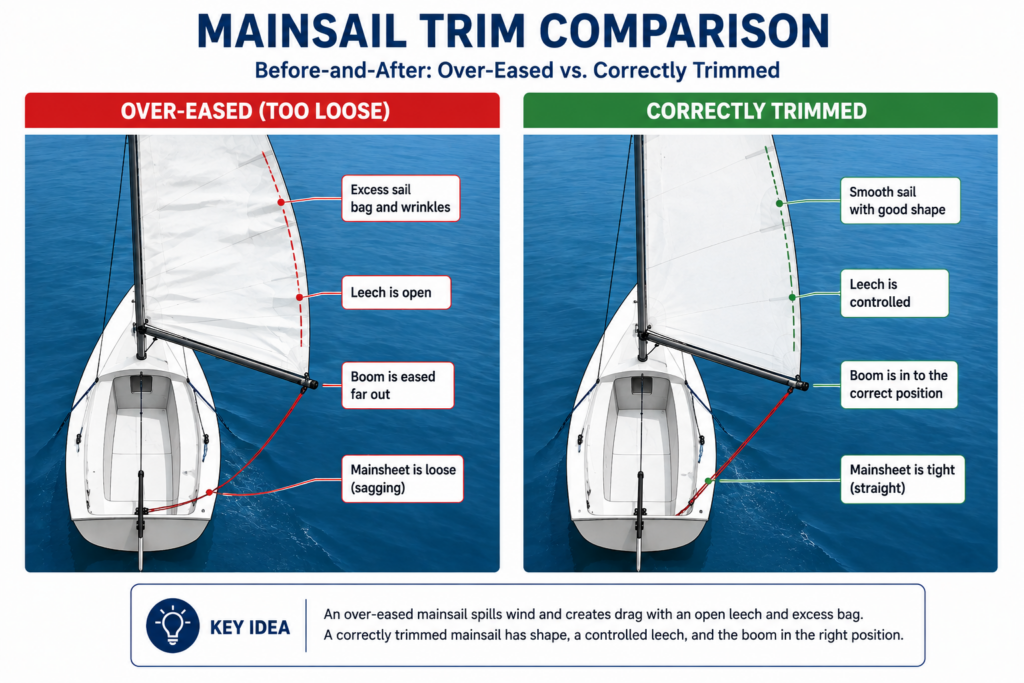
The mainsheet primarily controls the angle of the mainsail. Pulling it in moves the boom closer to the centreline. Easing it allows the boom to move farther away. Therefore, every adjustment changes the angle at which the wind meets the sail.
What Happens When You Pull It In
When you trim the mainsheet, the sail becomes more aligned with the centreline of the boat. On upwind points of sail, this helps the sail produce efficient lift. However, pulling the sheet too far creates an overtrimmed sail. Instead of flowing smoothly across the sail, the wind begins to stall, reducing performance and increasing unnecessary heel.
What Happens When You Ease It
Easing the mainsheet lets the boom move outward. As a result, the sail aligns better with broader points of sail and stronger gusts. Although easing the sail reduces excessive heel, letting it out too far causes the sail to luff and lose power. The goal is not to keep the sheet tight—it is to keep the sail working efficiently.
Common Beginner Mistakes
Oversheeting
Many beginners assume a tighter sail must be faster. In reality, oversheeting is one of the most common trimming errors. Watch the sail for smooth airflow rather than simply pulling harder.
Allowing the Sail to Flap Constantly
Meanwhile, leaving the sail luffing wastes power and causes unnecessary wear. Small adjustments made early are better than waiting until the sail flaps loudly.
Using the Mainsheet to Steer
Although easing the mainsheet can reduce heel during a gust, it should not replace proper steering. Use the helm to control direction and the mainsheet to control the sail. Together they keep the boat balanced.
**Beginner Tip:** Watch the sail—not the rope. The sail tells you whether the adjustment is correct.
The Jib Sheet
After learning the mainsheet, the next control every beginner should master is the jib sheet. Although the jib is smaller than the mainsail on most cruising boats, it plays an equally important role in making the boat move efficiently. The mainsail and jib are designed to work together. Therefore, adjusting one sail while ignoring the other rarely produces the best results.
Why the Jib Is Different
Unlike the mainsail, which is attached to the mast and boom, the jib is attached along its leading edge and has no boom. Instead, its position is controlled by one of two jib sheets. Only one sheet is under load at a time. When the boat tacks, the working sheet is eased while the opposite sheet becomes the new working sheet.
Trimming the Headsail
First, steer onto your chosen point of sail. Next, trim the jib until it stops luffing. Then continue trimming only until the sail develops a smooth, efficient shape. Resist the temptation to keep pulling simply because the line still moves. Instead, let the sail tell you when it is correctly trimmed.
Signs the Jib Is Correctly Trimmed
A properly trimmed jib has a smooth, even shape from luff to leech. The sail is full without looking baggy, and the telltales stream aft together. As a result, the boat feels balanced and accelerates without excessive heel.
Signs It Is Too Tight
An overtrimmed jib often stalls the airflow. The boat may heel more without gaining speed, and steering can begin to feel heavy. If the inside telltales lift while the outside telltales remain straight, easing the sheet slightly often restores smooth airflow.
Signs It Is Too Loose
A jib that is eased too far begins to luff along its leading edge. Although beginners sometimes ignore this fluttering, it is a clear sign that the sail is no longer producing efficient lift. Fortunately, a small trim adjustment usually solves the problem.
The Traveller
Few sail controls confuse beginners more than the traveller. At first glance it appears to do exactly the same job as the mainsheet because both affect the boom. However, they accomplish this in different ways, and understanding that difference is one of the biggest milestones in learning sail trim.
What the Traveller Actually Does
The traveller moves the boom sideways across the boat while keeping the mainsheet at nearly the same tension. Because the boom’s position changes without dramatically changing sail twist, the traveller becomes a valuable fine-tuning tool, especially when sailing upwind.
Traveller vs. Mainsheet
| Traveller | Mainsheet |
| Moves the boom sideways | Pulls the boom in or eases it out |
| Fine-tunes sail angle | Primary sail angle control |
| Often adjusted occasionally | Adjusted constantly |
| Useful for balancing heel | Used on every point of sail |
Why Racers Love the Traveller
Experienced sailors and racers use the traveller to make small adjustments without disturbing the overall shape of the mainsail. For example, in a sudden gust they may lower the traveller to reduce heel while keeping good sail shape. This level of precision is valuable, but it is not essential for your first days on the water.
Should Beginners Use It?
Yes—but only a little. Learn to trim the mainsheet confidently before worrying about the traveller. Once you understand how the mainsail responds, the traveller becomes a useful refinement rather than another confusing control.
For a deeper explanation of mainsail control, consider referring readers to the North Sails sail trim resources after this section.
The Outhaul
The first three controls you have learned—the mainsheet, jib sheet, and traveller—primarily change the angle of a sail. The outhaul introduces the second big idea of this article: changing sail shape. Although it is adjusted far less often than the sheets, it has a noticeable effect on how powerful the mainsail becomes.
What It Changes
The outhaul is attached near the clew of the mainsail at the end of the boom. Tightening it stretches the foot of the sail and flattens the lower third. Easing it allows the sail to become fuller, increasing its draft, also called camber.
Loose Outhaul
A looser outhaul creates a deeper sail. Because a fuller sail captures more wind, it develops more power in light air. However, the same fullness can create unnecessary heel and drag once the wind increases.
Tight Outhaul
As the breeze builds, sailors gradually tighten the outhaul to flatten the sail. As a result, the boat heels less, feels more balanced, and often sails faster because the sail is no longer producing excessive drag.
When Beginners Should Adjust It
Fortunately, most beginners do not need to adjust the outhaul constantly. It is usually set once for the day’s conditions and only revisited if the wind changes significantly.
The Cunningham
The Cunningham is another sail-shape control. Although it looks like just another line near the mast, it performs a very specific job. Instead of changing the overall depth of the sail, it changes where that depth is located.
What It Does
Pulling the Cunningham moves the deepest part of the mainsail forward. Easing it allows the draft to move farther aft. This helps the sail maintain an efficient shape as wind strength changes.
Why Wind Strength Matters
In light winds, sailors generally leave the Cunningham loose because a fuller sail generates useful power. Meanwhile, moderate winds may require only a small adjustment. In stronger winds, tightening the Cunningham helps flatten the front of the sail and improves control.
Will Beginners Use It Often?
Probably not. Although understanding the Cunningham is worthwhile, most new sailors can safely focus on the mainsheet and jib sheet first. Think of the Cunningham as a fine-tuning control that becomes more valuable as your sailing experience grows.
Which Sail Controls Should Beginners Actually Use?
One of the most common questions new sailors ask is, ‘Do I need to use all of these controls every time I sail?’ The reassuring answer is no. Instead, focus on mastering a few essential controls before worrying about advanced refinements.
| Control | Learn First? | Adjust Frequently? |
| Mainsheet | Yes | Constantly |
| Jib Sheet | Yes | Constantly |
| Traveller | Later | Occasionally |
| Outhaul | Later | Usually once per sail |
| Cunningham | Later | Rarely |
First, become comfortable trimming the mainsail and jib as the boat changes course. Next, learn how the traveller can improve balance. Finally, experiment with the outhaul and Cunningham as your understanding of sail shape develops. This gradual approach keeps sailing enjoyable and prevents information overload.
Looking Ahead
So far you have learned what each control does individually. However, experienced sailors rarely adjust only one control at a time. In the next section, you will see how the mainsheet, traveller, outhaul, and Cunningham work together as a complete system whenever the wind changes.
How Sail Controls Work Together
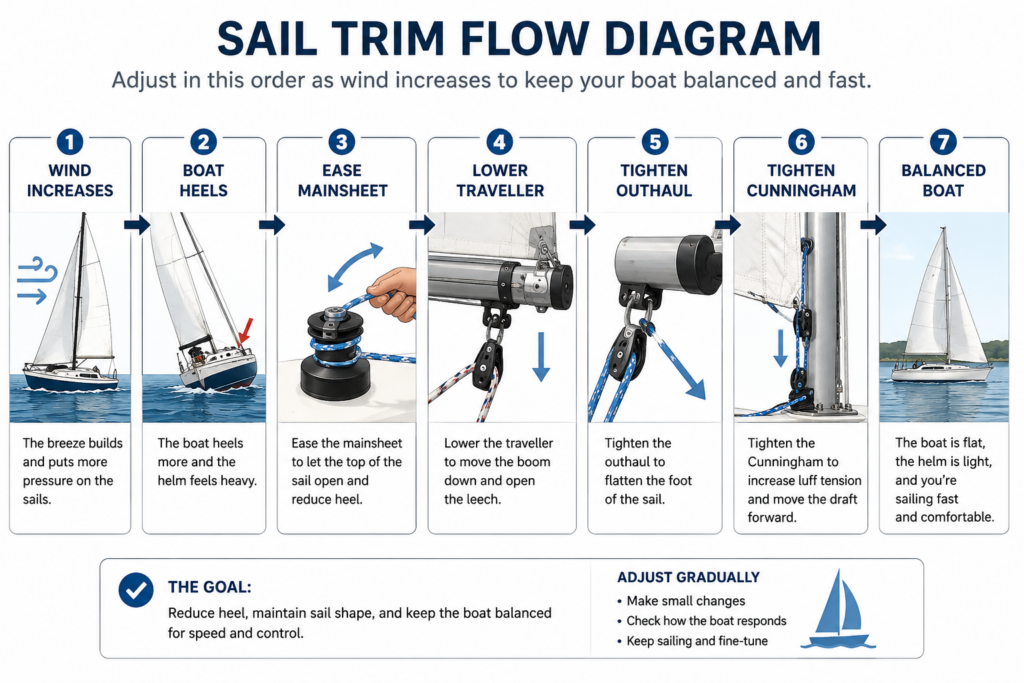
By now you have learned what each of the five primary sail controls does individually. However, experienced sailors rarely think about them one at a time. Instead, they think about the behaviour of the boat. If the boat heels too much, becomes difficult to steer, or begins to slow down, they choose the combination of adjustments that restores balance.
For example, imagine you are sailing on a close reach when a stronger gust arrives. Rather than making one dramatic adjustment, an experienced skipper may ease the mainsheet slightly, lower the traveller, tighten the outhaul if the breeze remains strong, and add a little Cunningham tension. Each adjustment contributes something different, yet together they produce a flatter, more balanced sail plan.
A Simple Beginner Trimming Routine
1. Choose the correct point of sail.
2. Trim the mainsail until it just stops luffing.
3. Trim the jib until both sails work together.
4. Check the telltales and adjust if necessary.
5. Observe the boat’s heel angle.
6. Notice the pressure on the helm.
7. Make one small adjustment at a time and observe the result.
Common Beginner Mistakes
Pulling Every Rope
More adjustments do not automatically produce better sailing. Understand why you are changing a control before touching it.
Ignoring Sail Shape
Many beginners focus only on sail angle. Remember that sail shape is just as important.
Watching the Rope Instead of the Sail
The sail provides the feedback. Watch how it fills, twists, and luffs.
Forgetting Wind Strength Changes
Conditions change constantly. Reassess your trim as the wind builds or fades.
Adjusting Everything at Once
Change one control, observe the result, then decide if another adjustment is needed.
Beginner Tip: One adjustment, then observe.
Frequently Asked Questions
Which sail control should beginners learn first?
The mainsheet and jib sheet should be your priority because you will use them on every sail.
Do I need to use the traveller?
Yes, but only after you are comfortable with the mainsheet.
What does the Cunningham actually do?
It moves the draft of the mainsail forward as wind strength increases.
Is the outhaul only for racing?
No. Cruising sailors also benefit from adjusting sail shape for changing conditions.
Which control reduces heel?
The mainsheet, traveller, outhaul, and Cunningham can all contribute, depending on the situation.
Can sail controls make the boat faster?
Absolutely. Correct sail trim improves efficiency, balance, and boat speed.
Key Takeaways
Every sail control changes either sail angle or sail shape.
Master the mainsheet and jib sheet before worrying about advanced controls.
The traveller fine-tunes boom position without dramatically changing sail twist.
The outhaul controls fullness in the lower mainsail.
The Cunningham moves the draft forward in stronger winds.
Sail controls work together as a complete system.
Always watch the sail before watching the rope.
Knowledge Check
1. Which two characteristics can every sail control change?
A) Length and colour
B) Angle and shape
C) Weight and balance
D) Speed and direction
2. Which control should most beginners learn first?
A) Cunningham
B) Traveller
C) Mainsheet
D) Outhaul
3. What is the primary job of the jib sheet?
4. What does the traveller mainly change?
5. Which control flattens the lower mainsail?
6. What does the Cunningham move?
7. Why is oversheeting a problem?
8. What should you watch first when trimming?
9. Should you adjust every control at once?
10. Which two controls are adjusted most frequently while sailing?
Your Next Steps
Continue building your sailing knowledge with:
• How to Trim a Sail
• Points of Sail Explained
• How to Read the Wind
• How to Steer a Sailboat
• Parts of a Sailboat Explained
• Using Telltales
• Weather Helm Explained
• Sail Shape Explained
• Heavy Weather Sailing
• Reefing a Sailboat