Points of Sail: 5 Powerful Lessons for New Sailors
Reading time: 25 minutes
Introduction
The relationship between the boat and the wind is described by the points of sail. A sailboat cannot simply point in any direction and move forward.
Unlike a powerboat, which uses an engine to push through the water, a sailboat depends on the wind. The direction the wind comes from affects almost everything the boat does: how fast it travels, how much it heels, where the sails should be positioned, and whether the boat can move toward its destination at all.
Learning the points of sail is one of the first major steps in becoming a sailor. At first, the idea may seem confusing. There are several new terms, the sails keep changing position, and the boat may feel different every time it turns.
But the main idea is simple:
A point of sail describes the direction a sailboat is traveling relative to the wind.
Understanding the five points of sail is one of the first skills every sailor must learn.
Once you understand that idea, many other sailing skills begin to make sense.
You will understand why the sails flap when the boat turns too far into the wind. You will know why the boat heels more on some courses than others. You will also begin to recognize when the sails need to be pulled in, eased out, or adjusted slightly.
Most importantly, you will stop thinking only about where the boat is pointing and start thinking about where the wind is coming from.
That is the foundation of sailing.
Quick Summary
A point of sail is your boat’s direction relative to the wind.
Sailboats cannot sail directly into the wind.
There are five basic points of sail.
Sail trim changes as the boat turns.
Knowing your point of sail improves speed, comfort, and safety.
What Are Points of Sail?
American Sailing describes the points of sail as the range of courses a sailboat can and cannot travel relative to the wind—a relationship that becomes increasingly intuitive as you gain experience at the helm.
The points of sail are the different directions a sailboat can travel relative to the direction of the wind.
They do not describe where the boat is traveling on a map.
They do not tell you whether the boat is heading north, south, east, or west.
Instead, they describe the angle between the boat and the wind.
For example, imagine your boat is traveling north.
If the wind is blowing from the east, it is hitting the side of the boat. That places the boat on one point of sail.
If the wind changes and begins blowing from the north, it is now coming from directly ahead. The boat has moved into a completely different relationship with the wind, even though its compass direction has not changed.
The opposite can also happen.
A boat may turn from north to west, but if the wind turns at the same time, the boat could remain on the same point of sail.
This is why sailors pay so much attention to wind direction.
The compass tells you where the boat is going.
The wind tells you how the boat must be sailed.
Why Every Sailor Must Understand Points of Sail
The points of sail are not just a set of terms to memorize. They help sailors make practical decisions every time they are on the water.
Once you know your point of sail, you can make a good guess about:
how the sails should be trimmed
how much the boat may heel
how fast the boat may travel
whether the boat is moving efficiently
what maneuver may be needed next
Without this knowledge, sailing can feel like guesswork.
A beginner may notice that the sails are flapping but not understand why. Another sailor may pull the sails in as tightly as possible, believing tighter sails always mean more speed. Someone sailing downwind may not realize that the boom could swing suddenly across the cockpit.
Understanding the points of sail helps turn these surprises into predictable events.
Why Points of Sail Matter
Boat Speed
A sailboat does not travel at the same speed on every point of sail.
On some points of sail, the wind flows smoothly across the sails and creates strong forward power. On others, the sails work less efficiently.
A boat may feel quick and lively on a beam reach, slower while sailing close hauled, and surprisingly gentle while running directly downwind.
Learning the points of sail helps you understand why the boat speeds up or slows down as it changes direction.
Sail Trim
The sails must be adjusted whenever the boat’s angle to the wind changes.
When sailing toward the wind, the sails are usually pulled closer to the centerline of the boat.
When sailing away from the wind, the sails are eased farther out.
Correct sail trim allows the wind to flow smoothly around the sails. Poor sail trim can make the boat slower, harder to steer, and less comfortable.
Comfort
Some points of sail feel calmer than others.
When sailing close to the wind, the boat may heel more and move sharply through the waves. On a broad reach, it may feel flatter and more relaxed. Running directly downwind may feel gentle, although the boat can sometimes roll from side to side.
Knowing how the boat behaves on each point of sail helps the skipper choose a course that best suits the crew.
This is especially useful when sailing with children, nervous passengers, or people who are new to boating.
Safety
Understanding the wind also improves safety.
A sailor who knows the point of sail is less likely to:
The wind can change quickly, so sailors must keep watching it rather than assuming it will stay the same.
Navigation
The shortest path to a destination is not always a direction the boat can sail.
If your destination is directly upwind, you cannot simply point the bow at it and keep sailing. Instead, you must travel at an angle to the wind and make a series of turns.
This zigzag path may look longer on a chart, but it is the only practical way to make progress toward an upwind destination.
Understanding the points of sail helps sailors plan routes that work with the wind instead of fighting it.
The Main Lesson
Before learning the names of the different points of sail, remember one key rule:
Every sailing decision begins with knowing where the wind is coming from.
The wind affects the boat’s direction, sail trim, speed, balance, and safety.
A sailor who loses track of the wind quickly loses track of what the boat is doing.
The One Thing You Must Know First: Wind Direction
Finding the wind is one of the most important skills in sailing.
Experienced sailors check it constantly. They do not look once at the beginning of the day and then forget about it. Wind direction can shift as the boat moves, as gusts pass over the water, or as the shoreline changes the airflow.
Sailors often talk about true wind and apparent wind.
The difference can become quite detailed, but beginners only need a simple explanation.
True wind is the wind moving across the water without taking the boat’s movement into account.
Apparent wind is the wind that seems to come toward a moving boat. It is a combination of the true wind and the airflow created by the boat’s own speed.
Think about riding a bicycle on a calm day.
Even when there is very little natural wind, you feel air moving against your face because the bicycle is moving forward. That felt wind is similar to apparent wind.
The faster the boat travels, the more the apparent wind may change in strength and direction.
For now, you do not need to calculate these angles. Simply understand that the wind felt aboard a moving boat may be slightly different from the wind felt while standing still.
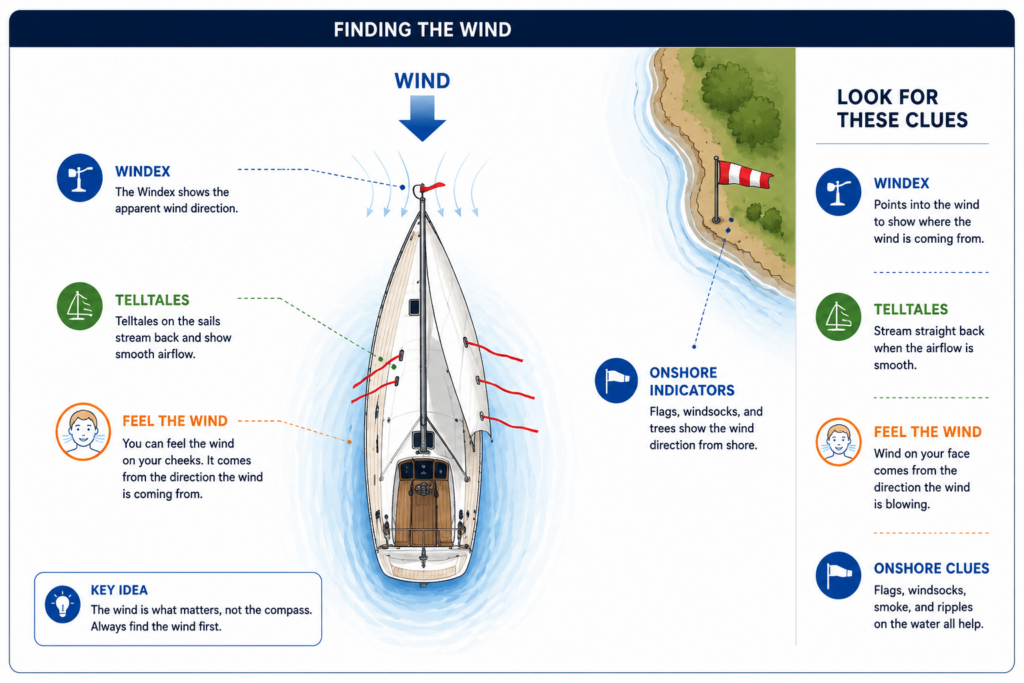
How to Find the Wind
There is no single “best” way to find the wind. Experienced sailors use several clues and compare them to build a complete picture.
Look at the Windex
A Windex is a small wind indicator usually mounted at the top of the mast.
It has an arrow that points toward the direction the wind is coming from.
A quick glance upward helps the helmsman understand the boat’s angle to the wind. However, a Windex can be harder to see at night, in bright sunlight, or when the boat is rocking.
Watch the Telltales
Telltales are small pieces of yarn, ribbon, or fabric attached to the sails or rigging.
When air flows smoothly over the sails, they stream backward.
When the airflow becomes uneven, they flutter, droop, or move in different directions.
Telltales help sailors understand both wind direction and sail trim.
Feel the Wind on Your Face
You can often locate the wind simply by turning your head slowly.
When the wind feels equal on both cheeks, you are probably facing directly into it.
Some sailors also notice which ear feels cooler or which way loose hair moves.
This method is simple, but it works surprisingly well.
Watch the Water
Wind leaves visible clues on the surface of the water.
Look for:
ripples
darker patches
small waves
lines of moving texture
gusts traveling across the water
A darker patch often indicates stronger wind approaching the boat.
Look at Flags and Nearby Objects
Flags, streamers, smoke, tree branches, anchored boats, and other sailboats can all help reveal wind direction.
Do not rely on only one clue. Conditions near shore can be different from conditions farther out on the water.
Good sailors combine several signs.
Before you can identify your point of sail, you first need to know where the wind is coming from.
Key Takeaway
Sailors use several clues to identify wind direction. The more clues that agree, the more confident you can be.
The No Sail Zone
Once you know where the wind is coming from, you can understand one of the most important limits in sailing:
A sailboat cannot sail directly into the wind.
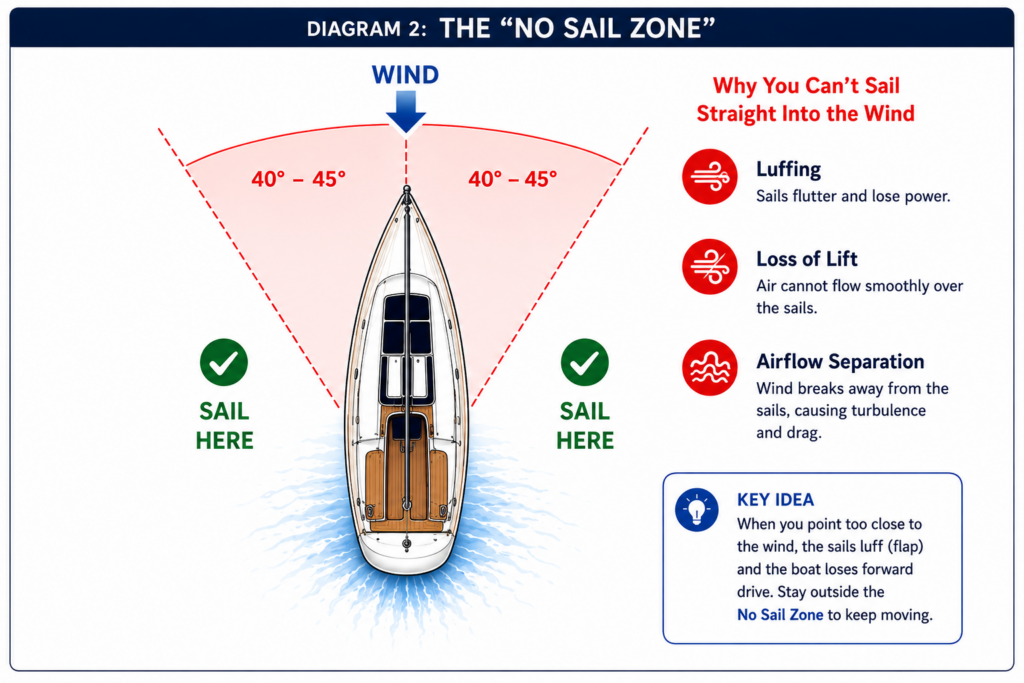
The area directly upwind is called the No Sail Zone, or No Go Zone.
The RYA notes that roughly 40 degrees off the wind is about as close as a typical sailboat can sail, which is why reaching an upwind destination requires tacking back and forth across the no-sail zone.
The exact angle depends on the boat, its sails, wind strength, wave conditions, and the skill of the sailor.
Why a Sailboat Cannot Sail Straight Into the Wind
A sail works best when air flows smoothly across both sides of it.
This airflow creates lift, which helps pull the boat forward.
When the boat turns directly into the wind, the air no longer flows smoothly across the sail. Instead, it strikes the front edge of the sail and separates unevenly.
The sail loses its smooth shape and begins to flap.
This flapping is called luffing.
A luffing sail produces very little useful power. As a result, the boat slows down and may eventually stop.
Loss of Lift
Lift is the force that helps move a sailboat forward.
When the boat is sailing at a useful angle to the wind, the curved shape of the sail guides the air smoothly around it.
When the boat points too close to the wind, the airflow separates from the sail. The sail can no longer generate enough lift to keep the boat moving efficiently.
The boat may continue to drift, but it is no longer sailing effectively.
Sailing Into Irons
If the boat turns too far into the No Sail Zone and loses its forward speed, it may become stuck with the bow pointing directly into the wind.
Sailors call this being in irons.
A sailboat cannot sail directly into the wind because the sails lose lift and begin to luff.
The sails flap, the rudder becomes less effective, and the boat may even begin drifting backward.
This is common for beginners and is usually not dangerous in open water. However, it can become a problem near docks, rocks, or other boats where there is little room to recover.
How Sailors Travel Upwind
Although a sailboat cannot sail directly into the wind, it can still reach an upwind destination.
The skipper sails the boat at an angle just outside the No Sail Zone. After sailing some distance, the boat turns and sails at a similar angle on the other side of the wind.
This turn is called a tack.
By sailing back and forth in a zigzag pattern, the boat gradually works its way upwind.
Key Takeaway
A sailboat cannot sail directly into the wind. To reach an upwind destination, it sails at an angle to the wind and changes direction by tacking.
What You Should Understand So Far
Before moving on to the five basic points of sail, make sure these ideas are clear:
A point of sail describes the boat’s direction relative to the wind.
Compass direction does not determine the point of sail.
Wind direction affects speed, sail trim, comfort, safety, and navigation.
Sailors use Windexes, telltales, flags, water patterns, and physical sensation to find the wind.
A sailboat cannot sail directly into the wind.
The No Sail Zone usually extends about 40 to 45 degrees on either side of the wind.
When a boat points too close to the wind, the sails luff and lose lift.
Sailors reach upwind destinations by sailing at an angle and tacking.
With these foundations in place, the five basic points of sail become much easier to understand.
The Five Basic Points of Sail
Once you know where the wind is coming from, you can identify your point of sail.
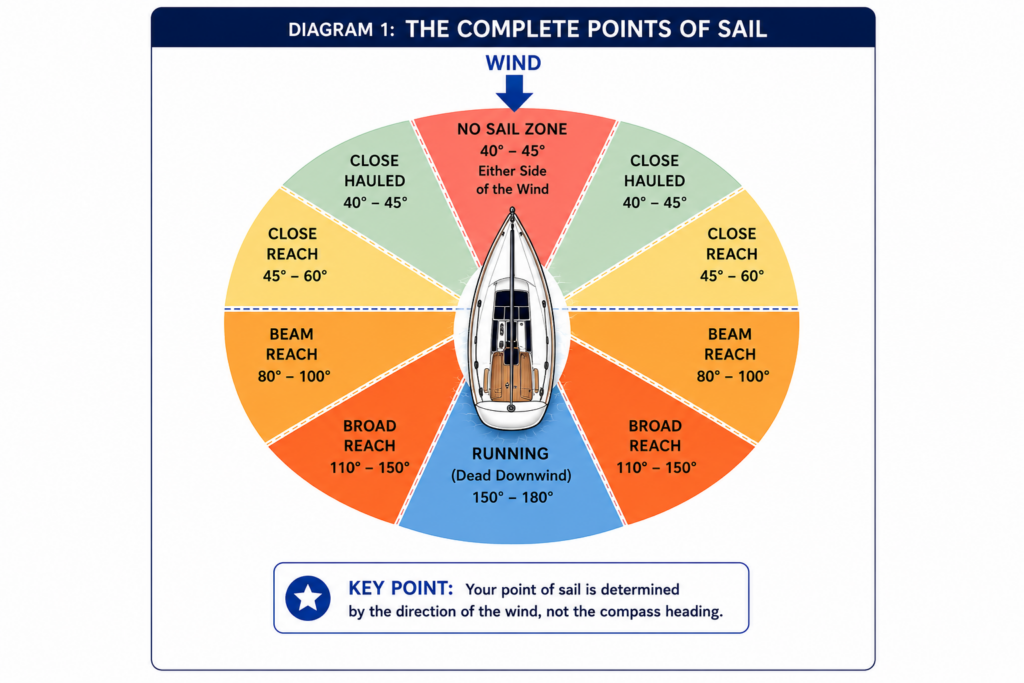
The five basic points of sail are:
Close hauled
Close reach
Beam reach
Broad reach
Running
These names describe the angle between the boat and the wind.
They are not five separate positions that a boat suddenly jumps between. Instead, they are useful labels along a continuous path around the wind. As the boat turns, it moves gradually from one point of sail to another.
As this happens:
the sails are trimmed in or eased out
the boat’s speed changes
the amount of heel changes
the steering feels different
the crew may feel more or less comfortable
The easiest way to learn the points of sail is to begin close to the wind and then gradually turn away from it.
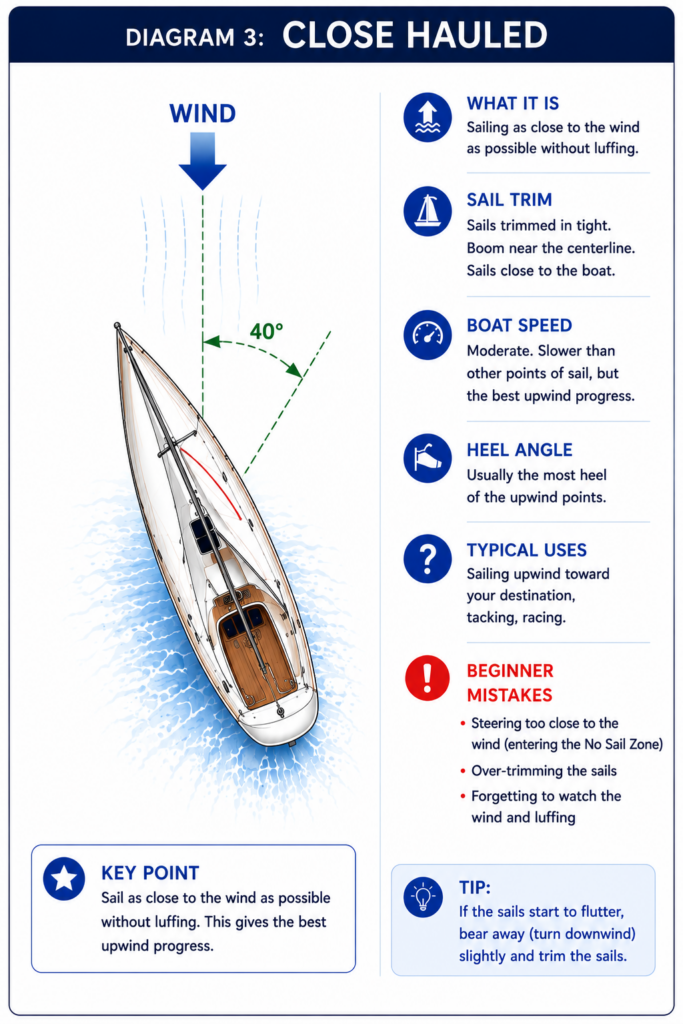
Close Hauled
What Is Close Hauled?
A boat is close hauled when it is sailing as close to the wind as it can without entering the No Sail Zone.
The wind is coming from ahead and slightly off one side of the bow.
Most cruising sailboats cannot sail closer than about 40 to 45 degrees to the wind. Some boats can point a little higher, while others need to sail at a wider angle.
Close hauled is the point of sail most closely associated with sailing upwind.
A boat cannot point directly at an upwind destination, so it sails close hauled on one side of the wind, tacks, and then sails close hauled on the other side.
Close hauled is the closest angle a sailboat can sail toward the wind while maintaining lift.
Where Does the Wind Come From?
Imagine standing at the bow and facing forward.
On a close-hauled course, the wind would strike the front and side of your face. It may feel as though it is coming over one shoulder.
The boat is traveling almost toward the wind, but not directly into it.
How Are the Sails Trimmed?
On a close-hauled course, both sails are trimmed fairly tightly.
The mainsail is pulled close to the centreline of the boat, and the boom remains near the middle.
The jib is also sheeted in close.
The sails should not be pulled in as tightly as possible. They still need a smooth, curved shape so the air can flow efficiently across them.
A common beginner mistake is to assume that tighter sails always create more power. In reality, sails that are over-trimmed become less efficient.
Boat Speed
Close hauled is usually not the fastest point of sail.
The boat is working partly against the wind, so some of the wind’s force pushes it sideways instead of forward.
The keel or centerboard resists much of this sideways movement, but the boat still slips sideways slightly. This sideways drift is called leeway.
Heel Angle
Boats often heel noticeably when sailing close hauled.
The wind presses strongly against the side of the sails, creating both forward force and sideways force.
A moderate amount of heel is normal. However, too much heel can make the boat harder to steer and less comfortable for the crew.
Typical Uses
Close hauled is commonly used when:
sailing toward an upwind destination
leaving a downwind shoreline
making progress through a narrow channel
preparing to tack
racing toward an upwind mark
Common Beginner Mistakes
Beginners often:
steer too close to the wind
allow the sails to luff
pull the sails in too tightly
focus only on the compass instead of the wind
fight the tiller instead of adjusting sail trim
Key Takeaway
Close hauled allows a sailboat to make progress upwind while staying just outside the No Sail Zone. It requires careful steering and proper sail trim, but it is the foundation of sailing efficiently toward an upwind destination.
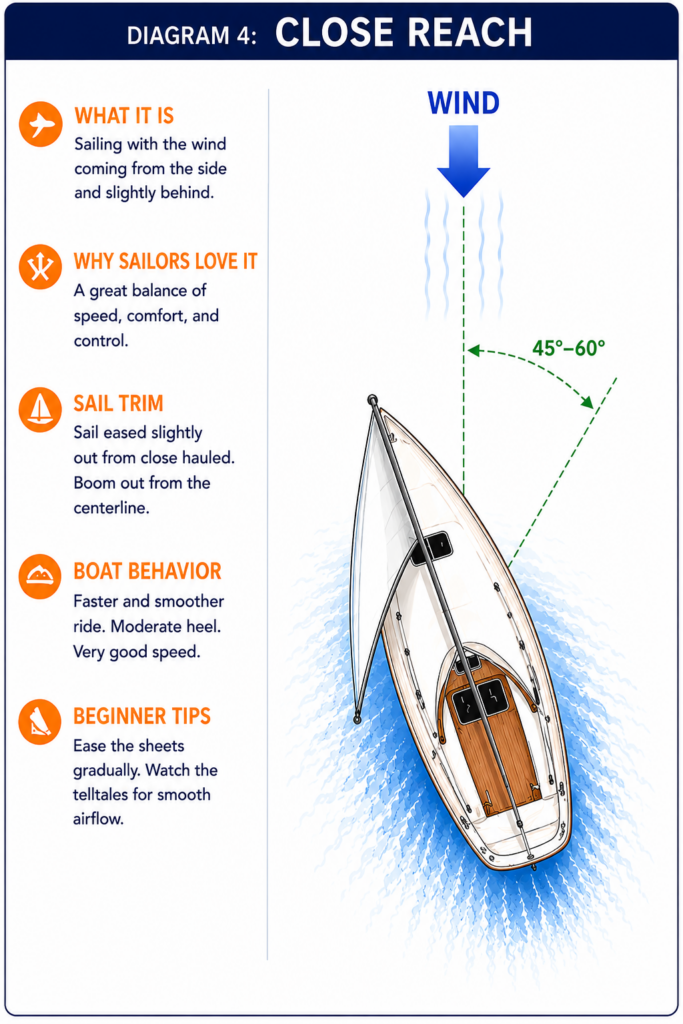
Close Reach
What Is a Close Reach?
A close reach occurs when the boat turns slightly away from a close-hauled course.
The wind still comes from ahead of the boat, but it approaches more from the side.
The boat is no longer trying to sail as close to the wind as possible.
This small change often makes the boat feel faster, smoother, and easier to control.
A close reach is fast, efficient, and one of the easiest points of sail to learn.
Why Do Many Sailors Enjoy It?
A close reach gives the sails a strong, steady flow of air.
The boat can still make useful progress toward an upwind destination, but it does not have to work as hard as it does when sailing close hauled.
For many sailors, a close reach offers an excellent balance of speed, comfort, and control.
The boat may feel lively without feeling difficult to handle.
How Are the Sails Trimmed?
The sails should be eased slightly compared with a close-hauled course.
The boom moves a little farther away from the centerline, and the jib opens slightly.
A useful beginner method is to ease the sheet slowly until the front edge of the sail just begins to luff. Then trim it in slightly until the luffing stops.
This helps you find an efficient sail angle without over-sheeting.
Boat behavior
On a close reach, the boat often:
accelerates more easily
heels slightly less
responds well to the rudder
feels less likely to stall
handles small steering errors more easily
Because there is more room between the boat and the No Sail Zone, beginners have a little more freedom to make small course corrections.
Beginner Tips
Keep watching the telltales and the front edges of the sails.
If the sails begin to flutter, you may have turned too close to the wind or eased the sheets too far.
If the sails remain full but the boat feels slow, they may be trimmed too tightly.
Key Takeaway
A close reach is often one of the easiest and most enjoyable points of sail. It combines good speed, comfortable handling, and forgiving sail trim, making it an excellent course for beginners.
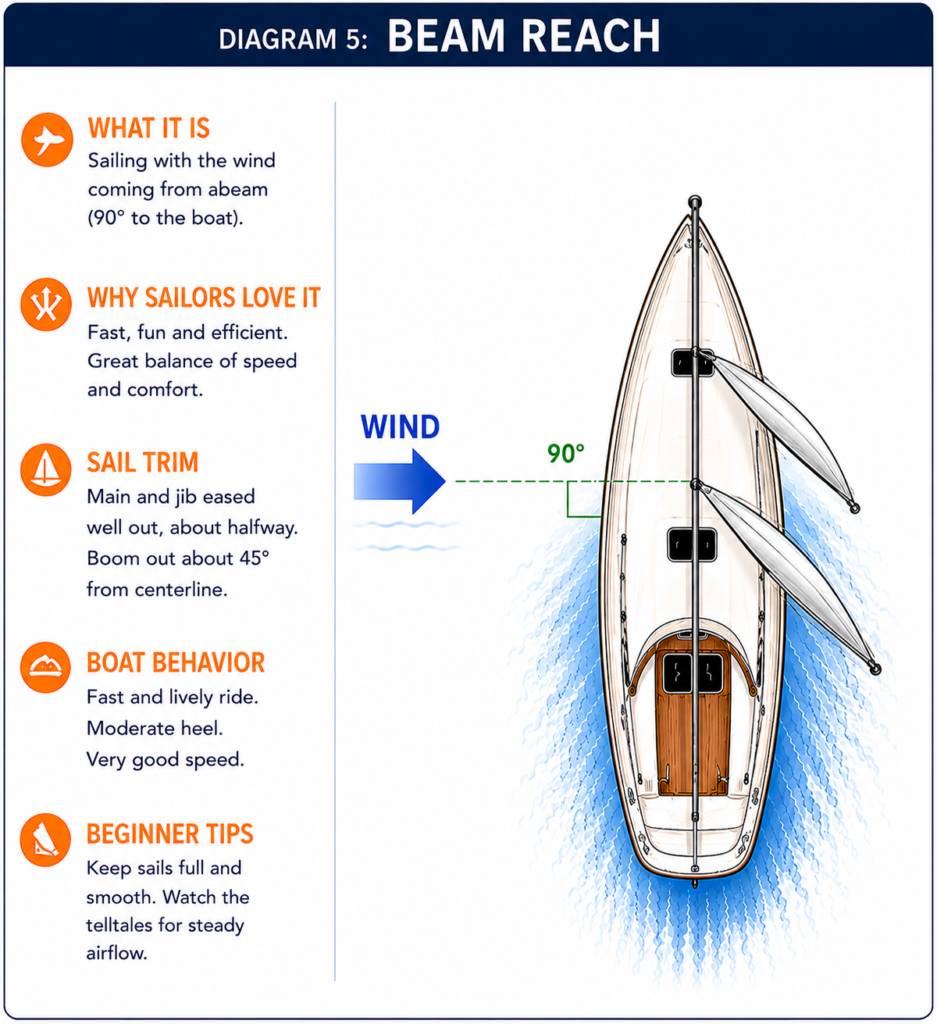
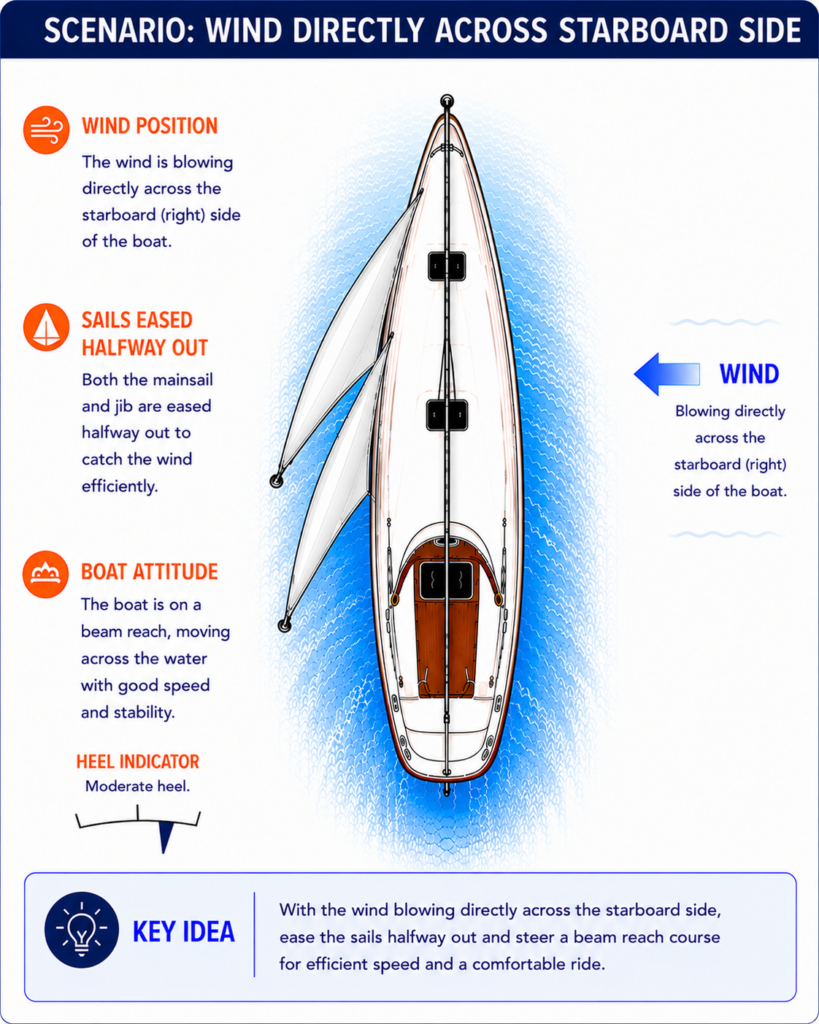
Beam Reach
What Is a Beam Reach?
A beam reach occurs when the wind comes almost directly across the side of the boat.
The word beam refers to the widest part of the boat.
If the wind is striking the boat at about a right angle, the boat is on a beam reach.
This is one of the easiest points of sail for beginners to recognize.
Many sailors consider the beam reach the fastest and most comfortable point of sail.
Why Is It Often Fast?
Many cruising sailboats travel very efficiently on or near a beam reach.
The sails receive strong, steady airflow, and the boat is no longer trying to push toward the wind.
The exact fastest angle depends on the design of the boat, its sails, the wind strength, and the sea conditions. However, a beam reach is commonly one of the fastest and most enjoyable points of sail.
How Are the Sails Trimmed?
The sails are eased farther out than they are on a close reach.
The boom may sit roughly halfway between the centerline of the boat and its farthest outward position.
The jib is also eased so it can maintain a smooth, curved shape.
The goal is not simply to place the sails at a fixed angle. Ease the sails until they just begin to luff, then trim them in slightly until the luffing stops.
Helm Feel
A well-balanced boat on a beam reach often feels steady and responsive.
The rudder should not require heavy pressure.
If the helm feels difficult or the boat constantly wants to turn, the sails may need adjustment.
A heavy helm can also be a sign that the boat is heeling too much.
Boat Balance
A beam reach often gives the crew a comfortable combination of:
good speed
manageable heel
clear steering response
stable sail pressure
predictable movement
This is why many sailing schools use beam reaches when teaching basic steering and sail trim.
Beginner Tips
Notice how the boat sounds and feels.
You may hear the water moving more quickly along the hull. The tiller or wheel may feel light, and the boat may hold its course easily.
These physical clues are valuable. Good sailors do not rely only on instruments. They also learn to feel when the boat is moving well.
Key Takeaway
A beam reach is often the most efficient and confidence-building point of sail for beginners. It combines strong boat speed, balanced steering, and comfortable heel, making it an ideal course for learning sail trim and boat handling.
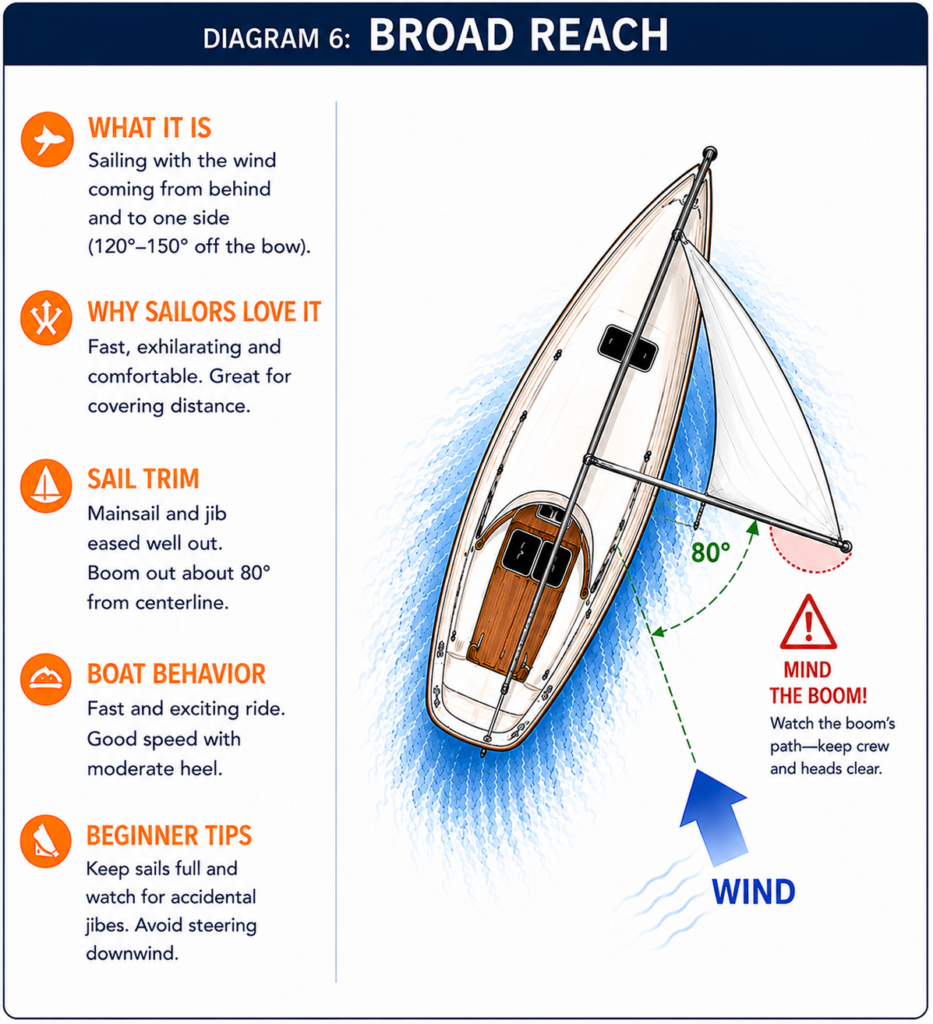
Broad Reach
What Is a Broad Reach?
A broad reach occurs when the wind comes from behind the boat at an angle.
The boat is sailing downwind, but the wind is not directly behind it.
A broad reach is often fast, smooth, and comfortable.
Because the wind pushes the boat more from behind than from the side, the boat usually heels less than it does on an upwind course.
A broad reach combines excellent speed with comfortable sailing conditions.
How Are the Sails Trimmed?
The sails are eased well out.
The boom moves well away from the centreline, and the mainsail opens wide.
The jib is also eased. However, the mainsail may begin to block some of the wind from reaching the jib.
This blocked airflow is called blanketing.
Small changes in course or sail trim may allow the jib to fill properly again.
Boat Behavior
On a broad reach, the boat often feels:
fast
flatter
smoother
comfortable
easier on the crew
Waves approaching from behind or from the rear quarter may help push the boat forward.
In stronger winds, the boat may even surf down the face of a wave. Beginners, however, should learn this skill only in suitable conditions with an experienced sailor aboard.
Risk of an Accidental gibe
A broad reach brings the boat closer to running directly downwind.
If the boat turns too far and the stern passes through the wind, the mainsail can suddenly fill on the opposite side.
The boom may then swing quickly across the cockpit.
This is called an accidental gibe.
The risk increases when:
the wind shifts
the boat rolls
the helmsman wanders off course
waves turn the stern
the crew loses track of the wind direction
Beginner Tips
A broad reach is generally comfortable, but it requires good awareness of the wind.
Keep watching the boom, steer smoothly, and avoid drifting too close to a run unless you intend to gibe.
Key Takeaway
A broad reach is often one of the most comfortable and enjoyable points of sail. It offers good speed with less heel than upwind sailing, but sailors must remain alert to the possibility of an accidental gibe.
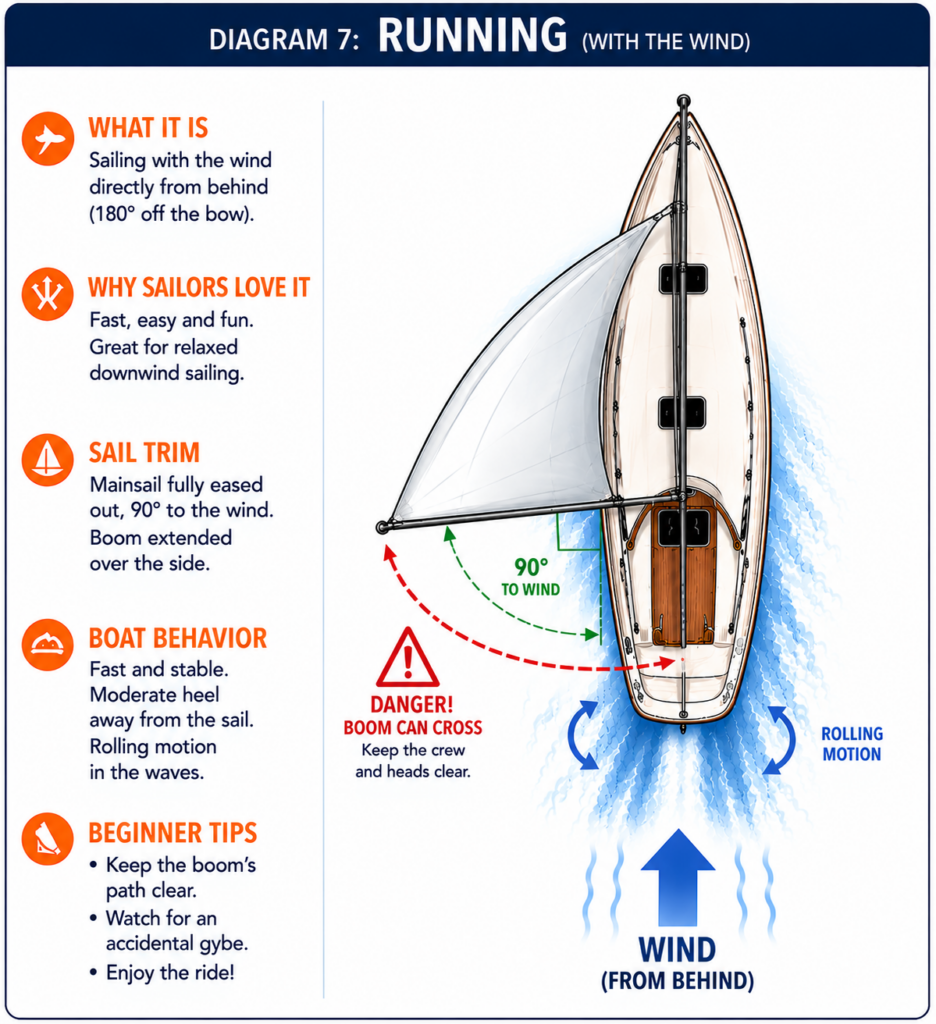
Running (Dead Downwind)
What Is Running?
A boat is running when the wind comes almost directly from behind.
This is also called sailing dead downwind.
The boat and the wind are moving in nearly the same direction.
It may seem as though this should always be the fastest point of sail, but that is usually not the case.
Running places the wind almost directly behind the sailboat and requires careful steering to avoid an accidental gibe.
How Do the Sails Work?
When a boat is running, the sails act more like barriers catching the wind than wings creating lift.
There is often less smooth airflow across the sails than there is on a reach.
The boat may travel comfortably, but it can sometimes feel slower or less stable than it does on a broad reach.
For this reason, sailors will often sail a series of broad reaches instead of pointing directly downwind.
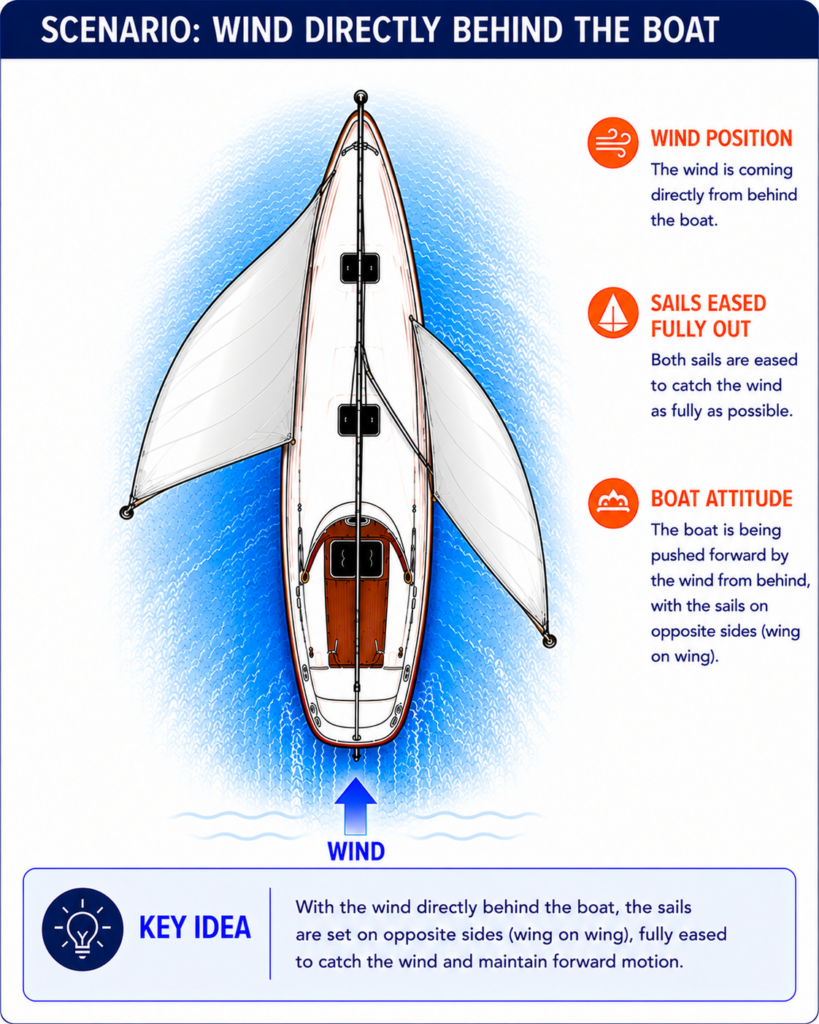
Wing-on-Wing
When running, the mainsail and jib may be set on opposite sides of the boat.
This arrangement is called wing-on-wing.
The mainsail catches the wind on one side, while the jib catches it on the other.
Wing-on-wing can work well when:
the wind direction is steady
the boat can hold a straight course
the sea is fairly calm
the crew keeps a careful watch on the boom
Boat behavior
Running feels different from the other points of sail.
Because the boat is moving in the same direction as the wind, the apparent wind often feels lighter.
The mainsail may also blanket the jib, causing it to collapse, refill, or flap as the boat rolls or the wind shifts.
Without steady wind pressure from the side, the boat may also roll from side to side, especially in waves.
Risks of Running
Running requires careful attention because:
accidental gibes can happen quickly
the apparent wind is often lighter
the mainsail can blanket the jib
the boat may roll more in waves
Even a small change in course can move the wind from one side of the mainsail to the other, causing the boom to swing forcefully across the boat.
Beginner Tips
When sailing downwind:
keep track of the wind direction
watch the boom at all times
steer smoothly
avoid sudden course changes
warn the crew before gybing
never allow anyone to sit in the boom’s path
For many beginners, a broad reach is a safer and more comfortable choice than running directly downwind.
Key Takeaway
Running allows a sailboat to travel almost directly with the wind, but it requires careful steering and constant awareness of the boom. Many sailors choose to sail broad reaches instead because they are often faster, more stable, and more forgiving.
Comparing the Five Points of Sail
Point of Sail
Approximate Wind Angle
Sail Position
Typical Speed
Typical Heel
Beginner Difficulty
Common Use
Close Hauled
About 40–45° from the wind
Trimmed close to the centreline
Moderate
Higher
Moderate
Sailing upwind
Close Reach
About 50–75° from the wind
Slightly eased
Fast
Moderate
Easy
Fast upwind progress
Beam Reach
About 90° from the wind
Eased about halfway
Often very fast
Moderate
Easy
Comfortable, efficient sailing
Broad Reach
About 110–160° from the wind
Eased well out
Fast
Lower
Moderate
Downwind cruising
Running
About 180° from the wind
Fully eased
Moderate
Low, but may roll
Moderate
Sailing directly downwind
Note: These angles are approximate. Boat design, sail shape, wind strength, waves, current, and crew skill all affect how a boat performs.
The most important lesson is not to memorize an exact angle for every point of sail.
Instead, learn the pattern.
As the boat turns away from the wind, the sails are gradually eased farther out.
Close hauled: sails trimmed close to the centerline
Close reach: sails eased slightly
Beam reach: sails eased farther out
Broad reach: sails opened wide
Running: sails eased to their widest practical position
Once you understand this progression, the points of sail become much easier to recognize. Instead of memorizing five separate terms, you begin to see them as one connected system.
How Sail Trim and Boat behavior Change
Once you understand the five basic points of sail, the next step is learning how both the sails and the boat change as you move from one point of sail to another.
A sailboat is always reacting to the wind. As the boat turns, the angle of the wind changes, so the sails must change as well.
The main rule is simple:
As you turn away from the wind, ease the sails out. As you turn toward the wind, trim the sails in.
This adjustment happens gradually, not all at once.
How Sail Trim Changes
The sails follow a steady progression as the boat turns away from the wind:
Close Hauled ↓ Close Reach ↓ Beam Reach ↓ Broad Reach ↓ Running
On a close-hauled course, the sails are trimmed close to the centerline of the boat.
As the boat bears away onto a close reach, the sheets are eased slightly.
On a beam reach, the boom moves farther out.
On a broad reach, the sails are opened wide.
When running, the mainsail may be eased almost as far as it can safely go.
The jib follows the same general pattern, although on downwind courses it may sometimes be blanketed by the mainsail.
Trimming and Easing the Sails
Sailors adjust the sails using ropes called sheets.
Trim in means to pull a sheet tighter.
Ease means to let a sheet out.
A simple way to find good sail trim is:
Ease the sail slowly.
Watch for the front edge to begin luffing.
Trim it in just enough to stop the luffing.
This helps keep the sail full without pulling it in too tightly.
Key Takeaway
You do not need to memorize the exact sail position for every point of sail. Simply remember that as the boat turns away from the wind, the sails are eased farther out. As it turns back toward the wind, the sails are trimmed in.
How Boat behavior Changes
Different points of sail produce different combinations of speed, heel, comfort, and control.
Speed
A beam reach is often one of the fastest points of sail for a cruising sailboat.
Close hauled is usually slower because the boat is working partly against the wind.
A broad reach can also be fast and smooth.
Running directly downwind may feel easy, but it is not always the fastest course because the airflow across the sails is reduced.
Heel
The boat usually heels the most when sailing close hauled or on a close reach.
Heel often becomes more moderate on a beam reach.
On a broad reach or a run, the boat normally sails flatter because more of the wind’s force is pushing from behind.
A moderate amount of heel is normal. Too much heel can make the boat harder to steer and less comfortable for the crew.
Helm Feel
A well-trimmed boat should feel balanced.
If the tiller or wheel feels heavy, the sails may be producing too much sideways force, or the boat may be heeling too much.
If the helm feels very light and the boat does not respond well, the boat may be moving too slowly.
Good sailors pay attention to the pressure they feel through the helm.
Stability and Comfort
A beam reach often feels steady and comfortable.
Close hauled may feel more active because the boat heels and drives into the waves.
A broad reach often feels smooth and relaxed.
Running may feel flatter, but the boat is more likely to roll from side to side, especially in waves.
Visibility
The sails can sometimes block the helmsman’s view.
On some courses, the jib may hide boats or obstacles ahead.
On downwind courses, the mainsail may block visibility to one side of the boat.
Good sailors regularly look around both sides of the sails and keep a careful watch for other boats, obstacles, and hazards.
Key Takeaway
Every point of sail feels different. As the boat changes direction relative to the wind, its speed, heel, steering, comfort, and visibility all change with it.
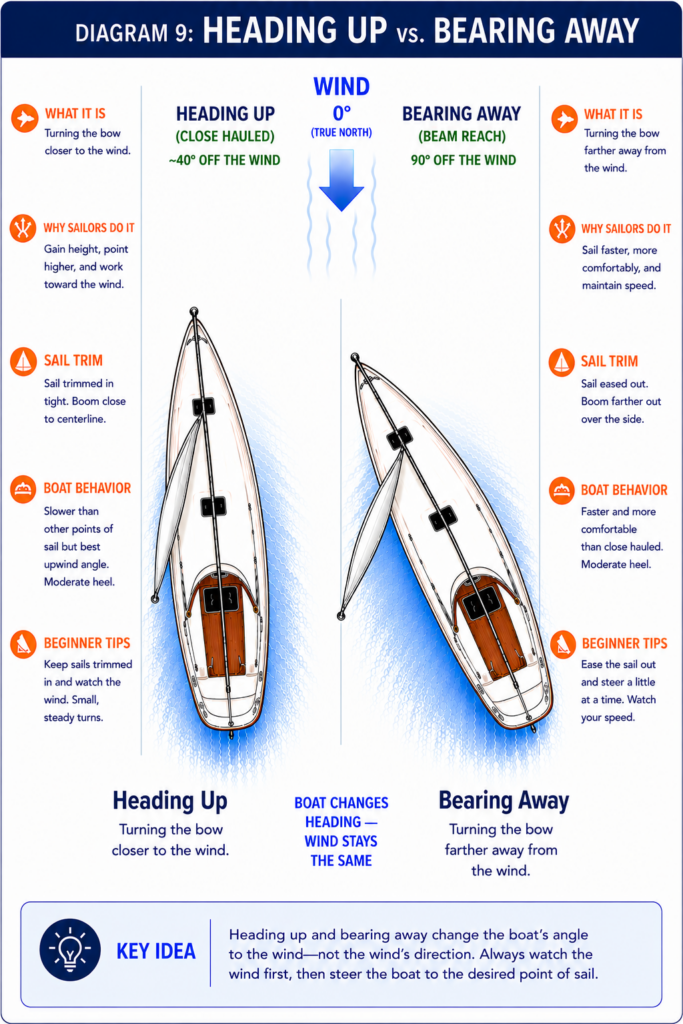
Heading Up and Bearing Away
There are two basic ways to change your point of sail.
Heading Up
Heading up means turning the bow toward the wind.
For example:
Running ↓ Broad Reach ↓ Beam Reach ↓ Close Reach ↓ Close Hauled
As you head up, the sails should be trimmed in gradually.
If you head up too far, the boat enters the No Sail Zone. The sails begin to luff, the boat slows, and the rudder becomes less effective.
Bearing Away
Bearing away means turning the bow away from the wind.
For example:
Close Hauled ↓ Close Reach ↓ Beam Reach ↓ Broad Reach ↓ Running
As you bear away, the sails should be eased out.
The boat will usually heel less, and the boom moves farther away from the centerline.
The farther you bear away, the more carefully you must watch for an accidental gibe.
As the wind moves farther aft, the sails are gradually eased to maintain efficient airflow.
Key Takeaway
Heading up = trim in. Bearing away = ease out.
These two movements are the foundation of sail trim.
Watch the Wind, Not Just the Compass
A compass tells you where the boat is pointing, but it does not tell you your point of sail.
The wind may shift even while the boat holds the same compass heading.
That means you can move from a beam reach to a close reach without turning the boat at all.
This is why sailors continually check:
the Windex
telltales
sail shape
the water’s surface
the wind on their face
The boat’s relationship to the wind matters more than the number on the compass.
Final Reminder
Good sailors do not simply steer a compass course—they continually adjust to the wind. Knowing where the wind is coming from is the foundation of every sailing decision.
Tacking and Gybing
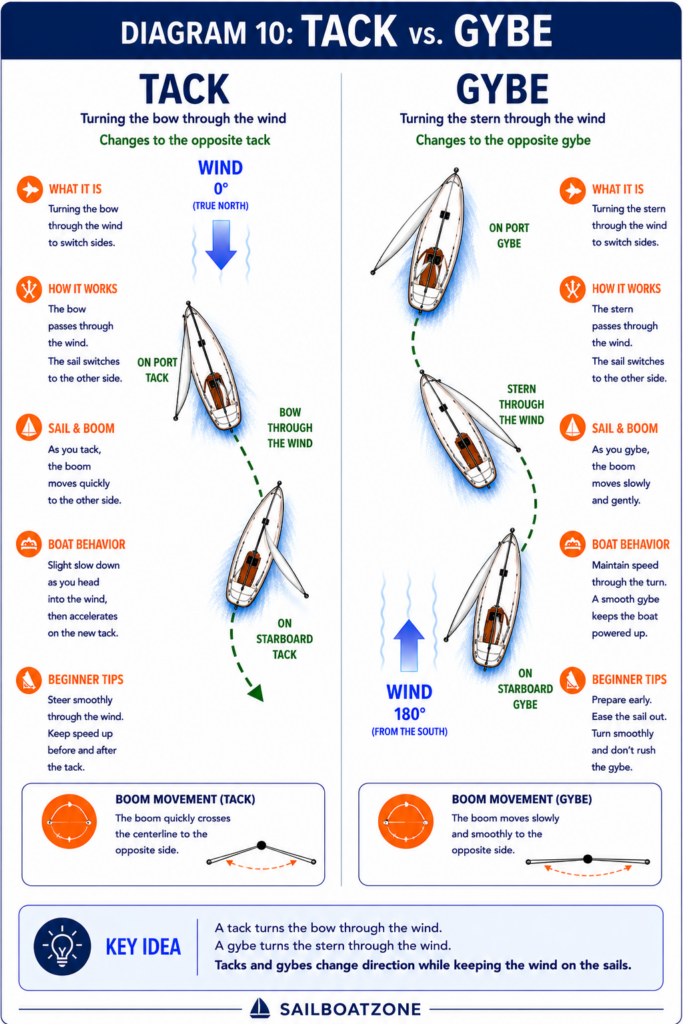
Tacking and gybing both move the sails from one side of the boat to the other, but they happen in different ways.
Tacking
A tack happens when the bow passes through the wind.
The sequence is:
Head up ↓ Enter the No Sail Zone ↓ Bow crosses the wind ↓ Sails fill on the opposite side
Tacking is used when sailing upwind.
During a tack, the sails usually luff briefly as the boat passes through the wind.
Gybing
A gibe happens when the stern passes through the wind.
The sequence is:
Bear away ↓ Approach dead downwind ↓ Stern crosses the wind ↓ Boom swings to the opposite side
A gibe must be carried out carefully because the boom can swing quickly and with great force.
Before gybing, the helmsman should warn the crew and make sure no one is in the boom’s path.
Tacking crosses the bow through the wind, while gybing brings the stern through the wind.
Key Takeaway
During a tack, the bow passes through the wind. During a gibe, the stern passes through the wind.
Common Beginner Mistakes
Every sailor makes mistakes while learning. In fact, making small mistakes—and learning from them—is one of the fastest ways to become a better sailor.
The good news is that most beginner mistakes are predictable. Once you know what they are, you’ll be much more likely to recognize them before they become bigger problems.
Looking at the Compass Instead of the Wind
This is probably the most common beginner mistake.
New sailors often steer toward a compass heading or a landmark on shore without noticing that the wind has shifted.
Remember:
Your point of sail is determined by the wind—not by the compass.
Keep checking your Windex, telltales, the water’s surface, and the feel of the wind on your face.
Over-Trimming the Sails
Many beginners believe tighter sails always produce more speed.
In reality, sails need a smooth, curved shape to work efficiently.
If they are pulled in too tightly, they become less efficient and can actually slow the boat down.
When in doubt, ease the sail until it just begins to luff, then trim it in until the luffing stops.
Under-Trimming the Sails
The opposite mistake is leaving the sails too loose.
Loose sails flap, lose their shape, and produce very little forward power.
A properly trimmed sail should usually be full and smooth—not fluttering.
Sailing Into Irons
If you steer too far toward the wind, the boat enters the No Sail Zone.
The sails begin to luff, the boat loses speed, and it may eventually stop with the bow pointing into the wind.
This is called being in irons.
It happens to every sailor at some point, so don’t panic. Bear away, allow the sails to fill again, and continue sailing.
Confusing Course with Point of Sail
Your compass heading and your point of sail are not the same thing.
You can sail due north on a beam reach one day and due north on a close reach the next if the wind changes.
Whenever you’re unsure, ask yourself:
Forgetting That the Wind Changes
The wind is constantly shifting.
Even a small wind shift can change your point of sail.
Experienced sailors check the wind regularly instead of assuming it hasn’t changed.
Fear of Heeling
Many first-time sailors become nervous when the boat heels.
A moderate amount of heel is perfectly normal and is often a sign that the sails are producing good power.
As your confidence grows, you’ll begin to recognize the difference between normal heel and excessive heel.
Real-World Sailing Scenarios
Let’s put everything you’ve learned into practice.
Scenario 1: “I Want to Sail Toward That Island”
The island lies almost directly upwind.
Can you simply point the bow at it?
No.
Instead, you’ll sail close hauled, then tack, and then sail close hauled on the opposite side.
By sailing this zigzag course, you’ll gradually make progress toward the island.
Scenario 2: “I Want Maximum Speed”
You’re sailing across a lake with plenty of open water.
Which point of sail will often give you the best speed?
For many cruising sailboats, the answer is a beam reach.
The sails receive excellent airflow, the helm feels balanced, and the boat often moves efficiently through the water.
Scenario 3: “The Boat Is Heeling Too Much”
You’re sailing close hauled, and everyone aboard feels uncomfortable.
What could you do?
Possible solutions include:
bear away slightly onto a close reach
ease the mainsail a little
reduce sail if the wind is strong
move the crew’s weight toward the high side
Small adjustments often make a big difference in both comfort and boat control.
Scenario 4: “I Need to Return to the Marina”
The marina lies downwind.
Should you sail directly toward it?
Maybe—but not always.
If the wind is steady and there’s plenty of room, running may work well.
In gusty conditions, however, many sailors prefer sailing on a broad reach and making a controlled gibe when needed.
Sometimes the fastest or most direct route is not the safest one.
Practice Exercise
Can you identify each point of sail?
Try answering before looking at the solutions.
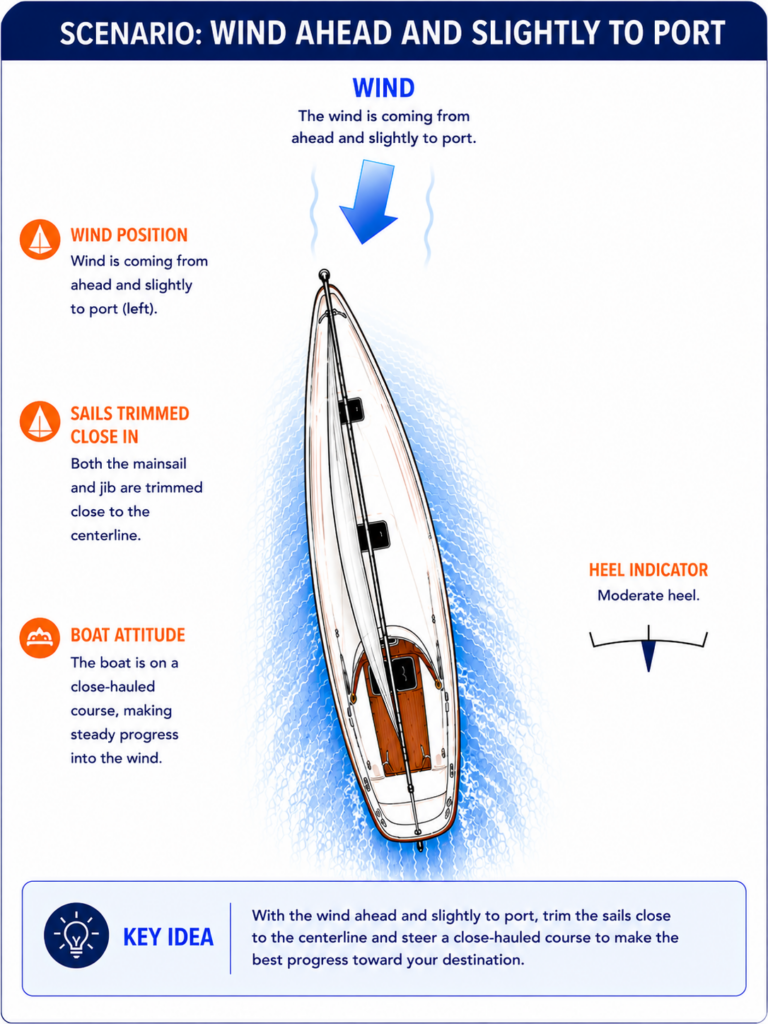
Boat A
The wind is coming from ahead and slightly to port.
The sails are trimmed close to the centerline.
Test your understanding by identifying the point of sail for each boat before checking the answers.
What point of sail is this?
Boat B
Test your understanding by identifying the point of sail for each boat before checking the answers.
The wind is blowing directly across the starboard side.
The sails are eased halfway out.
What point of sail is this?
Boat C
Test your understanding by identifying the point of sail for each boat before checking the answers.
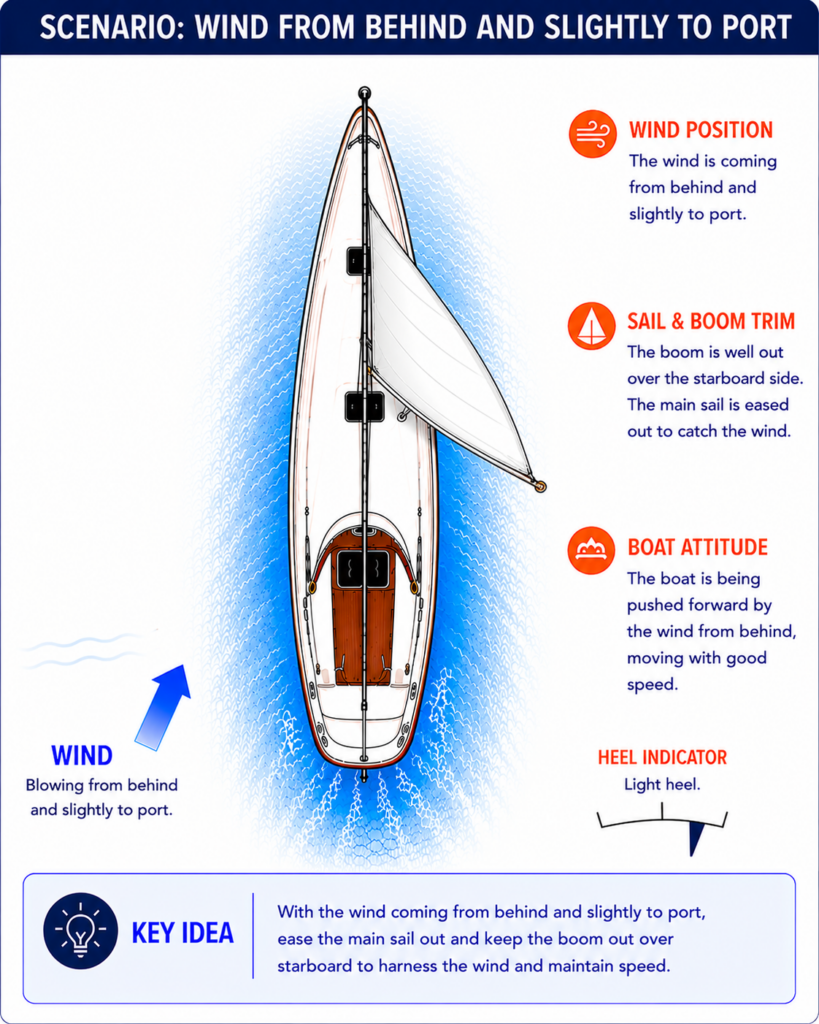
The wind is coming from behind and slightly to port.
The boom is well out over the starboard side.
What point of sail is this?
Boat D
Test your understanding by identifying the point of sail for each boat before checking the answers.
The wind is directly behind the boat.
The sails are fully eased.
What point of sail is this?
Scroll to the end for the quiz answers.
Key Takeaways
Congratulations! You’ve learned one of the most important foundations of sailing.
Let’s review the big ideas.
A point of sail describes your boat’s direction relative to the wind, not the compass.
Every sailing decision begins by identifying where the wind is coming from.
A sailboat cannot sail directly into the wind because the sails lose lift and begin to luff.
There are five basic points of sail: close hauled, close reach, beam reach, broad reach, and running.
As you turn away from the wind, the sails should be eased farther out.
As you turn toward the wind, the sails should be trimmed in.
Different points of sail affect the boat’s speed, heel, comfort, and helm feel.
Heading up turns the boat toward the wind. Bearing away turns it away from the wind.
During a tack, the bow passes through the wind. During a gibe, the stern passes through the wind.
Good sailors continually watch the wind—not just the compass.
Your Next Steps
Understanding the points of sail gives you the vocabulary to describe what a sailboat is doing. The next step is learning how to use that knowledge on the water.
As you continue exploring SailboatZone.com, you’ll build on this foundation with articles such as:
The more time you spend observing the wind and practicing these concepts, the more natural they will become.
Before long, you’ll stop thinking about the names of the points of sail and simply recognize them by the way the boat feels—a sure sign that you’re beginning to think like a sailor.

Comments
Pingback: Parts of a Sailboat: Complete Beginner’s Guide -