Read time approximately 30 minutes.
Introduction
Walk around any marina and you’ll hear sailors using words that can sound like a completely different language.
“Take the jib sheet.”
“Watch the boom.”
“Go forward to the bow.”
“Ease the mainsheet.”
If you’re new to sailing, it’s easy to feel overwhelmed. Every part of the boat seems to have its own name, and experienced sailors use those names without a second thought.
The good news is that you don’t need to memorize dozens of new terms all at once.
Like learning the parts of a bicycle before riding or the controls of a car before driving, learning the parts of a sailboat simply gives you a map. Once you understand that map, every sailing lesson becomes easier because you’ll know exactly what your instructor is talking about.
A physical model of a sailboat can help beginners visualize how the hull, keel, rudder, mast and sails fit together. This Catalina sailboat model on Amazon provides a three-dimensional reference to complement the diagrams in this lesson.
In this guide, we’ll walk around a sailboat together, learning the names and purposes of its major parts one step at a time. By the end, you’ll understand how the boat is organized and how its different systems work together to harness the wind.
Beginner Tip
Don’t worry about memorizing every term today. Instead, focus on understanding where each part is located and what job it performs. The names will become familiar the more you sail.
Why Learning the Parts of a Sailboat Matters
One of the biggest hurdles for new sailors isn’t steering the boat or trimming the sails—it’s understanding the vocabulary.
Imagine someone telling you to “pull the blue rope.”
On one sailboat, that might work.
On another, there could be ten blue ropes.
That’s why sailors use precise names instead.
When someone says, “Tighten the jib sheet,” everyone on board knows exactly which line they’re talking about.
Learning these terms isn’t about sounding like a sailor. It’s about communicating clearly and safely.
You’ll also discover that nearly every sailing resource assumes you already know the basic anatomy of a sailboat. Sailing books, instructional videos, certification courses, racing rules, and even weather discussions all use these terms without stopping to define them.
By spending a little time learning the parts of the boat now, you’ll make every future lesson easier to understand.
Think of this article as building a foundation. Once you know the names of the major parts, you’ll be ready to explore how they work together to make sailing possible.
Learning the basic parts of the boat is also a fundamental part of formal sailing instruction; the Royal Yachting Association introduces boat familiarization and basic sailing skills as part of its beginner sailing pathway.
The Three Main Parts of Every Sailboat
Looking at a sailboat for the first time can feel intimidating. There are masts, sails, ropes, wires, pulleys, rails, and countless other pieces of equipment.
Fortunately, you don’t have to learn everything at once.
Almost every sailboat can be understood by thinking of it as three major systems working together.
1. The Hull
The hull is the body of the boat.
Its job is to float, support the crew, carry equipment, and provide stability on the water. Everything else is built onto or supported by the hull.
Whether you’re sailing a small dinghy or a forty-foot cruising yacht, every sailboat starts with the hull.
2. The Rig
The rig is the framework that supports the sails.
It includes the mast, boom, standing rigging, and running rigging.
Think of the rig as the sailboat’s skeleton. It provides the structure that allows the sails to catch the wind and gives sailors the ability to adjust them for different conditions.
Without the rig, the sails would have nothing to attach to.
3. The Sails
The sails are the boat’s engine.
Instead of burning fuel, they capture the energy of the wind and convert it into forward motion.
As air flows around a properly trimmed sail, it creates lift that pulls the boat through the water. Understanding exactly how this works is one of the most fascinating parts of learning to sail, but for now, it’s enough to remember that the sails are what provide the power.
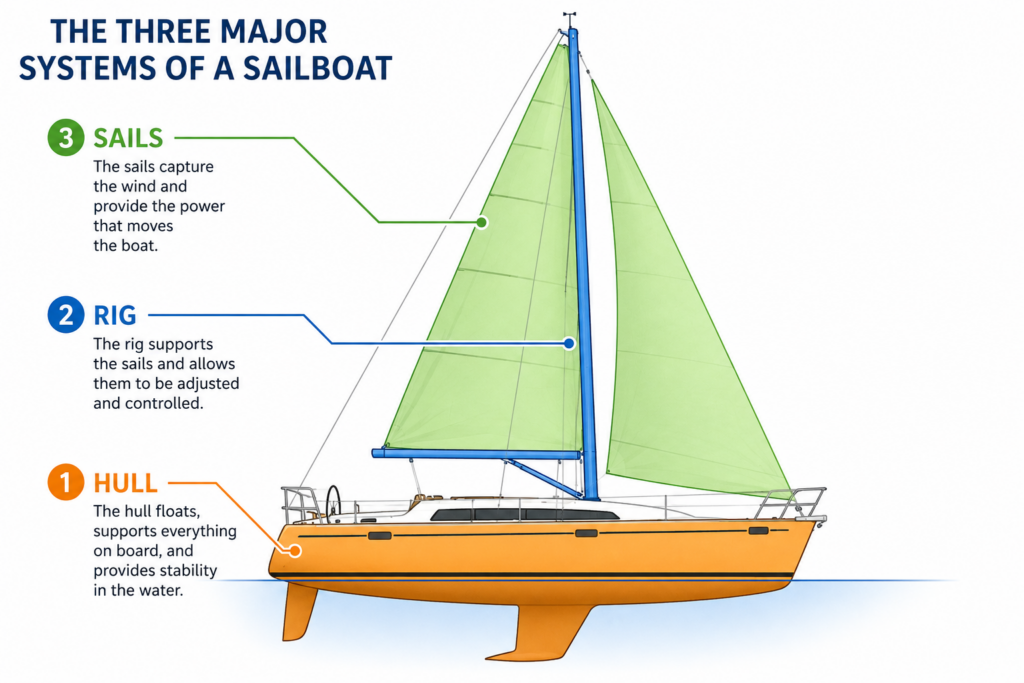
Diagram showing the three major systems of a sailboat: hull, rig, and sails
Sailboat Anatomy at a Glance
Now that you understand the three major systems, it’s time to see how they fit together.
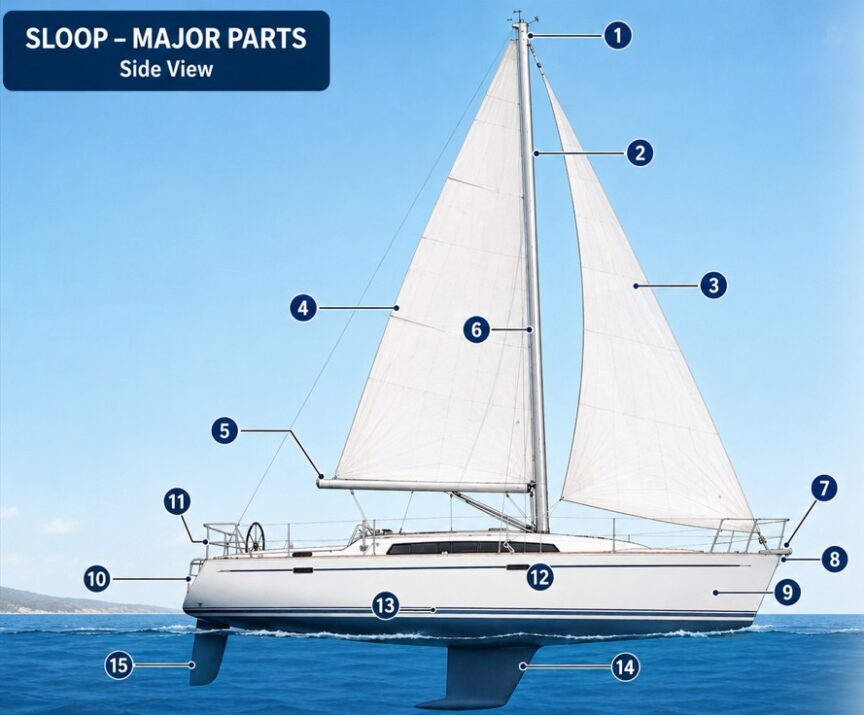
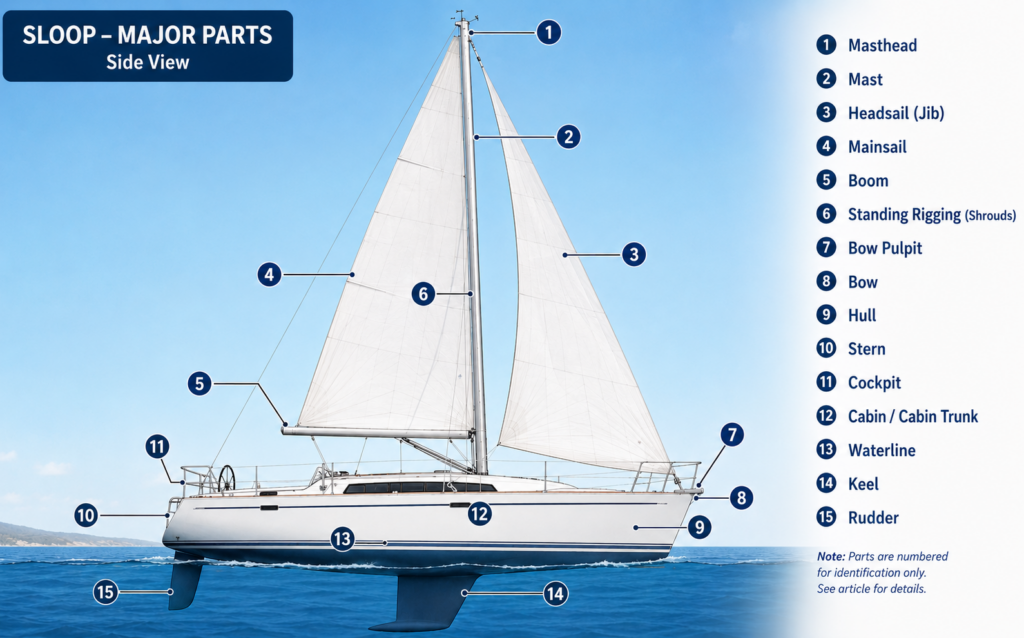
The illustration below labels the most common parts you’ll find on a modern recreational sailboat. Don’t worry if some of the names are unfamiliar—we’ll explore each one in detail throughout the rest of this guide.
For now, simply notice how the different systems connect.
The hull supports the rig.
The rig supports the sails.
The sails generate the power.
The keel keeps the boat stable.
The rudder steers the boat.
By the end of this article, you’ll recognize every major part and understand the role it plays.
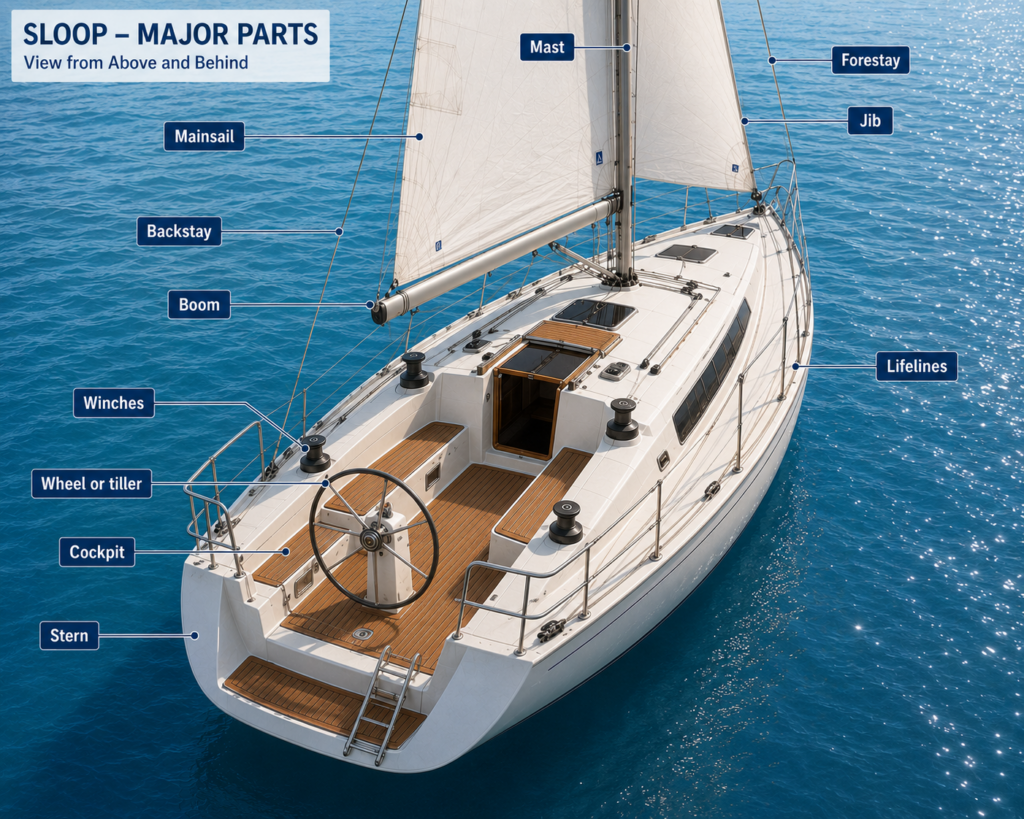
Complete labelled sailboat anatomy diagram for beginner sailors
Key Takeaway
Don’t think of a sailboat as fifty unrelated parts to memorize. Think of it as three systems working together:
- The hull floats and supports the boat.
- The rig holds the sails in place.
- The sails capture the wind and provide the power.
Everything else you’ll learn builds on these three ideas.
Part 2 – The Hull
If the rig and sails are what make a sailboat move, the hull is what makes sailing possible in the first place.
The hull is much more than the outside shell of the boat. It provides flotation, supports the rig, carries the crew and equipment, and works together with the keel and rudder to create a stable sailing platform.
As we explore the parts of the hull, don’t worry about memorizing every term immediately. Instead, try to picture yourself standing on the boat and walking from the front to the back. By the end of this section, you’ll have a mental map of the hull that will make future sailing lessons much easier to follow.
What Is the Hull?
The hull is the main body of the sailboat. It is the part that sits in the water and supports everything above it.
Its primary jobs are to:
- Float the boat.
- Carry the crew and equipment.
- Support the mast and rigging.
- Provide stability while sailing.
Every sailboat, from an eight-foot dinghy to a sixty-foot cruising yacht, has a hull. Although hull shapes vary depending on the boat’s purpose, they all perform these same basic functions.
A Quick Word About Flotation
A sailboat floats because its hull displaces water. As the hull pushes water aside, the displaced water creates an upward force that supports the weight of the boat.
You don’t need to understand all of the physics yet—just remember that the shape of the hull is carefully designed to float efficiently while moving smoothly through the water.
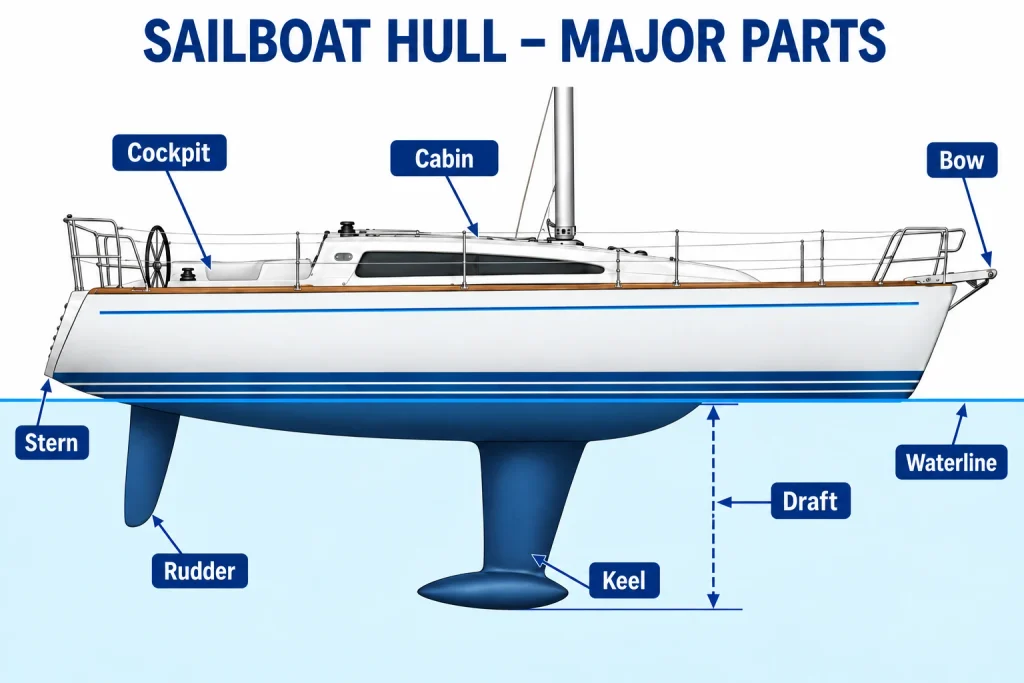
The Bow
The bow is the front of the boat.
As the boat moves forward, the bow is the first part to meet the water. Its shape helps slice through waves and reduces resistance, making the boat easier to propel.
Many pieces of equipment are located near the bow, including the anchor, bow cleats, and bow pulpit on larger sailboats.
You’ll often hear instructions such as:
- “Go to the bow.”
- “Secure the bow line.”
- “Watch the bow.”
Knowing where the bow is becomes second nature after only a few trips on the water.
Related Reading: Points of Sail • Docking a Sailboat
The Stern
The stern is the back of the boat.
On many sailboats, this is where you’ll find the steering system, whether it’s a tiller or a wheel. The rudder is also attached near the stern beneath the waterline.
The stern is often where passengers board from a dock and where swim ladders are installed on cruising boats.
Simply remember:
- Bow = front
- Stern = back
Those two terms alone will make following sailing instructions much easier.
Port and Starboard
Unlike a car, a sailboat doesn’t use the words left and right.
Instead, sailors use:
- Port = left side
- Starboard = right side
These terms never change, no matter which direction you’re facing.
Imagine standing at the helm looking toward the bow.
- Your left hand points toward port.
- Your right hand points toward starboard.
Why not just say left and right?
Because sailors are often facing different directions while working on the boat. If someone shouted, “Move to the left,” whose left?
Using port and starboard removes all confusion.
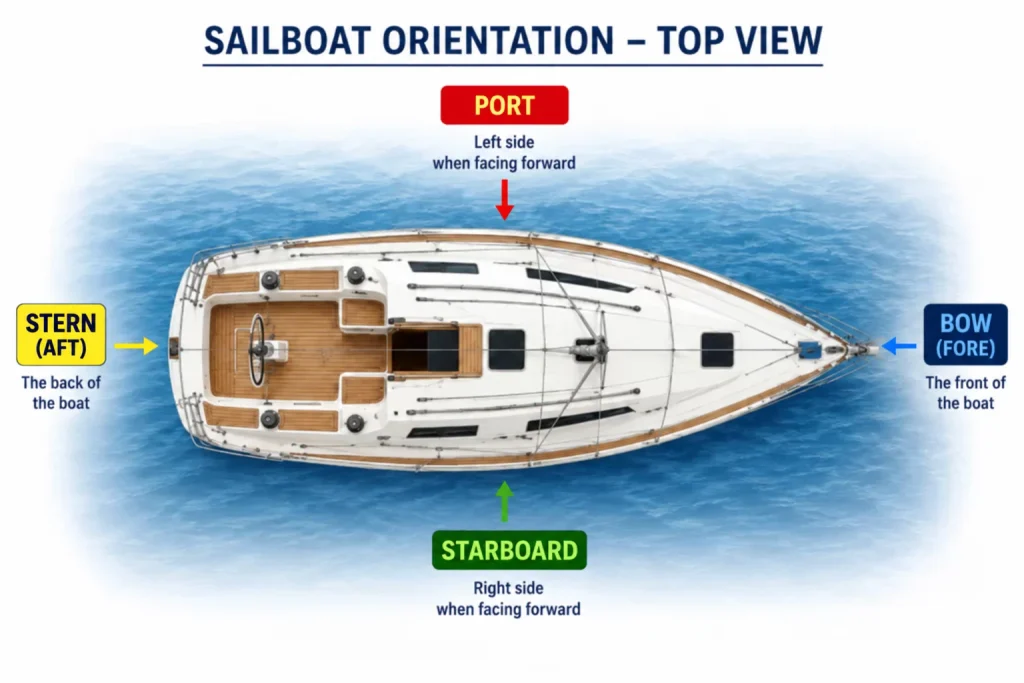
Top view showing port and starboard on a sailboat
Memory Tip
PORT and LEFT both have four letters. Many beginning sailors find this an easy way to remember which side is which.
Related Reading: Right of Way Rules
Beam
The beam is the widest part of the boat.
A sailboat with a wider beam generally has more interior space and often feels more stable initially. A narrower beam may reduce drag and improve performance in some conditions.
When sailors refer to a boat’s beam, they’re talking about its width—not a structural beam like you would find in a building.
Draft
The draft is how deep the boat extends below the water.
More specifically, it is the distance from the waterline down to the lowest point of the keel.
Draft matters because it determines where you can safely sail.
A sailboat with a deep draft cannot enter shallow water without risking running aground.
Before entering an unfamiliar harbour or anchorage, sailors compare their boat’s draft to the charted water depth.
Related Reading: Reading Nautical Charts
Keel
The keel is one of the most important parts of a sailboat.
Mounted beneath the hull, it performs two critical jobs.
First, it provides ballast, which helps keep the boat upright.
Second, it reduces the boat’s tendency to slide sideways when the wind pushes against the sails.
Without a keel, a sailboat would drift sideways far more than it would move forward.
There are many different keel designs, but they all serve these same basic purposes.
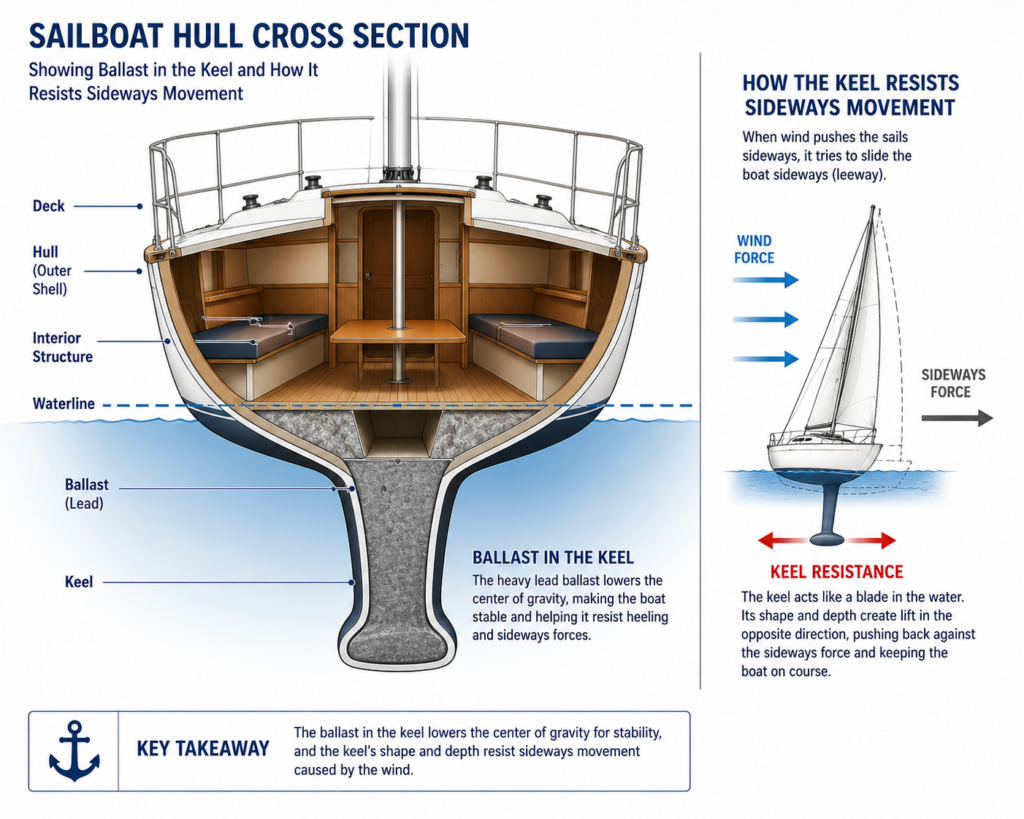
Cross-section showing how a sailboat keel provides stability
Beginner Misconception
Many people think the rudder keeps a sailboat from tipping over.
It doesn’t.
The keel is the primary source of stability. The rudder’s job is steering.
Related Reading: Why Sailboats Don’t Tip Over
Rudder
The rudder is the underwater steering surface attached near the stern.
When you turn the tiller or wheel, the rudder pivots, changing the flow of water and causing the boat to turn.
Unlike a car, steering a sailboat takes patience. The boat responds gradually, especially at slower speeds.
Understanding how the rudder works is one of the first skills every new sailor develops.
Related Reading: Steering a Sailboat
Cockpit
The cockpit is where the crew operates the boat.
Most of the controls you’ll use while sailing—including the helm, mainsheet, winches, and many control lines—are located here.
Think of the cockpit as the sailboat’s command center.
Cabin
Below the cockpit is the cabin.
Depending on the size of the sailboat, it may include:
- Sleeping berths
- Seating
- Storage
- A small galley (kitchen)
- A marine toilet (head)
Small day-sailing boats may have little or no cabin, while cruising sailboats can provide surprisingly comfortable living space.
Key Takeaways
The hull is the foundation of every sailboat. It not only floats the boat but also supports the systems that allow it to sail safely and efficiently.
Before moving on, make sure you’re comfortable identifying these essential terms:
- Hull – the main body of the boat
- Bow – the front
- Stern – the back
- Port – the left side
- Starboard – the right side
- Beam – the widest part of the boat
- Draft – how deep the boat sits in the water
- Keel – provides stability and reduces sideways drift
- Rudder – steers the boat
- Cockpit – where the boat is controlled
- Cabin – the interior living and storage space
In the next section, we’ll move upward from the hull to explore the rig—the mast, boom, standing rigging, and running rigging that support the sails and make sailing possible.
Part 3 – The Rig and Sails
So far, we’ve explored the hull, the foundation of every sailboat. It floats, carries the crew, and provides stability on the water.
Now it’s time to look upward.
The rig and sails are what transform a floating boat into a sailing boat. Together, they support the sails, harness the wind, and give the skipper complete control over the boat’s power.
At first glance, the mast, wires, ropes, and sails may seem like a confusing collection of equipment. But just like the hull, they become much easier to understand once you see how each part fits into the bigger picture.
What Is the Rig?
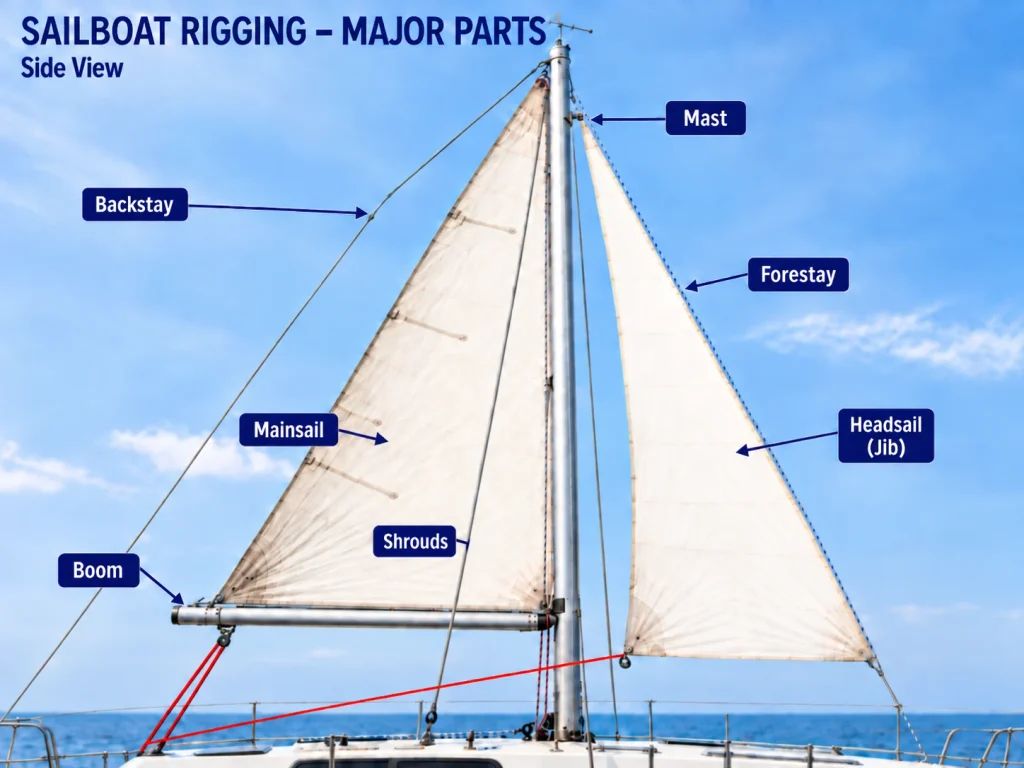
The rig is the entire structure that supports and controls the sails.
On a typical beginner sailboat, the rig includes:
- The mast
- The boom
- Standing rigging
- Running rigging
Think of the rig as the sailboat’s framework. Without it, the sails couldn’t be raised, trimmed, or controlled.
Although rig designs vary between different types of sailboats, the basic purpose remains the same: to hold the sails in the correct position so they can efficiently capture the wind.
The Mast
The mast is the tall vertical spar that supports the sails.
On most modern sailboats, it is made from aluminum, although carbon fiber is becoming more common on high-performance boats.
The mast performs several important jobs:
- Supports the mainsail
- Supports the standing rigging
- Provides attachment points for running rigging
- Keeps the entire rig upright
Because the mast experiences tremendous forces from both the wind and the sails, it relies on the standing rigging to remain stable.
The height of the mast also influences how much sail area a boat can carry. Generally speaking, a taller mast allows for larger sails, which can provide more power in lighter winds.
The Boom
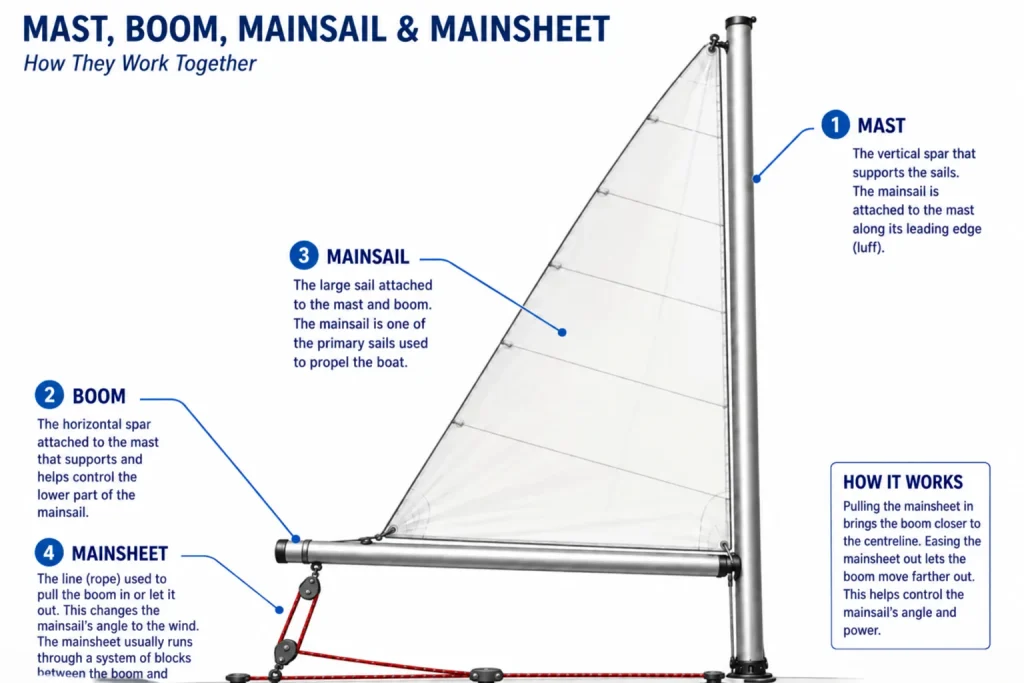
The boom is the horizontal spar attached near the bottom of the mast.
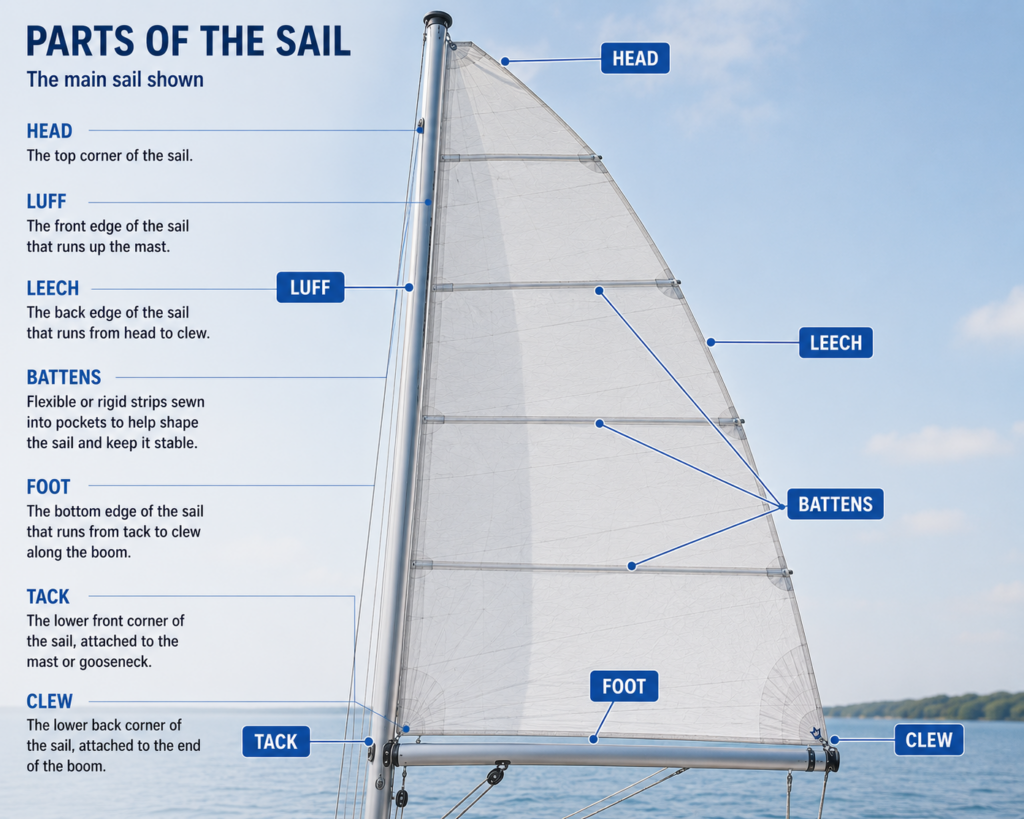
Its primary job is to support the foot (bottom edge) of the mainsail.
As the boat changes direction relative to the wind, the boom swings from one side of the boat to the other. The mainsheet controls how far it moves.
Although the boom looks harmless, it’s one of the most important safety considerations on a sailboat.
Safety First: Watch the Boom
During a tack, the boom usually crosses the boat in a controlled manner.
During a gybe, however, it can swing across very quickly and with considerable force.
Always know where the boom is, and never stand where it might swing unexpectedly.
Experienced sailors instinctively glance at the boom before moving around the cockpit. Developing this habit early will make you a safer sailor.
Standing Rigging
The mast doesn’t stand by itself.
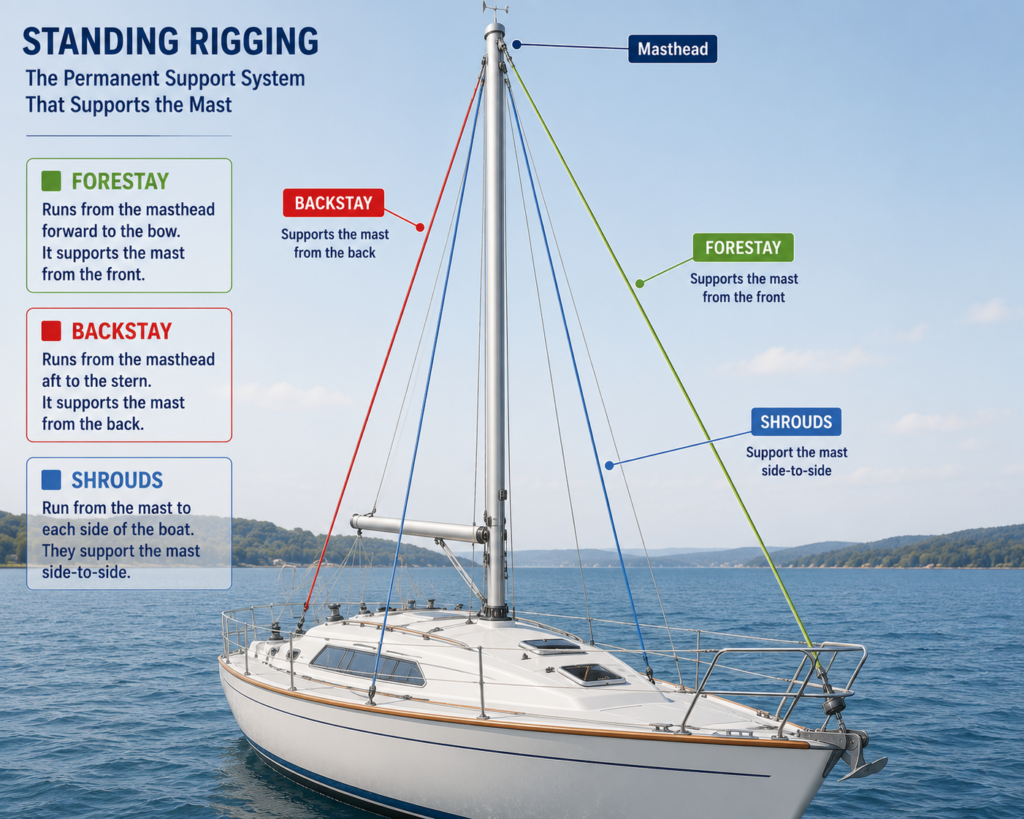
It is held upright by a network of strong wires called the standing rigging.
Unlike ropes that are constantly adjusted while sailing, standing rigging is designed to remain fixed in place.
Think of it as the guy wires that stabilize a tall radio tower.
The three most common parts are:
Forestay
The forestay runs from the top of the mast to the bow.
It supports the mast from the front and usually provides the attachment point for the headsail.
Backstay
The backstay runs from the top of the mast to the stern.
It balances the pull of the forestay and helps support the mast from behind.
Some smaller sailboats and certain rig designs do not have a backstay, but many cruising sailboats do.
Shrouds
The shrouds run from the mast down to both sides of the boat.
Their job is to prevent the mast from falling sideways.
Without properly tensioned shrouds, the mast would quickly become unstable.
Beginner Tip
A simple way to remember the difference:
Standing rigging supports the mast.
Running rigging controls the sails.
Running Rigging
If the standing rigging holds everything in place, the running rigging allows you to control it.
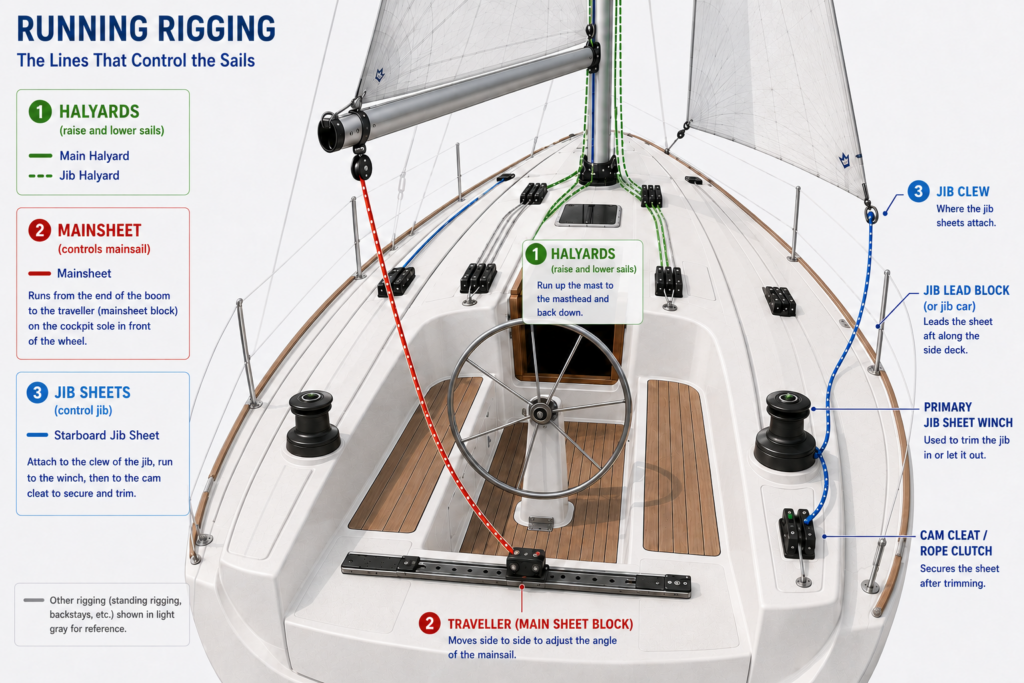
Running rigging refers to the movable lines that sailors adjust while sailing.
Unlike standing rigging, these lines are constantly being pulled, eased, and trimmed.
Halyards
A halyard is used to raise and lower a sail.
Each sail typically has its own halyard.
Once the sail is raised, the halyard usually stays in place until it’s time to lower the sail.
Sheets
A sheet controls the angle of a sail relative to the wind.
This is one of the most important adjustments a sailor makes.
The mainsail is controlled by the mainsheet, while the headsail is controlled by one or two jib sheets.
Despite the name, sheets are ropes—not fabric.
Other Control Lines
Many sailboats also have additional control lines that adjust sail shape and performance.
As a beginner, you don’t need to learn them all immediately.
Focus first on recognizing the halyards and sheets. These are the controls you’ll use most often.
The Sails
Now that the rig is supporting everything, it’s time to look at the sails themselves.
The sails are what capture the wind and turn it into forward motion.
Each sail has a specific job.
Mainsail
The mainsail is the primary sail on most sailboats.
It is attached to both the mast and the boom and provides much of the boat’s driving power.
Because the mainsail is large and centrally located, it plays a major role in steering balance, speed, and overall performance.
As you progress in sailing, you’ll learn how adjusting the mainsail affects almost every aspect of the boat’s behavior.
Headsail (Jib or Genoa)
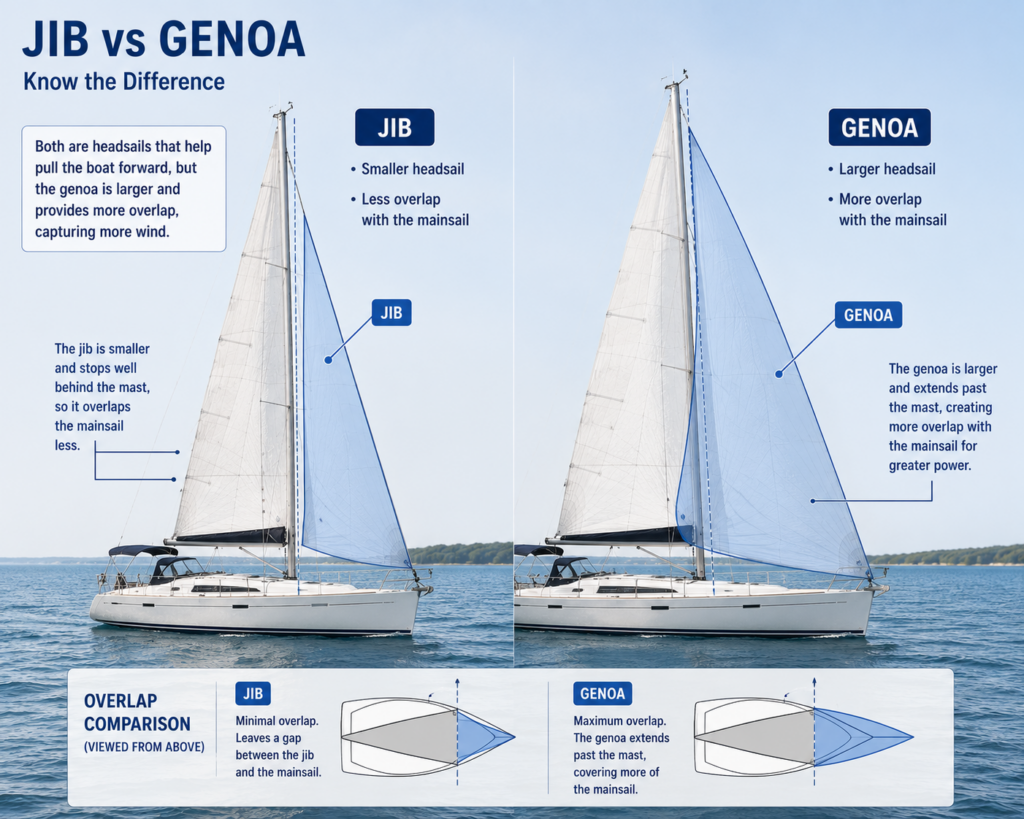
The sail located forward of the mast is called the headsail.
On most beginner sailboats, this will be either:
- A jib
- A genoa
Both perform the same general function, but a genoa is larger and overlaps the mast more than a standard jib.
Together, the mainsail and headsail work as a team. Properly trimmed, they create smooth airflow that improves both speed and efficiency.
As a beginner, don’t worry too much about the differences. Simply remember that the headsail is the sail in front of the mast.
Optional Sails
Many sailboats carry additional sails for specific wind conditions.
Some of the most common include:
Spinnaker
A large, lightweight sail designed for sailing downwind in lighter winds.
Code Zero
A specialized sail used in very light winds and on broad reaching courses.
Storm Sail
A small, heavily reinforced sail designed for use in severe weather when safety is more important than speed.
Most beginning sailors won’t encounter these sails right away, but it’s helpful to know they exist as you continue learning.
Sail trim changes as the boat changes its angle to the wind, which is why understanding the different points of sail becomes important once you begin using the mainsail and headsail underway. The RYA provides a useful introduction to the points of sail and basic sail trimming.
Key Takeaways
The rig and sails work together as one complete system.
The mast provides the main support.
The boom supports the bottom of the mainsail and must always be respected for safety.
The standing rigging keeps the mast upright.
The running rigging allows you to raise, lower, and adjust the sails.
Finally, the mainsail and headsail work together to capture the wind and move the boat forward.
In the next section, we’ll move from the structure of the sailboat to the controls you’ll use while sailing, including the helm, mainsheet, winches, and cleats—the equipment that lets you steer the boat and adjust its sails with confidence.
Part 4 – Controls and Deck Hardware
Up to this point, we’ve looked at the hull, the rig, and the sails. Together, these parts give a sailboat its structure and its ability to harness the wind.
Now it’s time to look at the equipment you’ll actually use while sailing.
Think of these controls as the interface between you and the boat. They allow you to steer, adjust the sails, and respond to changing wind conditions. While they may seem intimidating at first, most beginners quickly discover that only a handful of controls are used regularly.
We’ll finish by looking at the deck hardware—the fittings permanently mounted to the boat that make sailing safer, easier, and more efficient.
The Helm
The helm is the steering station of the sailboat.
When someone says, “Take the helm,” they’re asking you to take control of steering the boat.
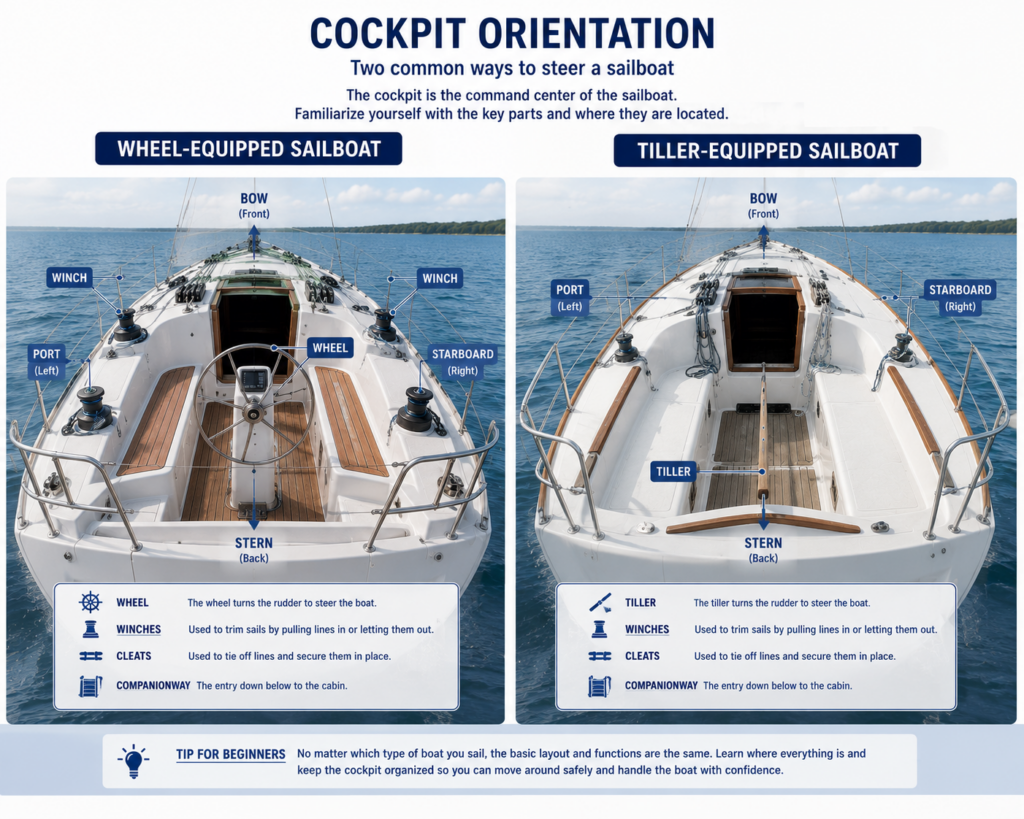
Depending on the size and design of the sailboat, the helm may consist of either:
- A tiller
- A steering wheel
Both perform the same job—they turn the rudder beneath the boat—but they do it in different ways.
Wheel vs. Tiller
Tiller
A tiller is a simple lever attached directly to the rudder.
When you move the tiller, the rudder turns immediately.
One concept often surprises beginners:
You move the tiller in the opposite direction from where you want the boat to turn.
For example:
- Push the tiller to port, and the boat turns to starboard.
- Push the tiller to starboard, and the boat turns to port.
Although this feels unusual at first, most sailors adapt surprisingly quickly.
Tillers are common on smaller sailboats because they are lightweight, simple, and provide excellent feedback about how the boat is moving through the water.
Wheel
Larger sailboats often use a steering wheel connected to the rudder through cables, chains, or hydraulic systems.
Unlike a tiller, a wheel behaves much like the steering wheel of a car.
Turn the wheel to starboard, and the boat gradually turns to starboard.
A wheel is often more comfortable on larger boats and leaves more room in the cockpit, but it provides less direct feedback than a tiller.
Neither system is inherently better—they simply suit different types of boats.
Related Reading: Steering a Sailboat
The Mainsheet
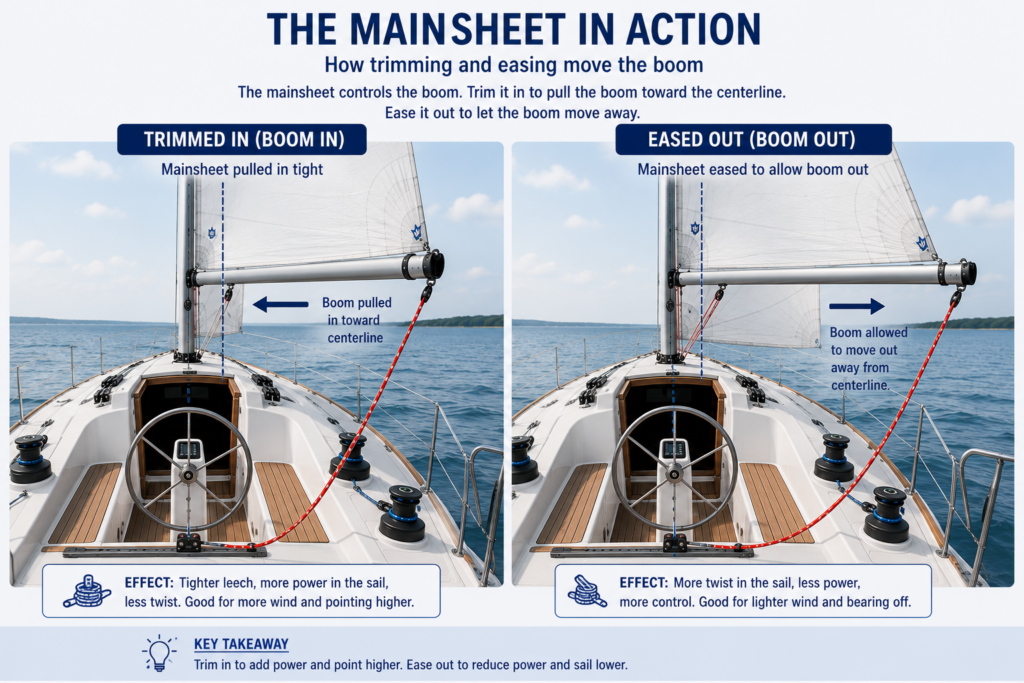
The mainsheet controls the position of the boom and, therefore, the angle of the mainsail.
As the wind changes or the boat changes direction, you’ll constantly adjust the mainsheet to keep the mainsail working efficiently.
Pulling in the mainsheet generally brings the boom closer to the center of the boat.
Easing the mainsheet allows the boom to move farther away.
One of the most common beginner mistakes is assuming the mainsheet controls the sail itself. In reality, it controls the boom, and the boom positions the sail.
Related Reading: Sail Trim Basics
Jib Sheets
The jib sheets control the headsail.
Just as the mainsheet controls the mainsail, the jib sheets adjust the angle of the jib or genoa relative to the wind.
Most boats have two jib sheets:
- One for the port side
- One for the starboard side
Only one sheet is normally under tension at a time, depending on which tack the boat is sailing.
When the boat tacks, the working sheet is released while the opposite sheet is trimmed.
As you gain experience, adjusting the jib sheets will become one of your most common sailing tasks.
Halyards
If sheets adjust the sails, halyards raise and lower them.
Each major sail has its own halyard.
You’ll normally use a halyard:
- Before leaving the dock
- When lowering sails at the end of the day
- When reefing or changing sails
Unlike sheets, halyards usually aren’t adjusted constantly while sailing. Once a sail is properly hoisted, the halyard typically remains secured until it’s time to lower the sail again.
Winches
Some lines become difficult to pull by hand, especially on larger boats.
That’s where winches come in.
A winch is a mechanical device that provides leverage, allowing you to tension lines much more easily.
Rather than pulling directly on a heavily loaded sheet, sailors wrap the line around the winch several times before turning the winch handle.
The friction created by the wraps dramatically reduces the effort required.
For further study into winches, and for detailed images and descriptions, please see the full article How to Use a Winch Safely.
Safety First: Respect the Winch
Winches can generate tremendous pulling force.
Keep fingers, loose clothing, and long hair clear of the rotating drum.
Never place your hand inside a loop of rope under tension, and always pay attention to where the line will run if it suddenly releases.
Good habits developed early make sailing much safer.
Cleats
Once a line has been adjusted, it needs to stay where you put it.
That’s the job of a cleat.
A cleat is a metal or composite fitting used to secure ropes quickly and securely.
Whether you’re tying up at the dock or securing a halyard after raising a sail, you’ll use cleats constantly.
One of the first knots every sailor learns is the cleat hitch, which holds firmly while remaining easy to untie.
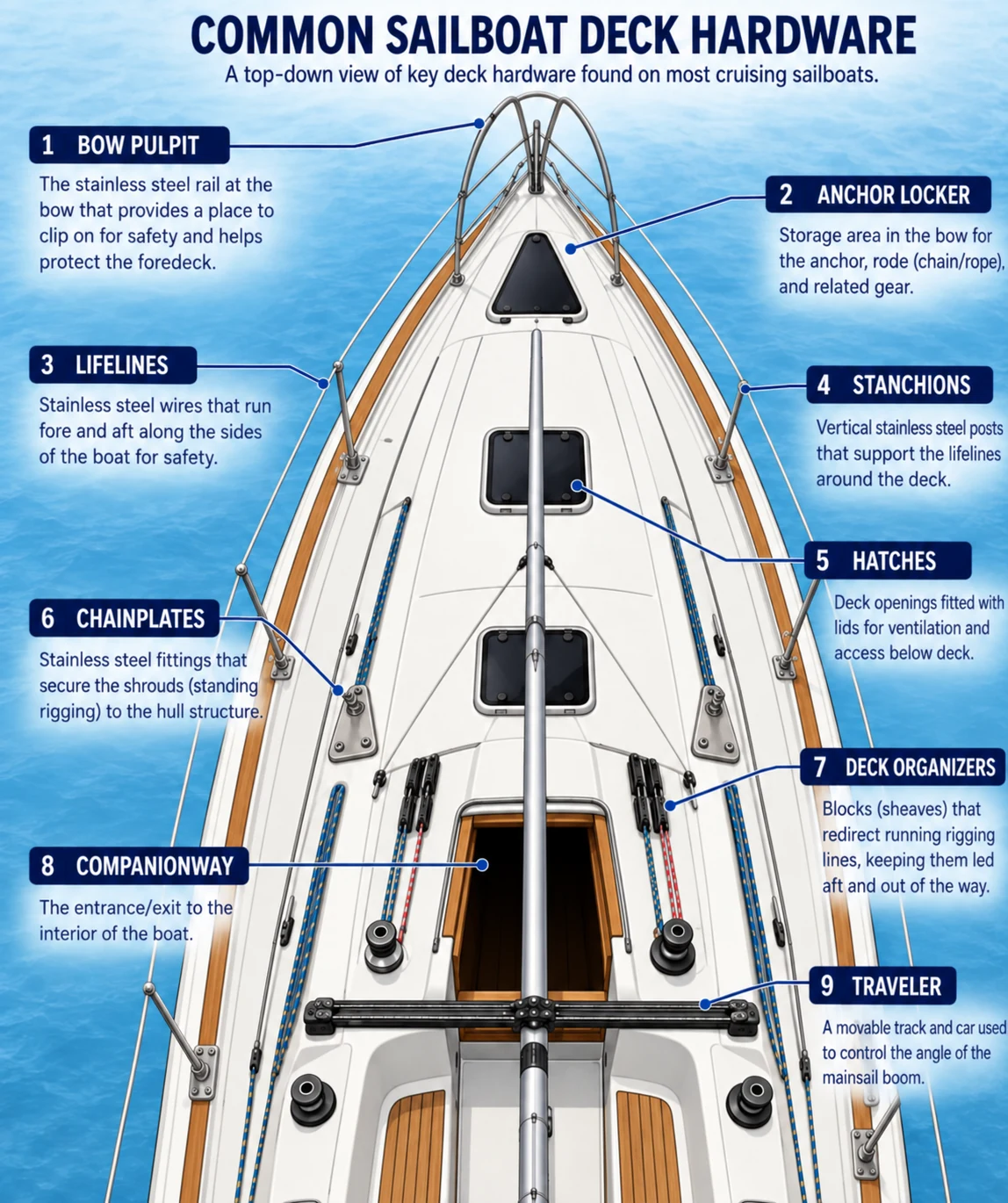
Common Deck Hardware
As you move around a sailboat, you’ll notice numerous fittings mounted permanently to the deck.
Each one has a specific purpose, and together they help organize lines, improve safety, and make the boat easier to operate.
Here are some of the most common pieces of deck hardware you’ll encounter.
Bow Pulpit
A sturdy metal rail at the bow that provides protection and support when working near the front of the boat.
Stern Rail
A protective rail surrounding the stern that helps prevent crew from falling overboard.
Lifelines
Strong stainless-steel cables running along both sides of the deck between the bow and stern rails.
They provide a safety barrier while moving around the boat.
Stanchions
The vertical posts that support the lifelines.
Hatches
Openings in the deck that provide light, ventilation, and access to the cabin below.
Companionway
The main entrance between the cockpit and the cabin.
Most companionways can be closed using sliding hatches and removable companionway boards.
Anchor Locker
A storage compartment near the bow designed to hold the anchor and its rode.
Keeping the anchor in its own compartment helps keep the deck uncluttered and ready for use.
Chainplates
Heavy-duty metal fittings that connect the standing rigging to the hull.
They transfer enormous loads from the mast safely into the structure of the boat.
Deck Organizers
Small pulleys mounted on deck that guide control lines neatly from the mast toward the cockpit.
They reduce friction and help keep lines organized.
Traveler
The traveler is a movable track that allows the attachment point of the mainsheet to slide from side to side.
Beginners don’t need to master the traveler immediately, but it’s useful to recognize it as another control that fine-tunes mainsail trim.
Beginner Tip
Don’t feel pressured to memorize every piece of deck hardware before your first sail.
Most beginning sailors spend the majority of their time using just a few controls: the helm, mainsheet, jib sheets, and occasionally the halyards.
The rest will become familiar naturally as your experience grows.
Key Takeaways
The controls are what allow you to communicate with the boat.
The helm steers the rudder.
The mainsheet controls the boom and mainsail.
The jib sheets adjust the headsail.
The halyards raise and lower the sails.
The winches provide the leverage needed to tension heavily loaded lines.
The cleats secure those lines once they’re adjusted.
Finally, the various pieces of deck hardware help organize the boat, support the rig, and keep the crew safe.
By this point, you know the names of nearly every major part you’ll encounter on a typical recreational sailboat. In the final section, we’ll bring all of these systems together, explore how they work as one, review the key concepts, answer common beginner questions, and test your knowledge with a short quiz.
Part 5 – Bringing It All Together
By now, you’ve toured a sailboat from bow to stern.
You’ve learned about the hull, the rig, the sails, the controls, and the deck hardware. More importantly, you’ve seen that a sailboat isn’t just a collection of unrelated parts—it is a carefully designed system where every component has a purpose.
At first, sailing terminology can seem overwhelming. But if you’ve followed this guide from the beginning, you’ve already built a solid foundation. You now understand the language that sailors use every day, and that vocabulary will make every lesson that follows much easier to understand.
Before we finish, let’s step back and see how all of these parts work together to move a sailboat safely and efficiently through the water.
How All the Parts Work Together
Imagine standing at the dock on a breezy afternoon.
The sails are lowered.
Nothing moves.
The boat simply floats.
Now imagine raising the sails.
As the wind begins flowing over them, the entire boat comes alive.
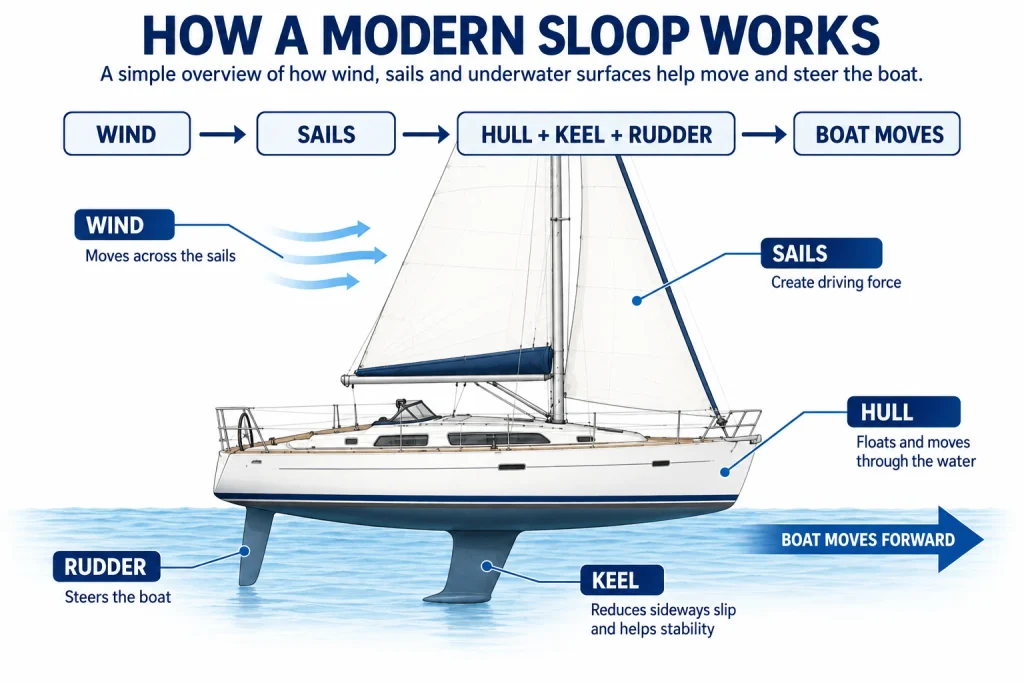
The sails generate aerodynamic force.
That force is transferred into the mast and boom.
The standing rigging keeps the mast upright while the running rigging allows the skipper to adjust the sails for the changing wind.
The hull supports everything above the water.
Below the surface, the keel resists sideways movement while helping keep the boat upright.
Finally, the rudder allows the skipper to steer.
Each part depends on the others.
Remove any one of these major systems, and the sailboat can no longer function as intended.
This systems approach is one of the biggest mindset shifts for new sailors.
Rather than memorizing fifty separate parts, think about how each one contributes to moving the boat.
When you begin learning sail trim, docking, or boat handling, you’ll already understand where each part fits into the bigger picture.
Common Beginner Mistakes
Every new sailor makes mistakes.
In fact, making mistakes is one of the fastest ways to learn.
Here are some of the most common misunderstandings—and how to avoid them.
Calling the Bow “the Front”
Everyone knows what you mean.
But sailors almost always say bow instead of front.
Likewise, they say stern instead of back.
Using the proper terms makes communication much clearer, especially when people are working in different parts of the boat.
Using Left and Right Instead of Port and Starboard
This is probably the most common beginner habit.
Remember:
- Port = left
- Starboard = right
Unlike left and right, these terms never change regardless of which direction you’re facing.
Thinking Every Rope Is Just a Rope
You’ll often hear sailors say:
“There are no ropes on a sailboat.”
That’s not entirely true.
While a few ropes retain that name (such as the anchor rode or bolt rope), most working ropes have specific names based on their job.
For example:
- Halyards raise sails.
- Sheets control sails.
- Dock lines secure the boat.
Learning these names helps you understand instructions more quickly.
Confusing the Mainsail and the Headsail
The mainsail is attached to the mast and boom.
The headsail sits forward of the mast.
A quick glance at the mast will tell you which sail is which.
Thinking the Rudder Keeps the Boat Upright
The rudder’s job is steering.
The keel provides most of the boat’s stability.
This is one of the biggest misconceptions among people who have never sailed before.
Trying to Memorize Everything
You don’t need to become fluent in sailing vocabulary after reading one article.
Experienced sailors didn’t learn it all in a day either.
Instead, focus on recognizing the major systems.
The details will become familiar every time you step aboard.
Remember
Sailing isn’t about memorizing dozens of terms.
It’s about understanding how the pieces fit together.
Once you understand the system, the vocabulary becomes much easier to remember.
Quick Reference Table
The following table summarizes the most important parts of a sailboat and their primary functions.
| Part | What It Does | Think of It As |
|---|---|---|
| Hull | Floats and supports the boat | The body |
| Mast | Supports the sails | The backbone |
| Boom | Supports the bottom of the mainsail | A horizontal arm |
| Keel | Provides stability and reduces sideways drift | An underwater fin |
| Rudder | Steers the boat | An underwater steering wheel |
| Mainsail | Provides much of the boat’s power | The primary engine |
| Headsail (Jib/Genoa) | Adds power and improves efficiency | The front sail |
| Halyards | Raise and lower sails | Elevator cables |
| Sheets | Adjust sail angle | Steering controls for the sails |
| Winches | Multiply pulling force | Sailing’s gearbox |
| Cleats | Secure lines | Rope anchors |
Review
Congratulations!
You’ve just learned one of the most important foundations of sailing.
Before moving on to more advanced topics, let’s review the big ideas.
Key Takeaways
- Every sailboat is made up of systems that work together.
- The hull floats the boat and supports everything else.
- The rig supports and controls the sails.
- The sails capture the wind and generate power.
- The keel provides stability and reduces sideways drift.
- The rudder steers the boat.
- The controls allow the skipper to adjust the sails and steer the boat.
- Learning these parts makes every future sailing lesson easier to understand.
Once these concepts become familiar, you’ll find yourself recognizing the parts of sailboats in marinas, books, videos, and on the water.
Knowledge Check
See how many of these questions you can answer without looking back.
- What is the main body of a sailboat called?
- What is the front of a sailboat called?
- What is the difference between port and starboard?
- What are the three major systems found on almost every sailboat?
- What is the purpose of the keel?
- Which part of the boat is used for steering?
- What is the difference between standing rigging and running rigging?
- Which sail is attached to both the mast and the boom?
- What is the purpose of a halyard?
- Why do sailors use specific names like sheet and halyard instead of simply saying rope?
Challenge Yourself: If you can confidently answer eight or more of these questions, you’ve built an excellent foundation for the rest of your sailing education.
Frequently Asked Questions
What are the main parts of a sailboat?
Every sailboat can be understood as three major systems: the hull, the rig, and the sails. Within those systems are important components such as the mast, boom, keel, rudder, cockpit, standing rigging, and running rigging.
What is the front of a sailboat called?
The front of a sailboat is called the bow. The back is called the stern.
What is the difference between a mast and a boom?
The mast is the tall vertical spar that supports the sails, while the boom is the horizontal spar attached to the mast that supports the bottom edge of the mainsail.
Why does a sailboat have a keel?
The keel provides ballast to improve stability and helps prevent the boat from sliding sideways as the wind pushes against the sails.
What is the purpose of the rudder?
The rudder steers the sailboat by redirecting the flow of water beneath the stern.
Related Reading: Steering a Sailboat
Are ropes on a sailboat really called ropes?
Some are, but most working ropes are given names based on their function. For example, halyards raise sails, sheets adjust sails, and dock lines secure the boat.
What is standing rigging?
Standing rigging consists of the fixed wires that support the mast, including the forestay, backstay, and shrouds.
What is running rigging?
Running rigging refers to the movable lines used to raise, lower, and adjust the sails, including halyards and sheets.
Do all sailboats have the same parts?
No. Sailboats vary in size and design, but almost all have the same basic systems: a hull, a rig, sails, steering controls, and some form of keel or centerboard.
Where to Go Next
Now that you’re familiar with the anatomy of a sailboat, you’re ready to begin learning how those parts work together under sail.
The structured course continues with Lesson 2, Basic Sailing Terminology, which introduces the directional and operational language used throughout the lessons that follow.
Final Thoughts
Every experienced sailor once stood exactly where you are now—trying to remember which end was the bow, wondering why sailors said port instead of left, and feeling like there were far too many new words to learn.
The good news is that you don’t need to know everything before you go sailing.
You only need a solid foundation.
That’s exactly what you’ve built in this guide.
The next time you step aboard a sailboat, you’ll no longer see a confusing collection of ropes, wires, and equipment. You’ll recognize a series of systems working together, each with a clear purpose. And as your experience grows, those names won’t just be vocabulary—they’ll become familiar tools that help you sail with greater understanding and confidence.