

Estimated read time for full article: 12–15 minutes
A sailboat can do something that seems impossible the first time you think about it: it can travel across the wind and even make progress toward the direction the wind is coming from. If the wind were simply pushing the sails from behind, neither should be possible.
That puzzle is the best place to begin. Sails do sometimes behave a little like parachutes, especially when sailing well downwind. However, much of sailing depends on something more interesting. A properly shaped sail interacts with moving air, creating an aerodynamic force. The keel or centreboard then resists much of the boat’s sideways motion. Together, the parts above and below the water turn wind energy into controlled movement.
You do not need an engineering degree to understand this. Instead, you need a useful mental model that explains what you can actually see and feel aboard the boat.
By the end of this lesson, you should be able to connect this chain:
apparent wind → airflow → aerodynamic force → sail angle and shape → keel resistance → boat motion → feedback → trim adjustment
The Beginner Question: How Can Wind Make a Sailboat Move?
Imagine holding a large sheet in a breeze. If you face it squarely into the wind, the wind pushes it away from you. That is easy to understand. A sailboat running downwind can use a similar effect: the sails present area to the wind and the boat is driven generally in the same direction the air is moving.
Now turn the boat sideways to the wind. It can still sail. Turn it farther, so the bow points partly toward where the wind is coming from, and it can still sail. Clearly, “the wind pushes the boat” is not a complete explanation.
The missing idea is that a sail is not merely a cloth wall. When properly trimmed, it is a curved aerodynamic surface. Air moves around it, pressure varies around it, and the sail redirects the airflow. As a result, the sail experiences a force that can be separated into useful components.
If you need a refresher on the basic relationship between boat heading and wind direction, review SailboatZone’s Points of Sail Explained. That lesson names the different courses; this one explains why the sails can work on them.
Beginner Tip: Do not try to picture the wind as a hand pushing the boat in one direction. Picture air flowing around a shaped sail while the boat’s underwater surfaces resist sideways movement.
Start With the Wind the Sail Actually Feels
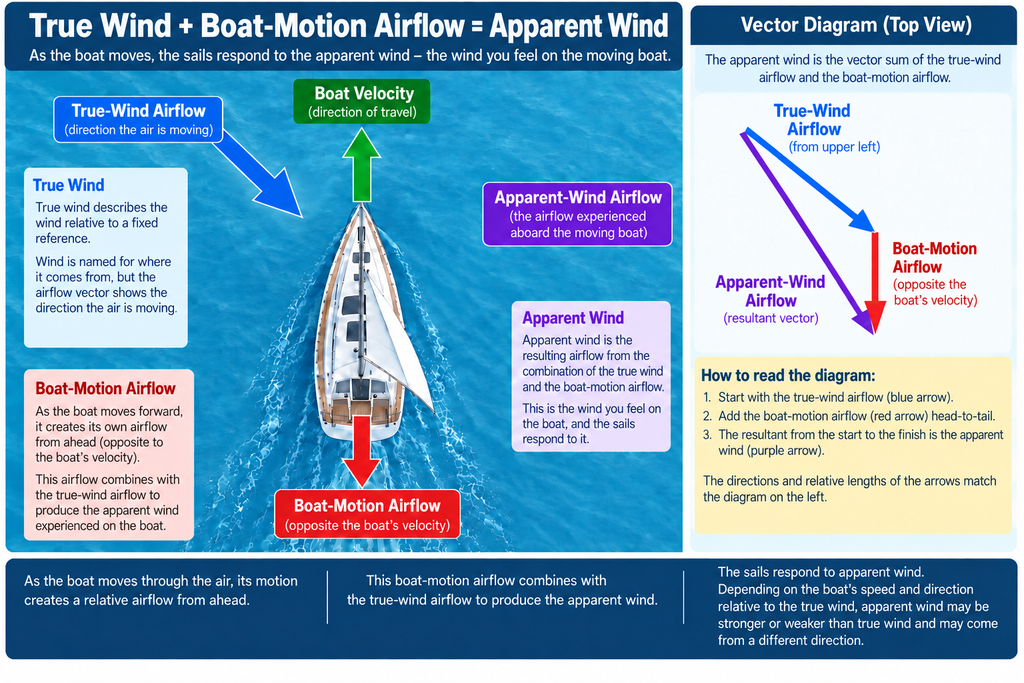
Before discussing lift, there is one important complication: the sail responds to the air moving past it, not simply to the wind reported by a weather station.
True wind describes the wind relative to a fixed reference, while apparent wind is the wind experienced aboard the moving boat. For practical sailing, apparent wind combines the effect of the true wind with the boat’s own motion. Therefore, when the boat changes speed or direction, the apparent wind experienced by the sails can change even if the true wind itself remains steady.
For example, ride a bicycle on a calm day and you feel air coming from ahead. The atmosphere did not suddenly develop a headwind; your motion created the relative airflow you feel. Likewise, a moving sailboat changes the wind experienced by its sails.
Therefore, a change in boat speed can change apparent wind even when the true wind stays constant. A change in course can do the same thing. This is one reason sail trim is never a set-it-and-forget-it job.
Learner Checkpoint: The sail works in the apparent wind it experiences. If the boat changes speed or direction, the airflow over the sail can change even when the true wind does not.
A Sail Is an Aerodynamic Surface
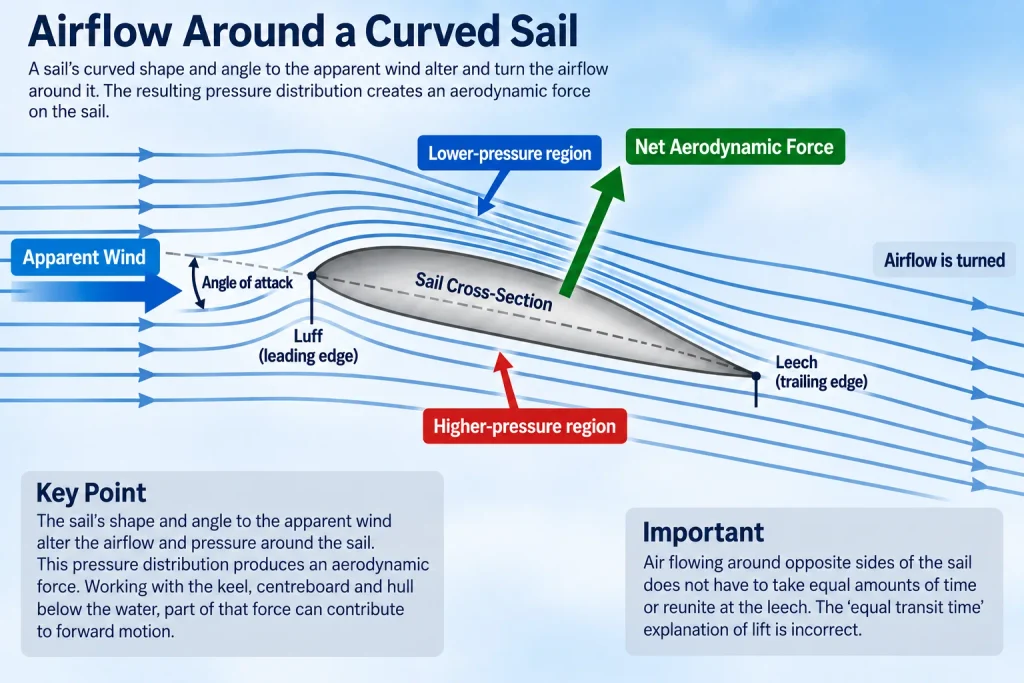
Look at a well-trimmed sail from above and it is not flat. It has curvature, often called draft or depth. Air approaching the sail is guided around both sides of that curved surface. The pressures around the sail are not equal, and the sail also changes the direction of the moving air. Together, these effects create a net aerodynamic force.
This is where explanations can become unnecessarily confusing. You may have heard that two particles of air split at the front of an airfoil and must meet again at the back. They do not. That so-called equal-transit-time explanation is misleading.
For a deeper look at the physics, NASA’s Glenn Research Center explains that lift is a mechanical aerodynamic force and also warns that several popular explanations of lift are incorrect. For sailors, the useful lesson is simpler: sail shape, angle and airflow all matter.
Although aircraft wings and sails operate in different orientations and circumstances, the same broad aerodynamic language is useful. The sail experiences one overall force caused by its interaction with the airflow.
Lift and Drag: What the Forces Actually Mean
Aerodynamicists often describe the overall force by splitting it into two components: lift and drag. Lift acts perpendicular to the incoming airflow. Drag acts generally parallel to it.
That distinction is not just sailing shorthand. NASA’s overview of aerodynamic forces defines lift and drag as components of a single net aerodynamic force relative to the flow direction.
A common beginner mistake is to imagine lift as the part that always points toward the bow. It does not. Likewise, drag is not simply a braking force pointing astern. Their directions are defined relative to the airflow. What matters to the sailor is how the total sail force is oriented relative to the boat.
Change the sail’s angle to the apparent wind and you change that force. Change the sail’s shape and you change it again. Therefore, the sheet is doing more than moving a piece of cloth in or out; it is helping establish the sail’s working angle and shape.
Why the Boat Does Not Simply Slide Sideways
At this point you may notice a problem. When sailing across or toward the wind, much of the aerodynamic force from the sails is directed sideways. Why does the whole boat not simply skid sideways across the water?
The answer is below the surface.
The keel or centreboard does more than simply block sideways movement. As the boat moves forward with a small amount of leeway, water flows around the underwater foil at an angle, creating a hydrodynamic force that strongly opposes the sideways component of the sail force. The hull also contributes resistance, while the rudder helps control direction. None of these effects eliminates sideways motion completely, so a sailing boat normally makes some leeway.
If these underwater parts are still unfamiliar, SailboatZone’s Parts of a Sailboat: Complete Beginner’s Guide will help you identify the keel, rudder and other major components before you continue.
This is the conceptual turning point: the sails do not propel the boat by themselves. The rig above the water and the hull and foils below the water work as a system.
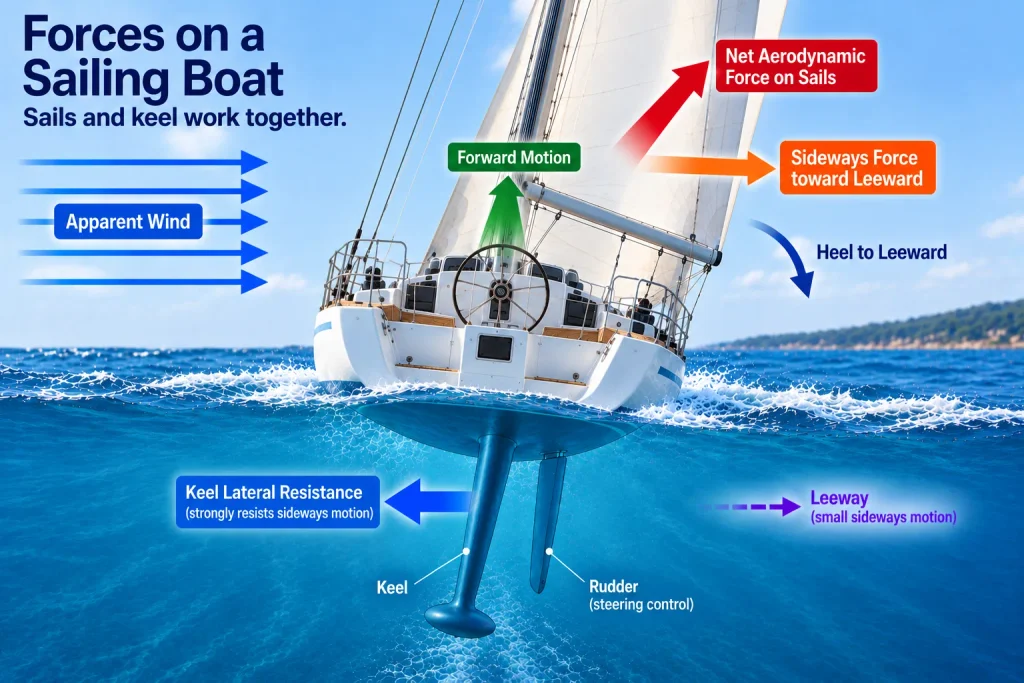
Key Takeaway: A sailboat’s ability to travel across and toward the wind depends on aerodynamic force from the sails working together with hydrodynamic forces from the keel or centreboard, hull and rudder. The boat is an air-and-water system, not a sail working alone.
How Those Forces Produce Forward Motion
Now put the two halves together. The sail’s aerodynamic force already contains a component in the boat’s forward direction as well as a substantial sideways component. Meanwhile, the keel, centreboard and hull develop hydrodynamic forces that strongly oppose lateral motion. The combined aerodynamic and hydrodynamic force balance allows the boat to move mostly forward rather than simply sliding sideways.
This does not mean the keel somehow turns sideways force into forward force like a gearbox. Instead, the boat is simultaneously interacting with two fluids: air above the water and water below it. Each interaction produces forces, and the resulting balance determines how the boat actually moves.
Fortunately, you do not need to calculate vectors while sailing. You only need to understand what the diagram represents: the direction of the wind does not have to match the direction of travel.
Why a Sailboat Cannot Sail Directly Into the Wind
If sails can generate aerodynamic force, why not point the bow straight into the wind and keep going?
Because a normally rigged sailing boat needs a useful angle between the sail and the apparent wind. As the bow turns too close to the wind, the sails can no longer maintain the same useful flow and driving force. They begin to luff, the boat slows, and steering becomes less effective.
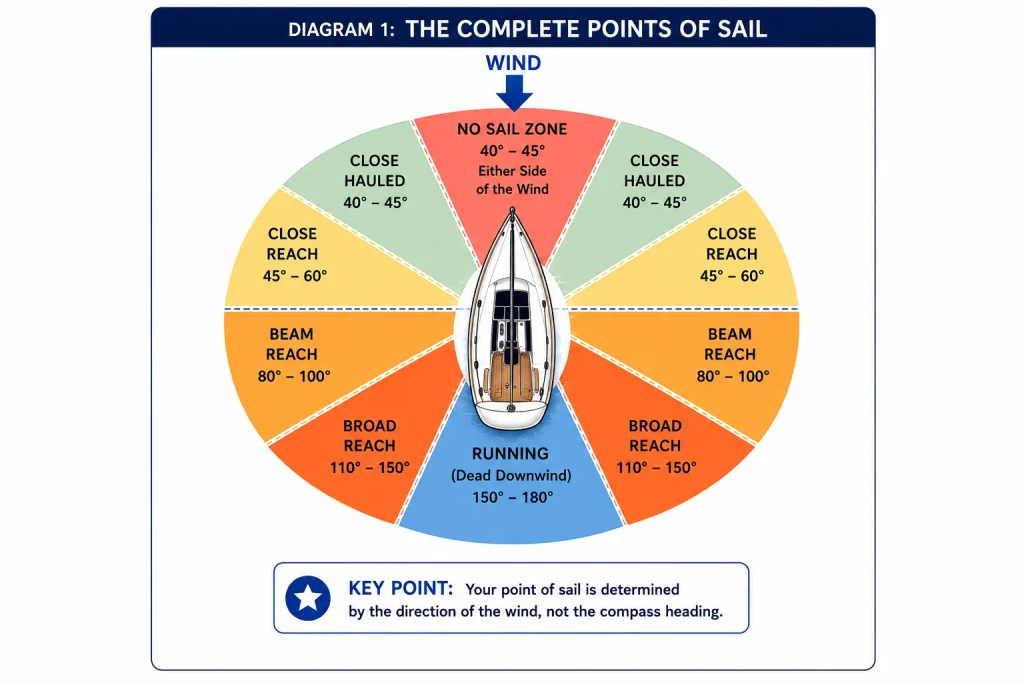
The region around the wind direction where a boat cannot maintain normal sailing progress is commonly called the no-go or no-sail zone. Its width varies with boat design, sails, wind strength, sea state and other conditions. Performance-oriented boats may sail closer to the wind than some cruising or training boats, so there is no single angle that applies to every sailboat.
SailboatZone’s How to Sail Upwind shows how sailors solve this problem in practice: sail close-hauled on one tack, tack through the wind, and continue on the other tack to work toward an upwind destination.
How Sail Shape Changes the Force
Sail position is only part of the story. Shape matters too.
Draft is the depth or fullness of the sail’s curved shape. A fuller sail and a flatter sail interact with the airflow differently. Draft position describes where the deepest part of that curve lies. Twist describes how the sail’s angle changes from bottom to top. The luff is the leading edge, while the leech is the trailing edge.
Then there is angle of attack: broadly, the angle at which the airflow meets the sail. Change course, sheet tension or other sail controls and that relationship changes.
For a beginner, the goal is not to master every tuning control today. Instead, notice the cause-and-effect relationship. A sail is a three-dimensional adjustable surface. Pulling on a control may change its position, its shape, or both.
That is why SailboatZone’s How to Trim a Sail emphasizes watching the sail rather than simply pulling harder on a rope.
Attached Flow, Separation and Stall
When airflow follows the sail smoothly, we describe much of that flow as attached. However, if the sail is presented at an unsuitable angle, portions of the flow can separate from the surface. If separation becomes substantial, the sail can stall and its useful force can fall sharply.
This explains a classic beginner surprise. Pulling a sail tighter can make the boat heel more without making it faster. The sail may look impressively full, yet its angle to the airflow may be poor. In contrast, easing the sheet slightly can restore better flow and the boat may accelerate.
What Telltales Reveal About Airflow
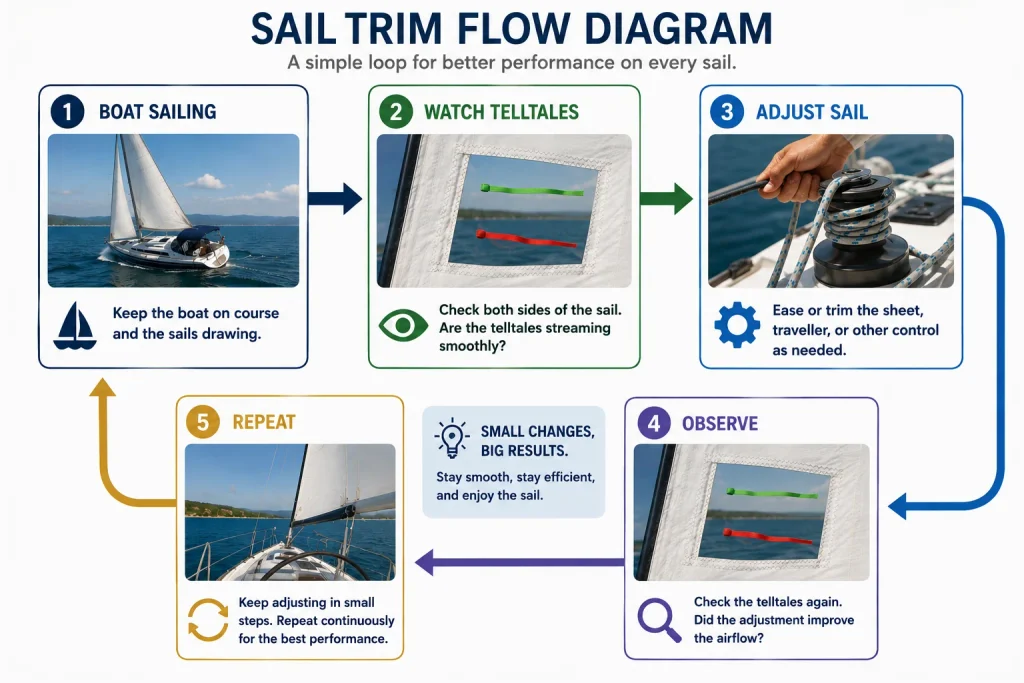
Air is invisible, which makes sail trim harder to learn by sight alone. Fortunately, telltales give you clues. These small pieces of yarn or ribbon respond to the local airflow around the sail.
When telltales stream smoothly, they often indicate relatively orderly local flow. When one lifts, dances or disappears behind the sail, the airflow on that side may be changing or separating. However, telltales are indicators, not magic traffic lights. Their meaning depends on where they are located and the point of sail.
For now, remember the purpose: telltales make invisible airflow partly visible. The dedicated telltale lesson can teach you how to use them for actual trimming.
How the Mainsail and Jib Work Together
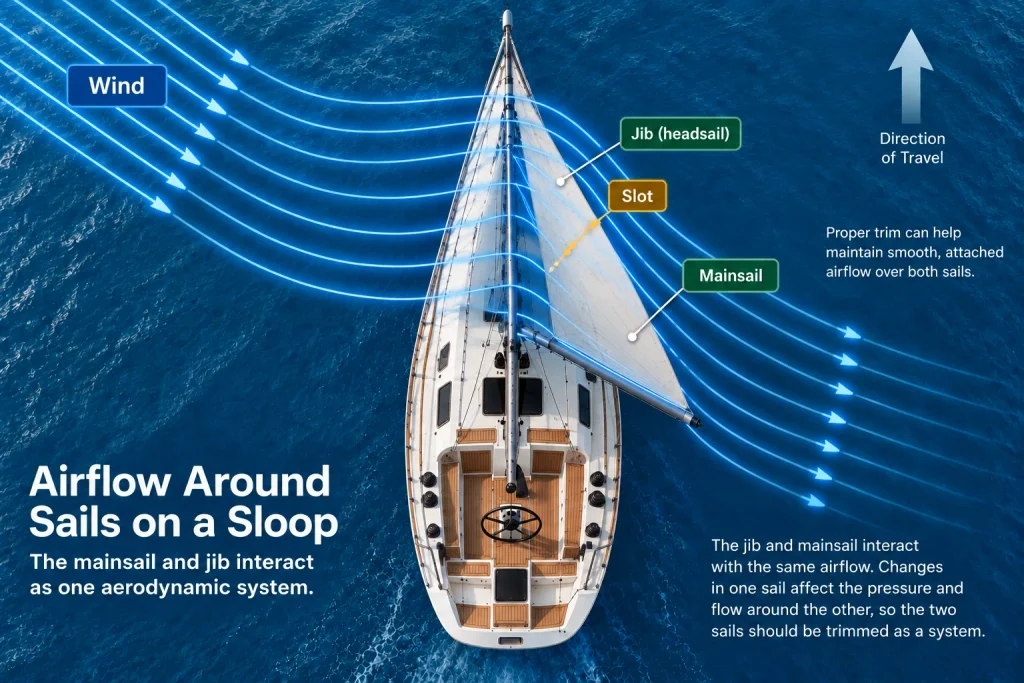
On a sloop, the mainsail and jib are not two unrelated engines. Airflow around one affects the flow field around the other. Their combined shapes, positions and spacing influence the overall aerodynamic system.
You may encounter a simplified claim that the narrow slot between the jib and mainsail merely “speeds up the air” and therefore creates extra lift. The real interaction is more complicated. Fortunately, beginners do not need to solve it mathematically.
The practical lesson is that changing one sail can affect how the other behaves. Therefore, trim the rig as a system rather than assuming each sail can always be perfected independently.
How Sail Forces Change Around the Points of Sail
As the boat changes course relative to the wind, the sails must change too. Close-hauled, the sails are generally trimmed relatively close to the centreline. On a close reach they ease somewhat. On a beam reach they ease farther. On a broad reach and run, they are normally eased much farther out.
Meanwhile, the character of the airflow changes. Upwind and reaching, aerodynamic lift is especially important. Farther downwind, drag becomes increasingly significant, and on a run the sails can behave more like surfaces being driven from behind.
The transition is not an on/off switch. Lift and drag are components of the same overall aerodynamic force, and both can be present. Instead of memorizing a separate theory for every point of sail, keep asking the same question: what apparent wind is the sail experiencing, and is the sail positioned and shaped appropriately for it?
For a practical example, SailboatZone’s How to Sail a Beam Reach applies this relationship on one of the easiest and most useful courses for a beginner.
Why Sail Trim Matters
Sail trim is where all this theory becomes useful. The working loop is simple:
wind changes → apparent wind changes → required sail angle or shape changes → sailor trims → boat responds
If the sail is too loose for the course, the luff may flutter and the boat may lose drive. If it is too tight, the sail can be over-trimmed, creating unnecessary heel or poor airflow. Correct basic trim lies between those extremes and changes continuously with course and conditions.
For example, suppose you bear away from a close reach toward a beam reach but leave the sheets untouched. The sails are now likely too tight for the new apparent-wind angle. Ease them and watch what happens. Likewise, if you head up, you will generally need to trim in.
What the Beginner Should Feel on the Boat
Good sailors do not stare at diagrams while underway. They learn to feel the result.
A well-trimmed boat may accelerate and settle into a steady groove. Poor trim may produce luffing, slowing, excessive heel or heavier pressure on the helm. A gust may increase heel and weather helm. A badly overpowered boat can feel loaded and difficult even though the sails appear full.
Because several causes can produce similar symptoms, avoid diagnosing from one clue alone. Look at sail shape, telltales, boat speed, heel, heading and helm feel together. Over time, these clues become a conversation between the boat and the sailor.
Common Beginner Misconceptions About How Sails Work
“The wind just pushes the sail.” That is only part of the downwind picture. Across and toward the wind, the sail acts as an aerodynamic surface.
“More heel means more speed.” Extra heel may mean extra load, not useful speed. Too much heel can increase drag and reduce control.
“Tighter sails always create more power.” Over-trimming can worsen airflow and create heel without useful drive.
“Lift always points forward.” Lift is defined relative to the airflow, not the bow.
“The keel only prevents capsizing.” A keel or centreboard also resists lateral motion through the water.
“A full sail must be correctly trimmed.” A sail can look full while being over-trimmed or partly stalled.
“Air must meet again at the leech.” There is no equal-transit-time rule requiring air to reunite at the trailing edge.
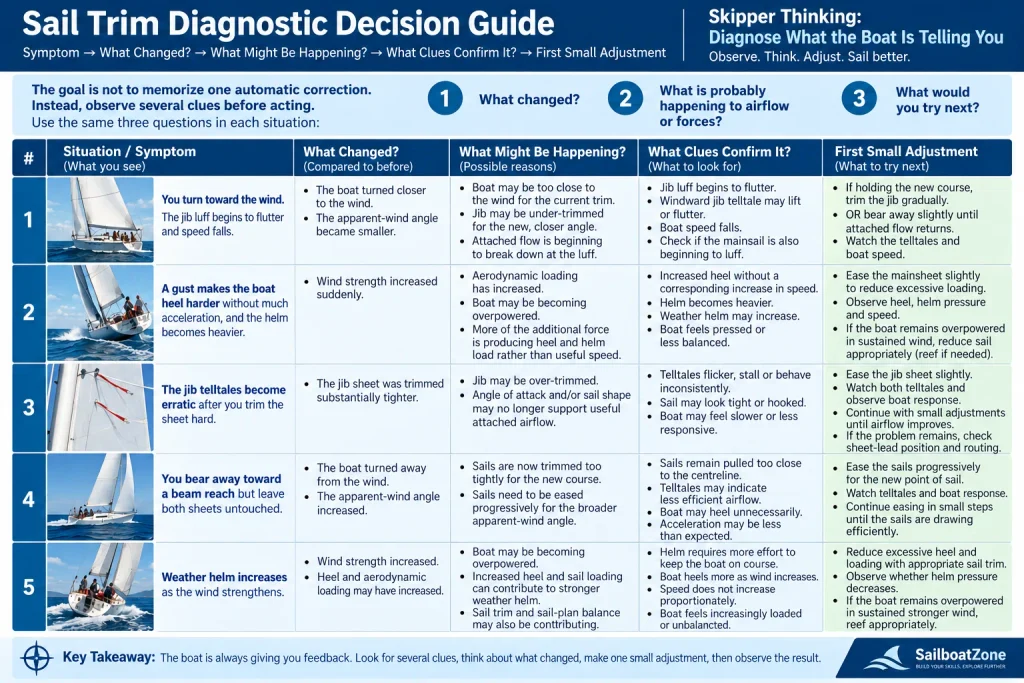
Skipper Thinking: Diagnose What the Boat Is Telling You
Use the same three questions in each situation: What changed? What is probably happening to airflow or forces? What would you try next?
1. You turn toward the wind. The jib luff begins to flutter and speed falls.
2. A gust makes the boat heel harder without much acceleration, and the helm becomes heavier.
3. The jib telltales become erratic after you trim the sheet hard.
4. You bear away toward a beam reach but leave both sheets untouched.
5. Weather helm increases as the wind strengthens.
The goal is not to memorize one automatic correction. Instead, observe several clues before acting.
From Understanding Sails to Actually Trimming Them
The complete model is now straightforward: apparent wind meets a shaped sail; airflow creates aerodynamic force; the keel and hull resist sideways movement; the boat responds through speed, heel, leeway and helm feel; then the sailor observes and adjusts.
Next, apply that model in How to Trim a Sail: Master the Basics of Sail Trim.
Knowledge Check
10. Why is it better to diagnose sail trim using several clues – such as telltales, sail shape, speed, heel and helm feel – rather than relying on one clue alone?
9. You bear away from a close reach toward a beam reach without changing the sheets. What has changed about the apparent-wind angle, and what would you generally do with the sails?
8. A boat heels harder after the sails are pulled in tightly, but it does not accelerate. What might be happening, and what simple trim change could you test?
7. What can happen when airflow separates substantially from a sail and the sail begins to stall?
6. What is the difference between a fuller and flatter sail, and why can sail shape affect the force the sail produces?
5. Why can a sailboat make progress toward an upwind destination but not normally sail directly into the wind?
4. How does a keel or centreboard help a sailboat make forward progress instead of simply sliding sideways?
3. How are lift and drag defined relative to the incoming airflow?
2. What is apparent wind, and why can it change when the boat changes speed or direction even if the true wind stays steady?
1. Why is “the wind pushes the sails” an incomplete explanation of how a sailboat moves across or toward the wind?
Summary
Sails are adjustable aerodynamic surfaces working in apparent wind. Their lift and drag combine into an overall aerodynamic force. Meanwhile, the keel or centreboard develops hydrodynamic force as water flows around it, while the hull and rudder also contribute to the boat’s motion and control. Together, these air-and-water forces allow the boat to make useful forward progress while limiting sideways motion. Sail angle and shape influence airflow, while telltales, speed, heel and helm feel provide feedback. Therefore, good sailing becomes a continuous cycle: observe, adjust, and observe again.
Quiz
1. Which wind does a moving sail respond to most directly?
A. Forecast wind B. Apparent wind C. Current direction D. Magnetic north
2. Lift is the component of aerodynamic force that acts:
A. Perpendicular to the incoming airflow B. Always toward the bow C. Straight upward D. Parallel to the keel
3. What is the most accurate beginner description of the keel or centreboard’s role when sailing across the wind?
A. It only adds ballast B. It develops hydrodynamic force that strongly opposes lateral motion C. It pulls the boat forward like a propeller D. It eliminates all leeway
4. What normally happens as a sailboat points too close to the wind?
A. The sails gain unlimited power B. The sails begin to luff and useful drive falls C. The keel stops producing any force D. Apparent wind disappears
5. Which statement about the no-go zone is most accurate?
A. It is exactly 45 degrees for every sailboat B. It varies with the boat, sails and conditions C. It exists only in strong wind D. Cruising boats do not have one
6. A sail can look full yet still perform poorly because:
A. Full sails cannot create lift B. It may be over-trimmed or experiencing separated airflow C. Telltales create drag D. The keel is too deep
7. What do telltales primarily help a sailor observe?
A. Local airflow around the sail B. Water depth C. Compass error D. Hull speed limits
8. You bear away from a close reach toward a beam reach. What will you generally need to do?
A. Ease the sails B. Trim the sails tighter C. Head into the no-go zone D. Stop the boat
9. Why can a sailboat make forward progress while much of the sail force is sideways?
A. The rudder pulls the boat forward B. Aerodynamic and hydrodynamic forces work together, with underwater surfaces strongly opposing lateral motion C. Wind always pushes from directly astern D. The mast converts sideways force into thrust
10. What is the best beginner habit when diagnosing poor sail trim?
A. React to one clue immediately B. Pull every sheet tighter C. Observe sail shape, telltales, speed, heel, heading and helm feel together D. Ignore boat feel and watch only the sail
Quiz Answer Key
1. B – Apparent wind
2. A – Perpendicular to the incoming airflow
3. B – It develops hydrodynamic force that strongly opposes lateral motion
4. B – The sails begin to luff and useful drive falls
5. B – It varies with the boat, sails and conditions
6. B – It may be over-trimmed or experiencing separated airflow
7. A – Local airflow around the sail
8. A – Ease the sails
9. B – Aerodynamic and hydrodynamic forces work together
10. C – Observe several clues together
Scoring Guide
9-10 correct: Excellent. You have a strong working model of how sails create useful force and are ready to apply it to practical sail trim.
7-8 correct: Good. You understand the main ideas. Review any missed questions before moving on.
5-6 correct: Developing. Revisit apparent wind, lift and drag, hydrodynamic force, stall and the trim feedback loop.
0-4 correct: Review recommended. Read the lesson again slowly and use the diagrams to rebuild the air-and-water force model before continuing.