
Estimated read time for full article: 8–10 minutes
Introduction: Why Sail Trim Matters
Every sailboat depends on properly trimmed sails to move efficiently through the water. Although beginners often focus on steering, experienced sailors know that good sail trim has an even greater influence on speed, comfort, balance, and control. Simply put, sail trim means adjusting the sails so they work with the wind instead of against it.
Fortunately, sail trim is not as complicated as it first appears. You do not need to memorize dozens of techniques before your first sail. Instead, you only need to understand one simple idea: as the wind or your direction changes, the sails must change too. If you want greater understanding of these concepts, immerse yourself in our article on Basic Sailing Terminology.
By the end of this article, you will understand what sail trim is, how to recognize when the sails need adjustment, and how to make small, confident corrections while sailing.
Quick Takeaways
• Sail trim means adjusting the sails to match the wind.
• Small adjustments usually work better than large ones.
• Watch the sails, not just the ropes.
• Good sail trim improves speed, comfort, and steering.
• Sail trim is an ongoing process, not a one-time setup.
What Does ‘Trim a Sail’ Mean?
The word ‘trim’ simply means to adjust. In sailing, trimming a sail means changing its position until it captures the wind efficiently. Sometimes that means pulling the sail closer to the center of the boat. At other times, it means easing it farther out.
A helpful way to picture this is to imagine holding your hand out the window of a moving car. A slight change in angle dramatically changes how the air pushes on your hand. Likewise, even a small adjustment to a sail can noticeably change how the boat feels.
Therefore, trimming a sail is not about pulling every rope as tight as possible. Instead, it is about finding the position where the sail works best for the current conditions. To better understand sail position and terminology, see our article Parts of a Sail.
Beginner Tip
Look at the sail before touching any line. The sail tells you far more than the rope does.
Internal Link Opportunities
• Parts of a Sail
• How Sails Work
• Basic Sailing Terminology
The One Rule of Sail Trim
If you remember only one lesson from this article, remember this: match the sail to the wind.
Whenever the boat changes direction, the sails usually need to change with it. Likewise, if the wind becomes stronger, weaker, or shifts direction, the sails may also need adjustment. Good sailors constantly make small corrections instead of waiting until something feels wrong.
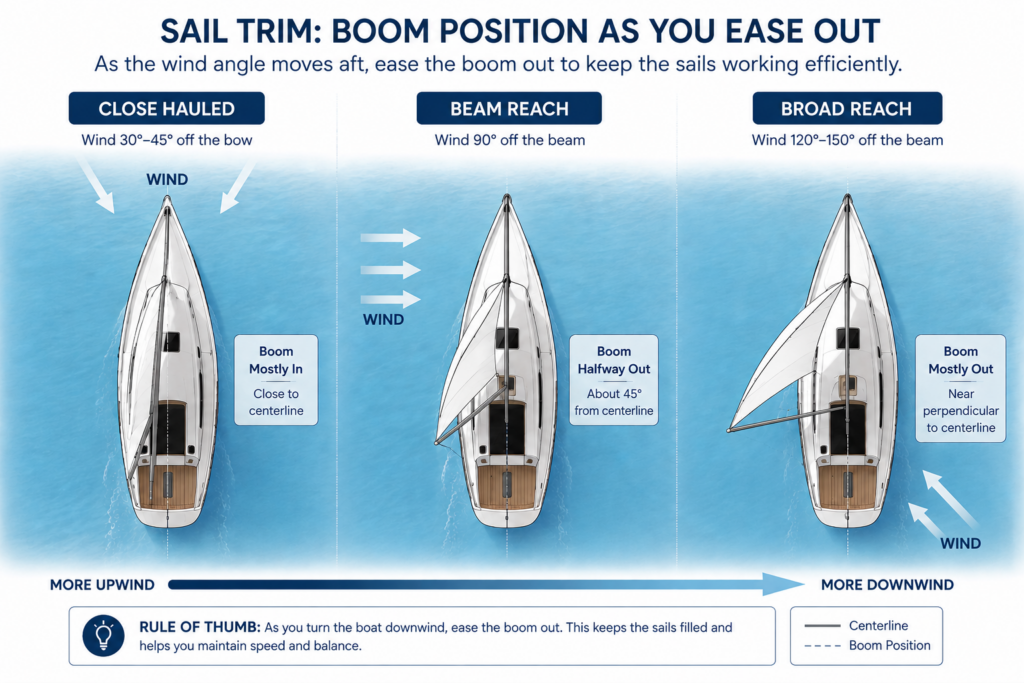
For example, imagine sailing on a beam reach before gradually turning toward the wind. As the boat points closer to the wind, the sails should be trimmed in. On the other hand, if you bear away onto a broad reach, the sails should be eased farther out. For better clarity on what these sailing terms mean, see out article on Sailing Terminology.
Because the wind is always changing, sail trim is never truly finished. Instead, think of it as a continuous conversation between you, the wind, and the boat.
Common Beginner Mistake
Many beginners set the sails once and leave them alone. However, good sail trim requires frequent, small adjustments throughout the sail. This is covered in much better detail in our article How to Sail a Sailboat.
Learner Checkpoint
At this stage you should understand what sail trim means, why it matters, and why the sails must be adjusted whenever the wind or the boat’s direction changes.
Internal Link Opportunities
• Points of Sail Explained
How to Know When the Sail Needs Trimming
Now that you understand what sail trim is, the next step is learning how to recognise when an adjustment is needed. Fortunately, the sails provide constant feedback. Rather than guessing, you can simply observe what the sail and the boat are telling you.
First, make a habit of looking at the sail every few seconds. Meanwhile, pay attention to how the boat feels through the helm. Over time, these observations become second nature.
Signs the Sail Is Too Loose
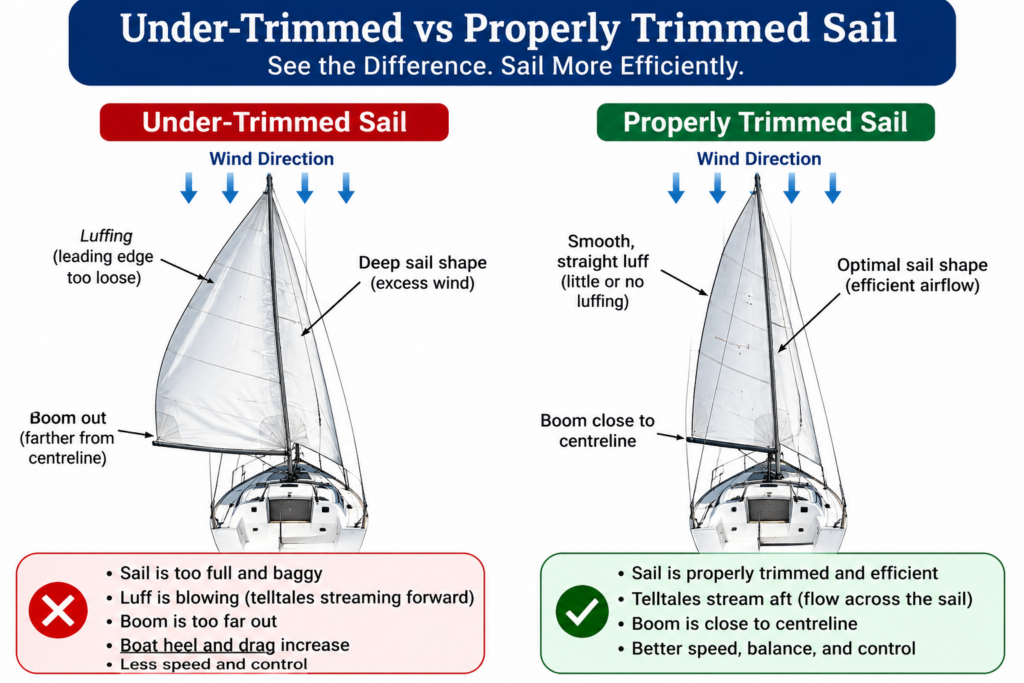
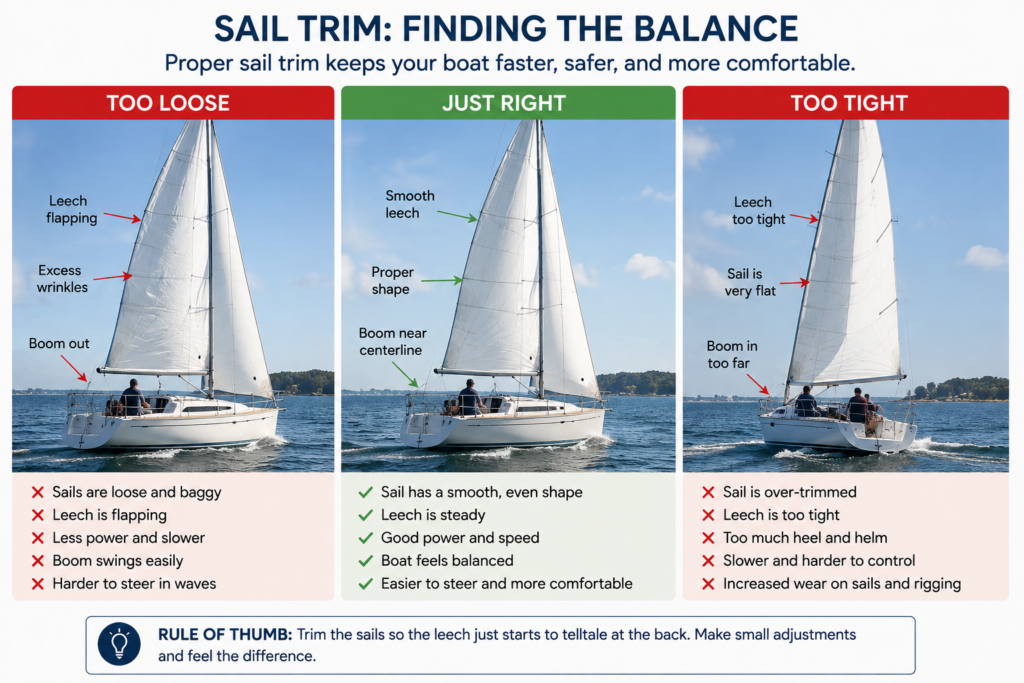
If the sail is eased too far, the front edge may begin to flap. This is called luffing. As a result, the sail loses much of its ability to drive the boat forward. You may also notice that the boat slows down and feels sluggish. Therefore, if the sail is luffing for more than a moment, trim it in gradually until the flapping just disappears.
Signs the Sail Is Too Tight
On the other hand, a sail can also be trimmed too tightly. In that case, the boat may heel more than necessary, the helm may feel heavier, and the boat may not accelerate as expected. Although it seems logical to pull the sail in tighter for more power, over-trimming often makes the sail less efficient instead.
Signs the Sail Is Trimmed Well
A properly trimmed sail looks smooth and stable. The sail is no longer flapping, the boat maintains a comfortable heel angle, and the helm feels balanced. Likewise, the boat moves steadily without constant steering corrections. Good sail trim usually feels calm rather than dramatic.
Beginner Tip
Whenever you make an adjustment, change only a few centimetres of sheet at a time. Then wait several seconds before deciding whether another adjustment is needed.
Which Controls Change Sail Trim?
Next, it helps to know which ropes actually adjust the sails. Fortunately, beginners only need to understand two primary controls.
The Mainsheet
The mainsheet controls the mainsail. Pulling the mainsheet brings the boom closer to the centreline, while easing it allows the boom to swing farther out. Consequently, the mainsheet is the primary control you will use to trim the mainsail during normal sailing.
The Jib Sheets
Similarly, the jib sheets control the position of the jib. As the boat changes its point of sail, the jib sheets are either trimmed in or eased out to match the wind. Together, the mainsail and jib should be adjusted whenever conditions change.
What About Winches?
Winches do not change sail trim by themselves. Instead, they provide the mechanical advantage needed to pull heavily loaded sheets. In other words, the winch is a tool that helps you trim the sail—it is not the control itself.

Common Beginner Mistake
Many new sailors focus on pulling harder instead of observing the sail. However, good sail trim comes from watching the sail first and adjusting only as much as needed.
Learner Checkpoint
You should now be able to recognise the most common signs of under-trimmed and over-trimmed sails. In addition, you know which controls are used to make basic sail trim adjustments and why small, deliberate corrections are usually more effective than large ones.
Internal Link Opportunities
• Parts of a Sailboat
• Running Rigging Explained
• Winches Explained
• Reading the Helm
• Why Sailboats Heel
Basic Sail Trim on Every Point of Sail
Now that you know what good sail trim looks like, it is time to apply it on the water. Fortunately, you do not need to memorise exact angles. Instead, remember one simple pattern: as the boat turns away from the wind, the sails are eased farther out. Conversely, as the boat turns toward the wind, the sails are trimmed closer to the centreline. For a more complete understanding of these concepts, see our article on “Points of Sail“.
Therefore, rather than chasing perfect measurements, focus on observing the sail and making small adjustments that keep it drawing smoothly.
Close Hauled
When sailing as close to the wind as possible, both the mainsail and jib are trimmed in relatively tight. However, avoid pulling them in until they are over-trimmed. The sails should be firm, smooth, and free from unnecessary luffing.
Close Reach and Beam Reach
As you bear away from the wind, ease both sails gradually. Meanwhile, keep watching the leading edge of each sail. If it begins to luff, trim in slightly until the sail fills again.
Broad Reach and Running
Finally, on broader points of sail, the sails are eased much farther out. Nevertheless, continue making small adjustments as the wind changes. Even on a steady day, tiny corrections often improve both comfort and boat speed.
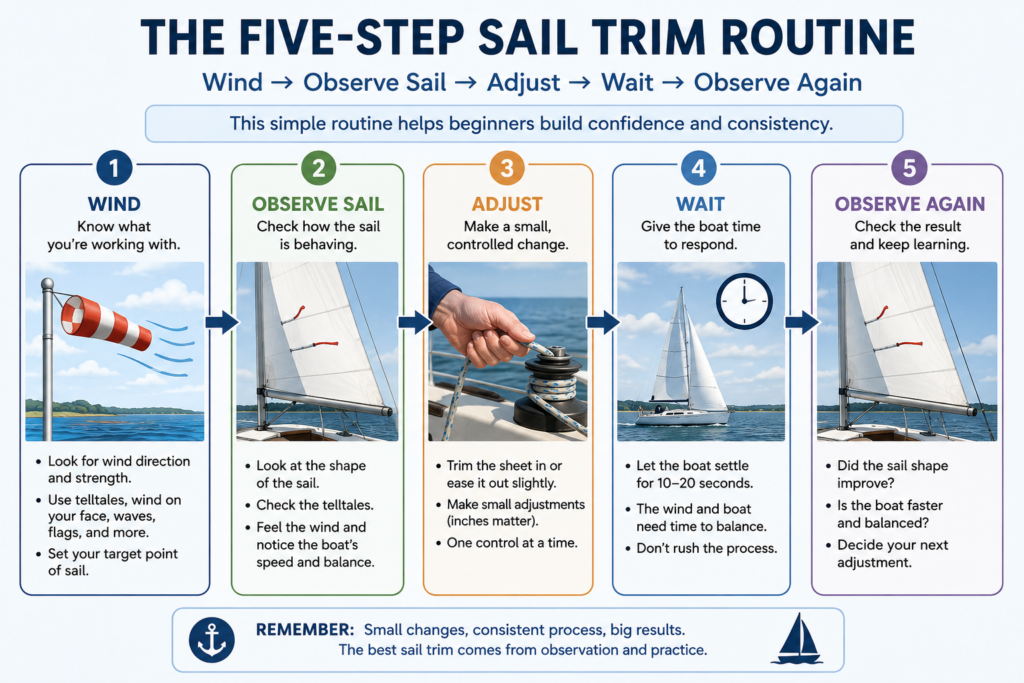
A Simple Five-Step Sail Trim Routine
Instead of wondering what to adjust first, follow the same routine every time. Consequently, sail trim becomes a repeatable habit rather than a guessing game.
1. Look at the Wind
First, identify where the wind is coming from before touching any control.
2. Look at the Sail
Next, check whether the sail is smooth, drawing well, or beginning to luff.
3. Make a Small Adjustment
Then, trim in or ease out only a small amount. Large movements often create new problems, whereas small changes are easier to evaluate.
4. Wait and Observe
Afterward, give the boat a few seconds to respond. As a result, you will learn how each adjustment affects the boat.
5. Repeat
Finally, repeat this process throughout your sail. Because the wind is always changing, good sailors are always observing and making minor corrections.
Common Beginner Mistakes
Even experienced sailors occasionally misjudge sail trim. However, beginners can improve quickly by avoiding a few common habits.
• Pulling every sail in as tightly as possible.
• Ignoring a sail that is luffing.
• Making large adjustments instead of small ones.
• Looking only at the ropes instead of the sail.
• Forgetting to re-trim after the wind or course changes.
Beginner Tip
Whenever something feels wrong, resist the urge to make a dramatic correction. Instead, pause, observe, and adjust one thing at a time.
Key Takeaways
Sail trim is simply the process of matching the sails to the wind. Furthermore, successful sailors rely on observation rather than force. By watching the sails, making small adjustments, and repeating the same simple routine, you will gradually develop the confidence to keep your boat balanced, comfortable, and moving efficiently.
Knowledge Check
1. What does ‘trim a sail’ mean?
2. What is luffing?
3. Which control trims the mainsail?
4. As you bear away from the wind, should the sails generally be eased or trimmed in?
5. Why are small adjustments better than large ones?
6. What should you look at before touching a control line?
7. Why is sail trim never truly finished?
8. Name one common beginner mistake discussed in this article.
Suggested Internal Links
• Reading the Helm
• Running Rigging Explained
• How Sails Work
• Parts of a Sailboat
Putting It All Together: A Real-World Example
Finally, let’s bring everything together in a simple sailing scenario. Imagine you have left the marina and are sailing comfortably on a beam reach. At first, the sails are drawing well, the boat feels balanced, and the helm is light. However, a few minutes later the wind begins to increase.
Rather than reacting immediately with a large adjustment, pause and observe. First, look at the sails. Next, notice how the boat feels. Is the boat heeling more than before? Has the helm become heavier? Is either sail beginning to luff? These observations will tell you what adjustment, if any, is required.
Suppose you decide to turn slightly toward the wind. Consequently, both the mainsail and the jib will usually need to be trimmed in a little. On the other hand, if you bear away onto a broad reach, both sails should normally be eased farther out. Because the wind is rarely constant, continue repeating this simple cycle of observing, adjusting, and observing again.
How Long Does It Take to Learn Sail Trim?
Fortunately, you do not need years of experience before sail trim begins to make sense. Most beginners start recognising the difference between good and poor sail trim after only a few outings. Furthermore, every hour on the water helps develop the habit of looking at the sails instead of relying on guesswork.
Although expert sailors continue refining their techniques throughout their lives, the basic principles remain surprisingly simple. Therefore, focus on mastering the fundamentals before worrying about advanced controls such as the traveller, vang, outhaul, or Cunningham.
Beginner Tip
Practice changing only one thing at a time. For example, adjust the mainsheet while keeping your course steady. Then observe how the boat responds before making another change. As a result, you will quickly learn which adjustment produced the improvement.
Where to Go Next
Now that you understand the fundamentals of sail trim, you are ready to build on that knowledge. Likewise, each new topic will make sail trim easier to understand because sailing skills are closely connected.
Continue Your Beginner Sailing Journey
Suggested internal links:
• How Sails Work
• Reading Telltales
• Points of Sail Explained
• How to Read the Wind
• Reading the Helm
• Weather Helm vs Lee Helm
• Running Rigging Explained
• How to Use a Winch
Final Review
Throughout this guide you have learned that sail trim is not about strength or complicated techniques. Instead, it is about observation and small, deliberate adjustments. Moreover, every change should have a purpose based on what the sail and the boat are telling you.
Remember these four guiding principles:
• Match the sails to the wind.
• Watch the sails before touching the sheets.
• Make small adjustments.
• Repeat the process throughout your sail.
If you consistently follow these principles, you will become a smoother, more confident sailor. Eventually, trimming the sails will become almost automatic, allowing you to spend less time thinking about the controls and more time enjoying the experience of sailing.
Common Beginner Mistake
Trying to memorise exact sail angles for every situation. Instead, learn to read the sail itself. Since every boat and every wind condition is slightly different, observation is far more valuable than memorisation.
IMAGE PLACEHOLDER 8
Type: Lifestyle photograph of a beginner helming a sailboat with balanced sails on a beam reach.
Alt text: Beginner sailor enjoying a well-trimmed sailboat.
Caption: Good sail trim makes sailing smoother, easier, and more enjoyable.
Frequently Asked Questions
How often should I trim my sails?
Continuously. Although some adjustments are tiny, experienced sailors are always observing the wind and making small corrections. As conditions change, your sail trim should change as well.
Should the sails ever flap?
A brief flutter while turning or making an adjustment is normal. However, a sail that continues luffing is usually a sign that it needs to be trimmed or that the boat’s heading should change.
Which sail should I adjust first?
There is no universal rule. Nevertheless, many beginners find it easiest to observe the mainsail first because it is larger and easier to see. Afterward, trim the jib so both sails work together.
Can I over-trim a sail?
Yes. Pulling a sail in too tightly can make it less efficient. Therefore, avoid assuming tighter is always better.
Do I need expensive equipment to learn sail trim?
No. The most valuable tools are your eyes and your willingness to observe. As your experience grows, advanced sail controls become more useful, but they are not required to learn the fundamentals.
Knowledge Check
1. What is the goal of sail trim?
2. What does luffing tell you about a sail?
3. As you turn away from the wind, should the sails generally be eased or trimmed in?
4. Which line primarily controls the mainsail?
5. Why are small adjustments usually better than large ones?
6. What should you observe before adjusting a sail?
7. True or False: Sail trim is a one-time adjustment made after leaving the dock.
8. What are the five steps in the beginner sail trim routine?
9. Name one sign of an over-trimmed sail.
10. Why is good sail trim important for comfort as well as speed?
Answer Key
1. Adjust the sails so they match the wind efficiently.
2. The sail is too loose or the boat’s heading needs adjustment.
3. Eased farther out.
4. The mainsheet.
5. They are easier to evaluate and prevent over-correcting.
6. Look at the sail and the wind.
7. False.
8. Look at the wind, look at the sail, make a small adjustment, wait, and observe again.
9. Examples include excessive heel, a heavy helm, or poor performance despite tight sails.
10. Balanced sails make the boat easier to steer and more comfortable.
Key Takeaways
First, sail trim is simply the process of matching the sails to the wind. Second, the sail itself provides the best feedback, so learn to watch it carefully. Third, make small adjustments instead of dramatic ones. Finally, remember that sail trim is an ongoing habit rather than a single task. Consequently, every hour on the water will build your confidence and improve your ability to recognise what the boat needs.
Suggested External Resources
• World Sailing – Learn to Sail resources
• Royal Yachting Association (RYA) sailing knowledge
• NOAA Marine Weather
Next Articles to Read
To continue building your sailing knowledge, consider reading:
• How Sails Work
• Reading Telltales
• Weather Helm vs Lee Helm
• Sail Twist Explained
• Outhaul, Vang, Cunningham, and Traveller Explained
• How to Reef a Sail
• How to Sail a Sailboat
Comments
Pingback: How to Read the Wind: The Essential Beginner’s Guide -