
Quick Summary
Leaving the dock is one of those sailing skills that can feel harder than it really is. The boat is close to expensive objects, the fairway may be narrow, people may be watching, and beginners often feel as though everything has to happen at once. Fortunately, how to leave the dock is usually more about preparation than impressive boat-handling skill. Before a single dock line comes off, you should know where the wind is coming from, whether current is affecting the boat, which direction you intend to go, and which line will be released last.
In this guide, you will learn how to prepare the boat and crew, understand the forces acting on the hull, use dock lines deliberately, leave several common types of berths, and recognize when conditions are telling you to stop and try again. The goal is not to leave quickly. Instead, the goal is to leave slowly, predictably, and under control. That is exactly how experienced sailors approach close-quarters maneuvering.
Table of Contents
Why Leaving the Dock Feels Difficult
Before You Untie Anything
Understanding Wind, Current, and Momentum
Preparing the Boat for Departure
Understanding Dock Lines Before Departure
Leaving the Dock Step by Step
Leaving Different Types of Berths
What to Do When the Wind Is Working Against You
Common Beginner Mistakes
practicing Dock Departures Safely
Frequently Asked Questions
Key Takeaways
What’s Next?
Why Leaving the Dock Feels Difficult
Every beginner worries about hitting something
Open water gives you room to think. A marina does not. When your sailboat is sitting in a slip, there may be another boat only a few feet away, a dock beside you, pilings behind you, and a narrow fairway ahead. That makes even a simple departure feel important.
For a beginner, the natural reaction is often to hurry. You may want to untie the lines, get the boat moving, and escape the crowded marina as quickly as possible. However, speed usually makes close-quarters maneuvering harder, not easier. The better approach is to slow the process down before the boat ever moves. Look around. Decide what the wind is trying to do to the boat. Decide which way the bow and stern need to move. Then remove the lines in an order that supports that plan.
Why sailboats behave differently from cars
A sailboat does not steer like a car in one very important respect: the rudder needs water moving past it before it can become effective. Turning the wheel or tiller while the boat is completely stationary may move the rudder, but it does not necessarily make the boat turn. As the boat begins moving through the water, the rudder gains authority and your steering becomes more predictable.
Meanwhile, the wind may be pushing the bow sideways, current may be moving the entire boat, and the propeller may influence the stern when you shift into forward or reverse. Therefore, leaving the dock is less about pointing the steering wheel where you want to go and more about understanding several forces working at the same time. If steering itself is still unfamiliar, review How to Steer a Sailboat before practicing in a confined marina.
Good preparation prevents most departure problems
Most difficult departures begin before the boat moves. A dock line is released too early. The skipper has not checked the wind. A fender is stowed before it is no longer needed. A crew member does not know which line to release. Or the engine is put into gear before anyone has agreed on the plan.
Fortunately, these are preparation problems, and preparation is something you can control. Rig the boat first, organize the cockpit, brief the crew, identify your escape route, and keep the boat secured until you are genuinely ready to go. If you need a refresher on getting the boat ready before departure, see How to Rig a Sailboat and Basic Sailing Terminology.
A calm departure does not begin when the last dock line comes off. It begins several minutes earlier, while the boat is still safely tied to the dock.
Before You Untie Anything
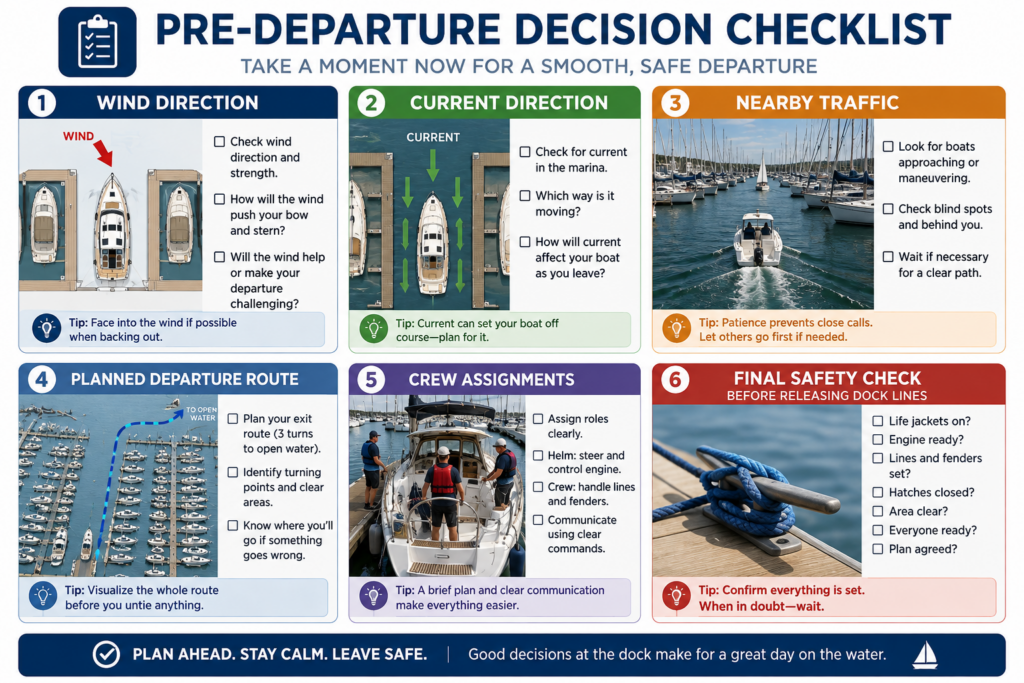
Many beginners believe that leaving the dock begins when the first dock line is released. In reality, the departure begins several minutes earlier while the boat is still securely tied up. The more planning you do before casting off, the fewer decisions you’ll need to make once the boat starts moving.
Experienced sailors often appear calm because they have already thought through the entire departure. They know where the wind is coming from, which dock lines will be released first, where the boat will go next, and what they will do if something unexpected happens.
Fortunately, you can develop the same habit. Every successful departure follows a simple routine: observe, plan, prepare, then leave.
Observe the Wind Direction
First, determine where the wind is coming from. Wind has a greater influence on a sailboat than many beginners expect, especially at slow speeds when there is very little water flowing past the rudder.
Look for clues such as:
- Flags on nearby buildings
- Masthead wind indicators (Windexes)
- Ripples on the water
- Trees moving ashore
- Telltales on nearby boats
- The way your own boat is lying against the dock lines
Ask yourself one simple question:
“If I released every dock line right now, which way would the boat move?”
That answer forms the basis of your departure plan.
For example, if the wind is pushing the boat gently away from the dock, you can often use that movement to your advantage. On the other hand, if the wind is pressing the boat firmly against the dock, you’ll probably need a different strategy, perhaps using a spring line or engine power to pivot the boat before leaving.
This is one of the first times you’ll use the skills taught in How to Read the Wind for actual boat handling rather than sail trim.
Before every departure, it’s worth checking the latest marine forecast to understand expected wind conditions and any advisories. NOAA Marine Weather provides detailed marine forecasts that help sailors plan safer departures.
Check for Current and Tide
Next, consider whether current is affecting the boat.
Unlike the wind, current is usually invisible. However, it can move a sailboat surprisingly quickly because it pushes against the hull and keel beneath the water.
Look for signs such as:
- Water flowing past pilings
- Floating seaweed or debris
- Mooring buoys drifting
- Water movement around dock structures
If you’re sailing in tidal waters, determine whether the tide is flooding or ebbing and how that affects your marina.
Sometimes the wind and current work together.
Sometimes they work against each other.
For example, the wind may push the bow away from the dock while the current carries the entire boat sideways toward another slip.
Therefore, always consider both forces together before deciding how to leave.
Look for Nearby Boats and Obstacles
Meanwhile, take a slow look around the marina.
Avoid focusing only on the boat directly beside you. Instead, scan the entire area.
Look for:
- Boats entering the fairway
- Boats preparing to leave their slips
- Dinghies and kayaks
- Fuel docks
- Pilings
- Shallow water
- Floating docks
- Construction work
- Overhead obstacles
Likewise, remember that a sailboat doesn’t simply move forward. The stern often swings as the boat turns, especially while reversing.
Many beginners watch only the bow and forget that the stern may move several feet in the opposite direction.
Taking thirty seconds to observe the marina often prevents several minutes of stress later.
Plan Your Departure Route
Now that you’ve evaluated the conditions, decide exactly what you want the boat to do.
Don’t simply think,
“I’ll back out and see what happens.”
Instead, mentally rehearse the entire maneuver.
For example:
- Reverse straight back two boat lengths.
- Turn the wheel to port.
- Shift into forward.
- Proceed down the fairway at idle speed.
Having a simple plan gives you confidence because you’re responding to a situation you’ve already imagined.
Although plans sometimes change, having one is always better than making decisions while the boat is drifting.
Assign Simple Crew Responsibilities
Finally, if other people are aboard, explain exactly what each person will do.
Keep instructions simple.
Instead of saying,
“Help with the lines.”
say,
“Please remove the stern line when I ask, bring it aboard, and then sit down.”
Clear instructions reduce confusion and help everyone stay calm.
Likewise, remind your crew never to:
- Jump between the dock and the boat
- Try to stop the boat with their hands or feet
- Wrap a dock line around their hand
- Stand where a line could tighten suddenly
If someone is unsure what to do, that’s perfectly normal. Give one job at a time and explain it before the boat begins moving.
Beginner Tip
Never untie the boat until you already know exactly where it will go.
If you can’t describe your first three maneuvers, leave the dock lines attached and spend another minute observing the conditions. One minute of planning can prevent ten minutes of recovering from a mistake.
Understanding Wind, Current, and Momentum
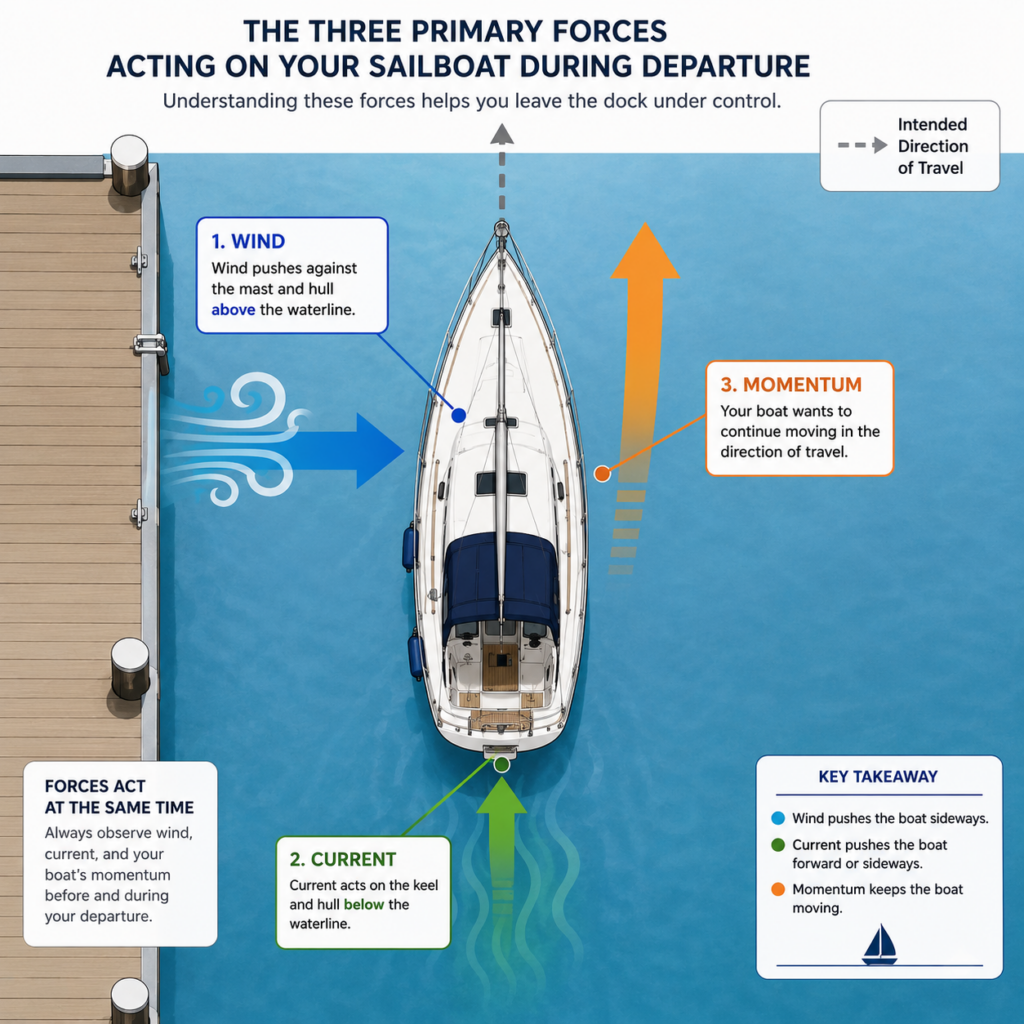
One of the biggest differences between driving a car and handling a sailboat is that a sailboat never stops responding to the forces around it. Even with the engine idling, the wind and current continue to push the boat, and momentum keeps it moving after you’ve shifted into neutral.
Beginners often focus on the throttle or the steering wheel (or tiller), believing they control everything. However, successful docking and departure begin with understanding the forces acting on the boat. Once you can predict how those forces affect your sailboat, you’ll make smoother, calmer departures with far less stress.
Fortunately, you don’t need to become an expert in physics. You simply need to recognize which force is acting on the boat and how to work with it rather than against it.
Wind Pushes the Boat Above the Water
Wind affects everything above the waterline.
That includes:
- The mast
- The sails (if raised)
- The boom
- The rigging
- The cabin
- The hull above the water
Think of your sailboat as a giant weather vane. Even while tied to the dock, the wind is constantly trying to push the exposed parts of the boat.
For example, a strong crosswind may push the bow sideways as soon as the last dock line is released. Likewise, a breeze blowing directly onto the dock may hold the boat against the fenders, making it difficult to leave without first creating space.
Understanding where the wind is acting allows you to anticipate these movements instead of reacting to them after they’ve already begun.
If you’re unsure how to identify the wind direction, review How to Read the Wind before practicing dock departures.
Current Moves Everything Below the Water
Current is different from wind because it acts beneath the surface.
Instead of pushing against the mast and cabin, it pushes against:
- The hull
- The keel
- The rudder
- The propeller
Unlike the wind, you cannot always see or feel the current directly. Nevertheless, it can have a significant effect on your departure.
For example, imagine leaving a slip on a calm day with almost no wind. The boat may still drift sideways because a tidal current is flowing through the marina.
In contrast, there may be days when the wind is strong enough to overcome a weak current. Every situation is different, which is why experienced sailors always consider both forces before leaving the dock.
Momentum Keeps the Boat Moving
Momentum is simply the tendency of the boat to keep moving once it has started.
A sailboat is heavy. Even a small cruising sailboat may weigh several thousand kilograms. As a result, it does not stop immediately when you reduce the throttle.
Many beginners expect the boat to respond like a car.
It won’t.
If you shift into neutral, the boat continues to glide.
If you turn the wheel sharply while moving very slowly, the boat may continue straight ahead until enough water flows across the rudder for it to begin turning.
Likewise, reversing direction takes time. You cannot instantly switch from reverse to forward and expect the boat to stop immediately.
Understanding momentum helps explain why smooth, gradual maneuvers are almost always more effective than sudden, aggressive ones.
Why Slow Is Usually Better
Many beginners become nervous and add more throttle because they feel the boat isn’t responding quickly enough.
Ironically, this often makes the situation worse.
Extra speed gives you less time to think, reduces your margin for error, and increases the force of any collision.
Instead, use just enough throttle to maintain steerage. Idle speed is often all that’s required in a marina.
Remember that your objective isn’t to leave the dock quickly.
Your objective is to leave under complete control.
Because sailboats continue moving after the throttle is reduced, small adjustments usually produce smoother results than large corrections.
Experienced skippers often appear to move very slowly around docks. That isn’t because they’re uncertain.
It’s because they’re giving themselves time to observe, think, and make deliberate decisions.
Common Beginner Mistake
Trying to leave the dock too quickly.
Many new sailors assume speed will help them escape a difficult situation.
In reality, speed usually removes options.
If the boat begins moving in the wrong direction, a slow-moving boat is much easier to correct than one traveling several knots through a crowded marina.
Whenever possible, operate at idle speed until you’re well clear of nearby boats and dock structures.
Preparing the Boat for Departure
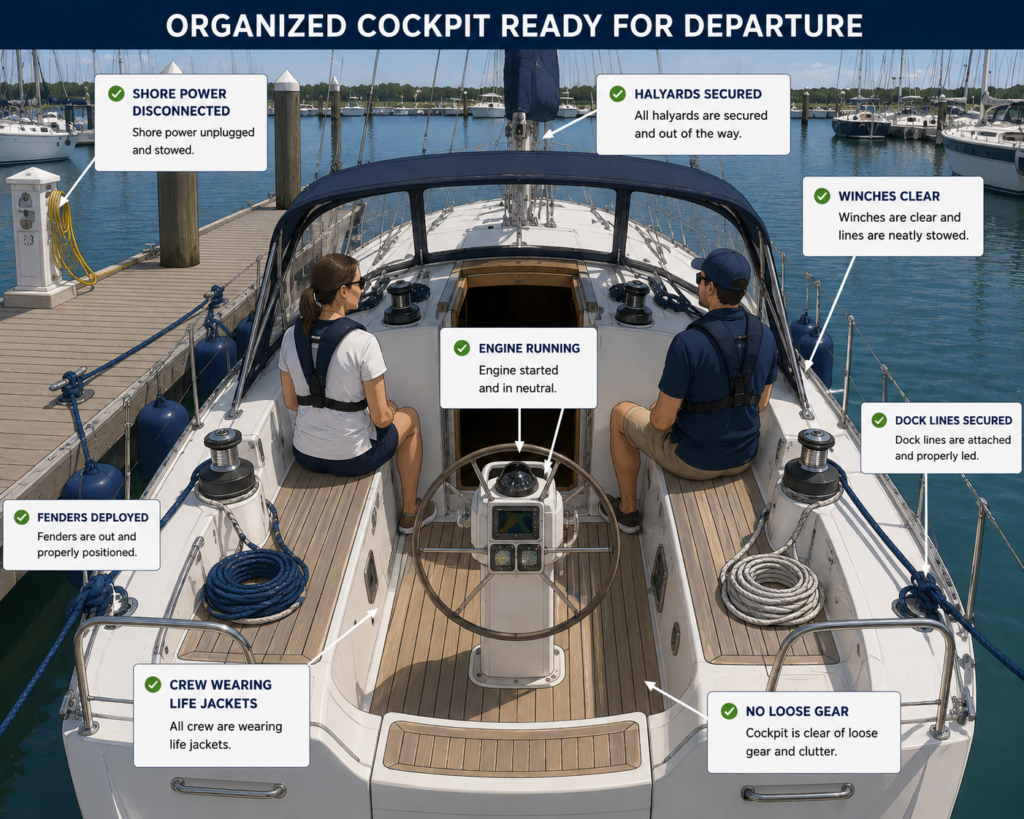
Once you’ve assessed the wind, current, and your departure route, it’s time to prepare the boat. This is where many experienced sailors separate themselves from beginners. They don’t rush to cast off. Instead, they follow the same preparation routine every time they leave the dock.
Developing a consistent routine has two major benefits. First, it helps prevent forgotten tasks. Second, it builds confidence because every departure feels familiar, even when conditions change.
Rather than trying to remember everything at once, work through the same sequence from top to bottom.
Start the Engine
If your sailboat has an auxiliary engine, start it while the boat is still securely tied to the dock.
Allow it to idle for a minute or two before departure.
This gives you time to confirm that:
- The engine starts normally.
- The controls operate correctly.
- The transmission shifts into both forward and reverse.
- The throttle responds smoothly.
- No warning alarms are sounding.
Never assume the engine is ready simply because it started yesterday. Small mechanical issues are much easier to deal with while you’re still tied safely alongside the dock.
Likewise, avoid casting off until you’re confident the engine is running reliably.
Warm Up and Confirm Cooling Water
As the engine idles, check for cooling water flowing from the exhaust outlet.
This is often called the “telltale” or water discharge, depending on the engine manufacturer.
A steady flow of cooling water indicates that the raw-water pump is circulating water through the engine.
If little or no water appears after a short time, shut the engine down and investigate before leaving the dock.
Common causes include:
- A blocked raw-water intake.
- A closed seawater intake valve.
- A clogged strainer.
- An impeller problem.
Fortunately, discovering these issues while still tied to the dock is far less stressful than finding them halfway out of the marina.
Disconnect Shore Power
If you’ve been plugged into shore power, disconnect it before departure.
The typical sequence is:
- Switch off high-power electrical loads.
- Turn off the shore power breaker.
- Disconnect the shore power cord from the pedestal.
- Disconnect the cord from the boat.
- Coil and stow the cable securely.
Before leaving, confirm that no cables, hoses, or extension cords remain attached to the boat.
Although this sounds obvious, forgetting shore power is one of the more common mistakes new boat owners make.
Stow Fenders
Next, decide whether your fenders should remain deployed or be brought aboard.
Many sailors leave them hanging until the boat has completely cleared the dock. This provides extra protection if the boat drifts back unexpectedly.
Once you’re safely underway, retrieve the fenders and secure them where they won’t roll around the cockpit or create a tripping hazard.
Likewise, check that nothing is hanging over the side that could catch a piling or another boat during departure.
Prepare the Dock Lines
Before releasing anything, organize every dock line.
Each line should:
- Run free without knots.
- Be clear of winches and cleats unless intentionally secured.
- Be free of tangles.
- Be ready to come aboard quickly.
- Not pass underneath other lines unnecessarily.
Take a moment to identify:
- Bow line
- Stern line
- Forward spring line
- Aft spring line
You’ll learn exactly which lines are released first in the next section. For now, simply make sure every line is organized and ready.
A tangled dock line can delay your departure at exactly the wrong moment.
Brief the Crew
If other people are aboard, gather everyone before removing the first line.
Explain:
- The departure plan.
- Who releases each line.
- Which side of the boat everyone should stay on.
- When crew should move.
- When everyone should remain seated.
Keep instructions simple.
For example:
“I’ll shift into reverse. When I say ‘release the bow line,’ remove it completely and bring it aboard. Then sit down until we’re clear of the dock.”
Clear communication helps everyone stay relaxed.
In contrast, shouting instructions after the boat has already begun moving usually creates confusion rather than solving it.
Beginner Tip
Do every departure in exactly the same order.
Professional pilots and experienced sailors rely on checklists because routines reduce mistakes. By following the same preparation sequence every time, you’ll spend less mental energy remembering what comes next and more attention observing the conditions around you.
Understanding Dock Lines Before Departure
Dock lines may seem simple, but they play a critical role in a controlled departure. Knowing what each line does—and more importantly, when to remove it—can make the difference between a smooth cast-off and an embarrassing struggle against the wind or current.
Many beginners think of dock lines as ropes that simply tie the boat to the dock. In reality, each line is designed to control movement in a specific direction. Once you understand their purpose, you’ll begin using them strategically rather than removing them all at once.
Fortunately, you don’t need to memorize every possible docking arrangement. Start by learning the four most common dock lines.
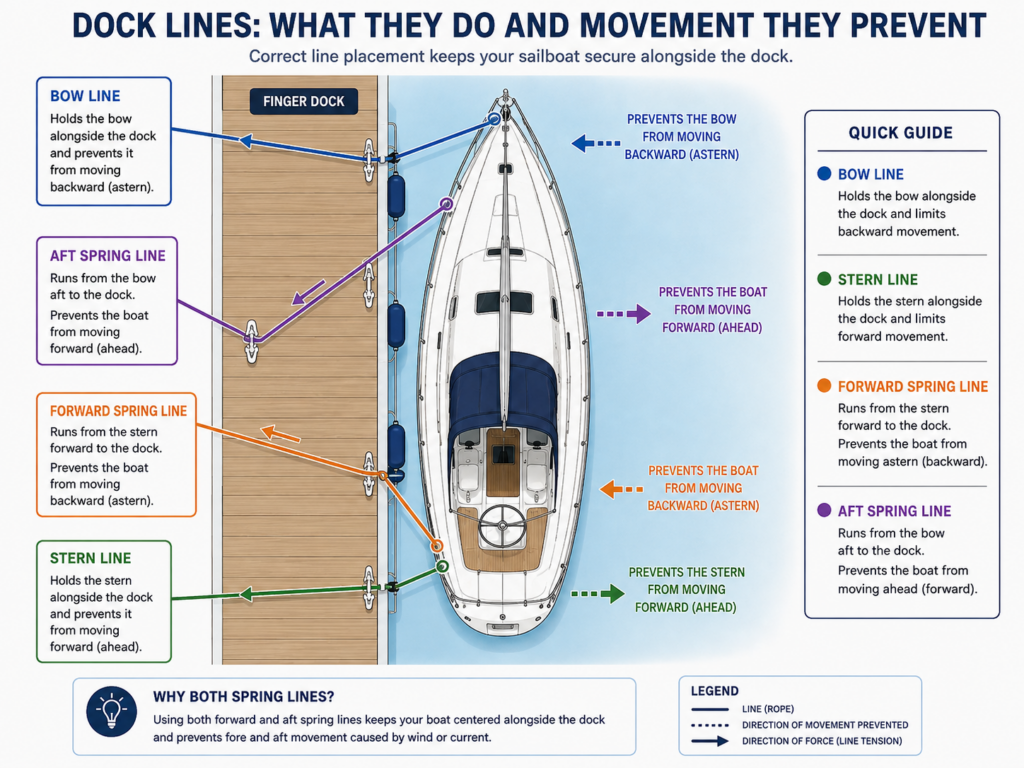
Bow Line
The bow line runs from the bow of the sailboat to a cleat or piling on the dock.
Its primary purpose is to prevent the bow from drifting away from the dock or moving backward.
When the boat is secured with only a bow line, the stern can usually swing outward if pushed by the wind or engine.
The bow line is often one of the last lines removed because it helps keep the front of the boat under control while the skipper prepares to leave.
However, the exact order depends on the wind, current, and the type of berth.
Stern Line
The stern line runs from the stern of the boat to the dock.
Its job is to keep the stern alongside the dock and prevent it from moving forward.
Once the stern line is removed, the stern is free to swing.
Sometimes that’s exactly what you want.
For example, if you’re reversing out of a slip, allowing the stern to move away from the dock may help position the boat for departure.
On the other hand, removing the stern line too early may allow the boat to pivot before you’re ready.
Spring Lines
Spring lines confuse many beginners because they don’t simply hold the boat against the dock.
Instead, they prevent the boat from moving forward or backward along the dock.
There are two common types:
- Forward spring line
- Aft spring line
A forward spring usually runs from a stern cleat forward to the dock.
An aft spring usually runs from a bow cleat aft to the dock.
Because spring lines resist forward or backward movement, they can also be used with gentle engine power to pivot the boat away from the dock.
For example, if the wind is pushing the boat firmly onto the dock, leaving a spring line attached while applying light engine power can help swing the bow or stern into a better position before the final line is released.
You’ll learn this technique in greater detail in future articles such as Spring Lines Explained and Docking a Sailboat.
Which Line Comes Off First?
There is no universal answer.
The correct sequence depends on:
- Wind direction
- Current
- Dock layout
- Your departure plan
- Whether you’re leaving forward or in reverse
This surprises many beginners, who expect there to be one “correct” order.
Instead, think of dock lines as tools.
You remove the lines that are no longer helping you while keeping the line that gives you the greatest control until the last possible moment.
For example, if a crosswind is trying to push the bow away from the dock, you may leave the bow line attached longer.
If the stern needs to stay alongside while you prepare to reverse, the stern line may remain attached until the final moments.
Always ask yourself:
“Which line is helping me the most right now?”
Which Line Stays On the Longest?
In many departures, one dock line remains attached until everything else is ready.
This is often called the controlling line because it allows the skipper to keep the boat positioned while the crew prepares for departure.
Only when:
- the engine is running,
- the crew is ready,
- the departure path is clear,
- and the skipper gives the command,
should that final line be released.
This simple habit prevents the boat from drifting unexpectedly before everyone is prepared.
Common Beginner Mistake
Removing every dock line at once.
This is one of the most common mistakes new sailors make.
Once every line has been released, the boat is no longer under the dock’s control. At that point, the wind and current immediately begin moving it wherever they choose.
Instead, remove the lines one at a time while maintaining control of the boat with the remaining line or lines.
A controlled departure almost always feels calm and deliberate—not rushed.
Leaving the Dock Step by Step
Now it’s time to put everything together.
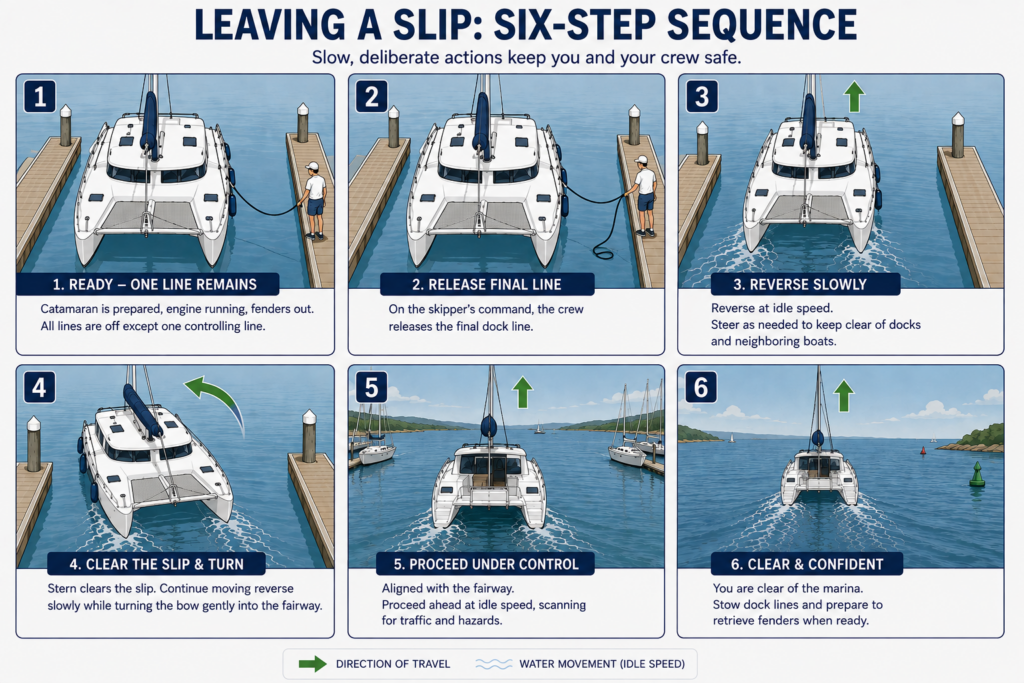
You’ve checked the weather, assessed the wind and current, prepared the boat, organized the dock lines, and planned your departure. The actual maneuver is simply the final step in a process that began several minutes ago.
Beginners often believe the hardest part is steering the boat away from the dock. In reality, the goal is much simpler:
Maintain control from the moment the first dock line is released until you’re safely clear of the marina.
If something doesn’t go according to plan, remember that there’s rarely a need to rush. Slow, deliberate movements almost always produce the best results.
Start with a Plan
Before anyone touches a dock line, take one final look around.
Confirm that:
- The engine is running smoothly.
- Everyone is wearing a life jacket if appropriate.
- The fairway is clear.
- Wind and current haven’t changed significantly.
- The crew understands their responsibilities.
If anything feels uncertain, stop and reassess.
There is no penalty for waiting another minute.
However, once the final line is released, the boat begins responding immediately to the wind and current. It’s much easier to adjust the plan while you’re still tied to the dock.
Release the Correct Dock Lines
Begin releasing dock lines according to the departure plan you developed earlier.
Avoid the temptation to remove every line immediately.
Instead, release the lines that are no longer helping you while leaving the controlling line attached until you’re ready to move.
For example, if the bow is likely to drift away from the dock, you may keep the bow line attached until the last moment.
Likewise, if you’re using a spring line to pivot the boat away from the dock, leave that line secured until it has done its job.
Each departure is different.
Rather than memorizing a single sequence, ask yourself:
“Which line gives me the most control right now?”
Control the Boat with the Remaining Lines
One of the biggest differences between beginner and experienced sailors is that experienced sailors often use dock lines to help move the boat.
Instead of fighting the wind, they allow a remaining spring line or bow line to hold the boat in position while the engine gently pivots the hull into a better angle for departure.
This technique requires only light engine power.
Never try to overpower the dock lines with excessive throttle.
Instead, let the line do the work while the engine supplies gentle pressure.
Once the boat has rotated into the desired position, the final line can be released and brought aboard.
Although this may sound advanced, you’ll learn much more about spring-line departures in a future article devoted entirely to close-quarters boat handling.
Use Idle Speed
As soon as the boat begins moving, resist the urge to increase the throttle.
Most marina maneuvers should be performed at idle speed or only slightly above idle.
Remember:
You don’t need speed.
You need control.
Moving slowly gives you time to:
- Observe the boat’s movement.
- Make small steering corrections.
- Shift between forward and reverse smoothly.
- React if another boat suddenly appears.
As a result, even if something unexpected happens, you’ll have far more options than if you were moving too quickly.
Steer Only After Water Is Flowing Over the Rudder
Many beginners are surprised when they turn the wheel and nothing seems to happen.
This is perfectly normal.
The rudder becomes effective only when water is flowing across it.
If the boat is barely moving, turning the wheel all the way to one side usually has very little immediate effect.
Instead, allow the boat to begin moving before expecting significant steering response.
Likewise, remember that reversing affects steering differently from moving forward.
Take your time and allow the boat to respond before making another steering correction.
Small, patient adjustments almost always work better than large, rapid movements.
Clear the Dock
Once you’re clear of nearby boats and dock structures, continue at a slow speed until you’ve exited the marina or reached open water.
Only after you’re safely clear should you:
- Retrieve any remaining fenders.
- Coil and stow dock lines.
- Complete any final preparations for sailing.
Avoid trying to tidy the boat while you’re still maneuvering through a crowded marina.
Boat control always comes first.
Stop and Reassess if Necessary
Not every departure goes exactly as planned.
Perhaps another boat suddenly enters the fairway.
Maybe the wind shifts.
Or perhaps the stern doesn’t swing quite the way you expected.
That’s okay.
Experienced sailors frequently pause, return to neutral, or even secure the boat alongside the dock again if conditions change.
There is absolutely no shame in aborting a departure.
In fact, recognizing when to stop and rethink the situation is one of the best signs of good seamanship.
Remember:
The goal isn’t to leave the dock quickly.
The goal is to leave safely and under control.
Beginner Tip
There is no prize for leaving quickly.
Most docking mistakes happen because people feel rushed.
Slow down.
Think ahead.
Make one deliberate action at a time.
A calm departure is almost always a successful departure.
Leaving Different Types of Berths
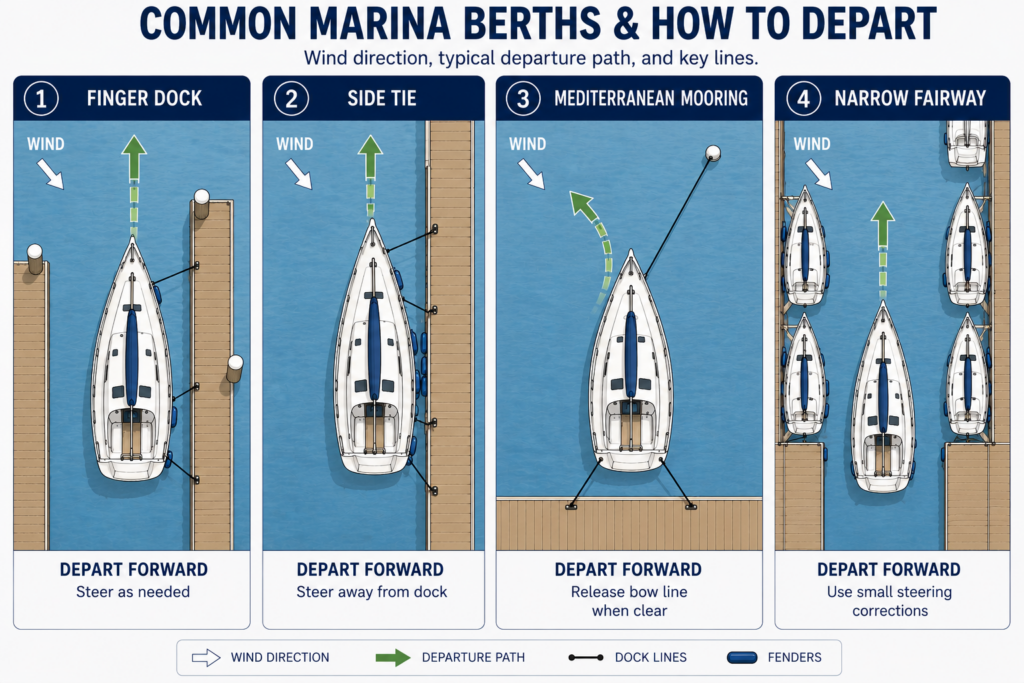
Not every sailboat leaves the dock the same way. The techniques you’ve learned so far apply to all departures, but the exact maneuver depends on the type of berth you’re leaving.
Fortunately, the principles remain the same:
- Observe the conditions.
- Plan your route.
- Keep control of the boat.
- Leave slowly.
Once you understand how different berth layouts affect the boat’s movement, you’ll find it much easier to adapt when visiting unfamiliar marinas.
Finger Dock
A finger dock is one of the easiest berths for beginners because it provides space on one side of the boat while leaving the opposite side open.
Most modern marinas use finger docks.
Typically, you’ll reverse out of the slip before turning into the fairway.
As you begin backing out:
- Keep your speed at idle.
- Watch both the bow and the stern.
- Allow the stern to swing gradually.
- Begin steering only after the boat has started moving.
If the wind is blowing across the slip, expect either the bow or stern to drift.
Instead of fighting every small movement, anticipate it and make gentle corrections.
Likewise, avoid turning the wheel excessively. Large steering movements often create larger corrections than necessary.
For many beginners, finger docks provide an excellent place to practice because they offer predictable departures in relatively open water.
Side Tie
A side tie, sometimes called coming alongside, means the boat is secured parallel to a dock rather than inside a slip.
Although this arrangement may appear simpler, the wind often has a greater effect because the entire side of the boat is exposed.
If the wind is blowing away from the dock, departure is usually straightforward.
Release the controlling line, shift gently into gear, and allow the wind to help move the boat away before turning.
However, if the wind is pressing the boat against the dock, patience becomes much more important.
Rather than applying excessive throttle, use the appropriate controlling line or spring line to help pivot the boat before releasing the final line.
A slow, controlled departure almost always works better than trying to overpower the wind.
Mediterranean Mooring
Mediterranean mooring, often called Med mooring, is common in many parts of Europe but less common in North America.
In this arrangement, the stern is tied to the dock while the bow is secured to an anchor or permanent mooring line.
Because the boat pivots differently, departures follow a different sequence than those described earlier.
Fortunately, the same principles still apply:
- Observe the wind.
- Understand the forces acting on the boat.
- Release lines in a controlled order.
- Avoid rushing.
A complete discussion of Med mooring is beyond the scope of this beginner’s guide, but it’s helpful to recognize the arrangement if you encounter it while traveling.
Narrow Fairway
Some marinas leave very little room to turn after backing out of a slip.
These narrow fairways require patience more than precision.
As you reverse:
- Keep the boat moving slowly.
- Watch the stern carefully.
- Leave extra room for neighboring boats.
- Avoid large steering corrections.
If another boat is approaching, don’t hesitate to pause and allow it to pass before continuing.
Likewise, remember that there is no obligation to complete the maneuver immediately.
Waiting for a safer opportunity is almost always the better decision.
In particularly confined spaces, experienced sailors sometimes stop the boat completely, reassess the situation, and then continue once they are satisfied with their position.
Marina Layouts Vary
Every marina is different.
Some have floating docks.
Others have fixed docks with significant tidal changes.
Some provide wide fairways that make turning easy.
Others require careful planning because space is limited.
Rather than memorizing one departure technique, focus on understanding why the boat behaves the way it does.
Once you understand the effects of wind, current, momentum, and dock layout, you’ll be able to adapt your departure to almost any marina.
This flexible approach is far more valuable than memorizing a single sequence of steps.
Image Placeholder
What to Do When the Wind Is Working Against You
Every sailor eventually encounters a departure where the wind seems determined to keep the boat exactly where it is—or push it somewhere you don’t want to go.
This is perfectly normal.
The goal isn’t to overpower the wind. Instead, it’s to understand how the wind is affecting your sailboat and use that knowledge to your advantage.
Fortunately, even strong winds become much less intimidating once you learn how they influence the boat during the first few seconds after leaving the dock.
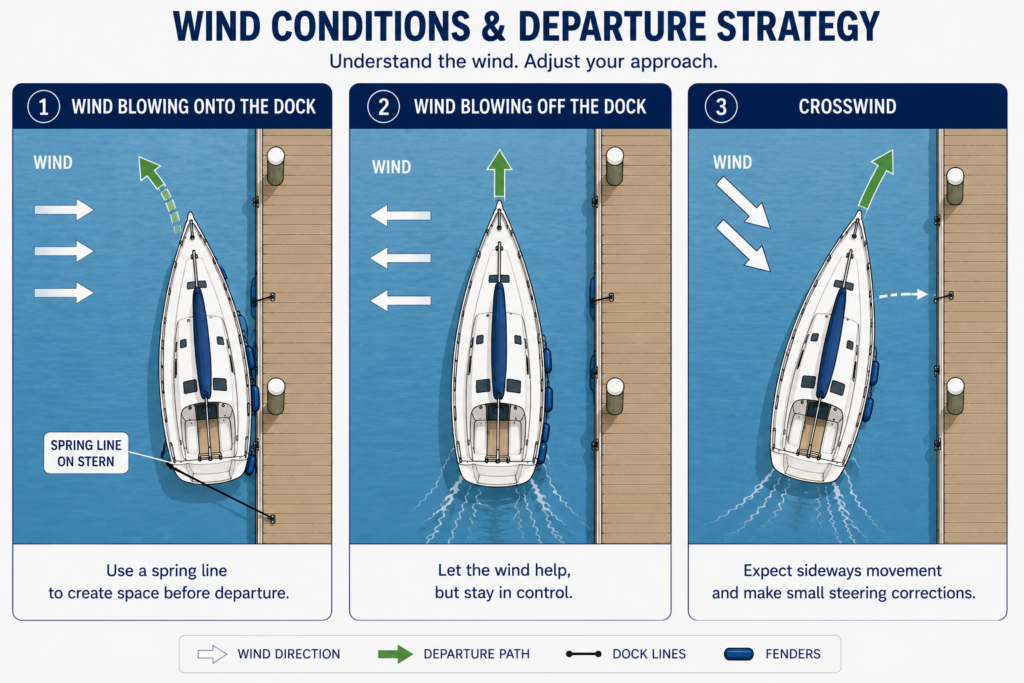
Wind Blowing Onto the Dock
Many beginners consider this the most difficult departure.
When the wind is blowing directly onto the dock, it presses the hull against the fenders. Simply releasing every dock line and applying throttle usually doesn’t work. The boat remains pinned against the dock, and increasing engine power often makes the situation worse.
Instead, think about creating space before trying to leave.
In many situations, a spring line can be used to hold one part of the boat while gentle engine power pivots the other end away from the dock.
For example, holding the stern with an aft spring line while engaging slow forward gear may allow the bow to swing safely away from the dock. Once there’s enough clearance, the final line can be released and the boat can depart under control.
Although this technique requires practice, it is far more effective than relying on excessive throttle.
Wind Blowing Off the Dock
A wind blowing away from the dock often makes departure easier.
As the controlling line is released, the wind naturally helps move the boat away from the dock.
However, don’t let this create a false sense of confidence.
If the boat drifts away too quickly, you may lose the opportunity to control the direction of the bow or stern before entering the fairway.
Instead, allow the wind to assist while maintaining slow engine speed and steady steering.
Likewise, be careful that the boat doesn’t drift into pilings, neighboring docks, or other boats located downwind.
The wind may be helping you leave the dock, but it still requires your full attention.
Crosswind Departures
Crosswinds are among the most common conditions encountered in marinas.
A crosswind pushes the boat sideways while you’re trying to move forward or backward.
Depending on its direction, the wind may:
- Push the bow sideways.
- Swing the stern unexpectedly.
- Carry the entire boat across the fairway.
- Reduce your available turning room.
Fortunately, the solution usually isn’t more speed.
Instead, anticipate the sideways movement before it happens.
Leave extra space.
Use gentle steering corrections.
Allow the boat to respond before making another adjustment.
Because sailboats react slowly, patience often produces better results than constant corrections.
When Spring Lines Help
Spring lines are one of the most useful tools for leaving a dock in challenging conditions.
Rather than thinking of them as just another dock line, think of them as a way to control the boat’s pivot point.
By leaving an appropriate spring line attached while applying light engine power, you can often:
- Swing the bow away from the dock.
- Swing the stern away from the dock.
- Prevent unwanted forward movement.
- Prevent unwanted backward movement.
- Gain valuable space before releasing the final line.
Learning to use spring lines effectively is a fundamental docking skill. The Associated Marine Training website offers excellent beginner resources on close-quarters boat handling and marina maneuvers.
You’ll explore these techniques in much greater detail in future SailboatZone articles, particularly Spring Lines Explained and How to Dock a Sailboat.
Common Beginner Mistake
Trying to overpower the wind.
When the boat doesn’t move as expected, many beginners instinctively add more throttle.
Unfortunately, extra speed rarely solves the problem.
Instead, it often:
- Reduces reaction time.
- Makes steering corrections more abrupt.
- Increases the force of any collision.
- Makes the skipper feel rushed.
Whenever possible, solve the problem with planning, proper line handling, and boat positioning—not engine power.
A slow boat under control is almost always safer than a fast boat that the skipper is struggling to manage.
Remember
Every departure is unique.
Some days the wind will help you.
Other days it will work against you.
The objective isn’t to memorize a different technique for every possible situation.
Instead, develop the habit of asking three simple questions before casting off:
- Where is the wind trying to move my boat?
- How can I use that movement to my advantage?
- Which dock line gives me the greatest control right now?
If you can answer those questions before releasing the final line, you’ll make better decisions regardless of the marina or weather conditions.
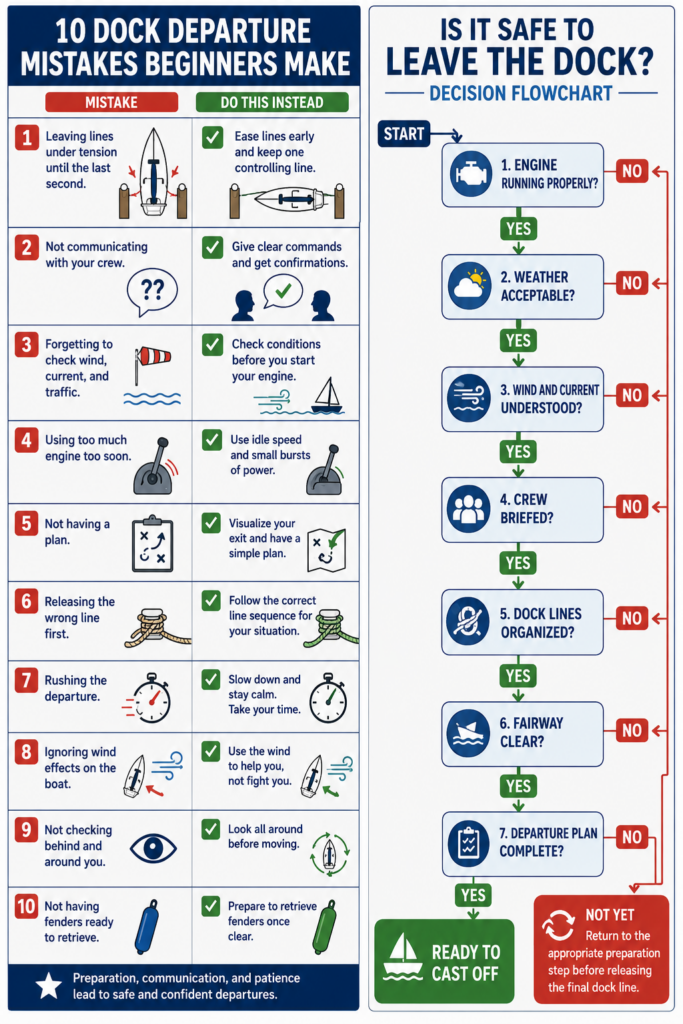
Common Beginner Mistakes
Every sailor makes mistakes while learning to leave the dock.
The good news is that most docking mishaps aren’t caused by a lack of steering skill. Instead, they happen because the skipper becomes rushed, skips part of the preparation, or reacts too quickly once the boat begins moving.
As you’ve seen throughout this guide, successful departures are usually slow, deliberate, and well planned. By recognizing the most common beginner mistakes, you’ll be much more likely to avoid them yourself.
Untying Every Line Too Soon
This is probably the most common mistake beginners make.
Once the last dock line is released, the boat immediately becomes subject to the wind, current, and momentum.
If you’re not completely ready, the boat begins making decisions for you.
Instead, keep one controlling line attached until:
- The engine is running.
- The crew is ready.
- Your departure path is clear.
- You know exactly what will happen next.
Only then should the final line be released.
Using Too Much Throttle
When the boat doesn’t respond immediately, many beginners instinctively push the throttle farther forward.
Unfortunately, this usually makes the situation worse.
More speed means:
- Less thinking time.
- Larger steering corrections.
- Greater stopping distance.
- Harder impacts if something goes wrong.
Instead, remember one simple rule:
Use only enough throttle to maintain steerage.
Idle speed is sufficient for most marina departures.
Forgetting the Fenders
Fenders protect your boat while you’re still close to the dock.
Some beginners bring them aboard before leaving.
Others forget them hanging over the side long after they’ve left the marina.
A better routine is to leave the fenders deployed until you’re safely clear of nearby boats and dock structures.
Once you’re in open water, retrieve and stow them neatly.
Looking Only at the Bow
When steering away from the dock, beginners naturally watch the bow because it’s directly in front of them.
However, the stern often swings much farther than expected.
This is especially true while reversing.
Instead of watching only one end of the boat, develop the habit of scanning continuously:
- Bow
- Stern
- Dock
- Fairway
- Other boats
This broader awareness helps you anticipate problems before they develop.
Steering Before the Boat Is Moving
Many new sailors turn the wheel all the way over before the boat has started moving.
Then they become frustrated because nothing happens.
Remember that the rudder only works when water flows across it.
Allow the boat to begin moving before expecting significant steering response.
Likewise, avoid making repeated steering corrections while waiting for the first one to take effect.
Ignoring Wind Direction
Sometimes beginners become so focused on the engine and helm that they forget the wind entirely.
Unfortunately, the wind never forgets.
The moment the final dock line is released, the wind begins pushing on:
- The mast
- The cabin
- The boom
- The hull above the waterline
Always identify the wind direction before beginning your departure.
It remains one of the most important pieces of information you’ll gather.
Not Briefing the Crew
Crew members cannot read your mind.
If nobody knows when to release a line—or which line to release—the departure quickly becomes confusing.
Instead, explain everyone’s job before the engine goes into gear.
Simple instructions are almost always the best instructions.
Trying to Rush
Many beginners feel pressure because other boats are waiting.
As a result, they hurry.
Ironically, rushing usually delays the departure even more.
Experienced sailors understand that taking an extra thirty seconds to prepare is far preferable to spending five minutes recovering from a mistake.
Never let another skipper pressure you into departing before you’re ready.
Panicking After a Small Mistake
Almost every skipper has experienced a departure that didn’t begin exactly as planned.
Perhaps the wind catches the bow.
Perhaps the stern swings farther than expected.
Perhaps a crew member releases the wrong line.
Don’t panic.
Slow down.
Shift to neutral if necessary.
Think.
Then decide on your next action.
Most minor problems become major problems only when the skipper begins reacting emotionally instead of thoughtfully.
Failing to Have a Backup Plan
Even the best departure plans occasionally need to change.
A boat may suddenly enter the fairway.
The wind may increase.
The current may prove stronger than expected.
Ask yourself one final question before leaving the dock:
“If this doesn’t work, what will I do?”
Sometimes the answer is simply:
“I’ll stop and tie the boat back up.”
There is absolutely nothing wrong with that decision.
Good seamanship isn’t about never making mistakes.
It’s about recognizing them early and responding calmly.
Practicing Dock Departures Safely
Like every boating skill, leaving the dock improves with repetition.
Fortunately, you don’t need difficult conditions to become proficient.
Practice on Calm Days
Begin practicing when the wind is light and the water is calm.
Removing unnecessary challenges allows you to focus on learning the departure sequence rather than fighting the weather.
Choose an Empty Marina
If possible, practice during quieter times when fewer boats are moving around the marina.
Early mornings and weekdays often provide excellent opportunities.
Less traffic means less pressure and more room to think.
Repeat the Same Departure
Rather than trying a different maneuver every time, repeat the same departure several times.
Each repetition builds confidence.
You’ll soon notice that many actions become automatic.
That’s exactly what you’re aiming for.
Build Confidence Gradually
As your experience grows, begin practicing in slightly stronger winds or different marina layouts.
There’s no need to rush this process.
Confidence comes from many successful departures—not one difficult one.
Structured instruction can dramatically shorten the learning curve. US Sailing offers educational resources and training pathways that reinforce safe boat-handling skills for new sailors.
Frequently Asked Questions
Even after understanding the basic departure sequence, most beginners still have a few practical questions. The answers below address some of the situations you’re most likely to encounter during your first few outings.
Should I Raise the Sails Before Leaving the Dock?
In almost every situation, no.
Leave the dock under engine power with the sails secured.
Once you’re well clear of the marina, other boats, shallow water, and navigation hazards, head into open water where you have room to maneuver. Then turn the boat into the wind and hoist the sails.
Raising sails while still tied to the dock or maneuvering through a marina can make the boat more difficult to control and may create unnecessary hazards.
How Fast Should I Leave the Dock?
Slower than most beginners think.
Idle speed is usually all that’s required.
Your goal isn’t to accelerate away from the dock. Instead, your goal is to maintain enough water flow over the rudder to steer while keeping plenty of time to think and react.
If you’re wondering whether you’re using too much throttle, you probably are.
Which Dock Line Should I Remove Last?
There isn’t one universal answer.
The last line removed should be the one that gives you the greatest control under the current conditions.
Depending on the wind, current, and dock layout, this may be:
- The bow line.
- The stern line.
- A forward spring line.
- An aft spring line.
Think about which line is helping the boat stay where you want it. That line usually remains attached until the final moments of departure.
Can One Person Leave the Dock Alone?
Yes.
Many sailors regularly leave and return to the dock without crew.
However, single-handed departures require additional planning because the skipper must:
- Operate the engine.
- Steer the boat.
- Handle every dock line.
- Observe surrounding traffic.
If you’re learning to sail, it’s much easier to practice with another person aboard until you become comfortable with the basic sequence.
Should I Leave Under Sail or Under Power?
For beginners, almost always under power.
Marinas are designed for slow-speed maneuvering under engine power.
Once you’ve cleared the marina and reached open water, you can safely hoist the sails and begin sailing.
Likewise, when returning to the marina, lower the sails before entering and complete the docking maneuver under engine power.
What If I Start Drifting Toward Another Boat?
Stay calm.
Avoid making large steering or throttle corrections out of panic.
Instead:
- Shift to neutral if appropriate.
- Assess what the wind and current are doing.
- Use gentle throttle adjustments.
- Make smooth steering corrections.
If necessary, stop the maneuver entirely.
Sometimes the safest decision is to return to the dock, secure the boat again, and start over.
There is no embarrassment in trying again.
What If the Wind Is Too Strong?
Sometimes the safest decision is not to leave.
If strong winds exceed your experience level, consider waiting until conditions improve.
Experienced sailors postpone departures all the time.
Good seamanship isn’t about proving you can handle every situation.
It’s about making sound decisions before problems develop.
As your skills improve, you’ll gradually become comfortable leaving the dock in a wider range of conditions.
When Should I Abort a Departure?
Abort the departure whenever you feel you’ve lost control of the situation.
Examples include:
- Another boat suddenly blocks the fairway.
- The wind shifts dramatically.
- A dock line becomes tangled.
- The engine isn’t operating properly.
- A crew member is confused or not ready.
- The boat begins moving somewhere you didn’t expect.
If there’s enough room, return to the dock and secure the boat.
Take a few minutes to understand what happened before trying again.
Experienced sailors do this regularly.
Key Takeaways
Before you leave the dock, remember these essential principles:
- Preparation is more important than boat-handling skill.
- Always assess the wind, current, and marina before casting off.
- Plan your departure before releasing the first dock line.
- Keep one controlling line attached until you’re ready to move.
- Use idle speed whenever possible.
- Allow water to flow over the rudder before expecting the boat to turn.
- Don’t rush because another boat is waiting.
- Small, smooth corrections are better than large, sudden ones.
- If something doesn’t feel right, stop and reassess.
- Confidence comes from practicing the same routine repeatedly.
Leaving the dock is one of the first skills every sailor must learn, and it’s also one of the most rewarding. After a few successful departures, you’ll begin to trust both your preparation and your ability to read the conditions around you.
What’s Next?
Now that you know how to leave the dock safely and confidently, you’re ready to continue building your boat-handling skills.
Your next lessons on SailboatZone should be:
- How to Dock a Sailboat (future article) — Learn how to return to the dock with the same calm, controlled approach you used when departing.
- How to Steer a Sailboat — Refine your steering technique using smooth, deliberate helm movements.
- How to Trim a Sail — Learn how proper sail trim improves boat speed, balance, and control.
- Points of Sail Explained — Understand how your boat’s direction relative to the wind affects sail trim and performance.
- Tacking vs. Gybing — Master the two essential methods of changing direction under sail.
- Anchoring a Sailboat — Finish your day on the water by learning how to anchor safely and confidently.
Every new skill builds on the last. By following this sequence, you’ll develop a solid foundation that makes sailing safer, more enjoyable, and far less intimidating.