
Approximate reading time: 35 minutes
Introduction
If you’ve ever driven a car, you already know how to steer—at least that’s what many beginners assume. Then they step aboard a sailboat, take hold of the wheel or tiller, and quickly discover that sailing is a very different experience.
A car goes wherever you point the front wheels. A sailboat doesn’t.
Instead, a sailboat is constantly interacting with three powerful forces: the wind, the sails, and the water. The helm gives you control over the boat’s direction, but it doesn’t overpower those forces. Learning to steer well is really about learning to work with them rather than against them.
That may sound complicated, but it isn’t.
In fact, one of the biggest surprises for new sailors is that good steering involves doing less, not more.
Experienced helmsmen rarely make dramatic movements. They don’t saw the wheel back and forth or shove the tiller from side to side. Instead, they make small, deliberate corrections while allowing the boat to settle naturally on its course.
Think of steering a sailboat as gently guiding the boat rather than forcing it to obey.
Once you understand how the rudder works, how the wind affects the boat, and how the sails and helm work together, steering becomes one of the most satisfying parts of sailing.
By the end of this guide, you’ll understand not only how to steer a sailboat, but why experienced sailors steer the way they do.
Learner Outcome
After reading this article, you’ll understand how the helm controls a sailboat, why the rudder works the way it does, and how to steer smoothly and confidently in normal sailing conditions.
Quick Summary
If you’re new to sailing, these are the most important ideas to keep in mind.
- Steering controls the boat’s direction, not its speed.
- The wind determines where a sailboat can and cannot travel.
- Small steering corrections almost always work better than large ones.
- Steering and sail trim always work together.
- A balanced sailboat is easier to steer and more enjoyable to sail.
Don’t worry if some of these ideas seem unfamiliar right now. We’ll build each concept step by step throughout this guide.
Table of Contents
- Meet the Helm
- How a Sailboat Actually Turns
- Wheel vs. Tiller Steering
- Which Way Do You Turn?
- Learning to Steer Straight
- Reading the Feel of the Helm
- Steering with the Wind
- Steering and Sail Trim Work Together
- Common Steering Mistakes Every Beginner Makes
- Steering During Common Manoeuvres
- Steering in Different Conditions
- Steering with Confidence
1. Meet the Helm
Before you can steer a sailboat, it’s helpful to understand the equipment you’re using.
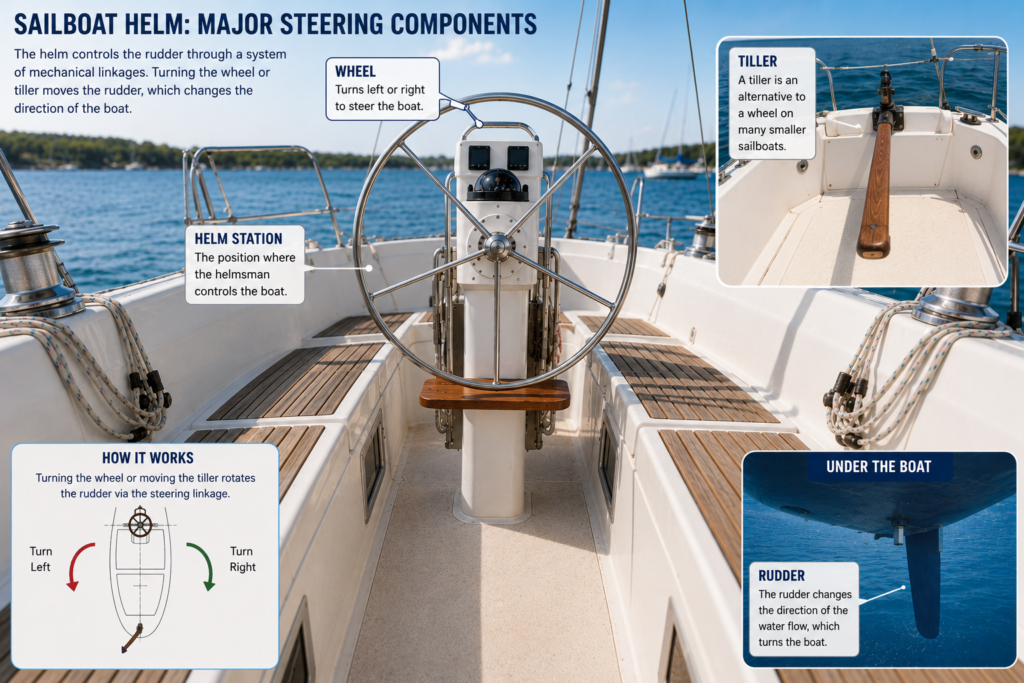
The place where the boat is steered is called the helm.
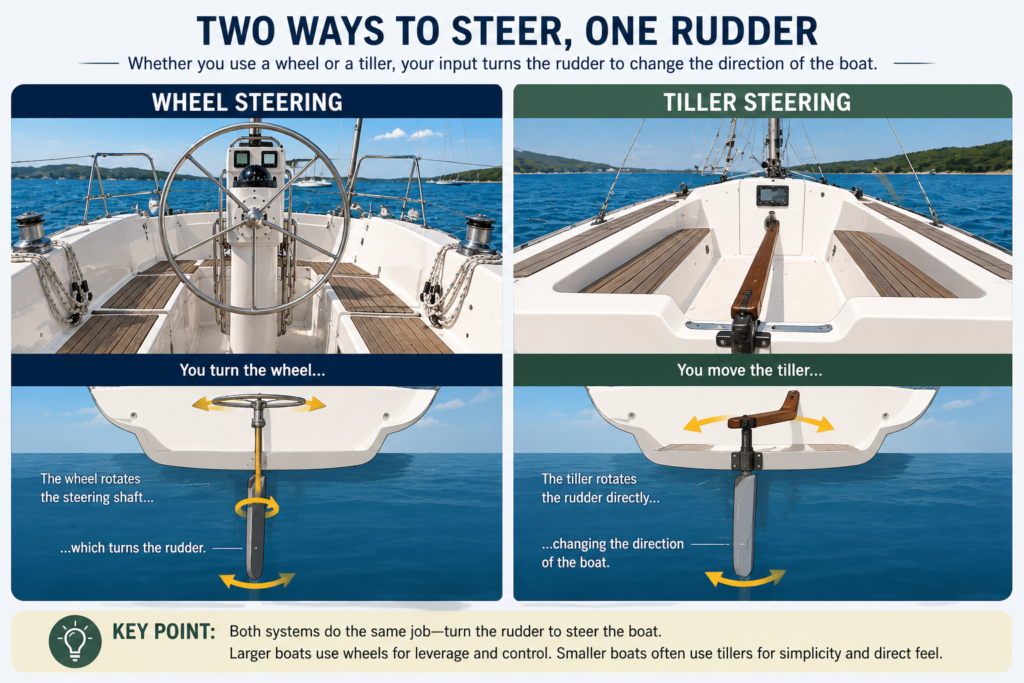
Depending on the size and design of the sailboat, the helm may consist of either a wheel or a tiller. Both perform exactly the same job: they control the rudder, which turns the boat.
Many larger cruising sailboats use a wheel because it is comfortable to operate and takes up less cockpit space when several people are aboard. Smaller sailboats often use a tiller because it is simple, lightweight, responsive, and gives the skipper a direct feel for what the boat is doing.
Although they look very different, don’t think of them as two different steering systems. They’re simply two different ways of controlling the same rudder.
We’ll compare wheels and tillers in detail later in this guide.
What Does the Helm Actually Do?
Many beginners assume the wheel points the boat in the direction they want to go.
That’s not quite true.
The helm doesn’t point the boat.
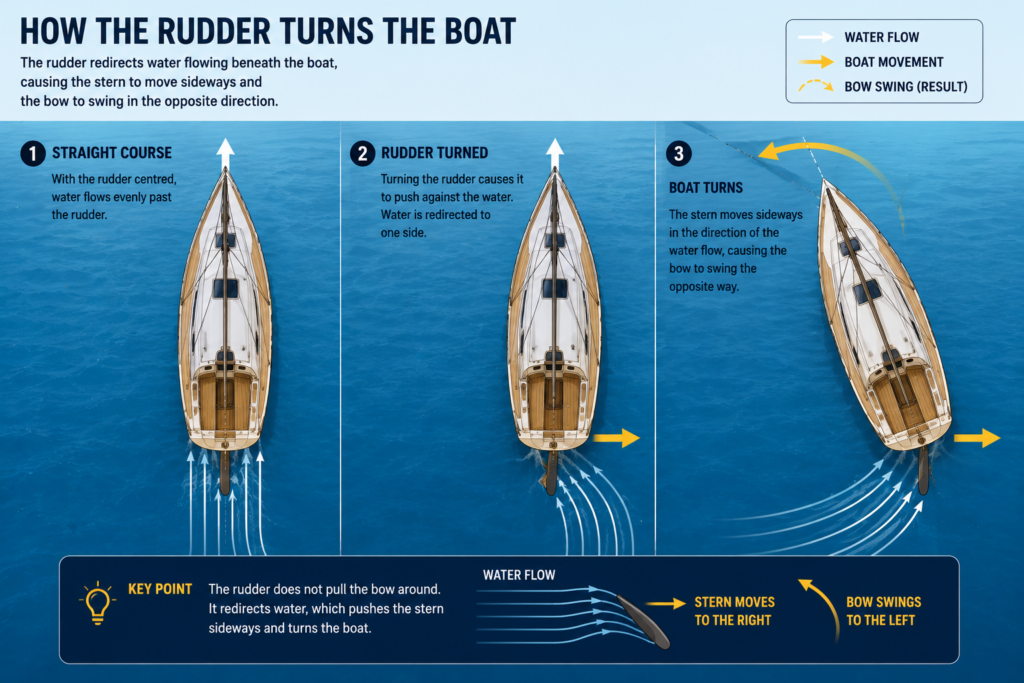
It turns the rudder, and the rudder redirects water flowing past the boat. That change in water flow causes the stern to move sideways, allowing the bow to swing in the opposite direction.
This may sound like a small distinction, but it’s one of the most important concepts in sailing.
Instead of pulling the bow around, the rudder works by pushing against moving water.
That also explains why steering feels different depending on how fast the boat is moving.
When the boat is travelling slowly, very little water is flowing over the rudder. Steering feels sluggish, and larger helm movements may be needed before the boat begins to respond.
As the boat gains speed, more water flows across the rudder, making it much more effective. Small steering inputs suddenly become all that’s required.
This is one reason experienced sailors avoid making large steering movements. Once the rudder has enough water flowing across it, only gentle corrections are usually necessary.
The Helm Station
The area where you stand or sit while steering is commonly called the helm station.
From here, the helmsman should be able to:
- See ahead of the boat.
- Watch the sails.
- Observe the wind.
- Monitor nearby boats and hazards.
- Reach important controls when necessary.
Good steering isn’t just about turning the wheel. It’s about constantly observing what’s happening around the boat.
Experienced sailors spend as much time looking outside the boat as they do looking at the helm itself.
Steering Begins Before You Touch the Helm
One of the biggest mindset shifts for beginners is realizing that steering starts with observation.
Before making any correction, ask yourself:
- Where is the wind coming from?
- Are the sails trimmed properly?
- Is the boat balanced?
- Am I actually off course?
Many steering problems aren’t steering problems at all. They’re sail trim problems.
For example, if the sails are poorly trimmed, you may find yourself constantly fighting the wheel just to stay on course. Rather than forcing the helm, experienced sailors usually adjust the sails first and then make only a small steering correction.
You’ll learn much more about this relationship later in this guide, but it’s worth introducing now because it explains why sailing often looks so effortless when experienced sailors are at the helm.
Beginner Tip
If you find yourself making large steering corrections every few seconds, resist the temptation to turn the wheel even farther. Instead, pause for a moment and ask whether the boat actually needs more steering—or whether it needs better sail trim. Small corrections almost always produce smoother, faster, and more comfortable sailing.
Diagram 1 — Helm Components
Internal Links
To continue building your understanding of sailboat steering, these articles pair naturally with this lesson:
- Parts of a Sailboat (understand where the helm, rudder, and cockpit fit into the boat’s overall design)
- Points of Sail (learn how wind direction affects the way a sailboat is steered)
- How Sails Work (discover why sails create the forces that the helm must manage)
- Rudder Explained (learn exactly how the rudder changes a sailboat’s direction)
Looking Ahead
Now that you know what the helm is and how it controls the rudder, the next step is understanding how a sailboat actually turns.
You may be surprised to learn that the rudder doesn’t pull the boat around like the steering wheels on a car. Instead, it redirects the flow of water beneath the boat, and understanding that simple principle will make every steering movement more predictable and more confident.
2. How a Sailboat Actually Turns
If you’ve ever watched a sailboat from shore, you may have wondered what actually makes it turn.
At first glance, it looks as though the wheel simply points the boat in a new direction, much like the steering wheel in a car. But that’s not what happens.
A sailboat turns because the rudder changes the direction of the water flowing past it. The movement of that water pushes the stern sideways, allowing the bow to swing in the opposite direction.
Understanding this simple idea will help you become a much smoother helmsman.
The Rudder Doesn’t Pull the Boat
A common misconception among beginners is that the rudder pulls the front of the boat around.
In reality, the rudder is located at the stern, not the bow.
When you move the wheel or tiller, the rudder rotates into the flow of water passing beneath the boat. That angled rudder redirects the water to one side. According to Newton’s Third Law, the water pushes back against the rudder with an equal and opposite force.
That force moves the stern sideways.
As the stern moves, the bow naturally swings the opposite way.
Instead of imagining the bow being pulled around, picture someone gently pushing the back of a shopping cart. The rear moves first, causing the front to pivot in a new direction. A sailboat behaves in much the same way.
Water Flow Is the Secret
One of the most important lessons for a new sailor is this:
No moving water means very little steering.
The rudder only works effectively when water is flowing across it.
Imagine dipping your hand into a still bathtub. You can wave it back and forth, but you don’t feel much resistance.
Now imagine holding your hand out of a moving car window. Even a small angle creates significant pressure because the air is moving quickly past your hand.
The rudder works in exactly the same way.
As your sailboat gains speed, more water flows over the rudder, increasing its effectiveness. This is why steering becomes more responsive once the boat is moving well.
Why Boats Don’t Turn Instantly
Another difference between sailboats and cars is momentum.
Cars ride on tires that grip the road. When you turn the steering wheel, the tires immediately redirect the vehicle.
A sailboat is floating in water.
Even after the rudder begins redirecting the flow of water, the boat’s weight and momentum continue carrying it forward for a short distance before the turn develops.
This delay catches many beginners by surprise.
They turn the wheel.
Nothing seems to happen.
So they turn it farther.
A moment later the boat suddenly swings much more than they intended.
This is called oversteering, and it’s one of the most common beginner mistakes.
The solution is surprisingly simple.
Make a small steering correction.
Wait.
Let the boat respond.
If another correction is needed, make another small adjustment.
Patience produces straighter, smoother steering than constantly moving the helm.
Speed Makes Steering Easier
Many beginners assume a slower boat should be easier to steer.
In reality, the opposite is often true.
At very slow speeds, the rudder has little water flowing across it, so it has less authority.
As speed increases, steering becomes more responsive.
This is especially noticeable when manoeuvring around a marina. Boats often respond slowly until they begin moving, after which the helm suddenly becomes much more effective.
This doesn’t mean you should travel quickly in confined spaces. Instead, it helps explain why gentle bursts of speed are sometimes used during docking manoeuvres to improve rudder control. We’ll explore that topic in the Docking a Sailboat article.
Beginner Tip
Think ahead of the boat.
Your steering input today affects where the boat will be a few seconds from now. Rather than reacting after the boat has wandered off course, make small corrections early and allow the boat time to respond.
Diagram 2 — How the Rudder Turns the Boat
Internal Links
- Rudder Explained
- Keel Explained
- How Sails Work
3. Wheel vs. Tiller Steering
Every sailboat is steered using a helm, but not every helm looks the same.
If you spend time around different boats, you’ll notice that some have a large steering wheel while others use what looks like a long wooden or metal handle extending from the rudder.
This handle is called a tiller.
Although they look very different, both systems accomplish exactly the same task: turning the rudder.
The choice between them depends largely on the size and purpose of the boat.
Wheel Steering
Most cruising sailboats over about 30 feet use a steering wheel.
Turning the wheel moves a series of cables, chains, gears, or hydraulic components that eventually rotate the rudder.
Because of this mechanical connection, wheel steering often feels smooth and requires relatively little physical effort.
Advantages
- Comfortable on long passages.
- Familiar to people who drive cars.
- Leaves more usable cockpit space when centred.
- Well suited to larger, heavier boats.
Disadvantages
- Provides less direct feedback from the rudder.
- More mechanical components require maintenance.
- Can make beginners think a sailboat steers like a car.
Tiller Steering
A tiller is a long lever attached directly to the rudder stock.
Instead of turning a wheel, you simply move the tiller from side to side.
Because the tiller connects directly to the rudder, you immediately feel how the water is pushing against it. Many sailors enjoy this direct feedback because it helps them sense what the boat is doing.
Advantages
- Simple and reliable.
- Excellent feedback from the rudder.
- Lightweight.
- Easy to maintain.
Disadvantages
- Can require more physical effort on larger boats.
- Takes up cockpit space while steering.
- Feels unfamiliar to many beginners.
The One Thing That Confuses Everyone
If you’ve never used a tiller before, one characteristic seems backwards.
To turn the bow to port, you move the tiller toward starboard.
To turn the bow to starboard, you move the tiller toward port.
At first, this feels completely unnatural.
The reason becomes obvious when you remember what the tiller is connected to.
Moving the tiller pushes the top of the rudder in one direction, causing the bottom of the rudder to angle the opposite way. That angled rudder redirects the water and swings the stern, causing the bow to turn where you want it to go.
After only a short time on the water, most sailors stop thinking about the mechanics and simply steer instinctively.
Should Beginners Learn Both?
Absolutely.
Even if you expect to sail only larger cruising boats with wheels, learning on a tiller can help you develop a better understanding of how the rudder behaves.
Likewise, sailors who begin on a tiller usually adapt quickly to steering with a wheel because they already understand what the rudder is doing beneath the boat.
The principles of good steering remain exactly the same:
- Make small corrections.
- Look well ahead.
- Let the boat respond.
- Work with the wind instead of fighting it.
Whether your hands are holding a wheel or a tiller, these habits will make you a smoother, more confident helmsman.
Wheel vs. Tiller at a Glance
| Wheel | Tiller |
|---|---|
| Turn the wheel in the direction you want the bow to go. | Move the tiller opposite the direction you want the bow to turn. |
| Common on larger cruising sailboats. | Common on smaller sailboats and dinghies. |
| Smooth, familiar steering. | Direct, responsive steering. |
| Less feedback from the rudder. | Excellent feel for the boat. |
Diagram 3 — Wheel vs. Tiller Steering
Internal Links
- Types of Sailboats
- Steering with a Wheel
- Steering with a Tiller
- Parts of a Sailboat
Looking Ahead
Now that you understand how a rudder turns a sailboat and the difference between wheel and tiller steering, it’s time to look at how steering changes depending on the boat’s relationship to the wind.
You’ll discover that a sailboat doesn’t steer exactly the same on every point of sail. As the wind moves around the boat, the helm becomes more or less sensitive, and learning to anticipate those changes is an important step toward steering with confidence.
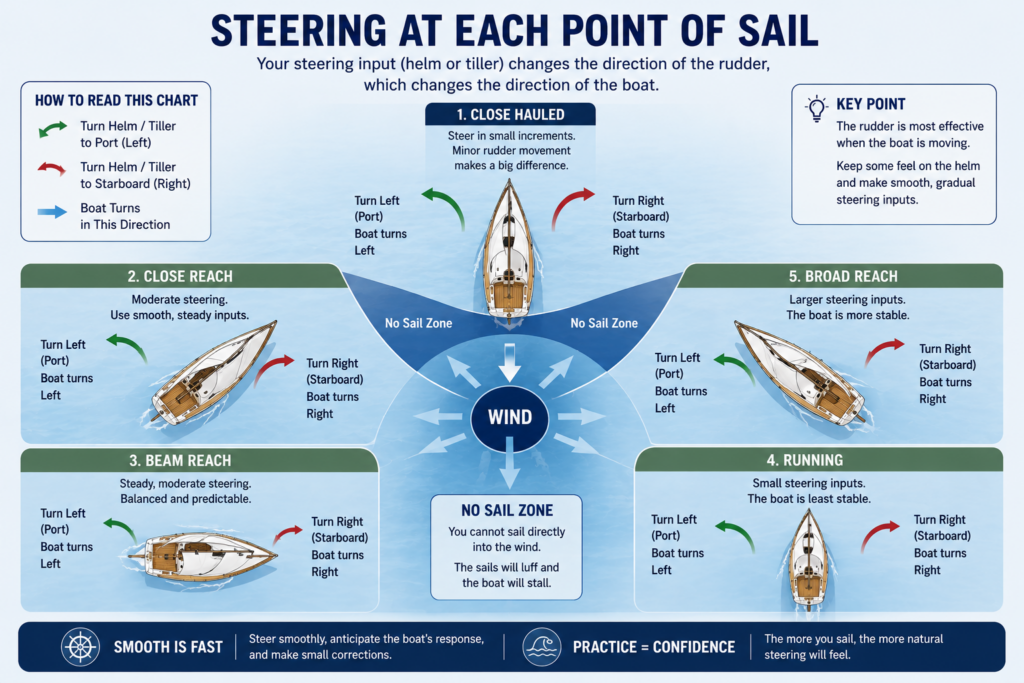
4. Steering on Different Points of Sail
By now, you understand that the rudder turns a sailboat by redirecting water flowing beneath it. But there’s another factor that has an enormous influence on steering:
The direction of the wind.
A sailboat doesn’t handle the same way on every course. As the wind changes relative to the boat, the sails generate different amounts of power, the boat heels differently, and the helm feels lighter or heavier.
If you’ve already read our Points of Sail guide, you’ll know that every sailing course falls into one of five basic points of sail. Each one requires slightly different steering techniques.
The good news is that the principles remain the same. Your goal is always to make small, smooth corrections while allowing the boat to find its natural balance.
Close Hauled
When sailing close hauled, you’re sailing as close to the wind as the boat can efficiently travel—typically about 40 to 45 degrees off the wind.
This is one of the most demanding points of sail for beginners.
The sails are trimmed tightly, the boat often heels noticeably, and small steering movements produce significant changes in sail performance.
Steer too far toward the wind and the sails begin to luff, losing their smooth airflow and power.
Steer too far away from the wind and the boat slows because you’re no longer sailing as efficiently upwind.
Rather than staring at the compass, experienced sailors often watch the front edge of the sails or the telltales. These provide immediate feedback about whether the boat is maintaining the proper angle to the wind.
Beginner Tip
When sailing close hauled, resist the temptation to chase every tiny movement. Small, patient corrections keep the sails drawing efficiently and produce a much smoother ride.
Close Reach
A close reach is often one of the easiest and most enjoyable points of sail.
The wind comes from slightly farther aft, the sails remain well powered, and the boat generally feels balanced.
Many sailors find steering on a close reach more forgiving than sailing close hauled because the boat has a little more room for small steering errors before the sails begin to lose efficiency.
It’s an excellent point of sail for practising smooth steering.
Beam Reach
A beam reach occurs when the wind blows directly across the side of the boat.
Many sailors consider this the fastest and most comfortable point of sail.
The sails are producing excellent power, yet the helm often feels light and predictable.
For beginners, this is an ideal time to practise looking well ahead instead of watching the bow.
Choose a distant landmark—a buoy, shoreline feature, or mountain peak—and steer toward it using only gentle corrections.
You’ll often discover that the boat naturally wants to hold its course if you simply avoid oversteering.
Broad Reach
On a broad reach, the wind comes from behind and to one side.
The sails are eased well out, and the boat remains efficient while travelling comfortably downwind.
Because the sails are farther from the centreline, steering becomes a little more sensitive.
Large steering movements can change the wind angle quickly, so smooth helm control becomes increasingly important.
Running
When sailing dead downwind, the wind comes almost directly from behind the boat.
This is usually the least stable point of sail.
Small steering errors can cause the wind to shift rapidly across the stern, increasing the risk of an accidental gybe, where the boom swings forcefully from one side of the boat to the other.
For that reason, experienced sailors pay close attention to their heading while running.
Steering should remain calm, deliberate, and predictable.
If conditions become challenging, many sailors choose to sail a series of broad reaches instead of travelling directly downwind.
Steering Changes with Every Point of Sail
As you gain experience, you’ll begin noticing that the helm seems to have its own personality.
Sometimes the boat feels eager to turn.
Other times it seems reluctant to respond.
This isn’t because the rudder has changed.
It’s because the balance between the wind, the sails, and the hull is constantly changing.
The more balanced the boat becomes, the easier steering feels.
Diagram 4 — Steering on Different Points of Sail
Internal Links
- Points of Sail
- Sail Trim Basics
- How Sails Work
5. Learning to Steer Straight
One of the first challenges every beginner faces is simply sailing in a straight line.
At first, it sounds easy.
In practice, most new sailors steer a course that looks more like a series of gentle zigzags.
If that’s happened to you, don’t worry. Nearly everyone experiences it.
Fortunately, the solution isn’t better reflexes.
It’s better patience.
Why Beginners Zigzag
The most common cause of zigzagging is oversteering.
Imagine you’re riding a bicycle along a narrow path.
If you made large handlebar movements every time you drifted a few centimetres, the bike would weave from side to side.
The same thing happens on a sailboat.
A beginner notices the bow drifting slightly.
They turn the helm too much.
The boat responds a few seconds later.
Now it’s drifting the opposite way.
Another large correction follows.
The cycle repeats.
Good steering breaks this pattern by making only the smallest correction needed and then waiting to see how the boat responds.
Look Far Ahead
One of the simplest ways to improve your steering is also one of the easiest to forget.
Don’t stare at the bow.
Instead, pick a point well ahead on the horizon.
This could be:
- A buoy.
- A distant island.
- A mountain peak.
- A shoreline tree.
- A cloud directly ahead.
Looking farther ahead makes small heading changes much easier to notice before they become large ones.
It’s exactly the same technique experienced drivers use when travelling on a highway.
Let the Boat Finish the Turn
Remember that a sailboat has momentum.
Even after you return the helm to centre, the boat continues turning for a short time.
That’s perfectly normal.
Rather than fighting this natural movement, learn to anticipate it.
Small correction.
Wait.
Observe.
Correct again only if necessary.
Experienced sailors often appear relaxed because they’ve learned to trust the boat instead of constantly forcing it.
Common Beginner Mistake
If you find yourself moving the wheel or tiller every second or two, you’re probably steering too much. Aim for fewer, smaller corrections and allow the boat time to settle on its course.
6. Reading the Feel of the Helm
One of the most valuable skills in sailing isn’t something you see.
It’s something you feel.
As you spend more time at the helm, you’ll notice that the steering system constantly communicates with you.
A balanced boat feels different from an unbalanced one.
Learning to recognize those sensations is one of the fastest ways to improve your sailing.
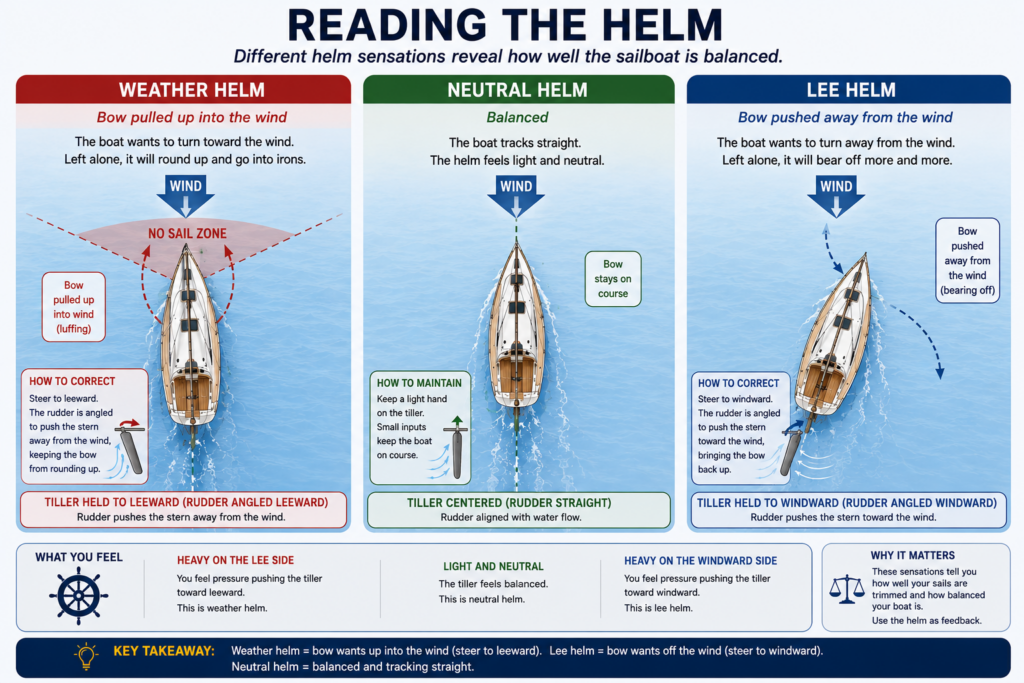
Heavy Helm
A heavy helm requires constant effort to hold.
You may feel as though the wheel wants to pull strongly in one direction or the tiller constantly pushes against your hand.
Heavy helm usually means the boat is out of balance.
Often the sails are producing more turning force than the rudder should have to counteract.
The solution usually isn’t to fight harder.
It’s to improve the boat’s balance by adjusting sail trim or reducing sail if conditions are becoming too windy.
Light Helm
A light helm feels easy to steer.
The wheel or tiller responds smoothly with very little effort.
This is generally a sign that the boat is properly balanced.
Most sailors aim for this comfortable feeling.
Balanced Helm
An ideally balanced sailboat almost seems to steer itself.
You still guide it, of course, but you aren’t wrestling with the helm.
Instead, the boat tracks naturally with only occasional corrections.
When experienced sailors talk about a boat being “well balanced,” this is what they mean.
Weather Helm
Most sailboats naturally develop a slight tendency to turn toward the wind.
This is called weather helm.
A small amount of weather helm is considered desirable because it helps the boat round up gently if the helm is released.
Too much weather helm, however, creates unnecessary drag, tires the helmsman, and slows the boat.
Lee Helm
The opposite condition is called lee helm.
Here, the boat naturally wants to turn away from the wind.
Most sailors consider lee helm undesirable because it reduces the boat’s natural tendency to head safely into the wind if control is lost.
Fortunately, properly designed and properly trimmed sailboats rarely experience significant lee helm.
The Boat Is Giving You Information
Don’t think of the helm as something you simply control.
Think of it as something that communicates.
If steering suddenly becomes heavy…
Ask why.
If the boat constantly wants to round up…
Ask why.
If the helm suddenly feels unusually light…
Ask why.
These changes often provide early clues that the wind has strengthened, sail trim needs adjustment, or the boat’s balance has changed.
Learning to listen to those clues is one of the hallmarks of an experienced sailor.
Diagram 5 — Reading the Helm
Internal Links
- Weather Helm vs. Lee Helm
- Sail Trim Basics
- Reading the Wind
Looking Ahead
You’ve now learned how steering changes on different points of sail, why beginners often zigzag, and how the helm communicates the boat’s balance.
In the next section, we’ll combine these ideas by learning how to steer with the wind instead of fighting it. You’ll also discover why many steering problems can be solved by adjusting the sails rather than turning the wheel, helping you sail more smoothly, more efficiently, and with far less effort.
7. Steering with the Wind
One of the biggest milestones in learning to sail is realizing that you don’t steer by watching the wheel.
You steer by watching the wind.
Beginners often focus almost entirely on the helm, believing every change in direction requires another steering correction. Experienced sailors do almost the opposite. They constantly observe the wind, the sails, and the boat’s balance, making only the steering corrections that are truly necessary.
The wind is continually changing. It shifts in direction, increases or decreases in strength, and arrives in gusts and lulls. A good helmsman notices these changes early and responds smoothly instead of waiting until the boat is already off course.
Let the Boat Tell You What It Needs
Your sailboat is constantly giving you information.
The trick is learning to recognize it.
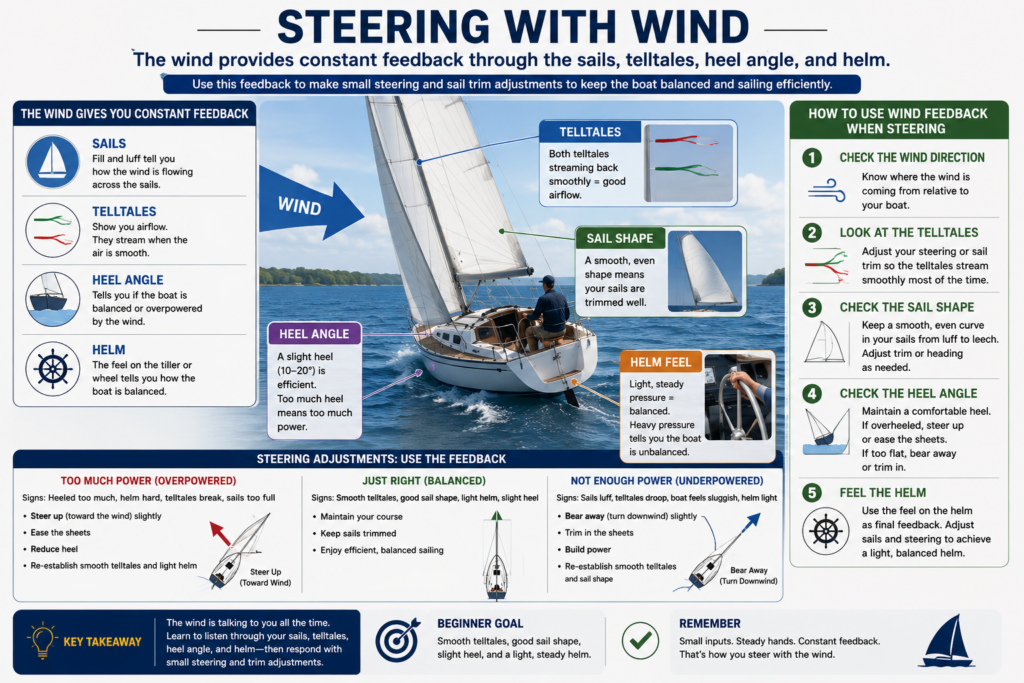
Some of the best indicators include:
- Telltales attached to the sails.
- The shape of the sails.
- The sound of luffing.
- The amount of heel.
- The feel of the helm.
Together, these clues tell you whether the boat is properly balanced or whether it needs a small steering or sail trim adjustment.
Watch the Telltales
Telltales are small ribbons attached to the sails that show how the air is flowing.
When both telltales stream smoothly aft, the sail is usually trimmed efficiently.
If the windward telltale begins lifting or fluttering, the boat may be pointing too close to the wind.
If the leeward telltale stalls behind the sail, you may have turned too far away from the wind or need to adjust the sail trim.
Rather than staring at the compass, experienced sailors frequently glance at these simple pieces of yarn because they provide immediate feedback.
Listen for Luffing
Sometimes your ears notice a problem before your eyes do.
When a sail begins luffing, it flaps loudly as the airflow separates from its surface.
This usually means you’ve steered too close to the wind or the sails need trimming.
Instead of making a large steering correction, try bearing away just a few degrees. Often that’s all the boat needs to regain smooth airflow.
Watch the Heel Angle
A sailboat’s heel also tells an important story.
A sudden increase in heel often means a gust has arrived.
Your first instinct might be to turn the wheel sharply.
Instead, pause and assess the situation.
Many gusts pass in only a few seconds. In moderate conditions, a slight steering adjustment combined with easing the mainsheet can often restore balance more effectively than large helm movements.
As you gain experience, you’ll begin anticipating these changes rather than simply reacting to them.
Diagram 6 — Steering with the Wind
Internal Links
- Using Telltales
- Reading the Wind
- Points of Sail
8. Steering and Sail Trim Work Together
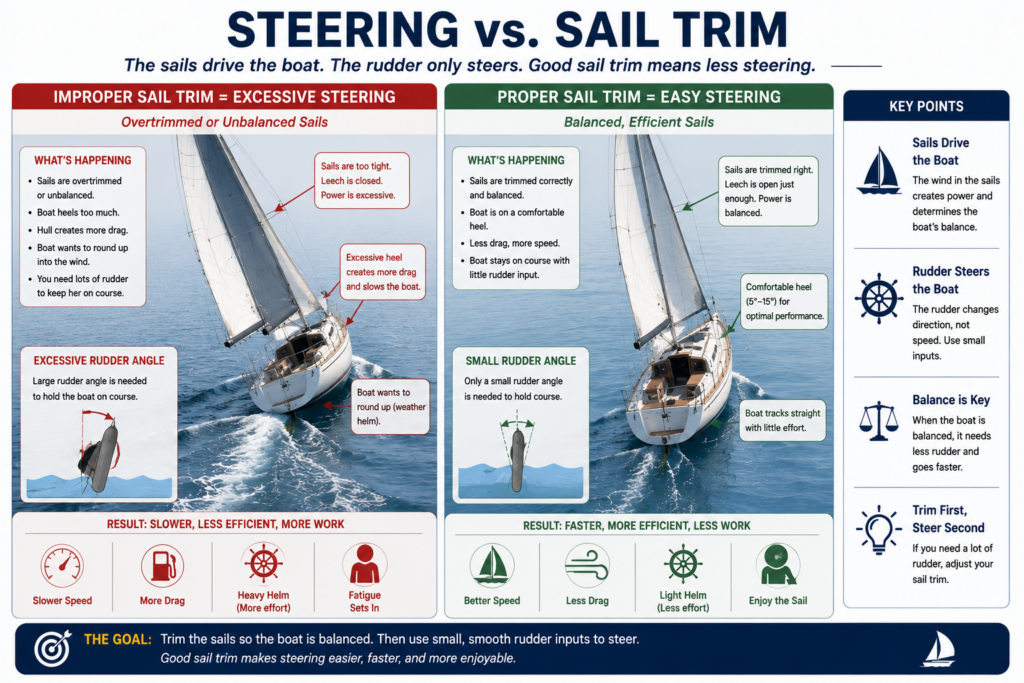
One of the most common misunderstandings among beginners is believing that every steering problem should be solved with the helm.
In reality, many steering problems begin with poor sail trim.
The rudder should make small adjustments to the boat’s direction.
It shouldn’t spend the entire day fighting the sails.
A Balanced Boat Is Easier to Steer
Imagine trying to push a shopping cart with one wheel constantly dragging sideways.
You could keep forcing it forward, but it would require unnecessary effort.
The same thing happens when sails are poorly trimmed.
If the sails are generating excessive turning force, the rudder must continually counteract that force.
The result is:
- heavier steering,
- increased drag,
- slower boat speed,
- greater fatigue for the helmsman.
A well-trimmed sailboat almost seems to steer itself.
Too Much Rudder Slows the Boat
Many beginners are surprised to learn that turning the rudder too far actually makes the boat slower.
A rudder works much like an airplane wing.
Small angles efficiently redirect the flow of water.
Large angles create turbulence and drag.
Instead of helping the boat, excessive rudder acts like a brake.
This is another reason experienced sailors rely on small steering corrections combined with good sail trim.
Adjust the Sails First
Suppose the boat constantly wants to turn toward the wind.
Many beginners grip the wheel tighter and continue fighting it.
Experienced sailors usually ask a different question:
“Why is the boat trying to turn?”
Perhaps the mainsail is trimmed too tightly.
Perhaps the wind has increased.
Perhaps it’s time to reef the sails.
Solving the root cause often eliminates the steering problem altogether.
Beginner Tip
Before making another steering correction, glance at the sails. If they don’t look balanced, adjusting the sheets may solve the problem more effectively than turning the helm.
Diagram 7 — Steering vs. Sail Trim
Internal Links
- Sail Trim Basics
- Mainsheet Explained
- Jib Sheet Explained
- Weather Helm vs. Lee Helm
9. Common Steering Mistakes Every Beginner Makes
Every sailor makes mistakes while learning.
The good news is that most steering mistakes are easy to recognize and even easier to correct once you know what to watch for.
Mistake #1 — Oversteering
This is by far the most common beginner mistake.
Large, frequent steering movements make the boat weave from side to side instead of following a smooth course.
Solution: Make one small correction, then wait for the boat to respond.
Mistake #2 — Watching the Bow
The bow moves constantly.
If you use it as your reference point, you’ll be tempted to correct every tiny movement.
Solution: Look well ahead toward the horizon or a distant landmark.
Mistake #3 — Ignoring Sail Trim
The rudder shouldn’t compensate for poorly trimmed sails.
Solution: Check sail trim whenever the helm feels unusually heavy or the boat constantly wants to turn.
Mistake #4 — Holding the Helm Too Tightly
A death grip on the wheel usually leads to unnecessary steering inputs.
Solution: Hold the helm comfortably and let the boat communicate through it.
Mistake #5 — Trying to Force the Boat
A sailboat naturally wants to find a balanced course.
Trying to overpower it usually creates more problems.
Solution: Work with the wind instead of fighting it.
Mistake #6 — Turning Too Late
Waiting until you’re far off course requires much larger steering corrections.
Solution: Make small adjustments as soon as you notice the boat beginning to wander.
Mistake #7 — Looking Inside the Boat Too Often
Checking lines, instruments, or talking with crew is important—but so is keeping your eyes outside.
The wind and water are constantly changing.
Solution: Spend most of your time looking where you’re going.
10. Steering During Common Manoeuvres
Steering techniques change slightly depending on what you’re trying to accomplish.
Here are a few common situations every beginner will encounter.
Holding a Course
Choose a distant object ahead and steer toward it.
Resist the temptation to chase every small movement of the bow.
Turning Upwind
Turns toward the wind should be smooth and deliberate.
Watch for the sails beginning to luff, then prepare for the tack if you’re crossing through the wind.
Turning Downwind
Downwind turns require extra attention because they can lead to an accidental gybe.
Steer steadily and avoid sudden changes in direction.
Sailing Around Another Boat
Plan your turn early.
Smooth, predictable movements make it easier for nearby sailors to understand your intentions.
Always follow the Rules of the Road and maintain a proper lookout.
Steering Through Small Waves
Rather than fighting every wave, allow the boat to rise and fall naturally.
Gentle corrections usually produce a smoother ride than constantly turning the helm.
Steering in Gusts
When a gust arrives, don’t panic.
Keep looking ahead, maintain a light touch on the helm, and make only the adjustments needed to keep the boat balanced.
Often a slight steering correction combined with easing the mainsail is all that’s required.
Scenario
You’re sailing across a lake on a beam reach when a stronger gust heels the boat farther than expected. Instead of making a sharp turn away from the wind, you ease the mainsheet slightly while making a small steering correction. The boat stands up, the helm becomes lighter, and you continue sailing comfortably without losing much speed.
Internal Links
- Tacking Explained
- Gybing Explained
- Rules of the Road
- Avoiding Collisions
- Docking a Sailboat
Looking Ahead
You’ve now learned how to steer with the wind, how sail trim affects the helm, and how to avoid the most common steering mistakes.
In the final section of this guide, you’ll learn how steering changes in different weather and sea conditions, practise exercises that build confidence at the helm, troubleshoot common steering problems, and test your knowledge with a short review before moving on to the next lessons in your sailing journey.
11. Steering in Different Conditions
By now, you’ve learned that good steering is about balance, patience, and working with the wind. Those principles remain true no matter where you sail.
What changes is how much steering input is needed.
As the wind and water change, so does the way the boat responds. Learning to anticipate these changes is what gradually transforms a beginner into a confident helmsman.
Steering in Light Wind
Light wind often surprises beginners because the boat feels slow and unresponsive.
With less wind filling the sails, the boat generates less speed. Since the rudder depends on water flowing across it, steering becomes less effective as well.
It’s tempting to make larger steering movements to force the boat to turn, but this usually creates unnecessary drag and slows the boat even more.
Instead:
- Keep steering movements small.
- Be patient while the boat responds.
- Maintain as much boat speed as possible.
- Avoid unnecessary turns.
Think of steering in light wind as guiding the boat gently rather than directing it forcefully.
Steering in Moderate Wind
Moderate wind is where most beginners learn to sail, and for good reason.
The sails have enough power to move the boat efficiently, the rudder has plenty of water flowing across it, and steering usually feels smooth and predictable.
This is the ideal time to practise all the skills you’ve learned in this article:
- Looking well ahead.
- Making small corrections.
- Watching the telltales.
- Feeling the helm.
- Steering with relaxed hands.
Most of your sailing experience will likely happen in these comfortable conditions.
Steering in Strong Wind
As the wind increases, the sails generate much more force.
The boat heels farther.
The helm often becomes heavier.
Small steering mistakes have larger consequences.
The solution isn’t stronger steering.
It’s better balance.
If the boat becomes difficult to control, ask yourself:
- Are the sails trimmed correctly?
- Should the mainsheet be eased?
- Is it time to reef the sails?
- Am I trying to carry too much sail for these conditions?
Remember that a balanced boat is almost always easier to steer than an overpowered one.
If conditions become uncomfortable, reducing sail is often the safest and fastest solution.
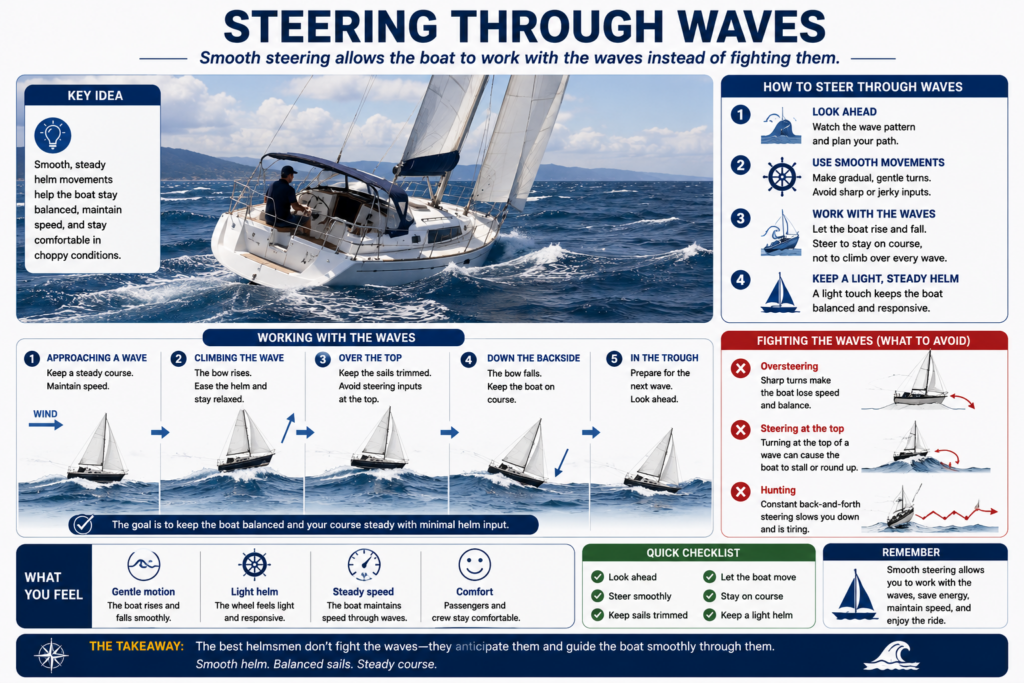
Steering Through Waves
Waves constantly push the bow from side to side.
Many beginners try to fight every movement.
Experienced sailors rarely do.
Instead, they allow the boat to move naturally while making only the corrections necessary to maintain the overall course.
Think of the boat riding over the waves rather than trying to cut perfectly straight through them.
A relaxed approach produces a smoother ride and requires much less effort.
Crossing Another Boat’s Wake
The wake from another boat can briefly alter your course.
As the bow climbs the first wave, the boat may try to turn.
As it slides down the back, the steering may feel different again.
Maintain a light grip on the helm and let the boat settle before making large corrections.
Usually the disturbance lasts only a few seconds.
Diagram 8 — Steering Through Waves
Internal Links
- Heavy Weather Sailing
- Reading the Wind
- Sail Trim Basics
12. Steering with Confidence
Confidence at the helm doesn’t come from memorizing techniques.
It comes from practice.
Every hour you spend steering teaches your hands and eyes how the boat naturally responds to the wind and water.
The goal isn’t perfect steering.
The goal is becoming calm, observant, and consistent.
Build Muscle Memory
Experienced sailors rarely think about every steering correction.
They’ve repeated the same movements hundreds of times until they become automatic.
You can develop that same confidence by practising deliberately.
Rather than trying to master everything at once, focus on one skill each time you sail.
Five Simple Practice Exercises
Exercise 1 — Sail Toward a Landmark
Choose a distant buoy, shoreline tree, or mountain peak.
Practise holding your course using only gentle steering corrections.
Avoid staring at the bow.
Exercise 2 — Maintain a Constant Heading
Using your compass or chartplotter, try holding the same heading for several minutes.
Notice how little steering is actually required.
Exercise 3 — Use Smaller Corrections
Challenge yourself to steer using half as much wheel or tiller movement as you normally would.
You’ll probably discover the boat tracks more smoothly.
Exercise 4 — Feel the Helm
Spend a few minutes paying attention to how the helm feels.
Is it light?
Heavy?
Balanced?
Ask yourself what the boat is trying to tell you.
Exercise 5 — Sail One Complete Circle
In open water with plenty of room, slowly steer the boat through a complete 360-degree turn.
Notice how the helm, heel angle, and sail trim change on each point of sail.
This is one of the best ways to connect everything you’ve learned in this guide.
Confidence Checklist
Before each sail, ask yourself:
☐ Do I know where the wind is coming from?
☐ Are my sails trimmed reasonably well?
☐ Am I looking well ahead?
☐ Am I making small steering corrections?
☐ Does the helm feel balanced?
If you answered “yes” to most of these questions, you’re already steering like a thoughtful sailor.
Beginner Troubleshooting Guide
| Problem | Likely Cause | Solution |
|---|---|---|
| Boat won’t turn | Boat speed is too low | Build speed before expecting a strong steering response. |
| Boat turns too much | Oversteering | Make smaller corrections and wait for the boat to respond. |
| Helm feels heavy | Excessive weather helm or poor sail trim | Ease the sails or rebalance the boat. |
| Boat wanders off course | Looking too close to the bow | Focus on a distant landmark instead. |
| Boat slows dramatically in turns | Rudder angle is too great | Reduce steering angle and steer more smoothly. |
Steering Checklist
Before Sailing
- Check the wind direction.
- Confirm the rudder moves freely.
- Ensure the sails are ready to hoist.
- Review your intended course.
While Sailing
- Look well ahead.
- Monitor the telltales.
- Feel the helm.
- Make small steering corrections.
- Stay aware of nearby boats.
During Turns
- Begin the turn early.
- Turn smoothly.
- Allow the boat time to respond.
- Avoid sudden helm movements.
After Each Manoeuvre
- Return the helm to a neutral position.
- Re-trim the sails if necessary.
- Confirm you’re back on your intended course.
- Scan for other boats and hazards.
Frequently Asked Questions
Why does my sailboat keep turning into the wind?
Most sailboats naturally develop a slight amount of weather helm. If the boat continually rounds up into the wind, the sails may be overpowered or improperly trimmed. Reducing sail or adjusting the mainsail usually improves the balance.
Why won’t my sailboat steer?
The rudder needs water flowing across it to work effectively. If the boat is moving very slowly, steering will naturally feel sluggish.
How much should I turn the wheel?
Usually much less than you think.
Most steering corrections require only a small movement of the wheel or tiller. Large steering inputs create drag and slow the boat.
Is a tiller harder than a wheel?
Not necessarily.
A tiller feels different because it moves opposite the direction you want the bow to turn, but many sailors find it provides better feedback and greater precision.
Can I steer without looking at the compass?
Yes.
In many situations, steering toward a distant landmark while monitoring the wind and sails works very well. A compass is helpful for maintaining an exact heading, especially offshore or in reduced visibility.
Why does the rudder feel heavy?
A heavy helm usually means the boat is out of balance.
Before forcing the helm, check your sail trim and consider whether the boat is carrying too much sail for the conditions.
Why do experienced sailors barely move the wheel?
Because they allow the boat to do much of the work.
Well-balanced sailboats naturally hold their course with surprisingly little steering input.
Key Takeaways
As you’ve seen throughout this guide, steering a sailboat isn’t about constantly turning the wheel or tiller. It’s about understanding how the wind, sails, rudder, and hull work together.
Remember these key ideas:
- Steering is about balance, not force.
- The rudder guides the boat by redirecting water; it does not pull the bow around.
- Sail trim and steering always work together.
- Small steering corrections are smoother, faster, and more efficient than large ones.
- Looking well ahead produces straighter courses.
- The feel of the helm tells you whether the boat is balanced.
- Good steering is calm, patient, and deliberate.
Master these fundamentals, and you’ll build a solid foundation for every other sailing skill you learn.
Knowledge Check
Test your understanding before moving on.
1. What actually causes a sailboat to turn?
A. The wheel pulls the bow sideways.
B. The rudder redirects water flowing beneath the boat.
C. The keel rotates the boat.
D. The sails twist the hull.
2. Why is oversteering inefficient?
A. It creates unnecessary drag and causes the boat to weave off course.
B. It makes the sails larger.
C. It reduces wind speed.
D. It strengthens the rudder.
3. What is weather helm?
A. A tendency for the boat to turn toward the wind.
B. A tendency for the boat to drift sideways.
C. Steering only in rough weather.
D. The force of waves against the rudder.
4. Why should you look ahead instead of at the bow?
A. The bow blocks your view.
B. Looking farther ahead helps you notice heading changes sooner and steer more smoothly.
C. The bow always points the wrong direction.
D. It’s easier to watch the sails.
5. Why does steering become more effective as boat speed increases?
A. The wheel becomes easier to turn.
B. More water flows across the rudder, increasing its effectiveness.
C. The keel becomes heavier.
D. The sails automatically flatten.
6. What should you check first if the helm suddenly feels heavy?
A. Whether the sails are properly trimmed.
B. The colour of the sails.
C. The anchor.
D. The cabin door.
7. True or False
A balanced sailboat usually requires fewer steering corrections.
8. Scenario
You’re sailing on a beam reach when the boat begins weaving from side to side. What’s the most likely cause, and what should you do first?
Next Steps in the Beginner Sailing Curriculum
You’ve now learned one of the most important practical skills in sailing: steering with confidence.
To continue building your knowledge, we recommend reading these articles next.
Review These Foundations
- Parts of a Sailboat
- Parts of a Sail
- How Sails Work
- Points of Sail
Continue Your Learning
- Tacking Explained
- Gybing Explained
- Sail Trim for Beginners
- Weather Helm vs. Lee Helm
- Reading the Wind
- Using Telltales
- Steering with a Tiller
- Steering with a Wheel
- Docking a Sailboat
- Leaving the Dock
- Coming Alongside
- Anchoring
- Rules of the Road
- Right of Way Under Sail
- Avoiding Collisions
Final Thoughts
Learning to steer a sailboat can seem intimidating at first, but every experienced sailor started exactly where you are now.
Take your time. Practise often. Let the boat teach you.
You’ll soon discover that good steering isn’t about quick reactions or physical strength. It’s about understanding how the boat behaves, noticing what the wind is telling you, and making calm, thoughtful decisions.
The more you sail, the more natural those skills will become—and before long, steering will feel less like controlling the boat and more like working in harmony with it.
Knowledge Check — Answer Key
1. What actually causes a sailboat to turn?
✅ B. The rudder redirects water flowing beneath the boat.
Explanation: The rudder changes the direction of water flowing past it, causing the stern to move sideways and the bow to swing in the opposite direction.
2. Why is oversteering inefficient?
✅ A. It creates unnecessary drag and causes the boat to weave off course.
Explanation: Large rudder angles slow the boat and force it to zigzag instead of sailing a smooth, efficient course.
3. What is weather helm?
✅ A. A tendency for the boat to turn toward the wind.
Explanation: If the helm is released, a boat with weather helm naturally rounds up into the wind and may eventually go into irons.
4. Why should you look ahead instead of at the bow?
✅ B. Looking farther ahead helps you notice heading changes sooner and steer more smoothly.
Explanation: Focusing on a distant landmark produces smaller, smoother steering corrections and a straighter course.
5. Why does steering become more effective as boat speed increases?
✅ B. More water flows across the rudder, increasing its effectiveness.
Explanation: The rudder only works efficiently when water is flowing over it. More speed means greater water flow and more steering authority.
6. What should you check first if the helm suddenly feels heavy?
✅ A. Whether the sails are properly trimmed.
Explanation: Heavy helm is often caused by poor sail trim or an unbalanced sail plan. Before forcing the helm, check the sails.
7. True or False
A balanced sailboat usually requires fewer steering corrections.
✅ True
Explanation: A well-balanced boat naturally holds its course with only small, occasional steering inputs.
8. Scenario
You’re sailing on a beam reach when the boat begins weaving from side to side. What’s the most likely cause, and what should you do first?
Sample Answer:
The most likely cause is oversteering. Rather than making larger steering corrections, look farther ahead toward a distant landmark, make smaller helm movements, and allow the boat time to respond. If the helm still feels heavy or the boat remains difficult to control, check the sail trim to make sure the boat is properly balanced.
Scoring Guide
8/8 — Excellent!
You understand the fundamentals of sailboat steering and are ready to learn more advanced manoeuvres such as tacking, gybing, and sail trim.
6–7 Correct — Well Done!
You have a solid grasp of the basics. Review the sections on rudder action, weather helm, and smooth steering before moving on.
4–5 Correct — Keep Practising
You’re building a good foundation. Re-read the sections on steering with the wind and reading the feel of the helm, then try the quiz again.
0–3 Correct — Read the Article Again
Steering a sailboat is a new skill with several important concepts. Go back through the article, paying particular attention to how the rudder works, how sail trim affects steering, and why small helm movements are more effective than large ones. Once those ideas click, the rest of sailing becomes much easier.