Questions about sailboat bathrooms, toilets and showers come up often with first time sailors. And let me just say, it is perfectly reasonable to ask, “Will the sailboat have a bathroom?”
Your initial tour through the boat will take you to the bathroom, or “head” as it is known in the boating world. The one in charge of cleaning and fixing the toilet will very likely describe exactly how to use the it and other amenities in the bathroom. Listen and learn.
Do sailboats have bathrooms? Yes, most sailboats will have some sort of bathroom. Boats with an enclosed cabin will have some form of toilet aboard. Boats that do not have a cabin will normally not have any bathroom facilities.
Sailboat Bathrooms
Sailors call the bathroom the head. For this article I will use bathroom and “head” interchangeably. Regardless of the variety of amenities, the head will always have at least a toilet.
Like most of the sailing lexicon, the term “head” originated with seafarers of old. The history of it goes something like this. Hundreds of years ago, in the heyday of wind powered shipping, large crews were required to man tall ships that could cross oceans for the purpose of shipping rare and valueable goods.
Of course provisioning for these large crews was of utmost importance, but equally important was sanitation aboard these vessels. Traditionally the ship’s captain would have his own facility located in the stern of the ship. All other crew’s “business” had to be conducted at the bow.
The bow happens to be where the jib or the head sail is located. When crew needed to “drop anchor” as it were, they’d inform those around that they’re “going up to the head.”
Crew would be required to use the foredecks to answer the call of nature for two important reasons.
The first reason is to maintain basic sanitation. The bow of the boat is part of the boat that is most awash during sailing. It is narrower than the beam (which is the full sailboat width). The bow dives headlong across waves as the boat moves forward under sail. As the waves break over the bow, the spray generated is sufficient to reliably wash the foredeck of the boat at frequent intervals.
The second reason crew were sent forward to “drop anchor” is because up at the bow, the wind would direct any unpleasant smells off the side of the boat and away from the crew.
Of course, if the boat were pointing directly into the wind and waves, all of that unpleasantness would be carried straight back to the stern. Not a good scene.
This would only happen during a tack, and would only last a second or two as the boat crossed the wind and settled in to a new heading. Crew were smart enough to know that when the bow crossed the wind, to stay off the foredecks.
As far as showers and sinks were concerned, old timey crew would have to wait for rainy weather to rinse off. Showers will be discussed later in the article, but generally speaking, showers are a relatively new phenomenon on boats and are normally found on more luxury oriented designs.
Modern Sailboat Toilets
On a sailboat, the head will usually only consist of a toilet and possibly a sink. Generally speaking the sailboat toilets come in three designs. The manual pump toilet, the self contained toilet, and the electric toilet.
Manual Pump Toilet
The manual pump toilet works on the same principles as a normal household toilet. By this, I mean, a water source is used to fill the toilet bowl to the satisfaction of the user. When the user finishes with the toilet, the contents are flushed out of the bowl and the toilet is reset for the next user.
Filling the toilet
For manual pump toilets, instead of a large tank of water that employs gravity to flush, it is the user that pumps the water that will fill the toilet bowl. This is done by selecting the “pump in” side of the pump switch. Pump the handle up and down until the bowl has enough water. Proceed as normal.
Emptying the Toilet
The toilet is manually pumped out when you finish and you’re ready to move on. The toilet is pumped out by flicking the switch to the “pump out” side. Patiently pump up and down until there is nothing left in the toilet bowl. The water will recede at about 20% per pump, so keep at it.
Manual pump toilets definitely get plugged. Electric toilets get plugged. I mean they really get jammed up something mean. This is a fact you must be prepared for. If you get instruction on how to use a particular marine toilet, please pay special attention and follow every rule you hear. A plugged toilet is no fun to fix.
How To NOT Plug a Sailboat Toilet
As mentioned above, fill the bowl with some water. Don’t fill the bowl all the way up. The toilet bowl should have the same proportionate amount of water as a regular house toilet. Half full is usually plenty of water. Complete your duty, then flush the toilet by moving the switch to “pump out” mode. Completely pump out everything in the toilet.
Next, fill the toilet up to about half way again. Complete all necessary “paper work”. Toilet paper is one of the typical culprits when a toilet gets plugged. Use paper sparingly. Pump out the head approximately every 10 squares of toilet paper used. Not kidding.
This kind of conservative approach to toilet paper use is going to ensure you do not plug the head. Fill the toilet again and repeat as necessary. You’re doing it right if you get frustrated by the tediousness of all the pumping in and flushing out.
A better option than flushing toilet paper is to keep a separate semi-air tight trash container in the head. I’ve seen a system where small paper bags were also kept in the head. The toilet paper you use goes in the paper bag. When you’re done, the paper bag is rolled up and goes in the trash container.
The trash container is also a really great idea because, really, nothing should go into the toilet unless it has passed through your body. There are plenty of things that sometimes go down the toilet at home that should absolutely never ever go down a marine head.
The major toilet jammers that I’ve encountered are toilet paper wads, feminine hygeine products, Q-tips, cotton swabs, fruit pits, apple cores, banana peels, and dental floss. Some of these were dropped into the toilet by mistake and were hastily pumped out of the bowl to hide the evidence. Please don’t do that.
Resetting the Toilet
Once you are finished everything and you are ready to leave the head, check over everything. Is the toilet pumped out and completely empty? If it is not pumped out, it will spill over the side when the boat heels over.
Is the switch flipped to “pump out” mode? If not, the valve will be left open and the toilet will fill when the boat heels over onto the toilet side of the boat. If it is a particularly deep heel over, the toilet may overflow and start filling the cabin of the sailboat. In short, always make sure you set the toilet valve to closed (pump out) while under way.
The Self Contained Toilet
This type of toilet has removable “cassettes” or cartridges for toilet contents. This type of toilet has many benefits over a marine toilet. For example, when one cassette is full, it is easily removed, and another empty one is inserted below the toilet bowl. Another benefit is that they will not readily get plugged since there is no plumbing like in a marine toilet.
Cassette style toilets are different than a standard porta-potty in that the toilet bowl and water reservoir are permanently mounted to the sailboat. The cartridges are sealed and contain the contents very effectively. Some come with wheels and an extendable handle for easy maneuvering. They can be emptied in public bathroom toilets or at any RV dump station.
Cassette style toilets are not for every sailboat. For example, on a longer sail, you will need to stock multiple cartridges. Space is at a premium on a sailboat and you may not want to take up valuable stowage space. Also, you may use up all of your cartridges before finding a place to empty them.
If in a remote or unpopulated area, some may choose to dump the cartridges over the side. This is not recommended and is disgusting, toxic to marine life and in fact illegal in most waters. Carefully consider where and how you use your sailboat before considering switching to a cassette style toilet for your head.
Electric toilets
Electric toilets take the work out of pumping water in and pumping the bowl empty. They are a bit nicer to use and have more of the feel of a home toilet.
The actual use of the electric toilet is very similar to the manual pump toilet except for oa few details. The electric toilet has an electric motor and also has what is called a macerator. This is an electrical mechanism of spinning blades that chops up anything that is flushed.
For most boat owners, the macerator pump is prone to plugging up. Again toilet paper is typically the culprit because it can wrap around the blades and render them useless. It is highly recommended that you use toilet paper recommended for marine or RV septic systems. If that is not available, use the cheapest store brand singly ply paper you can find and use it sparingly.
It is also a better idea to use a garbage recepticle for paper or other hygeine products. No sense taking risks on something as awful as potentially taking apart a marine septic system.
Holding Tanks
Holding tanks are a requirement on boats in most North American waters. Sailboats are self sufficient in all ways, including waste management. Holding tanks are limited in their capacity and should be used wisely and sparingly for all waste water, not just toilets.
Not all marinas will have pump out stations, so ensure you plan your trip accordingly. For a couple on a cruiser who uses the head sparingly, you may only need to pump out once, twice, maybe three times per month. This of course depends on the frequency of use, and as always your mileage may vay.
Showering on a Sailboat
Shower in the head
Showers do exist on sailboats, but honestly they are rarely used. There are a few considerations to make when pondering the use of an onboard shower.
Shower use on a sailboat means steam and moisture in an enclosed space. Think mold and mildew and overall cabin dampness. This kind of moisture is especially difficult to vent on rainy days or in humid environmnets.
Showers take up space and are therefore incorporated into the head. This means you will likely have to sit on the toilet or crouch uncomfortably in order to shower. This is not the worst thing in the world, but you will notice after a few times that you need to rest and recouperate after a shower in a cramped head.
Cockpit Shower
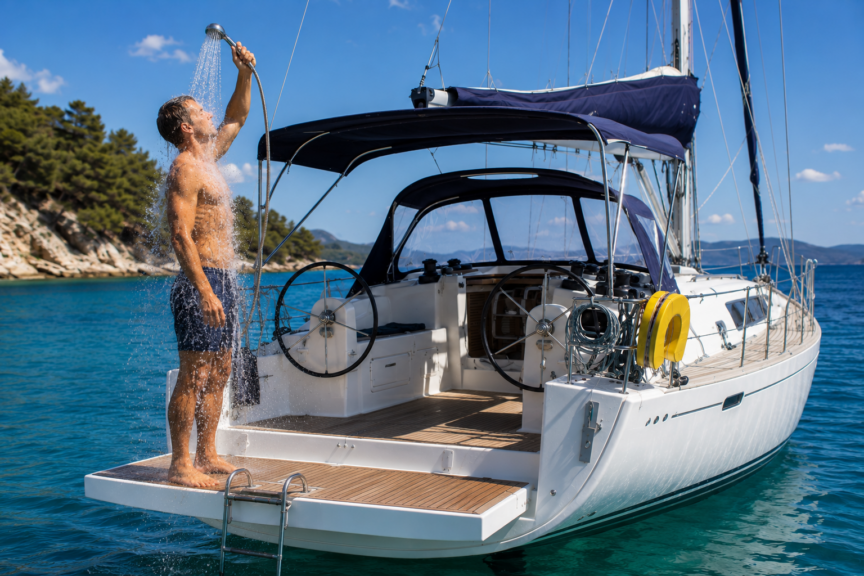
The most common way to clean up is in the cockpit. Here you will have plenty of room to move. The water will drain out the cockpit drains and when you’re done, your cockpit will be that much cleaner as well. Most people use sea water to wash and fresh water to rinse off.
If you are determined to bathe in warm water, you can heat some in a kettle and use a shower bag system. There are also many great solar-shower-bag options such as this if you’d rather use the sun’s energy to heat your rinse water.
The downside to showering in the cockpit is that you will have virtually no privacy. You can string up a tarp or drape something over the boom if privacy is an issue, but most people just wear a swimsuit and proceed without a care.
Shower at the Marina
The most common way to get clean is to use the facilities at a marina. There will be ample fresh hot water. You’ll have plenty of privacy. You won’t need to worry about filling up your holding tanks and pumping them out. Marinas may include showers and bathroom facilities as a part of their mooring fees. Some may require you pay individually for showers and laundry, but the cost is usually a few dollars in quarters.
Life Hack: Use Baby Wipes!
While at sea, and especially in rough weather, it is not always going to be possible to get clean. Simply using the head is going to be difficult if not impossible. One possibility that really works is to use baby wipes to freshen up. No really, think about it for a minute.
Baby wipes are durable moist little towelettes designed to clean up some nasty messes. They have gentle cleaning agents as well as aloe and other such moisturizers. They take up very little room in the boat and you don’t really use that many anyway. I am a huge fan of baby wipes, just not a big fan of the name.
Final Questions
What are the latest technologies related to sailboat bathrooms?
What do you do if you can not clear a plugged toilet?
Imagine you are on a particularly long leg of a long sail plan and your head gets plugged . After examining the problem and troubleshooting solutions, you determine that a partial or full rebuild is necessary. Here you will need a plan B. Like any system on a boat, make sure you have redundancies in place to deal with malfunction. For an unusable head, you will need to either “go” over the side, or use a bucket. It is always best for the environment to contain the contents until a suitable dump area is available.
Final Thoughts
Sailboats are entirely self sufficient. They are also supposed to be self contained as well, which complicates things when considering the bathroom aboard. The happiest sailors know their boat systems inside and out and are able to use these systems within their design tolerances. Sailboats do have toilets and showers and sinks, just like their at-home counterparts. The difference is because of the need for self containment, they may not always be the best option, although they are the most convenient. Most sailors on small to mid sized yachts use the head sparingly, if not as a last resort, in order to avoid all the pitfalls of maintaining it.