Why Sailing Has Its Own Language
Imagine stepping aboard a sailboat for the first time. Within minutes you may hear someone say, “Cast off the stern line,” “Trim the jib,” or “Move to port.” To a beginner, it can sound like another language. Fortunately, sailing terminology is far more logical than it first appears. Once you understand why these words exist, they become useful tools instead of obstacles.
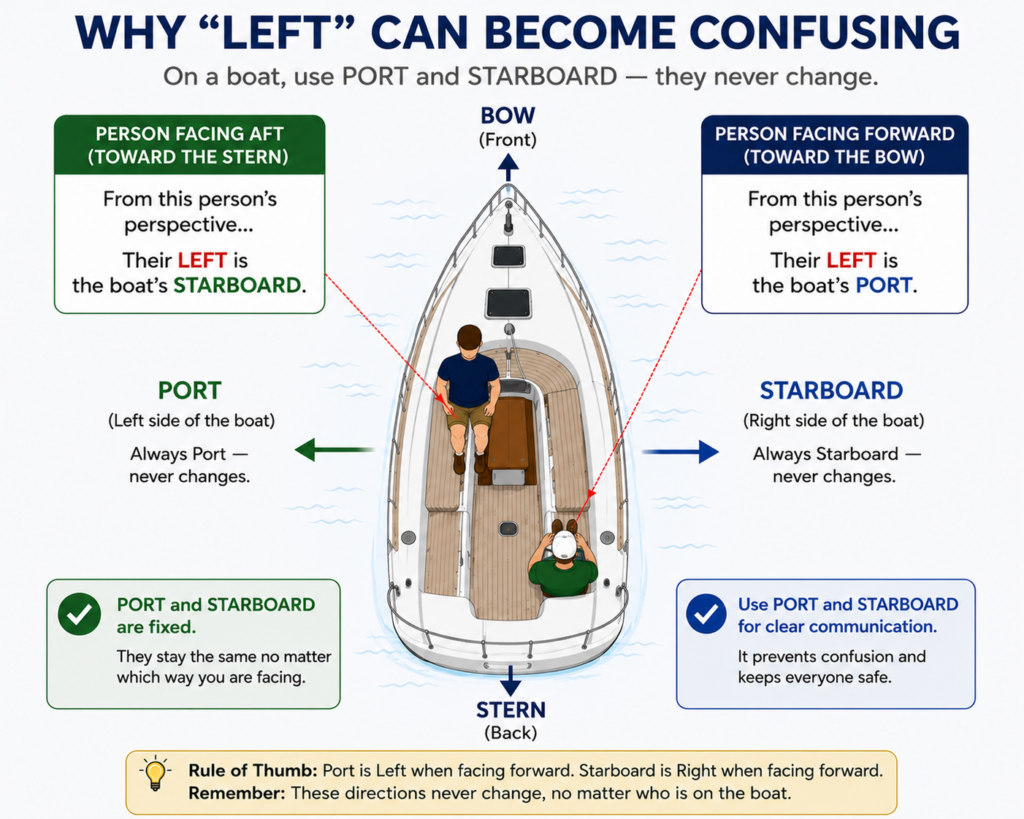
First, sailors don’t use special terminology to impress one another. They use it because boats move, people face different directions, and clear communication matters. If one person says “move left,” whose left do they mean? The answer changes depending on where each person is standing. However, the words port and starboard never change. Port is always the left side of the boat when facing the bow, and starboard is always the right side.
This consistency is one reason basic sailing terminology has survived for centuries. Whether you are sailing in Canada, Australia, the United Kingdom, or the Caribbean, experienced sailors understand the same core vocabulary. As a result, crews who have never met before can often work together safely with very little confusion.
Because sailboats operate in constantly changing wind, waves, and weather, precise communication also improves safety. During a manoeuvre there may only be seconds to react. Clear basic sailing terminology reduces hesitation and misunderstandings.
Fortunately, you do not need to memorize dozens of words before enjoying sailing. Instead, think of this article as a guided tour. You will learn the basic sailing terminology that you are most likely to hear during your first lessons, while leaving more advanced vocabulary for later articles.
Why Learning Basic Sailing Terminology Matters
Learning basic sailing terminology is not about passing a test. It is about making every lesson easier to understand. When your instructor says, “Ease the mainsheet,” you will know exactly what to look for. Likewise, when another sailor asks you to move toward the bow, you can respond confidently.
Knowing the language also builds confidence. Beginners often feel overwhelmed because every instruction contains unfamiliar words. As your vocabulary grows, sailing becomes far less intimidating. Instead of translating every sentence in your head, you can focus on steering, trimming sails, and enjoying the experience.
Another advantage is safety. Good communication helps crews coordinate docking, anchoring, reefing sails, and responding to changing conditions. Therefore, even a modest, most basic sailing terminology can make you a more capable crew member.
Throughout the SailboatZone beginner curriculum, these same terms will appear again and again. Mastering them now will make every future lesson easier to follow.
**Beginner Tip:** Don’t try to memorize every definition today. Read through the article once, then simply begin noticing the words each time you sail. Repetition is the fastest teacher.
The Most Important Rule: Everything Is Relative to the Boat
Perhaps the single most important idea in beginner sailing is that locations are described relative to the boat rather than the shoreline or the compass. This simple concept unlocks much of sailing terminology.
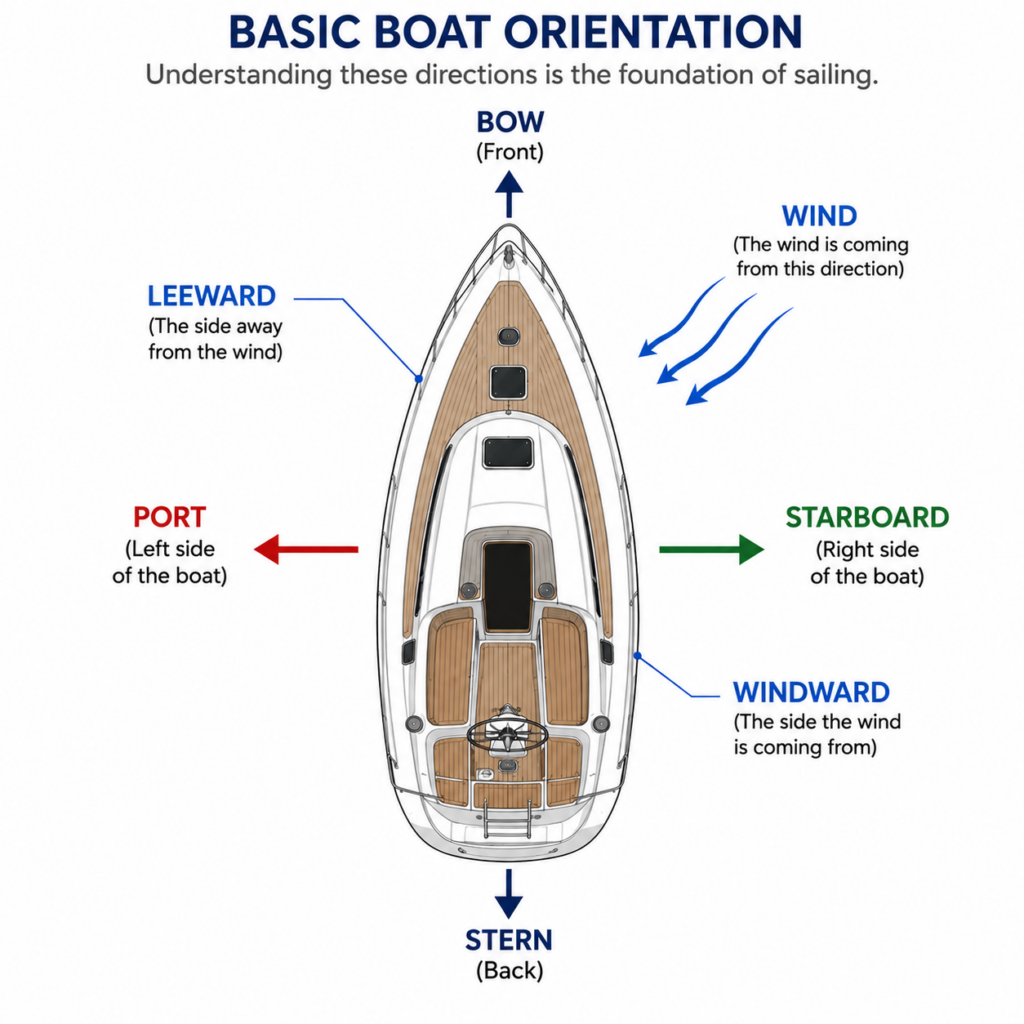
The front of the boat is the bow. The rear is the stern. The left side, when facing the bow, is port. The right side is starboard. Meanwhile, some terms describe your position relative to the wind. Windward refers to the side facing the wind, while leeward refers to the sheltered side away from the wind. You will explore these concepts in greater detail later in your sailing journey.
Directional Sailing Terminology Every Sailor Must Know
Now that you understand why sailors use precise language, it’s time to learn the directional terms you’ll hear on nearly every outing. These words become second nature surprisingly quickly because they always refer to fixed locations on the boat rather than where you happen to be standing.
Bow
The front of the boat. When someone asks you to move forward, they usually mean toward the bow.
Stern
The back of the boat. Many docking manoeuvres involve working from the stern.
Port
The left side of the boat when you are facing the bow. It never changes.
Starboard
The right side of the boat when facing the bow.
Forward
Any direction toward the bow.
Aft
Any direction toward the stern.
Amidships
The middle portion of the boat.
Windward
The side facing the wind.
Leeward
The side sheltered from the wind.
Above deck
On the exterior deck of the boat.
Below deck
Inside the cabin.
Quick Reference Table
| Everyday Word | Sailing Term |
| Front | Bow |
| Back | Stern |
| Left | Port |
| Right | Starboard |
| Middle | Amidships |
Beginner Scenario
For example, imagine your instructor says, ‘Take the fender forward to the bow on the starboard side.’ Because each term has a fixed meaning, there is no confusion, even if everyone aboard is facing different directions.
Parts of the Boat You’ll Hear Constantly
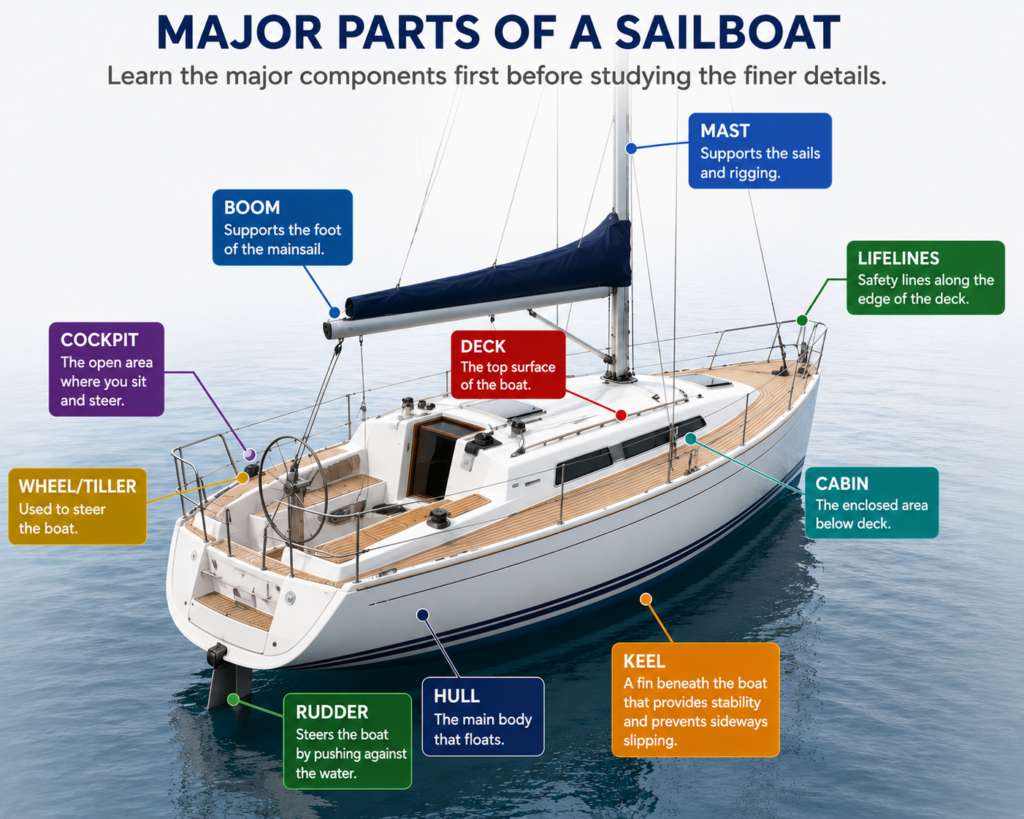
You do not need to memorize every fitting on a sailboat before your first sail. Instead, focus on the major components that instructors mention repeatedly.
Hull
The main body of the boat that floats on the water.
Deck
The surface you walk on outside the cabin.
Cockpit
The working area where the crew steers and controls the sails.
Cabin
The enclosed living space below deck.
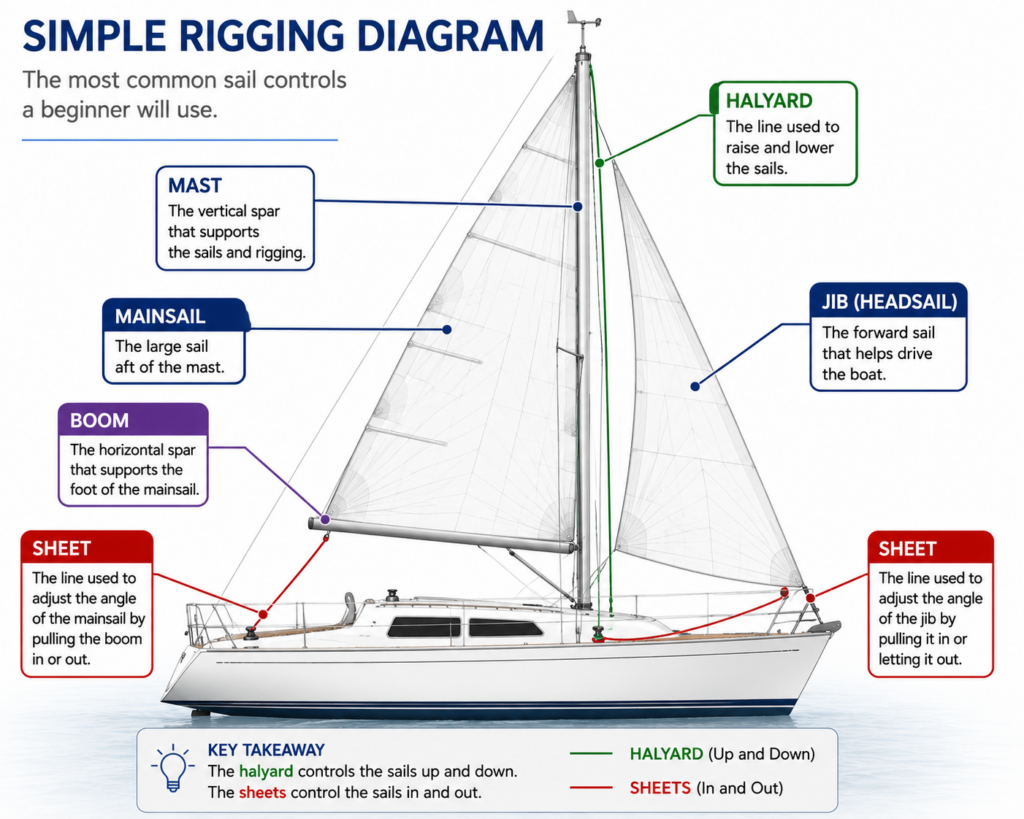
Mast
The tall spar that supports the sails.
Boom
The horizontal spar attached to the mast that supports the foot of the mainsail.
Keel
The underwater fin that helps prevent sideways slipping and improves stability.
Rudder
The underwater steering surface controlled by the wheel or tiller.
Wheel or Tiller
The steering control used to turn the rudder.
Lifelines
Safety wires running around the deck to help prevent falls.
Although these definitions are brief, they provide enough context to understand most beginner instruction. Later articles will examine each component in much greater detail.
Internal Links
• Parts of a Sailboat
• Sailboat Anatomy
• How a Sailboat Works
In Part 3 we’ll build on this foundation by introducing the basic sailing terminology around rigging, along with the steering and boat movement terms that every new sailor hears during their first lessons.
Basic Sail and Rigging Vocabulary
With the major parts of the boat in mind, the next step is understanding the equipment that supports and controls the sails. Fortunately, beginners only need a very basic sailing terminology to follow most sailing lessons. As you gain experience, these terms will appear so often that they quickly become second nature.
Mainsail
The primary sail attached to the mast and boom. It provides most of the boat’s driving power.
Jib
The smaller sail set forward of the mast. Working together with the mainsail, it helps balance and propel the boat.
Halyard
A line used to raise or lower a sail. Every sail has its own halyard.
Sheet
A line used to control the angle of a sail to the wind. A sheet does not raise the sail—it adjusts it.
Cleat
A fitting used to secure a line after it has been adjusted.
Winch
A mechanical drum that makes it easier to pull and hold heavily loaded lines.
Shrouds
The side support wires that hold the mast upright.
Forestay
The wire supporting the front of the mast.
Backstay
The wire supporting the rear of the mast.
Standing Rigging
The fixed wires that support the mast and normally do not move.
Running Rigging
The movable lines used to raise, lower and adjust sails.
One beginner mistake is assuming every rope on a sailboat has the same purpose. Instead, sailors give important lines specific names based on what they do. Learning those names makes instructions much easier to follow.
Internal links: Standing vs Running Rigging • Parts of a Sail • Sail Trim Basics
Basic Sailing Terminology for Steering and Boat Movement
Next, let’s look at the vocabulary you are likely to hear while the boat is underway. These are action words that describe how the boat is moving or what the helmsperson wants the boat to do.
Helm
The steering position or steering control, whether it is a wheel or tiller.
Helmsperson
The person steering the boat.
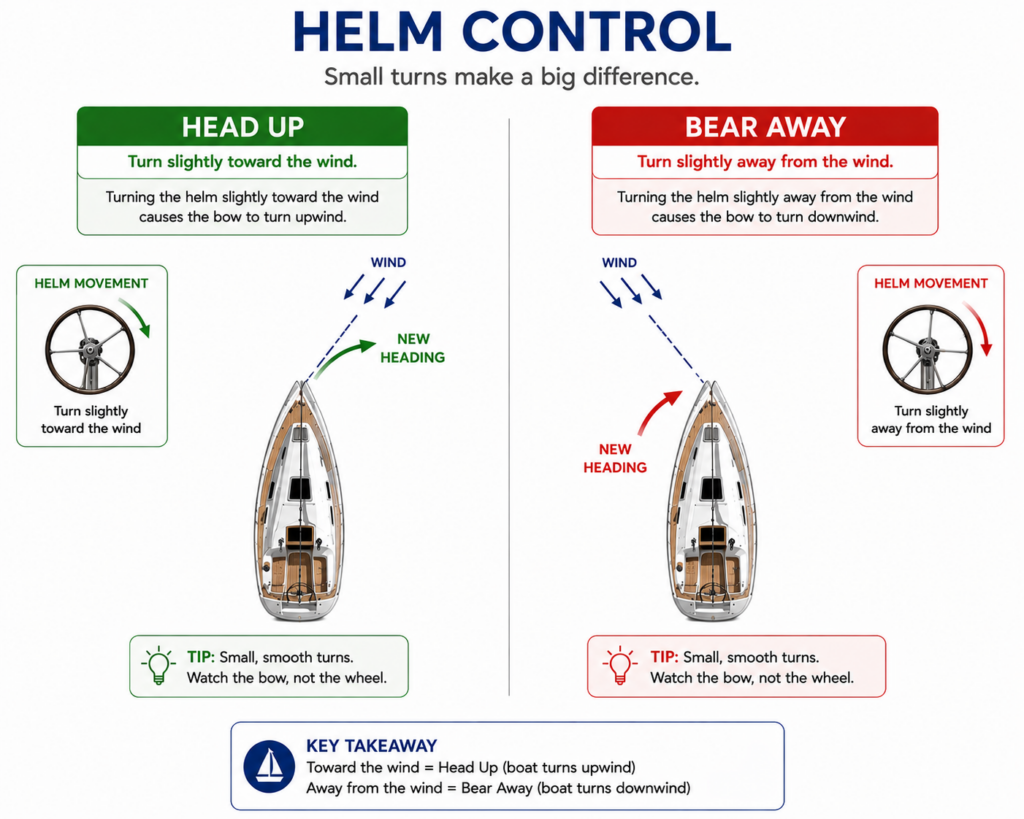
Head Up
Turn the bow closer to the wind.
Bear Away
Turn the bow away from the wind.
Luff
When a sail begins to flap because it is no longer drawing efficiently.
Heel
The natural leaning of a sailboat caused by the wind pushing on the sails.
Tack
Turn the bow through the wind to change direction.
Gybe
Turn the stern through the wind so the boom crosses the boat.
Underway
A boat that is moving or otherwise not secured to shore.
Making Way
A boat moving through the water under its own momentum or power.
Adrift
Floating freely without being anchored, moored or under control.
Scenario: ‘Head up two degrees’
Imagine your instructor says, ‘Head up two degrees.’ This does not mean spinning the wheel dramatically. Instead, make a very small turn so the bow points slightly closer to the wind. Therefore, good steering is usually made up of smooth, gentle corrections rather than large movements.
Likewise, if the instructor says, ‘Bear away,’ you would gently turn the boat away from the wind. Small adjustments help keep the sails drawing efficiently and the boat moving smoothly.
Common Beginner Mistake
New sailors often oversteer because they expect an immediate response. However, sailboats react more slowly than cars. Make a small steering input, wait for the boat to respond, and then make another correction if necessary.
Looking Ahead
Part 4 introduces basic sailing terminology around wind, points of sail, docking vocabulary and the essential safety terms that every new sailor should recognize before leaving the dock.
Basic Sailing Terminology for Wind and Sailing Direction
Every sailing decision begins with the wind. Rather than thinking only about compass direction, sailors constantly describe where the wind is coming from in relation to the boat. Therefore, understanding a few key wind terms will make future sailing lessons much easier.
True Wind
The actual wind blowing across the water, unaffected by the boat’s movement.
Apparent Wind
The wind felt on the moving boat. It combines the true wind with the boat’s speed and direction.
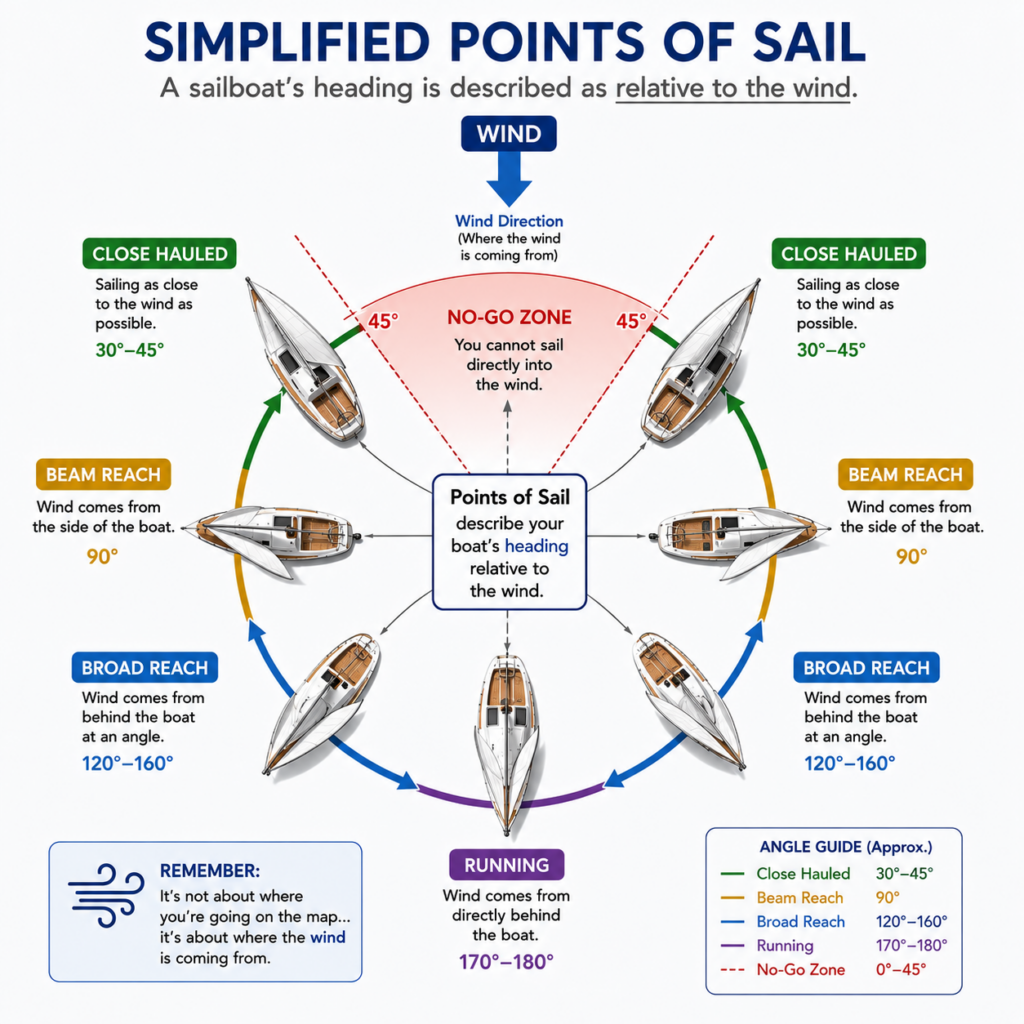
No-Go Zone
The area directly upwind where a sailboat cannot sail efficiently because the sails lose lift and begin to luff.
Close Hauled
Sailing as close to the wind as practical with the sails trimmed in.
Beam Reach
The wind blows across the side of the boat. This is often the fastest and most comfortable point of sail.
Broad Reach
The wind comes from behind at an angle with the sails eased farther out.
Running
Sailing with the wind almost directly behind the boat.
Upwind
Travelling generally toward the wind by sailing a series of tacks.
Downwind
Travelling generally with the wind behind the boat.
Points of Sail
The different angles a sailboat can travel relative to the wind.
For now, simply become familiar with these names. Later articles explain how to trim the sails for each point of sail and why the boat behaves differently on each heading.
Internal links: Points of Sail Explained • Sail Trim Basics • How Sails Work
Docking and Mooring Terminology
Next, let’s look at the basic sailing terminology used when arriving at or leaving the dock. Although docking can feel intimidating at first, the terminology is straightforward once you know what each word means.
Dock
A structure where boats tie up.
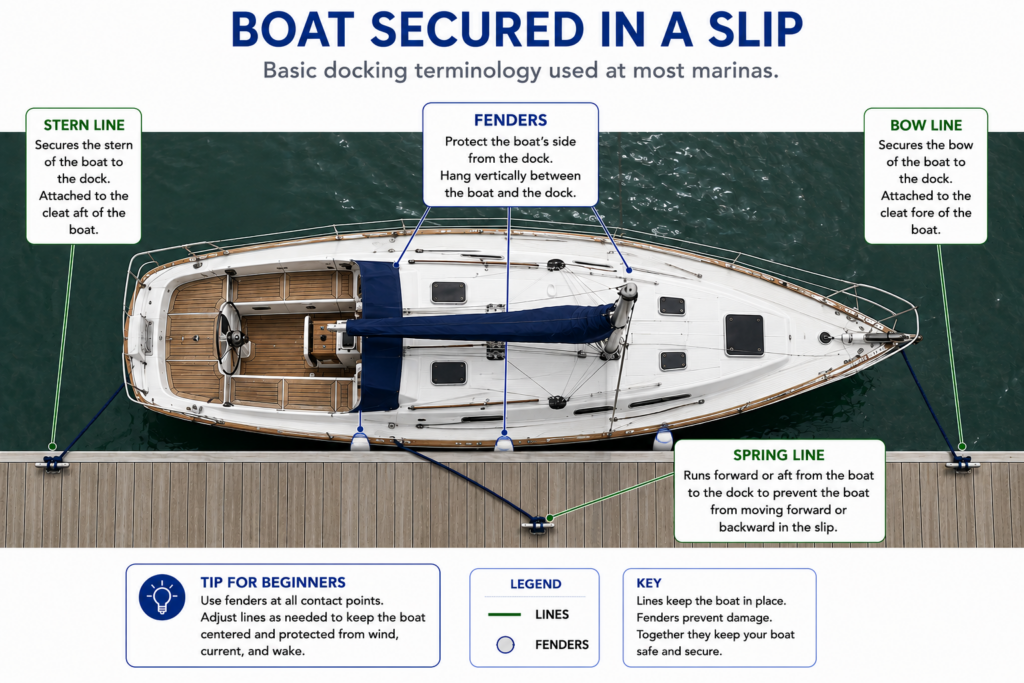
Slip
The individual parking space assigned to a boat in a marina.
Pier
A larger structure extending into the water that may contain multiple docks or slips.
Mooring Ball
A permanently anchored floating buoy that boats secure to instead of anchoring.
Fender
A protective cushion placed between the boat and the dock.
Spring Line
A dock line that limits forward or backward movement while docking.
Cleat
A fitting used to secure dock lines.
Bow Line
A line attached near the bow.
Stern Line
A line attached near the stern.
Dock Lines
The general term for the lines securing the boat to the dock.
Internal links: Docking a Sailboat • Mooring Basics • Spring Lines Explained
Safety Terms Every Beginner Should Know
Finally, every sailor should recognize a handful of essential safety terms. You may not use them every day, but knowing what they mean can make communication faster during an emergency.
PFD
Personal Flotation Device, commonly called a lifejacket.
Mayday
The international distress call used when there is immediate danger to life.
Pan-Pan
An urgent call for assistance when the situation is serious but not immediately life-threatening.
MOB
Man Overboard. An alert that someone has fallen into the water.
Stand-On Vessel
The vessel that should normally maintain its course and speed under the collision regulations.
Give-Way Vessel
The vessel responsible for taking early action to avoid a collision.
Grounding
When a boat touches the bottom unintentionally.
Capsize
When a boat tips over.
Heaving To
A technique that slows or nearly stops the boat while maintaining control.
Fortunately, true emergencies are uncommon. However, learning these terms before you need them is part of becoming a safe and confident sailor.
Basic Sailing Terminology used in Commands
During your first few sailing lessons, your instructor will probably use short, clear commands. Knowing what they mean allows you to react calmly and confidently.
Ready About?
A warning that the boat is about to tack.
Helm’s Alee
The helm has been turned to begin the tack.
Ease the Sheet
Let the sail out gradually.
Trim In
Pull the sail closer to the centreline.
Hold Your Course
Continue steering the current heading.
Hard Over
Turn the helm as far as practical.
Cast Off
Release a line from its cleat or dock.
Make Fast
Secure a line to a cleat.
Coming About
The boat is turning through the wind.
Prepare to Gybe
Get ready for the boom to cross the boat.
While this guide covers the basic sailing terminology that every beginner should know, you can continue building your vocabulary with the Discover Boating Glossary of Boating Terms, which provides definitions for hundreds of additional boating and sailing terms.
Scenario
For example, your instructor might call: ‘Ready about?… Helm’s alee… Trim the jib… Steady on your new course.’ Although this sounds fast at first, each command simply tells the crew what is about to happen and what action to take.
Beginner Terms You Don’t Need to Memorize Yet
Fortunately, not every sailing term is essential on day one. Words such as fairlead, gooseneck, chainplate, traveller, Cunningham, outhaul, vang, genoa cars and telltales become important as your skills grow. For now, recognize that they exist, but don’t feel pressured to memorize them.
Quick Reference Glossary
| Term | Definition |
| Aft | Toward the stern |
| Beam Reach | Wind across the side of the boat |
| Bow | Front of the boat |
| Cleat | Fitting used to secure a line |
| Cockpit | Primary working area |
| Deck | Walking surface |
| Gybe | Turn the stern through the wind |
| Halyard | Raises a sail |
| Head Up | Turn toward the wind |
| Heel | Boat leaning under sail |
| Helm | Steering position |
| Hull | Main body of the boat |
| Jib | Forward sail |
| Keel | Underwater stabilizing fin |
| Leeward | Sheltered side |
| Luff | Flapping sail |
| Mainsail | Primary sail |
| Mast | Vertical spar |
| Port | Left side facing forward |
| Rudder | Steering surface |
| Sheet | Controls sail angle |
| Starboard | Right side facing forward |
| Stern | Back of the boat |
| Tack | Turn the bow through the wind |
| Windward | Side facing the wind |
| Winch | Mechanical line-handling drum |
If you’d like to explore additional basic sailing terminology beyond those covered in this guide, the RYA Sailing Glossary provides an excellent reference used in internationally recognized sailing courses.
Frequently Asked Questions
Why do sailors say port instead of left?
Because port never changes regardless of which way someone is facing.
What’s the difference between a rope and a sheet?
A sheet is a specific line used to control a sail.
Is every rope called a line?
Most ropes aboard become lines once they serve a specific purpose.
What does helm mean?
It refers to the steering position or steering control.
Do experienced sailors really use these words?
Yes. These are everyday working terms on sailboats.
Key Takeaways
• Sailing terminology improves communication and safety.
• Most beginner terms describe the boat, the wind, or boat movement.
• You do not need to memorize everything at once.
• Confidence grows as the vocabulary becomes familiar.
• Each article in the SailboatZone curriculum builds on these same foundational terms.
Knowledge Check
1. Which side of the boat is port?
2. What is the front of a boat called?
3. Which line raises a sail?
4. What does ‘head up’ mean?
5. Which point of sail often provides excellent speed and comfort?
6. What does PFD stand for?
7. What is a fender used for?
8. What does Mayday mean?
9. Which part of the boat steers it underwater?
10. What command tells you to release a dock line?
Answer Key
1. Left side facing the bow
2. Bow
3. Halyard
4. Turn toward the wind
5. Beam reach
6. Personal Flotation Device
7. Protect the boat from docks or other boats
8. Immediate danger to life
9. Rudder
10. Cast Off